

A candle gift box label should show the product identity, net contents, a visible safety warning, and maker details on the outside. Optional gift elements can sit on secondary panels or an insert.
The main question is what a buyer needs to read before purchase or before opening the box. That information belongs on the outer box. Extra gift-facing details can follow once the required fields are clear. For gift sets, a short contents line can help without taking over the front.
A candle gift box label should clearly show the product name, net contents, a visible fire-safety warning, and maker contact details. Optional elements such as scent notes, a contents list for sets, and traceability codes can be added if space allows.
Small candle brands and gift-set sellers often run out of room once warnings, weights, and codes compete with the front-panel design. The cleanest solution is to decide what must be readable on the outside and what can move to an insert or the inner container label. Start with the required fields, then add scent disclosure and traceability only where they do not crowd the main consumer-facing panels. A physical proof on the real box catches most problems before the box goes on sale.
What must stay on the outside of a candle gift box?
Keep the product identity, net contents, visible safety warning, and maker details on the outer box when it is the main thing the shopper sees.
Does the safety warning need to appear on the outer gift box? Yes. When the gift box is the main consumer-facing package, key identity and hazard information belong outside. For the broader structure around outer-pack and container information, see candle labels and packaging.
Build order workflow
Use this order to place the required fields first and the gift-facing extras last. It keeps the outside readable before you add optional details.
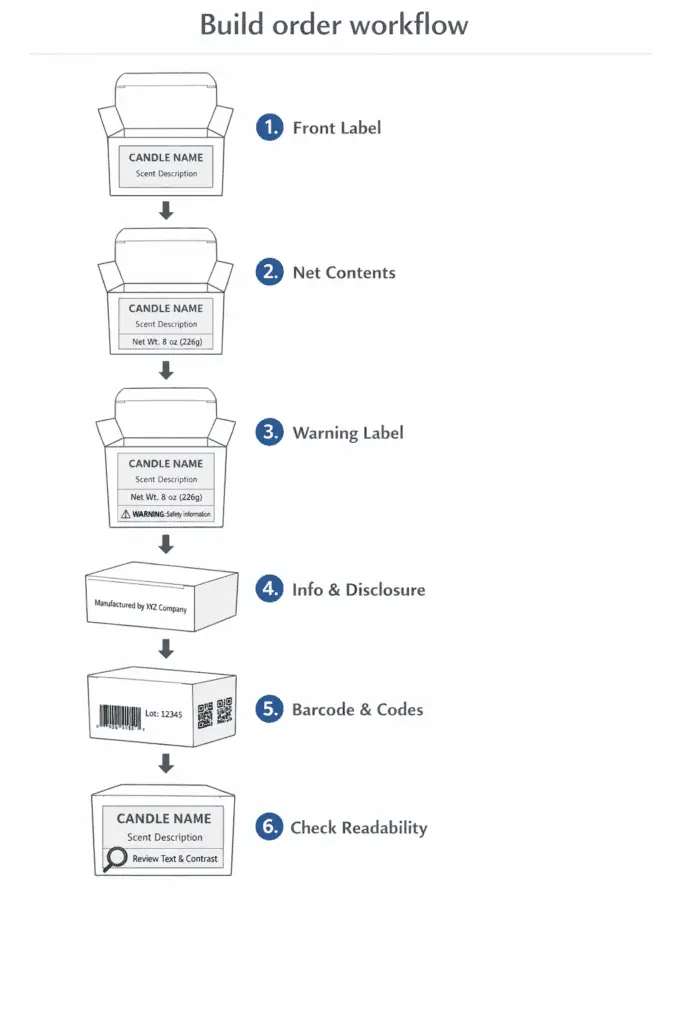
- Pick the front-facing panel shoppers see first and reserve it for brand and scent or product identity.
- Add net contents where it can be seen without opening the box.
- Place the safety warning block on a visible outer panel, not under a flap, band, or closure.
- Add scent notes and any required disclosure lines on a secondary panel.
- Add traceability elements such as barcode, batch or lot code, and optional QR code on a flat, low-glare panel.
- Lock typography and contrast so required small text stays readable.
Required elements for a candle gift box label
A candle gift box label needs product identity, net contents, a visible safety warning, and maker contact. Everything else is secondary.
If the box is the main thing shoppers see before purchase, these core fields should be visible without opening it.
A practical minimum includes:
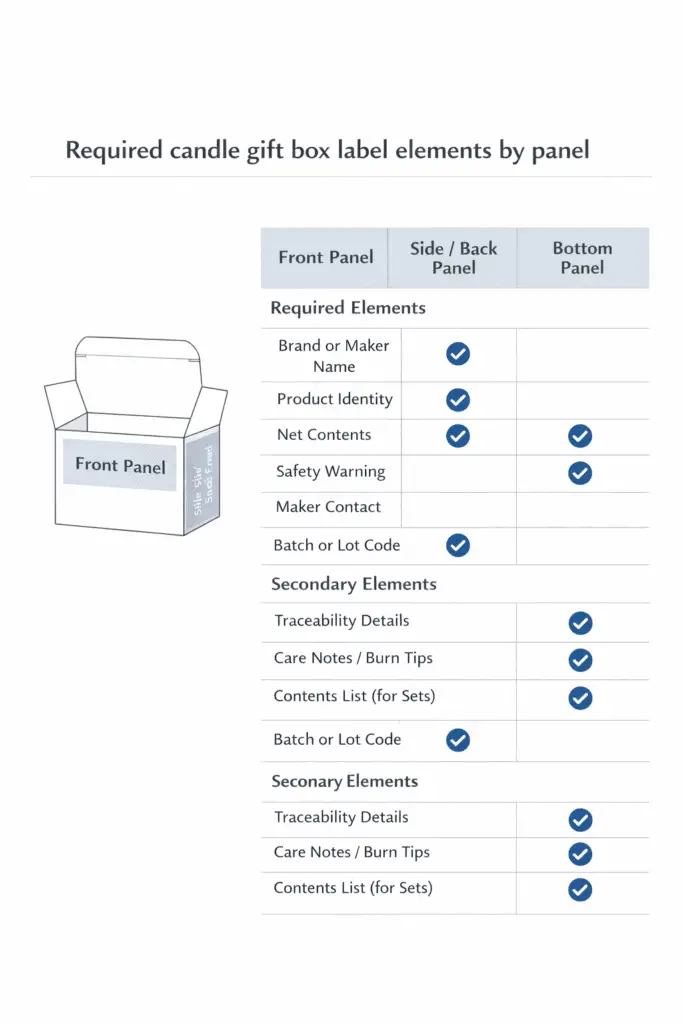
- Brand or maker name
- Product identity, meaning what it is and the scent name
- Net contents
- Safety warning block
- Maker contact or traceability details
| Item | Best panel | Why it belongs there |
|---|---|---|
| Brand or maker name | Front | Fast recognition |
| Product identity | Front | Helps buyers know what they are getting |
| Net contents | Front or near front | Visible before opening |
| Safety warning block | Side or back | Readable without opening |
| Maker contact or traceability | Side, back, or bottom | Helps with support, issues, or recalls |
| Batch or lot code | Bottom or side | Useful for quality tracking |
| Care notes or burn tips | Side or back | Helps the customer use it properly |
| Contents list for sets | Side or back | Reduces confusion and returns |
Pre-print checks
- Read the front at arm’s length. Brand, scent, and net contents should be clear in one glance.
- Confirm the required core fields are present.
- Check that nothing important falls on a crease, fold, tab, or seam.
What can move to an insert or inner candle label?
Secondary details such as longer care notes, fuller scent storytelling, QR-led support content, or a longer brand note can move to an insert or inner candle label if the outside already covers the core fields. Do not move required identity, net contents, or the visible warning off the main consumer-facing package.
Optional elements that improve the gift experience
Optional elements should make the box feel warmer or clearer without competing with the required information. Good additions include:
Optional gift copy should support the purchase experience without displacing the required outer-box fields.
What should a gift set box add beyond the core label fields?
For gift sets, add a compact contents list, scent names if the items differ, and any short To/From or message area that fits without crowding the warning and identity panels.
- A To/From line
- A short write-in message area
- A one-line brand note
- A compact “what’s inside” list for sets
Keep optional elements on a secondary panel rather than the front.
Practical guardrails
- Do not place a message box so close to the safety block that it distracts from or covers warnings.
- Use a pen-friendly surface for any write-in area. Glossy coatings can smear, and textured stocks can feather ink.
- Keep brand story copy short. One sentence is enough.
Safety and warning statements for candle gift packaging
Place a clear fire-safety warning on a visible outer panel when the gift box is handled or viewed before the candle inside. Keep the front clean, and use the side or back for the warning block.
A useful rule is to place the warning near the opening path, where the customer is likely to see it while opening or handling the box. Keep the warning block simple, with one short text block and a small row of icons if needed.
Warning block checklist
- Put the warning on a visible outer panel
- Use high contrast
- Avoid glossy glare over warning text
- Do not shrink icons or type just to fit more marketing copy
- Keep the message simple and direct
Text matters most. Icons help only if they are large enough to be understood easily.
Fragrance notes, allergens, and disclosure rules
List scent notes clearly, and include allergen or sensitizer disclosure only when your market and supplier documentation require it. Keep this information on a back or side panel where it stays readable without taking over the design.
Start with what the customer expects to see:
- The scent name
- A short notes line, such as “vanilla, amber, cedar”
- Any required allergen or sensitizer disclosure based on your market and supplier documentation
What to collect before writing disclosure copy
- Fragrance supplier SDS and related compliance statements
- Any required allergen or sensitizer information for your market
- Your final scent notes line
Do not guess. Use supplier documentation and keep claims limited to what you can support. If you want to say “unscented,” make sure it is truly unscented and not simply low-fragrance.
Materials and finishes for durable, premium-feel labels
Choose a finish that keeps the label readable and intact on the gift box.
Matte, gloss, film, or foil can support the look, but the required information still has to stay clear on the outer panels.
Typography and readability on small gift box panels
Use clear type and a simple hierarchy so the required outer-box information stays readable at a glance.
The product name and scent should lead the hierarchy, and the smallest required text still needs to read easily on the assembled box.
Readability rules
- Keep important text away from trim lines, folds, and seams
- Use clear, open typefaces
- Avoid scripts, hairline fonts, and overly condensed styles
- Avoid all-caps for long warning blocks
- Increase spacing if microcopy starts looking gray or crowded
How to choose color and contrast for brand consistency
Pick colors that fit the brand without weakening contrast on the real box stock.
The front should stay easy to read, and secondary panels should keep warnings and disclosures clear.
US vs EU/UK candle gift box label requirements, high level
US gift-box labeling usually centers on core identity, net contents, maker details, and visible safety information. In the EU and UK, the outer box can need formal CLP hazard elements when the fragranced candle is classified as a hazardous mixture.
The key first question is whether the box is only a gift carton or whether it is the main consumer-facing package at the point of sale.
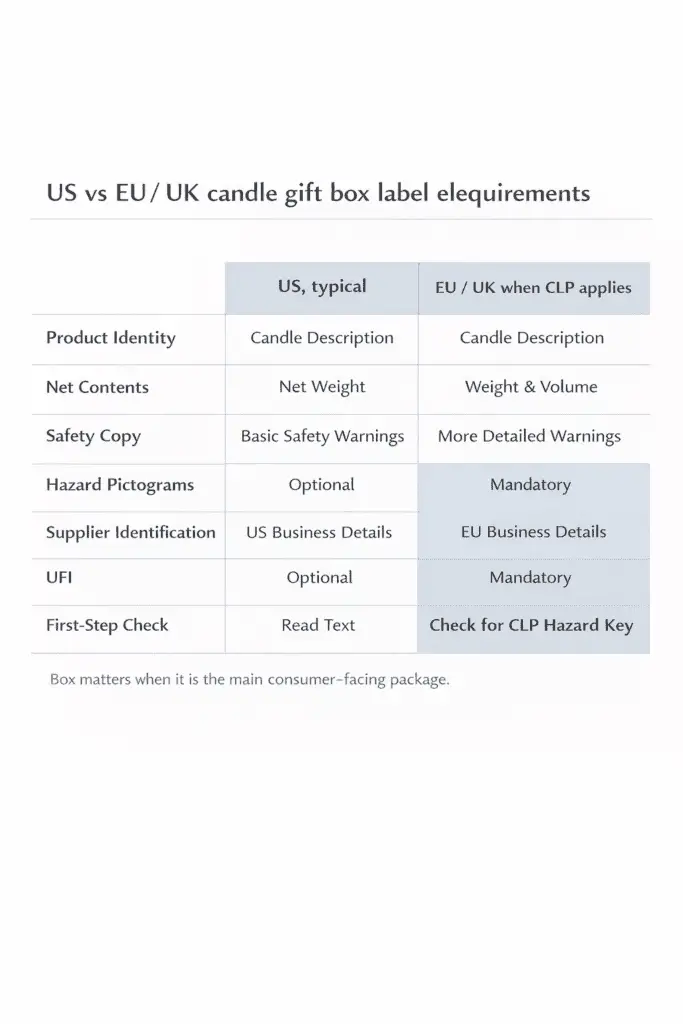
US, typical expectations
- Product identity
- Net contents
- Safety messaging
- Traceability and batch control
- Retailer-friendly presentation
EU/UK, when CLP applies
- Hazard pictograms
- Signal word
- Hazard statements
- Precautionary statements
- Supplier identification
- UFI when required
High-level summary
| Topic | US, typical | EU/UK, when CLP applies |
|---|---|---|
| Main framework | Safety guidance and retailer expectations | CLP hazard communication rules |
| Safety copy | Common safe-use wording | Hazard framework may control the wording |
| Hazard pictograms | Usually not presented as CLP diamonds | Standard CLP pictograms may be required |
| UFI | Not applicable | May be required for notified hazardous mixtures |
| First step | Confirm retailer needs and baseline safety wording | Confirm supplier classification and build label elements from that |
If the box is the main thing shoppers see before purchase, it cannot be just decorative. Key identity and hazard information should be on the outside.
Label size and placement on the gift box
Choose the principal display panel first, then size the label so it stays inside the safe area and away from seams, windows, and folds.
The front is for identity. Side or back panels carry warnings and disclosures, and the bottom can take dense traceability blocks.
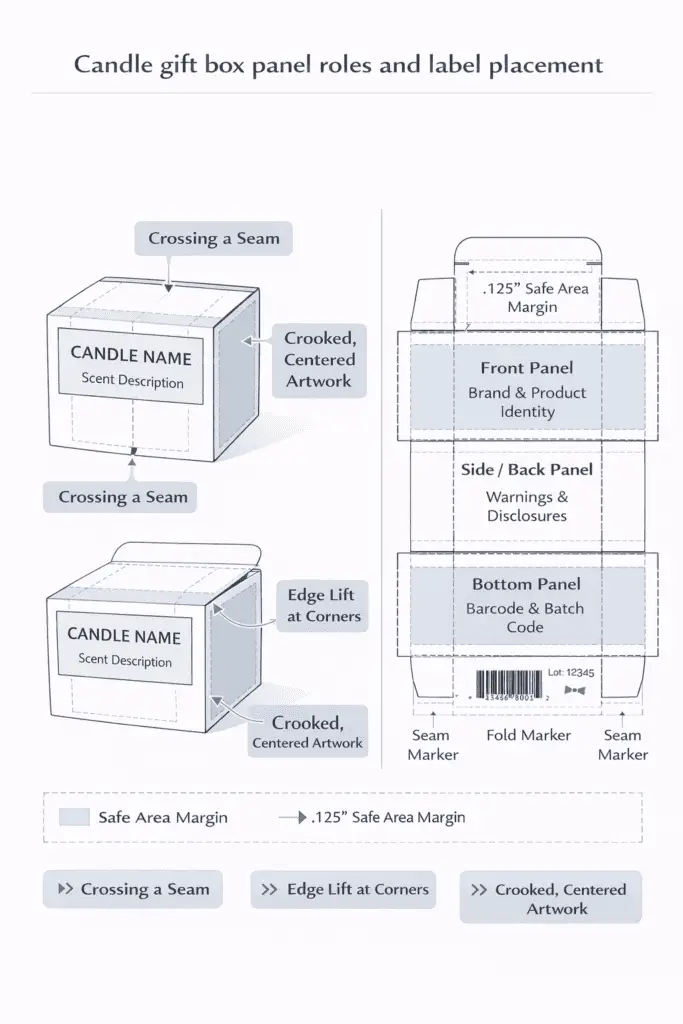
Panel roles
- Front: best for brand, scent, and product identity
- Side or back: best for warnings, disclosures, and QR content
- Bottom: best for barcodes, batch or lot codes, and dense compliance blocks
Common placement problems
- Wrinkle across a seam: the label crosses a fold line
- Edge lift at corners: the label is too close to an edge or lands on a slick coating
- Looks crooked when assembled: the art was centered on the flat dieline, not the actual assembled view
Keep the main label on one flat panel. Do not run it across two panels unless you want future regret.
Barcodes, batch or lot number, and QR codes
Use a barcode and batch or lot code when traceability or retail checkout requires them, and keep any QR code secondary to the core outer-box information.
Good traceability setup
- Barcode on a flat, low-glare panel
- Batch or lot code in plain readable characters
- QR code on a side or back panel
- No codes crossing folds, seams, or tuck flaps
Barcodes help retail checkout and inventory. QR codes help the customer after purchase. Both have value.
Final takeaway
A strong candle gift box label keeps the outside focused on what the buyer needs first.
- It tells the buyer what the product is
- It shows net contents and the key safety information clearly
- It keeps maker details and any needed traceability easy to find
- It moves optional gift extras to secondary panels or an insert
If those pieces are in the right place, the box can still feel like a gift without hiding the information that matters.