
Candle safety compliance is the pre-sale process of confirming that a candle burns in a controlled way, carries the right label layers, and meets any market-specific hazard duties before you sell it.
On this page, a safe candle means a release-ready candle whose tested build, warning communication, and market duties stay aligned, not room-placement advice, child-and-pet household guidance, ingredient-health claims, or shipping-durability performance. That scope covers product fire safety, primary labeling, hazard-triggered CLP or UFI duties when they apply, and traceable release records. Full burn-test methods, label-build steps, and wick or container selection stay on their own pages.
What candle safety compliance means before sale
Candle safety compliance before sale means checking four jobs as one release decision: burn behavior, selling-label basics, hazard-label duties when classification triggers them, and records that tie the released SKU back to its tested build.
This page owns that release overview at the parent level. Full burn testing, exact label builds, and EU CLP setup stay on narrower pages because they answer separate search intents.
Which candle safety standards apply in the US vs EU
In the US, candle compliance usually combines ASTM standards, CPSC rules, and primary-label rules, while in the EU it combines general product safety, candle-label standards, and CLP when the mixture is hazardous.
If you need the broader making workflow, start with our candle making guide. For the standards-only breakdown, see candle safety standards and legal requirements and ASTM candle safety standards explained. The fastest way to stay organized is to separate four jobs: product fire safety, primary labeling, hazard classification, and market-specific documentation.
| Rule or standard | Where it applies | What it covers | What you check in practice |
|---|---|---|---|
| ASTM F2058 | US | Cautionary labeling for candles | Use recognizable fire-safety warnings and place them where buyers can see them |
| ASTM F2417 | US | General fire safety for candles | Test the candle so normal use stays controlled and predictable |
| ASTM F2179 | US | Glass containers produced for candle use | Choose heat-appropriate containers and confirm performance in burn testing |
| CPSC lead-core wick rule | US | Prohibits candles with lead-core wicks | Verify wick materials with suppliers and keep records |
| FPLA-style primary label rules | US | Statement of identity, business name and place, net quantity | Make sure the selling label identifies the product and the responsible business clearly |
| GPSR | EU | General consumer product safety duties | Maintain traceability, safety information, and a clear response path if a problem appears |
| EN 15493 | EU | Fire safety specification for candles | Check burning behavior and safe-use rules against the intended product type |
| EN 15494 | EU | Product safety labels for candles | Use the right safety signs and warning information on the product or packaging |
| CLP | EU | Hazard classification and hazard communication for hazardous mixtures | Add hazard pictograms, a signal word, and required statements when classification triggers them |
| UFI / PCN | EU | Poison-centre identification duties for certain hazardous mixtures | Add the UFI and complete the required notification when CLP obligations require it |
Are candle safety standards the same as legal requirements?
No. ASTM and EN documents set consensus safety and labeling expectations, while legal duties come from rules such as the CPSC lead-core wick ban, US primary-label requirements, the EU GPSR, and CLP or UFI duties when hazardous classification triggers them. That is why this page tracks both families together. It is also why ASTM F2326 on visible emissions and EN 15426 on soot behavior matter as supporting standards even when your immediate release decision is mostly about labeling and market duties.
If you sell across more than one market, use a separate release checklist for each region instead of one blended rule set. Our candle compliance checklist by market is the best next step once you know which rule family applies to your SKU.
What must a candle safety label include (icons & text)
A candle safety label on this page means the label system a buyer sees before use: the selling label, the fire-safety warning layer, and, in the EU only when classification triggers it, the CLP hazard layer. This section shows how those layers fit together before sale, while exact label builds stay on the label-specific pages.
In practice, a candle label often has three layers: the primary selling label, the fire-safety warning label, and, in the EU only when the mixture is classified as hazardous, a CLP hazard label. For the deeper label-only breakdown, see legally required candle product labels, EU CLP label examples, and how to create CLP-compliant candle labels for the EU.
Start by aligning your label wording with your actual safety approach, including materials, wick choice, and testing. The label and the candle should behave consistently in real homes, not contradict each other.
| Label layer | What it does | What usually belongs there |
|---|---|---|
| Primary label | Identifies the product and responsible business | Product identity, maker or business name, location details as required, net quantity where applicable |
| Fire-safety warning label | Helps the buyer use the candle safely | Warning header, fire-safety icons, burn within sight, keep away from things that catch fire, keep away from children and pets, trim and stop-use rules |
| CLP hazard label | Communicates legally triggered mixture hazards in the EU | Pictograms, signal word, hazard statements, precautionary statements, supplier details, and UFI when required |
For US sale, the primary label should identify the product, the responsible business, and net quantity when the candle is sold by measure. The fire-safety warning label does a different job, because it tells the buyer how to avoid the main burn and fire risks. In the EU, EN-style candle warnings can still apply even when no CLP hazard label is needed, because CLP elements are triggered by hazardous classification, not by the product being a candle.
Most labels work best when they combine short, action-first sentences with recognizable icons, because buyers skim. Check legibility at the final print size on the real container and under normal indoor light. If the warning text is hard to read, enlarge the layout or move information to outer packaging instead of crowding the base label.
Include these elements, organized by job instead of by habit:
- A clear product identity and responsible business identification on the selling label
- A visible warning header plus the three core safety warnings: burn within sight, keep away from things that catch fire, keep away from children and pets
- A stable-surface and heat warning, so buyers do not place hot glass on delicate furniture
- A few action rules: trim before lighting, do not move while burning or hot, stop use if the container is damaged or the flame behaves unusually
- Maker identification and a way to trace the batch or scent name, so you can respond quickly if a customer reports a problem
- CLP hazard elements only when the candle mixture is actually classified as hazardous for the EU market
If you sell in regions with hazard-label requirements for mixtures, your outer packaging and listings may need additional hazard communication beyond normal candle-use warnings. Even when extra text is not legally required, consistency still helps. Repeat your core warnings on the base label, and make sure they also appear anywhere the product is presented, especially when buyers are deciding from photos alone.
Why burn testing still matters before sale
Burn testing supports candle safety standards because it shows whether the released build, container, and warning instructions still behave in a controlled way in normal use and under higher heat load.
On this page, the point is the decision, not the full protocol. Use our candle burn test guide for the complete method and one log format for repeatable records, then bring the pass or fail result back into your release checklist, label review, and market-specific documentation.
What should a candle compliance checklist cover before sale
A strong pre-sale candle compliance check confirms the tested build, the label, the online listing, the instruction set, and the market-specific warnings before the product goes live.
IFRA, SDS, and CLP documents belong here only as support records. IFRA helps confirm fragrance-use limits, the SDS feeds hazard review, and CLP or UFI matter only when that review classifies the EU product as hazardous.
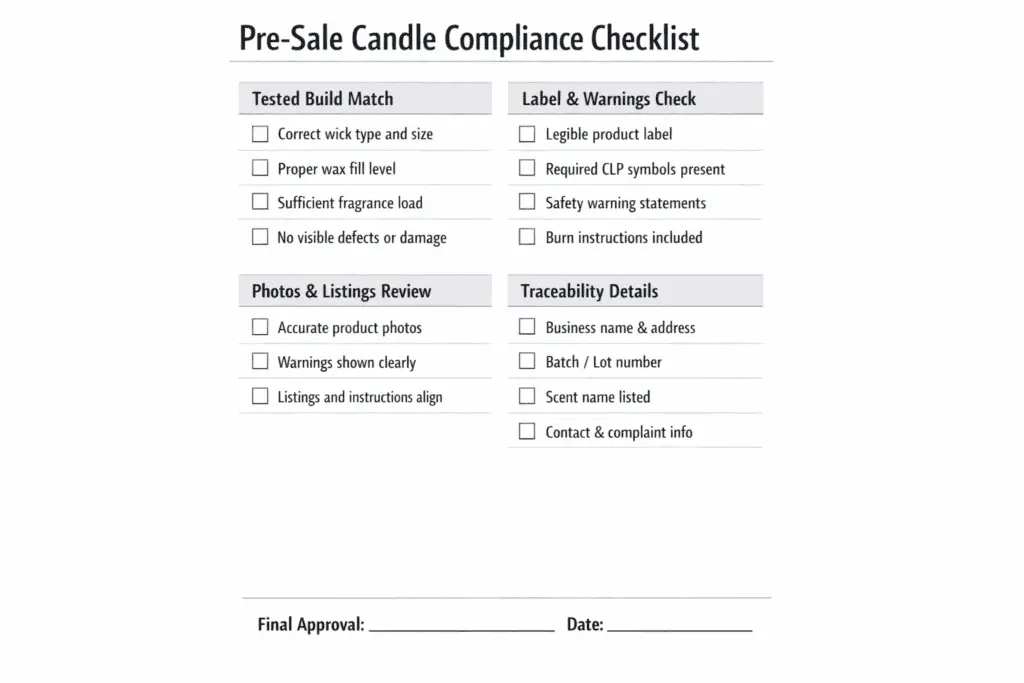
Use one pass for product safety and a second pass for what the buyer sees. For a market-by-market worksheet, use our candle compliance checklist by market. The goal is not to build a giant QA system on this page. The goal is to make sure the candle you release matches the candle you tested and the label you show.
- Confirm the released SKU matches the tested build: same jar, wick, wax, fragrance recipe, and label version
- Confirm the primary label and warning label are readable, and add CLP elements only when classification triggers them
- Confirm your product photos show the warning label and basic use instructions clearly enough to verify from images
- Confirm the instruction card or listing copy matches your tested trim rule, burn-time guidance, and stop-use cues
- Repeat child and pet warnings anywhere placement risk is high, and use keeping kids and pets safe around candles for the dedicated room-placement guidance
- Keep traceability details such as business identity, lot or batch notes, scent name, and a complaint route easy to retrieve
Use this section to confirm the release decision, not to replace the full market worksheet or the full burn-test method. Those narrower tasks stay on their own pages even when their results affect the final compliance check.
What records prove a candle was tested and labeled for the target market?
Keep one record set that ties the released SKU to the tested build and the label the buyer receives.
- A burn-test log for the released build
- A build record for the jar, wick, wax, fragrance recipe, and label version
- Supplier material specifications or declarations for the container and wick
- SDS and IFRA documents where the fragrance or market requires them
- CLP classification output and UFI or poison-centre notification records when EU hazardous-mixture rules trigger them
- Batch or lot notes plus a complaint and traceability route
Detailed wick sizing, container selection, wax-melt differences, workspace setup, and shipping QC belong on their own pages because they answer different search intents. On this page, they matter only to the extent that they change your testing result, your warning text, or your market-specific compliance duties.
Frequently asked questions about candle safety standards and labels
Which ASTM standard covers candle warning labels?
ASTM F2058 is the main US standard for cautionary labeling on candle products. Use the ASTM-focused standards page when you need the standard-by-standard breakdown.
Which standard is most relevant to glass candle containers?
ASTM F2179 is the container-focused US standard most often referenced for glass candle containers produced for candle use. Use the ASTM page or the container-specific page when you need the narrower decision criteria.
When does CLP apply to candles in the EU?
CLP applies when the candle mixture is classified as hazardous under the EU rules for classification, labeling, and packaging. That decision is separate from normal fire-safety warnings, so use the EN-style safety warnings page and the CLP pages for the narrower label decision.
Do hazardous candles need different outer packaging?
Yes, if CLP applies, the required hazard information has to appear on the packaging or label the buyer actually receives. Do not rely on a product description alone to do the job of a required hazard label.
What has to be on a US candle label before sale?
A compliant US setup usually combines two jobs: a primary label that identifies the product and responsible business, and a warning label that tells the buyer how to avoid the main fire and heat risks. Use the label-specific pages when you need the exact field list for the product you sell.
Do all EU candles need CLP and UFI?
No. EU candles still need normal candle safety warnings, but CLP hazard elements and UFI duties apply only when the mixture is classified as hazardous and the notification rules are triggered for that product. Use the EU CLP pages for the product-level label decision.