Candle safety standards and labeling cover three jobs: make the product safer to burn, tell buyers how to use it safely, and give you records that support traceability by market.
This page is a practical starting point for US and EU basics. It shows which standards and label elements matter most, what to document before selling, and which deeper guides to use when you need a full label template, a market-specific checklist, or a standard-by-standard reference. Start with the complete candle making guide if you need the broader process first.
What candle safety standards and labeling rules actually cover
Candle safety standards and labeling rules set the baseline for fire safety, warning language, container performance, and market-specific hazard communication before a candle is sold.
Standards vs legal requirements: what each framework actually does
ASTM F2058 covers candle fire-safety labeling, ASTM F2417 covers candle fire-safety performance, and ASTM F2179 covers glass containers produced for candle use. EN 15493 covers candle fire safety, while EN 15494 covers product safety labels and warning display. CLP and other market rules are legal duties when they apply, so they are not the same thing as every voluntary candle standard.
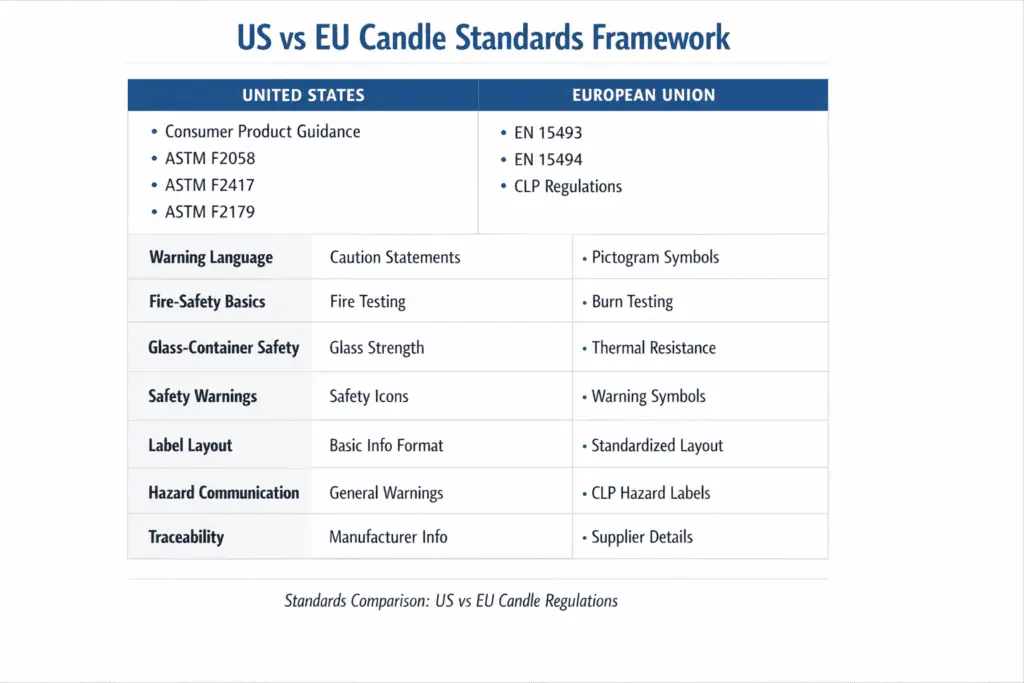
In the US, makers commonly review consumer-product guidance alongside ASTM candle standards such as F2058, F2417, and F2179. In the EU, makers usually separate general candle safety warnings from CLP duties that apply when a fragrance or mixture triggers hazard-classification requirements. For the standard-by-standard breakdown, use ASTM candle safety standards, EN 15493 candle fire safety standard, and EN 15494 candle labeling standard as your deeper references.
| Market | Main standards or frameworks to review | What they help you control |
| US | Candle guidance + ASTM F2058, F2417, F2179 | warning language, fire-safety basics, glass-container safety |
| EU | EN 15493, EN 15494, and CLP when classification applies | safety warnings, label layout, hazard communication, traceability |
How to label candles for sale (US vs EU basics)
Label candles with required candle warning language, maker identification, and traceability, then add market-specific hazard elements when required.
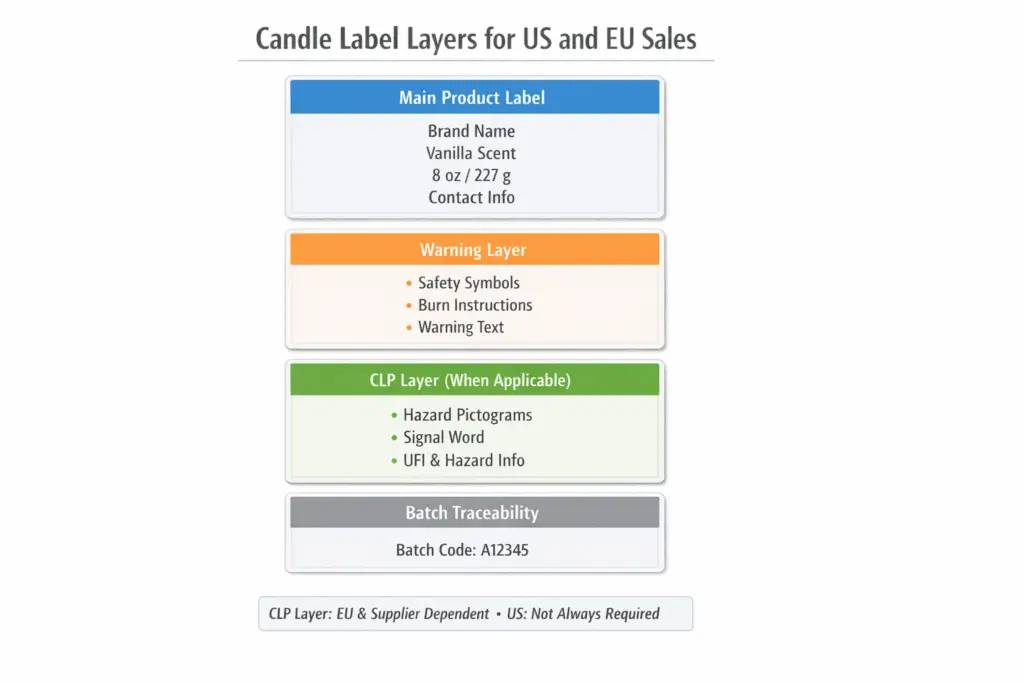
Keep the main product label separate from the warning layer. In the US, makers usually focus on product identity, business identification, net quantity, and clear burn warnings. In EU sales, you may also need hazard elements, signal words, pictograms, or UFI-linked information when supplier documents show CLP duties apply. When the finished candle is classified as hazardous, those CLP duties apply to the finished product rather than to every scented candle by default. UFI and PCN belong to that hazardous-mixture workflow. Open glass containers and similar formats are not always treated as CLP packaging, so the compliant label may need to sit on packaging that immediately contains the candle. Use legally required candle product labels for the general labeling breakdown, EU CLP label examples and templates for layout ideas, and CLP-compliant candle labels for the EU when you need the implementation workflow.
Core warning rules and pictograms to include on the warning layer
For many retail candles, the warning layer starts with three common rules: burn within sight, keep away from things that catch fire, and keep away from children and pets. EN 15494-style product safety labels may also use a general warning sign with supplementary safety symbols, and those symbols vary by candle type and risk.
These are the practical minimums most sellers include.
- Product identity, scent name, and size or net quantity where that information is expected on the main label.
- Business name and a contact method.
- Safety warnings and burn instructions, including trim guidance, burn-time limits, drafts, and never leaving a candle unattended.
- Batch or lot code that maps back to your ingredients, wick choice, and test notes.
- Hazard elements, pictograms, or UFI-linked details when your market and supplier documents show they apply.
This quick matrix shows how the label job usually splits.
| Label part | What it usually covers | Why it matters |
| Main product label | identity, size, business details, scent | helps buyers identify the product and supports traceability |
| Warning layer | fire-safety warnings and safe-burning instructions | sets use expectations and reduces preventable misuse |
| CLP layer (when applicable) | hazard elements, signal words, pictograms, UFI-linked information | supports hazard communication for the relevant market |
| Batch traceability | lot code linked to formula, wick, and container records | lets you trace changes and test results quickly |
Keep these records organized before you print or ship labels.
- Supplier safety documents for fragrance oils and additives.
- Batch records: wax, fragrance %, wick, container, cure window.
- Burn-test notes for each jar and wick combination you sell.
- Label version notes so you can track what changed by market or formula.
What to check before you sell or gift a candle
A simple pass-or-fail checklist catches more safety mistakes than guessing from one good-looking pour or one short burn session.
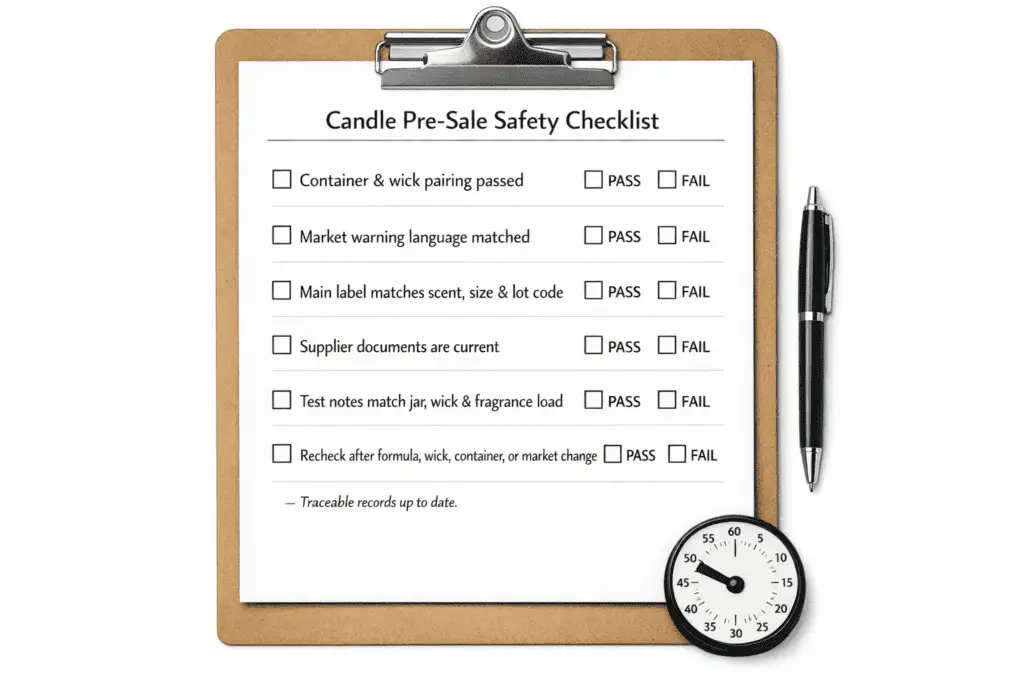
Use the candle compliance checklist by market when you want a market-specific version.
Keep the lot code tied to the supplier documents, burn-test notes, and current label version so traceability stays intact when a formula or market changes.
Run through this checklist before a candle leaves your workspace.
- The container and wick pairing has passed your current burn-test routine.
- The warning language matches the market where the candle will be sold or gifted.
- The main label matches the actual scent, size, and batch or lot code.
- Your supplier documents are current for the fragrance and any additive in the formula.
- Your test notes still match the exact jar, wick, and fragrance load now in use.
- You have rechecked the candle after any formula, wick, container, or market change.
Why burn-test records support label accuracy
Burn-test records show whether the labeled candle still matches the exact wick, fragrance load, container, and warning language you plan to sell. They also tell you when a formula, wick, or vessel change turns the product into a new test case instead of the same labeled product.
Keep these record fields tied to the same batch or lot code.
- Test date and batch or lot code.
- Exact jar, wick, wax, fragrance load, and label version used.
- Pass-or-fail notes for flame behavior, melt-pool behavior, and any retest trigger.
For the full maker workflow, use how to perform burn tests to ensure candle safety.
FAQ
Do candle makers need to know ASTM and EN standards to make a safer product?
Yes, because those standards give you a clearer safety baseline for labeling, fire behavior, and container performance. You do not need to memorize every document on day one, but you should know which standards apply to the market you plan to serve.
What should a candle label include at minimum?
At minimum, most makers start with product identity, business identification, clear warning language, and a batch or lot code. Market-specific hazard elements may also be needed when supplier documents or product classification show they apply.
When does CLP matter for scented candles in the EU?
CLP matters when the product or mixture creates hazard-classification duties for the market you are selling into. Use UFI and PCN for scented candles in the EU when you need the supplier-data and filing workflow.
Do I need a new burn test when I change the wick, container, or fragrance load?
Yes, because any of those changes can alter heat output, soot risk, melt-pool shape, and label accuracy. The safest habit is to treat every meaningful formula or vessel change as a new test case.
Are warnings alone enough if I have not documented the candle?
No. Warnings help the buyer, but your own burn-test notes, batch records, supplier documents, and label version history are what make the safety process repeatable and traceable.