

Candle additives are formula-level ingredients added in small amounts to change wax structure, surface finish, scent handling, or color and storage stability. On this page, common means the core additive families makers test first—such as binders, hardeners, crystal modifiers, and light-stability aids—rather than every specialty modifier or decorative embed.
For the broader map of additive roles, start with candle additives & enhancers ; for defect-based decisions, use a candle additives chooser and treat the sections below as family-level summaries rather than full troubleshooting or comparison guides. For broader context, see candle making.
Which common candle additive families are used most often?
The most common candle additive families are binders, hardeners, crystal modifiers, and light-stability aids, each used to change one formula variable before a maker moves to deeper troubleshooting or comparison. For the main guide, see candle making.
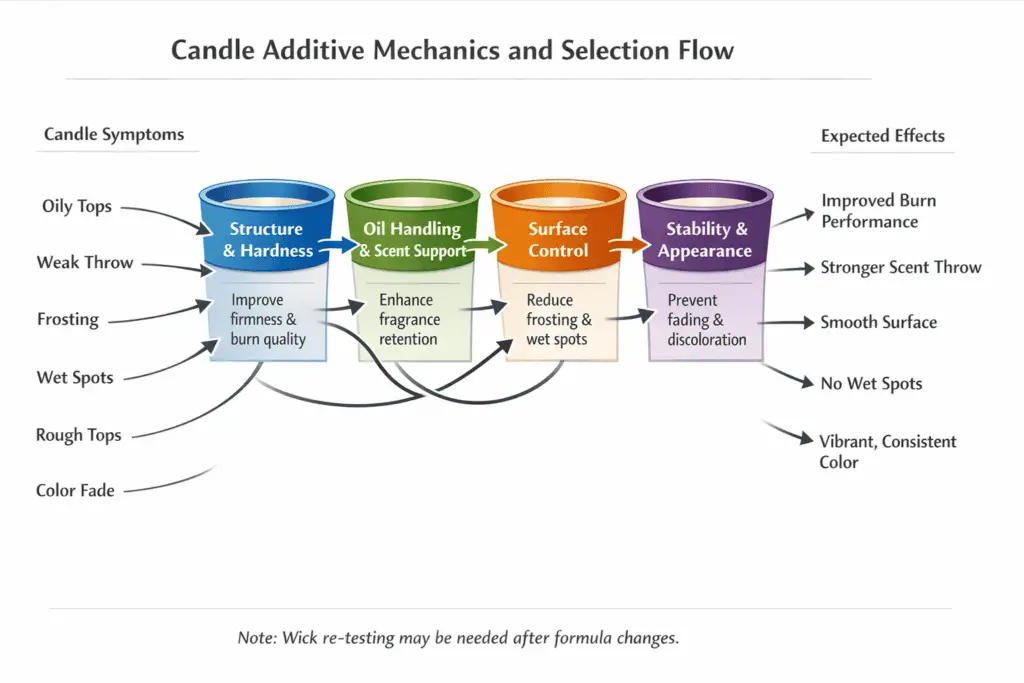
A common additive family changes one part of the wax system first: structure, oil compatibility, crystal pattern, or storage stability. In the wider candle-making process, additives stay optional until your wax, fragrance, wick, and cooling routine are already close to working; if you need that baseline first, see when candles work without additives.
Most additives fall into four practical buckets:
- Structure & hardness: raise firmness or melt point, improve pillar durability, and reduce slump in heat.
- Oil handling & scent support: help wax hold fragrance more evenly so you get less sweating and more consistent throw.
- Surface control: influence crystal growth so tops look smoother and frosting is less visible.
- Stability & appearance: help color resist fading or slow storage-related changes that show up as yellowing or off-notes.
This quick-reference table shows the main job each common additive family handles first:
| Additive family | Main job | Best first use | Watch-out |
| Vybar / polymer binders | Improve oil handling and opacity in paraffin-heavy blends | Oily tops, sweating, or uneven fragrance binding | Too much can thicken the wax and shrink the flame |
| Stearic acid | Increase hardness and melt point | Pillars, heat resistance, or firmer blends | Too much can increase shrink and glass pull-away |
| Microcrystalline wax | Add toughness and structure | Durability or a slightly higher melt profile | Can change fuel flow and require wick re-testing |
| Crystal modifiers / finish aids | Influence surface crystallization | Frosting, rough tops, or visible crystal pattern | Process still matters more than formula alone |
| UV inhibitors / stabilizers | Slow light-driven color change | Window displays or strong indoor lighting | Too much can dull clarity in light colors |
On this page, common refers to the families makers test first in standard candle formulas. Specialty modifiers and decorative embeds stay outside this page’s main scope.
A short screening sequence keeps the family-level view practical without turning this page into a full chooser:
- Name the symptom clearly. “Hot throw is weak” is different from “oily top” or “frosting on day 3.”
- Pick the mechanism you actually need. Weak hot throw often points to release + wick; oily tops point to oil compatibility; frosting points to crystal growth + cooling curve.
- Change one variable at a time. Same jar, same fragrance load, same wick—adjust only one additive or one dose step.
- Re-test the wick any time viscosity or melt pool changes. A small additive change can shift fuel flow and soot behavior.
- Log the batch like a recipe. Wax type, additive %, fragrance %, add temperature, pour temperature, room temp, cure days.
Use the chooser only when the family label is no longer enough and the real task is matching one defect to one controlled formula change.
How to choose between Vybar and stearic acid
Vybar is usually the better first test when a paraffin-heavy blend has oil-binding or opacity problems, while stearic acid is usually the better first test when the wax needs more hardness or a higher melt profile. Here, “better first test” means the family that matches the named defect first, not the globally superior additive; use stearic vs. Vybar for the full comparison and how Vybar behaves in candles for paraffin-heavy use cases.
How to improve scent throw with additives
Additives affect scent throw mainly by changing how evenly fragrance stays in the wax and how the burn releases it, but that is still a child use case rather than this page’s main job. Use a deeper scent-throw additives guide for additive selection and fragrance & scenting basics when the problem may come from oil choice or load rather than the additive family itself.
How to prevent frosting and wet spots with additives
Additives help limit frosting and wet spots only after cooling, jar temperature, and adhesion variables are already controlled, because those defects usually start with process before formula. At this level, the useful summary is that crystal modifiers and adhesion or toughness helpers are sometimes tested after the process is stable; for the full symptom route, use the candle additives troubleshooting guide or common soy-wax fixes.
How to stabilize color using UV inhibitors
UV inhibitors are a common stability family when the defect is light-driven color fade, while antioxidants address a different storage problem. Keep that distinction brief here, then route to a UV-fix guide for candle additives for use decisions and candle dye & coloring basics when the color system itself still needs work.
How to harden wax and raise melt point (stearic, microcrystalline)
Stearic acid and microcrystalline wax are common hardening families when the wax needs more firmness, a higher melt profile, or more structure, but detailed percentage testing belongs on child pages. Start with wax types and properties to confirm the base wax behavior, then move to the dedicated comparison path when the real decision is how to change paraffin-heavy formulas without stacking multiple additives at once.
How additives interact with soy, paraffin, coconut, and beeswax
The same additive can behave differently across wax families because each wax crystallizes and holds oil in a different way. The fastest way to avoid “it worked in soy but ruined my parasoy” is to match additive type to wax family and to the defect you’re actually fixing.
Compatibility snapshot (use as a starting hypothesis, then test)
| Wax family | What it’s most sensitive to | Additives that often help (when used lightly) | Common gotcha |
| Soy | Crystal growth (frosting), cooling curve | Crystal modifiers, small toughness helpers | Over-structuring can mute throw or haze tops |
| Paraffin / parasoy | Oil compatibility, mottling/opacity | Polymers/binders, opacity helpers | Too much binder can shrink flame or trap top notes |
| Coconut blends | Softness, oil migration, surface haze | Small binders/stabilizers, gentle modifiers | Small changes feel big; viscosity jumps can change wicking |
| Beeswax | Natural hardness, aroma carry, adhesion quirks | Minimal additives; small finish/stability aids | Background aroma can influence delicate fragrances |
A practical interaction rule: any additive that increases viscosity can reduce fuel flow through the wick, which can shrink flame size and change soot or mushrooming. That’s why compatibility isn’t just “will it dissolve,” but “will it change the burn enough to require a wick shift.”
How to dose additives safely (percentages & order of addition)
Here, safe dosing means small measured percentages, full dissolution, and consistent batch math; it does not replace the full mixing workflow or the separate compliance path. Use the mixing guide for candle additives for order-of-addition and calculation detail, and keep this page at the family-selection level.
How wicks respond to additives (soot, mushrooming, clogging)
Additives can change fuel flow enough to shift flame size, soot, or mushrooming, so wick response stays a subordinate caution rather than a full troubleshooting branch here. Start with wick sizing basics after a formula change, and use a wick-problems guide if the burn still looks unstable after one controlled re-test.
How to meet additive safety & compliance basics
Additive safety here means staying within supplier limits, keeping a SDS (Safety Data Sheet) and IFRA (International Fragrance Association) paperwork on file, and following regional labeling rules such as CLP (Classification, Labelling and Packaging) in the EU. That definition covers formula records and documentation only, not decorative-embed fire safety; for the document side of scent limits and supplier paperwork, review how to read IFRA and SDS documents for candles, and use whether candle additives are safe when the next question is additive-safety scope rather than paperwork.
Frequently asked questions about candle additives
These quick answers cover the edge cases that usually decide whether you should add a modifier, re-test the wick, or leave the formula alone.
Do you need additives for every candle?
No. If the wax, fragrance load, wick, and cooling routine are already stable, adding a modifier can create a new problem instead of solving one. Use additives when you can name the defect clearly and match it to one specific job. Keep the separate no-additives path in mind when the formula already works as mixed.
What should you test again after changing an additive?
Re-test wick size, flame shape, soot, mushrooming, melt pool depth, and surface finish. Even a small change in hardness or viscosity can change how the candle feeds the wick. Keep the re-test on wick behavior and burn results instead of stacking more additive changes at the same time.
Are decorative add-ins the same as candle additives?
No. Candle additives are formula modifiers used to change structure, finish, or stability inside the wax system. Decorative add-ins need their own safety review and should not be assumed safe just because a wax additive is safe. Treat decorative add-ins as a separate fire-safety path, not as part of the additive family map on this page.