
Beeswax usually burns the longest among common candle wax types when candle size, wick, vessel, wax mass, fragrance load, and burn schedule are comparable.
Candle wax types are wax bases used as candle fuel, including beeswax, soy, coconut, paraffin, palm, and wax blends. This page compares those waxes by burn duration so candle makers can choose the longest-lasting option under fair conditions.
“Longest” means total usable burn time with the same candle size, wick fit, container, wax weight, fragrance load, and burn schedule. It does not mean the best wax overall, the strongest scent throw, the safest wax, the cheapest wax, or the longest shelf life.
Which Candle Wax Burns the Longest?
Beeswax usually burns the longest among common candle wax types when wax weight, wick size, vessel, candle diameter, fragrance load, and burn schedule are comparable.
For a wider breakdown of wax categories, use the Candle Wax Types guide. In this comparison, the candle wax type is only the fuel base, not the wick, jar, fragrance oil, or candle style. The ranking below is a practical burn-duration guide, not a claim that one wax is best for every candle.
| Wax type | Burn-time position | Why it usually behaves that way | Main caution |
|---|---|---|---|
| Beeswax | Longest in many fair comparisons | Dense, hard wax tends to feed the flame slowly | Can still burn fast if over-wicked |
| Soy wax | Long to moderate | Softer than beeswax but often slower than paraffin in containers | Results change by jar diameter and wick |
| Palm wax | Long to moderate | Hard structure can support slower burn in some pillars | Format matters more than the label |
| Soy-coconut blend | Moderate to long | Blend ratio can slow or soften the burn | Formula varies by supplier |
| Coconut wax | Moderate | Soft wax is usually blended for structure | Pure-versus-blend comparisons can mislead |
| Paraffin wax | Moderate to faster | Often burns readily and is common in scented candles | Scent performance is separate from burn duration |
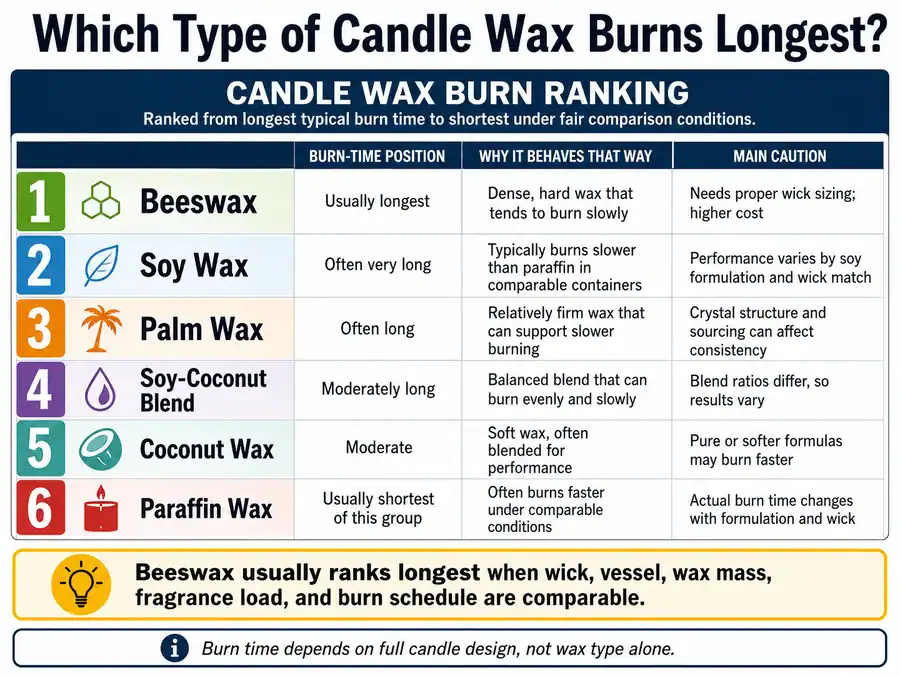
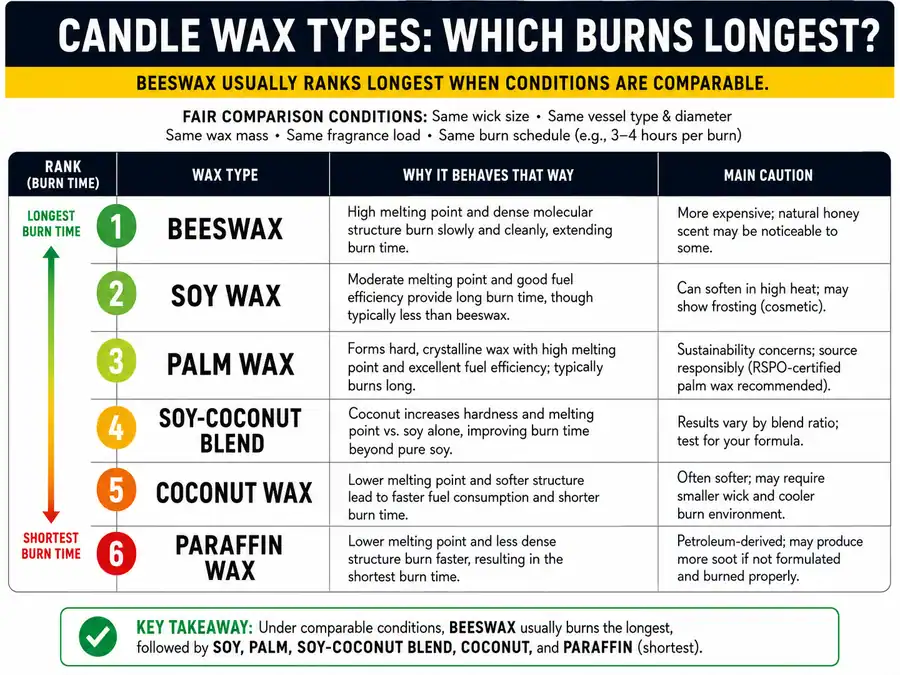
Beeswax usually ranks first because a harder, denser wax tends to consume more slowly when the wick is matched to the candle. Soy, palm, coconut, paraffin, and blends can still last a long time when the candle is larger, the wick is smaller, or the burn schedule is controlled.
The key comparison is usable burn time, not leftover wax. A candle that tunnels for 30 hours but leaves a thick wall of unused wax has not outperformed a shorter, cleaner full melt. For technical wax-temperature comparisons, route that question to Candle Wax Melting Point Chart instead of treating melt point as the whole answer.
Why Dense and Hard Waxes Usually Burn Longer
Dense and hard candle waxes usually burn longer because the flame consumes the wax fuel more slowly when the wick and candle size are matched.
Wax density means how much wax mass fits into a given volume. Wax hardness means how firmly the wax holds its structure before melting. Together, those properties can slow how quickly liquid wax reaches the flame.
Beeswax is the clearest example. It is firm, dense, and slow-feeding compared with many softer candle wax bases, so it often gives longer burn duration in the same candle size. That does not make beeswax the best candle wax for every goal. Scent throw, color, cost, sourcing, surface finish, and beginner handling are different decisions.
A hard wax can still burn too fast when the wick is too large. The wick controls how much melted wax reaches the flame, so over-wicking can erase much of the burn-time advantage. The opposite problem can happen with under-wicking: the candle may look like it lasts longer, but it tunnels and wastes fuel.
Density and hardness explain why one candle wax type may outlast another, but they do not replace fair comparison conditions. Compare the same wax mass, similar candle diameter, compatible wick, and similar burn sessions before ranking one wax above another.
How Melt Point Affects Candle Burn Time
Melt point affects candle burn time by changing how quickly wax softens, forms a melt pool, and feeds liquid fuel to the wick.
Melt point is the temperature range where a candle wax changes from solid to liquid. A higher melt point can support a slower burn, but it does not decide burn time by itself. For a fuller temperature-focused comparison, use Candle Wax Melting Point Chart.
A wax that melts too easily may feed the flame quickly, especially in a wide container or with a large wick. A wax that melts slowly may last longer, but it can tunnel if the wick cannot create a full melt pool. That is why beeswax often lasts longer, while softer waxes such as coconut wax usually need blend structure, wick control, or container matching.
Melt point should be read as one burn-duration variable beside density, hardness, wick size, candle diameter, and burn schedule. The practical outcome is simple: a higher-melting wax can last longer only when the candle design lets it burn cleanly.
Do Wax Blends Burn Longer Than Pure Waxes?
Wax blends can burn longer than pure waxes when the blend improves hardness, structure, wick fit, or melt-pool control.
A wax blend is a candle wax formula made from two or more wax bases, such as soy-coconut, paraffin-soy, or beeswax-soy. Blend ratios matter, so “blend” alone is not a reliable burn-time ranking. For the broader category breakdown, use Candle Wax Types.
Soy-coconut blends can last longer than soft coconut wax because soy adds structure. Paraffin-soy blends can burn differently from pure paraffin because the soy portion may slow the melt pool. Beeswax blends can extend firmness, but the result depends on how much beeswax is in the formula.
The tradeoff is predictability. Pure waxes are easier to compare by type, while blends depend on supplier formula, additive load, fragrance load, and wick match. A blend should be judged by measured burn behavior in the finished candle, not by the most durable wax in its ingredient list.
How to Compare Candle Wax Burn Time Fairly
A candle wax burn-time comparison is only fair when the wax weight, wick, candle diameter, vessel, fragrance load, and burn schedule are comparable.
Wax type is one variable in a candle system, not the only cause of burn duration. A beeswax candle may rank longest by wax type, but that ranking becomes unreliable when it is compared with a larger soy jar, a different wick, or a different burn pattern.
| Control variable | Why it changes burn time | How to compare it fairly |
|---|---|---|
| Wax mass | More wax can create more total hours regardless of wax type | Compare equal ounces or grams |
| Wick size | A larger wick can consume wax faster | Use a wick matched to the same vessel size and wax type |
| Candle diameter | Wider candles need more wick power or multiple wicks | Compare similar diameters |
| Vessel or mold type | Jars, pillars, tapers, votives, and tealights burn differently | Compare the same candle format |
| Fragrance load | Fragrance oil can change melt-pool behavior | Use a similar fragrance percentage |
| Dyes and additives | Additives can alter hardness, color behavior, or burn pattern | Keep additive use similar |
| Burn interval | Short and long sessions can change melt-pool development | Use the same session length |
| Wick trimming | A long wick can create a larger flame and faster wax use | Trim to the same height before each burn |
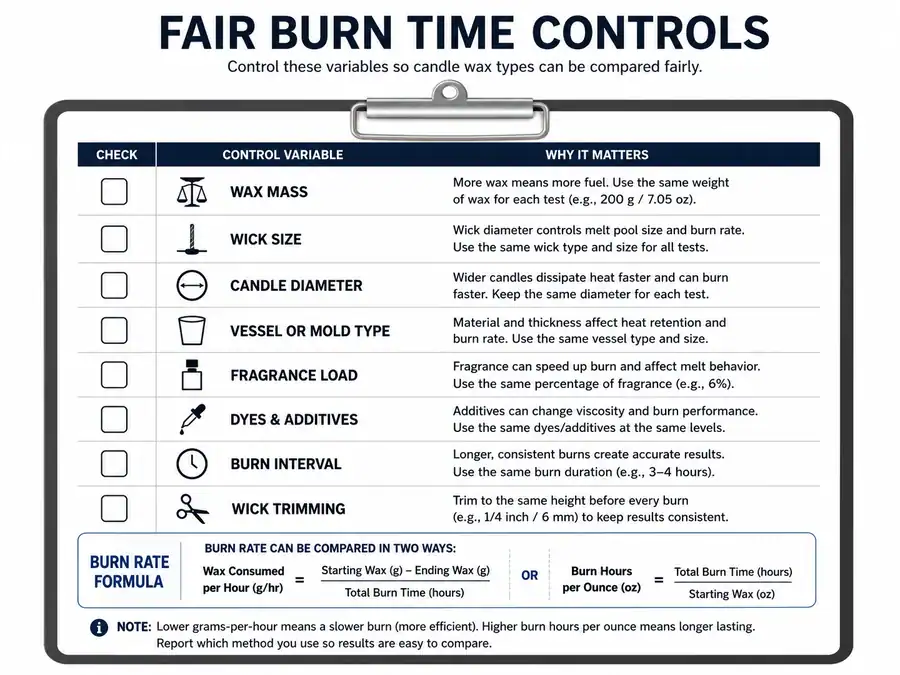
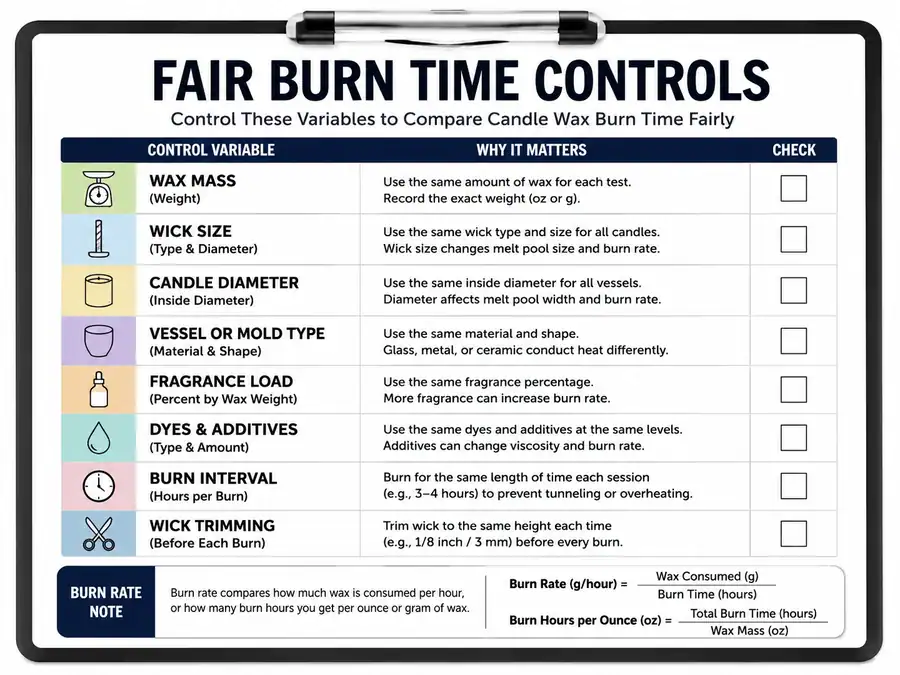
Burn hours and burn rate are related but not identical. Burn hours show total usable time; burn rate shows how quickly wax is consumed per hour. When two candles have different wax weights, burn rate gives a cleaner comparison than total hours alone.
Burn rate can be expressed as wax consumed per hour or as burn hours per ounce or gram of wax. Use the same unit for every candle in the comparison.
For the full formula and testing protocol, use How to Estimate Burn Time (Formula & Testing Protocol); this section only gives the comparison controls needed to interpret wax rankings. For exact wick sizing by jar diameter and wax type, use How to Size Your Candle Wick Correctly.
Candle Size, Shape, and Container Effects
Candle size, shape, and container design can change burn time independently from candle wax type.
Candle format means the physical structure of the candle, such as a jar, pillar, taper, votive, tealight, or container candle. Candle format is not the wax category. It changes wax mass, melt-pool width, wick count, flame exposure, and how quickly fuel reaches the flame.
| Candle format variable | Burn-time effect | Why it matters |
|---|---|---|
| Wax mass | Larger candles can burn longer even with a faster-burning wax | Total hours can reflect size, not wax type |
| Diameter | Wider candles often need larger or multiple wicks | More wick power can increase wax consumption |
| Jar or container shape | Heat retention and melt-pool shape can change burn behavior | The vessel can make wax seem slower or faster |
| Pillar shape | Exposed sides and wick fit affect how evenly wax is used | Poor matching can waste wax or shorten usable burn |
| Taper shape | Less wax mass can limit total burn hours | A long-burning wax may still have fewer total hours |
| Wick count | Multi-wick candles can consume more wax per hour | Total burn may feel strong but use fuel faster |
A large soy candle can outlast a small beeswax candle because it contains more wax, not because soy necessarily burns longer as a wax type. That comparison proves a size difference, not wax-type superiority.
Wax type ranking only works when candle format and wax mass are comparable. For format-specific candle design, use How to Make Candles in a Jar for container candles or How to Make Pillar Candles for molded candles; this page only explains format as a condition that changes burn-time comparisons.
How Wick Size Can Change Wax Burn Time
Wick size can shorten or extend candle burn time because the wick controls how much melted wax reaches the flame.
Wick size means the wick’s burn capacity for a candle’s wax type, vessel, and diameter. A larger wick usually creates a larger flame, a wider melt pool, and faster wax consumption. A smaller wick may slow the burn, but it can leave unused wax behind.
| Wick condition | Burn-time result | What it usually means |
|---|---|---|
| Wick is too large | Candle burns faster | Too much wax reaches the flame |
| Wick is too small | Candle may seem to last longer but tunnels | Wax is left unused around the edge |
| Wick fits the wax and vessel | Burn time is more usable | Melt pool reaches the right width without excess flame |
| Wick is not trimmed | Flame grows and wax burns faster | Extra wick length increases heat and soot risk |
| Wick is trimmed before each burn | Burn rate stays more stable | Flame size stays closer to the intended design |
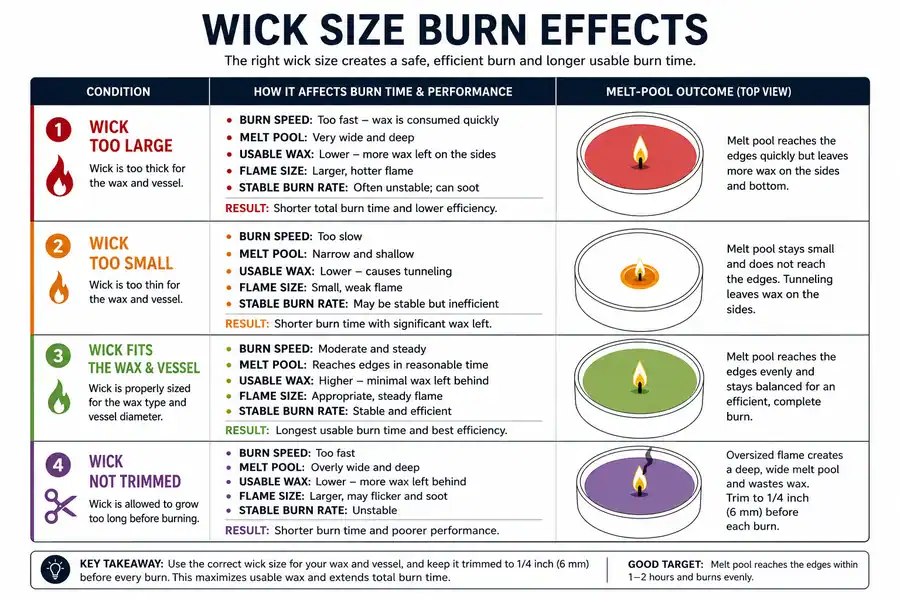
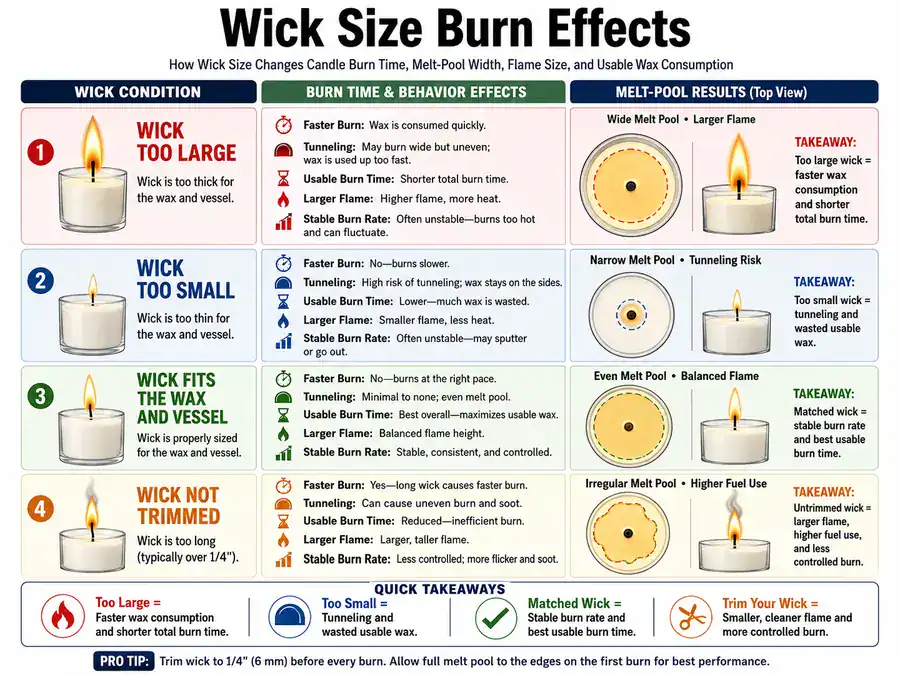
A long-lasting candle is not the same as an under-wicked candle. If a soy candle burns for many hours but leaves a thick wax wall, the candle has not delivered better burn duration; it has failed to use its fuel. If a beeswax candle is over-wicked, it can lose the slow-burn advantage that usually makes beeswax rank high.
For exact wick selection by jar diameter and wax type, use How to Size Your Candle Wick Correctly. This page only covers wick size as a burn-time variable, not a full wick chart.
Which Long-Burning Wax Should You Choose?
Choose beeswax for the longest burn time, soy for a slower container-candle option, and blends when you need a balance between burn time, handling, and candle format.
Here, “best” means best for usable burn time in the intended candle format, not best for scent throw, safety, cost, sustainability, or beginner handling.
The best long-burning candle wax depends on what “long-lasting” needs to do in the finished candle. A taper, pillar, and jar candle do not use wax in the same way, so the right choice should match the candle format, wick plan, and use case.
| Use case | Best fit | Why it fits |
|---|---|---|
| Longest burn by wax type | Beeswax | Dense, hard wax usually feeds the flame slowly |
| Long-lasting container candles | Soy wax or soy-heavy blends | Slower container burn with easier handling than beeswax |
| Long burn with a softer finish | Soy-coconut blend | Blend can improve structure while keeping a smooth container wax feel |
| Pillars or shaped candles | Beeswax, palm, or harder blends | Firm waxes hold shape and can support slower burn |
| Budget-sensitive long burn | Soy or paraffin-soy blend | Often easier to source than pure beeswax |
| Most predictable comparison test | Pure wax type | Fewer formula variables than supplier-specific blends |
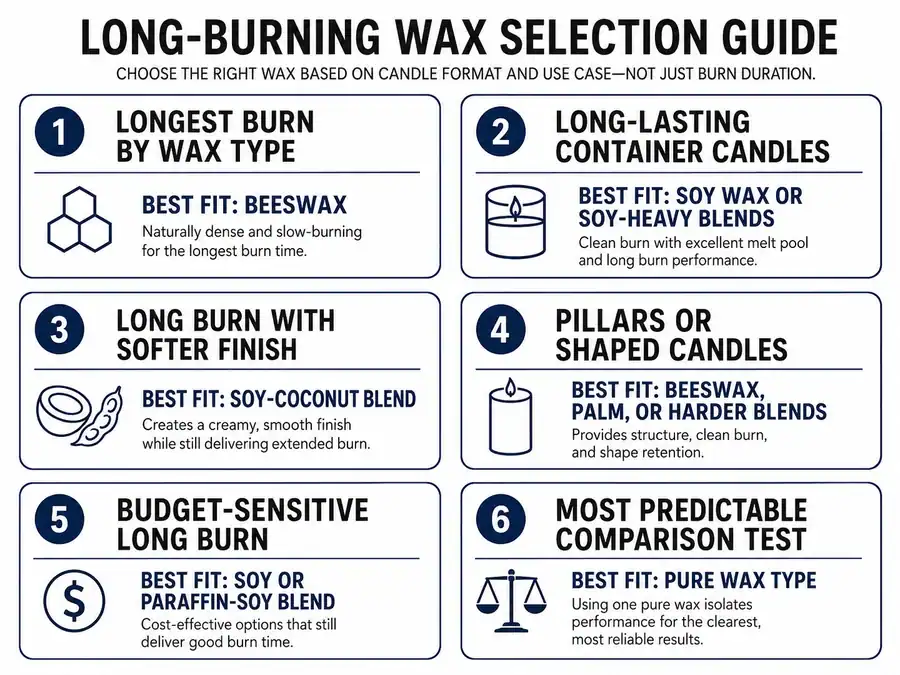
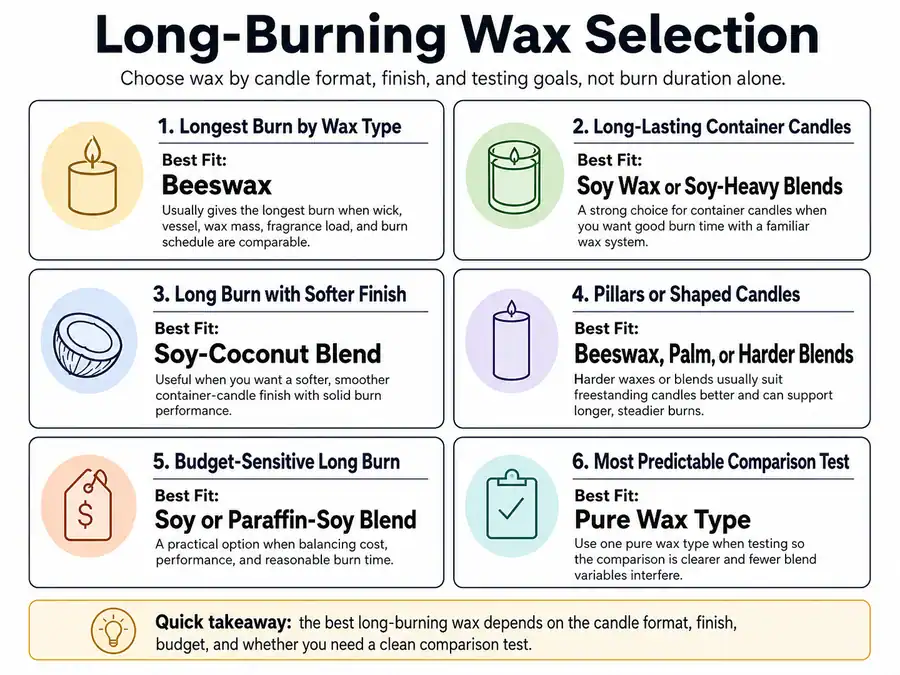
If burn duration is the only priority, beeswax is usually the clearest ranking answer. If the candle must carry strong fragrance, look smooth in jars, or stay affordable, soy wax and blends may be more practical even when they do not rank first for raw burn time.
For fragrance-led decisions, use Best Candle Wax for Scent Throw. For safety-led decisions, use Safest Candle Wax. For cost-led decisions, use Candle Wax Cost Comparison. Those choices should not be folded into a burn-time ranking because they answer different questions.
FAQs About Longest-Burning Candle Wax
Is beeswax always the longest-burning candle wax?
Beeswax is usually the longest-burning common candle wax, but it is not automatic in every candle design.
A small or over-wicked beeswax candle can burn faster than a larger, well-wicked soy candle. The fair comparison is equal wax weight, similar diameter, matched wick, similar vessel, and the same burn schedule.
Does soy wax burn longer than paraffin?
Soy wax often burns longer than paraffin in comparable container candles, but the result depends on wick size, jar diameter, additives, and fragrance load.
Soy is softer than beeswax, so it usually does not take the top burn-duration position. Its main burn-time value is slower container use when the candle is designed correctly.
Do wax blends burn longer than pure waxes?
Wax blends can burn longer than pure waxes when the formula improves structure, hardness, or wick fit.
A soy-coconut blend may burn longer than very soft coconut wax, while a paraffin-soy blend may burn slower than a paraffin-only candle. The blend ratio matters more than the blend name.
Does wick size affect candle burn time?
Yes. Wick size can change candle burn time as much as the wax type because the wick controls fuel flow to the flame.
A wick that is too large burns wax too fast. A wick that is too small may leave unused wax, which can make the candle seem long-lasting without giving full usable burn time.
Does candle size affect which wax lasts longest?
Yes. Candle size affects total burn time because larger candles contain more wax fuel.
A large soy candle can outlast a small beeswax candle because it has more wax. That does not prove soy burns longer by type; it proves the candles were not equal in size.
Is the longest-burning wax the best candle wax?
The longest-burning wax is not always the best candle wax because burn duration is only one buying or making criterion.
Beeswax is usually the best choice for maximum burn duration. Soy, coconut blends, paraffin blends, or palm wax may fit better when the goal is scent throw, jar appearance, cost control, or beginner handling.