

You can use container wax in some candle molds, but only in limited cases, and it often fails in freestanding or detailed molds because it is softer and more adhesive than mold wax. Container wax is wax made for jars, tins, or vessels, so it is usually softer and stickier than wax made for molds. In this article, “works” means the wax releases cleanly, holds its shape, keeps enough detail, and stays firm enough to handle after testing. Use this article to decide whether to test the wax, adjust your plan, or switch to pillar, tart, or mold wax.
What a Molded Candle Needs From Wax
A molded candle needs wax that can release from the mold, stand on its own, keep its details, and remain firm enough to handle after cooling.
For this article, “works” does not mean the wax only hardens inside the mold. It means the finished piece comes out cleanly and still behaves like a freestanding molded candle after demolding.
| Molded candle requirement | What it means | Why container wax may struggle |
| Clean release | The candle comes out without tearing, smearing, or leaving wax behind. | Container wax may be more adhesive because it is made for vessels. |
| Freestanding strength | The candle holds its shape without a jar or tin around it. | Softer wax may lean, slump, or flatten after demolding. |
| Detail retention | Edges, ridges, patterns, and small shapes stay visible. | Sticky or soft surfaces can blur fine mold details. |
| Handling firmness | The candle can be moved without dents or fingerprints. | Some container waxes stay too soft for clean handling. |
| Delayed stability | The candle still looks stable after resting. | A piece can seem fine at first, then sag or lose shape later. |
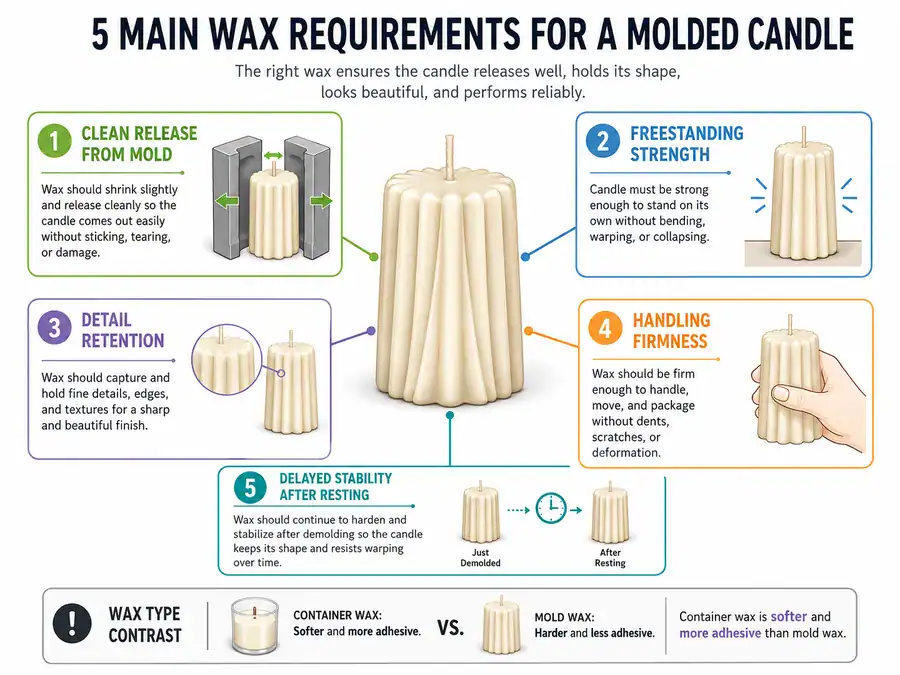
Method note: Use this table as a mold-compatibility screen, not as a full candle-performance test. If a test piece sticks, dents, slumps, or loses detail, the wax has not passed the molded-candle standard even if it became solid.
If your goal is a reliable freestanding candle, choose a wax made for candle molds rather than treating container wax as the default. Mold fit comes before wick choice, fragrance strength, or production scaling.
Container Wax vs Pillar or Mold Wax for Molds
Pillar or mold wax is usually better for molds because it is made to release cleanly and hold a freestanding shape.
Container wax is made for jars, tins, or other vessels, so it may stay softer or stickier after cooling. Pillar or mold wax means wax formulated for molded or freestanding candles, not just any wax that feels harder.
| Factor | Container wax | Pillar or mold wax | Mold decision |
| Intended use | Jars, tins, and vessels | Freestanding or molded candles | Use the wax for the form it was designed to support. |
| Release behavior | May cling to mold walls | Usually releases more cleanly | For clean demolding, pillar or mold wax is safer. |
| Shape strength | Often softer after cooling | Usually firmer after cooling | For pillars or 3D shapes, use mold-suitable wax. |
| Detail quality | May smear or soften fine details | Usually keeps edges and texture better | For detailed molds, avoid soft container wax unless a test passes. |
| Best use in this article | Small tests, simple flexible molds, wax melts, or embeds | Pillars, detailed molds, votives, and freestanding shapes | Treat container wax as conditional, not universal. |
Method note: This comparison is limited to mold behavior: release, firmness, freestanding shape, and detail. It does not rank wax brands, scent throw, jar adhesion, burn quality, or full wax-buying choices.
A harder-feeling container wax can still fail if it sticks to the mold or dents after release. A mold-suitable wax is the better starting point when the candle must stand alone, show detail, or be repeated in batches.
When Container Wax Can Work in Candle Molds
Container wax can sometimes work in small, simple, flexible molds after a test confirms release, firmness, detail, and delayed stability.
The cases most likely to work are narrow:
- small silicone molds with simple shapes;
- wax melts that do not need to stand like pillars;
- tiny embeds supported by another candle structure later;
- low-detail decorative test pieces that pass a delayed stability check.
In these cases, “works” means acceptable for limited use after testing, not guaranteed mold performance.
| Use case | Suitability | Why it may work | Decision |
| Small silicone mold with a simple shape | Likely to work | Flexible sides reduce release stress, and the shape has fewer weak points. | Test one piece before making more. |
| Wax melts | Likely to work | The wax does not need to stand like a pillar candle. | Use only if the piece releases and stays firm enough to handle. |
| Small embeds | Likely to work | Embeds are usually supported by another candle structure later. | Keep the shape simple and test surface detail. |
| Low-detail decorative test piece | Risky | It may look fine at first but dent or soften later. | Recheck after resting before using the batch. |
| Tall freestanding mold | Avoid | Soft wax has more chance to lean, slump, or flatten. | Choose a wax made for candle molds. |
| Intricate 3D mold | Avoid | Fine lines and thin sections can tear, smear, or lose detail. | Use mold wax instead of forcing container wax. |
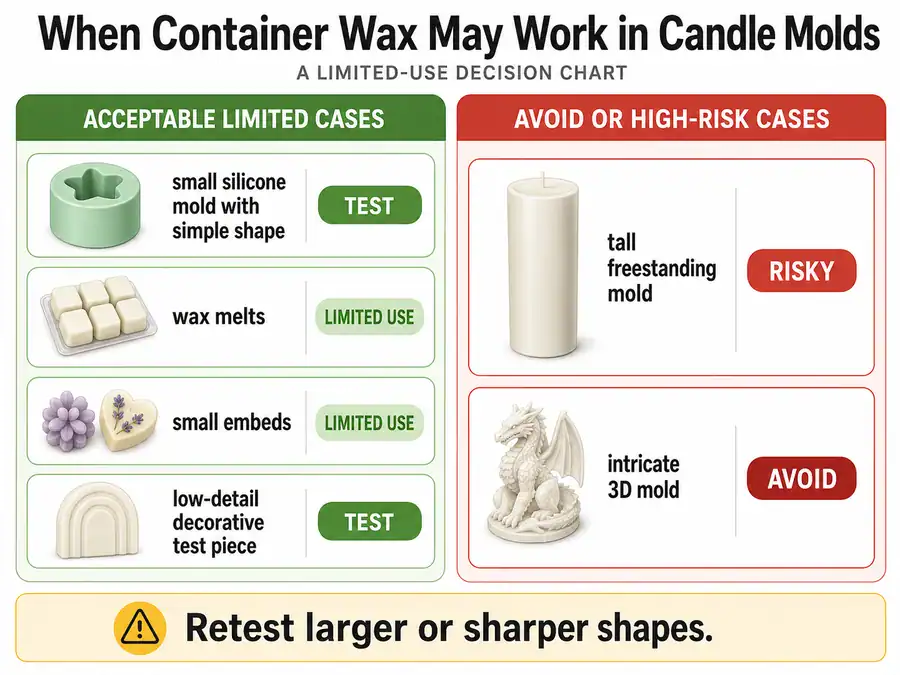
Method note: Treat this as a small mold-compatibility screen. A container wax that works in a flat melt or tiny embed has not automatically passed for pillars, tall shapes, or detailed molds.
If your test succeeds only in a small flexible mold, keep that result narrow. Do not scale the same wax into larger or sharper molds unless a new test piece passes release, firmness, detail, and delayed stability again.
When Container Wax Fails in Candle Molds
Container wax usually fails when it sticks, tears, slumps, dents, loses detail, or stays too soft to handle as a freestanding shape.
“Fails” means the wax-mold pairing does not meet the release, shape, detail, or handling standard. Tiny surface marks are not the same as failure, but structural softness, tearing, or delayed slump means the wax is not suited to that mold.
| Failure sign | Likely wax-related cause | What it tells you | Next step |
| Wax sticks to the mold wall | The wax is too adhesive for clean release. | The wax may be better suited to containers than molds. | Try a simpler flexible mold or switch wax. |
| Edges tear during demolding | The wax is too soft or grips fine mold details. | The shape is asking more from the wax than it can hold. | Use mold wax for detailed pieces. |
| Candle slumps after release | The wax lacks freestanding strength. | The test failed even if demolding looked clean. | Reject this wax for tall or unsupported shapes. |
| Surface dents easily | The finished piece remains too soft for handling. | It may mark during storage, gifting, or packing. | Use only for low-structure pieces, if at all. |
| Details look blurred | The wax cannot keep crisp texture or edges. | The mold detail is too fine for this wax. | Move to a firmer mold-suitable wax. |
| Piece feels greasy or tacky | The wax surface is not setting cleanly for this use. | Handling and detail quality may stay poor. | Do not scale the batch. |
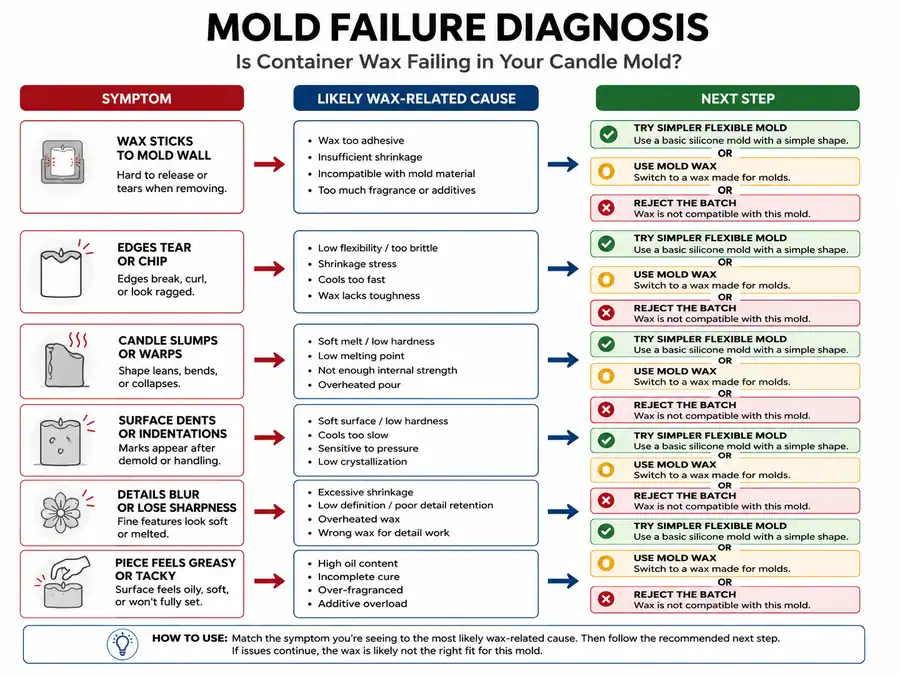
Method note: Use the failure log to separate wax suitability from mold technique. Release tricks may help minor sticking, but they do not fix wax that is structurally too soft for a freestanding molded candle.
If the only issue is slight sticking, mold-release troubleshooting may be the next step. If the piece slumps, dents, or loses shape after demolding, the better next step is a wax made for candle molds rather than more release work.
How to Test Container Wax in a Mold Before Using It
A test batch checks whether container wax can release, hold shape, keep detail, and stay firm in one small mold.
This test is a mold-compatibility check, not a full burn test, wick test, safety review, or sale-readiness check. Choose a small simple mold, pour a test piece, cool it fully, demold it gently, then inspect release, detail, and firmness. Recheck the piece after it has fully cooled and rested at room temperature, because a container-wax test can release cleanly at first and still dent, lean, flatten, or soften afterward.
Use this mold compatibility pass/fail checklist before making a larger batch:
- Choose the smallest simple mold that represents the shape you want to make.
- Pour one test piece instead of a full batch.
- Let the wax cool fully before demolding.
- Demold slowly and watch for sticking, tearing, smearing, or stretched edges.
- Check whether the piece stands, keeps detail, and resists fingerprints.
- Recheck the piece after it has fully cooled and rested at room temperature for dents, leaning, flattening, or delayed slump.
- Classify the result as use, adjust, or reject.
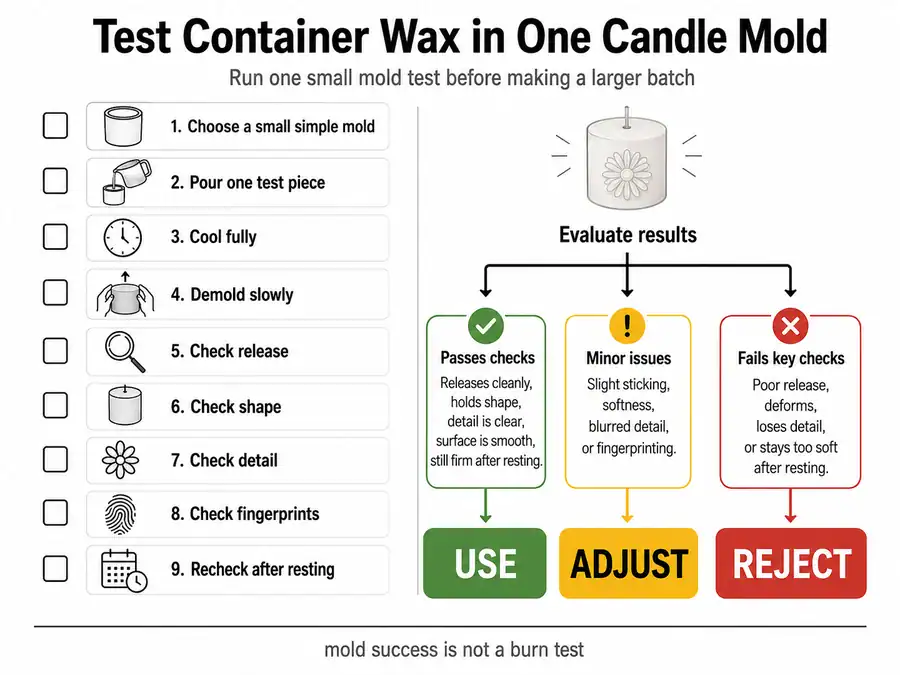
| Test result | What you see | Decision |
| Use | The wax releases cleanly, keeps its shape, holds detail, and still looks stable later. | Keep the use narrow to that wax, mold, and shape. |
| Adjust | The wax mostly releases, but has light sticking, soft edges, or minor detail loss. | Try a simpler mold, longer cooling, or a different mold plan before scaling. |
| Reject | The piece tears, slumps, dents easily, feels tacky, or loses important detail. | Do not use that container wax for that molded candle. |
| Retest | The result changes after resting, or a different mold shape is planned. | Run a new test before making more pieces. |
Method note: Record the wax, mold material, shape type, cooling result, demold result, and delayed stability. This keeps the decision tied to mold performance instead of guessing from wax type alone.
If the test fails because the mold is complex or the shape is unsupported, choose a wax made for candle molds rather than turning the test into a full release-method or mold-volume project.
Can You Harden or Blend Container Wax to Make It Work?
Yes, you can sometimes harden or blend container wax for mold tests, but the modified wax becomes a new blend that must be retested.
For this page, “make it work” only means passing a small mold test. It does not mean the blend is universal, sale-ready, burn-tested, or suitable for every mold shape.
| Before changing the wax | Why it matters |
| Check whether the current wax failed because of softness, sticking, or shape loss. | Different failures do not all need the same response. |
| Treat every wax change as a new test material. | A modified blend may release, cool, and handle differently from the original wax. |
| Avoid exact formulas unless you are following supplier guidance. | Ratio advice can drift into formulation work that this compatibility page does not cover. |
| Retest the same mold-performance points after any change. | Release, firmness, detail, and delayed stability still decide whether the blend works. |
| Switch to mold wax when the candle must be reliable. | Using the right wax is usually safer than forcing a container wax to behave differently. |
Method note: Do not judge a modified wax only by whether it feels harder. A useful molded-candle blend still needs clean release, freestanding strength, detail retention, and stable handling after demolding.
If you want to experiment, keep the blend small and document the result. If you need repeatable pillars, sharp detail, or dependable freestanding shapes, choose a wax made for candle molds instead of relying on adjustment.
If It Comes Out of the Mold, Is It Safe to Burn?
No — a container-wax candle that comes out of a mold has only passed a physical mold test, not a burn, wick, safety, or sale-readiness test.
Keep the mold test and burn test separate: mold success proves physical shape only, while burn safety depends on wick sizing, melt behavior, flame behavior, and the final candle design.
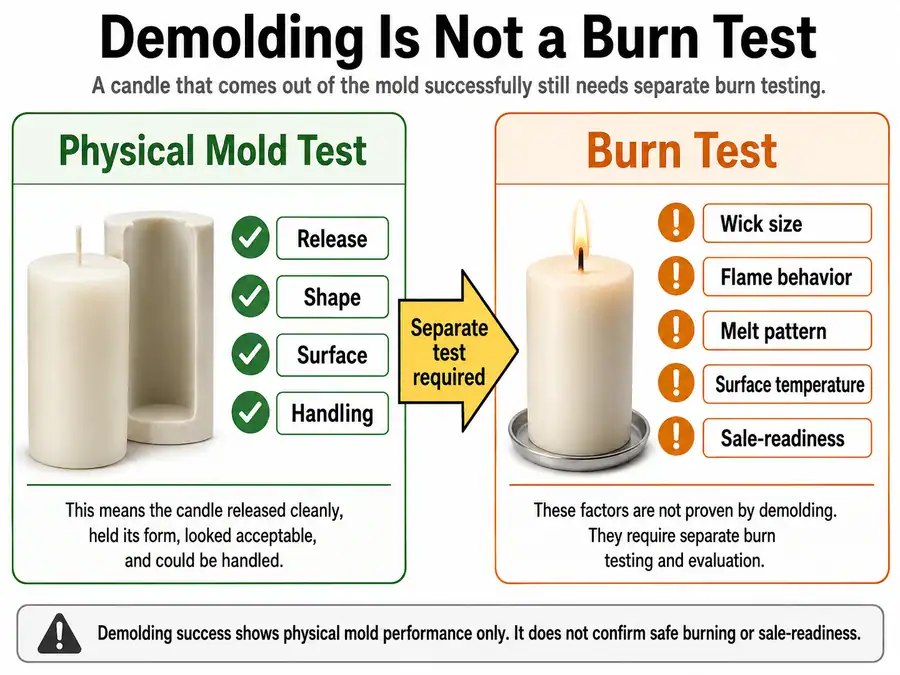
Demolding proves the wax can survive release from that mold. It does not prove the candle has the right wick, stable flame behavior, clean melt pattern, safe surface temperature, or suitable performance for gifting or selling.
| Demolding proves | Demolding does not prove |
| The wax released from the mold. | The candle is safe or optimized to burn. |
| The shape stayed intact after cooling. | The wick is the right size for the shape. |
| The surface and details survived handling. | The candle will melt evenly or predictably. |
| The piece may work as a test shape. | The candle is ready to sell, label, or batch-produce. |
Caveat: Treat a successful demolded container-wax candle as a physical sample first. If you plan to burn it, test burn behavior separately and keep wick sizing, candle safety, and sale-readiness as separate decisions.
If the candle is decorative, unstable, oddly shaped, or made from an experimental blend, do not assume it should be burned just because it has a wick. A molded candle can look finished while still needing a burn test before regular use.
FAQ
These answers cover the most common container-wax mold questions without turning the page into a full wax-buying, formulation, or burn-testing guide.
Can I use container wax in silicone molds?
Yes, container wax can sometimes work in small, simple silicone molds if a test piece releases cleanly and stays firm. It is less reliable for tall, detailed, or freestanding candle molds.
Why does container wax stick to candle molds?
Container wax often sticks because it is made to adhere inside jars or tins rather than release from mold walls. If sticking is heavy, the wax may be wrong for that mold.
Can I use container wax for wax melts?
Yes, container wax may work better for wax melts than for freestanding molded candles because melts do not need to hold a tall candle shape. Test firmness, release, and handling before making more.
Can I mix container wax with pillar wax for molds?
Yes, but any mixed wax becomes a new blend that needs a fresh mold test. Do not assume a harder blend will release cleanly, hold detail, or burn correctly.
Should I just use pillar or mold wax instead?
Yes, use pillar or mold wax when you need a reliable freestanding candle, crisp detail, or repeatable molded results. Container wax is best treated as a limited test option.