

The best candle molds for selling repeatedly produce sale-ready candles with low defects, stable shape, manageable upkeep, and favorable mold-level ROI.
Candle molds are reusable or semi-reusable production forms that control candle shape, dimensions, surface finish, release behavior, and batch consistency. For sellers, a good mold is not the cheapest or most decorative option; it is the one that keeps usable output stable across repeated pours. This page compares mold materials, release behavior, repeatable shape, batch capacity, and mold-level ROI so you can choose molds that reduce waste and support restocks. Here, mold-level ROI means payback from usable candles after rejects and replacements, while beginner tutorials, wax formulation, packaging, business setup, legal compliance, and full product pricing stay outside this page.
Best candle mold choice by seller scenario
| Seller scenario | Best mold direction | Why it fits selling | Main failure risk | Test before scaling |
| Testing a new product | Low-cost plastic or simple silicone mold | Limits upfront spend while demand is unproven | Shorter life, warping, or early release decline | Run repeated pours before buying duplicates |
| Restocking a proven pillar or simple shape | Metal or rigid production mold | Supports stable walls, repeatable dimensions, and batch consistency | Dents, corrosion, seam wear, or harder release | Check shape, finish, and release across several batches |
| Selling detailed decorative candles | Flexible silicone mold with stable detail areas | Supports easier release for shapes that need detail retention | Tearing, stretching, trapped residue, or broken detail | Compare usable candles against a simpler mold |
| Running seasonal or novelty products | Low-buy-in mold with a realistic payback window | Reduces risk when the selling window is short | Demand drops before the mold earns back its cost | Estimate expected units before buying premium seasonal molds |
| Scaling batch output | Several identical molds or a tested multi-cavity mold | Raises usable output when release and dimensions stay consistent | More cavities can multiply defects | Track reject-adjusted output, not cavity count alone |
| Reducing demolding defects | Mold with proven taper, clean surface, and manageable flexibility | Keeps more candles sale-ready after release | Sticking, tearing, dents, or residue marks | Retest after normal cooling and cleaning |
| Keeping packaging fit stable | Reorderable mold with documented cavity dimensions | Protects product photos, labels, boxes, and SKU consistency | Supplier changes, discontinued listings, or small dimension drift | Save supplier, SKU, cavity size, and test results |
Which Candle Mold Materials Last Long Enough for Selling?
The best candle mold material for selling survives repeated pours while keeping shape, release, and finish consistent enough for sale.
A candle mold is a reusable or semi-reusable production form that controls candle shape, dimensions, surface finish, release behavior, and batch consistency. For seller use, durability means repeated candle-production life, not just a mold feeling hard, thick, or heatproof once. If you need the basic mold formats first, start with a types of candle molds overview before judging which material is worth scaling.
| Mold material | Seller-use strength | Main durability risk | Best selling fit |
| Silicone | Flexible release and reusable shape options | Tears, stretching, surface residue, detail damage | Small batches, shaped candles, designs that need easier release |
| Metal | Stable walls and repeatable simple forms | Dents, corrosion, seam wear, release difficulty | Pillars, tapers, simple repeatable shapes |
| Plastic | Low upfront cost and easy test buying | Warping, cracking, surface wear, shorter life | Short runs, test products, low-volume experiments |
| Polycarbonate | Clear rigid structure and consistent cavity shape | Scratching, cracking, heat or cleaning damage | Repeated geometric shapes where visibility helps pouring |
| Rigid production molds such as acrylic, polycarbonate, aluminum, or supplier-grade forms | Strong repeatability and batch control | Higher buy-in, harder release, storage needs | Restockable products and repeat seller batches |
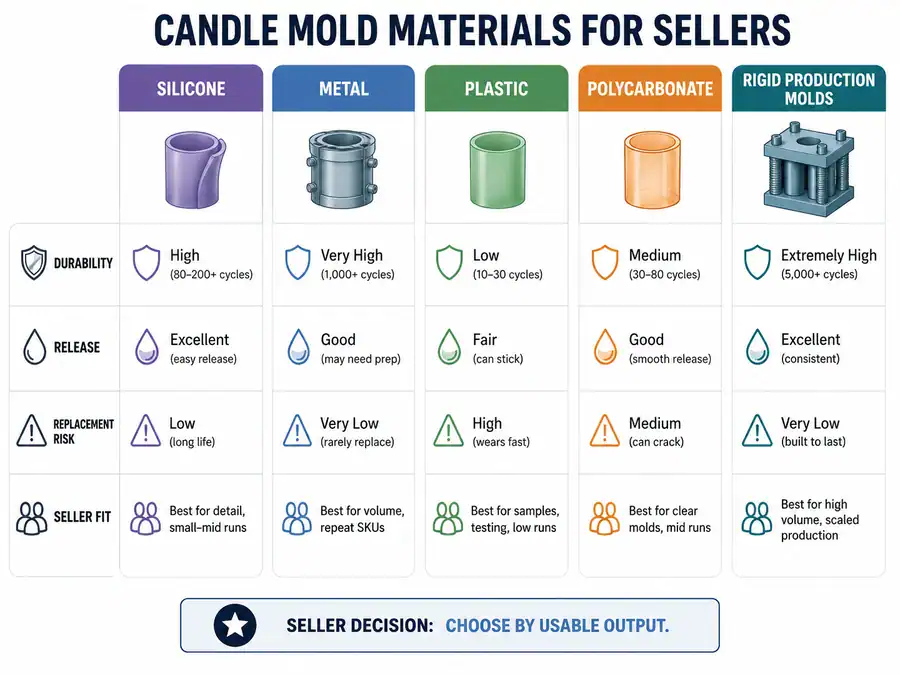
A mold fails for selling when it starts creating unsellable candles faster than it saves time or money. Common failure signs include deformation, surface wear, poor release, inconsistent dimensions, and cleaning damage that changes the finish. Cheap molds can become higher-cost molds if they warp, tear, or create rejects before they have produced enough usable candles.
| Material | Expected durability profile | Release behavior | Replacement risk | Seller suitability |
| Silicone | Good when the wall, seams, and detail stay stable | Usually forgiving, but can tear or hold residue | Medium if stretched, overheated, or scrubbed | Strong for detail when defect rate stays low |
| Metal | Strong for repeated simple shapes | May need careful release habits | Low to medium if denting and corrosion are controlled | Strong for repeatable pillars and tapers |
| Plastic | Shorter seller life than stronger materials | Can release well early, then decline | Higher under heat, pressure, or cleaning wear | Better for testing than long-term scaling |
| Polycarbonate | Good when heat and cleaning stay within limits | Rigid release can be less forgiving | Medium if scratched or cracked | Useful for clear, repeatable forms |
| Rigid production molds such as acrylic, polycarbonate, aluminum, or supplier-grade forms | Strong when matched to the candle type | Depends on finish, taper, and release design | Lower if maintained well | Best for consistent, restockable output |
The seller decision rule is simple: choose the material that produces the most usable candles over its expected life, not the material with the lowest upfront price. For wax-by-wax fit, use a wax-specific mold compatibility guide instead of turning this section into wax formulation. For detailed care steps, use a candle mold cleaning guide; this page only judges cleaning where it affects lifespan, release, and sellable output.
Seller check before buying more of the same mold: record the supplier material, stated heat limit, care instructions, visible wear after test pours, release quality, and number of usable candles. Replace or stop scaling the mold when shape drift, surface damage, or repeated release failure lowers sale-ready output.
Check Heat Tolerance Before Choosing a Mold Material
A mold is durable for selling only if it tolerates repeated pour temperatures without deformation, leaking, or finish problems.
Heat tolerance is the supplier-stated temperature boundary plus the mold’s repeated-use behavior under your actual pouring routine. The supplier’s heat rating, material limits, and care instructions should override generic assumptions about silicone, metal, plastic, polycarbonate, or rigid molds. This section only checks whether heat shortens mold life; wax recipes, fragrance behavior, wick testing, and burn testing belong on separate pages.
| Heat check | What to record | Pass sign | Warning sign |
| Supplier maximum temperature | Listed limit in °F/°C | Your planned pour stays within the stated limit | No stated limit or unclear material documentation |
| Repeated pour behavior | Same mold across several test pours | Shape, seam, and finish stay stable | Warping, bulging, leaking, or tacky surfaces |
| Release after heat exposure | Demolding result after cooling | Candle releases without new sticking or tearing | Release gets worse after repeated warm pours |
| Surface finish | Candle surface from the same mold | Finish remains sale-ready | Dull marks, residue transfer, scratches, or dents |
| Cleaning after heated use | Care method used after each pour | Cleaning does not change shape or release | Scrubbing, solvents, or heat cleaning damage the mold |
Use the heat check before buying duplicates because one clean test pour does not prove the mold can survive seller batches. A mold that slowly deforms can change finished candle weight, lid or package fit, surface finish, and buyer expectations. If the heat question depends on wax type, pour temperature, or material limits, route that decision to wax-specific mold compatibility rather than guessing from material name alone.
Seller test note: write down the mold material, supplier heat limit, planned pour temperature in °F/°C, number of test pours, and any deformation, leaking, finish change, or release change. Keep the mold only if the same form stays stable through repeated pours and normal cleaning.
Choose Molds You Can Clean Without Shortening Their Lifespan
Mold maintenance matters for sellers because cleaning damage and poor storage can shorten mold life and increase defects.
A mold is better for selling when cleaning and storage do not damage release quality, shape, or detail. Maintenance means the care actions that preserve clean release, stable shape, and repeatable output across batches.
| Maintenance issue | Likely cause | Seller impact | Fix, retest, or replace |
| Residue buildup | Wax, color, or release residue left after pours | Dull finish, sticking, or surface marks | Fix with supplier-approved cleaning, then retest |
| Abrasive surface wear | Scrubbing, scraping, or harsh tools | Rougher release surface and visible candle flaws | Retest if minor; replace if flaws repeat |
| Flexible mold deformation | Folded, compressed, or poorly supported storage | Shape drift and uneven finished candles | Fix storage support, then compare next batch |
| Detail texture damage | Over-cleaning fine areas or pulling residue from details | Broken detail or inconsistent finish | Retest once; replace if damage remains visible |
| Loss of release performance | Surface aging, residue, or material fatigue | More sticking and higher reject count | Replace if clean process candles still fail |
Choose molds that match the cleaning routine you can repeat after every batch. Supplier care instructions should control the cleaning method because the wrong tool, solvent, heat, or storage position can damage the mold faster than normal pouring. If you need step-by-step care, use a candle mold cleaning guide rather than turning mold selection into a full cleaning tutorial.
Use these replacement cues before buying more duplicates of the same mold:
- Repeated sticking happens after normal cooling and supplier-approved cleaning.
- Visible deformation changes candle height, diameter, or symmetry.
- Surface damage transfers marks to candles that would otherwise be sellable.
- Detail breaks, softens, or loses definition across repeated pours.
- Cleaning takes enough time or force that the mold raises cost per usable candle.
Cleaning burden affects mold-level ROI because every damaged batch reduces usable candles and shortens the mold’s payback life. If a cleaned mold starts causing release failures, route the issue to demolding troubleshooting; if the failures change the payback math, judge it again in the ROI section.
Which Molds Release Candles Consistently With Fewer Defects?
A mold is only good for selling if it releases candles cleanly and repeatedly enough to keep the reject rate low.
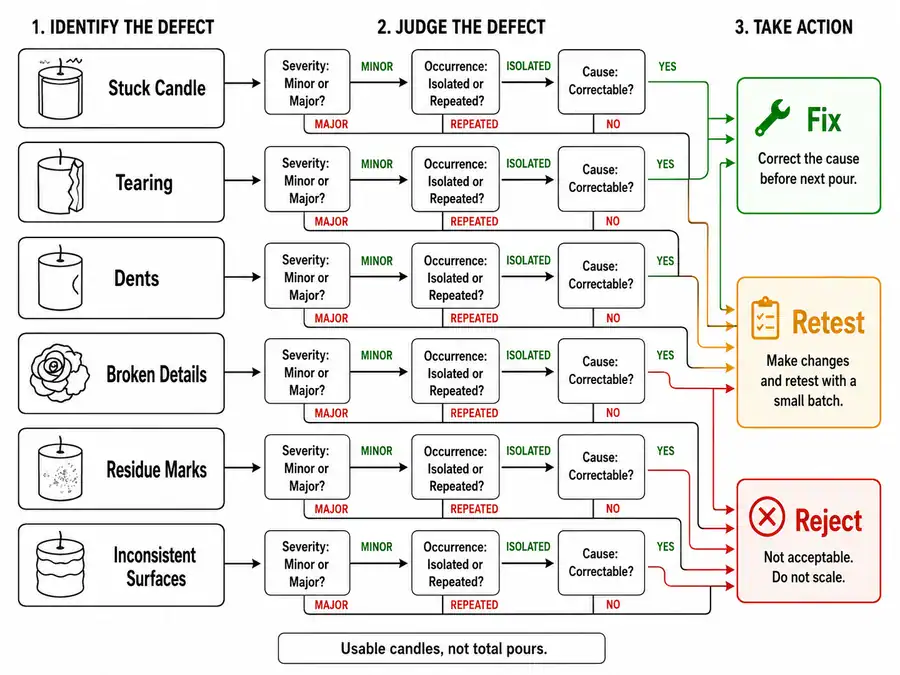
Release consistency means repeated clean demolding across batches without damaging candle shape, surface, or detail. For sellers, the reject rate should be judged by usable candles, not total candles poured. One failed candle can come from process error, but repeated release failures point to a mold-selection problem.
| Defect | Likely mold-related cause | Seller impact | Fix, retest, or reject |
| Stuck candle | Poor taper, worn release surface, rigid shape, or residue | Lost product and longer demolding time | Fix process once, then retest |
| Tearing | Flexible mold stress, thin details, or aggressive pulling | Unsellable surface or broken edges | Retest with gentler release; reject if repeated |
| Dents | Excess pressure during release or weak mold support | Visible flaws and lower sale readiness | Fix handling and support, then retest |
| Broken details | Fine protrusions, undercuts, or fragile shape areas | Higher reject count on decorative candles | Retest only if the shape has enough value |
| Residue marks | Dirty, aging, or incompatible mold surface | Dull finish and inconsistent appearance | Clean by supplier guidance, then retest |
| Inconsistent surfaces | Surface wear, trapped residue, or shape instability | Product photos may not match delivered candles | Reject if finish drift continues |
Silicone often releases shaped candles more easily than rigid materials, but it can stretch, tear, or hold residue. Metal and rigid molds can keep simple shapes stable, but poor taper or surface wear can make release less forgiving. High-detail molds may look premium, yet they can lower usable output when fine edges, undercuts, or trapped wax raise breakage risk.
Use this seller decision rule after a small test batch:
- Fix when the defect appears once and the likely cause is process-related.
- Retest when the mold still looks stable but needs proof across repeated pours.
- Reject when the same mold repeatedly damages candles that would otherwise be sellable.
A mold that repeatedly damages otherwise sellable candles should not be scaled. If the candle is stuck and needs step-by-step recovery, use stuck candle demolding troubleshooting; if wax behavior may be causing the defect, use wax-specific mold compatibility; if you need a full tracking sheet, use a candle testing log template. The next risk to judge is whether decorative mold detail raises reject rate enough to cancel its premium value.
When Does Mold Detail Increase Demolding Risk?
The most detailed mold is not always the best mold for selling if it increases breakage or reject rate.
Detail retention means repeated visible shape fidelity without breakage, trapped wax, residue, or loss of surface quality. Detailed molds are worth using for selling only when the added perceived value outweighs the extra demolding risk and the usable output stays high enough to justify scaling.
| Detail feature | Likely release risk | Seller impact | Test before scaling action |
| Undercuts | Candle catches inside the mold | Higher breakage and slower release | Test several pours before buying duplicates |
| Narrow recesses | Wax or residue stays trapped | Surface flaws and more cleaning time | Inspect detail after each test batch |
| Thin protrusions | Fine parts snap during demolding | Unsellable decorative candles | Compare usable count against simpler molds |
| Stiff mold walls | More pressure needed to release | Dents, cracks, or distorted shapes | Retest with a smaller batch before scaling |
| Deep texture | Residue marks or uneven finish | Product finish varies across batches | Reject if flaws repeat after cleaning |
| Complex shape with no taper | Candle releases unevenly | More lost candles per production cycle | Use only if repeated output stays sale-ready |
Simple molds usually win on speed, repeatability, and lower reject risk. Detailed molds can still work for sellers, but only when the detail survives repeated demolding without raising defects beyond the added product value. “Best” does not mean most decorative, most intricate, or most visually novel; it means the detail stays sellable through repeated production.
Use this test-before-scaling checklist:
- Run more than one test pour before buying the mold in quantity.
- Count usable candles, not total candles poured.
- Check whether details break, smear, trap residue, or slow demolding.
- Compare the detailed mold against a simpler mold with similar finished size.
- Keep the detailed mold only if its added value is stronger than its extra reject risk.
If the reader wants aesthetic-led shape ideas, use a decorative candle molds guide. If a candle is already stuck or breaking during removal, route that problem to stuck candle demolding troubleshooting. If the mold looks promising but needs proof before bulk buying, continue with a seller testing protocol before scaling.
How Do Molds Keep Candle Shapes and Sizes Repeatable?
A mold is repeatable for selling when it produces candles consistent enough in shape, size, finish, and weight to restock the same product.
Repeatability does not mean factory-perfect sameness; it means controlled, sale-ready consistency across batches. Mold shape control supports SKU consistency, reliable inventory, lower buyer confusion, and lower reject risk. Measure repeatability across multiple pours, not one good candle.
| Batch | Cavity ID | Height | Diameter | Finished weight | Visible variance note |
| Test 1 | A | 3.00 in | 2.00 in | 7.8 oz | Clean finish, no visible lean |
| Test 1 | B | 3.02 in | 2.00 in | 7.9 oz | Slight rim mark |
| Test 2 | A | 3.00 in | 2.01 in | 7.8 oz | Finish matches product photo |
| Test 2 | B | 3.03 in | 2.00 in | 8.0 oz | Minor height difference |
| Test 3 | A | 2.99 in | 2.00 in | 7.8 oz | Sale-ready |
| Test 3 | B | 3.04 in | 2.01 in | 8.1 oz | Watch for cavity drift |
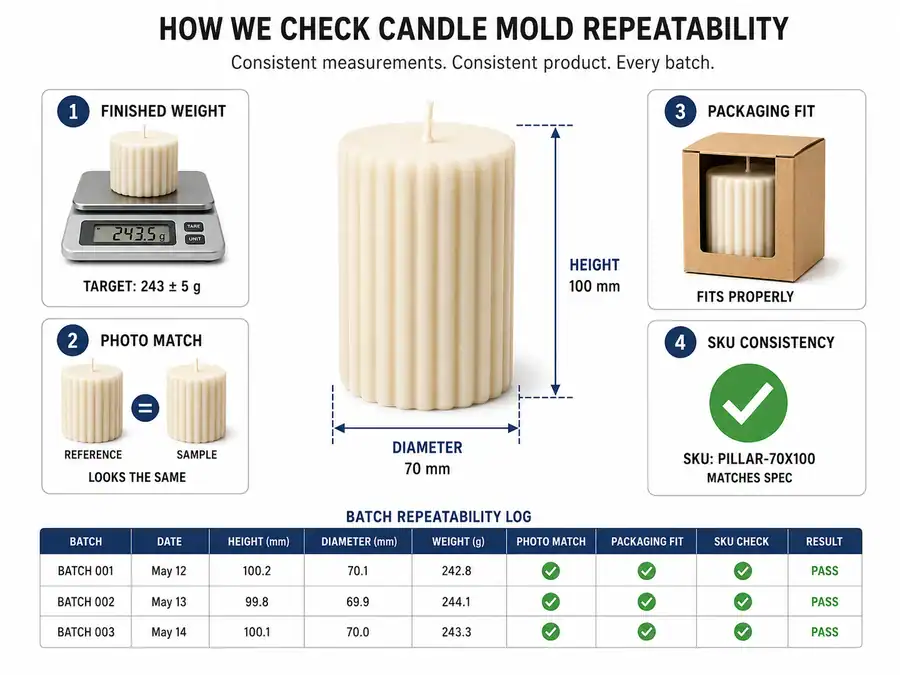
Repeatability matters because product photos need to match delivered items, packaging fit should be predictable, restock orders should stay consistent, and material planning becomes easier. Decorative shape alone is not enough if the finished candle varies too much for one product listing.
Use this repeatable-enough-to-sell checklist:
- The candle shape matches the product photo across batches.
- Height and diameter stay close enough for the same packaging.
- Finished weight stays stable enough for material planning.
- Surface finish remains sale-ready after normal release and cleaning.
- Multi-cavity molds produce candles close enough to sell under one SKU.
- The same mold can be replaced or reordered without changing the product line.
Small handmade variation can be normal, but uncontrolled drift weakens product reliability. If the reader wants visual style ideas, route that to a decorative candle molds guide. If packaging fit becomes the main issue, use candle packaging and label fit guidance. If supplier choice becomes a broad sourcing question, move that to a supplier buying guide; this section only judges supplier fit where it affects repeatable candle output.
Can You Reorder the Same Mold and Keep the Same Product?
Repeatable selling depends on whether the seller can replace or reorder the same mold without changing the product.
Supplier standardization means the ability to buy the same mold spec again. One good mold is not enough if the seller cannot replace it, duplicate it, or reorder it without changing the finished candle’s dimensions, shape, or surface finish.
| Detail to document | Why it matters for selling |
| Supplier name | Helps trace the original mold source |
| Mold SKU or listing ID | Reduces the chance of buying a similar but different mold |
| Cavity dimensions | Protects finished candle height, diameter, and packaging fit |
| Mold material | Keeps release, finish, and care needs more predictable |
| Cavity count | Supports repeatable batch planning |
| Reorder status | Flags whether the mold can still be replaced |
| Test results | Shows whether the mold produced sale-ready output before scaling |
Reorder reliability matters because sellers need product-line continuity, restocks, matching product photos, wholesale consistency, and replacement planning. Marketplace listings can group similar molds that are not identical, and unbranded duplicates may have small dimension changes that alter the finished candle.
| Reorder risk | What can happen | Seller response |
| Discontinued mold | The product can no longer be restocked the same way | Buy backups only after testing the mold |
| Listing variation | A reordered mold makes a slightly different candle | Save dimensions and compare before scaling |
| Unbranded duplicate | Similar photos hide different specs | Track cavity measurements, not just appearance |
| Material change | Release, finish, or cleaning behavior changes | Retest before adding it to production |
| Cavity-count change | Batch planning no longer matches prior records | Update the production log before restocking |
Document a proven mold before scaling a product around it. If supplier selection turns into broader sourcing strategy, use a supplier buying guide. If the main need is production planning, move to a candle production workflow. If the reader needs mold test records, use a candle testing log template.
How Many Candles Can the Mold Help You Produce Reliably?
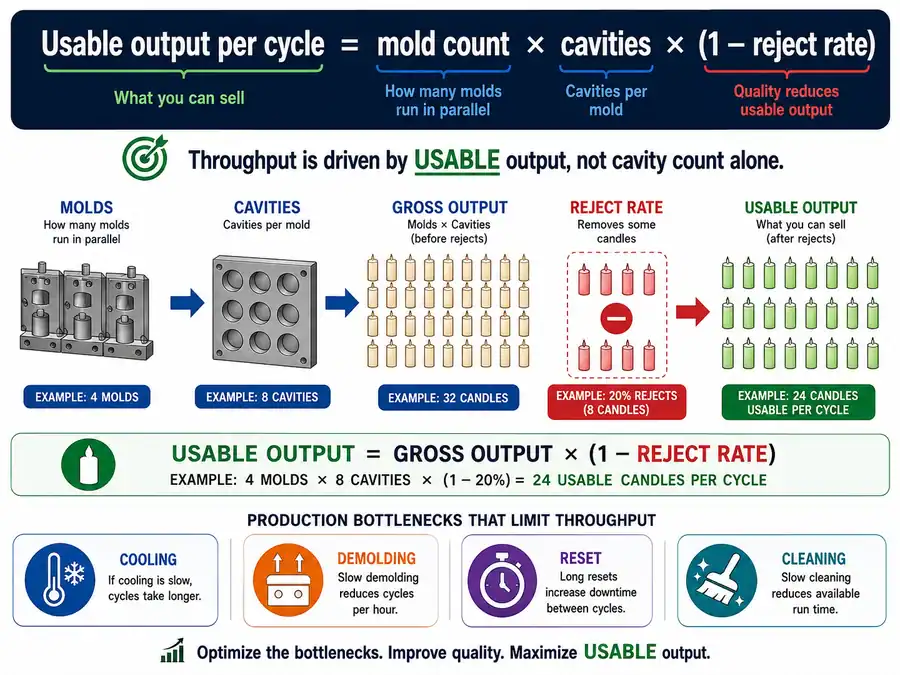
Mold throughput for sellers should be measured by usable candles per cycle, not the number of cavities or molds alone.
Production efficiency means mold-limited output that remains repeatable and sale-ready after pouring, cooling, demolding, and reset. A selling mold is efficient when it increases usable candles per production cycle without increasing defects, rushed demolding, or inconsistent output.
Usable output per cycle = mold count × cavities × (1 − reject rate)
| Setup | Capacity strength | Main bottleneck | Seller fit |
| One single-cavity mold | Simple to test and control | Low output per cycle | Product testing and slow-selling designs |
| Several identical molds | Higher output with the same candle shape | More cooling space and reset time | Restockable products with steady demand |
| One multi-cavity mold | More candles from one pour setup | Defects repeat across more cavities if the mold is poor | Proven products with low reject rates |
| Mixed mold set | More product variety | Harder tracking and less repeatable batching | Small catalogs before narrowing winners |
Mold bottlenecks include mold count, cavities per mold, cooling time, demolding time, reset or cleaning time, and reject rate. More cavities are not automatically better because cooling and demolding windows can limit output even when cavity count is high. Capacity only helps when demand, wax process, cooling space, and release reliability support the batch size.
Use this quick capacity check before buying more molds:
- Count usable candles, not total candles poured.
- Record the number of molds and cavities used per cycle.
- Track cooling, demolding, and reset time.
- Note whether larger batches increase defects.
- Compare single molds, identical duplicates, and multi-cavity molds using the same reject-adjusted formula.
ROI includes time and usable output efficiency at the mold level, not full production operations or total business profit. If the reader needs operations planning, use a candle production workflow. If the next decision is cavity economics, move to multi-cavity mold economics. If the question is payback, use the ROI section and calculator.
When Are Multi-Cavity Molds Worth It?
Multi-cavity molds are not automatically better for selling because their value depends on usable output, not cavity count alone.
Multi-cavity mold economics means the relationship between cavity count, usable output, reject rate, mold price, and real production volume. The extra cavities are useful only when the seller can pour, cool, demold, inspect, and store the candles consistently.
Usable output per batch = cavities × successful release rate
| Mold setup | Cavity count | Output upside | Defect amplification risk | Best seller use case |
| Single mold | 1 | Easy control and low testing risk | One failed candle at a time | New products, small runs, untested shapes |
| Several identical molds | 1 each | Higher output while keeping the same product form | Defects stay separated by mold | Proven products with steady restocks |
| Multi-cavity mold | 2+ | Faster repeat batches from one mold format | One poor mold can waste several candles per cycle | Tested SKUs with low reject rates and demand |
| Mixed cavity set | Varies | More variety from one batch plan | Harder tracking and less SKU consistency | Limited seasonal runs or small catalog tests |
More cavities can improve ROI or multiply waste. A multi-cavity mold is worth upgrading to only when extra cavities lower cost per usable candle without raising the reject rate. Cavity-to-cavity variation also matters because total output can rise while repeatability weakens.
Use this upgrade rule: buy a multi-cavity mold after the single-cavity or small-batch version has proven demand, clean release, stable dimensions, and enough repeat volume. If the mold has not been tested yet, use the seller testing protocol before scaling. If the question becomes full operations planning, route it to a candle production workflow; if the question becomes full profit math, use a candle pricing calculator rather than treating cavity count as automatic profitability.
How Do You Calculate Mold ROI and Cost per Usable Candle?
Mold ROI means mold-level payback from usable candles, not full candle-business profitability.
Cost per usable candle is the mold price divided by expected candles that are sale-ready after rejects. The calculation must include usable cycles, cavity count, and reject rate because theoretical output is less useful than sellable output.
Calculator inputs: mold price, expected usable cycles, cavities per cycle, and reject rate.
Cost per usable candle = mold price ÷ expected usable candles after rejects
Expected usable candles = usable cycles × cavities per cycle × (1 − reject rate)
Worked example: a $40 mold with 80 usable cycles, 2 cavities, and a 10% reject rate produces 144 expected usable candles, so the mold cost is about $0.28 per usable candle.
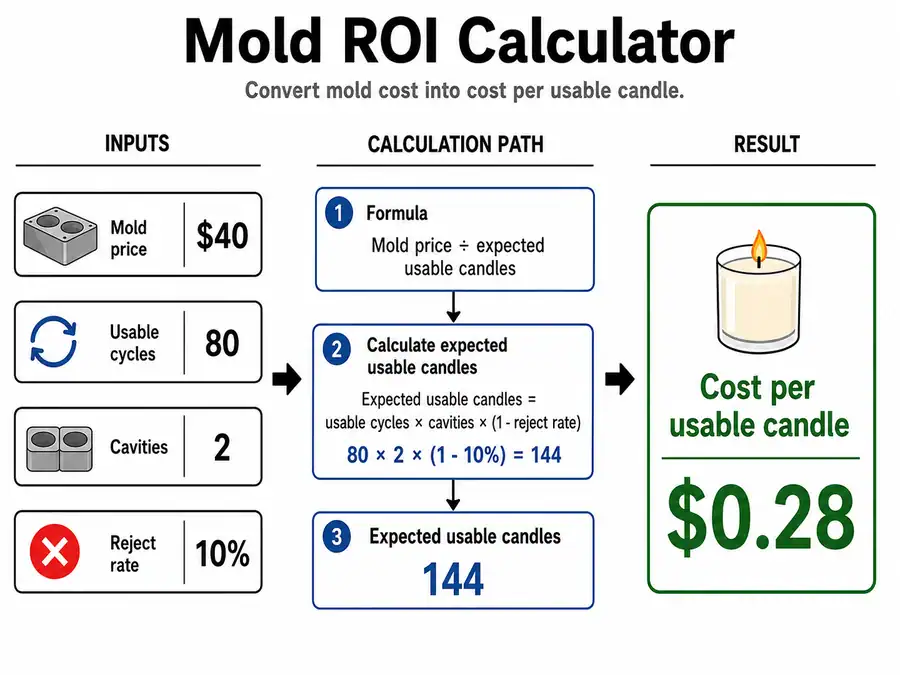
Interpretation rule: choose the mold with the lower cost per usable candle only when it also keeps release, dimensions, finish, and replacement risk acceptable for the product volume.
| Calculator input | What it means | Example value | Why it matters |
| Mold price | Amount paid for the mold | $40 | Sets the payback target |
| Usable cycles | Expected repeat pours before replacement | 80 | Spreads the mold cost over time |
| Cavities per cycle | Saleable candle spaces per pour cycle | 2 | Changes output per batch |
| Reject rate | Share of candles lost to mold-related defects | 10% | Converts theoretical output into usable output |
| Expected usable candles | Cycles × cavities × successful release rate | 144 | Shows likely sale-ready output |
| Cost per usable candle | Mold price ÷ expected usable candles | $0.28 | Helps compare molds fairly |
A premium mold can be cheaper over time if it lasts longer, releases cleaner candles, and produces more usable cycles. A cheap mold can still win when the seller is testing demand, making a seasonal or low-volume SKU, or avoiding bulk spend before a design is proven.
| Mold choice | When it can win | When it can cost more |
| Premium mold | Repeated SKU, low defect rate, long mold life, stable dimensions | Demand is unproven or the mold does not improve usable output |
| Cheap mold | Testing a new shape, short run, seasonal experiment, low volume | Warping, tearing, poor release, or early replacement raises rejects |
| Multi-cavity mold | Proven demand and stable cavity-to-cavity output | Extra cavities create more flawed candles per cycle |
| Decorative specialty mold | Higher perceived value and low breakage | Detail causes slow release, breakage, or too many rejects |
ROI here excludes wax, wick, fragrance, packaging, tax, marketplace fees, and complete profit margin. Use a candle pricing calculator for total candle pricing, and use business or pricing content for full profitability. If the candle still needs sale-readiness proof, use candle safety and burn testing before treating mold payback as a finished selling decision.
The seller rule is to buy the mold that proves the best cost per usable candle for the tested product volume. The lowest mold price is not the best value if the mold creates more rejects, shorter life, or inconsistent restocks.
When Does a Seasonal Mold Pay Back Fast Enough?
A mold can be physically durable but still weak for selling if it only has a short seasonal payback window.
Reuse value means the number of realistic selling windows a mold can support. Evergreen molds usually carry lower ROI risk because the seller can reuse them across more batches, listings, and restock cycles. Seasonal, event, novelty, or trend-based molds need enough expected sales during a shorter window to cover mold cost and acceptable defect risk.
| Mold type | Selling-window length | Reuse frequency | ROI risk | Seller decision |
| Evergreen mold | Year-round or recurring | Higher across repeat batches | Lower when output stays usable | Better for proven SKUs and restocks |
| Seasonal mold | Short holiday, event, or campaign window | Lower unless reused each season | Higher if demand drops before payback | Buy only when expected units can cover cost |
| Trend or novelty mold | Uncertain or short-lived | Harder to predict | Higher if the style fades quickly | Test small before scaling |
| Low-cost seasonal mold | Short window, low buy-in | Limited but lower exposure | Lower than premium seasonal molds | Useful for small test runs |
“Best” here means profitable across realistic selling windows, not trendiest, most festive, or most visually novel. A low-cost seasonal mold may still work for a small test run, but a premium novelty mold can become weak if it cannot earn back its cost before demand drops.
Use this payback-window checklist before buying seasonal molds:
- Can the mold sell enough units before the buying window ends?
- Can the mold be reused next season without looking outdated?
- Does the shape fit more than one listing, scent line, or gift set?
- Is the expected reject rate low enough for the short sales window?
- Would a simpler evergreen mold produce steadier usable output?
- Is the mold cheap enough to treat as a test rather than a core SKU?
If the reader wants holiday product ideas, route that to seasonal candle product ideas. If the reader wants shape inspiration, use a decorative candle molds guide. If the decision needs full pricing or demand planning, use a candle pricing calculator or candle production workflow instead of turning seasonal reuse into a marketing plan.
Test the Mold Before Scaling: A Seller’s Validation Protocol
One good candle is not enough proof that a mold is ready for selling or bulk purchase.
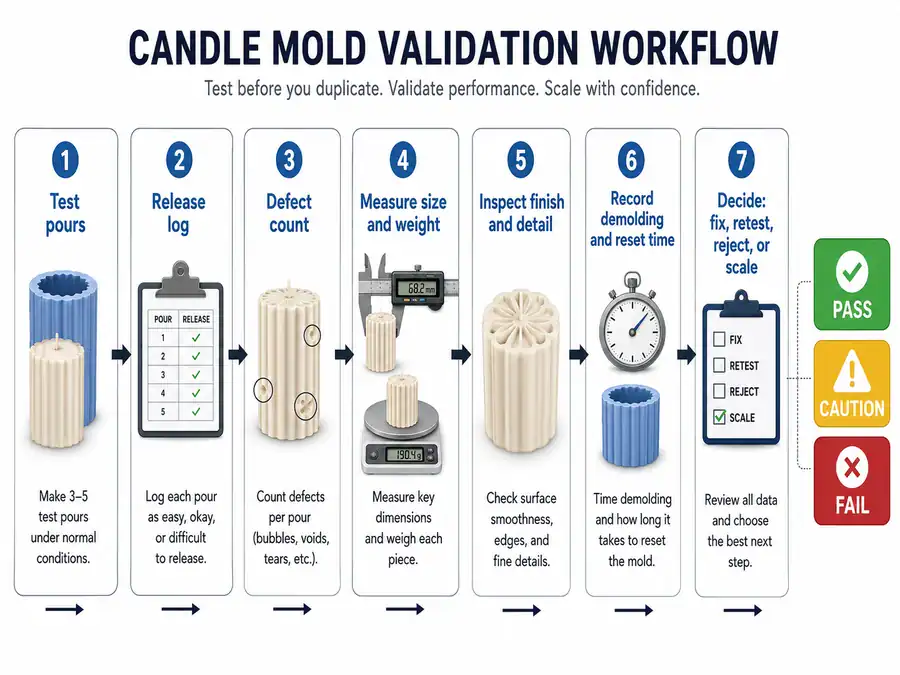
Seller mold testing means proving repeatable, sellable output from a specific mold under the seller’s wax, workflow, and product conditions. Test the mold across repeated pours before scaling, and track release quality, defect count, dimensions, demolding time, and usable output. Mold testing does not replace candle safety testing, burn testing, labeling compliance, insurance decisions, or a full QA system.
Use this validation checklist before buying duplicates or building a product line around a mold:
- Run repeated test pours with the same mold.
- Log whether each candle releases cleanly.
- Count defects by type, not just total failed candles.
- Measure height, diameter, and finished weight.
- Inspect finish, detail, seam areas, and surface marks.
- Record demolding time and reset time.
- Decide whether to fix, retest, reject, or scale.
| Test result | What it may indicate | Next action |
| Clean release across repeated pours | The mold may be stable enough for seller use | Scale carefully and keep logging output |
| One isolated defect | Process, cooling, or handling may be the cause | Fix the likely variable and retest |
| Repeated sticking | Mold shape, surface, residue, or release design may be weak | Use stuck candle demolding troubleshooting before scaling |
| Repeated dimension drift | Mold may be deforming or cavity consistency may be poor | Reject or limit to non-restock products |
| Slow demolding every batch | The mold may raise labor cost and lower throughput | Compare against a simpler mold |
| Surface flaws after cleaning | Care method or mold surface may be damaging output | Retest after supplier-approved care, then reject if repeated |
| Detail breakage | Shape complexity may be too risky for sale-ready output | Use a simpler shape or keep as a limited test |
Use this pass/caution/fail guide:
| Decision | Use when | Seller action |
| Pass | Repeated pours produce sale-ready candles with stable release, dimensions, and finish | Buy cautiously in small multiples |
| Caution | Defects are occasional, explainable, and fixable | Retest before scaling |
| Fail | The same mold repeatedly creates unsellable candles | Do not bulk-buy the mold |
Do not bulk-buy a mold until repeated tests show acceptable usable output. If the reader needs a tracking sheet, use a candle testing log template. If the candle itself needs sale-readiness proof, use candle safety and burn testing. If the next question is capacity, use a candle production workflow; if the next question is payback, return to mold ROI and cost per usable candle.
Final Buying Rule
Choose candle molds by repeated usable output, not product listing claims.
The best mold for selling is the one that keeps producing sale-ready candles after repeated pours: clean release, stable dimensions, manageable cleaning, and a cost per usable candle that fits the product volume. Treat “professional,” “premium,” or “for business use” in a listing as claims to verify, not proof that the mold is ready for bulk buying.
Use this final checklist before scaling a mold:
- Does it release cleanly across repeated test pours?
- Does it keep the same shape, size, finish, and finished weight well enough for one SKU?
- Can you clean and store it without damaging release quality or detail?
- Can you reorder or replace it without changing the product?
- Does its usable output justify the mold price after defects?
- Does its selling window match the payback period?
- Has it passed a small validation batch before you buy duplicates?
If the mold passes those checks, it is a stronger seller choice than a cheaper, trendier, or more decorative mold that creates more rejects. Use dedicated pricing, production, safety, or testing pages for full business math, workflow planning, burn testing, and compliance decisions; this buying rule should stay focused on mold selection.