
Do not burn or test-burn a candle or wax batch containing food-use vanilla extract.
The affected candle is any wax-and-wick candle or wax batch into which food-use vanilla extract was added. Here, handling it safely means preventing ignition or further burning, allowing hot material to cool, and keeping the affected batch out of combustion use. It does not mean rewicking, diluting, reheating, transferring, or adding another fragrance to make the same wax burnable. Identify whether the wax is unpoured and hot, poured and hot, poured and cool, or already burning before taking the next action.
I Used Vanilla Extract in My Candle—Should I Burn It?
Do not burn or test-burn a candle or wax batch that contains food-use vanilla extract.
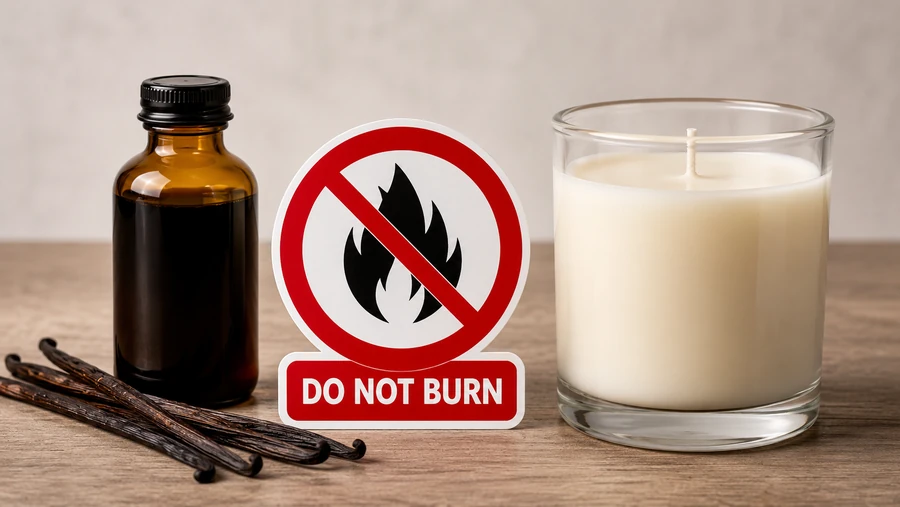
The affected candle is a wax-and-wick candle or wax batch into which vanilla extract was added. Handling it safely means preventing ignition or further burning, stabilizing the material, and keeping the affected wax out of combustion use. Federal standards define vanilla extract as a food flavoring solution containing vanilla-bean constituents in aqueous ethyl alcohol. This identity is different from a fragrance product formulated and documented for candle use. eCFR+1 “Do not burn” applies when the candle is:
- Unlit or curing.
- Fully cooled.
- Still in the pouring vessel.
- Already poured into a container.
- Previously lit for a brief test.
An unlit candle avoids the immediate hazards of an active flame, but being unlit does not make the affected wax suitable for later burning.
Do not try
- Test-burning the candle once.
- Reusing the wax with a different wick.
- Adding more wax to dilute the vanilla extract.
- Reheating or transferring the mixture for another burnable candle.
- Adding fragrance oil to the affected wax.
- Relighting it to check whether it burns normally.
These actions change parts of the candle but do not supply evidence that the original wax mixture is suitable for combustion. A fragrance product intended for candles belongs only in a separate new batch.
Methods note: This failure log records rejected correction ideas rather than measured accident rates. Its purpose is to make the burn-salvage boundary explicit without claiming that these methods were tested.
The broader differences between vanilla extract and candle fragrance materials are outside this immediate safety task. The present decision remains the same: keep the affected batch unlit and identify its current state before touching, moving, or disposing of it.
Which State Is the Candle In Right Now?
The candle’s heat and ignition state changes the next action, but no state makes the vanilla-extract-containing batch suitable for burning.
Classify it as unpoured and hot, poured and hot, poured and cool, or already burning. “Poured” does not mean “cool,” and an extinguished flame does not mean the wax or container is ready to move.
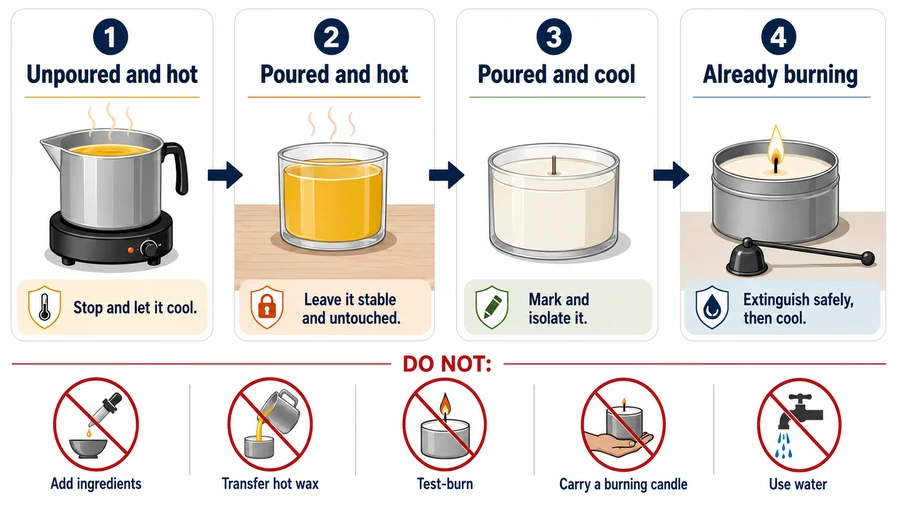
Already lit: Extinguish the candle now if ordinary candle extinguishing can be performed safely. Do not use water, and do not carry the burning candle to another location.
The National Candle Association advises using a candle snuffer or gently blowing out the flame, avoiding water because it can splatter hot wax, and waiting until the wax has cooled before moving the candle. National Candle Association
| Current state | Do now | Do not do | Exit condition |
|---|---|---|---|
| Wax is unpoured or remains hot in the melting vessel | Stop the candle-making process. Leave the vessel stable on a heat-resistant surface and allow the wax and vessel to cool. | Do not add ingredients, transfer the wax, or pour it to salvage the batch. | The wax is no longer liquid, and the vessel is fully cool. |
| The candle is poured, but the wax or container is still hot | Leave the container stable and keep people, pets, and combustible materials away while it cools. | Do not move, dismantle, freeze, clean, or handle the candle while it is hot. | The wax and the entire container are fully cool. |
| The poured candle is fully cool and unlit | Mark or isolate it so nobody mistakes it for a candle intended for burning. | Do not test-burn it or store it among usable candles. | The candle is isolated and ready for a disposition decision. |
| The candle is already lit | Extinguish it using an ordinary candle-extinguishing method when this can be done safely. Keep people and pets away. | Do not use water, carry the candle, pour the wax, or touch the hot container. | The flame and wick glow are out, the wax and container are fully cool, and the candle cannot be relit accidentally. |
If the fire spreads beyond the candle, nearby material ignites, the container creates an immediate hazard, or ordinary extinguishing does not control the flame, leave the danger area and contact the applicable emergency service. Do not continue candle troubleshooting during an uncontrolled fire. Why instructions fail when the candle state is omitted:
- “Throw it away” may prompt someone to handle liquid wax or a hot container.
- “Set it aside” does not resolve an active flame.
- “Blow it out” does not confirm that the wick glow has ended or that the container has cooled.
- “It is unlit” can be misread as permission to burn it later.
- “The outside feels cool” does not prove that wax deeper in the container has fully cooled.
Methods note: This matrix separates heat and ignition states so the reader does not apply cool-candle handling to liquid wax or an active flame. It does not predict how a particular mixture would burn.
Once the state is clear, follow the matching stop, cool, and isolate action before handling any candle component.
How to Extinguish, Cool, and Isolate the Candle
Stop using the vanilla-extract-containing candle, extinguish any flame without water, leave hot wax undisturbed, and isolate the candle only after the wax and container are fully cool.
Safe action means ending combustion, preventing movement while the candle is hot, and making sure nobody can relight it. It does not mean transferring, repouring, refrigerating, reheating, or adding another ingredient to the affected wax.
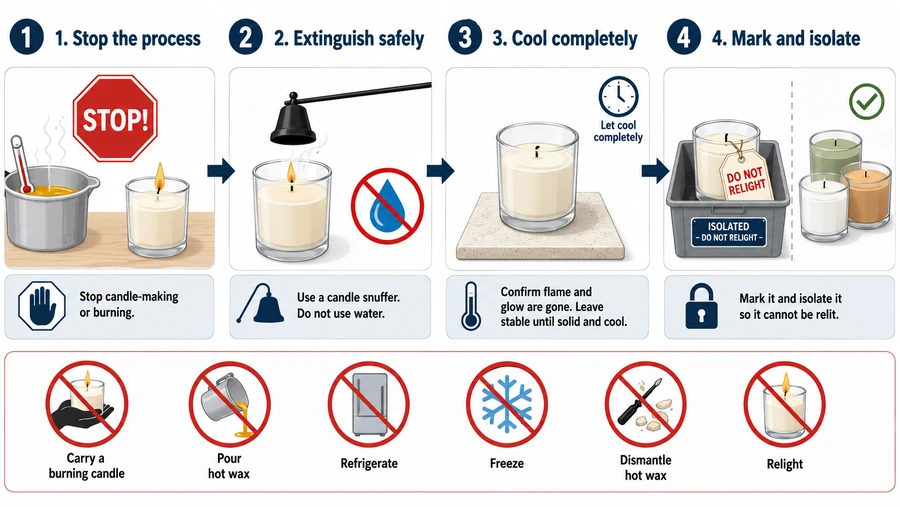
- Stop the candle-making or burning process.
Do not pour unpoured wax, continue mixing, trim or replace the wick, or perform another test burn.
- Extinguish an active flame when ordinary candle extinguishing can be performed safely.
Use an ordinary candle-extinguishing method, such as a candle snuffer. Do not use water because it can spread or splash hot wax.
- Do not carry or move a burning candle.
Keep people, pets, loose clothing, paper, curtains, and other combustible materials away from the immediate area.
- Check that the flame and wick glow have ended.
A flame that appears extinguished may leave a glowing wick or hot liquid wax. Do not touch, pour, dismantle, or cover the candle while these conditions remain.
- Allow the affected wax and container to cool naturally.
Leave the vessel stable on a heat-resistant surface. Do not use water, a refrigerator, a freezer, or rapid temperature changes to speed cooling.
- Isolate the cooled candle.
Mark it clearly or place it apart from candles intended for use. Keep it where another person cannot mistake it for a burnable candle.
- Confirm the exit condition.
Continue to disposal or component handling only when there is no flame, wick glow, liquid wax, or residual heat in the container.
Do not try
- Carrying the burning candle to a sink.
- Pouring water onto the flame or wax.
- Pouring hot wax into another container.
- Moving the candle immediately after extinguishing it.
- Relighting it to diagnose flame or scent behavior.
- Freezing or refrigerating the hot container.
- Scraping out wax while the center remains soft or warm.
If the fire spreads beyond the candle, nearby material ignites, the container breaks and creates an immediate hazard, or ordinary extinguishing does not control the situation, leave the danger area and follow applicable emergency guidance. Injury, uncontrolled fire, and property damage are not candle-troubleshooting conditions. Completion check
- The flame is out.
- The wick is no longer glowing.
- The wax is solid.
- The container is fully cool.
- The candle is separated from usable candles.
- Nobody can relight it accidentally.
The affected candle is ready for a disposition decision only after every completion condition is met.
Can You Save the Candle, or Should You Dispose of It?
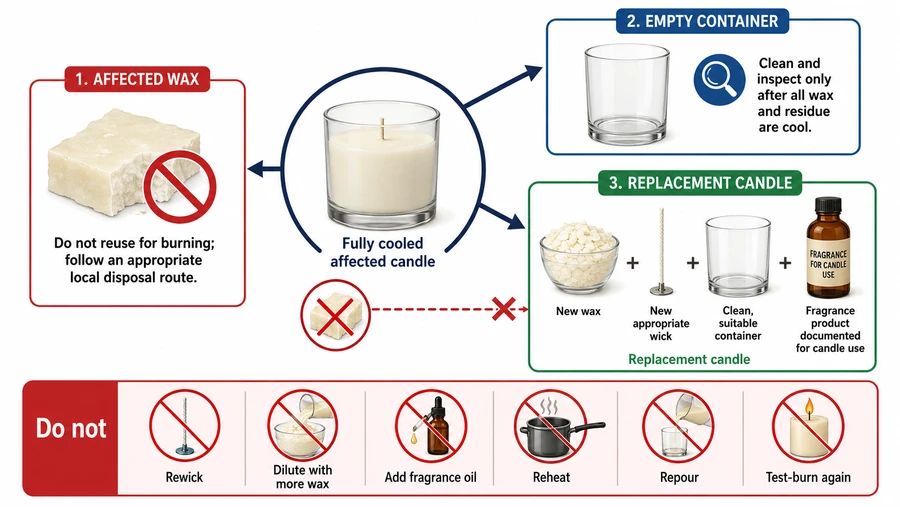
The vanilla-extract-containing wax should not be salvaged for burning, but the empty container may be a separate cleanup-and-reuse decision after the candle is fully cool.
The affected batch is the wax containing food-use vanilla extract. A replacement batch is a separate candle made with new wax, an appropriate wick, a suitable container, and fragrance documented for the intended candle application. “Saving the candle” can describe several different actions, but they do not have the same outcome:
- Saving the affected wax for burning: No.
- Reusing the original wick to correct the candle: No.
- Cleaning and assessing the empty container: A separate decision after full cooling.
- Making another vanilla-scented candle: Use a completely separate batch.
Do not try to salvage the affected wax by
- Rewicking it.
- Adding more wax to dilute the vanilla extract.
- Adding fragrance oil to cover or correct the mistake.
- Reheating and repouring the same mixture for burning.
- Moving it into another candle container.
- Performing another test burn.
These changes do not turn the affected batch into wax documented as suitable for candle combustion.
| Object or component | Allowed next action | Prohibited assumption | Required prerequisite |
|---|---|---|---|
| Affected wax | Keep it out of future candle-burning use and prepare it for an appropriate local disposal route. | More wax, another wick, or another fragrance can correct it. | The wax and vessel are fully cool. |
| Wick and wick tab | Remove or discard them only as part of the cooled candle’s handling process. | The wick can be reused to salvage the affected wax. | No flame, glow, liquid wax, or residual heat remains. |
| Separated vanilla residue | Contain it with the affected material. | Separated residue means the remaining wax is safe to burn. | The residue and wax are cool and stable. |
| Candle container | Clean and inspect it separately when suitable for reuse. | A reusable container makes the original candle reusable. | The container and its contents are fully cool. |
| Work-surface residue | Let it cool or solidify before controlled removal. | Hot water can safely wash the wax into a drain. | The residue is no longer hot or spreading. |
| Separate replacement batch | Begin with new materials and verified candle-use documentation. | Adding a documented fragrance to the affected wax creates a replacement batch. | The original batch has been retired from combustion use. |
A container that feels cool on the outside may still hold warm or partly liquid wax. Do not begin component separation until the entire candle has reached room temperature and the wax is solid. Minimum disposal and cleanup route
- Cool: Confirm that the candle, wax, wick, and container are fully extinguished and cool.
- Contain: Keep the cooled wax and removable residue in an appropriate temporary or disposable container.
- Route: Follow applicable local household-waste requirements and handle container cleaning or recycling as a separate task.
Do not pour melted wax into a sink, toilet, floor drain, or outdoor drain. Do not wash wax residue into plumbing with hot water. Local disposal and recycling rules vary, so one municipality’s instructions should not be treated as a universal rule. Replacement-batch prevention check A replacement candle is a completely new batch, not the original vanilla-extract-containing wax with another ingredient added to it. For this task, candle-safe means the exact fragrance product is documented by its supplier for the intended candle application and is used according to that documentation. It does not mean universally risk-free, suitable at any amount, or interchangeable with food flavorings. Before making the replacement candle:
- Confirm that the exact fragrance product is intended for candle use.
- Review the supplier’s current application and safety information.
- Check that the guidance applies to the selected candle type and wax.
- Follow the stated usage limits and wax requirements.
- Do not use the product when its intended application is unclear.
- Start with new wax, an appropriate wick, and a clean, suitable container.
- Keep the affected vanilla-extract-containing wax out of the replacement batch.
A vanilla scent name alone does not prove candle suitability. Vanilla extract, baking flavoring, diffuser oil, cosmetic fragrance, and a fragrance documented for candle use are not interchangeable categories. “I already used vanilla extract once—what exactly should I buy so I do not repeat the mistake?” Choose an exact fragrance product from a candle-supply source and verify that its supplier documentation supports the intended candle application. Do not choose a product only because its label or scent name includes “vanilla.”