
Unscented candles burn cleanly when wax, wick, container, additives, rest time, and burn testing work together without fragrance assumptions.
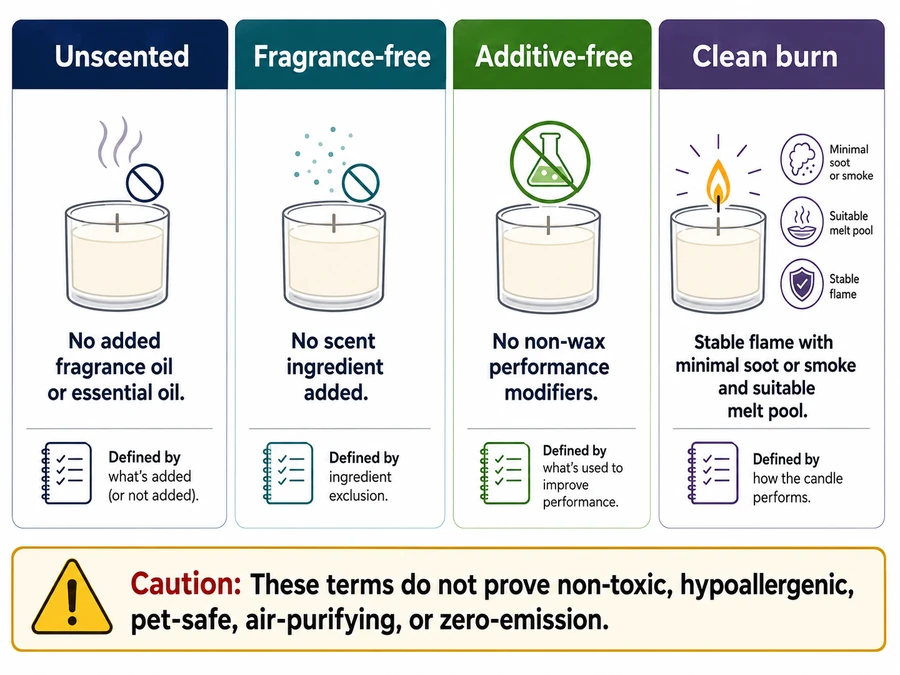
An unscented candle is a candle made without added fragrance oil or essential oil. Fragrance-free means no scent ingredient is added. Additive-free means no extra hardener, modifier, dye, or performance helper is added.
Clean burn means a stable flame, minimal soot or smoke, a melt pool that fits the wax and container, and no obvious instability from additives or wick choice. It does not mean non-toxic, zero-emission, hypoallergenic, air-purifying, pet-safe, certified organic, or medically safer for every room.
This guide shows how to make an unscented candle, keep the formula testable, decide whether additives belong in the recipe, and burn test the candle before calling it clean-burning.
Define What “Unscented” and “Clean Burn” Mean Before You Start
An unscented candle is made without added fragrance, while clean burn describes observed burn behavior during testing.
Unscented does not automatically mean additive-free, non-toxic, zero-emission, or safer for every person, pet, or room. In candle making, keep these terms separate before choosing wax, wick, container, or additives.
| Term | What it means here | What it does not prove |
|---|---|---|
| Unscented | No added fragrance oil or essential oil | No additives, no emissions, or medical safety |
| Fragrance-free | No scent ingredient added to the formula | No natural wax odor or zero odor |
| Additive-free | No non-wax performance modifiers added | Automatic clean burn |
| Clean burn | Stable flame, minimal soot or smoke, suitable melt pool, and no obvious wick or additive instability | Non-toxic, hypoallergenic, air-purifying, or pet-safe |
A clean-looking candle is not the same as a clean-burning candle. A smooth top, centered wick, and plain formula can still hide an oversized wick, a poor wax-container match, or an additive that changes flame behavior.
Use “clean burn” as a test result, not a marketing promise. The candle should show a steady flame, limited visible soot, controlled melt pool growth, and no severe smoking, mushrooming, tunneling, or overheating during a burn test.
This article omits fragrance oil on purpose. It does not cover fragrance load, scent throw, essential oils, or fragrance cure timing.
Additives need the same boundary. A candle can be unscented and still include wax hardeners, stearic acid, dyes, or other modifiers, but this article does not cover full additive taxonomy, dosage charts, or supplier-specific additive ranges.
Start with the wording first, then choose materials that can prove the claim through testing.
Choose a Wax That Can Burn Cleanly Without Fragrance
The best wax for an unscented candle fits the container, wick test plan, and desired structure; wax alone does not guarantee clean burn.
For unscented candles, wax selection is less about hiding scent issues and more about building a stable wax-wick-container system. A wax can be a good starting point and still fail if the wick is too large, the jar is too narrow, or an additive changes the melt pool.
| Wax choice | Good fit for unscented candles when… | Watch for during testing |
|---|---|---|
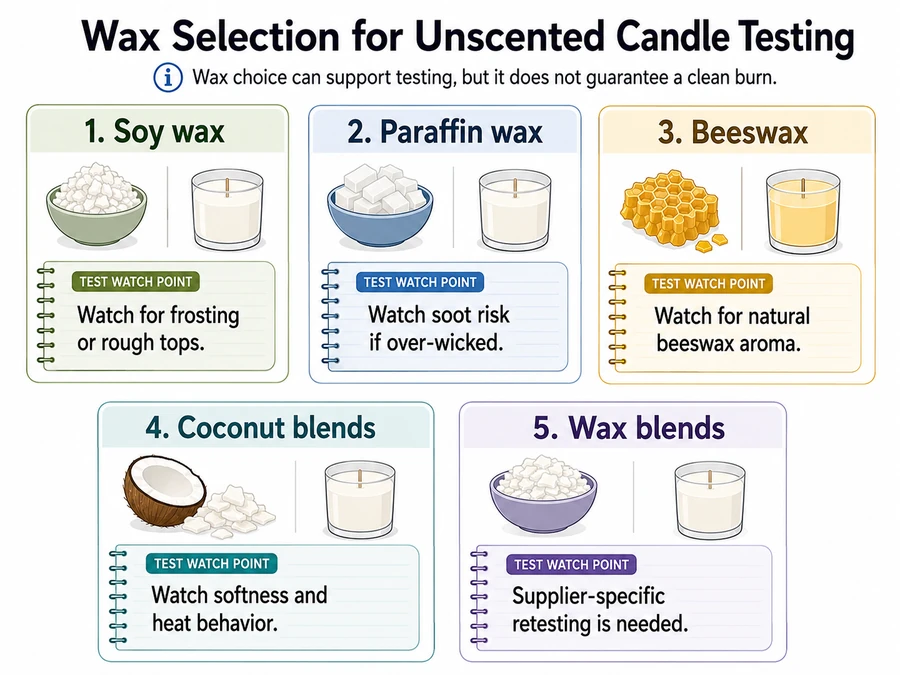
| Soy wax | You want a soft container candle with a mild natural wax profile | Frosting, rough tops, tunneling, or wick mismatch |
| Paraffin wax | You want strong structure, easy handling, or predictable burn behavior | Soot risk if over-wicked or poorly trimmed |
| Beeswax | You want a naturally firm wax with its own subtle honey-like aroma | It may not feel truly neutral to users expecting no odor |
| Coconut blends | You want a smooth container candle with a softer burn profile | Softness, heat behavior, and wick sizing |
| Wax blends | You want balanced structure, adhesion, and burn behavior | Supplier-specific handling and retesting needs |
No wax should be called the cleanest wax without a burn test. The candle making variable that matters most is the system: wax type, container diameter, wick series, wick size, additive choice, rest time, and test conditions.
Choose a wax by asking three practical questions. Does the wax suit the candle format you are making? Does the supplier give wick and handling guidance? Can you test nearby wick sizes without changing several variables at once?
Avoid bringing fragrance-load logic into this section. Unscented candles do not need scent throw tuning, fragrance binders, or essential-oil decisions.
Wax-specific pour temperatures, cure times, and defect patterns are outside this section. Here, the wax decision only needs to support a low-soot, stable, fragrance-free candle that can be tested clearly.
Once the wax is chosen, the wick becomes the next control point because the same wax can burn cleanly or poorly depending on wick size and container diameter.
Choose the Right Wick for the Wax and Container
The right wick for an unscented candle is chosen by wax type, container diameter, and burn-test results.
There is no universal wick for all unscented candles. A wick that works in one wax or jar can soot, tunnel, mushroom, or overheat when the container diameter or wax blend changes.
Use this decision path before testing:
| Decision point | What to do | What it prevents |
|---|---|---|
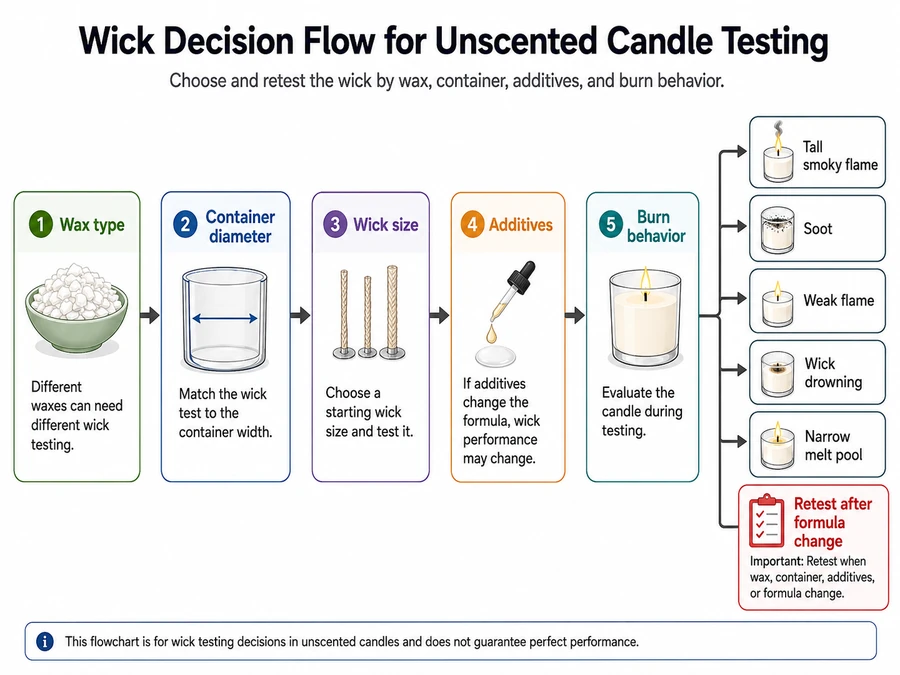
| Wax type | Start with a wick family recommended for that wax | Poor fuel draw or weak flame |
| Container diameter | Choose a test size for the actual jar width | Tunneling or overheating |
| Wick size | Test nearby sizes, not one guess | Over-wicking or under-wicking |
| Additives | Retest if the formula changes | False clean-burn results |
| Burn behavior | Judge flame, soot, melt pool, and heat | Calling an untested candle clean-burning |
A wick family is a line of wicks made with a similar braid, treatment, or burn behavior. The family sets the starting direction, but the wick size still needs testing inside the chosen wax and container.
The goal is not the biggest melt pool as fast as possible. The goal is a stable flame, controlled melt pool, minimal soot or smoke, and heat behavior that fits the candle format.
If the flame is tall, flickering, smoky, or leaving soot, the wick may be too large, poorly matched, or affected by additives. If the flame is weak, drowns, or leaves a narrow melt pool, the wick may be too small for the wax and container.
Supplier wick guidance can give a starting range, but it cannot replace burn testing. Use the starting range to choose a candle wick by wax and container, then record flame height, soot, melt pool, and heat in a burn test.
Keep jar heat testing separate from basic wick choice. This section explains wick logic without covering deeper container qualification or safety protocol.
Retest the Wick After Any Additive Change
After any additive change, the previous wick result is no longer guaranteed.
An additive can change wax hardness, melt behavior, opacity, or fuel flow. That means the candle may need a different wick even when the container and wax base stay the same.
| Additive change | Likely wick effect | Retest action |
|---|---|---|
| Hardener added | Flame may weaken or tunnel | Test the same wick and one size up |
| Stearic acid added | Melt pool may change | Compare flame, soot, and edge melt |
| Beeswax added | Wax may burn firmer or slower | Retest nearby wick sizes |
| Dye added | Wick may clog or mushroom | Check soot and flame stability |
| Any modifier removed | Fuel flow may increase | Watch for taller flame or heat |
Additive-wick dependency means a formula change can change how fuel reaches the flame. A candle that burned cleanly before the additive may smoke, tunnel, or overheat after the formula changes.
Do additives affect wick size? Yes, when the additive changes melt behavior or fuel flow.
Why did the candle smoke after adding stearic acid? The added material may have changed the wax-wick balance, so the previous wick size may no longer match the formula.
Retest with one additive change at a time. Keep the same container, same wax base, same pour process, and same test notes. Then compare flame height, soot, melt pool, mushrooming, and container heat.
This section explains why the wick must be retested. It does not cover additive percentages or supplier-specific ranges.
Decide Whether Additives Are Unnecessary, Optional, or Counterproductive
Most unscented candles should start without additives, then use additives only when a specific structure, handling, or burn issue justifies retesting.
Additives are conditional in candle making. They are not required just because the candle is unscented, and they should not be used to avoid proper wick testing.
Use this table before adding anything to the wax:
| Additive decision | Use when… | Avoid when… |
|---|---|---|
| No additive | The wax, wick, and container can pass burn testing without help | You are adding extras “just in case” |
| Optional additive | You need a named change, such as hardness, opacity, surface behavior, or burn adjustment | You have not tested the plain formula yet |
| Counterproductive additive | The additive creates soot, tunneling, wick instability, or harder testing | It masks the real wick or container problem |
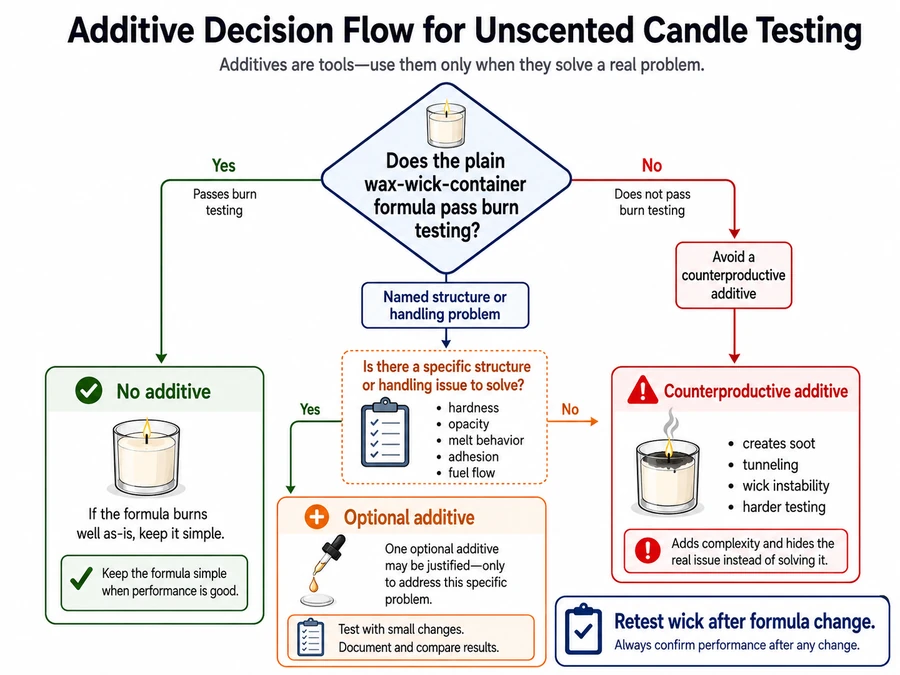
An additive is a non-fragrance material added to change wax behavior. In unscented candles, additives may change hardness, opacity, melt behavior, adhesion, or fuel flow.
Additive-free does not mean clean-burning by default. A plain wax candle can still smoke if the wick is too large, tunnel if the wick is too small, or overheat if the jar and flame are poorly matched.
Additive-assisted does not mean better by default either. A hardener, stearic acid, beeswax addition, dye, or specialty modifier can change fuel flow and make the previous wick result unreliable.
Start with the simplest test formula first. Then change one variable at a time: wax, wick, container, or additive. If the candle improves, the change has a clear test signal; if it worsens, you know which variable caused the problem.
This section only decides whether an additive belongs in the unscented candle test formula. It does not cover dosage, supplier ranges, or additive chemistry.
Keep Additives Below the Point Where They Create New Burn Problems
Optional additives should solve a named candle-making problem, not create a new burn problem.
In unscented candles, the cleaner formula is usually the one that passes burn testing with fewer variables. Use an additive only when the plain candle shows a structure, handling, or repeatability problem that the additive can fix without soot, smoke, tunneling, overheating, or wick instability.
Do unscented candles need additives? Usually no. Start without them, test the wax-wick-container system, and add one modifier only when the test points to a specific problem.
Dose charts, supplier ranges, and additive-specific chemistry are outside this section. This section only decides whether the additive belongs in the unscented candle test formula.
Avoid Treating an Additive-Free Candle as Automatically Clean-Burning
An additive-free candle still needs burn testing before it can be called clean-burning.
Use this claim check before describing the candle:
| Claim | Safe meaning | Required proof |
|---|---|---|
| Unscented | No added fragrance oil or essential oil | Formula review |
| Additive-free | No added wax modifiers, dyes, or performance helpers | Formula review |
| Clean-burning | Stable flame, minimal soot or smoke, controlled melt pool, no severe wick instability | Burn test |
| Non-toxic | Medical or emissions implication | Do not claim from this article |
Why can an additive-free candle fail? The wick, container diameter, rest time, draft exposure, trimming, or variable changes can still break the burn test. The better wording is simple: “This is an unscented, additive-free test candle,” not “this is clean-burning,” until the burn test supports the claim.
This keeps the section inside candle-making scope and avoids medical, pet-safety, emissions, or legal claims.
Build a Simple Unscented Candle Formula
A simple unscented candle formula is a starting test model, not a clean-burn guarantee.
Start with wax, container, wick, and no fragrance oil. Additives should enter the formula only when they solve a named problem and the candle will be retested.
| Formula model | What it includes | Best use | What must be tested |
|---|---|---|---|
| Baseline unscented | Wax + wick + container | First clean-burn test | Flame, soot, melt pool, heat |
| Additive-free | Wax + wick + container, no modifiers | Testing whether the wax can work alone | Tunneling, smoke, wick stability |
| Additive-assisted | Wax + wick + container + one modifier | Fixing a named structure or burn issue | New wick behavior after the change |
| Comparison batch | Same setup with one variable changed | Finding the cause of failure | Side-by-side burn notes |
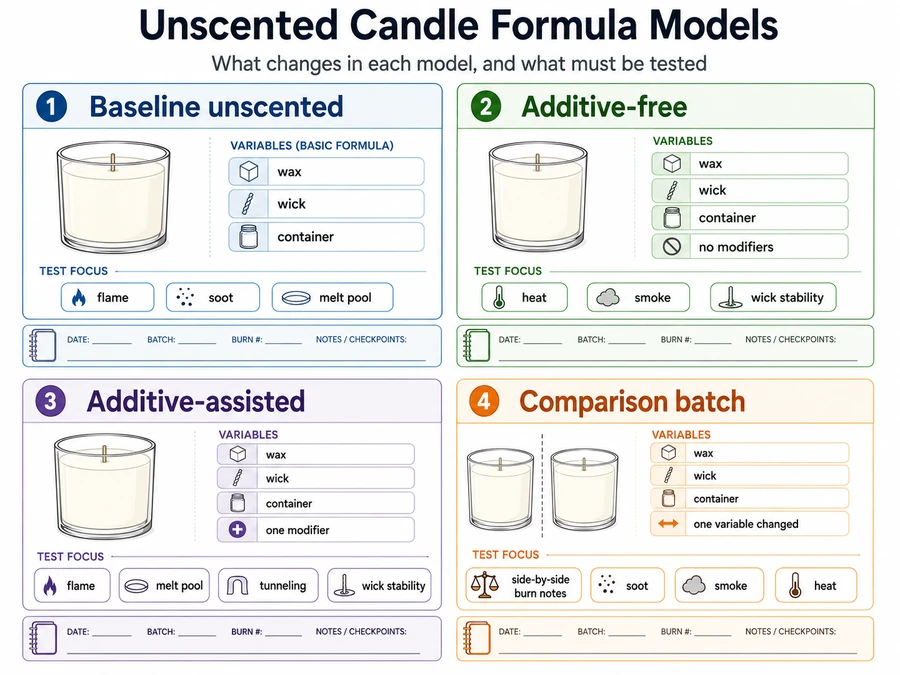
Keep the formula minimal at the start. A plain unscented candle gives a clearer test signal because fragrance oil, dye, and multiple additives are not competing with the wax and wick result.
A practical first batch can be written as: selected wax, chosen container, one centered wick, no fragrance oil, no dye, and no additive unless there is a specific reason. The next test should change only one variable.
If the candle tunnels, smokes, overheats, or forms heavy wick mushrooming, do not rewrite the whole recipe at once. Change the most likely cause first, then burn test again.
Formula models help organize candle making, but the final proof still comes from burn testing. A clean formula on paper can fail if the wick, container, rest time, or additive behavior is wrong.
Gather Only the Supplies That Support an Unscented Clean-Burn Test
Use supplies that help you make, measure, pour, rest, and burn test the unscented candle; leave fragrance tools out of this workflow.
The supply list should support the clean-burn test, not turn the article into a broad shopping guide. Required items are the materials and tools needed to control wax, wick, container, temperature, and test notes.
| Supply type | Include | Exclude from this unscented workflow |
|---|---|---|
| Wax | The selected container wax or wax blend | Wax taxonomy beyond the chosen test |
| Wick | Wick series and nearby test sizes | One-size-fits-all wick claims |
| Container | The actual jar or vessel used for testing | Advanced jar qualification systems |
| Measuring tools | Scale, thermometer, test notes | Guessing by volume or appearance |
| Pour tools | Heat-safe melting and pouring tools | Decorative finishing tools |
| Additives | Only a justified optional modifier | Fragrance oil, essential oil, scent binders |
| Testing tools | Wick trimmer, burn log, suitable test area | Full compliance-grade lab setup |
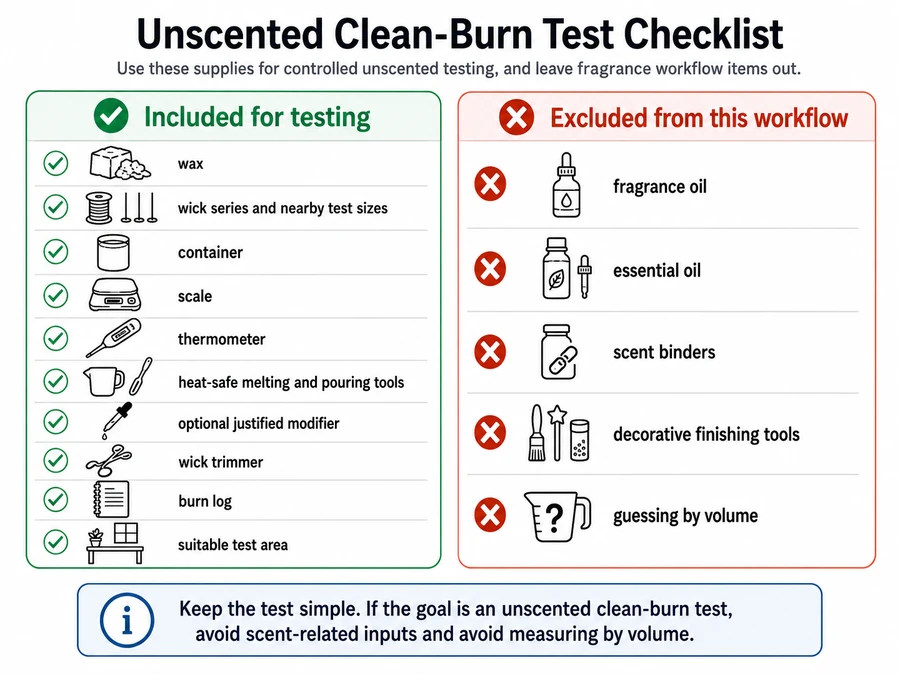
A test supply is useful when it reduces guessing. A scale helps repeat the formula, a thermometer helps control the pour, and a burn log helps connect soot, smoke, tunneling, or heat behavior to the variable you changed.
Optional supplies should stay below the definition and boundary work. A hardener, stearic acid, dye, or specialty modifier belongs in the formula only after the plain candle gives you a reason to test it.
Do not add affiliate-style supply recommendations before the article has separated unscented, additive-free, and clean-burning claims. Buying tools should support the test plan, not replace the test plan.
For this article, choose only the supplies that help prove the unscented candle burns cleanly.
Make the Candle Step by Step
Make an unscented candle by preparing the container, melting wax, adding only justified optional additives, pouring, resting, trimming, and burn testing.
Leave out fragrance oil and essential oil entirely. This process is for a fragrance-free candle, so the clean-burn result comes from wax, wick, container, additive choice, rest time, and testing.
| Step | What to do | Clean-burn reason |
|---|---|---|
| 1 | Choose the wax, container, and starter wick | Sets the wax-wick-container system |
| 2 | Clean and prepare the container | Reduces debris and setup errors |
| 3 | Center and secure the wick | Prevents uneven melt and side heating |
| 4 | Melt the wax under supplier guidance | Avoids overheating or poor handling |
| 5 | Add only a justified optional additive | Keeps the formula testable |
| 6 | Pour consistently | Gives a clearer test signal |
| 7 | Let the candle set and rest | Stabilizes the wax-wick system |
| 8 | Trim the wick and burn test | Proves or rejects the clean-burn claim |
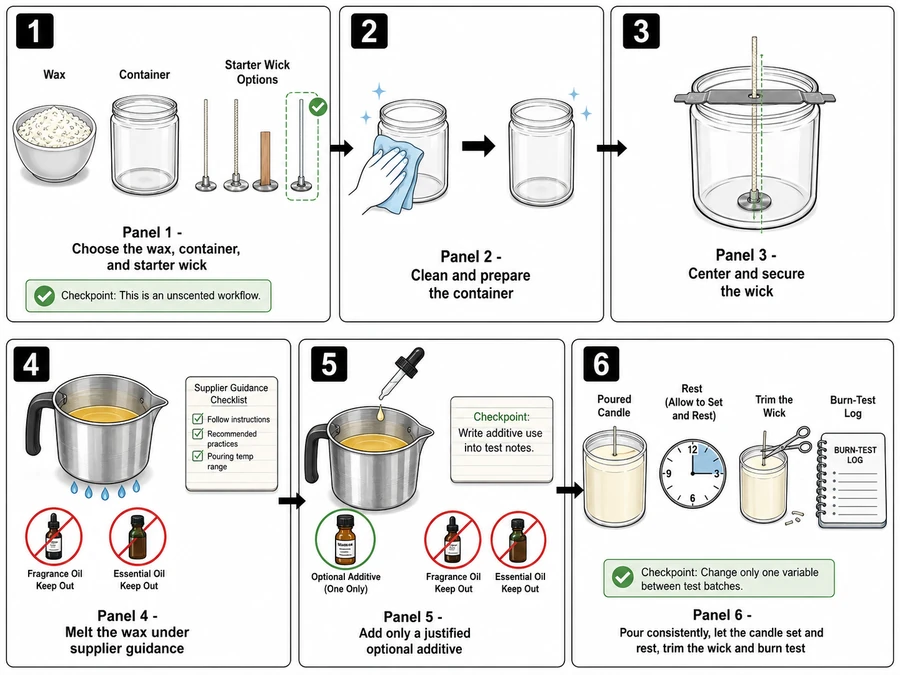
A simple unscented candle process should not borrow fragrance steps from a scented candle recipe. Do not add fragrance load, scent binders, essential oils, or scent-throw adjustments.
If you use an additive, write it into the test notes before pouring. The candle is no longer the same formula, so the wick result must be checked again.
Change only one variable between test batches. If the candle smokes after you changed wax, wick, and additive together, you will not know which change caused the failure.
This workflow makes the candle; the later burn-test step decides whether the candle actually burns cleanly.
Pour and Cool the Candle Without Confusing Appearance with Clean Burn
Pour temperature can improve structure and test consistency, but a smooth candle top does not prove a clean burn.
A clean-looking candle may still smoke, tunnel, overheat, or use the wrong wick. Pour and cooling control help create a stable candle structure, which makes the later burn-test signal easier to trust.
| Pour-control check | What to do | What it helps separate |
|---|---|---|
| Supplier range | Follow the wax maker’s handling guidance | Wax behavior from guesswork |
| Thermometer | Measure instead of estimating | Process control from chance |
| Overheating | Avoid heating beyond handling need | Wax stress from wick failure |
| Pour consistency | Use the same method across tests | Batch variation from formula change |
| Cooling area | Keep candles away from drafts | Cooling defects from burn defects |
| Inspection | Note sinkholes, cracks, frosting, or rough tops | Appearance issues from clean-burn proof |
Does pour temperature matter for unscented candles? Yes, because pour control can affect contraction, adhesion, sinkholes, cracking, frosting, and repeatable testing.
Why did the candle get sinkholes? Wax contraction, cooling speed, container temperature, or pour conditions may have left a void or depression as the candle set.
Does a smooth top mean the candle burns cleanly? No. Smooth tops show appearance control, not flame stability, soot behavior, melt-pool control, or wick suitability.
Wax-specific pour temperatures and deep surface-defect diagnosis are outside this section. Use this section to control the pour; use the burn-test section to decide whether the candle actually burns cleanly.
Let the Candle Rest Before the First Burn Test
For unscented candles, cure or rest time is about structural stabilization before testing, not fragrance throw.
No fragrance does not mean no rest time. The wax-wick-container system still needs to settle before the first burn result is treated as reliable.
| Timing check | What to do | Why it matters |
|---|---|---|
| Full set | Wait until the candle is fully firm | Prevents judging a partly settled candle |
| Supplier guidance | Follow the wax maker’s rest guidance | Keeps the test tied to the wax system |
| Test notes | Record the rest period before lighting | Makes batches easier to compare |
| Early test | Treat it as early feedback only | Prevents false final conclusions |
| Final test | Judge after a consistent rest period | Gives a cleaner burn-test signal |
Do unscented candles need to cure? Yes, but here “cure” means rest time for wax structure and test consistency, not scent development.
How long should you wait before the first burn test? Wait long enough for the candle to fully set and follow the wax supplier’s guidance rather than using a fragrance-cure rule.
Is cure time only for scented candles? No. Scented candles often use cure language for fragrance throw, but unscented candles still need rest time before judging wick and wax behavior.
This page treats rest time as a testing-control step. It does not cover wax-specific cure timing or fragrance-cure questions.
Test the Candle Before Calling It Clean-Burning
A candle burns cleanly when burn testing shows a stable flame, minimal soot or smoke, controlled melt pool, acceptable heat behavior, and no severe wick failure.
Clean-burning is a validation claim, not a recipe claim. The formula must prove itself during use because wax choice, wick size, container diameter, additives, rest time, and trimming all affect the result.
| Test signal | What you want to see | What it may mean if it fails |
|---|---|---|
| Flame | Steady flame without severe flicker | Draft, wick mismatch, or formula issue |
| Soot or smoke | Minimal visible soot or smoke | Over-wicking, long wick, additive issue, or draft |
| Melt pool | Controlled melt pool for the container | Wick too small, wick too large, or wax mismatch |
| Wick top | Limited mushrooming | Excess fuel draw or wick-formula mismatch |
| Container heat | Heat behavior stays within the candle’s intended use pattern | Jar, wick, or flame may need retesting |
| Repeat burns | Similar behavior across burns | One early pass was not enough proof |
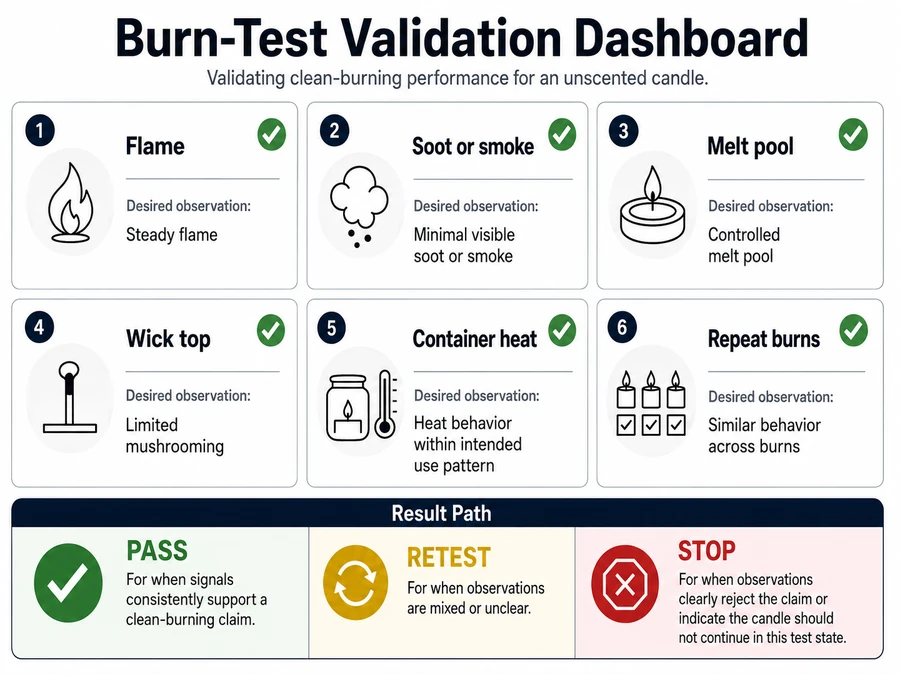
Burn testing means observing the candle during controlled trial burns before making a performance claim. For this page, the goal is not a full compliance protocol; the goal is to avoid calling an untested unscented candle clean-burning.
How do you know if an unscented candle burns cleanly? Look for repeated stable flame behavior, little visible soot or smoke, a melt pool that fits the container, and no severe wick failure after rest and trimming.
Do not use a smooth top, “natural wax,” no fragrance, or no additives as proof. Those details describe the formula or appearance; they do not prove the candle’s burn behavior.
If the test fails, change one variable before testing again. Start with wick trim and draft exposure, then review wick size, container diameter, additive changes, rest time, and wax match.
Use the burn-test result as pass, retest, or stop: pass when behavior repeats, retest when one variable changes, and stop when severe smoke or overheating appears.
Trim and Maintain the Wick During Testing and Use
Wick trimming can preserve clean-burn behavior, but it does not replace proper wick sizing or burn testing.
Treat wick care as a maintenance control after the candle formula has been built and tested. If the candle smokes because the wick was left too long, trimming may fix the next burn; if the candle keeps smoking after trimming, the formula or wick size needs retesting.
| What you see | Maintenance may be enough when… | Retest the formula when… |
|---|---|---|
| Tall flame | The wick was too long before lighting | The flame stays tall after trimming |
| Light soot | Soot appears after repeated untrimmed burns | Heavy soot returns quickly |
| Mushrooming | The wick top improves after trimming | Mushrooming returns early in each burn |
| Uneven melt | The flame stabilizes after proper care | Tunneling continues across tests |
| Hot container | Heat drops after flame control | Overheating continues after trimming |
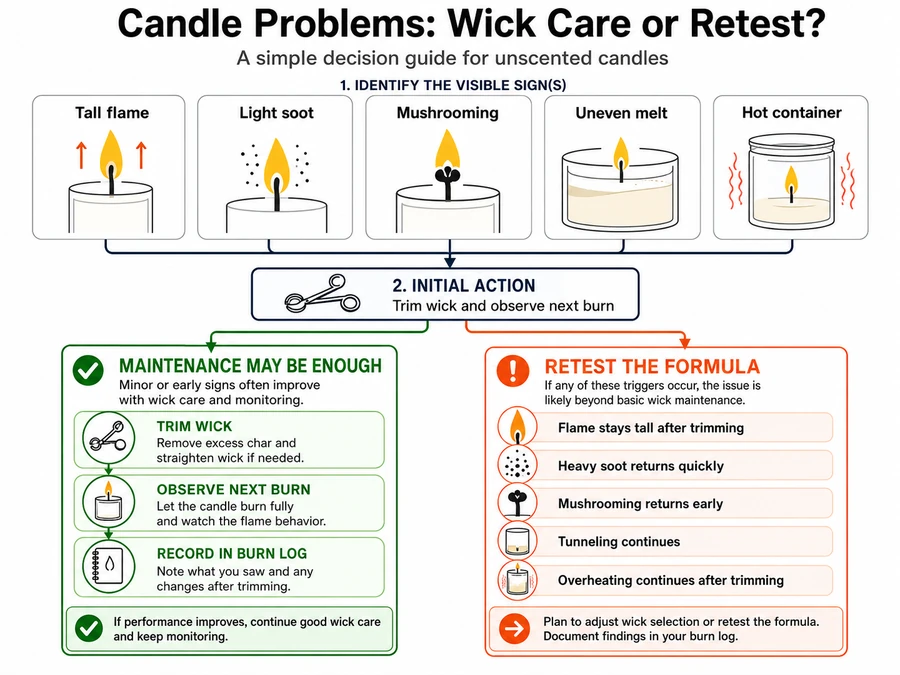
Wick maintenance means trimming and checking the wick so the tested candle keeps burning as designed. It helps control flame height, reduce excess fuel draw, limit mushrooming, and make repeat burns easier to compare.
Does trimming the wick reduce soot? Yes, when excess wick length is the cause. It will not fix an oversized wick, an unstable additive change, or a wax-container mismatch.
How short should the wick be before testing? Use the wick or candle-care guidance tied to the wick supplier or candle format, then record the trim state before each burn so the test is repeatable.
When is soot a maintenance problem instead of a formula problem? It is more likely a maintenance issue when the candle passed earlier tests and the flame improves after trimming. It is more likely a formula issue when soot, smoke, overheating, tunneling, or heavy mushrooming persists after care.
If trimming fixes the flame, keep the care step; if soot, smoke, or overheating persists, return to wick selection and burn testing.
Fix Soot, Smoke, Tunneling, or Overheating One Variable at a Time
An unscented candle may smoke, soot, tunnel, or overheat because of wick size, trim, draft, additives, container fit, or wax mismatch.
Start with the easiest reversible causes before changing the recipe. Check wick trim and draft first; if the problem continues, change one formula variable and run another burn test.
| Problem | Likely cause | First correction | Retest rule |
|---|---|---|---|
| Soot on jar or smoke | Wick too large, wick too long, draft, or additive change | Trim wick and remove draft first | If soot continues, test a smaller wick |
| Tall flame | Oversized wick or excess fuel draw | Trim and observe flame behavior | Retest wick size if flame stays tall |
| Tunneling | Wick too small, wax too firm, or short first burn | Compare nearby wick sizes | Change wick before adding new additives |
| Wick drowning | Wick too small or melt pool too deep | Review wick size and wax match | Test one wick change at a time |
| Heavy mushrooming | Excess fuel draw or wick-formula mismatch | Trim before lighting | Retest if mushrooming returns quickly |
| Container overheating | Wick too large, jar mismatch, or heat concentration | Stop the test and review wick/container pairing | Do not solve heat with additives alone |
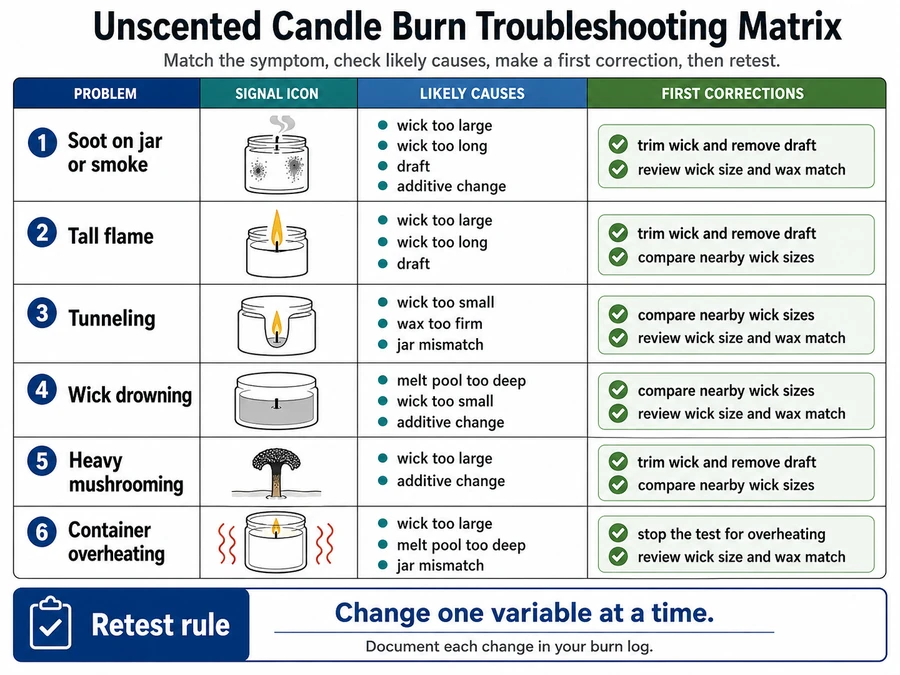
A one-variable test changes only one item between batches: wick size, wax, additive, container, rest time, or test condition. This keeps the cause visible instead of turning troubleshooting into guesswork.
What should you change first if a candle soots? Check wick trim and draft first because they are care and environment variables. If soot continues, review wick size, additive changes, container diameter, and previous burn-test notes before changing anything else.
If tunneling appears, do not assume the wax needs additives. A wick that is too small, a container that is too wide, or a short test burn can create a narrow melt pool without proving the wax formula is wrong.
If overheating appears, treat it as a failed test signal, not a cosmetic problem. Review the wick and container pairing before trying to correct the candle with hardeners, dyes, or other modifiers.
Common Mistakes That Cause Dirty Burn or Bad Test Results
A mistake belongs here only if it affects burn behavior, test reliability, additive decisions, or clean-burn claims.
Decorative-only problems, packaging choices, and business setup errors do not belong in this clean-burn check. The point is to find mistakes that make an unscented candle smoke, soot, tunnel, mislead the test, or hide the real formula problem.
| Mistake | Burn or test consequence | First correction |
|---|---|---|
| Treating unscented as automatically clean-burning | The candle may skip real validation | Burn test before making the claim |
| Using a universal wick size | Wick may soot, tunnel, or overheat | Choose by wax, container, and test result |
| Adding additives without a problem | Formula becomes harder to diagnose | Test the plain candle first |
| Copying a scented-candle recipe | Fragrance assumptions distort the formula | Remove fragrance steps and retest |
| Ignoring container diameter | Melt pool and heat behavior may fail | Match wick tests to the actual jar |
| Judging by a smooth top | Appearance replaces burn proof | Test flame, soot, melt pool, and heat |
| Skipping rest time | Early results may be misleading | Let the candle stabilize first |
| Changing wax, wick, and additive together | The failed variable becomes unclear | Change one variable, then retest |
What mistakes make unscented candles smoke? The most common causes are over-wicking, poor wick trimming, draft exposure, additive changes, and using a container that does not match the wick and wax.
Why did an additive-free candle fail? Additive-free only describes the formula. It can still fail if the wick is wrong, the container diameter is mismatched, the candle was tested too early, or the burn conditions changed.
What should you fix first? Fix the easiest reversible issue first, such as wick trim or draft. If the problem continues, change one formula variable and run another burn test.
This mistake list is limited to clean-burn and testing failures; decorative finish, packaging, and business mistakes are outside this article.
Know When to Keep the Formula Simple and When to Use Additives
Keep the formula simple when the plain wax, wick, and container can pass testing; use additives only when they solve a named problem.
The cleanest decision path is not “add nothing forever” or “add modifiers by default.” It is a controlled test: start simple, identify the failure, change one variable, and burn test again.
| Test result | Better decision | Why |
|---|---|---|
| Stable flame, little soot, controlled melt pool | Keep the formula simple | Extra additives add variables without a clear need |
| Tunneling with a weak flame | Review wick size before additives | The wick may be too small |
| Tall flame, soot, or smoke | Review trim, draft, and wick size first | Additives may hide the real cause |
| Poor structure but acceptable burn behavior | Consider one structure additive | The problem is handling or finish, not flame quality |
| Burn changes after an additive | Retest the wick | The formula no longer has the same fuel behavior |
An additive is useful when the problem is specific enough to test. A structure issue may justify one structure additive, but soot after over-wicking should send the test back to trim, draft, and wick size before more materials are added.
Choose the fewest formula changes that produce a repeatable stable burn. Simple is not automatically better, and additive-assisted is not automatically better; the result must stay tied to burn testing.