Glass suits display-forward candles and refill branding, while tins suit travel and low-breakage shipping.
On this page, the better choice means the better fit for display, shipping breakage risk, burn behavior, cost tradeoffs, and reuse or refill goals. It does not act as a full legal checklist, a safety-only verdict, or a complete wick-testing workflow.
Glass jars and tins are two material options for container candles that suit different product needs once wax, wick, heat, and handling are compared directly. Glass usually suits visibility, labeling, and refill positioning better, while tins usually suit portability, tighter packing, and lower breakage risk better.
Use the sections below to match material, size, and testing priorities to your product line, and start with candle containers if you want the broader material overview first.
Quick Comparison: When Glass Wins and When Tin Wins
Glass is usually the better choice for display, gifting, and refill-friendly candles, while tins are usually the better choice for travel, lower-breakage shipping, and tighter packaging costs.
| If your priority is… | Usually choose | Why |
|---|---|---|
| Luxury display or home decor | Glass | The flame is visible, labels read cleanly, and the vessel feels more premium on a shelf. |
| Travel candles or toss-in-a-bag portability | Tin | Tins are lighter, do not shatter, and usually handle bumps better in transit. |
| Lower shipping breakage risk | Tin | Tins usually need less protective packaging and have a lower crack risk during fulfillment. |
| Refill or reuse positioning | Glass | Glass often keeps its appearance longer and tends to suit refill branding better when it passes inspection. |
| Budget-sensitive lines | Tin | Tins often reduce packaging and damage costs, even when the shelf look is more practical than premium. |
| A balanced answer for most brands | Test both | The right wax, wick, diameter, and product use case still matter more than material alone. |
What Heat Resistance & Thermal Shock Mean for Glass vs Tin
Glass can crack from thermal shock when temperatures change fast, while tins usually dent or warp. Both need controlled heat and handling to stay safe.
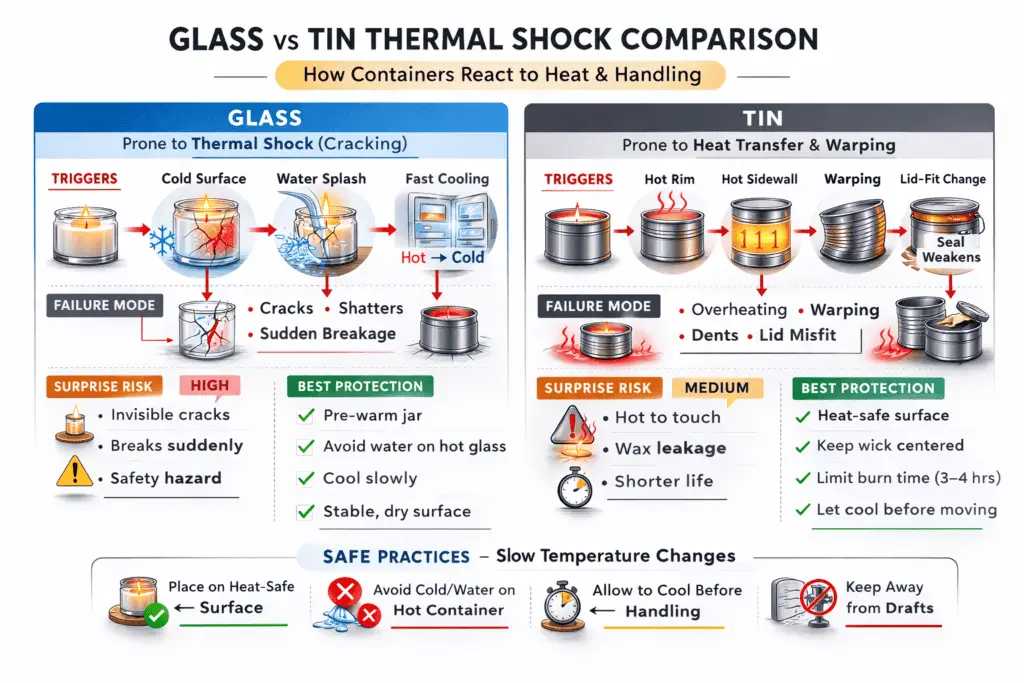
Thermal shock is cracking caused by a sudden temperature swing that creates stress across the glass wall. In candle use, the highest-risk moments are when a hot jar meets a cold surface, when cold water splashes near the base, or when a candle cools down too fast in a chilly room.
To make a clean comparison, compare glass vs tin containers using the same wax, wick, and fill level, then watch how the vessel behaves as the melt pool grows and the walls heat up. Glass is a brittle material. When the inside heats faster than the outside, the wall can develop stress that shows up as a crack line or sudden failure. Tin transfers heat quickly and can feel hotter at the rim and sidewalls, but the common failure mode is warping or a loose-fitting lid rather than shattering.
Key differences you can plan around
| What changes | Glass container | Tin container |
|---|---|---|
| Failure mode | Crack or chip under rapid temperature swings | Warp or dent, lid fit can change |
| Surprise risk | Higher if placed on cold stone, metal, or hit with water | Lower for shatter, higher for very hot-to-touch walls |
| Best protection | Stable surfaces, slow temperature changes, even burn setup | Heat-safe resting spot, avoid over-wicking, monitor wall temps |
Practical checklist to cut thermal shock risk, especially for glass
- Keep jars away from cold windowsills, unheated garages, and other fast temperature swings during pours and first burns.
- Place hot glass on a heat-safe coaster or trivet, not bare granite, tile, or metal.
- If a jar shows chips, hairline cracks, or unusual heat stress after cooling, retire it from use and review how to avoid cracked candle containers before scaling the setup.
For this page, keep safety treatment at the comparison level: glass carries more thermal-shock risk under fast temperature swings, while tins more often raise hot-wall and dent or warp concerns. For a safety-only verdict, use tin vs glass candle safety, and for a deeper thermal-shock workflow, use the dedicated crack-prevention page instead of expanding this comparison further.
Once heat behavior is stable, scent performance becomes the next variable, because the same wax and wick can smell different depending on how the container holds heat and headspace.
How Scent Throw Behaves in Glass vs Tin (Hot & Cold)
Cold throw is mostly about headspace and sealing, while hot throw comes from the wick-wax heat balance, and containers shift both.
Cold throw is the scent you notice from an unlit candle as fragrance molecules slowly move into the air. Hot throw is what you smell while the candle burns and warms the fragrance. Glass tends to present the melt pool and flame visually, but the bigger driver of throw is how warm the wax gets and how easily vapors move out of the vessel opening.
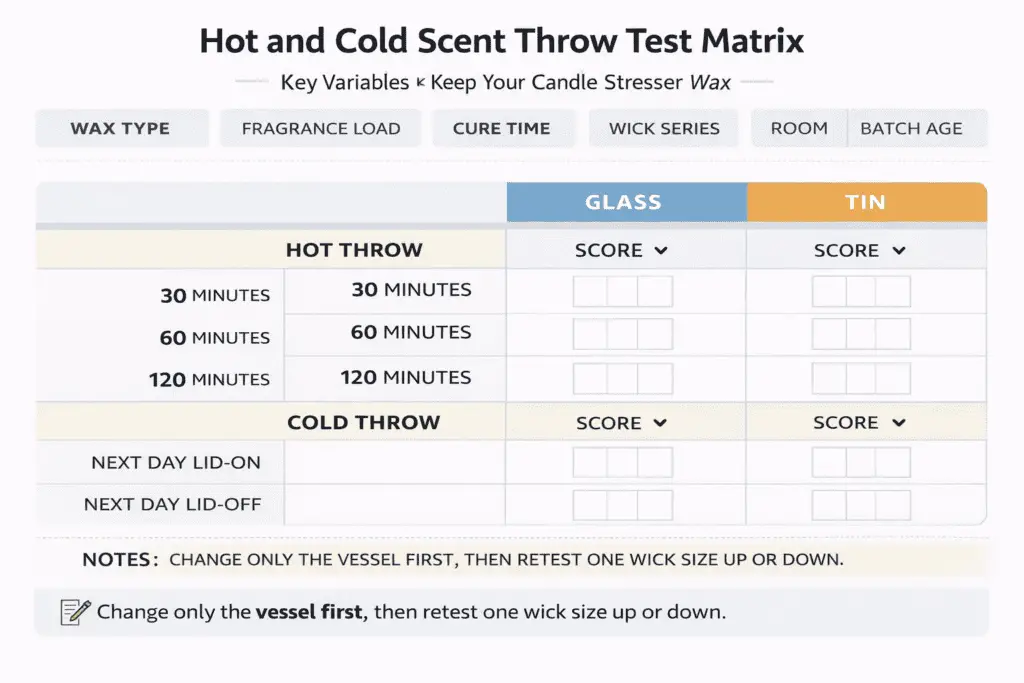
A useful way to decide is to compare container effects on throw by holding constant the wax type, fragrance load, cure time, and wick series while changing only the vessel. Tins can warm the sidewalls quickly, which may push more fragrance into the air early in the burn, but they can also run hotter at the edges if over-wicked. That raises soot risk and can make the scent feel harsh. Glass often feels more stable when the wick is right, but cold throw can drop if the lid policy traps fragrance inconsistently, for example when some candles are stored sealed and others are left open on shelves.
What usually changes the most
| Variable | Glass tends to do | Tin tends to do |
|---|---|---|
| Cold throw storage | Clear open-vs-closed difference by lid habit | Strong lid effect, liners or gaskets can hold scent longer |
| Early hot throw | Gradual build as the melt pool stabilizes | Can ramp faster near walls if the vessel runs warm |
| Best burn window | Often smoother when heat is balanced | Strong when balanced, sharp or sooty when too hot |
A simple throw test routine
- Use one room, one placement, one batch age, and the same cure time for every test.
- Burn to a stable melt pool, then score hot throw at 30, 60, and 120 minutes using the same scale.
- Score cold throw the next day with the lid on and off if a lid is part of the product, then retest one wick size up or down before blaming the vessel.
Wick choice still dominates hot throw, so choose the right wick size before changing container material or fragrance strength. To spot real differences across vessels, instead of relying on how the room smelled that day, keep a quick log to benchmark hot and cold throw by container, wick, cure time, and room size.
After throw is mapped, burn quality becomes the next checkpoint, because heat and airflow that boost scent can also raise soot, mushrooming, or tunneling.
Steps to Improve Burn Quality & Reduce Soot by Container Type
Cleaner burns come from balancing heat, airflow, and fuel so the wick stays stable, then adjusting the variables that change most between glass and tins.
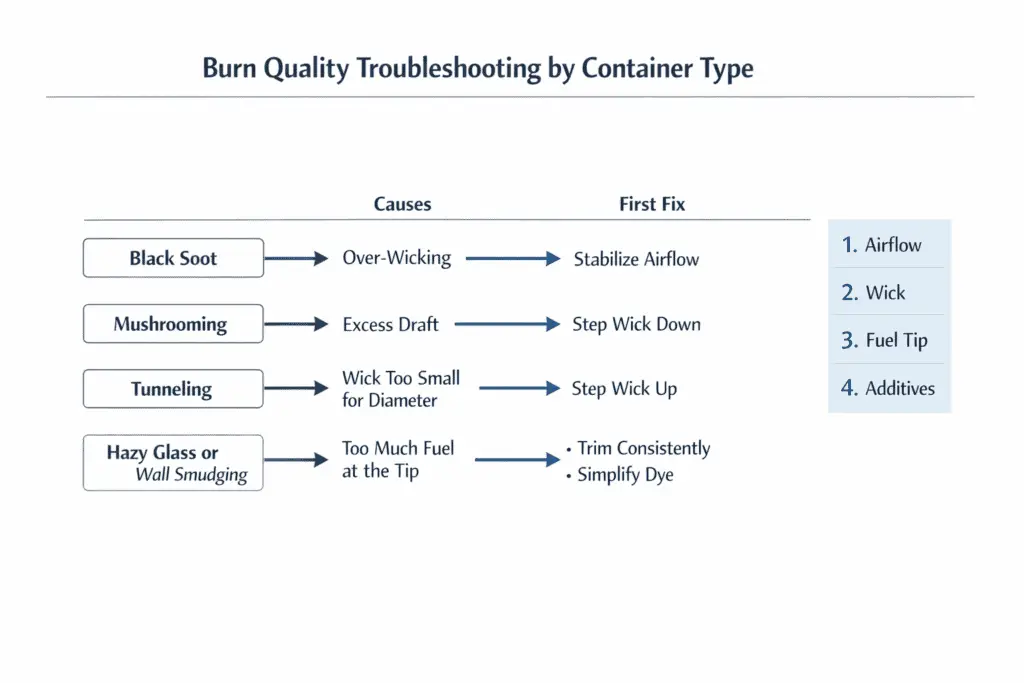
A quick way to compare burn behaviors by container is to run the same wax and fragrance in a glass jar and a tin with two nearby wick sizes, then track the first two burns for flame height, smoke, and residue.
Troubleshooting table
| Symptom you see | Most likely cause | First fix to try |
|---|---|---|
| Black soot on rim or label area | Over-wicking or drafty placement | Step down wick or move to a still-air spot |
| Mushrooming, large carbon cap | Too much fuel at the wick tip | Trim wick consistently, reduce wick size |
| Tunneling or deep center hole | Wick too small for diameter | Step up one wick size or switch series |
| Hazy glass or wall smudging | Hot soot plus fragrance or dye residue | Reduce heat, simplify dye, tighten wick choice |
Start with the highest-impact steps, in order
- Stabilize airflow first. Tins and wide jars both hate drafts, but tins often show it faster because the flame can lean, then smoke. Burn in the same spot every time, away from vents and open windows.
- Match wick to container diameter and heat behavior. If a tin is getting uncomfortably hot at the sidewall or the flame is dancing hard, it is often over-wicked even if the melt pool looks perfect. In glass, over-wicking often shows up as rim soot and rapid consumption.
- Check wick trim, fragrance, dye, and burn-time habits only after airflow and wick baseline. A short, even wick keeps fuel delivery steadier, while heavy dye, some fragrance blends, and long unattended burns can turn a borderline setup into a hot or sooty one, especially in smaller tins.
If you are stuck between two wick sizes, use a troubleshooting baseline to fix soot and tunneling without guessing. Pick the calmer flame, then correct melt-pool reach with one controlled change at a time. If the problem turns into an overheating pattern rather than a one-off test result, move the deeper workflow to prevent overheating and shattering containers instead of expanding this comparison page further.
Why Aesthetics & Branding Feel Different in Glass vs Tin
Glass signals display and ritual, while tins signal portability and practicality. The material cues shape what customers assume before they ever smell the candle.
If you compare branding cues by container, you will notice glass communicates through transparency, weight, and light play, while tins communicate through finish quality, lid fit, and graphic design.
What typically drives the premium feeling
Light and depth, glass advantage. Clear or frosted glass makes the flame visible, the wax look intentional, and the label feel like part of a home object. Even a simple white wax can read upscale when the vessel refracts warm light at night.
Tactile and sound cues, tin advantage if executed well. A tin can feel cheap when it is thin, flexy, or has a rattly lid, but it can feel high-end when the finish is matte and consistent, the lid seats cleanly, and the edges feel smooth.
Label real estate and readability. Taller glass often gives you a natural front panel for typography, while tins often need stronger hierarchy, one hero line, one scent descriptor, and clean batch details, to avoid looking crowded.
Low-cost tweaks that elevate tins
- Choose a finish that hides fingerprints under retail lighting. Matte often reads cleaner than glossy.
- Treat lid fit like a quality signal. A snug close feels intentional, a loose spin feels disposable.
- Use a simple two-zone design, bold brand and scent on top, compliance and batch info on the side.
- Add one craft cue that is repeatable, such as a consistent stamp, a minimalist top label, or a tidy warning label layout.
For both materials, photos and packaging should emphasize the vessel’s strengths, but the container still has to match the line’s actual use case. Glass usually feels more premium on display, while tins can look equally intentional when finish, lid fit, and label hierarchy are consistent.
How to Calculate Landed Cost for Glass vs Tin (COGS & Shipping)
Your real per-candle cost is materials plus packaging, labor, inbound freight, damage allowance, and outbound shipping, then divided by sellable units.
Start by building a unit cost stack you can repeat for every SKU, then adjust the two big swing factors, shipping weight and dimensions, and damage risk. To calculate landed cost per candle, treat each candle like a small supply chain project with inputs that change by container.
A practical cost stack per finished candle
- Direct materials, vessel and lid, wax, wick, fragrance, dye or additives, label, warning label, dust cover if used
- Packaging for shipping, inner wrap, insert, box, tape, void fill
- Labor, pour time plus finish time, labeling, wiping, boxing, expressed as cost per unit
- Inbound freight allocation, pallets or cartons of containers and wax distributed across units received
- Outbound shipping allocation, average cost to ship one unit or one order to your main customer region
- Damage and returns allowance, expected loss rate from cracks, dents, leaks, and arrived damaged claims
How container choice changes the math
- Glass often increases packaging and damage allowance, tins often reduce protective packaging but may require stronger branding finishes to compete on shelf.
- Dimensional weight can dominate outbound shipping, so the outside box size, not just the vessel weight, matters.
A simple 5-step method
- Pick one standard ship set per container, wrap, box, and insert, and weigh and measure it.
- Allocate inbound freight, outbound shipping, and a damage assumption in one tracker. Use your own history when possible, and review shipping breakage rate before calling glass and tin equal on cost.
- Compare the full landed cost against planned price and margin, then use the calculator or template page to model SKU changes consistently.
When you see the total, do a reality check. If the vessel choice changes landed cost more than your planned price difference, the prettier option may silently cap your margin.
What Durability & Reusability Look Like (Refilling Glass vs Tin)
Glass usually wins for long-term reuse and refills, while tins win for rugged handling and travel. Still, each has do-not-reuse failure signs.
Durability is not just about whether it will break. It is also about whether it will still feel nice after use and whether it can be cleaned without turning into a chore. If you want a refill program, the container needs to survive heat cycles, cleaning, and handling while still looking intentional on a shelf.
How they typically age
- Glass: resists dents and maintains a premium appearance, but can chip, crack, or develop stubborn soot film if overheated.
- Tin: resists drops and packs well, but can dent, scuff, warp near the rim, or develop rust spots if stored damp.
If refills matter to your brand, refill a glass candle jar only when the vessel passes a quick inspection. There should be no chips on the rim, no hairline cracks, no cloudy heat damage, and the base should sit flat. For tins, reuse tin candle containers only when the wall is not warped, the base is still flat, and the lid closes cleanly. A tin that rocks on the table or has a wavy rim will burn less predictably the next time.
How to clean candle vessels safely
- Freeze and pop: freeze the leftover wax, then gently pry out the puck and remove the wick tab.
- Low-heat melt-out: set the container in a shallow warm-water bath, pour off softened wax into a disposable cup, then wash.
- Wipe and polish for glass: use a soft cloth and mild degreaser to remove soot film without scratching.
- Tin care: dry immediately after washing, and avoid long soaks that invite rust at seams.
A simple rule keeps reuse from becoming a liability. If the container shows structural damage, chips, cracks, or warping, or holds a persistent odor you cannot remove, downgrade it to decor storage instead of a second burn. For the full cleanup workflow, see how to clean candle containers after the wax is gone.
What Environmental Impact & Recyclability Differ For Glass vs Tin
Both glass and tin are recyclable in many places, but local acceptance varies. Metal containers are often widely collected, while some curbside programs limit or pause glass, so prep and clear claims matter.
In practice, recyclable is not a universal yes-or-no label. It depends on what your local facility can sort, how strict they are about contamination, and whether labels or coatings interfere with processing. For a candle brand, the biggest difference is not the symbol on the bottom, it is whether customers can actually recycle the container where they live.
To compare recyclability trade-offs, start with local rules. Metal tins, whether aluminum or steel, are commonly accepted in curbside streams, while glass acceptance can be strong in some cities and reduced in others depending on program capacity and breakage issues.
Quick prep checklist for customers
- Let the container cool fully, then remove leftover wax.
- Pull out the wick tab and any metal sustainers.
- Wipe the inside so it is not oily or waxy.
- Follow local guidance on whether labels should stay on or be removed.
Before curbside pickup, prepare containers for recycling by focusing on contamination first. Wax residue, heavy fragrance oil film, and loose wick hardware are the most common reasons a container gets tossed during sorting. Also watch finishes. Some decorative coatings, liners, or heavy adhesives can reduce acceptance even when the base material is recyclable.
For eco messaging, avoid blanket claims like 100 percent recyclable everywhere. A better approach is to say that recyclability depends on local programs and provide the exact prep steps above, because vague just recycle it language tends to backfire when customers hit a local restriction.
If curbside rules are inconsistent, say so plainly and give customers the clean-out steps they need before reuse, return, or recycling.
Steps to Label and Heat-Test Containers (US/EU Basics)
Label with clear warnings and maker identity, then heat-test your exact container-wax-wick setup and keep records. Exact wording, symbols, and regional duties belong on the dedicated labeling workflow, so this page keeps compliance to a short comparison note.
For this comparison page, the practical point is that both materials still need labels that match real burn behavior and both still need heat testing. Use candle safety standards and the labeling workflow for the full legal and documentation process rather than expanding this page into the full checklist.
Which Is the Best Choice for Your Candle Line?
Choose glass when display, refill positioning, and a more premium shelf feel matter most; choose tins when portability, lower breakage risk, and tighter fulfillment costs matter most.
Here, the best choice means the best fit for display, shipping breakage risk, burn behavior, cost tradeoffs, and refill or reuse goals on this page, not a standalone safety or legal verdict. Test both when the formula runs hot, the fragrance reacts strongly to wick changes, or the line sits between premium display and travel use.
- Choose glass for home decor lines, giftable candles, refill concepts, and products where flame visibility is part of the experience.
- Choose tin for travel candles, event favors, beginner-friendly lines, and brands that need lighter, tougher packaging.
- Test both if your formula runs hot, your fragrance is sensitive to wick changes, or your brand sits between premium display and practical portability.
- Use a broader selection workflow when you need to compare more than material alone, such as diameter, label area, or intended use; in that case, move next to how to choose the best candle container.
Quick FAQ
Is glass or tin better for candles? Glass is usually better for display and refill-friendly positioning, while tins are usually better for travel, low-breakage shipping, and lighter packaging.
Which is safer to ship? Tins are usually safer to ship because they do not shatter, though they can still dent or warp if the setup runs too hot or the packaging is weak.
Which works best for travel candles? Tins usually make more sense for travel because they are lighter, more portable, and less fragile in bags, cars, and small gift sets.