
Candle dye is a wax-compatible colorant available in liquid, chip, flake, granule, block, and powder formats; choose the format by wax compatibility, measurement control, batch size, workflow, and cooled-color goal.
Food coloring, soap dye, mica, and other non-candle colorants are not automatic candle-dye substitutes. Here, “right” means the best fit for a defined wax, candle construction, batch scale, workflow, and cooled-color goal—not a universally superior, safest, strongest, or cheapest product. Confirm that the supplier documents candle-wax use, then compare format, compatibility, measurement demands, repeatability, storage, and the fully cooled result.
Candle-Dye Definition and Colorant Boundary
Candle dye is a colorant formulated or documented for candle-wax use; a material that changes wax color is not automatically candle dye.
“Candle-safe” here means the supplier documents candle-wax use under stated conditions. It does not guarantee compatibility with every wax or prove complete finished-candle safety.
| Decision | Evidence found | Selection outcome |
|---|---|---|
| Accept | The supplier identifies the material as candle dye and provides candle-wax use instructions. | Keep the candle dye on the selection list, then check wax compatibility and format. |
| Clarify | The listing says oil-soluble, wax-compatible, or multipurpose but does not document candle use. | Request technical instructions or supplier confirmation before testing. |
| Clarify | Candle use is stated, but concentration, measuring method, or compatible waxes are unclear. | Treat the candle dye as unverified for the planned wax and workflow. |
| Reject | The material is sold only for food, soap, cosmetics, resin, or textiles. | Do not treat it as candle dye without separate candle-wax documentation. |
| Reject | Suitability rests only on photos, reviews, color names, or broad marketing claims. | Remove it from the shortlist until technical evidence is available. |
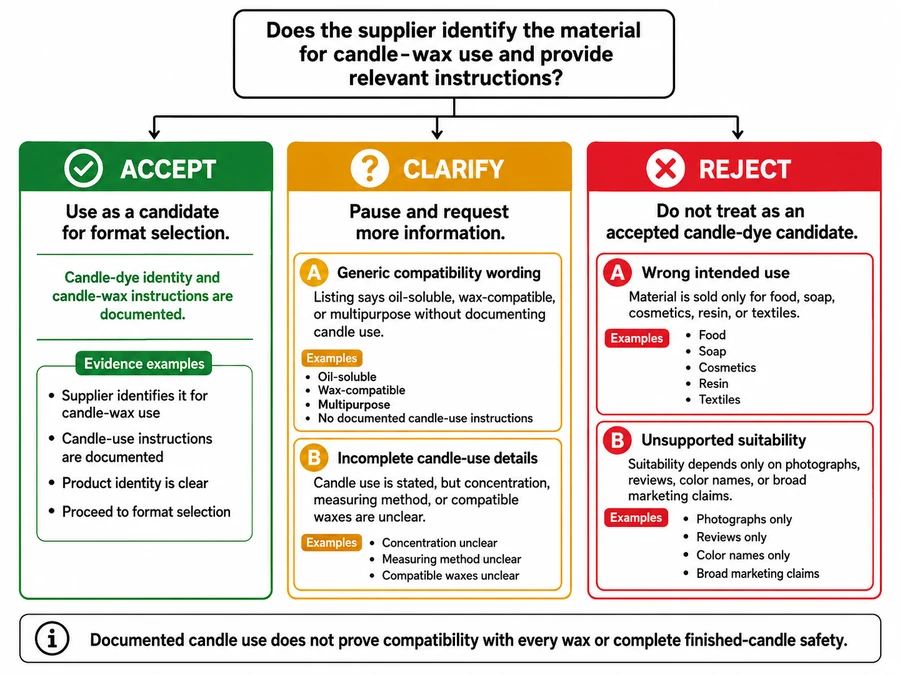
Method note: Classify a candle colorant by product identity, stated candle-wax use, technical instructions, and available safety documentation. Marketing images and visible color results cannot replace use documentation because unrelated colorants may still change the appearance of wax.
This evidence gate does not set dye amounts, interpret a full safety data sheet, test solubility in detail, or diagnose finished-candle burn problems.
Once a colorant passes this evidence gate, its physical delivery format becomes the next selection variable.
Candle-Dye Format Taxonomy
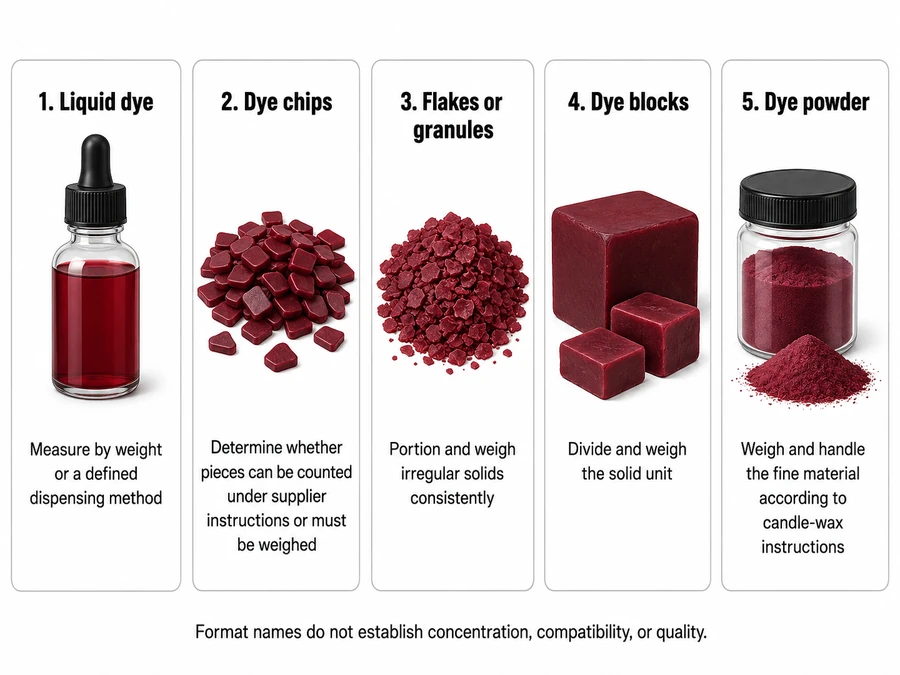
The main candle-dye formats are liquid dye, chips, flakes or granules, blocks, and powder; these names describe delivery form, not strength or quality.
“Type” in this section means physical delivery format, not brand, shade, chemical origin, concentration, compatibility, or quality.
- Liquid dye: A pourable supplier formulation measured by weight or a defined dispensing method.
- Dye chips: Small solid pieces that may be counted or weighed according to supplier instructions.
- Dye flakes: Thin, irregular solid pieces intended for portioning or weighing.
- Dye granules: Small solid particles that may overlap with supplier use of “flakes” or “chips.”
- Dye blocks: Larger solid units that are divided or weighed before use.
- Dye powder: A dry, fine format that requires documented candle-wax suitability and handling instructions.
| Candle-dye format | Physical form | Main handling question | What the label does not prove |
|---|---|---|---|
| Liquid dye | Pourable liquid | Can the maker measure repeatable small inputs with the available tools? | Standard concentration across suppliers |
| Dye chips | Small solid pieces | Are pieces uniform enough to count, or must they be weighed? | Equal mass or strength per chip |
| Flakes or granules | Small irregular solids | Can the maker portion and record the input consistently? | Interchangeability between supplier labels |
| Dye blocks | Larger solid unit | Can the maker divide and weigh the block without large input jumps? | Greater quality or stronger color |
| Dye powder | Fine dry particles | Can the maker weigh and handle the powder according to its instructions? | Greater concentration than liquid dye |
Method note: This taxonomy groups candle dyes by the physical form stated in supplier technical data and use instructions. Because “chip,” “flake,” and “granule” may describe overlapping forms, compare the stated measuring and handling method rather than relying on the format name alone.
A candle-dye format classification does not rank formats, set dosage, or prove universal wax compatibility.
With the format categories separated from strength and quality, the next step is comparing how each format fits a maker’s measuring process and batch scale.
Liquid vs Chips, Flakes, Blocks, and Powder
No candle-dye format is universally better; the right choice depends on measurement, adjustment size, workflow, batch scale, storage, and repeatability.
Liquid dye can support small adjustments when a scale or defined dispenser produces repeatable inputs. Chips, flakes, blocks, and powder may suit weighed batches, but piece size, crumbling, dust, transfer loss, and dividing effort change their handling burden. Physical format does not establish concentration, quality, compatibility, or usable yield.
| Candle-dye format | Measurement method | Adjustment control | Workflow burden | Batch-scale fit | Storage concern | Repeatability condition |
|---|---|---|---|---|---|---|
| Liquid dye | Weight or a defined dispensing method | Can permit small changes when the dispenser and input are repeatable | Fast portioning, with spill and stain risk | Small tests through production, depending on the measuring method | Leakage, staining, and dispenser contamination | Record the product, lot, mass or dispensing method, and wax batch |
| Dye chips | Weight or counted pieces when supplier instructions permit | Limited by piece uniformity when counted | Easy portioning, followed by full incorporation into wax | Often manageable for hobby and repeated batches | Pieces can be confused, lost, or mixed between shades | Weigh chips when piece mass varies |
| Flakes or granules | Weight | Smaller portions may be possible, but irregular shapes make counting unreliable | Portioning can create crumbs or transfer loss | Small through larger batches when the scale reads the input reliably | Crumbling, mixed labels, and open-container loss | Use weight and retain product identification |
| Dye blocks | Cut and weigh | Larger adjustment steps unless the block can be divided consistently | Adds cutting, transfer, and cleanup steps | Often easier to portion for larger batches than very small tests | Compact storage, with possible shade-identification errors | Weigh each divided portion rather than assuming equal pieces |
| Dye powder | Weight with a suitable scale | Small inputs may be possible, but control is limited by scale resolution | Fine material can create dust and transfer loss | Depends on the maker’s weighing and handling equipment | Moisture, dust escape, and container contamination | Use a repeatable weighing and transfer process |
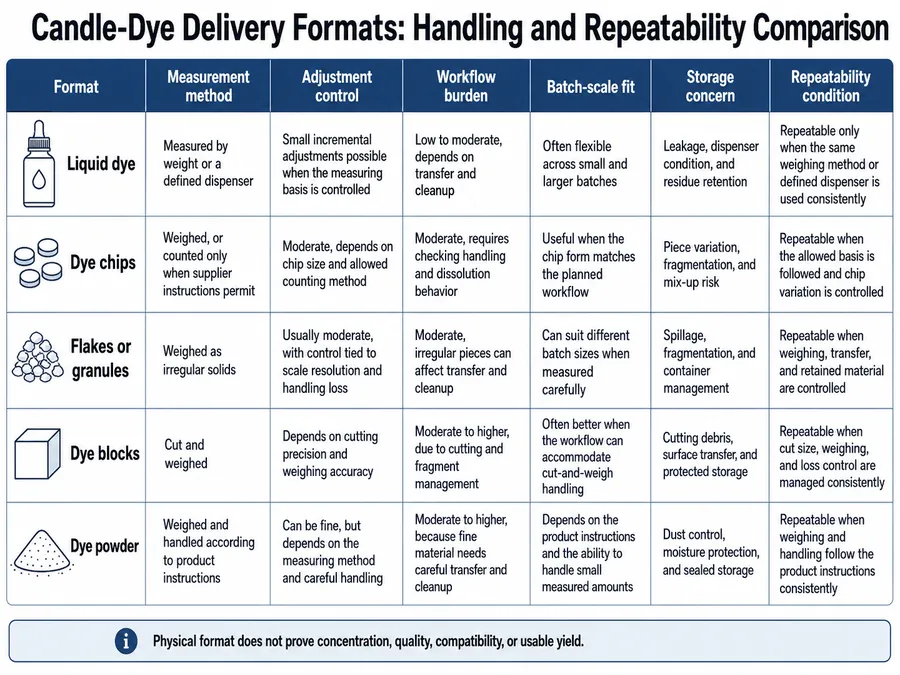
Equal-looking drops, chips, flakes, or block pieces do not establish equal dye mass. Equal mass does not establish equal color strength when suppliers use different concentrations or formulations. A convenient format may therefore be less repeatable, while a slower format may produce better input records.
Controlled benchmark method: Compare formats with the same wax system, batch size, tools, operator, and record sheet. Track the measuring method, smallest repeatable input, transfer loss, handling steps, storage condition, and cooled-result consistency. Do not force direct drop-to-piece or piece-to-powder conversions across suppliers because the benchmark tests handling and control, not universal dye strength.
This comparison does not set dye amounts, rank brands, prescribe incorporation times, or correct incomplete dissolution.
Select the format whose measuring method and handling demands remain repeatable at the intended batch scale.
Wax and Cooled-Color Fit
A candle dye fits a wax and color goal only when supplier instructions support the named wax and a fully cooled sample reaches the intended appearance.
“Compatible” means the candle dye is suitable for the intended wax under documented instructions. It does not mean the same dye will produce an identical shade, intensity, or required input in soy, paraffin, beeswax, coconut wax, container wax, or pillar wax.
| Wax family | Common base-wax condition | Possible effect on the visible dye result | Selection implication |
|---|---|---|---|
| Soy wax | Often pale, creamy, and opaque after cooling | The cooled wax may soften saturation or make a shade appear lighter and milkier | Judge the candle dye in a cooled sample made with the intended soy-wax product |
| Paraffin wax | May range from opaque to relatively translucent by grade and formulation | Greater translucency may make a hue appear clearer or stronger than in an opaque wax | Do not transfer the expected result from paraffin to an opaque wax without comparison |
| Beeswax | Usually carries a yellow, golden, or honey-toned baseline | The wax tone can shift pale shades and compete with cool or restrained targets | Decide whether the dye should preserve, complement, or cover the natural tone |
| Coconut wax or coconut blend | Often pale and soft-looking, but properties depend on the blend | Opacity and blend ingredients may produce a muted or pastel-looking cooled result | Test the named blend rather than treating all coconut-wax products alike |
| Any wax with additives or formulation changes | Base tone and opacity may differ from the unmodified wax | The same dye may appear different after an additive, blend, or product change | Treat the complete wax formulation as the comparison condition |
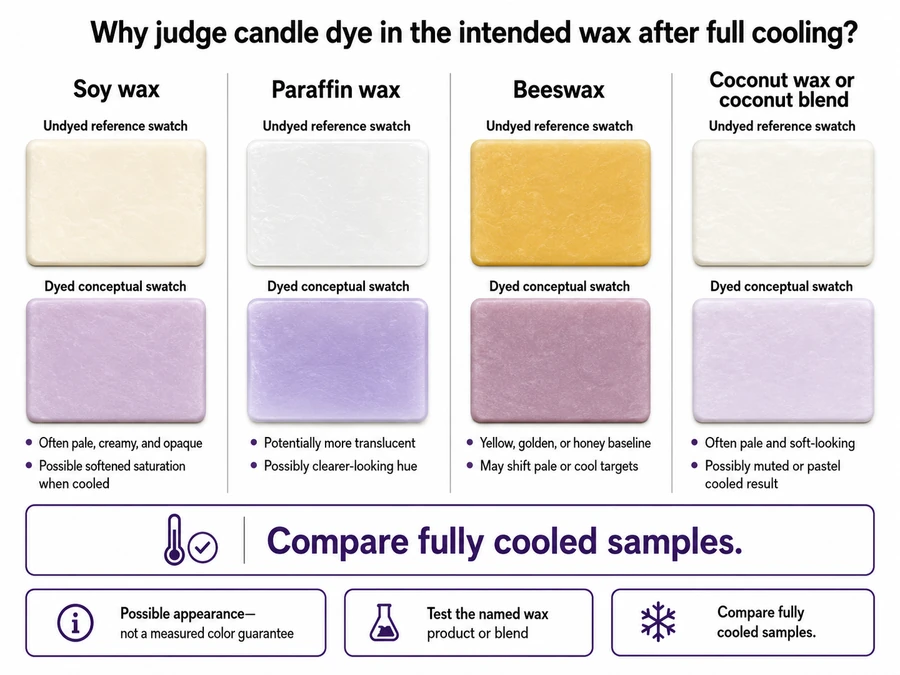
Pale, pastel, vivid, dark, restrained, translucent, and natural-looking are selection goals rather than fixed thresholds. “Natural-looking” means the cooled candle still shows the wax’s original tone instead of fully covering it.
Container and pillar candles do not require separate dye categories. Their wax formulations may differ in hardness, opacity, base tone, additives, or processing behavior, so each named wax may require a separate compatibility and cooled-color check.
Controlled swatch method: Keep the candle-dye identity, supplier lot, relative input, sample shape, and cooling conditions consistent where the supplier’s instructions permit. Include an undyed sample for every wax, label each sample by wax product and formulation, and compare fully cooled results.
This comparison does not provide exact dye-by-wax recipes, application temperatures, digital color matching, decorative effects, or finished-shade correction.
Select the candle-dye format whose documented wax fit and adjustment control can reach the intended cooled result without hiding the wax’s visual limits.
Measurement, Batch-Size, and Workflow Fit
A candle-dye format fits a batch only when its smallest repeatable input and total handling burden suit the batch size, tools, workspace, and recordkeeping method.
Product concentration is coloring strength per unit of candle dye. Measurement control is the maker’s ability to deliver, read, transfer, and repeat that unit with the available tool.
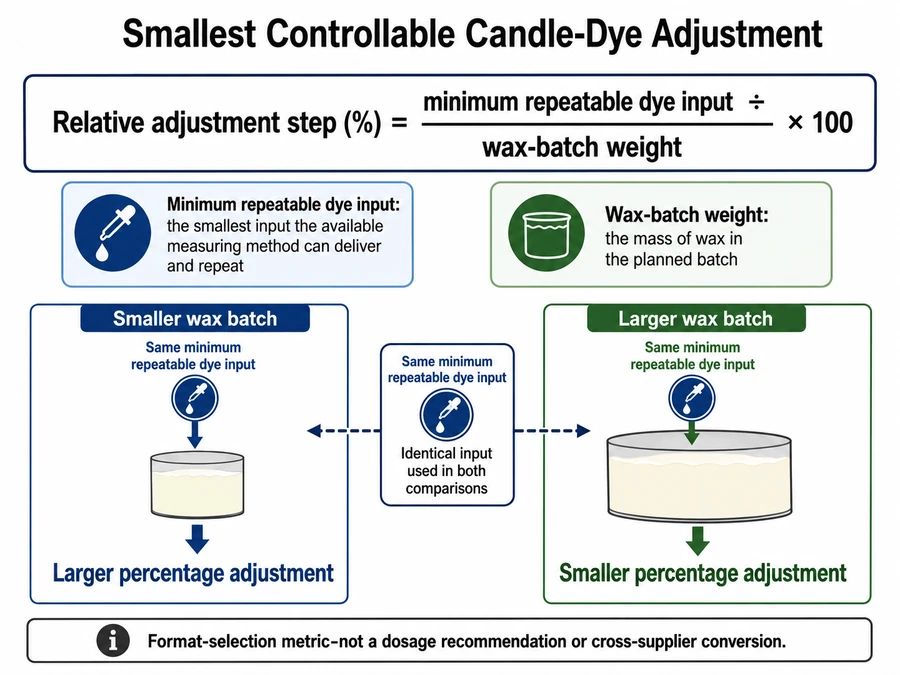
Relative adjustment step (%) = minimum repeatable dye input ÷ wax-batch weight × 100
This formula measures the smallest controllable batch-relative change. It is a format-selection metric, not a candle-dye dosage recommendation or a conversion between suppliers.
| Selection factor | What to check | Pass condition | Failure meaning |
|---|---|---|---|
| Input method | Mass, a defined dispenser, or a documented piece method | The same input can be reproduced with the available tool | Counting or dividing is too variable for the planned batch |
| Batch size | Minimum repeatable input relative to wax-batch weight | One repeatable input is no larger than the smallest planned adjustment | The format or tool is too coarse for the batch |
| Transfer | Dye left on droppers, containers, cutting tools, or transfer surfaces | The recorded input reaches the wax with controlled loss | The delivered amount differs from the recorded amount |
| Incorporation burden | Supplier instructions and the work required to add the format | The maker can follow the named product method consistently | The format adds uncontrolled preparation or distribution problems |
| Cleanup and storage | Leaks, stains, crumbs, dust, label loss, and mixed shades | Containment and identification remain manageable between batches | Loss or contamination weakens repeatability |
| Recordkeeping | Product, lot, wax, batch weight, input method, and cooled reference | Another recorded batch can be compared under the same stated conditions | The result cannot support repeat selection |
| Beginner fit | Tools, batch size, workspace, and ability to record each input | The format produces the smallest manageable measuring and handling error | “Easy” or “beginner-friendly” remains an unsupported general claim |
A fixed repeatable input creates a larger color adjustment in a smaller wax batch. A format that is too coarse for a small sample may fit a larger batch, but mathematical scaling does not prove that the color result transfers unchanged.
A repeatable dye system identifies the dye product and lot, wax product and lot, measured input, operator method, relevant working conditions, and fully cooled comparison state. “Consistent” must name whether the comparison concerns input, process, or cooled color.
A dye change cannot be blamed for weak scent throw, soot, flame changes, or melt-pool changes unless a matched test isolates the dye condition. Full formula diagnosis, wick correction, and burn-test procedures remain outside this selection page.
Select the candle-dye format whose repeatable input, batch-relative adjustment, handling burden, storage demands, and records remain manageable under the intended working conditions.
Dye-Selection Sequence and Decision Matrix
Choose candle dye by verifying intended use, qualifying wax and color goals, checking measurement and workflow fit, then shortlisting candidates for controlled testing.
The “right” or “best” candle dye is the highest-fit candidate for stated conditions, not a universal winner. Selection produces a documented test shortlist; it does not establish a final formula, exact amount, finished-candle safety result, or burn-test outcome.
Candle-Dye Selection Steps
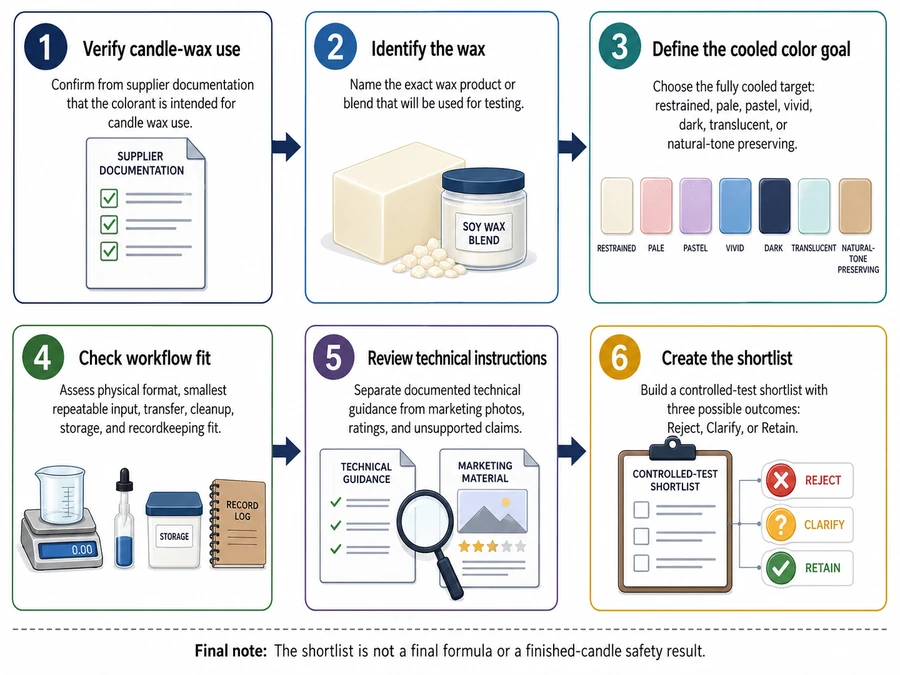
Candle-dye selection must verify category eligibility and intended candle-wax use before comparing wax fit, color goal, measurement, workflow, evidence, and test readiness.
- Verify candle use. Confirm that the supplier identifies the material for candle-wax use and provides relevant instructions.
- Identify the intended wax system. Record the named wax product or blend rather than relying only on a broad family such as soy or paraffin.
- Define the cooled color goal. State whether the target is restrained, pale, pastel, vivid, dark, translucent, or intended to preserve the wax’s natural tone.
- Check format and measurement fit. Compare liquid dye, chips, flakes, blocks, or powder by the smallest repeatable input available with the maker’s tools.
- Check total workflow fit. Include incorporation burden, transfer loss, cleanup, storage, adjustment, and recordkeeping.
- Review the evidence. Separate technical instructions and product documentation from marketing photographs, popularity, ratings, and unsupported claims.
- Create a controlled-test shortlist. Retain candidates that pass the evidence and fit checks, and record every unresolved condition that must be verified later.
Static Decision Matrix
The decision matrix classifies each candidate as passed, unresolved, rejected, or ready for a separate controlled test.
| Decision gate | Pass condition | If information is missing | If the candidate fails | Outcome |
|---|---|---|---|---|
| Intended candle use | Candle-wax use is stated in supplier documentation | Request clarification | Reject the candidate as candle dye | Pass, clarify, or reject |
| Wax qualification | The intended wax or relevant compatibility condition is documented | Mark wax fit as unresolved | Remove the candidate from this wax shortlist | Pass, clarify, or reject |
| Visual-goal fit | The format permits suitably controlled movement toward the cooled target | Retain only for a limited sample check | Reject for the stated visual goal | Shortlist, limit, or reject |
| Measurement fit | The smallest repeatable input suits the planned batch scale | Measure the input method before selection | Reject for that batch size or measuring setup | Pass, measure, or reject |
| Workflow fit | Measuring, transfer, cleanup, storage, and records are manageable | Record the unresolved operation | Reject when the burden cannot be controlled | Pass, clarify, or reject |
| Evidence quality | Technical identity, instructions, and relevant documentation are available | Request missing documents | Reject unsupported suitability claims | Pass, clarify, or reject |
| Testing readiness | Candidate identity, wax, format, lot, measurement method, and goal can be recorded | Complete the missing record fields | Do not begin controlled testing | Test-ready or stop |
Popularity does not pass an evidence gate. A highly rated liquid dye can remain unsuitable when its concentration, wax fit, or dispensing method is unclear; a less familiar solid dye can remain eligible when its instructions and measuring method fit the stated conditions.
Candle-Dye Shortlist Worksheet
The shortlist worksheet records the conditions required to reject, clarify, or retain a candle-dye candidate for later testing.
| Required input | Recorded condition |
|---|---|
| Candidate candle-dye name and supplier | ______________________________ |
| Physical format | Liquid / chips / flakes / blocks / powder / other documented format |
| Intended candle-wax use confirmed | Yes / unclear / no |
| Intended wax product or blend | ______________________________ |
| Candle construction | Container / pillar / other stated format |
| Cooled color goal | ______________________________ |
| Planned wax-batch weight | ______________________________ |
| Measurement method | Mass / defined dispenser / documented piece method |
| Minimum repeatable input known | Yes / unresolved |
| Main workflow concern | Measurement / transfer / incorporation / cleanup / storage / records |
| Technical instructions available | Yes / incomplete / no |
| Documentation requiring review | ______________________________ |
| Selection outcome | Reject / clarify / shortlist for controlled testing |
Selection result rules
- Reject when intended candle use is absent or contradicted.
- Clarify when compatibility, concentration, measurement, or instructions are incomplete.
- Shortlist when the candidate passes the current evidence and fit checks.
- Stop when the measuring method cannot produce a dependable input for the planned batch.
- Test later when the candidate qualifies for a separate controlled test.
- Evaluate separately when the unresolved question concerns exact dosage, full safety analysis, application technique, burn behavior, or defect diagnosis.
Modeled method: The sequence applies elimination gates before preference comparisons. Product identity and documented candle use come first because measurement convenience cannot correct an unsuitable colorant category. Wax, color, measurement, workflow, and evidence conditions then determine whether a candidate is rejected, clarified, or retained for a separate controlled test.
Use the completed shortlist as the starting record for testing, not as proof that the selected candle dye will produce a final formula or acceptable finished candle.
Product Evidence and Purchase Verification
A candle-dye candidate is ready for purchase testing only when its identity, intended candle-wax use, measurement basis, supplier-specific claims, and planned conditions can be verified.
A “quality” listing provides enough evidence to judge the stated use and planned test conditions. It does not prove universal compatibility, superior performance, complete safety, or equal concentration across suppliers.
Supplier dyes and usage charts are not interchangeable because concentration, carriers, units, dispensers, wax assumptions, and lot identity can differ. “Highly concentrated” is a product-specific claim, not a standard candle-dye grade.
Cost remains a subordinate selection factor. “Cheapest” means the lowest credible test-adjusted dye cost for the required result after delivered cost, tested consumption, handling loss, and unusable remainder are counted—not the lowest package price.
Candle-Dye Listing Evidence Matrix
The evidence matrix assigns each source only the decision role it can support.
| Evidence source | What it can support | What it cannot prove alone | Evidence rank | Purchase-stage decision |
|---|---|---|---|---|
| Supplier technical data | Product identity, physical format, stated compatibility, concentration description, measurement units, and named operating conditions | Finished results in every wax, batch size, or candle construction | High | Retain when the planned use fits the stated conditions |
| Supplier candle-use instructions | Intended candle use, stated measurement method, wax conditions, and operating directions | Universal compatibility or cross-supplier equivalence | High | Retain or clarify missing conditions |
| Safety data sheet (SDS) | Product identification and supplier-stated handling or hazard information | Color performance, wax compatibility, exact dosage, or complete finished-candle safety | High for its stated role | Confirm identity and handling information without treating it as performance proof |
| Documented test results | Performance under the named wax, candle-dye input, lot, process, cooling, and viewing conditions | Transfer to unnamed conditions | High when methods are supplied | Sample-test when the documented conditions differ from the planned use |
| Concentration statement | The supplier’s description of relative product strength | Equal strength across suppliers or formats | Medium unless the method and units are stated | Clarify the measuring basis before comparing yield |
| Current product page | Product name, format, package options, availability, current claims, and linked documents | Independent proof of compatibility or performance | Medium and date-sensitive | Confirm that the listing matches the technical documents |
| Customer reviews | Possible handling concerns, packaging failures, or recurring user questions | Compatibility, concentration, safety, repeatability, or production suitability | Supporting signal only | Use reviews to identify questions, not to pass a technical gate |
| Product photographs | Shade presentation, packaging appearance, and listing identity | The cooled result in the buyer’s wax or accurate strength comparison | Low | Do not buy solely from photographs |
| Marketing terms | Supplier positioning such as strong, easy, premium, professional, or beginner-friendly | A defined technical result | Lowest | Request measurable or documented meaning |
| Marketplace title or category | Basic listing placement | Authenticity, intended use, compatibility, documentation, or product identity | Lowest | Reject or clarify when stronger evidence is absent |
Reviews and images can reveal questions worth checking, but they cannot replace product identity, candle-use instructions, technical data, or documented test conditions. A cooled-wax photograph remains weak evidence when the listing omits the wax, dye input, product lot, cooling state, or image conditions.
Purchase Verification Sequence
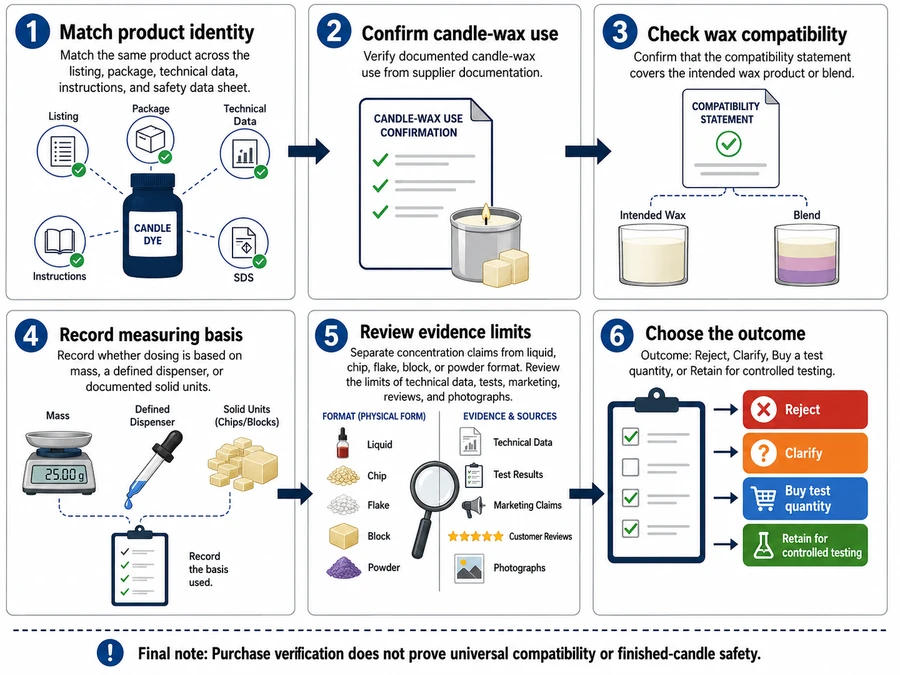
Purchase verification checks product identity and documented candle use before price, popularity, photographs, or convenience influence the decision.
- Match the product identity. Confirm that the listing, package, technical data, instructions, and SDS describe the same candle dye.
- Confirm intended candle use. Reject listings that provide no credible evidence of candle-wax use.
- Check the planned wax condition. Clarify whether the supplier’s compatibility statement covers the intended wax or blend.
- Identify the measuring basis. Record whether the candle dye is measured by mass, a defined dispenser, or documented solid units.
- Separate concentration from format. Do not infer strength from liquid, chip, flake, block, or powder form.
- Review the evidence limits. Note which claims come from technical data, supplier testing, marketing, reviews, or images.
- Choose the purchase outcome. Reject, request clarification, buy a test quantity, or retain the candidate for controlled testing.
| Listing condition | Evidence decision | Purchase outcome |
|---|---|---|
| Candle use is absent or contradicted | The candidate fails the category gate | Reject |
| Product identity differs across the listing and documents | The evidence set cannot be matched reliably | Reject or clarify |
| Candle use is stated, but wax compatibility or measurement is unclear | The candidate remains unresolved for the planned conditions | Clarify |
| Technical evidence is present, but the intended wax or visual target was not tested | Basic eligibility is established, not final suitability | Buy a test quantity or sample-test |
| Technical documents, product identity, measurement method, and intended conditions align | The candidate is ready for a controlled test shortlist | Buy for controlled testing |
| Reviews are positive, but technical documents are missing | Popularity does not pass the evidence gate | Clarify or reject |
| A bulk package is cheaper, but compatibility and tested consumption remain unknown | Package price does not establish usable value | Test before bulk purchase |
Method note: Record each evidence source in a dated worksheet and assign it only the role it can support. Resolve contradictions by giving product identity, technical data, use instructions, and documented test conditions more weight than marketing, images, or reviews.
Buy a candle dye for controlled testing only when its identity, intended use, supplier-specific measurement basis, documentation, wax condition, and planned color goal pass the evidence screen.