For most soy container candles, the best starting choice is a soy-safe liquid dye for clean, repeatable light-to-medium color, while dye blocks or chips are the better pick when you need the darkest reds, greens, and blues.
Soy wax is more opaque than paraffin, so the best format depends on how dark you want the finished candle, how repeatable your dosing needs to be, and whether you are willing to re-test the wick when color load goes up. Use the quick-pick table below to choose the format first, then use the later sections only to protect brightness and judge the cooled result.
Quick pick: which dye format is best for bright soy candles?
For bright soy candles, liquid dye is usually the best starting format for easy, repeatable light-to-medium shades, while dye blocks or chips are usually the better choice when you need the deepest color soy can hold.
Use this table to choose the right starting format before you test brand, shade, or load. For broader background, see Coloring Candles with Natural and Synthetic Dyes and How to Choose the Right Dye for Your Candles.
| If your real goal is… | Best starting format | Why it usually wins in soy | Main trade-off |
| Easy, repeatable light-to-medium color | Liquid dye | Fast to blend, easy to fine-tune, and easiest to repeat in small batches | Deep shades can still look softer in soy |
| Darkest possible red, green, blue, or near-black | Dye blocks or chips | Usually give soy the strongest color ceiling | Need more stirring, more heat discipline, and a wick re-test |
| Tiny weighed swatches and tidy bench testing | Dye flakes | Easy to portion for small calibration work | Strength varies by brand and shade |
| Lowest risk of muddy, particle-heavy jar color | Fully dissolved candle dye | Better for wick flow than particulate colorants | Any format can still be overloaded |
| Shimmer or sparkle | Not a primary choice for wicked soy jars | Better treated as a decorative effect than a main color system | Can muddy color and interfere with wicking |
Methods note: The drop counts, temperatures, fragrance percentages, and dye-load examples on this page are starter test ranges pulled from supplier support content and common soy-wax tech-sheet workflows, not universal pass/fail limits. Re-test every change in wax blend, fragrance load, jar diameter, wick series, and dye brand. Record your final recipe by weight before you scale a color that will be sold or repeated.
Use this quick rule if you need a faster answer than the full table:
- Choose liquid dye for fast, repeatable light-to-medium color.
- Choose dye blocks or chips when color depth matters more than speed.
- Choose flakes for weighed small-batch swatches.
- Skip mica and pigment when your real goal is bright, clean jar color.
What to buy when your goal is bright soy color
The best purchase for bright soy color is the dye format you can dose consistently in your own wax, jar, wick, and fragrance setup.
The brightest-looking label is not always the best choice. Soy wax is naturally more opaque, so clean results depend on repeatable dosing and full dissolution more than marketing claims about “maximum color.”
Use this shortlist before you buy:
- Choose a candle-specific dye that is explicitly labeled for soy wax or vegetable waxes, not craft-store fabric or food color.
- Prefer a format you can dose repeatably: dropper bottles for liquid dye, scored blocks or chips for deep shades, or weighable flakes for swatch work.
- Buy sample sizes first so you can test color depth without locking yourself into the wrong line.
- Keep one consistent dye line for your first round of testing so color strength does not shift between brands.
- If your goal is deep holiday shades or near-black, keep blocks or chips in play from the start instead of trying to force liquid dye to do all the work.
A practical starting setup for most makers is simple: keep liquid dye as the everyday option for light-to-medium shades, then use blocks or chips only when your target color needs a higher depth ceiling in soy.
Liquid dye vs dye chips for soy (which gives deeper color?)
In soy wax, dye blocks or chips usually reach darker, more saturated color than liquid dye, while liquid dye is easier to blend, adjust, and repeat for lighter-to-medium shades. Choose blocks when color depth matters most, and choose liquid when speed, shade control, and custom mixing matter more.
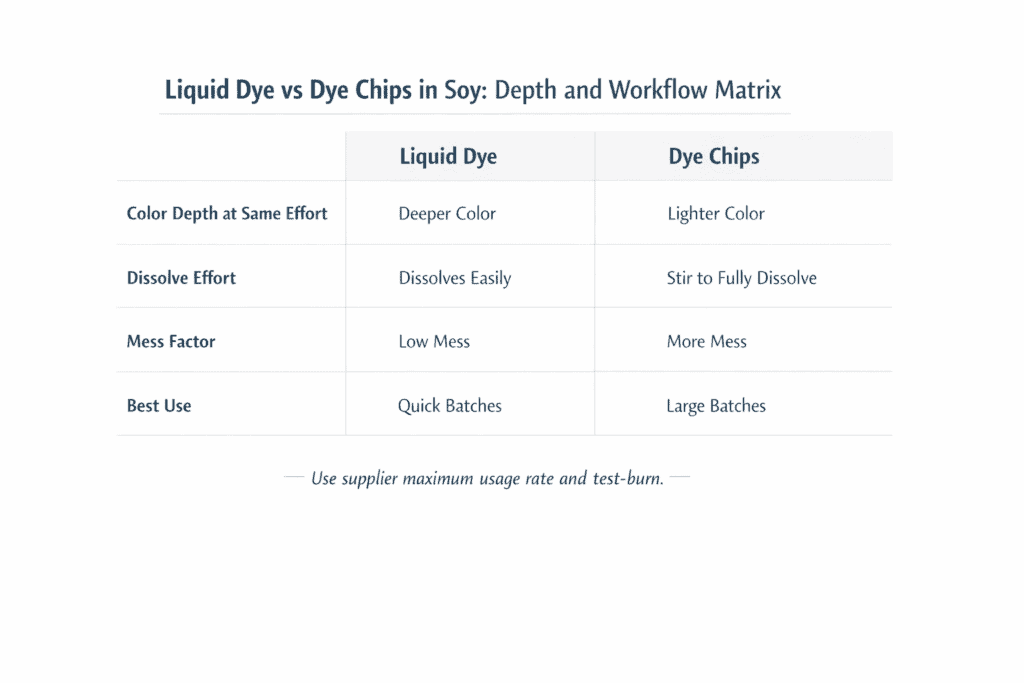
If you’re still learning the basics of wax, wick, and jars together, it’s smart to start with candle making basics so you understand how any colorant affects burn and appearance. Liquid dyes arrive pre-dissolved, so they slip into molten soy and usually clear quickly with just a minute or two of mixing. Dye chips are compressed solid dyes; they must soften and completely melt into the wax, and any tiny speck that survives can show up later as a streak or spot.
Here’s a simple side-by-side snapshot for typical soy container wax at a similar “medium” intensity:
| Format | Usually best for in soy | Color depth ceiling | Dissolve effort | Best fit |
| Liquid dye | Light to medium shades, quick shade adjustments, custom blends | Lower than blocks in very dark soy colors | Low | Small batches and frequent color changes |
| Dye chips or blocks | Darker saturated shades in opaque soy | Higher | Medium | Deep colors and repeatable production runs |
Use tables like this as rough guidance only. Follow your supplier’s usage guidance, and re-test any meaningful change in dye load, fragrance load, jar diameter, or wick series before you scale a darker formula.
Before you decide which format is “deeper,” take time to review dye types so you know whether your chips are formulated for soy or mainly designed for paraffin. For a fair test, run at least two mini-batches: same soy wax, same jar, same wick, similar warm add temperature (often around the upper part of the supplier’s recommended range), and mix each batch for at least a minute. Note how quickly each format clears in the pot, but judge the final winner only after the jars cool and cure because hot wax usually looks darker than the finished candle.
Because dye chips are solids, they’re more sensitive to low temperatures and lazy stirring. If you notice specks on the bottom or cloudy streaks up the sidewall, you’re seeing incomplete dissolution rather than proof that the format is wrong for soy. Use How to Color Candle Wax Without Clumps or Bleeding for dissolution help, and use How to Fix Uneven or Off-Color Candles if a finished jar still looks off after cooling.
In practice, many soy makers use liquid dye for everyday production and reserve chips for batches where maximum depth matters more than fast, repeatable workflow. If you prefer chips, document your melt temperature, stir time, chip weight, and resulting color depth in a small log so you can hit the same shade again when a customer asks for “exactly that teal” next season.
Best dye format by jar size, batch size, and color depth
The best dye format changes with your setup, not just your color goal.
Use this shortcut when the answer depends less on theory and more on your actual jar, batch size, and shade target.
| Setup | Best starting format | Why |
| Small test jars, pastel shades, or light-medium color | Liquid dye | Easiest way to adjust color in tiny steps without overloading the wax |
| Standard soy jars where repeatability matters more than maximum depth | Liquid dye or flakes | Both are easy to measure and repeat across test rounds |
| Large jars or dark jewel tones where color depth matters most | Dye blocks or chips | Better chance of reaching the strongest shade soy can hold |
| Production runs where you need the same deep color repeatedly | Weighed blocks or chips | Easier to standardize by weight once the formula is proven |
| Any jar where the wick is already borderline | Lower-load liquid dye first | Lets you chase color more gradually before stepping up wick testing |
If you are torn between two formats, start with the one that gives you the most repeatable dosing for your batch size, then test upward only when the cured jar still looks too soft.
Pigment vs dye in soy candles (wick safety & solubility)
In soy candles, dyes are designed to dissolve into the wax, while pigments remain tiny particles that can interfere with wick performance, so pigments are usually a poor fit for wicked containers.
If you’re unsure which colorants you’ve actually bought, check the supplier labeling first. Dyes are soluble colorants; in hot soy wax they blend into the melt so the liquid looks uniformly tinted with no visible specks. Pigments are insoluble particles that stay suspended in the wax, which can change how the candle burns and how cleanly fuel moves to the wick. Treat any pigment- or mica-heavy jar as its own wick-test case instead of assuming it will behave like a true dissolved dye.
That difference is why particle-heavy color systems create more risk in soy jars, especially with smaller wicks or already borderline setups. Use a simple failure log to connect symptoms you see with likely causes:
- Candle won’t stay lit or repeatedly drowns → likely the wick throat is clogged by pigment or mica particles gathered at the wick base.
- Heavy mushrooming and soot on the wick tip → the color load is probably too high for that wick and jar combination.
To reduce risk in soy jars, reserve pigments for decorative, unwicked pieces or for wax melts where wick flow is not the main issue. For projects that will be burned, candle dyes that fully dissolve are the safer starting point.
Mica is not the best primary colorant for bright soy jar candles because it stays particulate, muddies opaque wax, and can interfere with reliable wicking. For a full breakdown of when shimmer works and when it creates wick issues, see Can You Use Mica Powder in Candles?
How to keep soy color bright after you choose a dye format
Once you choose the right dye format, bright soy color depends more on temperature, fragrance load, and repeatable test batches than on the dye itself.
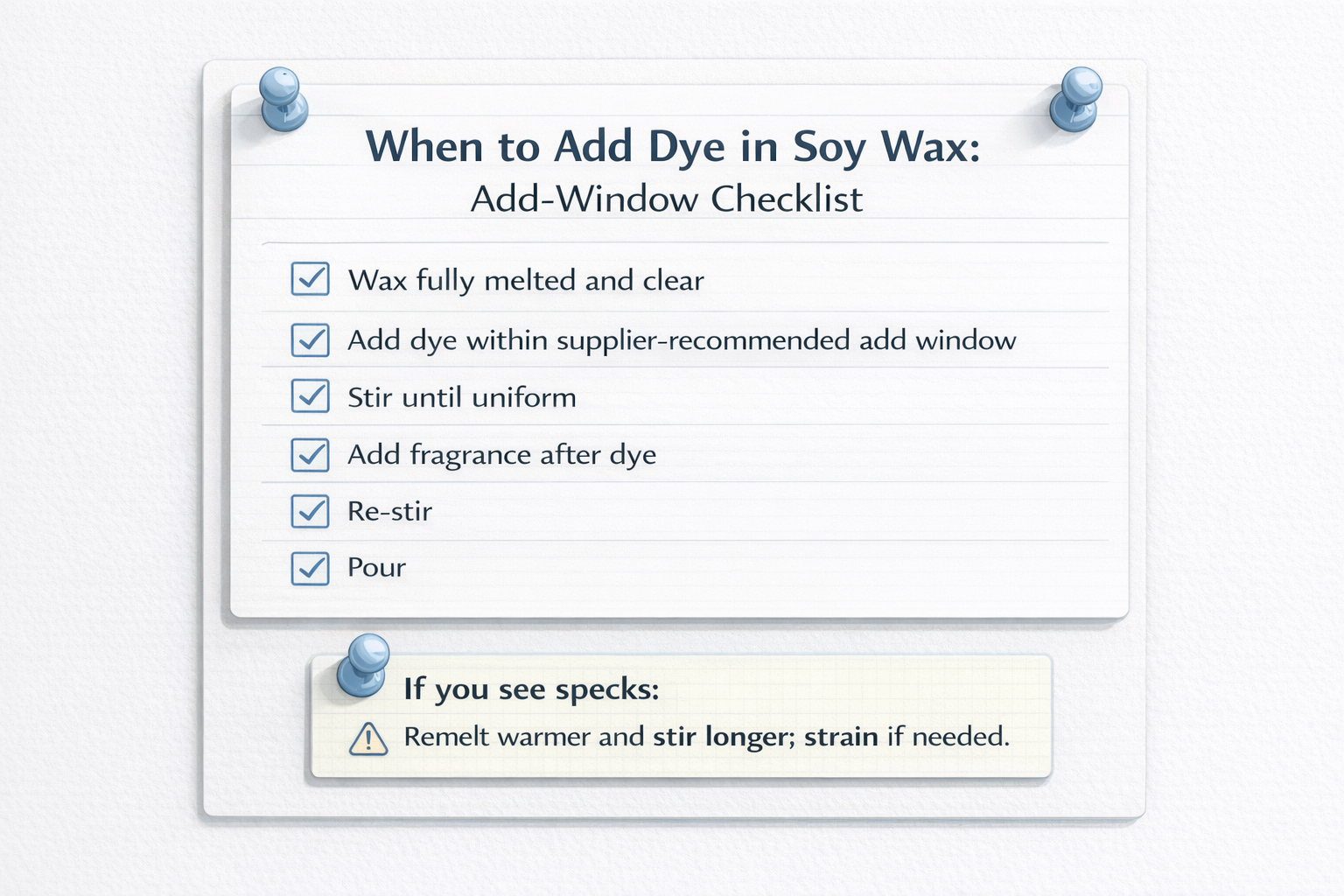
Add dye while the wax is fully melted and still hot enough for complete dissolution, then let the wax move toward its fragrance-add and pour ranges in the order your supplier recommends. For common soy container waxes, that usually means working in the fully melted zone first and not trying to rescue color after the wax has already turned cloudy or slushy. If you need a supplier example, review the handling ranges for popular soy blends like 444 and 464 and treat your own wax datasheet as the final authority.
Start with a small measured test batch before you chase the final shade. A simple 100 g sample is enough to increase dye in tiny repeatable steps, compare light, medium, and deep versions of the same color, and judge the winner after the candle cools and cures rather than while the wax is still hot in the pot.
- Heat soy wax until it is completely clear and within the supplier’s recommended melt range.
- Add dye at that hot-but-safe stage, then stir slowly for 60–120 seconds, scraping the bottom.
- Make sure the melt stays visually even before adding fragrance.
- Re-test the wick when you materially darken the shade or change the fragrance load.
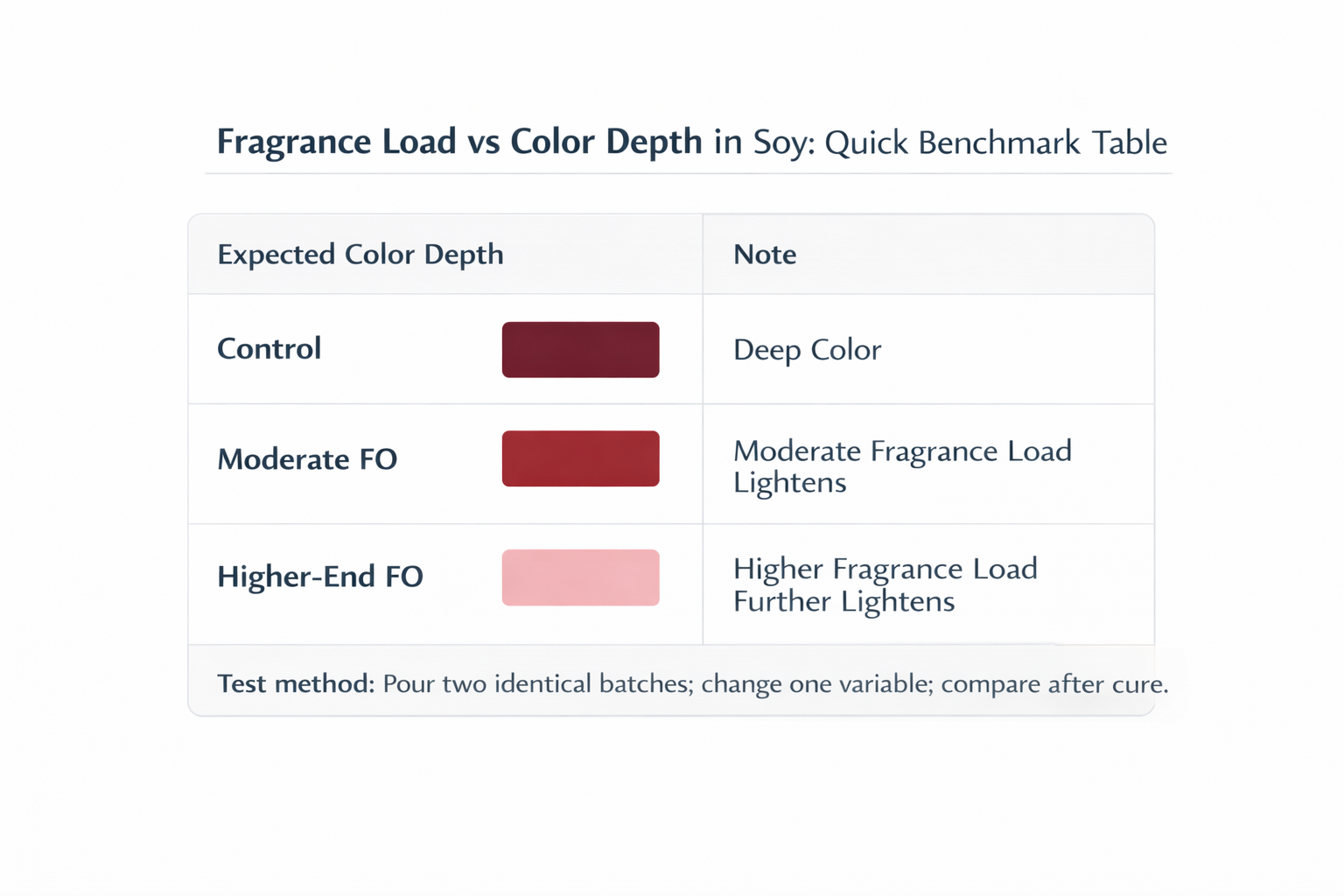
Fragrance load can soften or warm the finished color, especially with heavy or vanillin-rich oils. When you push soy toward the upper end of its fragrance range, the extra liquid can make colors look lighter, hazier, or slightly milky, so test fragrance and dye together rather than as separate decisions.
Record wax type, fragrance load, dye type, and cure result so you can repeat the version that actually worked instead of guessing later.
If the color still shifts during storage or light exposure, see How to Keep Candle Color from Fading for UV and storage-related color changes.
Quick answers before you buy dye for soy candles
These quick answers resolve the last buying questions most makers have before they choose a dye format for soy candles.
What is the best dye format for deep soy colors?
Dye blocks or chips are usually the best starting point when you want the darkest reds, greens, blues, or near-black shades in soy.
What is the best dye format for easy repeatability?
Liquid dye is usually the easiest starting choice for repeatable light-to-medium shades because you can adjust color in very small steps.
Which format is best for small-batch swatches?
Flakes or carefully dosed liquid dye are usually the easiest formats for small measured calibration work.
What is a good starting test size for soy dye?
Start with a small measured sample, such as 100 g of wax, and increase dye in tiny repeatable steps by drops or weight. Judge the color after the candle cools and cures, not only while the wax is still hot.
Does jar size or wick setup change the best choice?
Yes. The more borderline your wick setup already is, the more carefully you should increase dye load. In those cases, liquid dye at lower loads is usually the safer starting point.
Can mica replace candle dye in soy jar candles?
No. Mica is better treated as a decorative additive than as the main color system for a wicked soy container candle.
Does fragrance load reduce color brightness in soy?
Often, yes. Higher fragrance loads and vanillin-rich oils can soften or warm the finished color, so test fragrance and dye together rather than separately.