
No candle dye format is universally best for white, pastel, or soft-tone candles; the best option gives controlled low-dose color in the intended wax-and-fragrance system.
Candle dye is a wax-soluble colorant used to adjust a candle’s hue, while white pigments or whitening products may belong to a different colorant class. A white candle may need no conventional dye when the undyed wax already meets the target appearance. Here, “best” means most suitable for a clean, subtle, repeatable cured shade—not the cheapest, safest, strongest, most popular, universally superior, or best for burn performance.
| Selection criterion | Better fit for subtle colors | Warning sign |
|---|---|---|
| Low-dose control | Small, measurable shade changes | Large jumps from the smallest usable increment |
| Wax and fragrance fit | Clean cured color in the declared system | Yellow, muddy, or shifted undertones |
| Dispersion | Even color without specks or pockets | Residue, streaking, or uneven pale color |
| Repeatability | Similar cured shades across matched batches | Unexplained batch-to-batch variation |
Accept a dye when its smallest repeatable adjustment approaches the intended shade without overshooting, streaking, or shifting after cure. Reject it when the base wax, fragrance, dispersion, or minimum practical increment prevents a clean and repeatable result.
What Makes a Candle Dye Best for White, Pastel, and Soft-Tone Candles?
A candle dye suits white and soft-tone candles when it gives low-dose control, wax compatibility, low discoloration risk, clean cured color, even dispersion, repeatability, and stability.
“Best” means suitable for the intended subtle shade in the actual wax-and-fragrance system, not the strongest dye or a universal brand winner. The smallest practical adjustment should change the cured shade gradually without causing specks, muddiness, or a large jump in saturation.
| Selection criterion | Editorial weight | Strong subtle-color fit | Poor fit |
|---|---|---|---|
| Low-dose control | High | Small adjustments create gradual cured-color changes | The smallest usable amount overshoots the target |
| Wax compatibility | High | The dye remains clean in the intended wax | The base wax shifts the shade toward an unwanted cast |
| Discoloration risk | High | The scented candle stays acceptably close to the target | Fragrance produces yellow, brown, or muddy undertones |
| Cured-shade cleanliness | High | The finished shade remains clear and visually distinct | The cured color looks gray, dirty, or washed out |
| Dispersion | Medium | The dye dissolves evenly without visible specks | Pale areas reveal streaks, particles, or color pockets |
| Repeatability | High | Matched batches produce acceptably similar cured shades | Small measuring differences cause large visual changes |
| Stability | Medium | The shade remains acceptable during the stated check period | The color changes beyond the project’s tolerance |
These weights are editorial priorities rather than laboratory scores. A high-concentration dye can still be a poor pastel choice when its minimum practical increment is difficult to measure or repeat.
A result from one wax-and-fragrance combination should not be treated as proof that the same dye will perform identically in another combination. Product selection should remain tied to the actual materials, cured appearance, and viewing conditions used for the candle.
Choose the dye whose smallest repeatable adjustment preserves the intended pale target in the actual wax-and-fragrance combination.
What Do Bright White, Creamy White, Translucent Pastel, and Muddy Color Mean?
Bright white, creamy white, translucent pastel, and muddy color describe different cured appearances shaped by brightness, opacity, clarity, hue, and undertone.
Bright white appears highly luminous and neutral; creamy white carries a warm cast; translucent pastel keeps visible wax depth; muddy color loses clarity through an unwanted gray, brown, or yellow cast. The wax’s natural tone and opacity condition each appearance, so candle dye alone cannot create one absolute version of white.
| Appearance target | Brightness | Opacity and clarity | Undertone | What it means for dye selection |
|---|---|---|---|---|
| Bright white | High | Usually visually solid and clean | Neutral or slightly cool | Requires a light base wax with little unwanted warmth |
| Neutral white | High to moderate | Clean, with no obvious color cast | Balanced | Accepts slight wax character without appearing cream or gray |
| Creamy white | Moderate to high | Soft and visually warm | Ivory, beige, or yellow | May be an intended finish rather than a dye failure |
| Translucent pastel | Moderate | Clear hue with visible wax depth | Clean version of the chosen hue | Needs low saturation without dull gray contamination |
| Dusty tone | Muted | Soft clarity with intentional restraint | Controlled gray or brown influence | Works when muted color is part of the target |
| Muddy color | Low visual clarity | Hue appears blurred or dirty | Unwanted gray, brown, or yellow | Signals that the wax, fragrance, dye, or their combination missed the target |
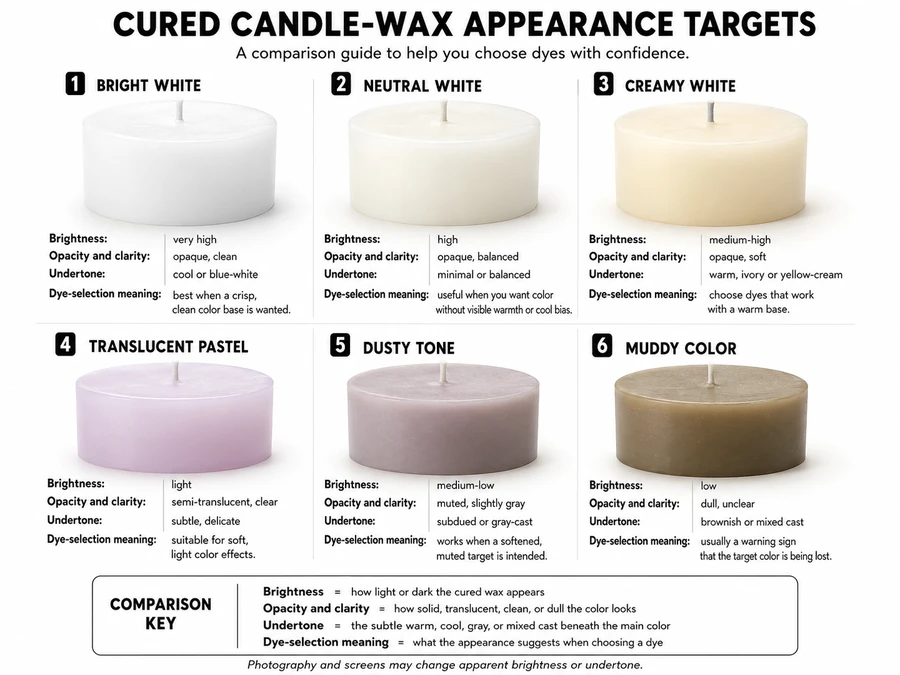
A useful cured-swatch comparison should identify the wax, undyed control, dye, fragrance status, dose method, cure interval, lighting, and limits of the image. Text labels matter because photography and screens may change the apparent brightness or undertone.
Define the intended appearance before comparing dyes, because the same candle dye may suit creamy white while failing a bright-white target.
How Does Wax Type Change White and Pastel Candle-Dye Results?
The same candle dye can cure brighter, warmer, clearer, or duller because each wax has its own base color, opacity, translucency, cooling pattern, and crystal structure.
Soy, paraffin, beeswax, and blended waxes can make one dye appear different after curing even when the dye and relative amount remain unchanged. The wax is part of the color system, so an undyed control is needed to separate wax-driven appearance from dye performance.
[IMAGE-PLACEHOLDER]
Visual type: Matched cured-wax swatches
Purpose: Show the same candle dye at the same relative amount in soy, paraffin, beeswax, and blended wax, with an undyed control beside each sample.
Alt text: Undyed and pastel-dyed cured swatches comparing the same candle dye across four wax systems.
Caption: Matched controls show how wax base color and opacity change the appearance of the same cured dye.
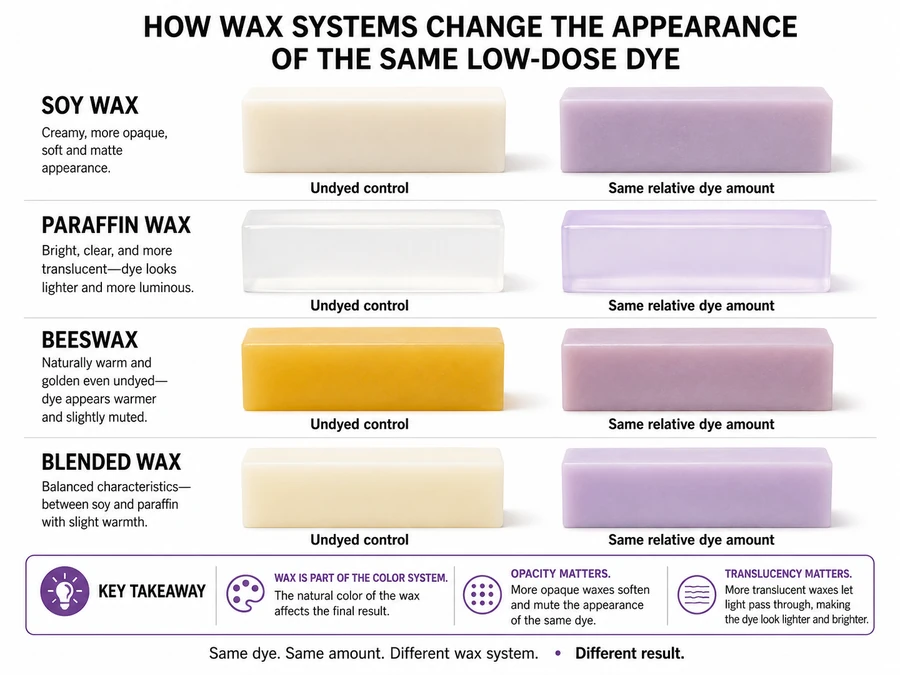
| Wax system | Undyed control may show | Possible effect on a pale dye | Selection implication |
|---|---|---|---|
| Soy wax | An opaque, creamy, or off-white base | The shade may appear softer, less translucent, or warmer | Judge the dye against the actual soy wax rather than a digital color chart |
| Paraffin wax | A clearer or more translucent base, depending on grade | Low color levels may appear brighter or clearer | Check whether the cured result has the required opacity and softness |
| Beeswax | A naturally yellow, golden, or warm base | Blues, whites, pinks, and lilacs may shift warmer or become muted | Treat the natural wax color as part of the intended shade |
| Blended wax | A base color and opacity shaped by the blend | The result may resemble one component or show a separate appearance | Test the named blend instead of predicting results from its main wax type |
These are common appearance tendencies, not fixed rankings. Wax grade, supplier formulation, lot, cooling conditions, and cure interval can change the finished result within the same general wax category.
Methods
Compare an undyed control and a dyed swatch for every wax being considered. Keep the dye identity, relative amount, batch mass, fragrance status, cooling location, cure interval, and viewing conditions unchanged. Record the exact wax product and lot so a later result is not incorrectly attributed to the candle dye.
Select candle dye only after the intended pale shade remains acceptable in the actual wax, not because it looked clean in another wax.
Why Do Fragrance Oils and Vanillin Change White or Pastel Candle Colors?
Fragrance oil can yellow, brown, warm, or muddy a pale candle even when the candle dye performs correctly.
Fragrance composition can alter the cured wax color independently of dye performance. Vanillin can signal discoloration risk when the supplier declares it, but it is not the only possible source of a color shift, and an unscented swatch cannot predict the final scented candle by itself.
[IMAGE-PLACEHOLDER]
Visual type: Scented-versus-unscented matched controls
Purpose: Compare wax-only, dye-only, fragrance-only, and dye-plus-fragrance samples after the same cure interval.
Alt text: Four cured candle controls separating wax, dye, fragrance, and combined color changes.
Caption: Four matched controls separate fragrance-driven discoloration from wax and candle-dye effects.
| Control sample | Dye | Fragrance | What the sample isolates | What to record |
|---|---|---|---|---|
| Wax only | No | No | Natural wax color and cure-related change | Base tone, opacity, undertone, and cure interval |
| Wax plus dye | Yes | No | Candle-dye appearance without fragrance | Hue, brightness, clarity, and dispersion |
| Wax plus fragrance | No | Yes | Fragrance-driven change without dye | Yellowing, browning, warming, or dulling |
| Wax plus dye and fragrance | Yes | Yes | The appearance of the finished candle system | Final hue, undertone, clarity, and difference from the target |
A yellow shift in both fragrance-containing controls points toward the fragrance or its interaction with the wax rather than the dye alone. A shift limited to the dye-and-fragrance sample suggests an interaction that cannot be identified from either ingredient in isolation.
Failure log
Record the sample identifier, wax product and lot, dye product, fragrance name, supplier, available vanillin information, fragrance status, cure interval, viewing conditions, observed change, and any missing documentation. Do not label vanillin as the cause when the supplier has not disclosed it or when the controls point to another variable.
Methods
Prepare matched control sets and state the number of samples examined. Keep the wax, batch mass, processing method, cure interval, and viewing conditions the same while changing only dye and fragrance status across the four controls. Supplier fragrance sheets, vanillin disclosures, safety data sheets, and IFRA documents should be interpreted only for the information they provide; they do not automatically guarantee color stability.
These controls identify the most likely contribution but do not prove a complete chemical cause or predict every production batch.
Choose the dye-and-fragrance combination only when the scented cured control remains acceptably close to the intended white or pastel target.
How Do You Judge Low-Dose Control for Pastel Candle Dye?
Judge low-dose control by whether repeatable, product-specific increments produce gradual cured-color changes before the candle dye overshoots the intended pastel shade.
Test the candle dye in matched batches and compare the cured results rather than relying on universal drop counts. A strong dye has high tint strength, but high strength does not automatically make it easy to meter for pale colors.
[IMAGE-PLACEHOLDER]
Visual type: One-variable low-dose ladder
Purpose: Show an undyed control followed by equal, product-specific dye increments, with the first visible change and overshoot point labeled.
Alt text: Cured candle-wax samples showing gradual product-specific dye increments from undyed wax to an oversaturated pastel.
Caption: The cured sample ladder identifies the smallest repeatable color change and the point where the pastel target becomes too dark.
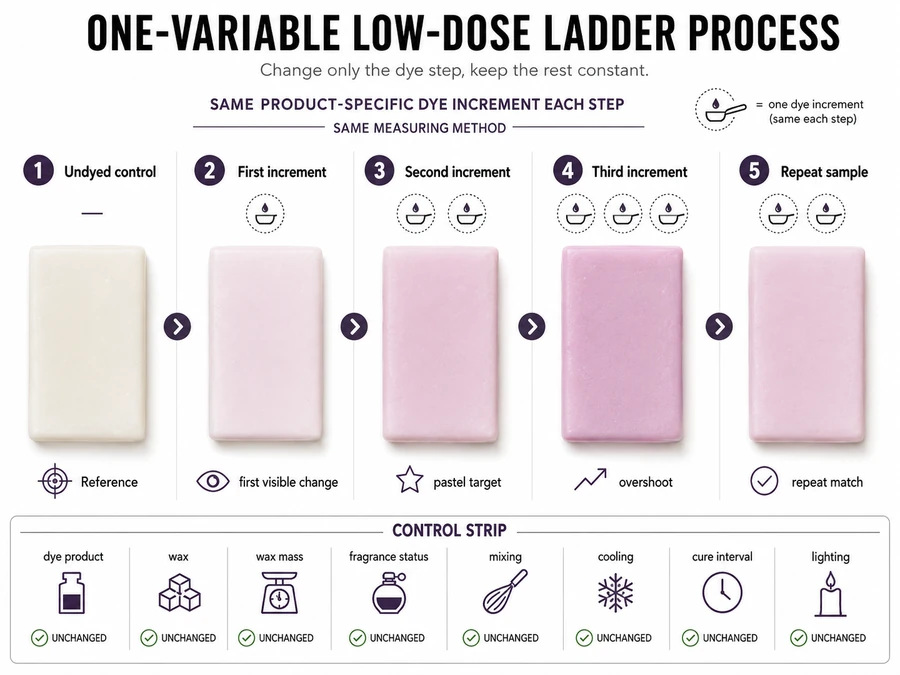
| Ladder sample | Dye adjustment | What to assess after curing | Decision |
|---|---|---|---|
| Undyed control | No dye | Natural wax color, opacity, and undertone | Establishes the visual baseline |
| First increment | Smallest practical addition | Whether a visible, even shade change appears | Accept when the increment can be measured and repeated |
| Second increment | Repeat the same addition | Whether the shade deepens gradually | Accept when the change remains controlled |
| Third increment | Repeat the same addition again | Whether the target is reached or passed | Mark the first sample that becomes too dark |
| Repeat sample | Reproduce the selected step | Whether the cured shade matches the earlier sample | Reject the method when the result cannot be repeated |
The minimum practical increment is the smallest amount the maker can add consistently with the chosen dispenser, scale, chip portion, or block-shaving method. It is more useful for pastel selection than tint strength alone because concentrated dye may create a large color jump from the smallest manageable addition.
Variable-control checklist
- Keep the dye product and dispenser unchanged.
- Keep the wax product, wax mass, and fragrance status unchanged.
- Add the same relative increment at each ladder step.
- Keep mixing and cooling conditions consistent.
- Compare samples only after the same declared cure interval.
- Record the test date and judge every sample under the same lighting.
Methods
Record the dye product, dispenser, fixed wax mass, relative increments, mixing conditions, cure interval, viewing conditions, and test date. Change only the dye increment across the ladder. The results apply to the declared materials and process; they should not be transferred between brands, dispensers, waxes, or fragrances without another controlled check.
Do not convert this ladder into a universal dosage chart because dye concentration, drop size, solid-fragment size, wax behavior, and target shade vary by product and process.
Choose candle dye whose smallest repeatable addition approaches the cured pastel target gradually rather than crossing it in one large color jump.
Liquid Dye vs Chips vs Blocks for Subtle Candle Colors
Liquid dye, chips, and blocks can all suit pastel candles; the best format meters, disperses, and repeats reliably in the declared batch and wax system.
No delivery format is universally superior. Suitability depends on the minimum practical increment, measuring consistency, complete dispersion, and the maker’s ability to reproduce the selected cured shade.
A dye format describes how the colorant is supplied, not its full chemistry or guaranteed performance. Liquid does not automatically mean easier control, while chips and blocks are not automatically less suitable for pale colors.
| Subtle-color criterion | Liquid dye | Dye chips | Dye blocks |
|---|---|---|---|
| Minimum practical increment | May allow small additions, but drop size can vary by dispenser and handling | A whole chip may be too large for a small pale batch unless the product supports repeatable subdivision | Shavings may allow gradual additions when they can be measured consistently |
| Measuring consistency | Depends on dispenser output and product concentration | Strong when chip size and batch size align; weaker when pieces vary | Depends on consistent shaving or weighing |
| Dispersion check | Must distribute evenly through the wax | Must dissolve fully before the pale shade is judged | Must dissolve fully; larger fragments may require closer observation |
| Small-batch suitability | Good when the smallest repeatable addition does not overshoot | Conditional on chip size and color strength | Conditional on the maker’s ability to create repeatable portions |
| Repeatability | Strong when dispenser, method, and product remain unchanged | Strong when equal pieces create acceptably similar cured shades | Strong when portion mass and dissolution remain consistent |
| Main warning sign | One drop causes a large color jump | A single piece produces more color than the target requires | Uneven shavings or incomplete dissolution create variable results |
The table is a conditional comparison, not a measured product ranking. Supplier concentration, chip dimensions, block composition, dispenser behavior, wax compatibility, and batch size can change which format offers the best control.
Complete dissolution matters more in pale candles because specks, streaks, and concentrated color pockets remain visible against a light wax base. A format should be rejected for the intended project when its smallest manageable portion repeatedly overshoots the target or fails to disperse evenly.
Select the format that gives the smallest repeatable cured-color change in the actual batch rather than assuming one delivery form is always best.
How Do You Evaluate Cured Color and Batch Repeatability?
Evaluate a candle dye after a stated cure interval, and use at least three controlled repeat batches when making a measured repeatability claim.
Molten wax provides an early color clue, but it does not show the final brightness, opacity, undertone, or saturation. Cooling and curing reveal the finished candle-dye shade that should control the approval decision.
A cure interval is the stated time between pouring a test sample and judging its finished color. Use the same interval for every sample being compared.
[IMAGE-PLACEHOLDER]
Visual type: Molten-versus-cured and repeated-batch benchmark
Purpose: Compare one dye while molten, after cooling, after the declared cure interval, and across three matched repeat batches.
Filename: candle-dye-molten-cured-repeatability-benchmark.webp
Alt text: Molten and cured pastel candle-dye samples beside three matched repeat batches.
Caption: Matched samples show how cooling and repeat production affect the approved pastel shade.
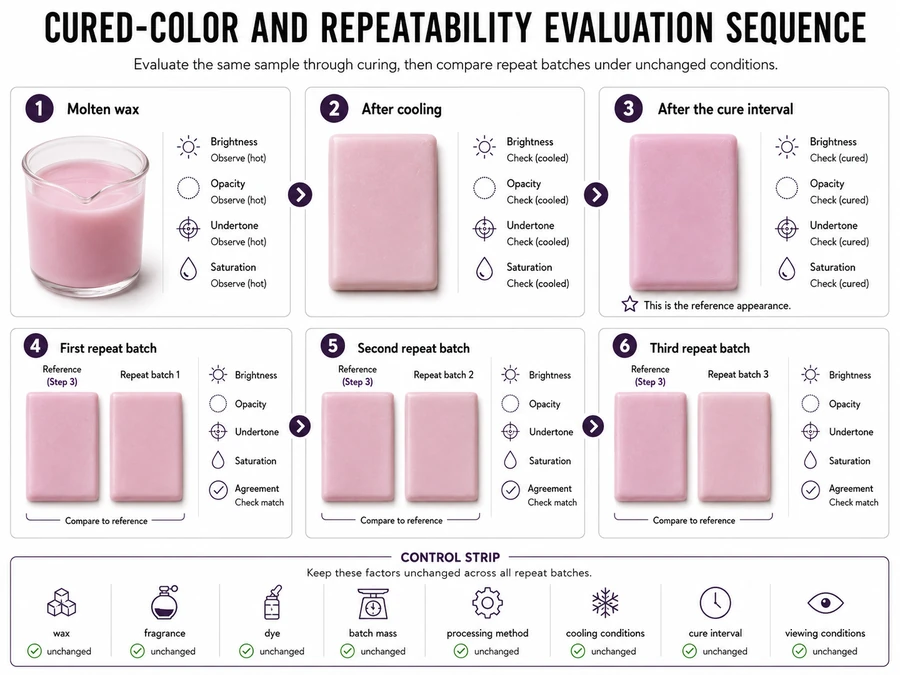
| Assessment point | What to examine | Approval use |
|---|---|---|
| Molten wax | Preliminary hue and color strength | Use only as an early observation |
| After cooling | Opacity, surface appearance, and major undertone shifts | Note changes but wait for the declared cure interval |
| After the cure interval | Finished brightness, clarity, hue, and saturation | Use as the main shade-approval point |
| First repeat batch | Similarity to the approved cured sample | Check whether the selected method can be reproduced |
| Second repeat batch | Similarity under the same materials and conditions | Look for unexplained shade movement |
| Third repeat batch | Agreement across the matched sample set | Support or reject a repeatability claim |
Use at least three matched samples when making a measured repeatability claim. Fewer samples may reveal a visible problem, but they do not support the same level of repeatability evidence.
Repeatability checklist
- Use the same wax product and record its lot when available.
- Use the same dye product, dispenser, and relative amount.
- Keep fragrance identity and fragrance status unchanged.
- Keep batch mass and mixing conditions consistent.
- Record the processing conditions used for each batch.
- Cool the samples in the same location and position.
- Judge every sample after the same cure interval.
- Compare the samples under the same lighting and background.
- Accept only the degree of variation allowed by the project’s visual target.
A shade does not need to appear mathematically identical to be useful. It needs to remain acceptably similar for the intended white, pastel, or soft-tone specification.
Methods
Prepare at least three matched samples with the same wax, fragrance, dye, batch mass, processing method, cooling conditions, cure interval, and viewing conditions. Change no planned variable between repeat batches. Record the test date and any known wax-lot or material change.
The result applies only to the declared materials and conditions; it is not a universal production-quality claim.
Once repeatability is acceptable, compare how the approved shade holds under declared storage and light conditions.
Maintaining Delicate Candle Colors Through Cure, Storage, and Light Exposure
Candle-dye stability means acceptable shade retention over a stated interval under declared storage, heat, and light conditions.
Stability does not mean permanent, fade-proof, heat-proof, or universally resistant. A delicate shade should be approved only for the conditions represented by matched protected and exposed samples.
[IMAGE-PLACEHOLDER]
Visual type: Protected-versus-exposed pastel swatches
Purpose: Compare matched cured samples kept under protected storage, ordinary indoor light, limited window light, and a declared warmer condition.
Filename: pastel-candle-dye-protected-exposed-swatches.webp
Alt text: Matched pastel candle swatches compared after protected storage and declared light and warmth exposure.
Caption: Protected and exposed swatches reveal condition-specific changes in delicate cured candle colors.
| Sample condition | Variable being checked | What to compare |
|---|---|---|
| Protected control | Continued curing with limited exposure | Natural change over the stated observation interval |
| Ordinary indoor light | Routine room display | Hue, brightness, and undertone against the protected control |
| Limited window-light exposure | Stronger light during a declared period | Fading, warming, yellowing, or loss of clarity |
| Declared warmer location | Condition-specific warmth | Shade shift relative to the protected sample |
| Repeat protected sample | Sample-to-sample agreement | Whether an apparent change may be normal batch variation |
The protected control matters because a candle can continue changing during the observation period without light being the only cause. Comparing exposed samples only with their original photographs can confuse camera, screen, lighting, and cure differences with actual dye movement.
A pale shade has failed the chosen stability check when its change exceeds the project’s stated visual tolerance. A slight change may remain acceptable for one maker while failing a client-approved white or pastel specification.
Methods
Record the exposure type, location, duration, wax, fragrance, dye product, relative amount, sample count, cure interval, viewing conditions, and test date. Use matched samples and keep all factors unchanged except the declared exposure. Compare protected and exposed samples under the same final lighting.
The finding applies only to the tested interval and conditions and should not be transferred to different waxes, fragrances, dye amounts, temperatures, or exposure levels.
Choose the candle dye only when its cured shade remains acceptably clean, repeatable, and stable under the conditions the finished candle is expected to face.
Final Candle-Dye Selection Checklist
Choose candle dye by defining the target, checking wax and fragrance effects, judging low-dose control, and validating the cured shade, repeatability, and stability.
The best option is the dye-and-format combination that produces clean, gradual, and repeatable color changes in the intended candle system. Strength or popularity alone does not make a dye suitable for white, pastel, or soft-tone candles.
Closing checklist
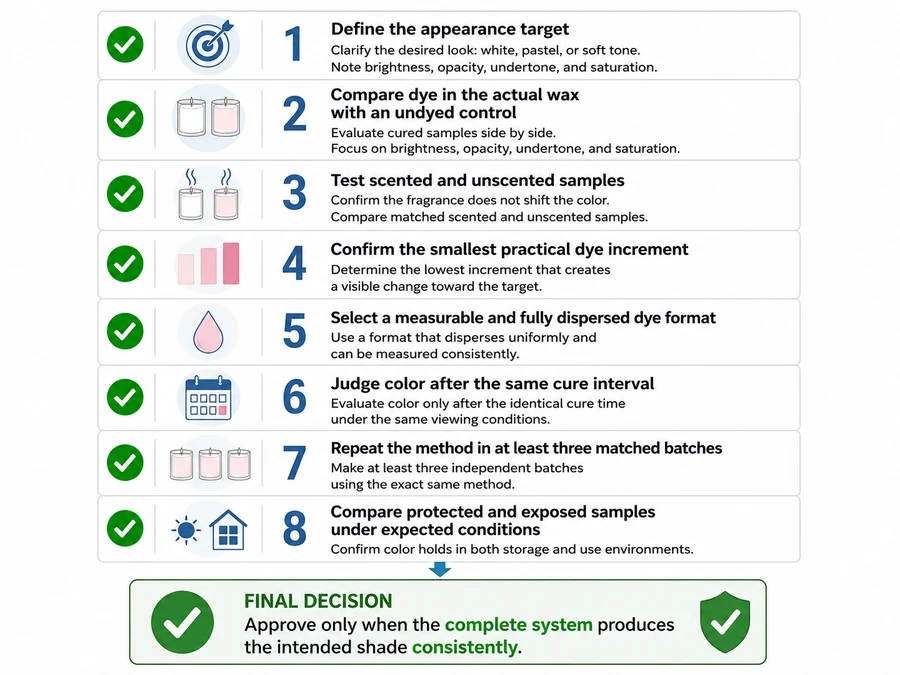
- Define the intended bright white, creamy white, translucent pastel, or muted appearance.
- Compare the dye in the actual wax using an undyed control.
- Test scented and unscented samples when fragrance may change the color.
- Confirm that the smallest practical dye increment approaches the target gradually.
- Select the liquid, chip, or block format that can be measured and dispersed consistently.
- Judge the finished color after the same declared cure interval.
- Repeat the selected method in at least three matched batches before making a repeatability claim.
- Compare protected and exposed samples under the expected storage and light conditions.
Approve the candle dye only when the complete wax, fragrance, dose, format, curing, and exposure system produces the intended subtle shade consistently.