
On June 14, 2026, observed package prices ranged from about $1.10 for one dye block to $6.50 for a 1-ounce liquid-dye bottle, but package price alone did not identify the lowest dye-only cost.
Candle dye is a colorant sold as liquid dye, dye chips, dye flakes, or dye blocks for coloring candle wax. In this comparison, “cost” means package price, normalized unit cost, usage-adjusted batch cost, or dye-only cost per finished candle. No format is universally cheapest because concentration, wax type, shade depth, package use, and handling loss can change the result. This page excludes full candle-production costs, selling prices, profit margins, detailed dosage instructions, safety analysis, and product rankings.
| Cost level | Meaning | Evidence basis |
|---|---|---|
| Package price | The listed price for one disclosed package | Supplier listing, currency, price status, and observation date |
| Normalized unit cost | Package price divided by listed volume, mass, or piece count | Supplier-stated package quantity |
| Usage-adjusted batch cost | Normalized unit cost multiplied by dye quantity used | Supplier-stated, measured, or modeled usage |
| Dye cost per candle | Dye-only batch cost divided by finished candles produced | Recorded or modeled batch yield |
| Practical purchase cost | Package spending adjusted for use, leftover stock, and documented loss | Disclosed planning period and consumption estimate |
How Do Liquid Dye, Dye Chips, and Dye Blocks Compare in Price?
Liquid dye, dye chips, and dye blocks use different package quantities and units, so listed prices identify only the lowest sticker price, not the lowest unit, batch, or per-candle cost.
Current examples range from about $1.10 for one dye block to $6.50 for a 1-ounce liquid-dye bottle. These sticker prices are not directly comparable because bottles may be listed by volume, solid flakes by mass, and chips or blocks by piece. (candlescience.com)
Dated Retail-Price Benchmark
The observed package prices range from $1.10 for one dye block to $6.50 for a 1-ounce liquid-dye bottle, but the listed units differ.
| Supplier | Dye format | Product example | Package quantity | Listed price | Price status | Observation date |
|---|---|---|---|---|---|---|
| CandleScience | Liquid dye | Blue liquid candle dye | 1 U.S. fl oz | $5.43 | Listed price | June 14, 2026 (candlescience.com) |
| Lone Star Candle Supply | Liquid dye | Liquid-dye range | 1 oz | $6.50 | April 2026 catalog price | June 14, 2026 (lonestarcandlesupply.com) |
| The Flaming Candle | Liquid dye | Purple liquid candle dye | 1 oz | $5.50 | Listed price; unavailable when checked | June 14, 2026 (The Flaming Candle) |
| The Flaming Candle | Dye chips | Red dye chips | 20 chips | $2.59 | Listed price; unavailable when checked | June 14, 2026 (The Flaming Candle) |
| The Flaming Candle | Dye blocks | Black dye block | 1 block | $1.10 | Listed price | June 14, 2026 (The Flaming Candle) |
| Bramble Berry | Dye flakes | Aqua blue candle-dye flakes | 1 weight oz | $4.99 | Listed price | June 14, 2026 (Bramble Berry) |
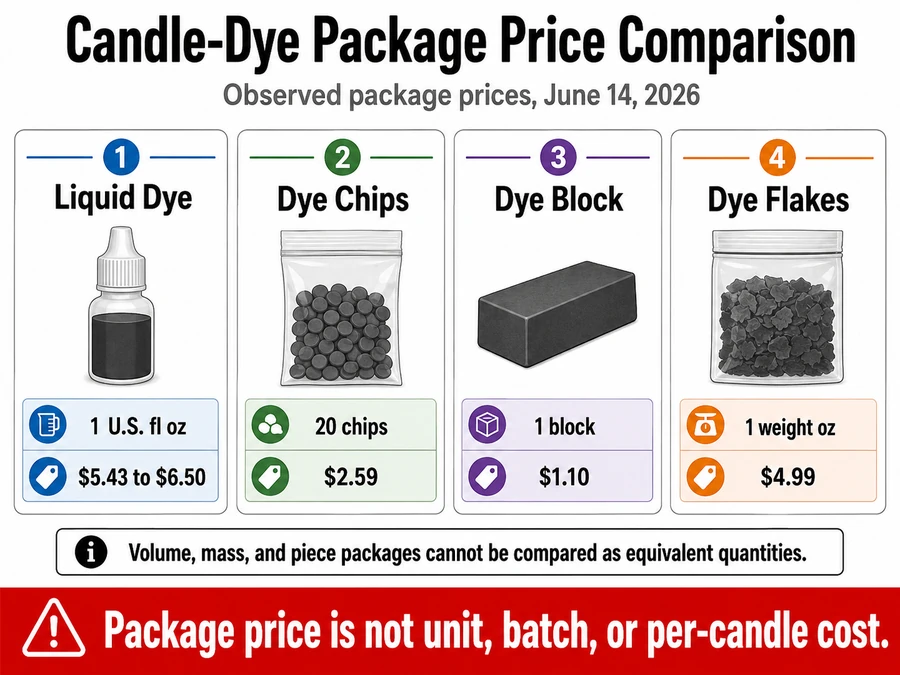
Methods: Prices and package quantities were recorded from supplier product pages or a current supplier catalog on June 14, 2026. The benchmark excludes shipping, tax, currency conversion, and unlisted discounts. It shows available package structures rather than a market average.
Landed package cost equals product price plus shipping and tax, minus applicable discounts. Use it only when every compared package uses the same disclosed purchase-cost basis.
The comparison keeps package price, normalized unit cost, usage-adjusted batch cost, dye cost per candle, and practical purchase cost as separate measures.
A $1.10 block has a lower upfront price than a $5.43 bottle, but that does not show which product colors more wax or costs less for an equivalent batch. A 20-chip package and a liquid bottle cannot be compared fairly until each product’s valid unit and required usage are stated.
What changed — June 14, 2026: Supplier prices, availability, package quantities, and promotional status were checked on this date. Impact: later changes can alter the benchmark, normalized costs, package-spend results, and comparisons based on them.
The fair comparison begins by calculating cost within separate volume, mass, and piece-count lanes.
How Do You Calculate Comparable Unit Cost for Liquid Dye, Chips, and Blocks?
Comparable candle-dye unit cost equals package price divided by package quantity, while liquid volume, solid mass, and piece-count units remain separate.
Liquid dye can be calculated per milliliter or fluid ounce. Weighed flakes or other solid dye can be calculated per gram or weight ounce. Unweighed chips and blocks must remain on a per-piece basis.
Normalized unit cost = package price ÷ package quantity
A U.S. fluid ounce measures volume and equals about 29.5735 milliliters. An avoirdupois ounce measures mass and equals about 28.3495 grams. These two ounce units are not interchangeable. (NIST Publications)
Mass-vs-Volume-vs-Piece Normalization Table
Liquid dye must remain volume-based, weighed solids mass-based, and unweighed chips or blocks piece-based until product-specific equivalence data exists.
| Format example | Listed price | Listed quantity | Valid normalized unit | Normalized cost | Comparison warning |
|---|---|---|---|---|---|
| CandleScience liquid dye | $5.43 | 1 U.S. fl oz | Cost per mL | $0.184/mL | Do not convert volume to mass without documented density. |
| Bramble Berry dye flakes | $4.99 | 1 weight oz | Cost per g | $0.176/g | A weight ounce is not a fluid ounce. |
| The Flaming Candle dye chips | $2.59 | 20 chips | Cost per chip | $0.130/chip | Chip mass is unknown, so cost per gram cannot be calculated. |
| The Flaming Candle dye block | $1.10 | 1 block | Cost per block | $1.10/block | Block mass is unknown, so the result remains per piece. |
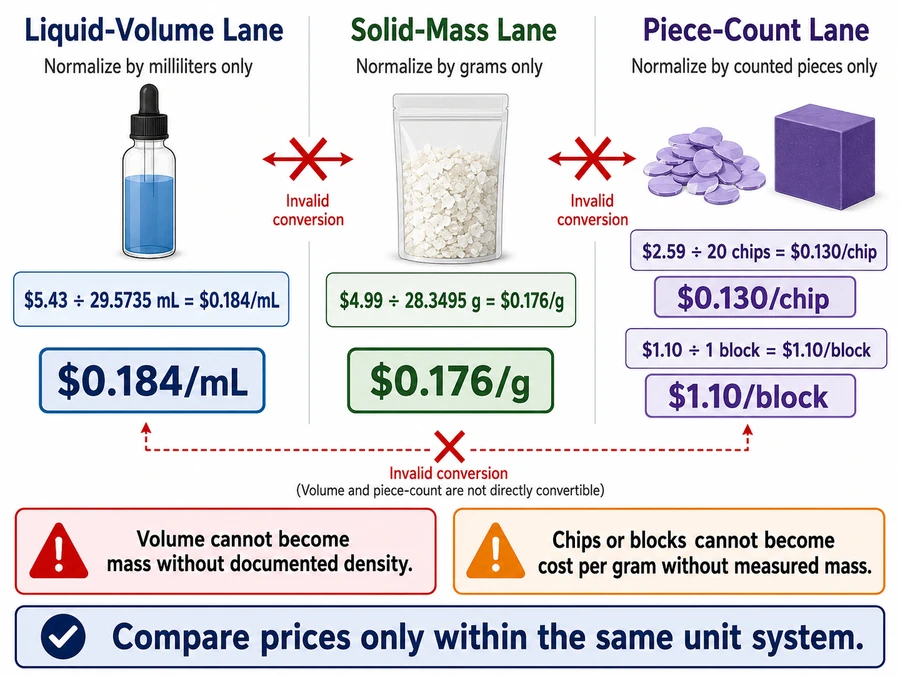
The listed quantities and prices come from the dated supplier observations above. (candlescience.com)
Volume-Based Liquid-Dye Calculation
The observed $5.43 liquid-dye bottle costs $0.184 per milliliter after converting 1 U.S. fluid ounce to 29.5735 milliliters.
$5.43 ÷ 29.5735 mL = $0.18361 per mL
Displayed result: $0.184/mL
The dividend is the bottle price, the divisor is its volume in milliliters, and the result is dollars per milliliter.
Mass-Based Solid-Dye Calculation
The observed $4.99 dye-flake package costs $0.176 per gram after converting 1 weight ounce to 28.3495 grams.
$4.99 ÷ 28.3495 g = $0.17602 per g
Displayed result: $0.176/g
The listed weight ounce is converted to grams before the package price is divided by mass.
Piece-Based Dye-Chip Calculation
$2.59 for 20 dye chips equals $0.130 per chip, with no valid cost-per-gram result unless chip mass is known.
$2.59 ÷ 20 chips = $0.1295 per chip
Displayed result: $0.130/chip
This value cannot be converted to cost per gram unless the chip mass is supplied or measured.
Piece-Based Dye-Block Calculation
A $1.10 single dye block costs $1.10 per block, with no valid mass-based comparison until the block is weighed.
$1.10 ÷ 1 block = $1.10 per block
Displayed result: $1.10/block
The result remains piece-based because the listing does not establish a comparable block mass.
Methods: The calculations use supplier package listings and NIST unit conversions. Full calculator values were retained until display rounding. All examples use U.S. dollars, so no exchange-rate conversion was required.
A liquid priced at $0.184 per milliliter cannot be declared cheaper or more expensive than chips priced at $0.130 each. Milliliters and pieces do not describe equivalent quantities or usable coloring yield.
When products use different currencies, convert each price with one disclosed exchange-rate date. When listings use different mass units, convert them to a shared mass unit before dividing. Do not assign an assumed weight to an unweighed chip or block.
Unit cost shows what a listed unit costs; batch cost requires the quantity consumed.
How Do You Calculate Candle-Dye Cost per Batch and per Candle?
Candle-dye cost per batch equals normalized unit cost multiplied by dye used; per-candle cost equals batch dye cost divided by finished candles.
The calculation covers candle dye only. It excludes wax, fragrance, wick, vessel, packaging, labor, overhead, selling expenses, customer shipping, and profit.
Dye cost per batch = normalized dye cost × dye quantity used
Dye cost per candle = dye-only batch cost ÷ finished candles produced
Candle-Dye Cost Comparator
Batch and per-candle dye cost require package price, package quantity, dye used, valid units, and finished candle yield.
| Comparator field | Required input | Unit or label | Purpose |
|---|---|---|---|
| Dye format | Liquid, chip, flake, or block | Format | Identifies the valid calculation lane |
| Package price | Listed purchase price | Currency | Establishes purchase cost |
| Package quantity | Bottle volume, solid mass, or piece count | mL, g, chip, or block | Supplies the unit-cost divisor |
| Normalized dye cost | Package price ÷ package quantity | Currency per valid unit | Supplies the batch-cost multiplier |
| Wax quantity | Wax in the batch | g or kg | States the batch basis |
| Dye quantity used | Recorded or assumed dye amount | mL, g, chip, or block | Supplies the batch-cost quantity |
| Finished yield | Completed candles from the batch | Candles | Supplies the per-candle divisor |
| Evidence class | Observed, supplier-stated, measured, or modeled | Label | Shows where the input came from |
| Unsupported conversion | Missing density, mass, or equivalence evidence | Warning | Blocks invalid cross-unit arithmetic |
Static Worked Example
In this modeled liquid-dye example, the batch dye cost is $0.1102 and the dye cost per finished candle is $0.0110.
- Observed package price: $5.43
- Observed package quantity: 29.5735 mL
- Calculated normalized cost: $0.18361/mL
- Modeled wax batch: 1,000 g
- Modeled dye quantity: 0.60 mL
- Modeled finished yield: 10 candles
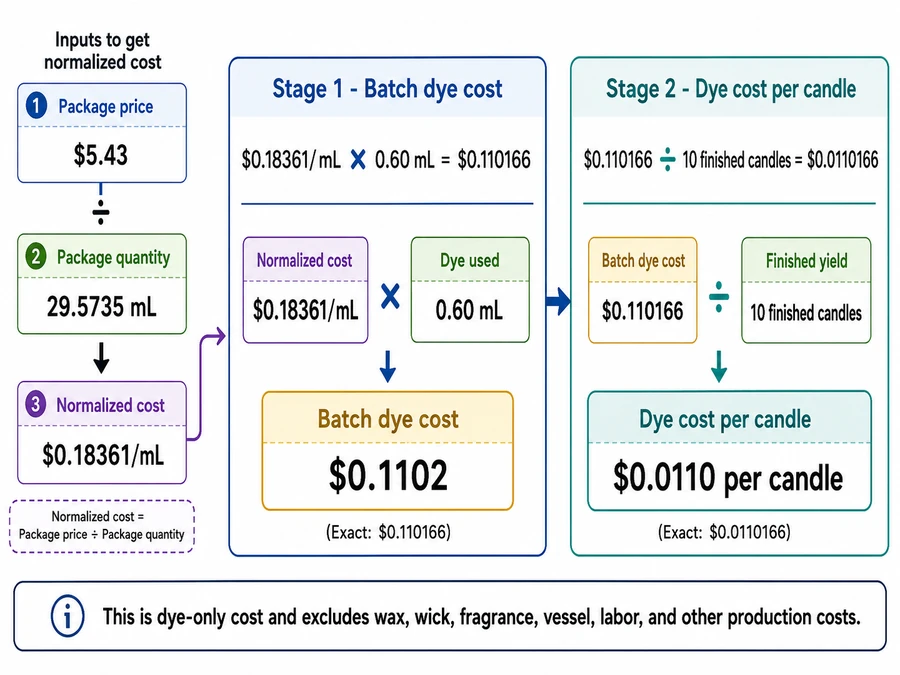
Step 1: Calculate the dye-only batch cost.
$0.18361/mL × 0.60 mL = $0.110166
Displayed batch cost: $0.1102
Step 2: Allocate the batch cost across finished candles.
$0.110166 ÷ 10 candles = $0.0110166 per candle
Displayed dye cost: $0.0110 per candle
Cost per candle means the candle-dye input allocated to one finished candle under the stated assumptions. It is not the candle’s total production cost or selling price.
When the same batch produces nine candles instead of ten:
$0.110166 ÷ 9 candles = $0.0122 per candle
A lower finished yield raises the allocated dye cost even when the dye quantity and package price remain unchanged.
Modeled Format Scenario
Under the disclosed model, the block has the lowest dye-only cost at $0.0880 per batch, followed by liquid at $0.1102 and chips at $0.1295. The three rows use a 1,000-gram wax batch, a modeled comparable shade target, and a yield of 10 candles; the quantities are not dosage recommendations.
| Format example | Normalized cost | Modeled dye quantity | Dye cost per batch | Dye cost per candle |
|---|---|---|---|---|
| Liquid dye | $0.18361/mL | 0.60 mL | $0.1102 | $0.0110 |
| Dye chips | $0.12950/chip | 1 chip | $0.1295 | $0.0130 |
| Dye block | $1.10/block | 0.08 block | $0.0880 | $0.0088 |
Methods: Package values come from the dated retail benchmark. Dye quantities, wax quantity, shade target, and candle yield are disclosed models created to show the formulas. The table does not represent measured color matches or supplier-backed equivalence.
Evidence labels separate four input types:
- Observed retail data is a price or package quantity recorded from a supplier.
- Supplier-stated data is a usage or yield figure published for a named product.
- Measured data is a quantity recorded during a real batch.
- Modeled data is a disclosed assumption used for calculation or sensitivity testing.
Package price cannot produce a batch-cost answer while the amount used remains unknown. The cheapest format can be named only after wax, shade target, usage basis, and finished yield are stated.
Why Can Concentration and Usable Yield Reverse the Cheapest Format?
Package or unit price cannot identify the cheapest candle-dye format unless the amount needed for the same wax-and-shade outcome is compared.
Usable yield is the amount of wax that a disclosed quantity of candle dye can color to a stated shade under named conditions. Concentration and yield can vary by supplier, product, color, wax, and target shade.
Wax type and target shade can change the quantity required, so a cost comparison must keep the wax, shade target, batch size, and evidence basis constant. This page uses that principle only to qualify cost and does not provide dosage instructions or wax-specific formulations.
CandleScience states that one ounce of its liquid-dye range can color up to 100 pounds of wax to a medium shade, while noting that wax, fragrance, additives, and color choice affect the result. This type of claim must remain attached to the named supplier and stated conditions. (candlescience.com)
Yield-Adjusted Format Comparison
Under the disclosed model, the block has the lowest batch cost at $0.0880, but the ranking changes when the required quantity changes.
| Product label | Format | Package basis | Usage basis | Wax basis | Shade basis | Effective batch cost | Evidence class |
|---|---|---|---|---|---|---|---|
| Model L | Liquid | 29.5735 mL | 0.60 mL per batch | 1,000 g | Modeled medium shade | $0.1102 | Observed price; modeled usage |
| Model C | Chips | 20 chips | 1 chip per batch | 1,000 g | Modeled medium shade | $0.1295 | Observed price; modeled usage |
| Model B | Block | 1 block | 0.08 block per batch | 1,000 g | Modeled medium shade | $0.0880 | Observed price; modeled usage |
Effective batch cost = quantity required for the controlled outcome × normalized dye cost
Under this model, the block has the highest cost per listed piece but the lowest batch cost because only 0.08 block is assigned to the batch. That result applies only to the disclosed quantities.
When the block requirement rises from 0.08 to 0.16 block:
$1.10/block × 0.16 block = $0.1760 per batch
At that quantity, the modeled liquid cost of $0.1102 becomes lower. The ranking reverses because the required quantity changed, not because the package prices changed.
Supplier yield claims are not directly comparable when they use different waxes, colors, shade depths, batch sizes, or measurement methods. Drops cannot be treated as milliliters without a product-specific measurement, and chips, shaved blocks, grams, and pieces are not universal equivalents.
“Equivalent cost” means the amount spent to reach a disclosed comparable shade target in a named wax and batch condition. It does not promise identical color, consistency, burn behavior, or long-term stability.
The calculation qualifies cost only; it does not supply complete dosage charts, recipes, or performance testing.
When Does a Larger Candle-Dye Package Reach Its Break-Even Quantity?
A larger candle-dye package saves money when total spending on the complete packages needed for expected use is lower than the alternative package strategy.
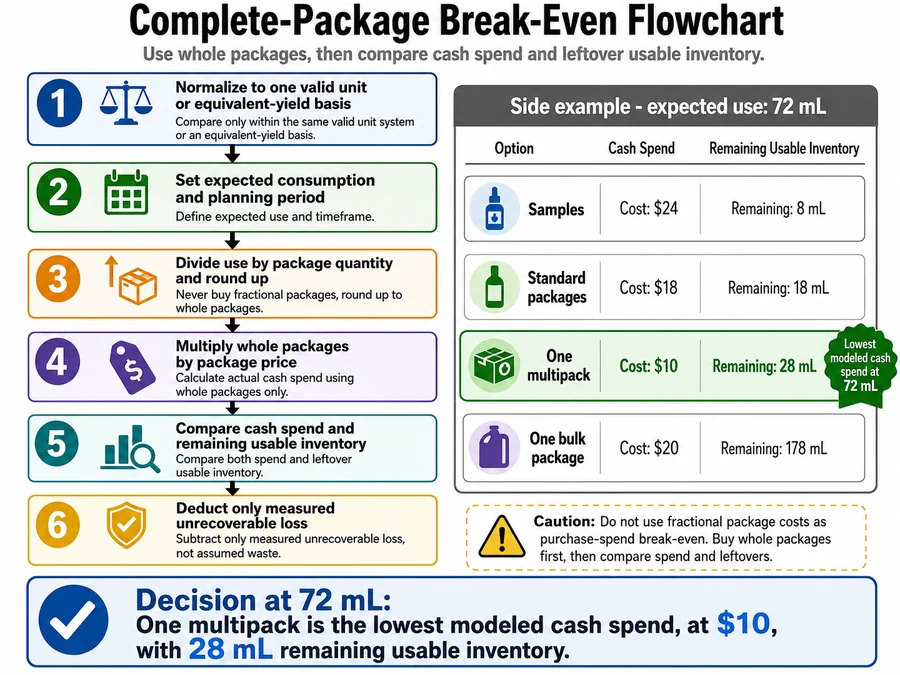
Purchase-spend break-even is the first quantity interval where complete-package cash spending becomes lower than the comparison option. The model below uses one liquid-dye unit basis, a 12-month period, expected consumption of 72 milliliters, and recoverable leftover stock.
Package Purchase-Spend Comparison
At 72 milliliters of expected use, the modeled multipack has the lowest cash purchase spend at $10; the sample, standard, and bulk strategies cost $24, $18, and $20.
| Package tier | Package price | Package quantity | Unit cost | Complete packages required | Total cash spend | Quantity obtained | Remaining usable inventory | First quantity where spend beats repeated samples |
|---|---|---|---|---|---|---|---|---|
| Sample package | $3.00 | 10 mL | $0.30/mL | 8 | $24.00 | 80 mL | 8 mL | Baseline |
| Standard package | $6.00 | 30 mL | $0.20/mL | 3 | $18.00 | 90 mL | 18 mL | Above 20 mL |
| Multipack | $10.00 | 100 mL | $0.10/mL | 1 | $10.00 | 100 mL | 28 mL | Above 30 mL |
| Bulk package | $20.00 | 250 mL | $0.08/mL | 1 | $20.00 | 250 mL | 178 mL | Above 60 mL |
Complete packages required = expected use ÷ package quantity, rounded up to the next whole package
Total purchase spend = complete packages required × package price
Remaining usable inventory = quantity obtained − expected use
The thresholds in the table compare each larger tier with repeated 10-milliliter sample purchases and assume that partial packages cannot be bought.
For 72 milliliters of expected use, eight sample packages cost $24, three standard packages cost $18, one multipack costs $10, and one bulk package costs $20.
How to Calculate Break-Even With Complete Packages
Use complete-package spending rather than a linear unit-saving formula when the seller does not offer fractional packages.
- Normalize the alternatives to the same valid unit or equivalent-yield basis.
- Set the expected consumption and planning period.
- Divide expected consumption by package quantity and round the result up to a whole package.
- Multiply the complete package count by the package price.
- Compare total cash spending and record the remaining usable quantity separately.
- Reduce usable quantity only for measured unrecoverable loss.
Methods: All prices and quantities in this package model are hypothetical. The calculation assumes the same dye concentration and usable yield, excludes shipping, taxes, and promotions, and treats remaining usable dye as recoverable inventory.
The four cost labels can produce different winners:
- Lowest unit cost: The bulk package at $0.08 per milliliter.
- Lowest upfront purchase: The sample package at $3.
- Lowest modeled 12-month purchase spend: The multipack at $10.
- Lowest practical cost: The package that reaches break-even without excessive unused stock or loss.
Unused but recoverable dye is not waste. It still ties up money and may prevent a lower unit price from creating savings during the stated period.
Current supplier listings show that package size can materially reduce unit price. For example, one navy-blue block is listed at $1.10, while 10 blocks are listed at $7.67 and 40 at $27.78. The lower per-block prices do not prove that a larger pack suits the buyer’s actual consumption. (The Flaming Candle)
Handling and storage losses should alter break-even only when the lost quantity is recorded.
Why Do Handling and Storage Losses Change the Real Cost of Candle Dye?
Handling and storage loss raise candle-dye cost only when purchased dye becomes unrecoverable or unusable.
A recoverable leftover remains usable in another batch. Unused inventory remains usable but falls outside the current planning period. Unrecoverable waste cannot be used because of leakage, contamination, residue, deterioration, or a recorded handling event.
Modeled Handling-Loss Example
A modeled 30.0-milliliter bottle with 0.9 milliliters of unrecoverable residue has a 3.0% loss rate; these values are not format averages.
Loss rate = unrecoverable quantity ÷ starting quantity × 100
0.9 mL ÷ 30.0 mL × 100 = 3.0%
Loss-adjusted unit cost = purchase price ÷ recovered usable quantity
For a modeled $6 bottle with 29.1 milliliters recovered, $6.00 ÷ 29.1 mL = $0.2062 per recovered milliliter, compared with $0.2000 per milliliter before loss.
Methods: Apply a loss adjustment only when the quantity is measured, unrecoverable, and tied to a named product or handling event. Usable leftovers remain inventory, while labor and cleanup time remain outside this dye-only calculation.
Use only measured or documented loss when adjusting candle-dye cost.
Which Dye Format Is Cheaper for Small Batches Versus Regular Production?
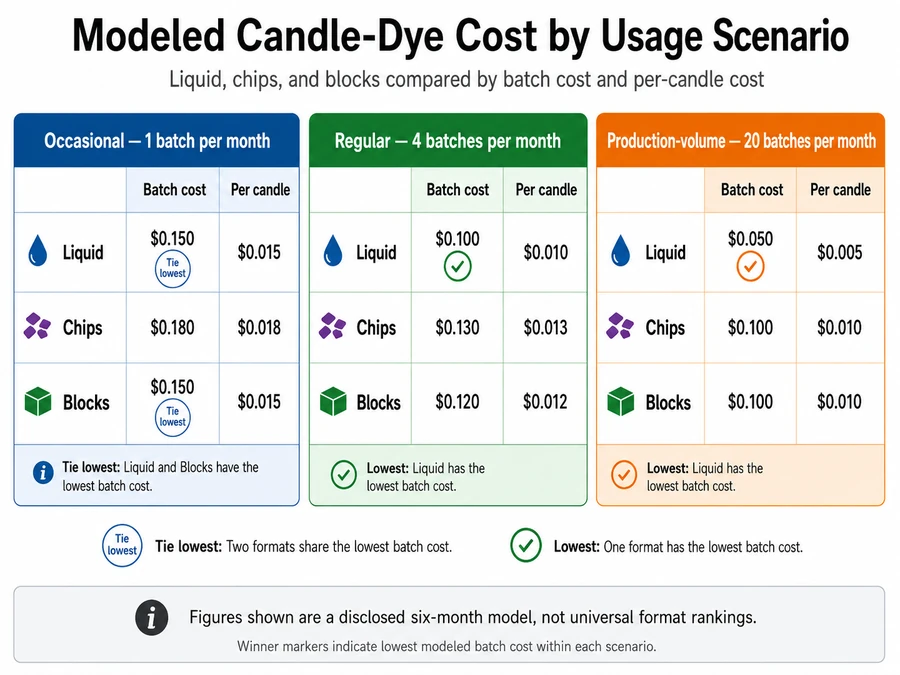
Under the disclosed six-month model, blocks and liquid tie for occasional batches, while liquid has the lowest modeled batch cost for regular and production-volume use.
The six-month model defines occasional production as 1 batch per month, regular production as 4 batches per month, and production-volume use as 20 batches per month. Each batch contains 1,000 grams of wax and produces 10 candles.
These are calculation labels for this comparison rather than industry classifications.
Small-Batch-vs-Production Scenario Matrix
This model does not establish a universal cheapest format because its package prices and assigned usage quantities are hypothetical.
| Scenario | Batches per month | Dye format | Package size | Upfront spend | Monthly dye use | Six-month package use | Dye cost per batch | Dye cost per candle | Practical verdict |
|---|---|---|---|---|---|---|---|---|---|
| Occasional | 1 | Liquid | 10 mL | $3.00 | 0.5 mL | 30% | $0.150 | $0.015 | Low consumed cost, but most of the package remains |
| Occasional | 1 | Chips | 10 chips | $1.80 | 1 chip | 60% | $0.180 | $0.018 | Moderate purchase price and highest batch cost |
| Occasional | 1 | Blocks | 1 block | $1.50 | 0.1 block | 60% | $0.150 | $0.015 | Lowest upfront spend and tied batch cost |
| Regular | 4 | Liquid | 30 mL | $6.00 | 2 mL | 40% | $0.100 | $0.010 | Lowest modeled batch cost |
| Regular | 4 | Chips | 50 chips | $6.50 | 4 chips | 48% | $0.130 | $0.013 | Higher purchase and batch costs |
| Regular | 4 | Blocks | 5 blocks | $6.00 | 0.4 block | 48% | $0.120 | $0.012 | Second-lowest modeled batch cost |
| Production-volume | 20 | Liquid | 100 mL | $10.00 | 10 mL | 60% | $0.050 | $0.005 | Lowest modeled cost at repeated use |
| Production-volume | 20 | Chips | 200 chips | $20.00 | 20 chips | 60% | $0.100 | $0.010 | Double the liquid batch cost |
| Production-volume | 20 | Blocks | 20 blocks | $20.00 | 2 blocks | 60% | $0.100 | $0.010 | Matches chips with higher upfront spend |
Monthly dye use = dye quantity per batch × batches per month
Package use = expected dye consumed ÷ usable package quantity × 100
Effective dye cost per batch = normalized unit cost × dye quantity per batch
The model holds currency, soy wax, medium shade, batch size, finished yield, and the six-month period constant. Its assigned equivalent-batch quantities are 0.5 milliliters of liquid dye, 1 chip, or 0.1 block.
For occasional batches, the block has the lowest upfront purchase at $1.50 and ties liquid dye at $0.150 per batch. The liquid package produces the same consumed batch cost but leaves 70% of the package unused after six months.
At four batches per month, the standard liquid package falls to $0.100 per batch. Its lower unit cost outweighs its remaining stock under the disclosed model.
At 20 batches per month, repeated use supports the larger liquid package. Its modeled batch cost falls to $0.050, compared with $0.100 for chips and blocks.
A larger package is not economical when expected consumption stays below its break-even quantity. Unused but recoverable dye remains inventory, while recorded unrecoverable loss reduces usable quantity.
Convenience and repeatability may influence a purchase, but they are not candle-dye savings without a measured change in consumption, loss, or completed yield.
The economical choice is the format whose package use matches the stated production period without requiring excess upfront spending.