
Candle additives are formula-level ingredients added to candle wax to change scent performance, appearance, structure, stability, or burn behavior. On this page, “candle additives” means wax additives such as fragrance oils, dyes, UV stabilizers, and structure modifiers; it does not include decorative embeds, botanicals, glitter, or the broader non-toxic-candle debate.
Most candles work with just wax, a wick, and heat, but small add-ons can solve problems that show up after a few test burns. Additives can increase scent, deepen or soften color, increase opacity, improve glass adhesion, or change how hard the finished candle feels. The same additive can help one wax and make another smoke, sweat, or lose hot throw if the dose is off. Knowing what each additive actually does makes it easier to pick a simple starting formula and troubleshoot from the melt pot to the first burn.
This page is the overview hub for candle additive families, what each family changes, and the main trade-offs. Use common additives used in candle making for deeper additive mechanics, and use how to choose candle additives, how to mix candle additives, are candle additives safe, and UV additives for discoloration when you need decision, process, safety, or UV detail.
Quick decision map (start here)
- Trying to fix wet spots or pull-away? Use this page to identify the additive family first, then test process variables before any adhesion-focused modifier.
- Trying to fix weak hot throw? Go to how to choose candle additives only after wick choice, fragrance load, and process are stable.
- Trying to fix fading or discoloration? Go to UV additives for discoloration after you confirm the dye and fragrance combination is the real issue.
- Trying to get a smoother, brighter white? Start by confirming whether you need an opacifier, then test titanium dioxide before later-stage visual tweaks.
- Trying to improve pillar hardness or mold release? Use this page to confirm the additive family, then go to how to mix candle additives if you need process detail.
What candle additive families are most common?
The main candle additive families are scent additives, color and appearance additives, structure and burn modifiers, stability and defect-control additives, and a smaller group of advanced specialty additives. Each family changes a different part of the formula, so the useful starting point is the family that matches the one problem you are trying to change.
In practice, the “right” additive on this page means the additive family that matches one defined formula problem after wick choice, wax selection, pour process, and cure conditions are already stable. Start from the smallest change that matches the problem, and add only one variable at a time. Always follow the handling notes and maximum-use guidance from your supplier before testing anything new.
Common vs advanced at a glance
- Common (most makers use early): fragrance oils, essential oils (with caution), liquid dyes, dye chips/blocks, UV inhibitors, titanium dioxide, stearic acid (pillars)
- Advanced/specialty (use after you’ve nailed basics): mica in wicked candles, Vybar, microcrystalline wax tuning, mottling with mineral oil, antioxidants, optical brighteners, odor neutralizers, IPM, TEC, EVA pellets
Here are the most common additive groups you’ll see, and what they’re for:
- Scent additives: fragrance oil or essential oil; sometimes solubility or fixative helpers (when compatible)
- Color & appearance additives: liquid dyes, dye chips/blocks, pigments/opacifiers (like titanium dioxide), mica (for melts, not always for wicked candles)
- Structure & burn modifiers: stearic acid, microcrystalline wax, polymer binders, “hardener” blends, softeners in some blends
- Defect-control helpers: UV inhibitors, adhesion promoters, antioxidants (mainly for stability in storage)
| Additive family | What it changes | When to use it | Main trade-off |
|---|---|---|---|
| Scent additives | Cold throw, hot throw, fragrance stability | When the candle needs scent or better scent consistency | Too much or the wrong match can reduce burn quality or mute hot throw |
| Color and appearance additives | Shade, opacity, brightness, shimmer | When you want a specific look or stronger white/pastel coverage | Overloading can create specks, soot, or wick-feeding issues |
| Structure and burn modifiers | Hardness, opacity, release, adhesion, surface finish | When you need cleaner release, smoother tops, or better jar appearance | Any structure change can alter melt pool behavior and wick demand |
| Stability and defect-control additives | Fading, discoloration, storage stability, odor control | When the formula already works and you are solving a specific shelf or display problem | Extra complexity with no guarantee of improvement if the base formula is unstable |
| Advanced/specialty additives | Narrow finish, clarity, separation, or adhesion problems | After your base wax, wick, and process are already repeatable | High drift risk, extra testing, and more ways to create new problems |
Use this table to identify the family first. Stay on this page for family-level orientation, then move to common additives used in candle making when you need additive-by-additive mechanics, or use the linked child pages when you need decision, safety, process, or UV detail.
1) Scent additives
Fragrance oil (FO) is the most common scent additive in container candles because it’s formulated for wax use and tends to be more consistent than essential oil (EO) across batches. EOs can work in some blends, but they’re more likely to fade, separate, or shift in hot throw depending on the oil family and the wax matrix.
Scent “helpers” exist, but they’re not magic. Some additives aim to improve solubility, reduce separation, or change how a blend behaves while curing. If you’re troubleshooting separation rings or cloudiness, focus first on process fundamentals, temperature, mixing time, and compatibility so you’re not changing three variables at once.
2) Color and appearance additives
Color additives fall into two big buckets:
- Soluble dyes (liquid dyes, dye chips/blocks): dissolve into the wax and color the candle without adding particles. These are common for clean-burning, evenly colored candles.
- Dispersed pigments/opacifiers (titanium dioxide, some specialty colorants): create opacity and can make pastels look stronger, but they must be dispersed well to avoid specking and wick issues.
A common beginner pitfall is over-coloring. Too much dye can thicken the melt or interfere with capillary action at the wick, which can show up as soot, small flame, or tunneling.
Titanium dioxide is useful when you want a smoother, more opaque white, but it behaves more like a fine particulate than a dye. Mica is best treated as a special-effect colorant that needs extra testing because it can clog a wick in some candles and is usually easier to use in melts than in wicked candles.
3) Structure and burn modifiers
These additives change the physical structure of the wax:
- Stearic acid (stearin): commonly used in pillars to increase hardness, opacity, and mold release.
- Microcrystalline wax: can improve flexibility and reduce cracking in some blends, and can help with adhesion/appearance depending on formulation.
- Vybar and polymer binders: can increase opacity and change how a wax holds fragrance, but too much can flatten hot throw and change burn behavior.
- Hardener blends: can change opacity, texture, and how the candle releases, but may also require wick adjustments.
The trade-off is that structure changes can alter how the melt pool forms, which changes wick demand. Structure modifiers and particulate additives often need a fresh wick test because they can change melt-pool behavior or how the wick feeds. That’s why “better tops” or cleaner release sometimes comes with a need to re-test wick size.
4) Stability and defect-control additives
UV inhibitors and stabilizers are designed to slow discoloration and fading, especially in dyed candles and some fragrance profiles that discolor naturally. Even with stabilizers, the best “fix” is usually a combination of realistic expectations for the dye and fragrance combination, controlled storage/display, and repeatable test conditions so you can tell whether a change actually helped.
Antioxidants and odor-control additives are more specialized. They are used more often in production or long-shelf-life contexts where oxidation, storage, or a target malodor is the real problem. They’re not a substitute for clean raw materials, good storage, and a stable base formula.
5) Advanced and specialty additives
Mottling with mineral oil, optical brighteners, IPM, TEC, and EVA pellets can all solve narrow finish, clarity, separation, or adhesion problems, but they are better treated as specialty additives after you have a stable base wax, wick, and process. For most beginners, they add complexity faster than they add value.
How do you choose the right candle additive?
On this page, the “right” additive means the additive family that matches one defined formula problem after wick choice, wax selection, pour process, jar prep, and cure time are already stable. Use this section as a short routing guide, then move to how to choose candle additives or how to mix candle additives when you need detailed decision or process work.
Use this sequence to avoid chasing your tail:
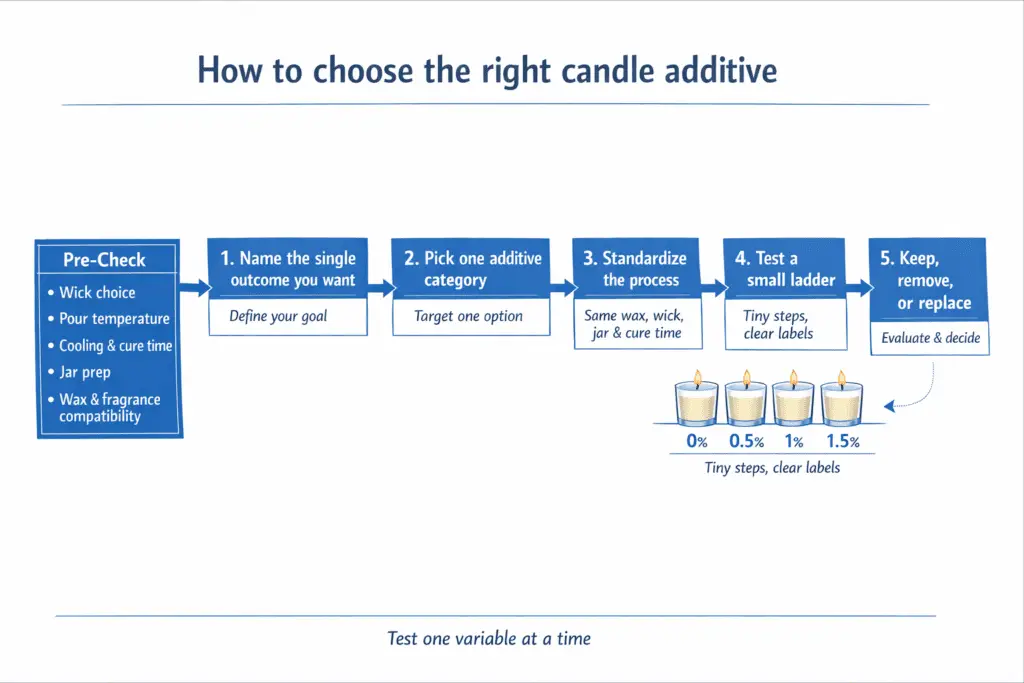
- Name the single outcome you want (stronger throw, deeper opacity, fewer wet spots, better mold release).
- Pick one additive category that targets that outcome.
- Standardize the process (same wax batch, same wick series, same jar, same cure time).
- Test a small ladder (tiny steps, clear labels, repeatable notes).
- Only then decide whether to keep, remove, or replace the additive.
Container candles more often use fragrance oils, dyes, UV inhibitors, and small finish or adhesion modifiers. Pillars and votives more often use stearic acid, Vybar, or hardener-type modifiers for structure and release. Soy-heavy blends usually respond best to process fixes first, then small modifier tests if the cosmetic problem remains.
You also may not need additives at all. If a candle already burns cleanly, throws well, looks good in its container, and stays stable in storage, extra ingredients can create more variables than benefits.
Which candle additives are safest, riskiest, or often unnecessary?
On this page, “safest,” “riskiest,” and “often unnecessary” refer to candle-fit and burn-performance risk during normal maker testing, not to toxicology, indoor-air, pet-safety, or regulatory claims. Use are candle additives safe for that deeper review.
Use this section only as a short routing layer: fragrance oils, candle dyes, UV inhibitors, and stearic acid are usually earlier tests, while mica in wicked candles, titanium dioxide, Vybar, microcrystalline wax, and hardener blends usually need more caution because they can change wick behavior, soot, or finish. For deeper compatibility questions, use candle additive safety, and use candles without additives when the base formula already works.
FAQ about candle additives
Do you need additives to make candles?
No. Most candles work with just wax, a wick, and heat. Additives make more sense when you have a specific problem to solve, like weak scent, fading color, rough tops, poor adhesion, or difficult mold release.
Which additives most often affect burn behavior?
Structure modifiers, heavy color loads, and particulate additives are the most common burn changers. Stearic acid, Vybar, hardeners, microcrystalline wax, titanium dioxide, and mica can all shift how the melt pool forms or how the wick feeds, which is why a cosmetic win often needs a fresh wick test. For the full problem-to-family route, use the additive chooser.
Which additive should you try first for a specific problem?
Start with the additive family that matches one defined problem after your base process is stable, then use the additive chooser for the detailed route. This hub only tells you which family to investigate first; it does not replace the full chooser or test plan.
Which additives are best left until later?
Specialty additives like mineral oil for mottling, optical brighteners, odor neutralizers, antioxidants, IPM, TEC, and EVA are better saved for later-stage troubleshooting. They can be useful, but they belong after you already have a stable formula and a clear reason to add one more variable, and deeper safety or choice questions should move to the safety page or the chooser.