
Soy wax is the best starting point for most beginner container candles, but the right wax still depends on candle type, scent goals, finish, and budget.
Many candle makers choose wax too early based on a single feature, such as scent throw or a natural label. The best candle wax is the one that fits the candle type, burn goals, budget, and amount of testing you can do. Soy, beeswax, paraffin, coconut, and blends each solve different problems for jars, tins, pillars, and molded candles. This guide helps you match the wax to the project so you can start with fewer mistakes and better results.
Best Candle Wax Overall: Soy vs Beeswax vs Paraffin vs Coconut
Among the main types of candle wax, soy wax is the best starting point for most beginner container candles because it is widely available, easy to work with, and suitable for common jar and tin candles.
Beeswax is often the better choice for firmer, longer-burning candles. Paraffin usually performs best for strong scent throw and lower upfront cost. Coconut wax, or coconut-based blends, can offer a smoother and more premium-looking finish, but they often cost more and may require more testing.
The reason people disagree so much about candle wax is simple: they are usually solving different problems. One person wants stronger fragrance, another wants easier beginner results, and another wants a more natural wax. They are not choosing between good and bad waxes. They are choosing between different priorities.
If ingredient preference matters most, that can change the answer. Makers who want a more natural-leaning option often choose soy, beeswax, or some blends, while makers focused on performance often compare those priorities against natural vs synthetic wax tradeoffs before deciding.
| Wax family | Best for | Main strength | Main weakness | Ideal reader |
| Soy | Beginner jars and tins | Easy to source and forgiving for first container candles | Can have lighter scent throw and rougher tops | Home maker who wants a simple starting point |
| Beeswax | Firm, long-burning candles | Dense, firm, and well suited to longer-burning styles | Higher cost and less flexible for low-budget testing | Maker who prioritizes firmness and long burn |
| Paraffin | Strong scent throw and value | Often throws fragrance very well and keeps costs down | Less appealing for those who prefer natural-leaning waxes | Maker focused on performance and margin |
| Coconut | Smooth container candles and premium blends | Creamy appearance and softer premium feel | Higher cost and less common as a simple first wax | Maker willing to pay more for finish and feel |
| Blends | Balanced tradeoffs | Can combine strengths such as better adhesion, throw, or finish | Harder to compare because formulas vary | Maker trying to solve one specific weakness in a pure wax |
This table compares the main candle wax families by use case, strength, weakness, and who each option usually suits best.
A simple way to choose, especially after a deeper soy vs beeswax vs paraffin comparison, is to match the wax to the job:
- Choose soy for your first jar or tin candle when ease matters most.
- Choose beeswax for firmer candles where shape and long burn matter more than low cost.
- Choose paraffin when stronger fragrance output or lower production cost matters most.
- Choose coconut or a blend when you want a smoother, more premium finish and are willing to test more.
Best Wax by Candle Type
Container candles usually need softer waxes with good adhesion, while pillar candles need firmer waxes or pillar blends that can hold their shape.
For most candle makers, candle format matters more than marketing. A wax that performs well in a jar may fail completely as a pillar. This is one of the biggest beginner mistakes. Before comparing scent throw, finish, or price, make sure the wax suits the candle type.
| Candle type | Best wax path | Why it fits | What to watch for |
| Jars | Soy, coconut blends, or other container waxes | Good vessel adhesion and softer structure suit glass containers | Rough tops, frosting, or weak adhesion if the wax is mismatched |
| Tins | Container waxes with good adhesion | Tins still need a wax that stays stable inside the vessel | Heat buildup and surface flaws can show quickly |
| Pillars | Pillar paraffin, beeswax, or pillar blends | Freestanding candles need firmness and clean release from molds | Slumping, dents, or bending if the wax is too soft |
| Votives | Firm votive or pillar-style blends | Small freestanding formats still need structure | Poor release or misshapen sides |
| Decorative shapes | Firm pillar blends or beeswax-heavy options | Detailed molds need strong shape retention | Fine details can deform with softer waxes |
| Emergency or utility candles | Beeswax, paraffin, or firmer utility blends | Longer burn and structural stability usually matter most | Decorative finish matters less than reliability |
This table shows which wax paths fit common candle formats and the main issue to watch for in each one.
A practical way to choose the right wax is to follow three steps:
- Decide whether the candle stays in a container or must stand on its own.
- Choose for the actual use case, such as home fragrance, décor, gifting, or utility.
- Fine-tune for scent throw, finish, and cost only after the format is correct.
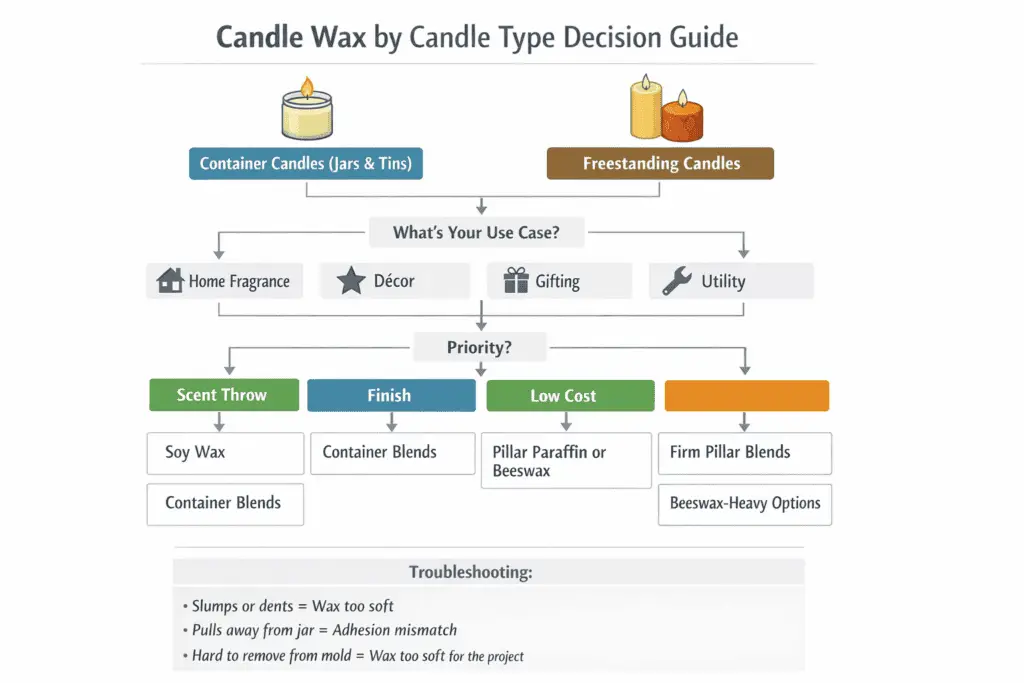
A few problems are easy to diagnose. If a freestanding candle slumps or dents, the wax is usually too soft. If a jar candle pulls away badly from the container, the wax may not have the right adhesion for that setup. If removing the candle from a mold is difficult, the wax is often too soft for that project.
How Candle Waxes Compare on Scent Throw, Burn, Adhesion, and Finish
Paraffin and paraffin-heavy blends usually deliver the strongest scent throw, while soy and coconut waxes often trade some fragrance strength for other advantages.
No wax wins every category. The best choice depends on whether you care most about fragrance strength, smoother tops, cleaner jar adhesion, cure speed, or overall burn behavior. These are common maker patterns rather than fixed rules, because the result also changes with vessel, wick, fragrance load, and typical cure time by wax type.
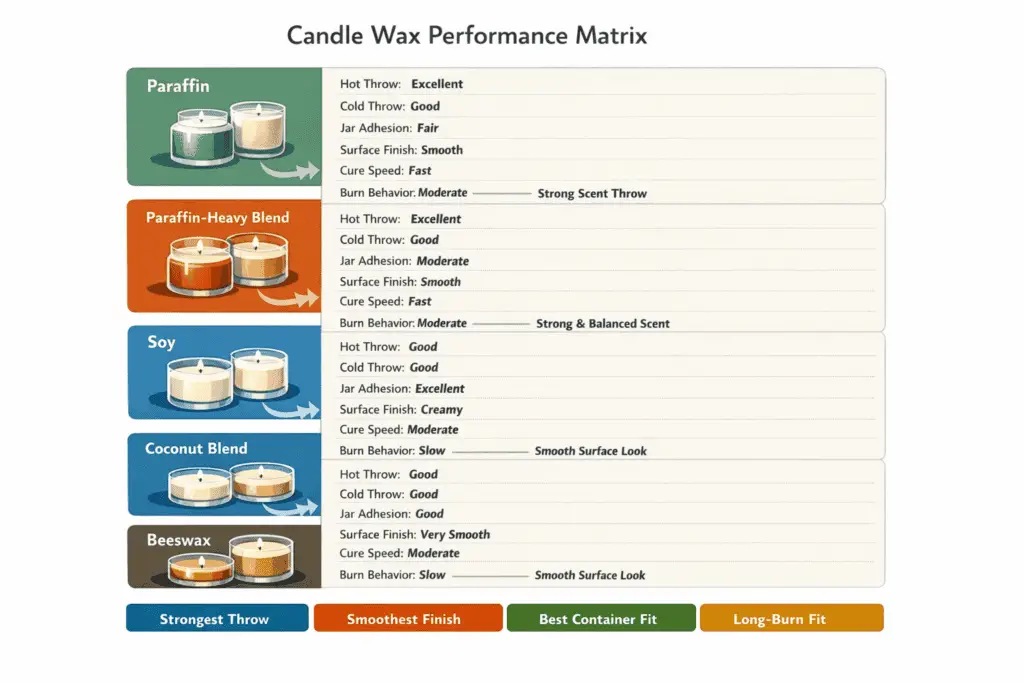
| Wax family | Hot throw | Cold throw | Jar adhesion | Surface finish | Cure speed | Burn behavior | Best when your priority is |
| Paraffin | Strong | Strong | Good in the right system | Usually smooth | Faster | Steady and performance-led | Maximum scent throw and easier repeatability |
| Paraffin-heavy blend | Strong | Strong | Good | Smooth | Faster to moderate | Balanced | Strong throw without going fully paraffin |
| Soy | Moderate | Moderate | Good in container formats | Can show rough tops or frosting | Slower | Gentle and container-friendly | Beginner jars and common home-use pours |
| Coconut blend | Moderate to strong | Moderate | Good to very good in the right blend | Often smooth | Moderate | Balanced | Premium-looking container candles |
| Beeswax | Mild to moderate | Mild | Less important than firmness | Firm, clean-looking molded finish | Moderate | Long and steady burn path | Shape retention and longer-burning styles |
This table compares common wax families by the performance traits makers usually test first.
A fast way to read the comparison is this:
- For the strongest scent throw, paraffin and paraffin-heavy blends usually lead.
- For smoother tops and a more polished finish, paraffin and some coconut blends often perform better.
- For container-friendly adhesion, soy blends and container-tuned waxes are usually safer choices than firmer freestanding waxes.
- For easier curing and repeatability, paraffin often requires less waiting than many soy-heavy waxes.
Common performance problems usually follow a pattern. Weak scent throw does not always mean the wax is wrong. The wick, fragrance load, cure time, and vessel size all affect the result. Rough tops on soy are common and do not automatically mean the candle failed. Poor jar adhesion usually points to a mismatch between wax, vessel, or pouring conditions. Testing too early, before cure is complete, can also make a wax seem worse than it really is.
A smart way to choose by performance is to keep it simple:
- Pick one main priority first, such as scent throw, finish, adhesion, cure speed, or burn behavior.
- Make sure the wax still fits the candle format.
- Accept one likely tradeoff, such as slower cure for soy or higher cost for a premium blend.
- Test only one major variable at a time.
How Wax Cost Changes the Best Choice
Paraffin is often the cheapest upfront, but the best-value wax depends on cost per candle, burn time, supplier availability, and how much waste or retesting you end up with.
Looking only at price per pound can be misleading. A wax that seems cheap may lose its advantage once freight, remake rates, local stock, or burn behavior enter the picture. Real value comes from comparing cost per candle first, then judging whether performance justifies the difference.
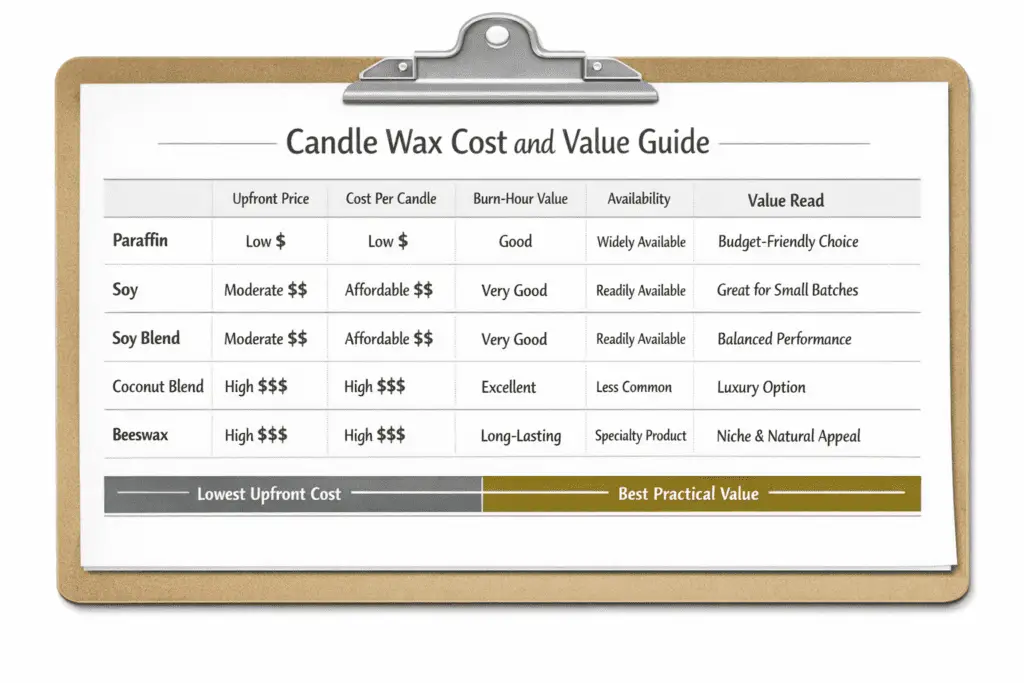
| Wax family | Upfront price pattern | Cost per candle pattern | Burn-hour value pattern | Availability pattern | Value read |
| Paraffin | Often lowest | Often lowest | Can remain strong when scent throw matters most | Common | Best for low upfront cost |
| Soy | Usually mid-range | Usually manageable for jars | Can offer solid value when local supply is easy | Widely available | Strong beginner value |
| Soy blend | Mid-range | Mid-range | Often better than pure soy when improved performance reduces rework | Common | Balanced value path |
| Coconut blend | Higher | Higher | Can improve if finish and adhesion reduce waste | More variable | Premium option, not the cheapest |
| Beeswax | Often highest | Often highest | Can make sense when long-burn priorities matter most | More variable | Niche value, not budget value |
This table shows how wax cost patterns can change the value equation before you decide whether a higher-priced wax is worth the tradeoff.
If cost is your main filter, a deeper candle wax cost breakdown is a better place to run price-per-pound and cost-per-candle math.
The quickest reading pattern is straightforward. Paraffin often wins on the lowest upfront cost. Soy and soy blends often offer the best practical value for small-batch container makers because they are easy to find and easier to work with. Coconut blends and beeswax usually need a stronger reason, such as finish preference, ingredient preference, or longer burn goals, before they make sense on value alone.
Final Verdict
Soy wax is the best overall starting point for most beginners making container candles because it is easy to find, relatively forgiving, and well suited to container candles.
That said, it is not the best at everything. Beeswax is better for firm, long-burning candles. Paraffin is often better for strong scent throw and lower cost. Coconut wax and premium blends can give a smoother, more refined finish, but they usually cost more and may require more testing. The real answer is not about picking the wax with the best marketing. It is about picking the wax that fits the candle you are actually trying to make.