
Stearic acid is a fatty-acid hardener, while Vybar is a polymer candle additive. On this page, “best” means the better first additive to test for a specific wax class and defect pattern: stearic acid for hardness and mold release, and Vybar for oil binding and smoother paraffin-based container finishes. It does not mean safest, strongest scent overall, or better in every formula.
Both additives can tighten wax, but they solve different primary problems and are not universal substitutes. For the main guide, see candle making. Use this comparison to decide which one fits your wax family and defect pattern first, then use the linked additive, scent, and troubleshooting pages for deeper dosage or testing questions.
What is stearic acid vs Vybar (and when to use each)
Stearic acid is a fatty-acid hardener that mainly increases firmness and mold release, while Vybar is a polymer additive that mainly binds oil for smoother tops and more even dye behavior in paraffin-heavy containers.
Start with additive basics so you’re clear on what each material can (and can’t) change in your wax system.
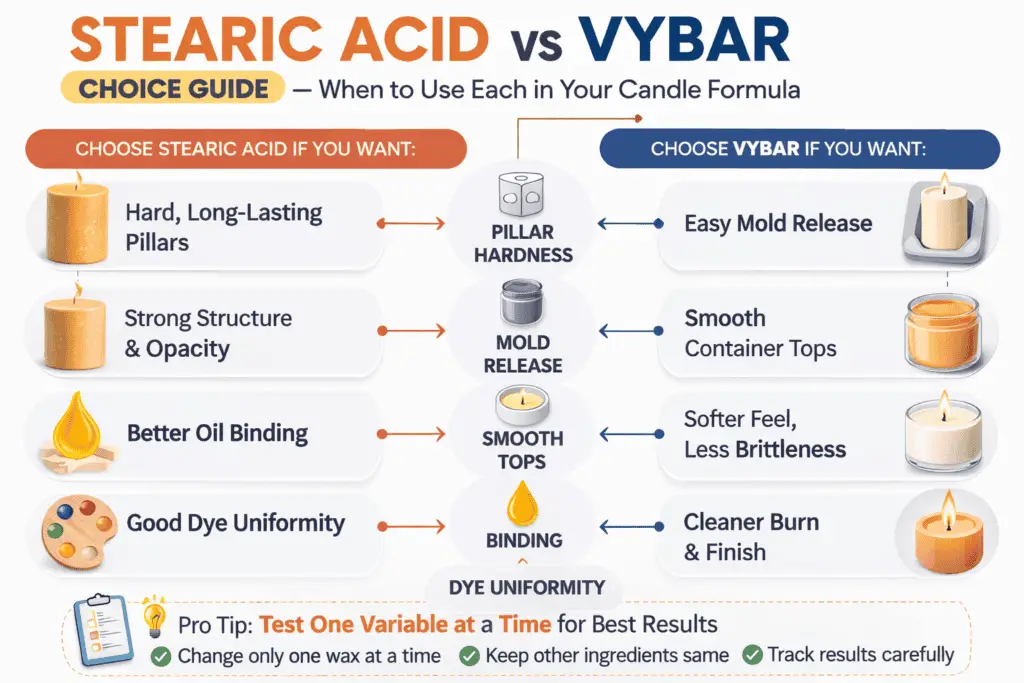
Stearic acid is a fatty-acid hardener that tends to make wax feel firmer and can help pillars and melts hold detail, edges, and shape.
Vybar is a polymer additive used to “hold” free oil and improve visual consistency, which often shows up as smoother jar tops, cleaner color, and fewer surface quirks when the formula is borderline.
Here’s the practical “when each wins” view:
| Your main goal | Stearic acid tends to help more | Vybar tends to help more |
| Crisp pillars, snaps, strong structure | Hardness and rigidity | Less relevant |
| Easier unmolding / cleaner release | Release behavior in molds | Less relevant |
| Smoother container tops and a glassier look | Sometimes, but can look “dry” | Top smoothness and surface uniformity |
| Managing free oil and visual instability | Indirectly | Oil-binding and appearance stability |
| Stronger, cleaner dye appearance | Can lighten/whiten some blends | Often improves color uniformity |
| When not to reach for it first | When your main problem is jar-top finish, dye streaking, or oil control in a paraffin container | When your main problem is pillar hardness, edge durability, or mold release |
A reliable way to choose without guesswork is to run paired tests that change only one variable at a time (same wax, same fragrance, same wick, same pour routine).
Treat choose candle additives as a defect-first decision, because both additives can look “bad” if the melt and pour conditions are off—even when the additive itself is fine.
If you’re chasing clarity in natural blends, rule out frosting, haze, cooling-rate shifts, fragrance incompatibility, or wax crystallization before blaming the additive choice.
Stearic acid and Vybar also are not always direct substitutes. Some formulas use both, but the safer approach is to treat each change as a separate test, and to treat Vybar type or grade changes like ingredient changes rather than simple swaps.
They can appear in the same formula, but co-use belongs to a separate test rather than a blanket recommendation. Vybar type or grade can change the result enough that a grade swap should be treated like an ingredient change, not like the same additive at a different label.
Quick starting points many makers test (then confirm by burn test and appearance after full cure):
- Stearic acid: start low for pillars or votives and increase in small steps only if you need more structure.
- Vybar: start low for paraffin-heavy containers when you’re chasing smoother tops or better oil and dye stability.
- Soy-forward containers: don’t assume either additive is required; rule out cooling rate and fragrance compatibility first, and only trial very small changes if you have a specific defect you can repeat.
Cost-in-use depends more on dose than bag price, so compare the two by grams per batch and by whether the additive reduces rework—not just by the price on the package.
When stearic acid wins vs Vybar
Stearic acid is usually the better first test than Vybar when the main problem is pillar hardness, edge durability, or cleaner mold release.
That is because stearic acid mainly changes structure, while Vybar mainly addresses oil behavior and surface finish in paraffin-heavy containers.
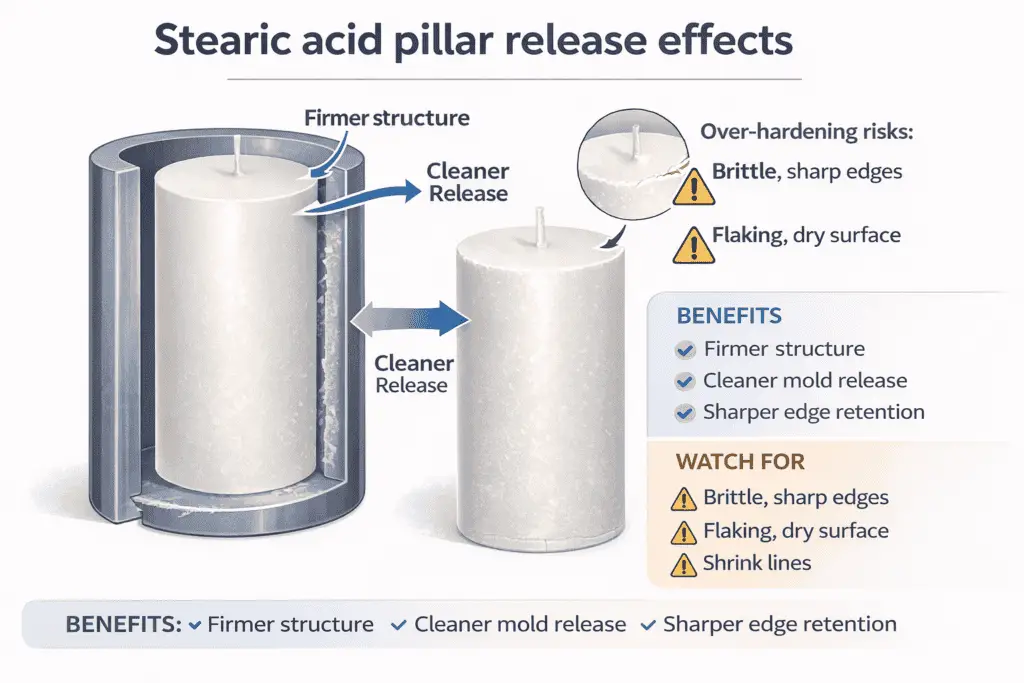
In pillars, stearic acid raises rigidity and can improve demolding, but too much can exaggerate shrink lines and shift burn behavior.
If a structure change affects burn, wick response, or release behavior, log it in Record lot and percent and compare it against the control batch before making another additive change.
When Vybar wins vs stearic acid
Vybar is usually the better first test than stearic acid when the main problem is smoother paraffin-heavy container tops, tighter oil control, or cleaner dye appearance.
That advantage is strongest in jar systems where finish and oil behavior matter more than added rigidity.
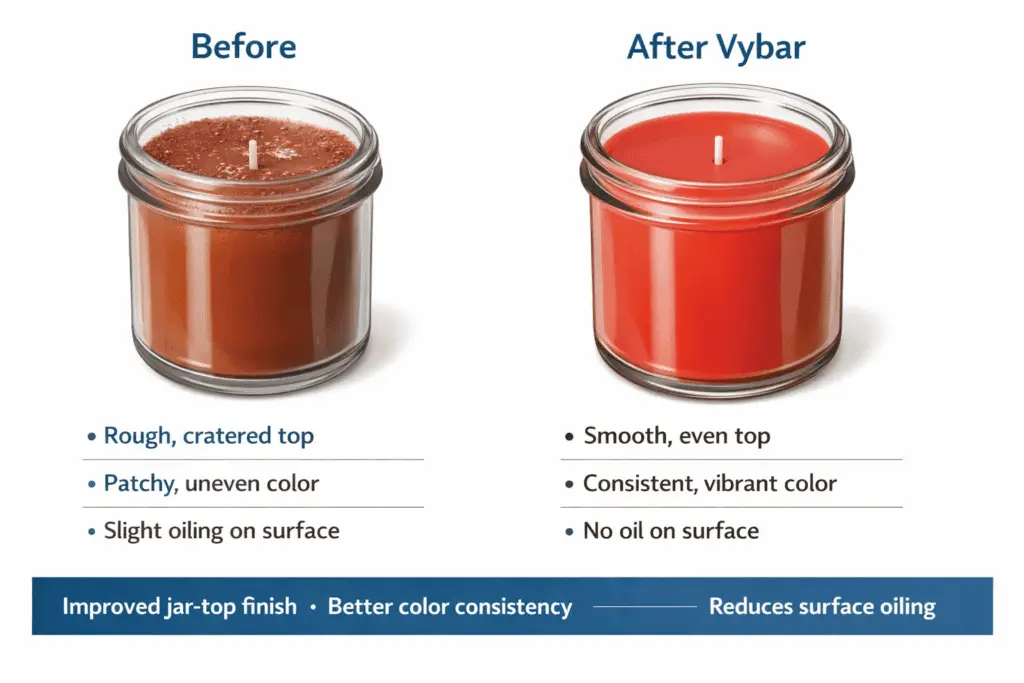
Because it’s designed to hold on to components that want to separate, it can improve dye dispersion in wax so color looks cleaner and less streaky, especially in paraffin-heavy blends.
Use Vybar for container candles if you need deeper grade and use details after the comparison is clear.
X-vs-Y: Stearic acid vs Vybar for hot throw and cold throw
Vybar can stabilize fragrance in paraffin-heavy containers, while stearic acid mainly changes structure and burn dynamics, so the better choice for hot throw vs cold throw depends on whether your issue is oil behavior, melt pool behavior, or both.
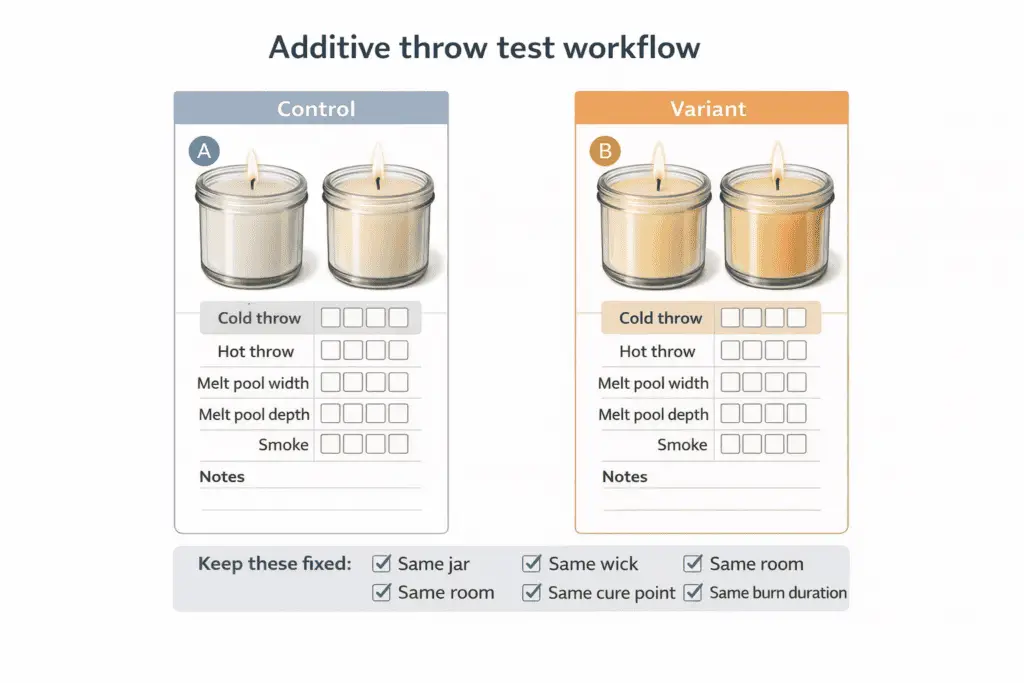
Cold throw is more sensitive to how fragrance sits in the wax at rest, while hot throw is more sensitive to melt-pool behavior and wick balance once the candle is burning.
Use this practical comparison when diagnosing throw:
- If cold throw fades fast or feels uneven: Vybar is more likely to help in paraffin-based containers by keeping fragrance and additives more evenly distributed.
- If hot throw is weak but cold throw is fine: additives are rarely the first fix; check wick size, melt pool depth, and airflow before changing the formula.
- If pillars smell muted: stearic can make the wax more rigid and change how fragrance migrates and releases, so it may require more careful burn tuning to avoid a “tight” scent profile.
Use fragrance load limits for wax-specific loading and test burn before scaling if you need deeper scent-focused follow-up.
How to choose between stearic acid and Vybar by wax class
Choose by matching the additive to the wax family’s actual defect: stearic acid first for pillar structure and release, Vybar first for paraffin-heavy container finish and oil control, and neither by default for soy-forward blends.
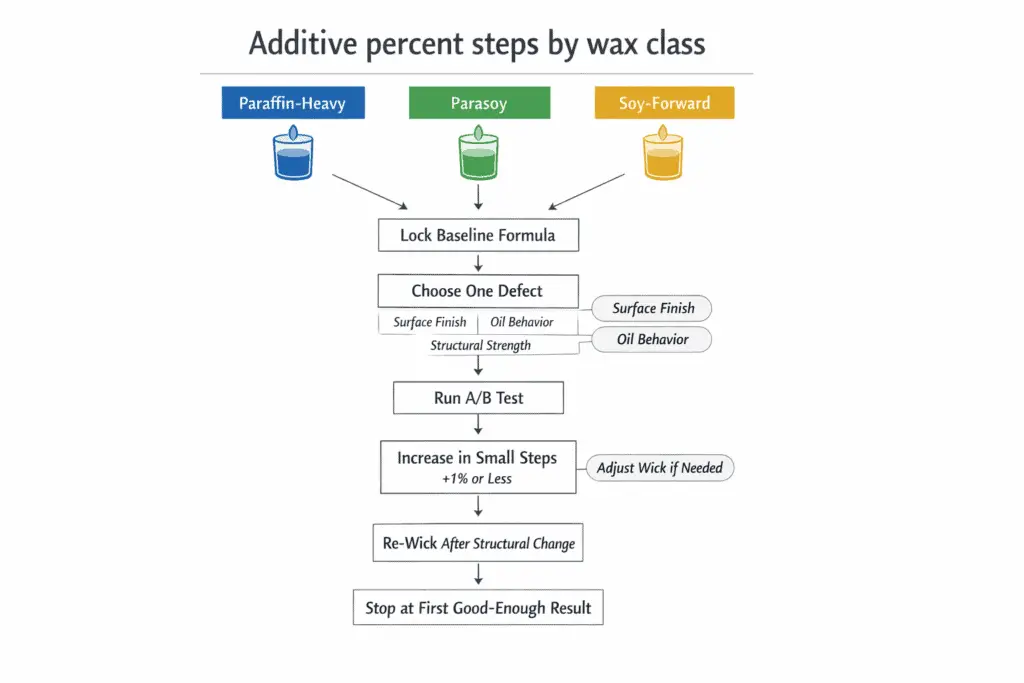
For paraffin-heavy blends, Vybar is usually the first lever when you’re fighting surface inconsistency, dye streaking, or visible oil behavior; for pillars and hard molds, stearic acid is usually the first lever when you need more structure and cleaner release.
For soy-forward blends, don’t assume either additive is the answer—many “additive” defects are really cooling rate, pour temp, or fragrance compatibility showing up as texture or frosting.
- Paraffin-heavy containers: start by testing Vybar if the defect is top finish, dye uniformity, or oil control.
- Paraffin pillars or votives: start by testing stearic acid if the defect is hardness, edge durability, or release.
- Parasoy blends: treat them as mixed-behavior systems and keep the first trial small.
- Soy-forward blends: keep process correction ahead of additive correction unless the same defect repeats under controlled conditions.
If the same defect persists after a small A/B trial, use diagnose additive issues for deeper troubleshooting.
Stearic acid vs Vybar for color, opacity, and finish
Stearic acid tends to increase opacity and can make colors look lighter, while Vybar more often improves finish consistency by reducing streaks and oil-related haze in paraffin-heavy blends.
On this page, treat that difference as a comparison between opacity and finish control, not as a full dye-correction workflow.
- Stearic acid: can produce a more opaque, pastel-leaning look and can change the same dye dose toward a lighter shade.
- Vybar: often supports cleaner-looking color by improving distribution and finish stability in paraffin-heavy containers.
If the result looks too chalky, reduce stearic first before increasing dye. If the result looks streaky or oily, trial a small Vybar change first, then keep deeper handling and product-specific safety details with the supplier SDS for the exact additive you bought.