

Wick bridging is a repeat-burn wick fault where the wick tip bends or hooks across the melt pool instead of standing upright and self-trimming cleanly.
If your wick keeps leaning across the melt pool after more than one burn, you are likely seeing wick bridging in a standard container candle. The first job is to confirm that it is true bridging, not normal curl, a carbon cap, or a one-off odd burn. From there, the useful path is simple: identify the pattern, check why it happens, test it in order, and decide whether a basic correction solves it. This page stays with standard container-candle cases and does not cover wood wicks or molded candles.
What Is Candle Wick Bridging?
Wick bridging is a repeat-burn wick fault where the tip hooks or bends across the melt pool instead of standing upright and burning itself cleanly.
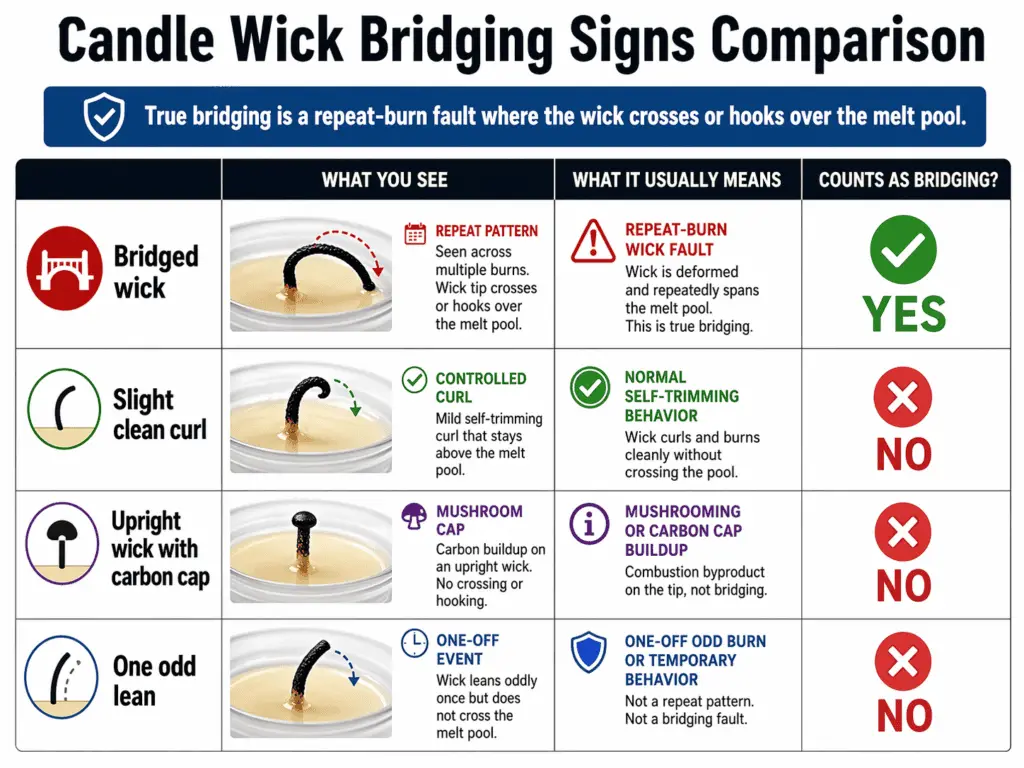
In a standard container candle, wick bridging means the wick has moved from a normal burn posture into a recurring fault pattern. The key clues are visible and specific: the tip lays or hooks over the melt pool, the same posture comes back after more than one burn, and the behavior is not explained by a healthy curl or a simple carbon cap alone.
A wick that bends once, then burns normally on the next run, does not give you enough to call it bridging. A wick that stays mostly upright while carrying a carbon mushroom is a different problem. If you want the wick-specific parent view, Wick Types and Sizing sits above this topic, while What Is Wick Curl and Why It Matters and Why Is My Candle Wick Mushrooming? Carbon Buildup, Smoke, and Fixes cover the closest sibling faults.
| What you see | What it usually means | Does it count as bridging? |
| Wick tip hooks across the melt pool on repeat burns | Recurring posture fault | Yes |
| Slight curl, clean flame, no melt-pool crossing | Healthy self-trimming behavior | No |
| Large carbon cap on an upright wick | Mushrooming | No |
| One odd lean on a single burn | Not enough proof yet | Not yet |
Does any bent wick count as bridging? No. A bent wick counts as bridging only when it crosses or hooks over the melt pool as a repeat-burn fault.
Does one odd burn count? No. You need the same pattern to return after another controlled burn.
Can bridging happen without a mushroomed tip? Yes. Mushrooming can appear with bridging, but it is not required for bridging to be real.
Wick Bridging vs Mushrooming vs Wick Curl
Bridging crosses the melt pool as a fault pattern, mushrooming centers on carbon buildup, and normal self-trimming curl can still be a healthy burn shape.
These three wick behaviors get mixed up because they can all make the tip look bent, dark, or off-center after a burn. The difference is the job the wick is doing. In bridging, the wick stops holding a stable upright posture and starts laying or hooking across the melt pool often enough to become a repeat problem. In mushrooming, the main issue is a carbon cap that builds on the tip, even if the wick still stands fairly upright. In normal curl, the wick bends as it burns, but the candle still burns cleanly and the wick does not start spanning the melt pool as a fault.
| Behavior | Wick posture | Carbon cap | Crosses the melt pool | Repeat-burn fault? |
| Bridging | Hooked or laid across | May or may not be present | Yes | Yes |
| Mushrooming | Mostly upright | Usually present | Not necessarily | Sometimes, but not by definition |
| Normal self-trimming curl | Curled but stable | Small or none | No | No |
If the wick is mainly smoky with a carbon cap but still stays upright, read Why Is My Candle Wick Mushrooming? Carbon Buildup, Smoke, and Fixes. If the wick curls yet still burns cleanly without spanning the melt pool, read What Is Wick Curl and Why It Matters.
Why Candle Wick Bridging Happens
Wick bridging usually starts when self-trim fails and a carbonized tip leans across the melt pool over repeat burns.
A wick is supposed to burn off its own tip in a controlled way. That is what self-trim means here: the burning wick shortens and keeps a workable posture without forming a stubborn, unbalanced end. When that clean burnoff stops happening, the burned end can turn into a carbonized tip, which is the blackened part left after the wick chars. That failure can come from an unstable charred tip, from a wick that is not behaving cleanly in the current wax or fragrance setup, or from burn conditions that distorted the posture enough that you still need a fair retest. Over repeat burns, that charred end can become heavy, uneven, or badly angled.
Once that happens, the wick may stop standing upright and start hooking toward or across the melt pool. That is why trimming helps some candles: it removes the unstable end and gives the wick a cleaner restart. What it does not prove yet is just as important. One odd burn does not prove the cause. A draft can push the flame and distort wick posture. A bridged wick also does not automatically mean the wick is the wrong size. Treat wick size or wick series as the next question only if the same fault returns after trim and still-air retesting.
Cause path, in order:
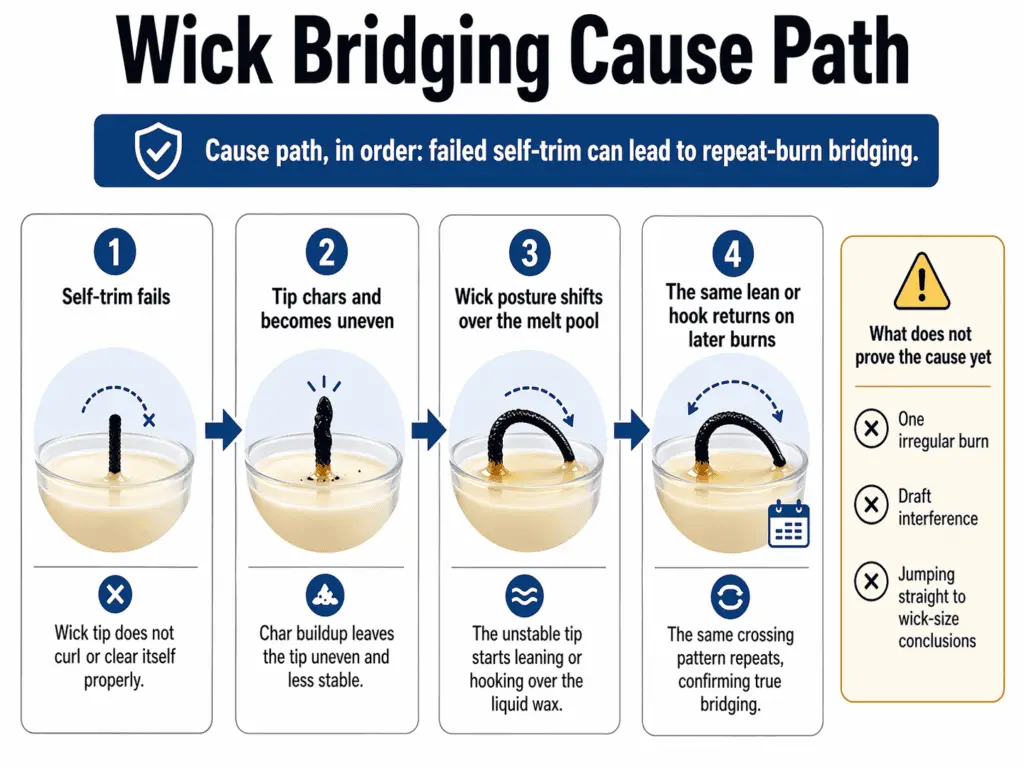
- The wick stops burning off its tip cleanly.
- The tip chars and becomes uneven.
- The wick posture shifts over the melt pool.
- The same lean or hook returns on later burns.
What does not prove the cause yet:
- One irregular burn by itself
- Draft interference or unstable room air
- A fast jump to wick-size conclusions
The next useful move is not guessing. Use How to Trim Candle Wicks (When, Why, and to What Length) first, then confirm the result with How to Burn Test Candle Wicks before treating the problem as a sizing issue.
How to Diagnose Candle Wick Bridging
Diagnose wick bridging in order: inspect the cooled wick, trim it, retest in still air, and check whether the same fault returns on later burns.
Do not resize first. A real wick-bridging diagnosis needs a controlled sequence, because one odd burn or a draft can make the wick look worse than it really is.
The useful check starts only after the candle has cooled enough for you to see the wick posture clearly. In this article, wick bridging is a repeat-burn fault, so the job is to decide whether the same hooked or laid-over posture keeps coming back under cleaner conditions. For the wick-specific parent view, Wick Types and Sizing sits above this topic, while How to Trim Candle Wicks (When, Why, and to What Length) and How to Burn Test Candle Wicks supply the supporting steps used below. Move to Wick Types and Sizing only if the pattern survives the check instead of clearing up after the reset.
- Let the candle cool fully, then inspect the wick posture.
- Check whether the wick tip crosses or hooks over the melt pool instead of standing mostly upright.
- Trim the wick to remove the unstable burned tip.
- Reburn the candle in still air. Here, still air means no fan, no open window, and no spot where the flame is getting pushed to one side.
- Compare that burn with the prior one. You are looking for the same bridge-like posture, not just any bend.
- Treat it as a real pattern only when the same fault returns after the trim-and-retest step.
| What you see | What it likely means | What to check next | What to do now |
| Wick tip hooks or lays across the melt pool on repeat burns | Confirmed bridge-like posture | Whether the same fault returned after trim and still-air retest | Treat it as real bridging and move to the fix path |
| Wick curls but does not cross the melt pool | Normal self-trimming curl may still be the better fit | Whether the flame stays clean and the wick stays usable | Do not call it bridging yet |
| Wick stays upright with a carbon cap | Mushrooming is the closer match | Whether carbon buildup, smoke, and cap growth are the main pattern | Route to the mushrooming page instead of treating it as bridging |
| One odd lean after a disturbed burn | Not enough proof yet | Whether airflow, handling, or a rough burn setup distorted the posture | Trim, retest, and do not resize yet |
| The same bridge-like posture returns after trim and retest | Local reset was not enough | Whether wick size or wick series needs review | Escalate to wick-size or wick-series review |
| The flame keeps leaning or the burn stays unstable in moving air | Draft-distorted burn conditions | Whether the candle behaves differently in still air | Repeat the check in still air before making any sizing call |
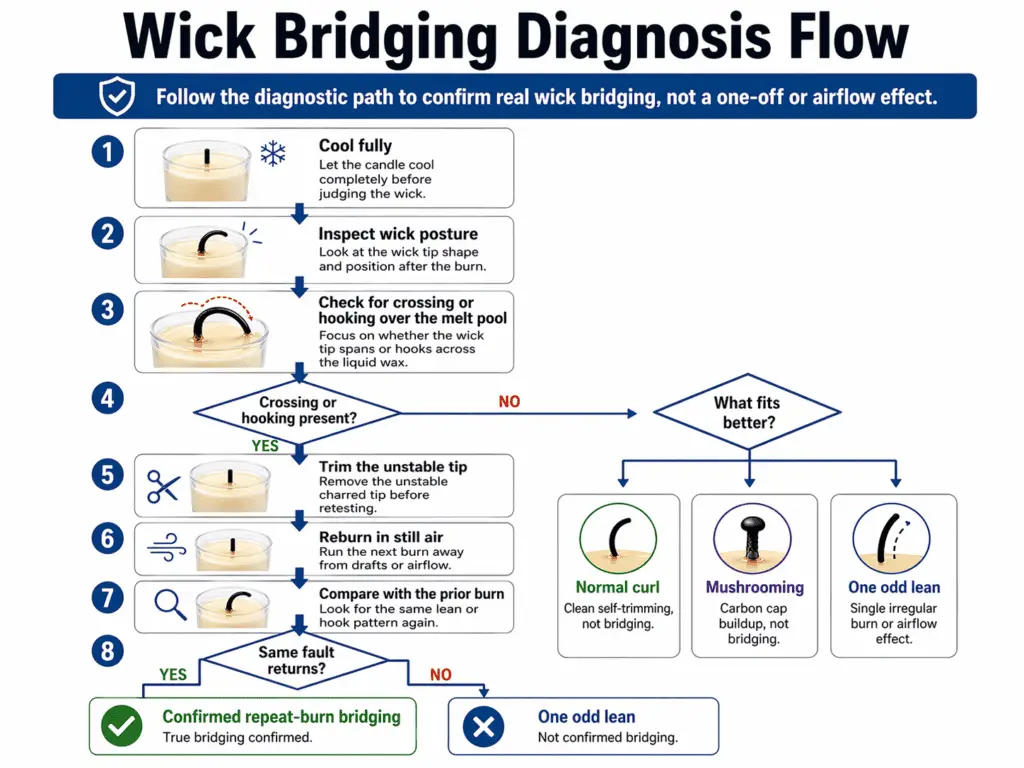
Do not diagnose yet if:
- you have seen only one irregular burn
- draft interference is still possible
- the main symptom is really a carbon cap or a healthy curl, not melt-pool crossing
How Airflow and Jar Conditions Can Mimic Wick Bridging
Drafts and jar conditions can make a wick look bridged even when the fault is not settled yet.
A flame pushed by moving air can lean the wick hard enough to imitate a bridge, especially if the wick was already carrying a dark, uneven tip. Jar shape can add confusion too when one side of the container runs hotter, cooler, or more shielded than the other. That does not mean the jar caused true bridging, but it can make the posture look more dramatic on one burn than on the next. That is why still-air retesting matters. If the wick only “bridges” in one room, in one spot, or with obvious flame disturbance, hold off on sizing decisions and repeat the check under calmer burn conditions.
If the wick keeps leaning without true melt-pool crossing, route to What Is Wick Curl and Why It Matters instead of treating this page as the full answer.
When Wick Bridging Is a One-Off vs a Repeat-Burn Problem
One strange burn is not enough to treat wick bridging as a real repeat problem.
Act on the issue when the same laid-over or hooked posture comes back after trimming and another controlled burn. If the wick burns normally after the reset, keep watching it rather than jumping ahead. If the same posture returns again, you have moved past a one-off event and into a problem that deserves correction.
Once the same bridged posture returns after trim and still-air retesting, stop rechecking the same question and move to the correction path.
How to Fix Candle Wick Bridging
Fix wick bridging by trimming first, retesting second, and moving to wick-size or series review only when the same pattern keeps returning.
On this page, fix does not mean one guaranteed cure. It means a staged action that ends in one of three outcomes: continue, escalate, or reject the setup.
The first move is the least costly one: remove the unstable burned tip, then see what the candle does on the next controlled burn. Start with How to Trim Candle Wicks (When, Why, and to What Length) if the wick tip is visibly charred or hooked. If the candle settles down after that retest, keep using it and keep watching later burns. If the flame, smoke, and carbon cap are really the main issue instead of melt-pool crossing, the closer match is Why Is My Candle Wick Mushrooming?
Carbon Buildup, Smoke, and Fixes. If bridging keeps coming back after a controlled retest, that is when Wick Types and Sizing and How to Size Your Candle Wick Correctly become the next route instead of more trimming.
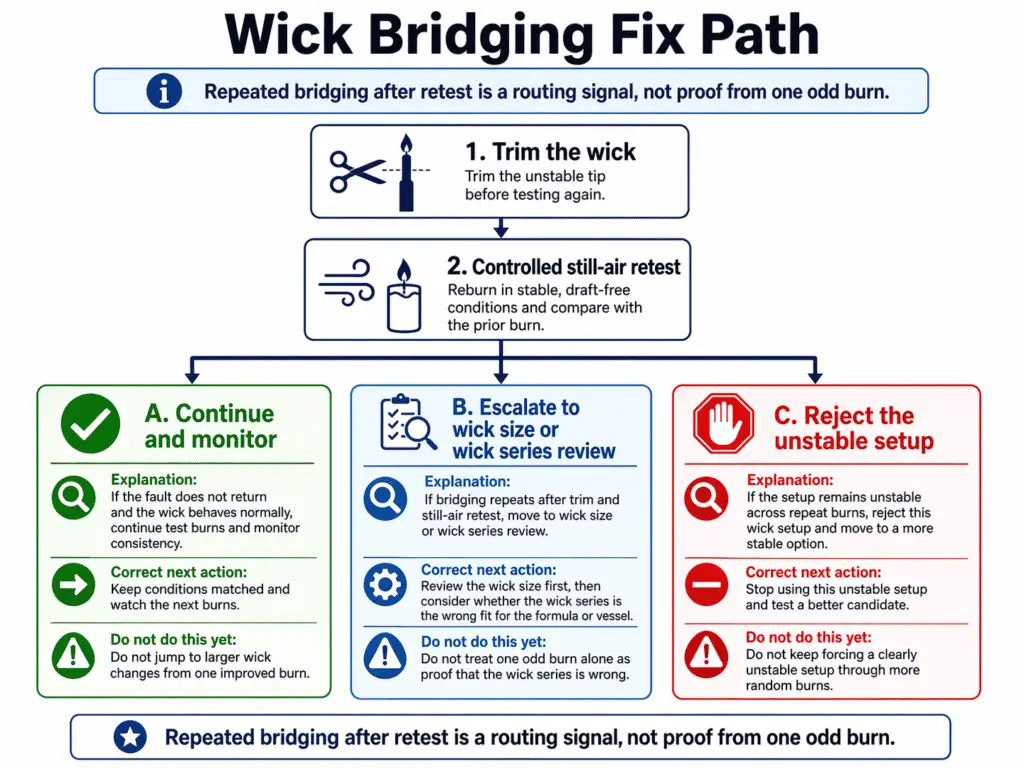
| After trim and retest | Likely next action | Do not do this yet |
| Wick burns upright and the bridge does not return | Continue using the candle and monitor later burns | Do not change wick size yet |
| Bridge returns on another controlled burn | Compare wick size or wick series next | Do not keep trimming forever |
| Burn stays unstable and hard to read | Reject the current setup and route outward | Do not force a local fix that keeps failing |
When not to keep trimming:
- the same bridge returns after the trim-and-retest step
- the candle stays unstable across repeat burns
- you are using trimming as a substitute for a sizing check
When Wick Bridging Points to a Wick Size or Series Mismatch
Persistent repeat-burn bridging after trim-and-retest is a routing signal, not proof from one odd burn.
This is the point where local troubleshooting has done its job. If the wick keeps hooking or laying across the melt pool after you trimmed it and gave it another fair burn in still air, the next question is no longer “Should I trim again?” The better question is whether the current wick choice is wrong for the setup. That can mean size mismatch, series mismatch, or both. A size mismatch is about the wick being too much or too little for the jar and wax setup. A series mismatch is about the wick family behaving poorly even if the size looked reasonable on paper. Use How to Size Your Candle Wick Correctly when you need the next sizing step, check Wick Types and Sizing when you need the broader comparison, and open Wick Size Chart by Jar Diameter & Wax Type only as the next tool, not as something to rebuild inside this page.
| What happened after trim and retest | What that usually means | Where to go next |
| The wick stabilized | Local correction worked | Stay on the current setup and monitor later burns |
| Bridging repeated across controlled burns | Local correction was not enough | How to Size Your Candle Wick Correctly |
| You need a broader wick-family comparison | The issue may be series related | Wick Types and Sizing |
| You are ready for a chart-based check | You need a starting point, not a final answer | Wick Size Chart by Jar Diameter & Wax Type |
Do not escalate yet if:
- you have only one odd burn on record
- a draft may still be part of the problem
- the symptom was really curl or mushrooming, not confirmed bridging
Routed Out of Scope: Wood Wicks and Molded-Candle Edge Cases
This page is for standard container-candle wick bridging only.
If the problem involves a wood wick, use How to Fix Common Wood Wick Problems (Tunneling, Going Out, Soot) instead of applying this page’s advice. If the issue is in a pillar, taper, or novelty mold, use How to Choose Wick Size for Molded Candles (Pillar, Taper, Novelty Shapes) because those formats follow a different path than the one covered here.