

The same candle wick family can sometimes be tested in tins and glass jars, but the final wick must be confirmed by burn testing.
A candle wick is the fuel-delivery part that pulls melted wax to the flame. The best wick for tins versus glass jars is not one universal size or brand. It is the safest starting point for the container material, inner diameter, wax type, fragrance load, wick family, and observed burn behavior. Tins often heat and transfer warmth differently than glass jars, so the same wick can burn cleaner in one vessel and too hot or too weak in another.
Can You Use the Same Wick in Tins and Glass Jars?
You can sometimes test the same candle wick family in tins and glass jars, but container heat behavior can change the final result.
A candle wick is the fuel-delivery component that pulls melted wax to the flame. “Best” means the best starting point for testing, not one universal wick size, brand, or guaranteed final result.
Use Wick Types and Sizing to keep wick family, diameter, wax type, and flame behavior tied together before comparing container material. Use Wick Size Estimator when you need exact wick-size ranges by diameter and wax. For exact wick-size ranges by diameter and wax, use the wick sizing guide or estimator.
| Tin container behavior | Glass jar behavior | Wick-selection implication | What to check during burn testing |
|---|---|---|---|
| Metal can warm and spread heat quickly. | Glass often shows wall soot and side wax more clearly. | The same wick family may be worth testing, but the final size can change. | Compare flame height, soot, melt pool, and vessel heat. |
| A tin can reach a deep melt pool sooner. | A glass jar may show slower edge coverage in the same wax. | Do not assume edge melt means the wick is correct. | Record melt-pool width in inches/mm after each test burn. |
| A small tin can hide soot until the lid, rim, or wax surface shows residue. | Glass makes soot marks easier to see. | Visible soot does not mean glass burns worse than tin. | Compare soot under the same wick family, wax, and fragrance load. |
| Heat can build later in the burn. | Wall thickness and shape can slow or concentrate heat. | A wick can pass early and fail later. | Repeat burns before finalizing the wick. |
The key split is same wick family versus same exact wick size. A wick family is a test range with similar construction and burn behavior; an exact wick size is one specific test choice inside that family. Testing the same family first can make sense when both vessels have similar inner diameter, wax type, and fragrance load, but changing to a cooler or hotter size may still be needed after burn testing.
For container heat and vessel safety, use the tin-versus-glass container safety guide. For a final wick decision, run a controlled candle wick burn test. A tin-versus-glass comparison works best when the candle wick, wax, fragrance load, and vessel diameter stay the same while only the container material changes.
Once the shared-family test is treated as a starting point, the next choice is how conservatively to begin in candle tins.
Best Wick Starting Points for Candle Tins
For candle tins, the best candle wick is a conservative burn-test starting point matched to the tin’s inner diameter, wax type, and fragrance load.
Tins may respond faster to flame heat than glass jars, so a wick that looks acceptable early can become too aggressive later. Best for tins means a lower-risk starting test range, not a universal tin wick size.
Start by measuring the tin’s inner diameter in inches/mm, then confirm the wax type, fragrance load, additives, and wick family before testing. Use Wick Size Estimator or Wick Types and Sizing for the first diameter-based range, then test from the conservative side when heat-up speed, soot, or a hot rim is likely. For exact diameter-based wick ranges, use the wick sizing guide.
Use this tin setup checklist before scaling a candle formula:
- Measure the tin’s inner diameter.
- Confirm wax type.
- Record fragrance load and additives.
- Choose a starting wick family from supplier guidance or an estimator.
- Test conservatively.
- Record flame height, melt pool, soot, and vessel heat.
- Repeat before scaling production.
A tin wick test should connect the candle wick to controlled flame behavior, steady melt-pool growth, and manageable vessel heat. Do tins usually need smaller wicks? Not always; a tin may need a cooler starting point, but wax hardness, fragrance load, diameter, and wick family can change the result. Should you start with the same wick family as glass? Yes, when the diameter and formula are similar, but the tin result must still stand on its own.
| Tin symptom | Likely meaning | First test action | Bridge if needed |
|---|---|---|---|
| Hot rim | Wick may be too aggressive or vessel may be unsuitable. | Stop, cool, reassess wick size and vessel. | Container safety guide |
| Fast deep melt pool | Wick may be too hot. | Downsize or test a cooler wick family. | Wick troubleshooting |
| Soot | Over-wicking, fragrance load, or poor trim may be involved. | Trim, retest, adjust size. | Wick troubleshooting |
| Weak melt pool | Wick may be too small or wax may be too hard. | Test the next size or family. | Wick estimator |
| Later-burn overheating | Early testing was incomplete. | Repeat multi-burn testing. | Burn-test guide |
If the tin becomes uncomfortably hot or shows unsafe heat behavior, treat that as a container-safety question, not only a wick-size question. Use Tin vs Glass Containers: Which Are Safer for Candle Use? when vessel heat or container suitability becomes the main concern. Use Candle Wick Troubleshooting when soot, tunneling, or weak melt-pool behavior continues after basic wick changes.
For the full testing sequence, use the candle wick burn-test guide. A tin that heats quickly needs slower decision-making, not a rushed final wick choice after one clean-looking burn. The next comparison is how glass jars change the same starting-point logic through visibility, wall heat, and side-wax clues.
Best Wick Starting Points for Glass Jar Candles
For glass jar candles, the best candle wick is a burn-test starting point matched to jar diameter, wax type, fragrance load, and visible burn behavior.
A candle wick is the fuel-delivery component that pulls melted wax to the flame, so glass jars require testing around soot, side wax, melt pool, and wall heat. Best for glass jars means the first test range for that jar design, not one wick size for every glass container.
Use estimate a starting wick range from the vessel diameter and wax system before comparing glass against tin. A glass jar can make soot, wall discoloration, side wax, and hot spots easier to see, but visibility does not automatically mean glass burns worse. It means the jar gives more visual evidence while you test wick fit.
Use this glass jar setup checklist before making a final wick choice:
- Measure the inner diameter in inches/mm.
- Check wax type and fragrance load.
- Choose a starting wick family.
- Observe side wax, soot, flame height, melt pool, and wall heat.
- Repeat test burns before finalizing.
- Route repeated side wax or safety concerns to the correct guide.
| Glass jar observation | Possible wick meaning | Possible non-wick cause | Next test action |
|---|---|---|---|
| Side wax remains after repeated burns. | Wick may be too small or too cool. | Jar diameter, taper, wax hardness, or room temperature may be involved. | Test the next size or review jar shape. |
| Soot appears on the glass. | Wick may be too large or burning too hot. | Fragrance load, poor trimming, or drafts may also cause soot. | Trim, retest, then adjust wick size if soot returns. |
| Wall heat rises quickly. | Wick may be too aggressive for the jar. | Jar thickness or shape may concentrate heat. | Stop testing if heat feels unsafe. |
| Melt pool stays narrow. | Wick may be underperforming. | Wax type or fragrance load may slow melt-pool growth. | Retest with the same formula before changing vessel type. |
| Wall discoloration appears. | Wick may be too hot or sooty. | Glass quality, residue, or fragrance system may contribute. | Compare with a cleaner trim and controlled burn conditions. |
If the question is whether the glass jar itself is safe for candles, use Tin vs Glass Containers: Which Are Safer for Candle Use? rather than treating the issue as only a wick problem. If the question is exact diameter-to-wick mapping, use the wick size estimator. If side wax continues after repeated testing, use wick troubleshooting or jar geometry guidance through Candle Wick Troubleshooting or Candle Jar Size Guide.
Use How to Burn Test Candle Wicks when you need to compare a glass jar wick test under controlled conditions. Jar thickness, diameter, taper, and shape can change the result, so glass jar wick selection should stay focused on wick performance signs: soot, melt pool, side wax, and wall heat. The clearest next comparison is how tins and glass jars show melt-pool, flame, soot, and heat signals differently during the same test.
Tin vs Glass Wick Behavior: Melt Pool, Flame, and Heat
A candle wick should be judged in tins versus glass jars by melt-pool behavior, flame height, soot, and vessel heat during a controlled burn test.
The fastest full melt pool is not always the best result, especially if flame height, soot, or vessel heat rises at the same time. Best melt-pool behavior means the wick creates steady wax consumption without chasing edge-to-edge melt at any cost.
Use How to Burn Test Candle Wicks when comparing the same wick across container materials. Keep the wax, fragrance load, similar diameter, wick family, and burn duration the same before reading the result. Compare melt-pool width in inches/mm, melt-pool depth, soot, flame behavior, and vessel heat across repeated burns.
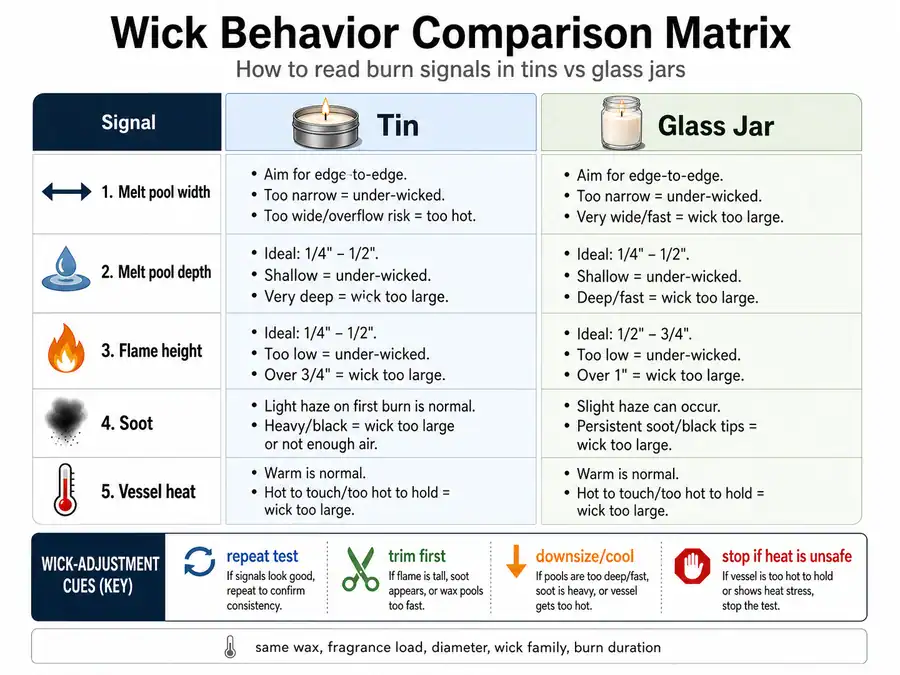
| Test signal | Tin behavior to watch | Glass behavior to watch | Wick adjustment direction |
|---|---|---|---|
| Melt-pool width | A tin may reach edge coverage faster. | A glass jar may show slower edge coverage or side wax. | Do not change wick size until repeated burns confirm the pattern. |
| Melt-pool depth | A tin can develop a deep pool sooner. | A glass jar may show depth and side wax more visibly. | Downsize or choose a cooler family if depth and heat rise together. |
| Flame height | A fast-heating tin may make the flame look more aggressive later. | Glass makes soot and flame effects easier to inspect. | Trim first, then adjust size if the flame stays too strong. |
| Soot | Tin soot may appear on rim, lid contact areas, or wax surface. | Glass soot is easier to see on the wall. | Compare trim, fragrance load, and wick size before blaming the vessel. |
| Vessel heat | Tin heat can spread quickly through the container. | Glass heat may appear as hot spots or concentrated wall warmth. | Stop if heat becomes a safety concern and reassess the vessel. |
Use the same comparison conditions each time: same wax, same fragrance load, similar inner diameter, same wick family, same burn duration, and repeated test burns. This comparison is a modeled decision aid, not proof that one container material always needs a hotter or cooler wick. A supplier wick guide can help choose the starting family, but the final candle wick choice still depends on burn-test evidence in the actual vessel.
Should you chase a full melt pool on the first burn? No; a full melt pool that arrives with high flame, soot, or excess vessel heat can signal over-wicking. Can the same wick create a deeper melt pool in a tin? Yes, because container heat behavior can change timing even when the formula and diameter are similar. When melt-pool behavior looks like a wax issue, compare the same wax system before switching to a new wick family.
If the main problem is tunneling after repeated burns, use How to Fix Candle Tunneling or Candle Wick Troubleshooting rather than turning this comparison into a full repair process. If heat becomes a vessel-safety concern, use Tin vs Glass Containers: Which Are Safer for Candle Use? or the container safety guide. If the user needs the full burn-test sequence, use the burn-test guide.
Warning Signs Your Wick Is Too Big for the Container
A candle wick is too big for a tin or glass jar when it creates excessive flame height, soot, fast melt-pool growth, or vessel heat during burn testing.
This is a wick-fit diagnosis first, not a full container safety evaluation. Best excludes any candle wick that creates heavy soot, an unstable flame, or concerning heat behavior in the test vessel.
A tin may show fast heat-up, a hot rim, or a melt pool that deepens too quickly. A glass jar may show visible soot, hot spots, side wax, or wall discoloration more clearly. If the test looks unsafe, stop treating it as a simple wick adjustment and move the concern to Tin vs Glass Containers: Which Are Safer for Candle Use?
| Symptom | More common in | Likely wick issue | First action | Bridge target |
|---|---|---|---|---|
| High flame | Both | Wick too large or untrimmed | Trim and retest | Wick troubleshooting |
| Heavy soot | Both, easier to see in glass | Over-wicking or fragrance issue | Check trim and formula | Wick troubleshooting |
| Hot rim | Tin | Wick too aggressive or vessel concern | Stop and reassess | Container safety |
| Side wax | Glass | Under-wick, short burn, or shape issue | Retest or adjust | Jar size and troubleshooting |
| Hot spot | Glass | Localized heat or vessel issue | Stop if concerning | Container safety |
| Deep melt pool | Both | Over-wicking | Downsize or test a cooler family | Wick estimator |
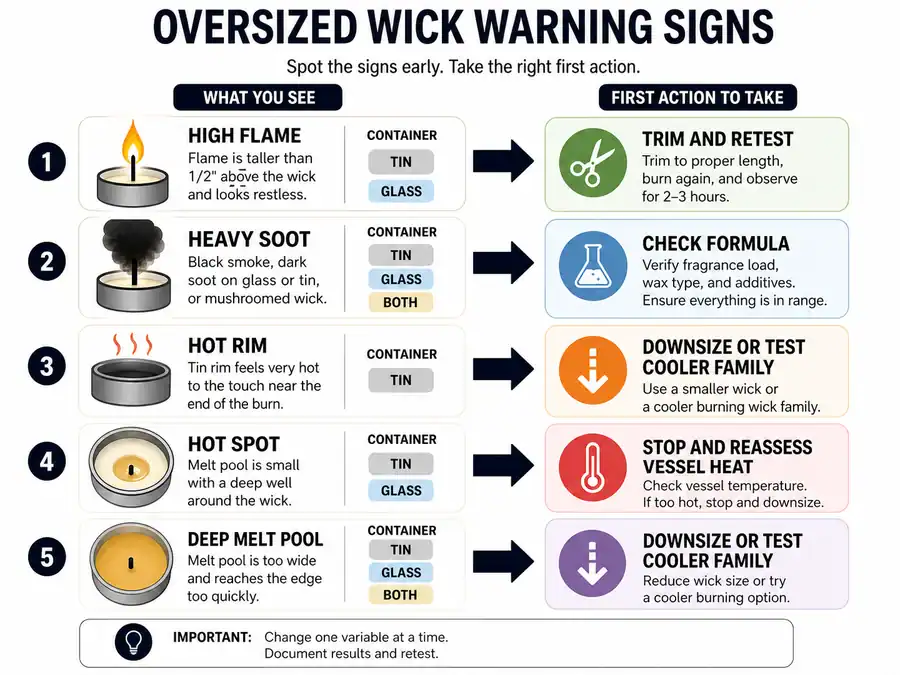
Use this first-fix order before changing too much at once:
- Trim the wick and retest.
- Confirm the same burn duration, room conditions, and vessel fill.
- Check fragrance load and additives.
- Downsize the wick or test a cooler wick family.
- Stop testing if vessel heat or glass behavior becomes concerning.
Visible soot can mean the wick is too large, but fragrance load, dye, drafts, and poor trimming can create the same symptom. Trim before changing wick size because a long wick can exaggerate flame height, soot, and mushrooming. If the issue appears formula-driven, compare Best Wicks for Soy Candles and Best Wicks for Paraffin Candles before blaming tin or glass alone.
Testing should repeat the symptom before the candle wick is rejected. Change one variable at a time so the result points to wick size, wick family, fragrance load, wax type, or vessel behavior. If the symptom is soot, tunneling, mushrooming, or drowning after multiple tests, route to Candle Wick Troubleshooting. If heat or vessel integrity is the concern, route to container safety.
Tin-Specific Wick Failure Patterns to Watch For
Tin-specific candle wick failures usually appear as fast heat-up, hot rim behavior, soot, or an overly fast melt pool during burn testing.
A hot rim can be normal warmth or a warning sign, depending on how quickly it appears and whether the flame is oversized. If the tin heats aggressively while the melt pool deepens fast, the wick may be too large for that vessel and formula.
| Tin failure | Likely cause | First adjustment | Offload trigger |
|---|---|---|---|
| Hot rim | Aggressive wick or unsuitable vessel | Stop, cool, reassess | Container safety |
| Fast melt pool | Wick too large or tin heat response | Downsize or test cooler family | Burn-test guide |
| Soot | Over-wicking or fragrance load | Trim, retest, diagnose | Wick troubleshooting |
| Later-burn heat | Early test was incomplete | Repeat longer testing | Burn-test guide |
A tin can look fine in an early burn and become too hot later as the wax level drops. Use How to Burn Test Candle Wicks when later-burn behavior changes the result. Small tins need careful wick trimming because soot can collect on the rim, lid contact area, or wax surface before it becomes obvious.
Glass-Specific Wick Failure Patterns to Watch For
Glass-specific candle wick failures often appear as visible soot, side wax, hot spots, wall discoloration, or repeated incomplete melt-pool coverage.
Glass does not always perform worse than tin; it simply makes many burn signs easier to see. A visible problem still needs diagnosis before the wick, wax, fragrance, or jar shape is blamed.
| Glass failure | Likely wick meaning | Possible non-wick cause | Bridge target |
|---|---|---|---|
| Visible soot | Wick too large | Fragrance load or trim | Wick troubleshooting |
| Side wax | Wick too small | Jar shape or short burn | Jar size guide |
| Hot spot | Localized heat | Vessel suitability | Container safety |
| Wall discoloration | Soot or heat | Formula or vessel issue | Troubleshooting and safety |
Side wax after one burn does not always prove the wick is too small. Repeated incomplete coverage, weak flame, and stable but narrow melt-pool growth make under-wicking more likely. The next decision is whether the tin-versus-glass result is really caused by wax, fragrance, diameter, shape, wick count, or setup.
Variables That Can Change the Tin vs Glass Wick Result
Tin versus glass matters, but wick choice also depends on wax type, fragrance load, additives, diameter, shape, wick count, and installation fit.
These variables qualify the container comparison; they do not turn this page into a wax guide, fragrance guide, or full wick chart. Each one can change the burn-test result enough to make a tin and glass jar behave differently with the same candle wick.
Use this section to check whether the tin-versus-glass difference is really caused by wax, fragrance, diameter, shape, wick count, or setup.
| Variable | Why it changes the result | Tin and glass implication | Best next check |
|---|---|---|---|
| Wax type | Wax hardness and melt behavior affect flame feed. | Container material may look like the cause when wax is the cause. | Compare the wax system. |
| Fragrance load | Fragrance can increase soot, drowning, or weak flame. | The same wick may pass plain wax and fail scented wax. | Test the final formula. |
| Additives and dye | Additives can change burn behavior. | Tin or glass may only reveal the issue differently. | Record every additive. |
| Inner diameter | Diameter controls melt-pool reach. | Same material can still need different wicks. | Use a sizing range. |
| Shape and depth | Taper, depth, square, or oval shapes change heat and edge melt. | Material alone cannot explain every side-wax pattern. | Compare vessel geometry. |
| Wick count | Wide vessels may need more than one flame. | Upsizing one wick is not always the right fix. | Route to wick-count decisions. |
| Installation fit | Tabs, clips, stickers, and centering affect stability. | A good wick can fail if it shifts or sits poorly. | Check setup before resizing. |
How Wax Type Changes the Tin vs Glass Wick Result
Wax type can change the best candle wick starting point in tins versus glass jars because the wick must match both the container and the wax system.
Soy, paraffin, beeswax, coconut wax, and blends can melt, feed the flame, and hold fragrance differently. That means wax behavior can override the apparent tin-versus-glass difference.
| Wax type | Tin behavior to watch | Glass behavior to watch | Bridge target |
|---|---|---|---|
| Soy | Slow or uneven melt interpretation | Side wax may persist | Best Wicks for Soy Candles |
| Paraffin | Can respond differently by wick family | May show soot clearly | Best Wicks for Paraffin Candles |
| Beeswax | Often needs stronger testing | May underperform with a weak wick | Best Wicks for Beeswax Candles |
| Coconut blend | Formula-sensitive | May vary by fragrance load | Best Wicks for Coconut/Coconut Apricot Candles |
A soy candle in a tin and a soy candle in glass can still need different test choices if diameter, fragrance load, or jar shape changes. A beeswax candle may need a stronger test range than a softer blend, but that belongs in wax-specific guidance. The container comparison should only explain why wax changes the result, then keep the final wax-specific answer in the matching wax wick page.
How Fragrance Load and Additives Affect Wick Choice in Tins and Glass
Fragrance load and additives can change the best candle wick starting point in tins and glass jars because the wick must burn the final candle formula.
A wick that works in plain wax can soot, mushroom, drown, or weaken after fragrance and dye are added. Best means the wick that works after the final fragrance load and additives are included, not only in unscented test wax.
Use this additive-pressure checklist before blaming the container:
- Record fragrance percentage.
- Record dye and additives.
- Test with the final formula.
- Compare the same formula in tin and glass.
- Do not change wick size and fragrance load in the same test.
- Retest before blaming the container.
If the same wick works in plain wax but fails after fragrance, retest with the final formula before blaming the container. If soot or drowning persists after repeated tests, route to candle wick troubleshooting. If the issue appears formula-driven, use the fragrance load or wick troubleshooting guide.
Why Diameter and Shape Still Matter More Than Container Material
A candle wick should be chosen by inner diameter and shape before tin-versus-glass material differences are interpreted.
Diameter often matters more than container material because the wick must create a melt pool that matches the vessel’s usable width. A tin and a glass jar with similar material labels can still need different wick tests if their inner shape, depth, or taper differs.
| Vessel factor | Why it matters | Tin or glass implication | Bridge target |
|---|---|---|---|
| Inner diameter | Primary wick-size variable | Same material can need different wicks | Wick Size Estimator |
| Shape | Changes melt-pool reach | Oval and square vessels may fail differently | Candle Jar Size Guide |
| Depth | Changes later-burn behavior | Early burns may mislead | Burn-Test Guide |
| Wide opening | May need wick-count decisions | One larger wick may overheat the center | Single Wick vs Double Wick: Which Jar Sizes Need Two Wicks? |
| Bottom setup | Affects wick placement and stability | Tabs, stickers, and clips can shift the burn | Pre-tabbed wick setup guidance |
Measure the inside diameter before choosing a tin or glass wick. A similarly sized tin and glass jar can start with the same wick family, but the final result must come from burn testing. Wide containers may need a separate wick-count decision instead of a larger single wick. The next step is to compare both vessel types with the same formula, the same wick family, and a controlled burn-test log.
How to Burn Test the Same Wick in a Tin and Glass Jar
The best way to compare a candle wick in a tin and a glass jar is to run a controlled side-by-side burn test.
Use the same wax, fragrance load, wick family, and similar vessel diameter so container material is the main difference being tested. Best means the wick that passes repeated burn checks in the actual vessel, not the wick that looks good once.
Use How to Burn Test Candle Wicks when you need the full testing sequence, but keep this tin-versus-glass test focused on comparison. A candle wick should be judged by flame height, melt-pool width in inches/mm, melt-pool depth, soot, mushrooming, and vessel heat. Use the Wick Size Estimator before testing if the tin and jar do not share a similar inner diameter.
Follow this side-by-side burn-test process:
- Choose one tin and one glass jar with the closest possible inner diameter.
- Use the same wax type, fragrance load, dye, additives, and fill weight.
- Choose the same wick family or starting test range.
- Trim both wicks to the same starting length before each burn.
- Burn both candles under the same room conditions and burn duration.
- Record flame height, melt-pool width, soot, mushrooming, and vessel heat.
- Repeat the burn before deciding whether the tin or glass jar needs a different wick.
| Test field | Tin result | Glass jar result | What the difference may mean |
|---|---|---|---|
| Inner diameter in inches/mm | Different diameter can explain different melt-pool reach. | ||
| Wax type | Wax behavior can override material assumptions. | ||
| Fragrance load | Fragrance can increase soot, drowning, or weak flame. | ||
| Wick family and size | Same family does not guarantee same final size. | ||
| Flame height | A taller or unstable flame may point to over-wicking. | ||
| Melt-pool width in inches/mm | Faster edge coverage may mean better fit or excess heat. | ||
| Melt-pool depth | A deep pool with heat or soot can signal an aggressive wick. | ||
| Soot or wall marks | Glass may reveal soot that a tin hides. | ||
| Vessel heat | Heat behavior may require wick or container reassessment. | ||
| Result after repeated burns | One clean burn is not enough for a final wick choice. |
Testing note: This comparison is a modeled decision method based on controlling variables, recording units, and repeating burns. It does not replace testing the actual candle formula in the actual vessel. Supplier wick guidance can help choose the first range, but the final candle wick must be confirmed by burn-test behavior.
If both candles fail in the same way, the wick family, wax system, fragrance load, or trimming method may be the real problem. If only the tin overheats or only the glass jar shows soot or side wax, container behavior may be changing the result. Use Candle Wick Troubleshooting when soot, tunneling, mushrooming, drowning, or weak flame persists after repeated tests.
The next practical step is to turn the burn-test result into a buying and setup checklist before purchasing wicks in quantity.
Buying and Testing Checklist for Tins vs Glass Jars
Before buying or finalizing candle wicks for tins or glass jars, choose by diameter, wax system, fragrance load, vessel material, tab fit, and burn-test observations.
A candle wick is not “best” because it is popular or sold as a tin or jar wick. It is best only when the starting range, installation fit, and repeated burn result match the actual candle design.
Use the Wick Size Estimator before buying a full pack when the container diameter, wax type, or wick family is still uncertain. Use the wax guides when soy, paraffin, beeswax, coconut, or blended wax behavior becomes the bigger variable than tin versus glass. Use the burn-test guide before scaling a formula beyond test candles.
Use this buying and testing checklist before finalizing wicks:
- Measure the inner diameter of every tin and glass jar in inches/mm.
- Confirm wax type before choosing a wick family.
- Record fragrance load, dye, and additives.
- Choose a starting wick range, not one final wick.
- Test tins and glass jars separately, even when the diameter is similar.
- Watch flame height, melt pool, soot, mushrooming, and vessel heat.
- Check whether the wick tab, adhesive, length, and centering method fit the vessel.
- Route wide vessels to a wick-count decision instead of forcing one oversized wick.
- Retest after any change to wax, fragrance load, dye, wick size, or vessel shape.
- Buy larger quantities only after repeated test burns confirm the result.
| Buying decision | Tin check | Glass jar check | Best next action |
|---|---|---|---|
| Wick family | Avoid overly aggressive starts in small tins. | Watch soot and side wax closely. | Test a range, not one size. |
| Wick size | Diameter still controls the first range. | Diameter and shape can change edge melt. | Use measured inner diameter. |
| Wax match | Wax can mask material effects. | Wax can exaggerate side wax or soot. | Compare wax-specific guidance. |
| Fragrance load | Soot may appear faster in small tins. | Glass makes soot easier to see. | Test the final formula. |
| Safety concern | Hot rim changes the question. | Hot spots change the question. | Use the safety guide. |
| Wide vessel | One large wick may overheat the center. | One wick may leave side wax. | Use the double-wick guide. |
| Repeated failure | Soot, tunneling, or drowning needs diagnosis. | Side wax or soot needs diagnosis. | Use troubleshooting. |
Pre-Tabbed Wick Fit and Base Compatibility in Tins vs Glass Jars
A candle wick can be the right burn-test choice for a tin or glass jar but still fail if the tab, base, adhesive, length, or centering method does not fit the container.
Pre-tabbed fit is a setup issue, not proof that the wick family is wrong. Check the physical fit before changing wick size.
Use Pre-Tabbed vs Spool Candle Wicks when the decision is about wick format rather than burn performance. Use Wick Centering Guide when the flame leans, the wick shifts, or the melt pool forms off-center. Use Candle Wick Stickers and Holders when the wick base will not stay fixed during pouring, cooling, or testing.
Use this fit checklist before rejecting a wick:
- Confirm the wick tab sits flat on the vessel base.
- Check that the tab size does not lift, tilt, or crowd a narrow tin.
- Make sure the wick length fits the container height.
- Confirm the wick is centered before the wax sets.
- Check whether the adhesive holds during pour temperature and cooling.
- Retest after fixing centering or tab movement.
- Use Burn-Test Guide after the wick is physically stable.
A glass jar may make off-center burning easier to see, while a tin may hide it until the melt pool pulls to one side. A wick that shifts during pouring can create soot, side wax, hot spots, or uneven melt without being the wrong wick family. Correct the setup first, then test burn behavior again.
Travel Tins vs Premium Glass Jars — Which Wick Test Should You Start With?
A travel tin and a premium glass jar may need different candle wick test priorities, but the final wick still depends on vessel size, wax system, fragrance load, and burn testing.
Use case changes what you watch first; it does not replace technical wick selection. Best means the wick starting point that fits the vessel use case while still passing burn-test checks.
| Use case | Main wick-test priority | Watch first | Use when needed |
|---|---|---|---|
| Small travel tin | Controlled flame and manageable heat | Hot rim, soot, deep melt pool | Wick troubleshooting or safety review |
| Gift tin | Repeatable burn behavior | Heat buildup and soot | Wick estimator and burn testing |
| Premium glass jar | Clean visible burn | Soot, side wax, hot spots | Jar size and troubleshooting |
| Display candle | Appearance plus burn performance | Wall marks and flame behavior | Burn testing before scaling |
| Wide tin or jar | Wick count boundary | Center heat or edge hang-up | Single-vs-double decision |
| Vessel still undecided | Container choice before wick choice | Diameter, shape, material, use case | Candle Container Selection Guide |
If the vessel itself is still undecided, use Candle Container Selection Guide before buying wicks in quantity. If the use case changes vessel diameter or wick count, return to Wick Size Estimator or Single Wick vs Double Wick: Which Jar Sizes Need Two Wicks? before forcing one wick to solve every problem. Packaging, branding, wholesale fit, and label design belong outside this wick-selection decision.
The final recommendation comes down to choosing a starting wick range, testing the actual vessel, and routing failures to the right next decision instead of guessing from container material alone.
Final Recommendation: Which Wick Should You Test First?
Test the wick range for the vessel’s inner diameter and wax system first, then choose the final candle wick after repeated tin and glass burn tests.
Best means the first evidence-based starting range, not a final wick size, universal brand, or product ranking. Adjust only after comparing flame height, melt pool, soot, mushrooming, vessel heat, and physical wick fit in the actual tin or glass jar.
Use this final decision flow:
- Measure the inner diameter in inches/mm.
- Choose a starting wick range from the Wick Size Estimator or a supplier guide.
- Account for wax type.
- Account for fragrance load and additives.
- Compare tin and glass burn behavior under the same test conditions.
- Watch for over-wick or under-wick signals.
- Check whether the vessel needs one wick or two.
- Confirm physical wick fit and centering.
- Run repeated burn tests.
- Finalize only after the wick passes in the actual vessel and formula.
| Final decision point | Choose this path when | Do not assume |
|---|---|---|
| Start with diameter and wax system. | You need a first test range. | Container material alone chooses the wick. |
| Test tin and glass separately. | The vessels use similar formulas but different materials. | One clean burn proves the final wick. |
| Downsize or cool the wick. | Flame, soot, deep melt pool, or vessel heat is too aggressive. | A fast full melt pool is always better. |
| Test a stronger range. | Repeated burns show weak flame, poor melt-pool reach, or persistent side wax. | One short burn proves under-wicking. |
| Check wick count. | A wide vessel cannot balance center heat and edge melt with one wick. | One oversized wick fixes every wide container. |
| Recheck setup. | The tab, adhesive, centering, or wick length is unstable. | A shifted wick means the wick family is wrong. |
Use How to Burn Test Candle Wicks for the full test schedule. Use Candle Wick Troubleshooting for persistent soot, tunneling, mushrooming, or drowning. Use Tin vs Glass Containers: Which Are Safer for Candle Use? for vessel heat and safety concerns.
Use Single Wick vs Double Wick when a wide vessel cannot be solved with one centered wick. Use wax-specific wick guides when soy, paraffin, beeswax, or coconut wax is the main variable. The right first wick test is the narrowest reasonable range for the measured vessel and wax system, followed by proof from repeated burns in the actual candle.