

Pre-tabbed wicks are better for simple, ready-to-place candle batches, while wick spools are better for custom lengths, bulk batches, and tighter inventory control.
Pre-tabbed wicks are pre-cut candle wick assemblies with a metal tab already attached, while wick spools are continuous wick stock that you cut and usually tab before use. The better choice depends on setup time, batch size, vessel height, waste, inventory, and how much manual preparation you accept. Pre-tabbed wicks suit beginners and standard containers; spools suit custom lengths, repeated batches, and makers who want more supply control. Neither format picks the correct wick size or replaces burn testing, so start with the practical difference before comparing cost and setup.
What’s the Practical Difference Between Pre-Tabbed Wicks and Wick Spools?
Pre-tabbed wicks are pre-cut wick assemblies with a metal tab already attached, while wick spools are continuous wick stock that candle makers cut and usually tab before use.
A pre-tabbed wick is a prepared wick assembly: the wick length is already cut, and the small metal base is already attached. A wick spool is continuous wick material, so the maker controls the cut length but must handle the extra preparation. The practical choice is not “which wick is better”; it is which purchasing format fits your batch size, setup tolerance, custom length needs, inventory, and cost sensitivity. Use Wick Types and Sizing when the question becomes wick diameter, wick series, wax match, or vessel sizing, because format choice alone does not choose the correct wick.
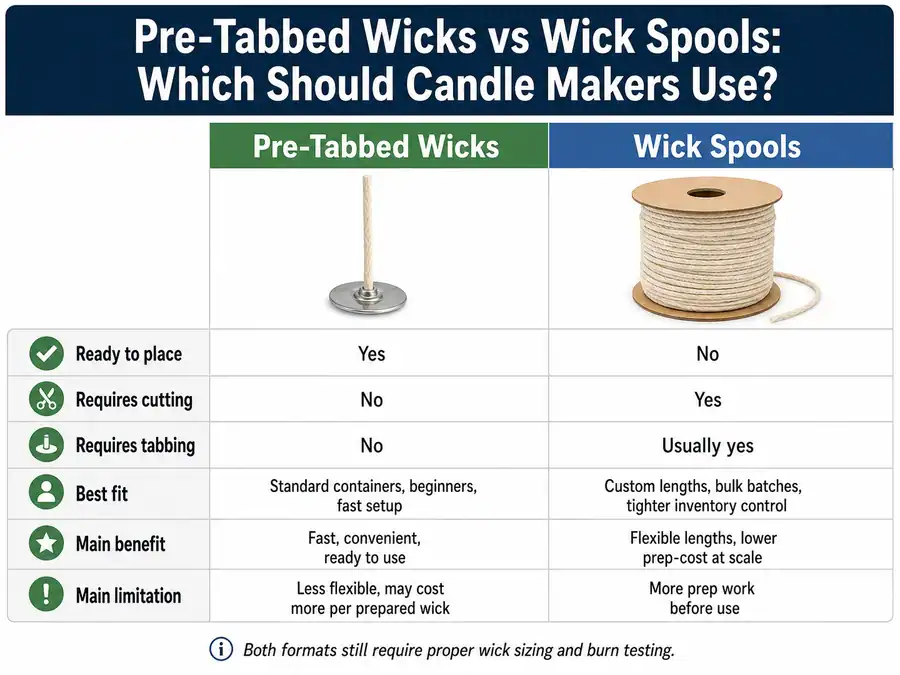
| Comparison point | Pre-tabbed wicks | Wick spools |
|---|---|---|
| Ready to place? | Yes, for wick preparation | No, not until cut and usually tabbed |
| Requires cutting? | No | Yes |
| Requires tabbing? | No | Usually yes |
| Best fit | Beginners, quick tests, standard containers, repeat small batches | Custom lengths, tall vessels, prototypes, repeated batches, bulk stock control |
| Main benefit | Faster setup and fewer preparation steps | More length control and supply flexibility |
| Main limitation | Fixed prepared lengths may not fit every vessel | More manual steps and more room for preparation error |
Pre-tabbed wicks are easier, not automatically better. They save preparation time because the cutting and tabbing are already done, but they can still be the wrong wick size for a wax, fragrance load, or vessel diameter.
Wick spools are more flexible, not automatically correct. They help when you need a custom cut length, but the finished candle still needs Wick Testing / Candle Burn Testing before you treat the format choice as a working wick choice.
Many makers use both formats. Pre-tabbed wicks can cover standard jars and small test batches, while spools can cover custom vessels, changing product lines, or higher-volume work where cut length and stock control matter more.
Which Wick Format Is Faster and Easier to Set Up?
Pre-tabbed wicks are faster because they are already cut and tabbed; wick spools require measuring, cutting, tabbing, and checking prepared length before placement.
Convenience here means fewer wick-preparation steps before pouring, not better candle performance. Pre-tabbed wicks are usually easier for beginners, quick tests, and small batches because the prepared unit can be placed or secured without making the wick assembly first. Wick spools take longer at the start, but the extra setup can be worth it when you need custom lengths, repeated cuts, or tighter control over wick inventory. Use Beginner candle making guide only when the question becomes the full candle-making process, not just wick preparation.
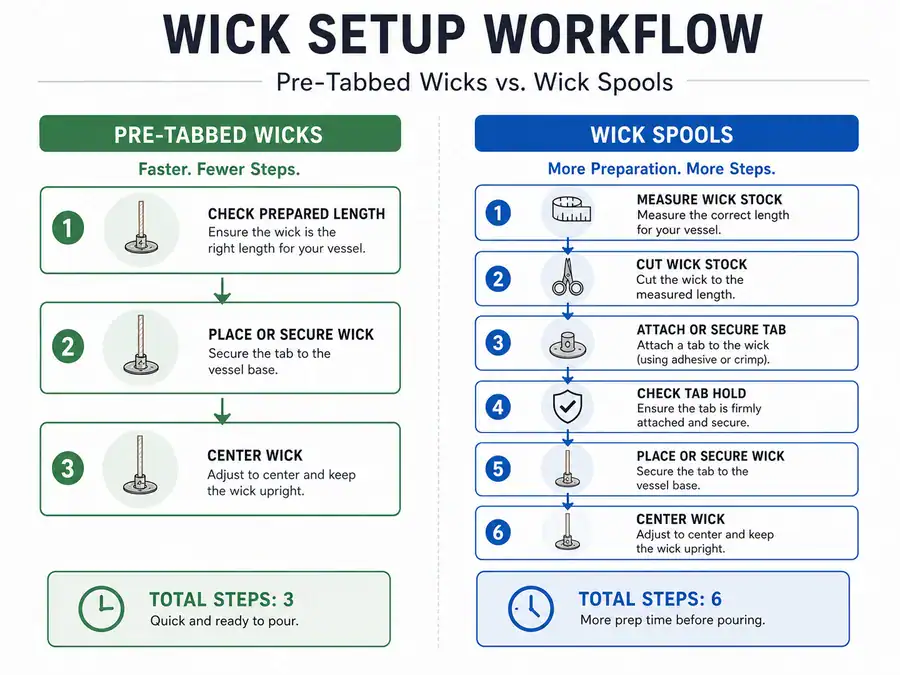
| Setup task | Pre-tabbed wick | Wick spool | Decision impact |
|---|---|---|---|
| Choose the wick format | Required | Required | Both start with the same format decision |
| Check prepared length | Required | Required | Pre-tabbed length is fixed; spool length is chosen by the maker |
| Measure wick stock | Not needed | Needed | Spools add a manual step |
| Cut wick stock | Not needed | Needed | Spools add time and consistency risk |
| Attach or secure a tab | Already done | Usually needed | Spools may need wick tabs and a securing method |
| Check tab hold | Usually supplier-prepared | Needed after tabbing | Spools require a quality check |
| Place or secure wick in vessel | Needed | Needed after assembly | Both still need placement control |
| Center wick | Needed | Needed | Format does not remove centering or later testing |
Are pre-tabbed wicks ready to use? Yes, for placement preparation, because the wick is already cut and attached to its metal tab. That does not mean the wick is already proven for the candle recipe.
Do wick spools need tabs? Usually yes, unless the maker uses another suitable assembly method for the candle format. For detailed manual assembly, use Wick tabbing how-to rather than turning the format comparison into a tabbing tutorial.
The faster choice is pre-tabbed when your goal is lower setup friction. The more controlled choice is spool stock when you accept extra preparation in exchange for custom length and repeatable stock use.
Which Option Costs Less Once Tabs, Labor, and Waste Are Included?
Cost means total practical format cost: wick stock, tabs, tools, cutting time, assembly labor, offcuts, wrong lengths, storage, and batch quantity.
Wick spools often lower material cost per usable wick at larger quantities, but the comparison changes when wick tabs, tools, cutting time, assembly labor, offcuts, and wrong-length waste are counted. Pre-tabbed wicks can cost more per prepared unit, yet still make sense when small batches, speed, or fewer preparation errors matter more than the lowest material price. This is about format-level economics, not live supplier pricing, cheapest brands, full candle cost of goods, or profitability. For deeper pricing by wick material or supplier-specific numbers, use the candle wick cost page.
Spool cost per usable wick = spool cost ÷ usable cut count + tab cost + optional labor estimate.
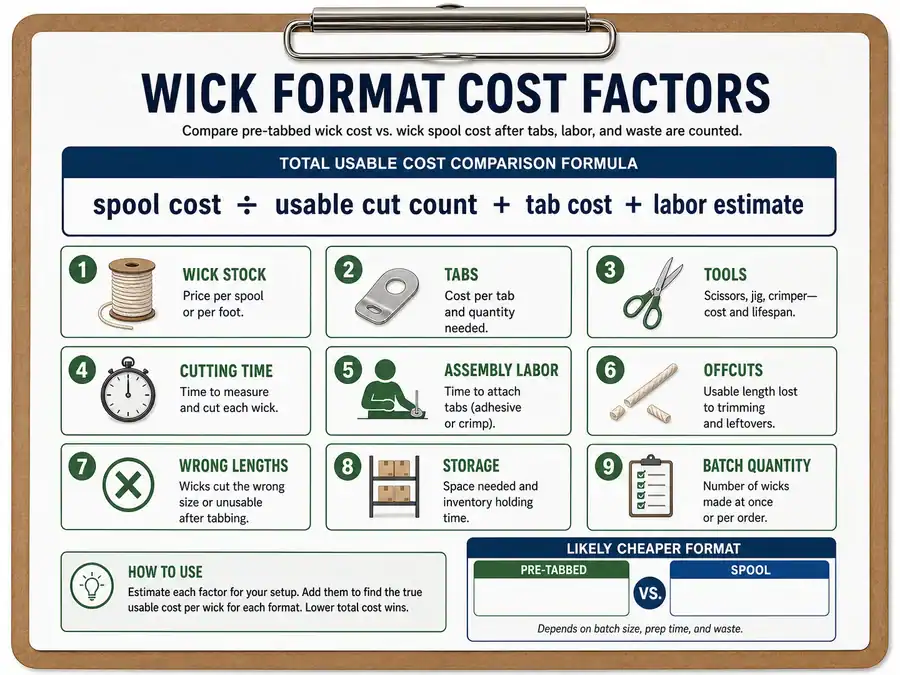
| Scenario | Pre-tabbed cost factor | Spool cost factor | Hidden cost to count | Likely cheaper format |
|---|---|---|---|---|
| First hobby batch | Higher prepared-unit cost | Low material cost, but extra setup | Tabs, cutter, mistakes, time | Pre-tabbed |
| Small test batch | Saves prep time | May waste short test cuts | Setup time and offcuts | Pre-tabbed |
| Repeated single vessel | Fixed length is easy to reorder | Repeated cuts can become consistent | Labor per batch | Depends on batch size |
| Tall custom vessel | May require buying longer prepared wicks | Cut length can match vessel height | Tabs and yield planning | Spool |
| Multiple vessel heights | Many fixed sizes may pile up | One stock can serve several lengths | Cut tracking | Spool |
| Small business batch | Convenience saves labor | Bulk stock can reduce unit material cost | Assembly time and quality checks | Depends on labor value |
| Frequent prototypes | Wrong prepared sizes can build up | Cuts can change between tests | Offcuts and retabbing | Spool |
| Standard jar line | Reorderable and simple | Useful only if volume offsets prep | Labor and storage | Pre-tabbed or hybrid |
| Bulk buying | May cost more for finished units | Bulk stock can spread material cost | Tabs, tools, labor | Spool |
| Low-waste workflow | No cutting scraps | Fewer wrong fixed sizes if measured well | Offcuts and rejected assemblies | Depends on use pattern |
Are spools cheaper? Sometimes, when batch volume and usable yield offset tabs, tools, and manual assembly. Are pre-tabbed wicks worth the markup? Often, when saved time, fewer parts, and simpler setup are more important than shaving material cost.
Do not compare spool price against pre-tabbed price without adding tab cost and labor exposure. A spool can look cheaper on the shelf while becoming less practical after short offcuts, inconsistent cuts, or extra preparation time are included.
If labor costing becomes part of a broader business process, move that planning to a Candle production workflow page. If cost questions require wick size, diameter, or series differences, keep the format comparison separate and use Wick Types and Sizing for those choices.
When Do Wick Spools Give You More Custom Length Control?
Wick spools give makers control over cut length, while pre-tabbed wicks come in supplier-prepared lengths that may or may not match a vessel height.
Length flexibility means adjustable wick length and tab pairing, not better burn performance, wax compatibility, fragrance compatibility, or automatic wick sizing. Spools help when a candle maker works with tall containers, unusual jars, prototypes, changing vessel lines, or candle forms that do not match common prepared wick lengths. Pre-tabbed wicks still work well when the vessel height matches an available prepared length and the maker wants less setup work. For diameter, series, wax, or vessel sizing questions, use Wick Types and Sizing instead of treating spool length as a sizing answer.
| Vessel or project situation | Pre-tabbed fit | Spool fit | What to check next |
|---|---|---|---|
| Standard jar with common height | Strong, if prepared length fits | Works, but may add unnecessary prep | Confirm wick size through testing |
| Tall container | May be too short | Strong, because length can be cut taller | Check tab fit and burn behavior |
| Short tin | May need trimming after placement | Works if cuts stay consistent | Avoid excess offcuts |
| Prototype vessel | May require many prepared lengths | Strong, because cuts can change between tests | Track each test length |
| Changing product line | Can create unused fixed sizes | Strong, because one stock can serve more lengths | Keep cut-length notes |
| Nonstandard candle form | May not match prepared options | Often better for custom length | Confirm assembly method |
| Beginner test in a known jar | Simple and low-friction | Possible, but adds tabbing work | Use the simpler format first |
| Repeated known size | Strong if the supplier length matches | Strong if volume makes prep worthwhile | Compare labor against stock control |
Can you cut candle wick to any length? Practically, you can cut spool stock to the length your vessel needs, but the cut wick still needs a suitable tab, secure attachment, and later burn validation.
What if pre-tabbed wicks are too short? Choose a longer prepared wick if available, or use spool stock so the cut length reaches the vessel height with enough extra wick for placement and trimming.
For unusual vessels where height and diameter both matter, use a Vessel-specific wick sizing guide after choosing the format. When the question becomes melt pool, flame behavior, mushrooming, soot, or validation, use Wick Testing / Candle Burn Testing rather than expanding this section into a full test method.
Which Format Fits Your Batch Size and Workflow?
Pre-tabbed wicks fit quick tests and predictable small batches; wick spools fit repeated, custom, or inventory-controlled candle workflows.
Production here means repeated candle batches, not industrial manufacturing. Pre-tabbed wicks help when the maker wants fast setup, fewer parts, and consistent prepared lengths for standard vessels. Wick spools help when batches repeat often, vessel heights vary, or one continuous stock is easier to manage than many fixed pre-tabbed lengths. If the workflow question turns into broader batching, staffing, wholesale planning, or process control, use the Candle production workflow page instead of expanding the wick-format decision.
| Workflow situation | Better fit | Why it fits | Watch-out |
|---|---|---|---|
| One-off hobby batch | Pre-tabbed wicks | Lowest setup work | Still needs the right wick size |
| Small test batch | Pre-tabbed wicks | Easy to compare prepared wicks quickly | Fixed lengths can limit odd vessels |
| Repeated standard jar | Pre-tabbed wicks or spools | Pre-tabbed saves time; spools can reduce stock complexity at volume | Compare labor against inventory control |
| Tall or custom vessel batch | Wick spools | Cut length can match vessel height | Requires tabbing and consistency checks |
| Multiple vessel heights | Wick spools | One spool can serve several cut lengths | Needs clear labeling and cut records |
| Small business line | Often hybrid | Pre-tabbed for standard items; spools for custom or repeated runs | Keep format choice separate from pricing strategy |
| Prototype-heavy workflow | Wick spools | Length can change between tests | Offcuts and manual errors can increase |
| Low-prep workflow | Pre-tabbed wicks | Fewer tools and fewer assembly steps | Less flexibility if prepared length is wrong |
A hybrid setup often makes the most sense once a maker has both predictable candles and custom work. Pre-tabbed wicks can stay in the workflow for fast standard pours, while spools handle odd heights, prototypes, and repeated batches where custom cut length matters.
Waste and inventory should stay tied to wick format. Pre-tabbed wicks can create unused fixed lengths when a vessel line changes, while spools can create offcuts or unused tabs when cuts are poorly planned. When waste becomes a detailed price or margin question, use the candle wick cost page rather than turning this into full cost accounting.
Wick spools also add workflow steps that pre-tabbed wicks remove. The maker must measure, cut, tab or secure the wick, check the tab hold, and label prepared lengths well enough to repeat them later.
Choose pre-tabbed wicks when the workflow depends on speed and low setup friction; choose spools when the workflow depends on custom length, repeated preparation, and tighter stock control.
Should Beginners Start With Pre-Tabbed Wicks or Wick Spools?
Most beginners should start with pre-tabbed wicks because they remove cutting and tabbing, but spools can work when custom length matters.
Beginner-friendly means fewer wick-preparation decisions, fewer tools, fewer manual assembly steps, and easier repeat setup. Pre-tabbed wicks are usually the easier starting format because the wick is already cut and attached to a metal tab. Wick spools are better for beginners only when custom vessel height, supply control, bulk practice, or learning manual wick preparation matters enough to accept extra setup work. For the full candle-making process, use a Beginner candle making guide rather than treating wick format as the whole beginner path.
| Beginner situation | Better starting format | Reason |
|---|---|---|
| First container candles in standard jars | Pre-tabbed wicks | Fewer setup steps before pouring |
| Learning basic wick placement | Pre-tabbed wicks | Lets the maker focus on placement and centering |
| Testing several prepared wick sizes | Pre-tabbed wicks | Easier to compare ready-made options |
| Using tall or unusual vessels | Wick spools | Cut length can match the vessel height |
| Learning how tabs attach | Wick spools | Gives practice with manual preparation |
| Planning repeated custom batches | Wick spools | Builds repeatable cut-length control |
| Avoiding extra tools | Pre-tabbed wicks | No separate tabbing setup is needed |
| Building both standard and custom candles | Both | Each format supports a different task |
Why do beginner candles still fail even with pre-tabbed wicks? Because pre-tabbed is only a preparation format. It does not choose the correct wick size, wax match, fragrance load, vessel diameter, or burn result.
Use Wick Types and Sizing when the problem is wick diameter, series, or matching the wick to the candle. Use Wick Testing / Candle Burn Testing when the problem is flame size, melt pool, soot, tunneling, mushrooming, or whether the candle actually performs correctly.
A beginner can still choose spools when the goal is learning manual prep early. In that case, keep the first setup simple: one vessel style, one cut length, clear labels, and a small number of test candles.
When the question becomes how to attach tabs cleanly, use the Wick tabbing how-to node instead of trying to learn the whole assembly process inside a format comparison.
Quick Decision Matrix: Use Pre-Tabbed Wicks, Wick Spools, or Both?
Use pre-tabbed wicks for simplicity, wick spools for custom length and repeated controlled batches, and both when standard and custom workflows coexist.
The best choice means the best purchasing format for the use case, not the best wick size, material, brand, or supplier. Pre-tabbed wicks reduce preparation work when the vessel, wick length, and batch pattern are predictable. Wick spools give more control when the maker needs custom cuts, repeated batches, or a smaller set of flexible inventory. A hybrid setup is valid when one candle line uses standard containers and another needs custom length control.
| Use case | Better format | Why it fits | What to do if unsure |
|---|---|---|---|
| First standard container candles | Pre-tabbed wicks | Less cutting, tabbing, and setup control needed | Use choosing the correct wick size and series if the question is wick diameter or series. |
| Small test batch | Pre-tabbed wicks | Faster to compare prepared wick options | Use burn testing the selected wick before treating any wick as final. |
| Tall or unusual vessels | Wick spools | Cut length can match vessel height | Use vessel sizing support when height and diameter both matter. |
| Repeated custom batches | Wick spools | The same stock can be cut to a planned length repeatedly | Keep cut-length notes so repeat batches stay consistent. |
| Multiple container heights | Wick spools | One spool can cover several prepared lengths | Track offcuts so flexibility does not become waste. |
| Standard jar product line | Pre-tabbed wicks or both | Prepared lengths save time; spools may help at volume | Compare labor and stock control before switching. |
| Prototype-heavy work | Wick spools | Length can change between tests without buying many fixed sizes | Keep the test scope limited to format and length. |
| Cost-sensitive bulk work | Wick spools | Bulk stock may reduce material cost after tabs and labor are counted | Use calculating detailed candle wick cost when price, labor, and waste need full modeling. |
| Material comparison question | Neither format decides it | Cotton, paper, and wood questions are material questions, not format questions | Use comparing cotton and wood wick materials if the decision shifts to wick material. |
| Standard plus custom workflow | Both | Pre-tabbed wicks serve standard candles; spools serve custom or repeated cuts | Keep each format assigned to a clear job. |
The matrix works only when the maker keeps the comparison at format level. It should not be used to pick wick diameter, wax match, fragrance load, flame behavior, or a final performance result.
If the decision still feels split, choose the format that removes the bigger constraint: pre-tabbed wicks remove prep work, while spools remove fixed-length limits. The final purchase should match the batch pattern, vessel height, labor tolerance, and testing plan.
Buying Checklist: When Should You Switch From Pre-Tabbed Wicks to Spools?
Stay pre-tabbed when simplicity matters most; switch to spools when custom length, repeated batches, and inventory control outweigh tabbing labor.
Use both formats when standard candles and custom work exist in the same workflow. A switch is worthwhile only when the added cutting, tabbing, labeling, and quality checks solve a real supply problem. It is not worthwhile if the maker only wants the lowest sticker price without counting tabs, tools, time, offcuts, and rejected assemblies. Keep the buying choice separate from wick sizing and burn validation.
Use this checklist to decide the format before shopping:
- Stay with pre-tabbed wicks if your vessels use common prepared lengths.
- Stay with pre-tabbed wicks if you want the fewest wick-preparation steps.
- Stay with pre-tabbed wicks if small batches and quick tests matter more than custom length.
- Stay with pre-tabbed wicks if cutting and tabbing would slow production more than it saves.
- Switch to wick spools if prepared lengths are often too short, too long, or unavailable.
- Switch to wick spools if repeated batches make custom cut lengths worth standardizing.
- Switch to wick spools if unused fixed wick sizes keep building up in storage.
- Switch to wick spools if you already have a reliable method for attaching tabs to cut wick stock.
- Use both if standard jars can stay pre-tabbed while tall, custom, or prototype vessels use spools.
- Pause the buying decision if the real issue is Wick Types and Sizing, because format cannot solve wick diameter or series selection.
- Pause the buying decision if the real issue is Wick Testing / Candle Burn Testing, because format cannot prove melt pool, flame behavior, soot level, or final candle performance.
- Recheck the cost if switching depends on candle wick cost page questions such as supplier pricing, labor value, or full cost modeling.
A simple switching threshold is practical, not universal: switch when the spool solves a recurring length, waste, batch, or inventory problem more often than it creates cutting and tabbing work.
Avoid switching just because spools look cheaper at first glance. A spool format can still cost more in practice if the maker loses time to inconsistent cuts, loose tabs, mislabeled lengths, or batches that still need replacement wicks.
After the format decision is clear, compare pre-tabbed wick packs and wick spool supplies by specs, length, tab size, material, and quantity without treating product listings as proof that one format is always better.