
Usually, no extra additive is needed for pre-blended candle wax unless supplier guidance or testing shows a specific gap the existing blend does not already handle.
A pre-blended candle wax is a supplier-formulated wax system sold for a target use and performance profile. On this page, extra additives means modifiers layered on top of that finished blend, not from-scratch wax design and not routine fragrance or dye use within the supplier’s stated limits. The practical default is to leave the blend unchanged unless supplier guidance or a verified performance gap shows a clear need for one controlled change.
Do pre-blended candle waxes already contain additives?
Many pre-blended candle waxes already contain additives or performance modifiers, so you should not assume they start as plain wax.
A pre-blended candle wax is a wax sold as a ready-made blend for a target result such as smoother tops, better glass adhesion, a cleaner surface, or a stated fragrance range. On this page, extra additives means modifiers added on top of that factory blend, not the blend itself and not normal fragrance or dye use by default.
This page is about candle additives in pre-blended candle wax contexts, not from-scratch wax design. That difference matters because a straight soy wax, a straight paraffin wax, and a pre-blended container wax do not start from the same baseline. If you treat every wax as additive-free, you can end up solving a problem that the blend already solved at the factory. That is how unnecessary stacking starts.
Usually, no extra additive is needed unless a specific validated gap remains.
That is a practical rule for pre-blended wax, not a rule for every wax. If the wax already pours, cures, burns, and finishes the way the supplier intended, leaving it unchanged is often the safer choice. Move past that default only when supplier notes, your baseline result, or a careful one-change test shows a clear missing result.
Look for signs that the wax is already doing more than a plain base wax:
- It is sold as a blend rather than a single raw wax
- The product page states a clear use case such as container candles, tarts, or pillars
- The supplier mentions smooth tops, adhesion, opacity, firmness, or UV support
- The listing gives a fragrance range or single-pour claim
- Technical notes describe the wax as ready-made, ready-formulated, or intended for a specific candle type
A quick product-page scan often tells you more than general candle advice. Match the exact wax name or SKU across the product page, technical sheet, and SDS. If those sources describe the wax as a finished system, treat that as your starting point. If they stay vague, pause before adding anything.
The table below shows the kind of baseline clues worth checking before you treat a pre-blended wax as a blank slate.
| What you see | What it usually means | What to do next |
| “Pre-blended” or “ready-formulated” | The wax may already include modifiers | Start with the current blend unchanged |
| Fragrance-load range | The wax was built for a target use window | Stay inside that window before changing the recipe |
| Smooth-top or adhesion claims | Surface performance may already be tuned | Check process variables before adding more |
| Container or pillar claim | The blend was built for a specific form | Do not assume it should act like another wax family |
| Single-pour language | The blend may already include support for finish and structure | Test the wax as sold before altering it |
The main question here is not “Can additives ever help?” It is “Does this blend already cover the job I want?” If the answer looks like yes, stop there. If the answer is unclear, confirm the supplier notes next. If the answer is no and the performance gap is real, then move outward to candle additives and enhancers, choose the right candle additive, or make candles without additives only after you have confirmed that the current blend is not already doing the work.
How should you check supplier guidance before changing a pre-blended wax?
Supplier guidance should be your first decision screen before you change any pre-blended wax.
Check the exact product page, technical sheet, SDS, fragrance-load note, and any ready-blend claim before you add another modifier. For this step, safe means staying inside the supplier’s stated limits for that specific blend, not assuming a change is fine in every wax.
General maker advice can suggest ideas, but it does not outrank the exact listing for your wax. A pre-blended wax may already be sold for a narrow use case, and that alone can answer whether another additive is needed. If a supplier says the wax is built for container candles with a certain fragrance range and smooth-top behavior, that claim should shape your next step more than a broad tip pulled from a different wax family.
Check these sources in order:
- Product page for the exact wax SKU
- Technical sheet or support notes
- SDS, if one is available
- Fragrance-load note or usage cap
- Any ready-blend, single-pour, or intended-use claim
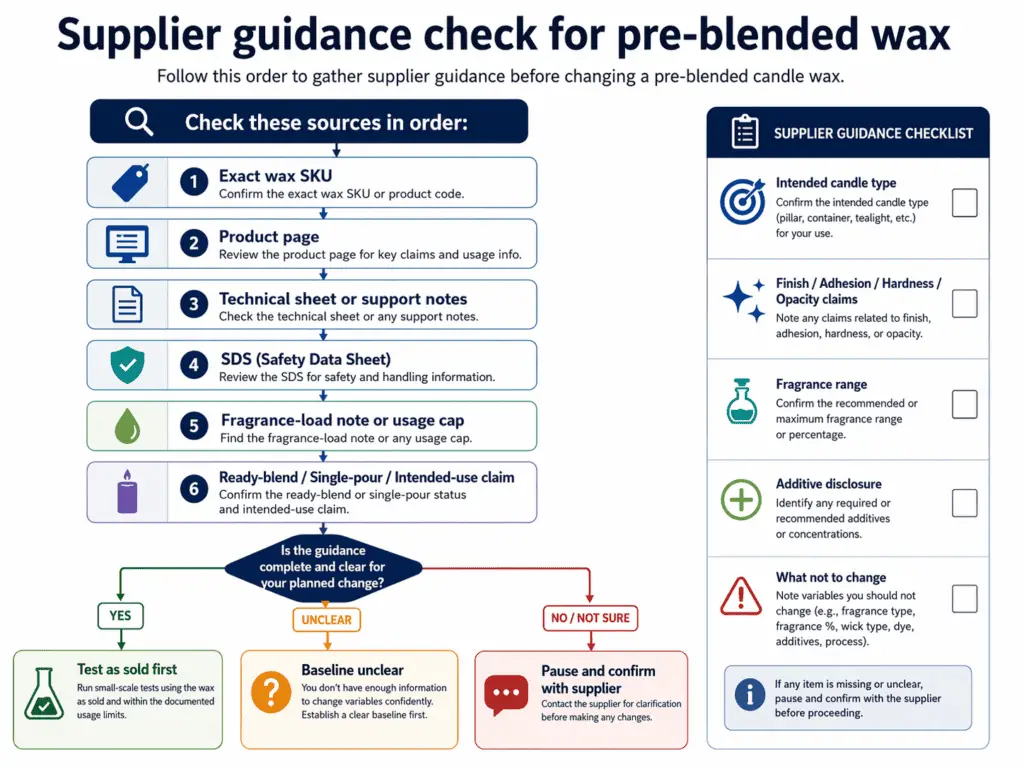
Focus on wording that tells you what the blend is already meant to do. Some supplier pages are direct and tell you the wax type, target use, and likely limits. Others are short and force you to piece the answer together from several places. Either way, your goal is the same: find out whether the wax is already designed for the outcome you want before you change anything.
Use this checklist when reading supplier material:
- Is the wax sold as a blend or as a straight wax?
- Is the intended candle type named?
- Are finish, adhesion, hardness, or opacity claims listed?
- Is a fragrance range or warning given?
- Is there any note about additives already in the blend?
- Does the supplier mention what not to change?
When disclosure is incomplete, do not fill the gap with random additive stacking. Keep the current blend as your control batch, note the missing supplier detail, and move to cautious one-change testing only when you still have a named reason to change the wax.
A simple record can keep that process clear:
| Supplier signal | Why it matters | Safer response |
| Exact use case is named | The blend likely has a built-in target | Test the wax as sold first |
| Fragrance range is stated | The wax already has a performance window | Stay within that range before adding modifiers |
| Surface or adhesion claims are listed | The blend may already address appearance issues | Check process variables before changing formula |
| No additive disclosure appears | You do not know the full baseline | Treat the wax as uncertain, not empty |
| Product page and sheet conflict | The baseline is unclear | Pause and confirm with the supplier before changing the blend |
If your notes still leave a gap, keep the gap narrow. Ask one practical question at a time, such as whether the wax is meant for your vessel type or whether the claimed fragrance range fits your current load. That is still decision support. It does not require a full chemistry detour.
When supplier guidance does not fully settle the issue, move to the next decision layer rather than guessing. Use a candle additive overview only after the supplier notes leave a real gap. Only mix candle additives properly when the product information still leaves you with a narrow, tested reason to change the blend. If the real issue is that the wax family itself is a poor fit for the job, first compare candle wax types instead of forcing a new additive into the current blend.
Why do you want to add more additive, and is that goal already handled by the blend?
The right additive decision starts with a named outcome, because on this page better means one specific result in the current pre-blended setup, not a vague overall upgrade.
In pre-blended wax, better should mean one specific result such as more hardness, more opacity, stronger fragrance retention, or more color stability. Once that goal is named, compare it to what the current blend is already sold to do before you add anything else.
A vague goal usually leads to a vague fix. “I want it to perform better” is not enough. “I want a firmer pillar,” “I want less visible discoloration,” or “I want a stronger hold on fragrance in this exact setup” is much more useful. A named goal gives you a cleaner decision: keep the blend as it is, confirm the supplier notes again, test one small change, or route the question to a narrower page.
This is a good way to separate a real additive question from a fuzzy upgrade instinct:
| Your stated goal | Does it sound additive-owned? | What to check first |
| More hardness | Sometimes | Whether the blend already targets firmness |
| More opacity | Sometimes | Whether the wax already gives the look you need |
| Better scent hold | Sometimes | Whether fragrance load or wick choice is the true limit |
| Better color stability | Sometimes | Whether the blend already includes support for that result |
| Smoother tops | Often not | Pour, cooling, cure, and process habits first |
| Better burn | Often not | Wick fit and vessel setup first |
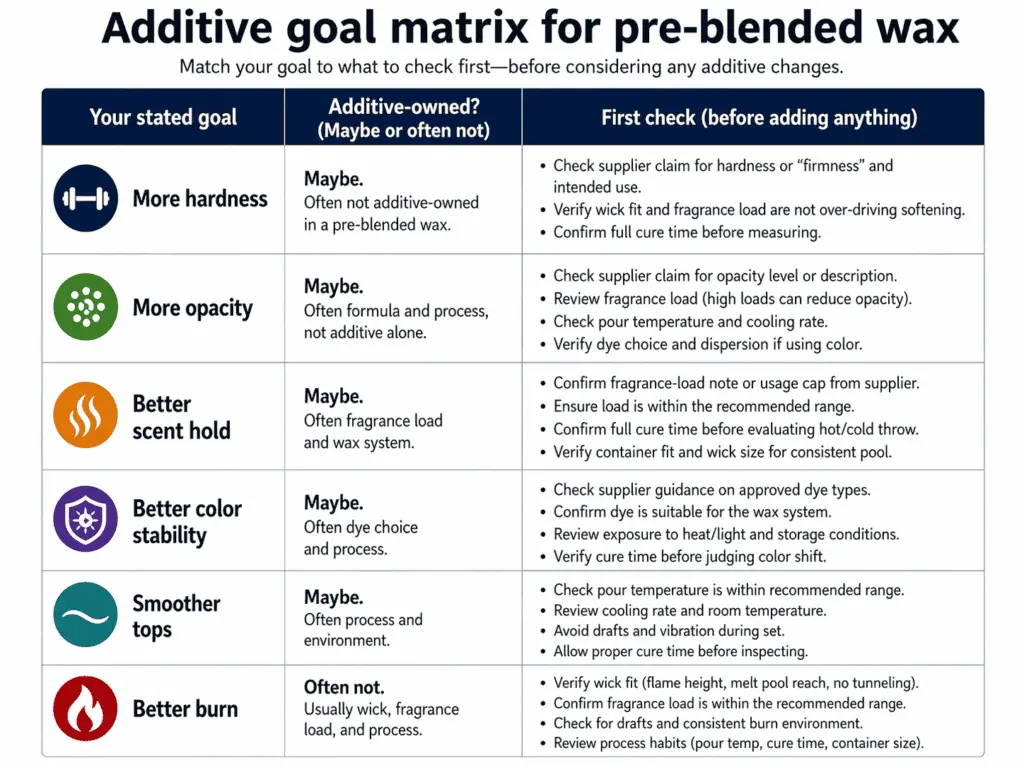
The goal-first method matters because a lot of candle problems sit outside the additive layer. A rough top does not automatically mean the blend needs a modifier. Weak scent does not automatically mean the wax needs more help. A harder candle body does not automatically mean the current blend failed. Sometimes the blend is fine and the variable is somewhere else.
A quick decision path helps:
- Name the exact result you want
- Check whether the supplier already claims that result for the blend
- Compare your current result with the claimed use case
- Decide whether the issue belongs to additives or another variable
- Test one change only if the gap still looks real
That is how you avoid using additives as a catch-all answer. It is also how you keep this page inside scope. This article is not the place for a full shopping list, a full additive selector, or a full fragrance strategy page. It is the place where you decide whether extra additive logic is even relevant.
When the goal is clear, the next move becomes much easier. If the issue really belongs to additive choice, choose the right additives for your candle type. If the goal is mostly about scent behavior, move to improve scent throw and fragrance retention. If the decision is mainly about hardness or opacity, compare stearic acid vs Vybar instead of treating all additives as if they do the same job.
When can extra additives create compatibility or stacking problems?
Extra additives can create compatibility or stacking problems when they duplicate a job the blend already does or when they shift the wax balance in the wrong direction.
On this page, safe means compatible and controlled use inside one specific pre-blended wax, not proof that an additive is always harmless or always useful. Advice that works in a straight wax does not always transfer cleanly to a pre-blended system.
That is the core tradeoff: an additive can solve one narrow problem while creating a new one somewhere else. A change that increases firmness may reduce adhesion. A change that improves one visual trait may alter how the candle burns. A move that sounds small can still be redundant if the blend already contains support for the same result.
Use the tradeoff table below to judge whether the possible gain is worth the risk inside a pre-blended system.
| Intended gain | Possible benefit | Likely tradeoff | When to stop |
| More hardness | Firmer candle body | Poorer adhesion, rougher finish, or a burn change | Stop when the blend already performs within intended use |
| More opacity | More solid appearance | Surface change or little practical gain | Stop when the visual issue is minor or already acceptable |
| More scent retention | Better hold in one setup | Weaker burn balance or confusion with wick or fragrance-load issues | Stop when the real issue is not additive-owned |
| More color support | Better resistance to discoloration | Redundant stacking if the blend already covers that need | Stop when supplier notes already point to built-in support |
A few failure patterns show up again and again:
- Adding a modifier because it worked in another wax family
- Treating a pre-blended wax like a straight wax
- Trying to solve a wick problem with a wax additive
- Trying to solve a process problem with more formula changes
- Making several changes at once and losing the baseline
Those patterns matter because compatibility problems are often created by mismatch, not by the additive name alone. The same additive can look reasonable in one wax and unnecessary in another. That is why the blend baseline and the stated goal have to stay together in the decision.
If the fit still looks uncertain, do not widen the page into a full defect guide. Move to choose the right candle additives when the issue is clearly additive-owned. If the change has already created a visible problem, use fix cloudiness or cracking from wrong additives. If the next issue is handling rather than fit, review how to mix candle additives into wax before you test again.
What candle problems are not really additive problems?
Extra additives are not the universal fix for candle defects.
Many visible problems belong to wick size, fragrance load, dye load, cure time, pour temperature, or process habits instead of missing additives. Here, the only question is whether additives are the right remedy for the symptom at all.
Use this section to rule additives out, not to diagnose the full defect. When the symptom clearly belongs to another variable, route to the narrower troubleshooting page instead of expanding the fix here.
These are common false matches:
| Symptom | Often blamed on additives | More likely first check |
| Weak scent throw | “The wax needs more help” | Fragrance load, wick fit, cure, room size |
| Frosting or cracking | “The wax needs another modifier” | Cooling, pour temperature, cure, process habits |
| Rough tops | “The blend is missing an additive” | Pour method and cooling pattern |
| Uneven burn | “The wax formula is wrong” | Wick sizing and vessel fit |
| Dull color | “The wax needs more additive” | Dye choice, load, and heat history |
When the symptom points away from the additive layer, stop adding more. If the defect looks tied to the change itself, use the page that helps you fix cloudiness or cracking from wrong additives. If the main question is the defect rather than the additive, check the page on why homemade candles crack. If your next step is handling rather than diagnosis, review how to mix candle additives properly before testing again.
How should you test one additive change at a time if you still need to experiment?
Any additive test in pre-blended wax should compare one controlled change against an unchanged baseline batch.
Use that check only when supplier notes and baseline review still leave one narrow question. Compare one unchanged control batch against one batch with a single additive change, keep the other variables the same, and stop when the result gets worse or the issue clearly belongs to wick, fragrance, or process variables.
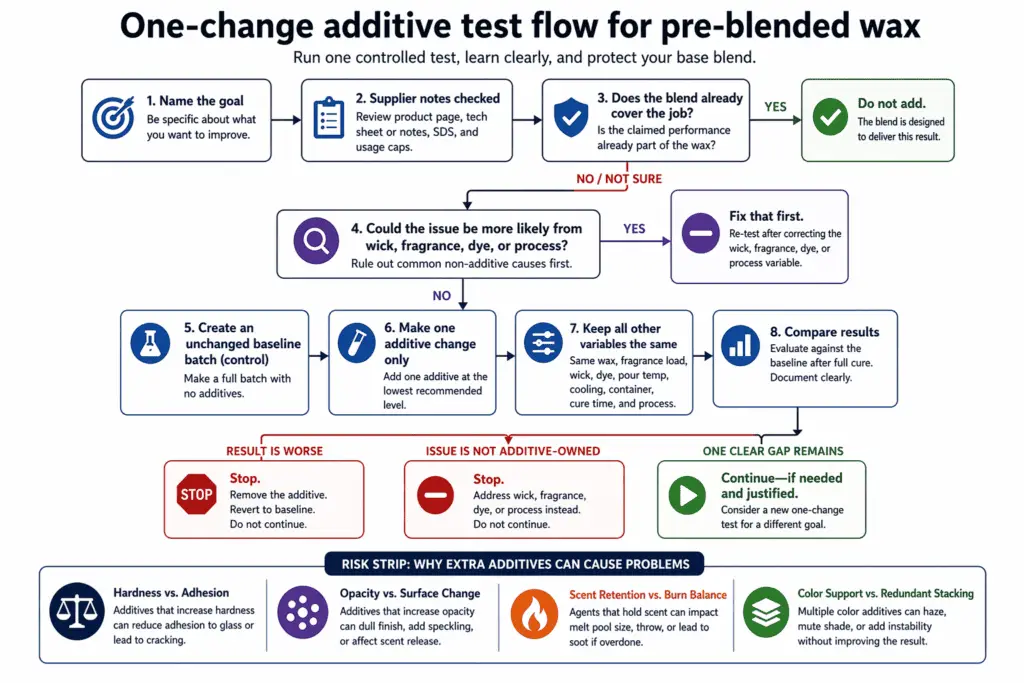
That last point is important. This page supports one-variable validation against a baseline, but it does not replace narrower usage or fix pages. If you need exact handling steps next, review how to properly mix candle additives into wax. If the experiment created a new defect, go to fix additive-related cloudiness or cracking. If you need a broader refresher before another test, return to candle additives and enhancers and narrow the decision again.