
The best fragrance oils for soy candles are candle-use oils that perform in soy wax, provide clear safety and use-rate documents, produce reliable cold and hot throw after testing, and can be tested before bulk buying.
A fragrance oil for soy candles is an aromatic concentrate intended for candle wax use and judged by how it behaves in soy wax after curing, burning, and basic document checks. Here, “best” means the oil fits soy candle performance, use-rate guidance, supplier transparency, and testability, not that it is the strongest or cheapest oil. Here, “safe” means documented candle-use guidance and hazard transparency, not harmless, edible, skin-safe, pet-safe, natural, or legally compliant everywhere.
This page covers soy candle fragrance oil selection, not exact fragrance-load math, supplier rankings, legal compliance, essential-oil comparisons, or full weak-throw troubleshooting.
| Buyer Goal | Best-Fit Oil Signal | Avoid |
|---|---|---|
| Strong hot throw | Candle-use oil with soy testing notes and trial size | Judging by bottle smell |
| Safer testing | Safety data sheet (SDS), International Fragrance Association (IFRA)-style guidance, and use-rate notes | Marketplace listing with no documents |
| Beginner use | Clear range, support path, and sample size | Bulk-only purchase |
| Pale candles | Lower discoloration risk notes | Untested vanilla or bakery oils |
| Repeatable batches | Supplier update or batch-change path | No document update trail |
What Makes a Fragrance Oil Good for Soy Candles?
A fragrance oil is good for soy candles when it is candle-use documented, soy-compatible, use-rate supported, and testable in a finished candle.
A good fragrance oil for soy candles is candle-use appropriate, soy-compatible, documented by the supplier, and testable in a finished soy candle. That means the oil should move through a simple chain: selected for soy wax, checked against use guidance, then tested for cold throw and hot throw in the finished candle.
A soy-compatible fragrance oil is a candle fragrance oil that the supplier positions for wax use and that gives enough information for a maker to test it in soy wax. Compatibility does not mean guaranteed strong hot throw. It means the oil is a reasonable candidate for testing.
Not every nice-smelling oil belongs in a soy candle. Perfume oil, diffuser oil, soap fragrance, or a generic “fragrance oil” should be skipped unless the supplier clearly documents candle wax use. “Best” here means best fit for soy candle use, not strongest bottle scent, highest price, cheapest option, most natural claim, or universal safety.
| Selection Signal | What to Look For | Why It Matters for Soy Candles | Pass / Caution / Skip |
|---|---|---|---|
| Candle-use or wax-use guidance | Product page says the oil is for candles or wax | Confirms the oil is meant for candle making, instead of only perfume, soap, or diffuser use | Pass if stated clearly |
| Soy wax note | Supplier mentions soy wax use or does not warn against it | Soy wax can soften, mute, or shift scent behavior | Pass or caution, depending on detail |
| Use-rate guidance | Supplier gives a usable range or maximum for candles | Helps screen oils before separate fragrance-load math | Pass if visible |
| SDS availability | Supplier provides a safety data sheet | Gives hazard and handling information for the oil | Pass if easy to access |
| IFRA-style guidance where relevant | Supplier gives category or use guidance | Helps separate documentation from marketing claims | Pass if matched to the intended candle use |
| Trial size available | Small bottle or sample size can be bought | Reduces waste before bulk buying | Pass if available |
| Candle-maker testing notes | Reviews or notes mention candle performance, instead of only scent preference | Points toward finished-candle behavior | Caution unless paired with your own test |
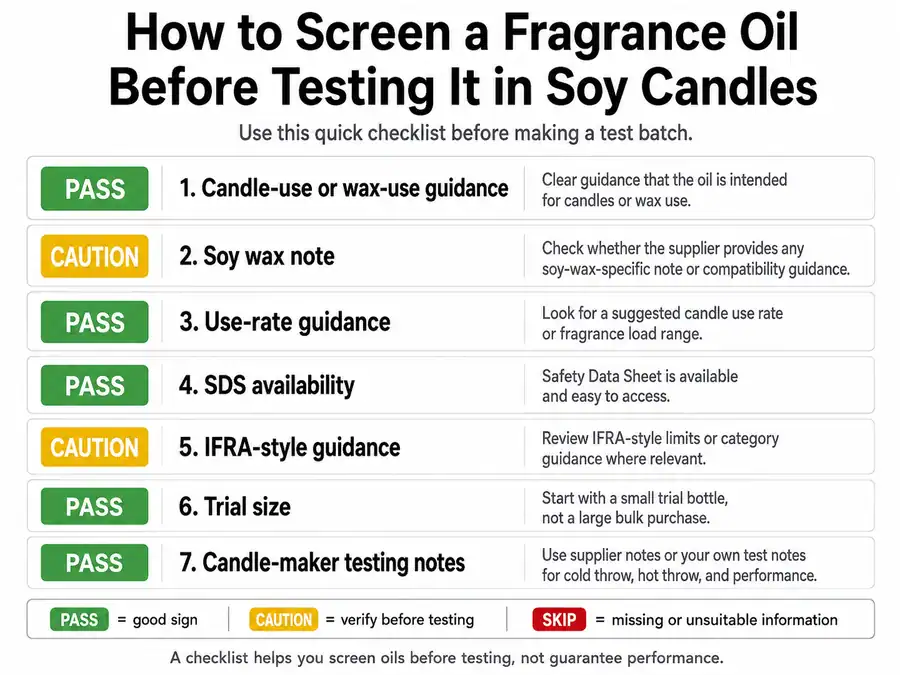
Method note: Use this checklist as a buying screen, not as proof that an oil will work. Supplier notes, SDS access, IFRA-style guidance, and reviews can reduce uncertainty, but the finished soy candle still needs testing.
Exact wax-specific usage rates are outside this selection article. This section only screens fragrance oils for soy candles before purchase; it does not calculate a full formula.
Comparing fragrance oils with essential oils changes the ingredient category, so it is outside this article’s scope. Broader soy wax behavior is also outside this selection screen.
How Should You Compare Cold Throw and Hot Throw?
Cold throw is the scent of the unlit soy candle, while hot throw is the scent released while the candle burns.
Both matter, but hot throw usually deserves more weight because it reflects real candle use. A fragrance oil for soy candles should be compared in the finished candle after curing and burning, not by bottle smell alone.
Cold throw (CT) is the scent a candle gives off when it is unlit. Hot throw (HT) is the scent released while the candle burns. Bottle smell is a poor stand-in for either one because raw oil intensity does not prove finished-candle scent throw.
| Result Pattern | What It Means | Selection Decision | If the Problem Continues |
|---|---|---|---|
| Strong CT / strong HT | The candle smells good unlit and while burning | Strong candidate after burn testing | Record results in a test log |
| Strong CT / weak HT | The candle smells good cold but underperforms while burning | Do not buy in bulk yet | Treat weak hot throw as a finished-candle troubleshooting issue |
| Weak CT / strong HT | The candle may lack shelf appeal but performs during use | Good candidate for burn-use performance | Decide based on selling channel |
| Weak CT / weak HT | The finished candle underperforms in both states | Skip or retest under controlled conditions | Check cure, wick, vessel, wax, load, and oil together |
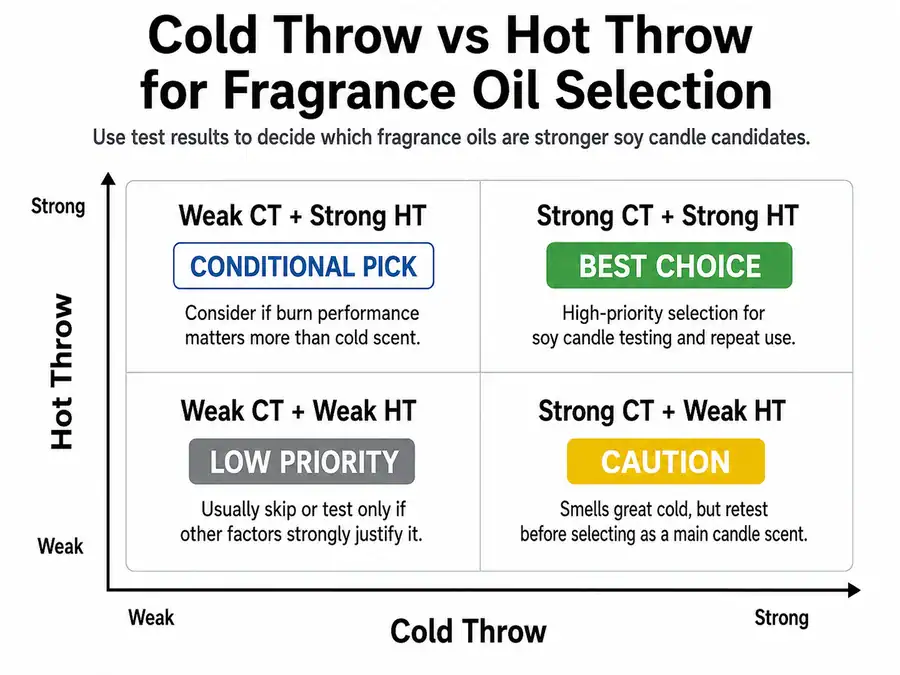
Method note: Compare fragrance oils under the same wax, wick, vessel, fragrance load, and cure window. Changing several variables at once makes the fragrance oil look better or worse than it is.
Cold throw is not useless. It matters for shelf appeal, gifting, and the first impression when someone opens a candle. Hot throw usually matters more for candles meant to scent a room while burning.
A strong bottle smell does not mean strong hot throw. It only means the raw oil smells strong before wax, wick, cure time, and burn behavior change the result.
If hot throw is weak, oil choice is only one possible cause. Cure time, wick fit, vessel size, wax behavior, and fragrance load can all affect the result. Cure timing and wick fit are finished-candle testing issues, not fragrance-oil selection shortcuts.
What Safety Documents Should You Check Before Buying?
Before buying fragrance oil for soy candles, check the safety data sheet (SDS), International Fragrance Association (IFRA)-style use guidance, supplier use-rate limits, candle-use statements, and market-specific labeling signals.
In this article, safe means the oil has candle-use guidance, hazard documentation, supplier use limits, and enough transparency for a candle maker to test and handle it responsibly. Before buying fragrance oil for soy candles, check for candle-use guidance, SDS access, IFRA-style documentation where relevant, supplier use limits, and allergen or CLP-related information if selling in regulated markets.
A safety data sheet (SDS) gives hazard and handling information for a fragrance oil. It does not certify the finished candle as safe. IFRA-style documentation can help with use guidance, but the relevant use category and supplier instructions still matter.
| Document / Signal | What It Helps With | What It Does Not Prove | When Deeper Review Is Needed |
|---|---|---|---|
| SDS | Hazard awareness, storage notes, handling precautions | That the finished soy candle is safe in every use case | When you need to interpret handling, storage, or hazard details |
| IFRA-style document or certificate | Use guidance and category-based limits where supplied | That the oil is harmless, candle-safe by itself, or legal everywhere | When category details affect the intended use |
| Supplier use-rate guidance | Candle-use limits before testing | That the highest listed amount is the best amount | When exact load decisions are needed |
| Allergen / CLP signals | Labeling awareness for sellers in regulated markets | That a label is complete or legally approved | When selling in a regulated market |
| Candle-use statement | Whether the supplier positions the oil for candles or wax | That it will perform well in soy wax | When the finished candle must be validated |
| Supplier document update path | A way to request current documents or updated safety data | That old downloaded files are still current | When documents may have changed or the formula is unclear |
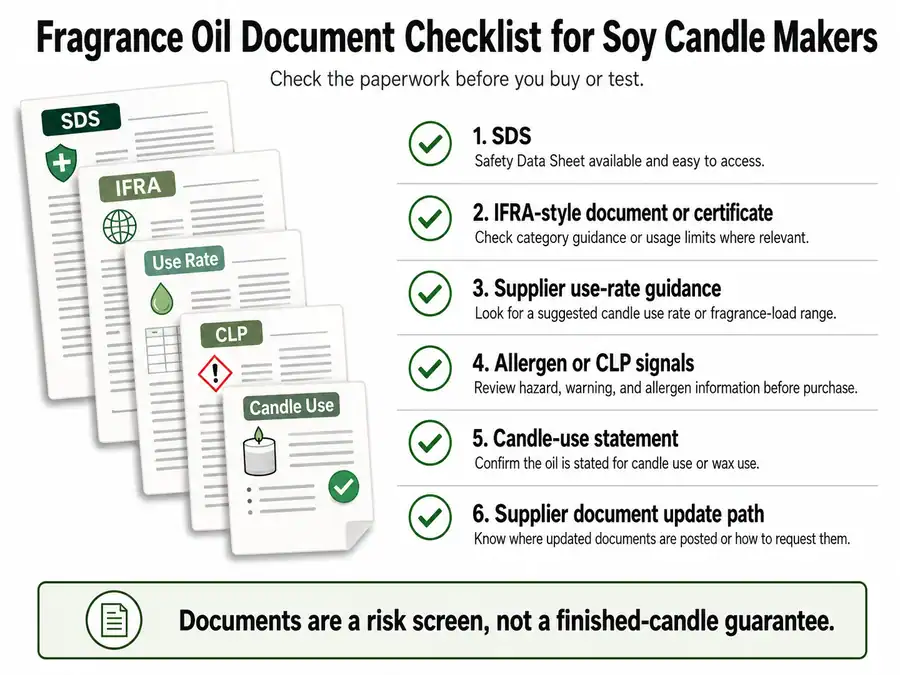
Method note: Treat documents as a risk screen, not as a guarantee. SDS access, IFRA-style guidance, use-rate limits, and supplier transparency reduce uncertainty before testing, but they do not replace safe handling, burn testing, or seller compliance checks.
“Natural,” “clean,” “phthalate-free,” and similar claims are not substitutes for documentation. Natural fragrance oils are not automatically safer, and a clean marketing claim does not explain candle-use limits, hazards, or labeling duties.
Hobbyists still need safe handling and use guidance because fragrance oil is a concentrated material. Sellers may need deeper labeling or jurisdiction-specific checks before offering candles to customers, so those questions sit outside this selection article.
How Should Fragrance Load Guidance Affect Your Choice?
Fragrance-load guidance should affect your choice by showing whether the oil has a practical candle-use range, but it should not decide your exact formula.
Choose fragrance oils with clear supplier use-rate guidance and realistic soy candle load expectations. The best fragrance oil is not the one that allows the highest percentage; it is the one with practical guidance that can be tested inside a stable soy candle system.
A visible use range helps you decide whether an oil is worth testing before purchase. It does not tell you the exact grams or ounces for your batch because exact amounts depend on wax, batch size, vessel, wick, and supplier guidance.
| Supplier Signal | Good Sign | Caution Sign | What to Do Next |
|---|---|---|---|
| Recommended use range visible | Supplier gives a candle-use range or starting point | Only a vague “use as desired” note appears | Prefer an oil with clearer guidance |
| Maximum use rate visible | Maximum is listed separately from suggested use | Maximum is presented as the best target | Treat maximum load as a limit, not a recommendation |
| Soy wax note included | Supplier mentions soy wax or candle wax testing | Product page only mentions soap, diffuser, or perfume use | Skip unless candle-use guidance is documented |
| Candle-use category clear | Product is positioned for candles or wax melts | Use category is unclear or mixed across product types | Ask supplier before testing |
| Calculator or support path available | Supplier gives technical help, calculator guidance, or test notes | No support path or document request option is visible | Buy only a small trial size or compare another oil |
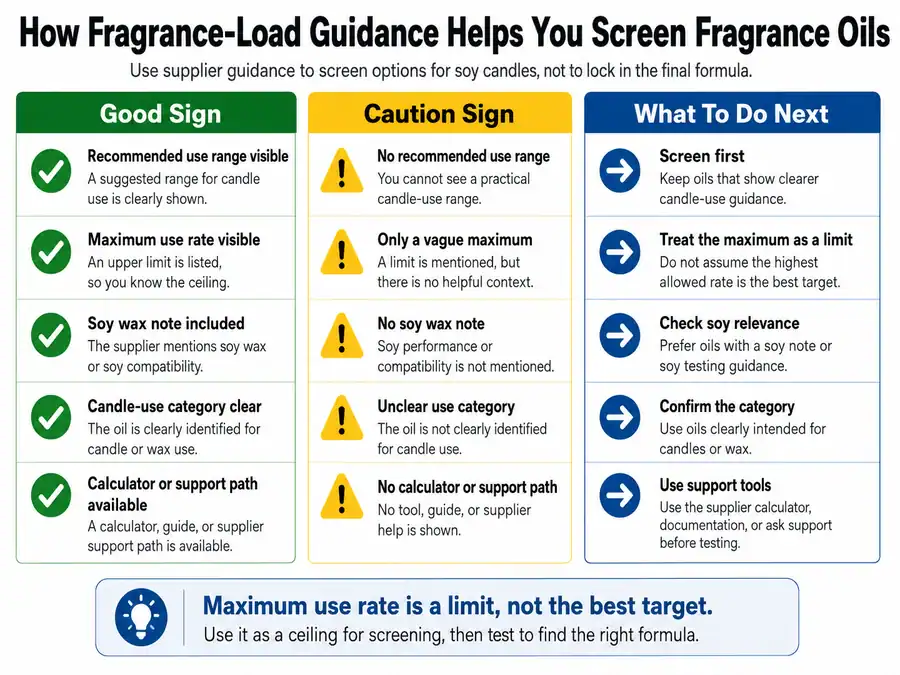
Method note: Use-rate guidance belongs in the buying screen because it tells you whether the oil has enough technical detail to test. It does not replace exact fragrance-load calculation or wax-specific formulation guidance.
More fragrance oil does not always mean stronger hot throw. Too much oil can affect burn behavior, stability, soot, or oil sweating, especially when the wick, wax, vessel, and load do not work together.
Maximum fragrance load is not the same as recommended load. A supplier’s maximum may describe an upper boundary, while the better starting point may be lower after wax, vessel, wick, and performance testing are considered.
Exact weights, wax-specific limits, and instability diagnosis are outside this selection article. If a candle is sweating or unstable, treat that as a formulation or troubleshooting issue rather than a simple fragrance-oil choice.
Which Supplier Signals Make an Oil Safer to Test?
Supplier transparency matters because a fragrance oil is easier to test in soy candles when the supplier shows candle-use documents, use guidance, and product consistency signals before you buy.
A supplier makes an oil safer to test when it provides candle-use positioning, accessible documents, visible use rates, trial sizes, and enough product information for repeatable testing. These signals reduce failed-purchase risk, but they do not guarantee strong hot throw or final candle safety.
| Supplier Signal | Why It Matters | Green Flag | Red Flag |
|---|---|---|---|
| SDS available | Shows hazard and handling information before testing | Easy download or request path | No document, unclear file, or only marketing claims |
| IFRA-style guidance available | Helps screen use guidance where relevant | Category or use guidance is accessible | No category, no limit, or no explanation |
| Use-rate guidance visible | Helps you decide whether the oil is practical to test | Suggested candle-use range is shown | “Use as desired” with no candle guidance |
| Candle-use positioning | Confirms the oil is meant for wax use | Product page states candle or wax use | Listing only mentions perfume, soap, or diffuser use |
| Trial size | Reduces risk before bulk buying | Sample, 1 oz, or small test size is available | Only large bottles are sold |
| Batch, update, or reformulation signal | Helps repeat tests with fewer surprises | Supplier notes formula changes or batch updates | No update trail when scent or documents change |
| Technical support path | Gives a way to ask document or use questions | Contact form, technical notes, or support email | Marketplace listing with no accountable supplier |
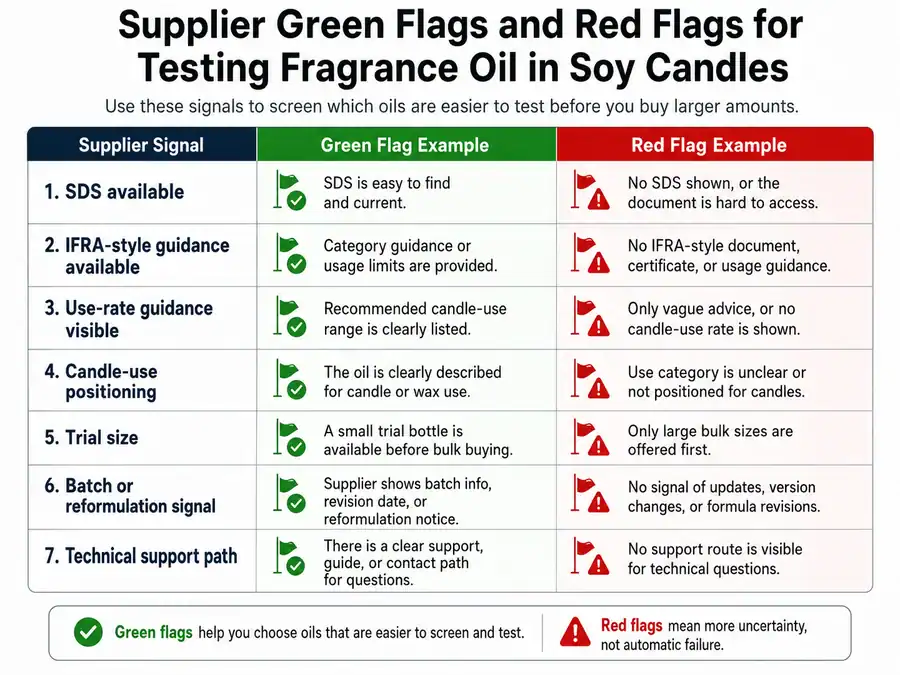
Method note: Use supplier transparency as a buying filter, not as proof. A transparent supplier makes testing easier because the oil has clearer documents, use guidance, and repeatability signals before it enters your soy wax system.
The biggest supplier is not automatically the best supplier. Catalog size, popularity, price, and reviews can help you shortlist options, but they do not prove that one fragrance oil performs well in your soy wax, wick, and vessel.
Marketplace oils are not always bad, but vague listings carry more uncertainty when candle-use documents are missing. This article evaluates supplier signals, not individual brand rankings.
Document interpretation and seller comparisons are outside this fragrance-oil selection article. This section only explains which supplier signals reduce uncertainty before testing.
Why Should You Burn Test a Fragrance Oil Before Buying in Bulk?
A fragrance oil is not fully proven for a soy candle until it has been tested in the same wax, wick, vessel, and fragrance load system the maker plans to use.
Supplier documents, scent descriptions, and soy-wax claims can screen candidates, but burn testing validates the finished candle system. The same fragrance oil can behave differently when the wax, wick, jar, fragrance load, cure time, or burn conditions change.
At a selection level, a small burn test should check cold throw after cure, hot throw while burning, flame behavior, melt pool behavior, soot or smoke changes, oil sweating or separation, vessel heat concerns, and scent consistency across the burn. Full test timing and step-by-step logging are outside this selection article.
| Failure Seen | Likely Meaning | Selection Lesson | What to Do Next |
|---|---|---|---|
| Strong bottle smell but weak hot throw | Raw oil strength did not carry into the candle system | Do not bulk buy based on bottle smell | Treat weak hot throw as a finished-candle troubleshooting issue |
| Good cold throw but poor burn scent | The candle smells good unlit but underperforms during use | Give hot throw more weight for burn-use candles | Review cure time, load, wick, and vessel together |
| More soot after adding new FO | The oil may have changed the burn balance | Treat soot as a system issue, not only an oil issue | Recheck the whole candle system |
| Oil sweating or separation | The load, wax, temperature, or oil fit may be off | Do not assume more oil will fix scent | Recheck load guidance and wax fit |
| Full bottle bought before testing | The maker took on bulk risk before validation | Trial size is lower risk when available | Track results before buying more |
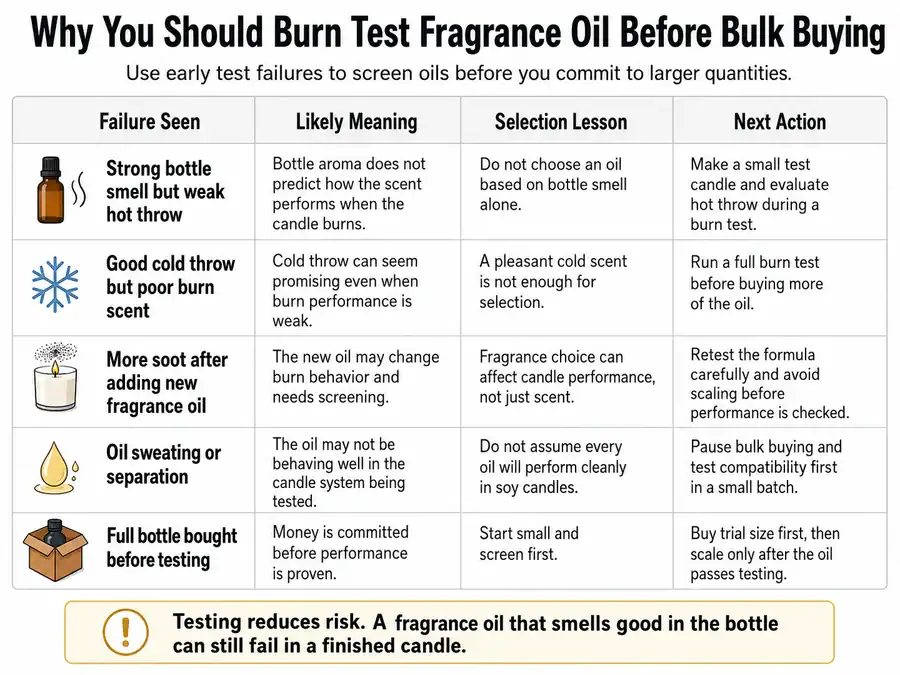
Method note: This is a minimum selection safeguard, not a full protocol. The goal is to stop a promising fragrance oil from being treated as bulk-ready before it has passed a small test in the exact candle system.
Yes, you still need to test when a supplier says the oil works in soy. That claim helps the oil enter your test set, but it does not prove your wick, jar, wax, load, and cure process will perform well together.
A failed burn test does not always mean the fragrance oil is bad. The wick, jar, wax, fragrance load, or cure time may be mismatched. Wick-specific diagnosis and finished-candle troubleshooting are outside this selection article.
Which Scent Categories Need Extra Testing in Soy Wax?
Vanilla, bakery, spice, amber, citrus, herbal, floral, fresh, and wood scents need extra soy-wax testing because throw and appearance can shift.
Scent preference does not equal soy candle performance. A fragrance oil can smell perfect in the bottle but still need extra testing because soy wax may soften, shift, or visually change the finished candle.
| Scent Family | Possible Soy Behavior | Discoloration Signal | Beginner Testing Priority | If a Problem Occurs |
|---|---|---|---|---|
| Vanilla / bakery | Can smell rich but may need longer throw testing | Higher risk of cream, tan, or brown tones | High | Treat discoloration as an appearance and formulation issue |
| Spice | Can become strong, sharp, or uneven while burning | Medium to high, depending on oil | High | Recheck burn behavior and testing notes |
| Amber / resin | Can feel warm and deep but may soften in soy | Medium to high | Medium-high | Compare hot throw after cure |
| Citrus | Can smell bright in the bottle but fade or shift in wax | Usually lower, but oil-dependent | Medium | Treat scent fade as a finished-candle performance issue |
| Herbal | Can turn soft, green, or medicinal in the finished candle | Usually low to medium | Medium | Test in the intended wax and vessel |
| Floral | Can stay clean or become powdery, sharp, or muted | Low to medium | Medium | Compare cold throw and hot throw separately |
| Fresh / clean | Can smell strong cold but lighter while burning | Usually low | Medium | Do not judge by bottle smell alone |
| Wood / smoke | Can feel complex but may need burn testing for balance | Medium, oil-dependent | Medium-high | Log soot, flame, and scent behavior |
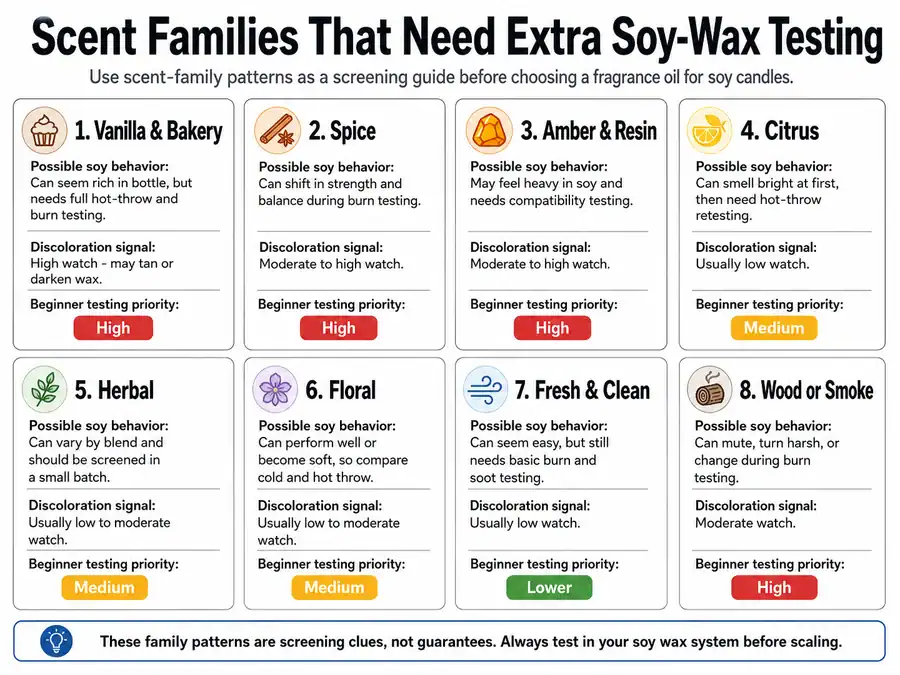
Method note: This table is a screening tool, not a rulebook. Scent-family risk comes from common soy candle testing concerns: throw strength, scent shift, discoloration, and finished appearance.
Vanilla oils are not bad for soy candles. They may simply need extra discoloration and throw testing before you use them in pale wax, white jars, or gift-ready candle lines.
Fresh scents do not always throw better. Scent family is only one signal; the wax, wick, vessel, fragrance load, cure time, and supplier formula still affect the result.
Discoloration does not automatically mean the oil is unsafe. This section flags appearance risk, but it does not diagnose every discoloration cause. If the color change is paired with a safety-document concern, go back to SDS, IFRA-style guidance, and supplier use notes.
Blending changes the task from choosing a compatible oil to designing a scent formula, so it is outside this article’s scope. Seasonal or market-demand planning is also outside this selection article.
Beginner Scorecard: How to Choose Your First Soy Candle Fragrance Oils
Beginners should score fragrance oils by candle-use fit, documentation, soy compatibility, throw potential, use-rate clarity, supplier transparency, trial-size access, and testing risk before prioritizing scent preference.
This scorecard is not a universal ranking. It helps first-time soy candle makers compare oils before buying trial sizes, without turning the decision into a starter kit, supplier ranking, legal checklist, batch-cost calculator, or scent quiz.
Must-have checks come first: candle-use intent, documentation, use guidance, and ability to test. Nice-to-have checks come second: trend appeal, label appeal, brand familiarity, and reviews.
| Score Item | 0 = Missing / Unclear | 1 = Partly Present | 2 = Clear / Documented / Testable |
|---|---|---|---|
| Candle-use or wax-use fit | No candle or wax use stated | Candle use is implied but vague | Supplier states candle or wax use |
| Soy compatibility signal | No soy or wax clue | Soy use appears in reviews only | Supplier notes soy, wax, or candle testing |
| Safety documents | No SDS or safety document path | Document is hard to find or incomplete | SDS is available or requestable |
| Use-rate guidance | No candle use range | General range with little detail | Clear candle-use range or maximum |
| Supplier transparency | Marketplace-style listing with little support | Some product notes, limited documents | Documents, support path, and product notes are visible |
| Trial and testing risk | Only bulk size available | Small size exists but little guidance | Trial size plus enough details for a controlled test |
Score interpretation
| Total Score | What It Means | Buying Decision |
|---|---|---|
| 10–12 | Strong candidate for a beginner test set | Buy trial size and test |
| 7–9 | Possible candidate, but uncertainty remains | Compare with another oil before buying |
| 0–6 | Too many gaps for a beginner purchase | Skip or research more |
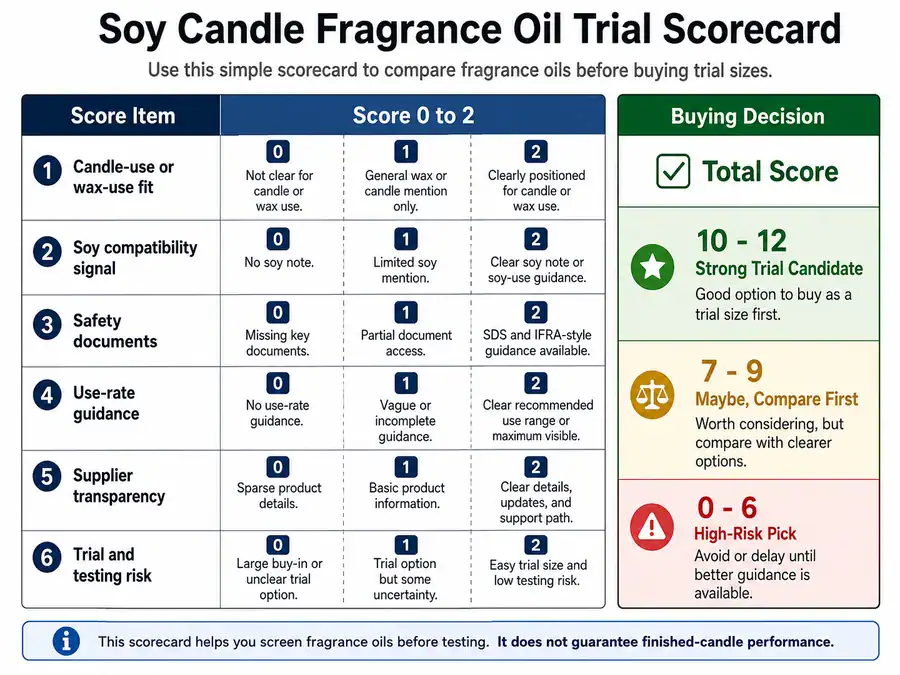
Method note: This scorecard uses only buying-screen signals from this article. It does not prove strong hot throw, finished-candle safety, seller compliance, or legal label accuracy.
A high score does not guarantee strong hot throw. It means the fragrance oil gives you enough evidence to justify a small test. A low score does not prove the oil is poor, but it raises the risk for a beginner.
After buying trial sizes, judge each fragrance oil in the same wax, wick, vessel, fragrance load, and cure window. First-project setup and exact fragrance-weight math are outside this selection article.
How Should You Choose Before Buying in Bulk?
No fragrance oil is “best” on its own; choose by candle-use suitability, soy compatibility, documentation, CT/HT expectations, trial-size availability, burn testing, and the scorecard.
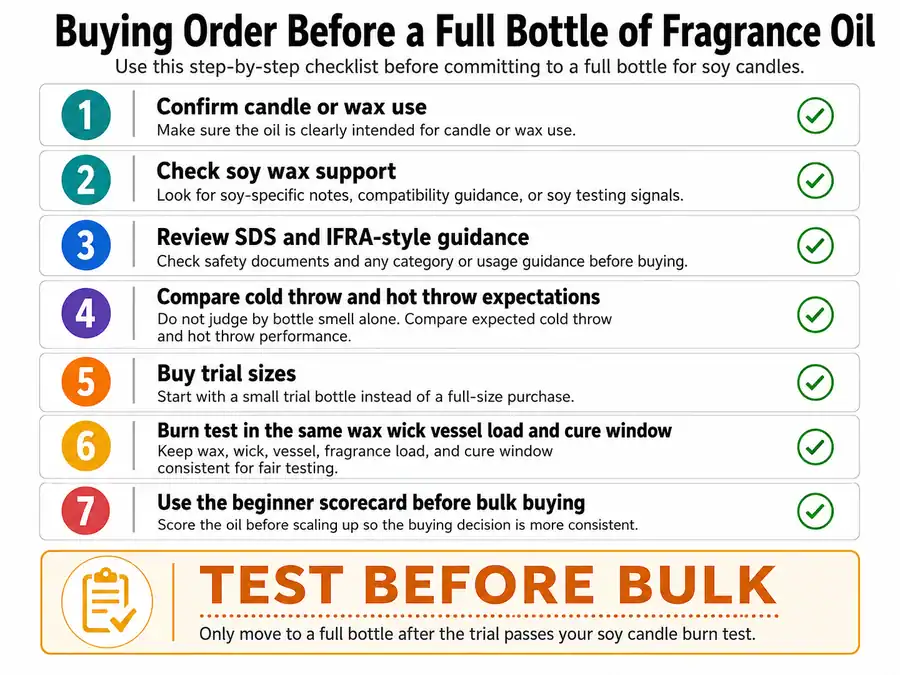
Use this buying order before you commit to a full bottle:
- Confirm the oil is intended for candle or wax use.
- Check whether soy wax use is stated, supported, or at least not contradicted.
- Review SDS access, IFRA-style guidance where relevant, and supplier use-rate information.
- Compare cold throw and hot throw expectations, not bottle smell alone.
- Buy trial sizes when possible.
- Burn test the oil in your own wax, wick, vessel, fragrance load, and cure window.
- Use the beginner scorecard to compare oils before buying in bulk.
Exact fragrance weights, legal documentation review, supplier comparison, and full burn-test logging are outside this selection article. Once a fragrance oil passes the buying screen, judge it through controlled testing before buying in bulk.