
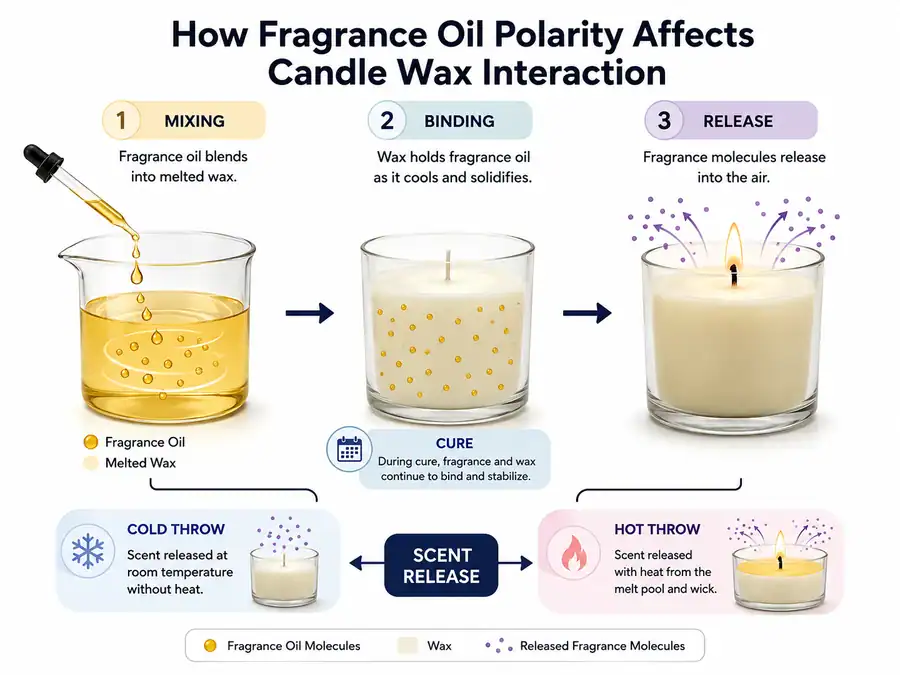
In candle making, fragrance oil polarity describes how an oil interacts, incorporates, binds, releases, or resists mixing with candle wax.
In Candle Fragrance & Scenting, the goal is to understand scented candle wax behavior rather than perfume projection, skin solubility, aromatherapy potency, or lab polarity values. Performance here means cold throw, hot throw, wax binding, cure behavior, visible stability, burn behavior, and repeatable test results. The same fragrance oil can behave differently in soy, paraffin, beeswax, coconut wax, and blends because each wax holds and releases oil differently.
This page does not cover gel-candle polarity testing, gel-safe non-polar fragrance requirements, or fragrance flashpoint rules.
What Fragrance Oil Polarity Means in Candle Making
In candle making, fragrance oil polarity describes how a fragrance oil interacts with a candle wax, which can affect how well it incorporates, cures, throws scent, and stays visually stable.
In Candle Fragrance & Scenting, this is about scented candle wax behavior, not perfume projection, skincare solubility, aromatherapy strength, or lab polarity measurement. Polarity matters because a fragrance oil must mix into wax, stay held during cooling and cure, and release scent when the candle is unlit or burning.
Polarity does not mean a fragrance is strong or weak. A polar fragrance oil is not automatically stronger, and a less polar oil is not automatically weaker. It only describes interaction and compatibility with a wax system.
| Term | Means in candle making | Does not mean |
|---|---|---|
| Fragrance oil polarity | How fragrance oil interacts with wax during mixing, cooling, cure, and burning | Guaranteed scent strength |
| Compatibility | The oil incorporates, stays stable, and gives usable cold and hot throw | Permission to exceed supplier limits |
| Fragrance strength | How noticeable the scent seems before or during burning | Proof that the oil binds well in every wax |
| Fragrance load | The percentage of fragrance oil used by wax weight | A fix for every weak-scent problem |
| Candle performance | Cold throw, hot throw, wax binding, cure behavior, visible stability, burn behavior, and repeatable test results | Perfume quality, skin safety, or supplier marketing strength |
Cold throw is the scent a finished candle gives off before lighting. Hot throw is the scent released while the candle burns. A fragrance can smell strong from the bottle but perform poorly in a finished candle if the wax does not hold or release it well.
Polarity is not the same as fragrance load. Fragrance load is the amount of fragrance oil added to the wax by weight. Compatibility can change whether a given load performs well, even when the amount of fragrance oil is calculated correctly.
You also cannot predict candle performance from polarity alone. Wax type, load, cure time, wick behavior, pouring process, container shape, and test conditions still affect the result.
A safety data sheet, or SDS, is a supplier document that lists handling, hazard, and composition notes. Supplier technical data sheets and SDS documents can help you check basic handling and use limits, but they do not prove that one fragrance will throw well in soy, paraffin, beeswax, coconut wax, or a blend.
Polarity only matters in candle making because wax changes the way fragrance oil is held and released. That is why the next step is comparing how different candle waxes behave with the same oil.
Why Different Candle Waxes Change Fragrance Performance
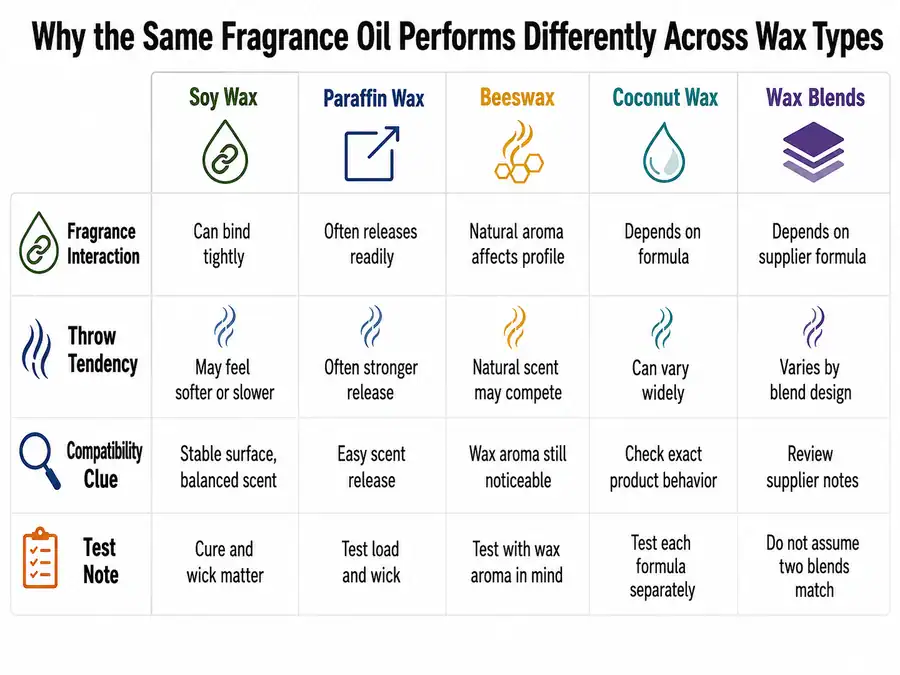
Common candle waxes differ in how they incorporate and release fragrance oil, which is why the same fragrance may perform differently across wax types.
This section compares scented-candle waxes: soy, paraffin, beeswax, coconut wax, and blends. It does not cover every industrial wax, cosmetic wax, furniture wax, or supplier-private formula.
Different waxes change fragrance performance because they hold, bind, release, and visually stabilize fragrance oil in different ways. That means “which wax holds fragrance best?” depends on what the maker means by “holds”: mixing cleanly, smelling strong cold, throwing well hot, curing without problems, or staying smooth on the surface.
| Wax type | Typical fragrance interaction | Throw tendency | Common compatibility clue | Test note |
|---|---|---|---|---|
| Soy wax | Can bind fragrance tightly and may need cure control | Cold throw may be easier than hot throw | Weak hot throw after cure, frosting, sweating, or surface changes | Retest with controlled cure time, load, and wick |
| Paraffin wax | Often releases fragrance readily | Hot throw can be strong when the wick and load fit | Strong scent but possible sweating or burn issues if overloaded | Do not skip burn testing because scent seems strong |
| Beeswax | Natural aroma and dense wax body can affect scent clarity | Added fragrance may seem softer or altered | Fragrance competes with the wax’s own smell | Test whether the wax aroma changes the scent profile |
| Coconut wax | Soft texture and blend design can change oil behavior | Can show good throw, but formula matters | Smooth surface in one blend, sweating in another | Treat each coconut blend as its own wax |
| Wax blends | Behavior depends on the blend, not only the named base wax | Can balance throw, texture, and stability | Results differ between supplier formulas | Test the exact blend you plan to sell |
No wax is universally best. A wax can release scent well but still have tradeoffs in appearance, burn behavior, cost, cure sensitivity, or container fit.
Blends do not always behave like their named base wax. A “soy blend” is not just soy, and a “coconut blend” is not just coconut. Treat every blend as its own test system because the added waxes and additives can change fragrance binding, release, and surface stability.
The next wax-specific sections separate compatibility clues from other causes. That matters because weak throw, sweating, wet spots, frosting, and uneven burn behavior can look like fragrance polarity problems even when cure time, load, wick choice, or process control is the real variable.
Soy Wax: Binding, Cure Sensitivity, and Weak Hot Throw Risk
Soy fragrance compatibility means the oil can incorporate into soy wax, remain stable through cure, and release usable scent during burning.
Soy weak hot throw can come from compatibility, cure, fragrance load, wick behavior, soy blend formula, or testing conditions. That makes soy wax easy to misdiagnose: the problem may look like polarity, but the real cause may be timing, load, burn setup, or the specific soy blend.
Here, compatible means the fragrance oil mixes cleanly, stays visually stable, cures without obvious separation, and gives usable cold and hot throw. It does not mean guaranteed strong scent, approval to exceed supplier limits, or the same result in every soy wax.
| Symptom | Likely variable | First retest action |
|---|---|---|
| Weak hot throw after cure | Compatibility, wick, load, or cure timing | Retest the same oil with one changed variable |
| Strong cold throw but weak hot throw | Wax binding, wick heat, or fragrance release | Burn-test with the same load and a documented wick change |
| Oil separation during cooling | Load, mixing, temperature, or wax/oil fit | Repeat at the same load with tighter process notes |
| Sweating after cure | Excess load, warm storage, or poor wax/oil fit | Lower load in a small retest and record storage conditions |
| Frosting plus weak throw | Soy crystallization, cooling, or formula sensitivity | Separate surface appearance from scent evaluation |
Methods note: Treat this checklist as a failure log, not a one-step diagnosis. Record wax name, fragrance oil, load percentage, fragrance-add temperature, cure days, wick, room conditions, and burn notes before changing the next test.
A soy candle that smells weak after curing should not be blamed on polarity alone. First separate the likely variable groups: fragrance/wax fit, cure time, load percentage, wick heat, soy blend formula, mixing process, and test setting.
Adding more fragrance oil does not always fix weak soy throw. Extra oil can worsen sweating, separation, burn quality, or surface stability when the wax is already near its practical holding point.
Soy may need a different fragrance oil than paraffin, but not always. The safer answer is controlled testing: keep the fragrance oil, load, container, and cure notes steady, then compare the wax result before changing the whole formula.
This section isolates why soy wax can make fragrance performance harder to judge.
Paraffin Wax: Why It Often Throws Strongly but Still Needs Testing
Paraffin often performs strongly for scent throw, but it still requires controlled testing because throw is not determined by wax type alone.
In this section, better performance means throw and stability under candle-making test conditions. It does not mean higher candle quality, cleaner burning, safety superiority, ethics, or sustainability.
Paraffin is often used as a comparison point because many fragrance oils incorporate and release well in it. That can make paraffin useful when testing whether a weak result is oil-specific or wax-specific. Still, scent throw depends on fragrance oil behavior, load, wick heat, melt pool, container, cure timing, and repeatable burn testing.
| Benchmark question | What paraffin can show | What it cannot prove |
|---|---|---|
| Does the oil throw at all? | Whether the fragrance can perform in a wax that often releases scent well | That the oil will throw equally in soy, beeswax, coconut wax, or blends |
| Is the weak result wax-specific? | Whether the same oil performs differently outside the original wax | That paraffin is the best wax for the candle line |
| Is the load behaving cleanly? | Whether the oil mixes and burns acceptably at the test load | That the same percentage is right in every wax |
| Is the wick part of the issue? | Whether heat and release improve under a controlled burn setup | That wax type alone caused the original weak throw |
Paraffin compatibility means the fragrance oil incorporates, releases, and stays stable under candle conditions. It does not mean paraffin is automatically the right choice for every candle or every maker.
The comparison is narrow: paraffin versus soy, beeswax, coconut wax, or blends on fragrance behavior only. Avoid turning this test into a safety article, sustainability comparison, petroleum discussion, or full wax buying guide.
A practical baseline test uses the same fragrance oil, container, fragrance load, cure window, and burn-note format across waxes. If paraffin throws clearly while soy does not, the result suggests a wax-interaction difference. If both are weak, the oil, load, wick, or test method may need review.
This section only uses paraffin as a scent-performance comparison point, not a universal recommendation.
Beeswax: Natural Aroma, Density, and Scent Clarity Limits
Beeswax fragrance performance depends on both wax compatibility and beeswax’s own natural aroma.
Weak or changed scent in beeswax does not automatically mean the fragrance oil is poor quality. The wax’s natural scent profile may mask, blend with, or shift how the added fragrance smells after cure and during burning.
For beeswax, performance means scent clarity, cold throw, hot throw, and how much the wax aroma competes with the chosen fragrance. It does not mean naturalness, purity, honey aroma quality, or therapeutic effect.
You can add fragrance oil to beeswax candles, but scent clarity must be tested. A fragrance that smells clean in soy or paraffin may smell softer, warmer, sweeter, or less distinct in beeswax because the wax is not a neutral-smelling base.
| Clarity clue | What it may mean | First test decision |
|---|---|---|
| Fragrance smells muted | Beeswax aroma may be masking top or middle notes | Retest with a clearer, stronger fragrance profile |
| Fragrance smells different | Wax aroma may be blending with the fragrance | Compare the same oil in a neutral test wax |
| Wax aroma dominates | The added fragrance may not suit beeswax’s natural scent | Test a different fragrance family |
| Cold throw seems pleasant but soft | Beeswax may hold a gentle scent before burning | Burn-test before rejecting the oil |
| Hot throw lacks definition | Wax density, wick heat, or fragrance fit may be limiting release | Retest with the same load and documented burn notes |
Masking is not the same as compatibility failure. Masking means the wax’s own aroma changes scent perception. Compatibility failure means the oil does not incorporate, stay stable, cure cleanly, or burn in a usable way.
Broad testing logic works better than a universal fragrance-family rule. Fragrance oils with clear, durable profiles may be easier to judge, while delicate notes can be harder to read in beeswax. That is a test decision, not a buying rule.
This section only explains why beeswax can change fragrance performance.
Coconut Wax and Blends: Why Formula Variation Changes Results
Coconut wax performance depends on the actual blend formula, not just the coconut label.
Many commercial coconut candle waxes are blended with soy, paraffin, palm, or additives, so test results cannot be generalized across every coconut wax. In candle making, coconut wax means coconut-based candle waxes and commercial coconut wax blends, not cosmetic coconut oil, food-grade coconut oil, or one universal wax formula.
Coconut wax and coconut wax blends can perform well, but results vary because softness, companion waxes, additives, and load tolerance change how fragrance oil is held and released. A blend that gives a smooth surface and strong throw from one supplier may sweat, soften, or throw differently in another formula.
| Blend variable | Performance effect | Test note |
|---|---|---|
| Softness | Can affect oil holding, surface feel, and sweating risk | Watch the surface after cure and warm storage |
| Companion wax | Can change throw, firmness, cure behavior, and burn feel | Treat soy-coconut, paraffin-coconut, and other blends separately |
| Additives | Can change opacity, texture, adhesion, and fragrance behavior | Do not assume two coconut blends behave alike |
| Fragrance load | Can improve scent up to a point, then create instability | Calculate and test the exact load before scaling |
| Supplier formula | Can change results even under the same label | Test the exact wax planned for production |
Coconut wax can hold fragrance well, but blend formula and load matter. Sweating in a coconut wax candle may involve softness, excess load, poor incorporation, storage warmth, or fragrance/wax compatibility.
Coconut wax is not automatically better than soy. It can outperform soy under defined test conditions, but it can also fail if the blend is too soft, the oil load is too high, or the fragrance does not suit that wax system.
This section only explains how blend variation affects fragrance performance testing.
Cold Throw vs Hot Throw: Why the Same Oil Can Perform Differently
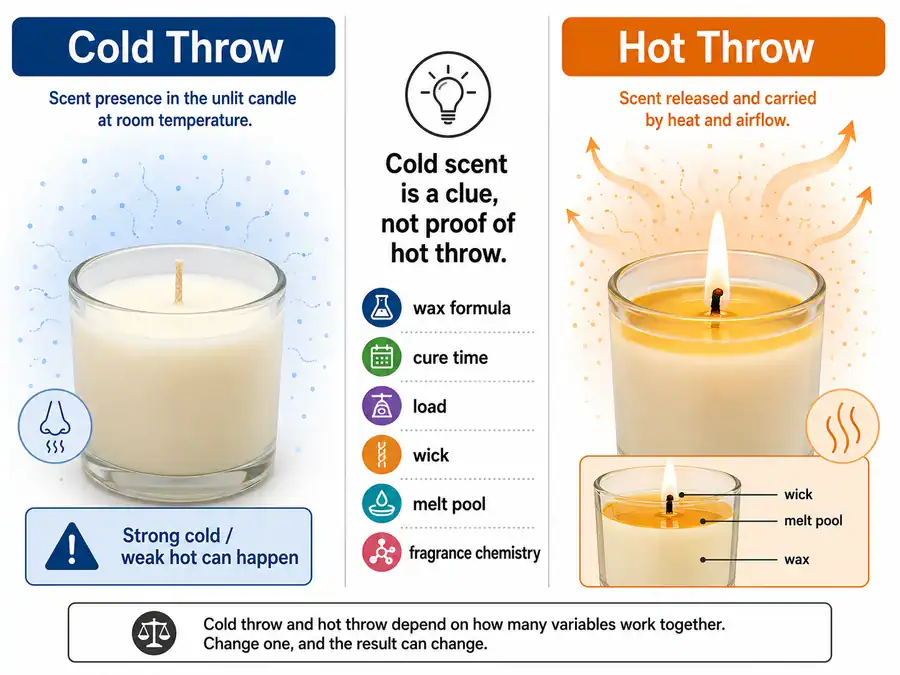
Cold throw is scent before burning; hot throw is scent during burning.
Fragrance oil polarity and wax compatibility can affect cold throw and hot throw differently because cold throw depends on room-temperature scent presence, while hot throw depends on release during burn conditions. In this section, throw means cold throw and hot throw as separate candle outcomes, not perfume projection, air-freshener strength, or aromatherapy diffusion.
A candle can smell strong cold but weak when lit because the wax may hold the fragrance well at room temperature but release it poorly under heat. The wick, melt pool, cure time, load, fragrance chemistry, and wax formula can all change the hot result.
| Failure pattern | Likely variable | What to retest |
|---|---|---|
| Strong cold throw / weak hot throw | Wax release, wick heat, cure, load, or oil compatibility | Retest burn performance with the same wax and one documented variable change |
| Weak cold throw / acceptable hot throw | Low room-temperature scent presence but usable heat release | Judge the candle by both cold and hot notes before rejecting the oil |
| No hot throw after cure | Wick, load, fragrance/wax fit, or test method | Repeat with a controlled burn log before changing multiple variables |
| Strong bottle scent / weak candle | Bottle strength does not translate into wax performance | Test the oil in the intended wax instead of judging from the bottle |
Methods note: Use this table as a failure-pattern log, not a final diagnosis. Record wax type, fragrance oil, load percentage, cure time, wick, vessel, cold throw notes, hot throw notes, and visible surface changes before retesting.
Cold throw cannot reliably predict hot throw. It is a clue, not proof. A strong cold candle may still burn with weak scent if the wax holds the oil too tightly, the wick does not create the right heat profile, or the fragrance does not release well in that wax.
Strong bottle scent also does not guarantee candle throw. Out-of-bottle strength measures how the fragrance smells before wax, cure, and burn variables change the result.
Cure Time, Fragrance Binding, and When to Judge Performance
Cure time is the post-pour period when wax and fragrance stabilize enough for a fair scent-performance test.
Curing can improve evaluation, but it is not a guaranteed fix for weak throw, separation, excess load, poor wick behavior, or true wax/fragrance incompatibility. Here, cure means post-pour stabilization of candle wax and fragrance before judging throw and stability. It does not mean a universal waiting period, food-style curing, soap curing, or resin curing.
Cure time affects fragrance performance because wax and fragrance may continue settling after the candle cools. A candle tested too early may seem weak, uneven, or misleading. A candle that still separates, sweats, burns poorly, or throws weakly after a controlled retest may have a formula or compatibility issue instead.
| Retest step | What to do | What it shows |
|---|---|---|
| Wait | Let the candle reach the chosen test point before judging throw | Reduces the risk of testing too early |
| Record | Note wax, fragrance, load, add temperature, cure time, wick, and vessel | Keeps the retest repeatable |
| Compare | Check cold throw, hot throw, surface stability, and burn behavior together | Separates scent from visual and burn variables |
| Adjust one variable | Change only one factor in the next test | Shows whether the issue responds to cure, load, wick, or wax choice |
| Bridge if needed | Move deeper only when the variable points outside this section | Prevents cure time from becoming a catch-all explanation |
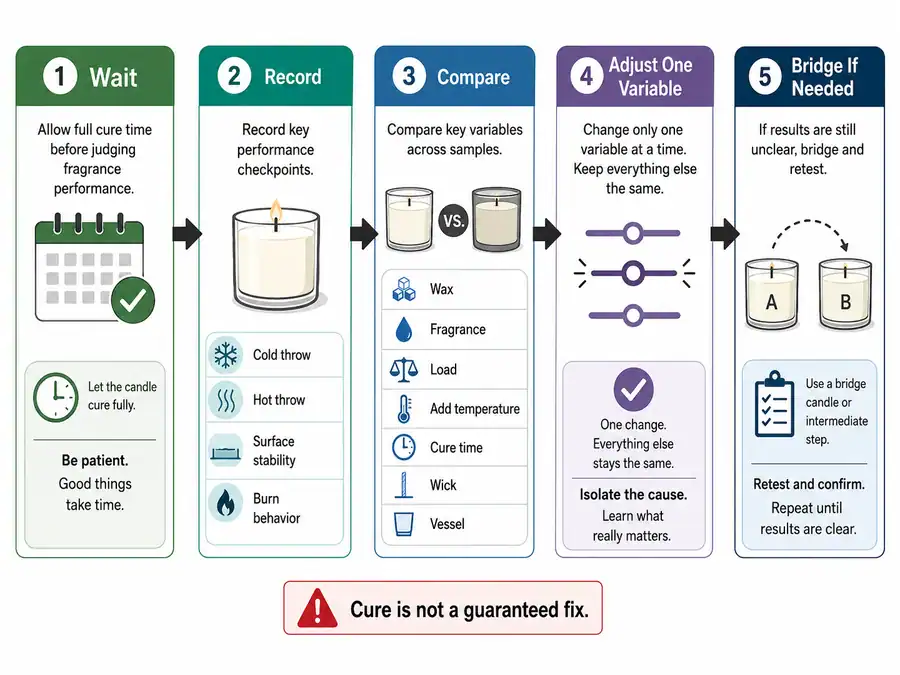
Methods note: This retest checklist controls evaluation timing. It cannot prove that a fragrance oil is compatible with every wax, and it cannot replace supplier limits, burn testing, or a wax-specific cure schedule.
Cure time can make testing fairer because fragrance binding and release may change as the candle stabilizes. It can also prevent a maker from changing the oil, wax, wick, and load all at once based on an early test.
Curing usually does not fix visible separation. Separation more often points to load, incorporation, temperature handling, or fragrance/wax compatibility. Waiting longer may make the candle easier to judge, but it does not make an overloaded or poorly incorporated formula stable.
Judge performance after the candle has reached a documented test point for that wax system, then compare repeatable cold throw, hot throw, visual stability, and burn notes.
Visual Clues of Poor Fragrance/Wax Fit
Visual instability can indicate poor fragrance/wax fit, but it can also come from fragrance load, incorporation temperature, cooling, container adhesion, or wax formulation.
Sweating, oil pooling, curdling, separation, frosting, and some wet-spot patterns can suggest that the fragrance/wax system needs retesting. They do not prove that polarity is the only cause.
Visual or physical instability means a finished-candle symptom that may involve fragrance incorporation, excess load, cooling, adhesion, wax type, or wax/fragrance mismatch.
| Symptom | Possible fragrance/wax clue | Other possible cause | First retest action |
|---|---|---|---|
| Sweating | The wax may not be holding the fragrance load cleanly | Warm storage, high load, soft wax, or supplier formula | Lower one test batch’s load and record storage conditions |
| Oil pooling | Fragrance may be separating after cure or heat exposure | Poor mixing, excess load, or wrong add temperature | Repeat with the same wax and oil at a controlled add step |
| Curdling or grainy texture | Oil may be disrupting wax structure during cooling | Cooling rate, additives, dye, or wax batch variation | Run a small unscented control beside the scented test |
| Separation lines | Fragrance incorporation may be uneven | Pour process, reheating, or container temperature | Keep the load steady and adjust only the mixing process |
| Frosting | Fragrance can contribute, but soy crystallization is often involved | Soy wax behavior, cooling, or room conditions | Compare scented and unscented soy controls |
| Wet spots | Usually an adhesion or cooling clue, not always fragrance fit | Glass temperature, shrinkage, wax type, or cooling speed | Test the same fragrance in the same wax with a controlled cool-down |
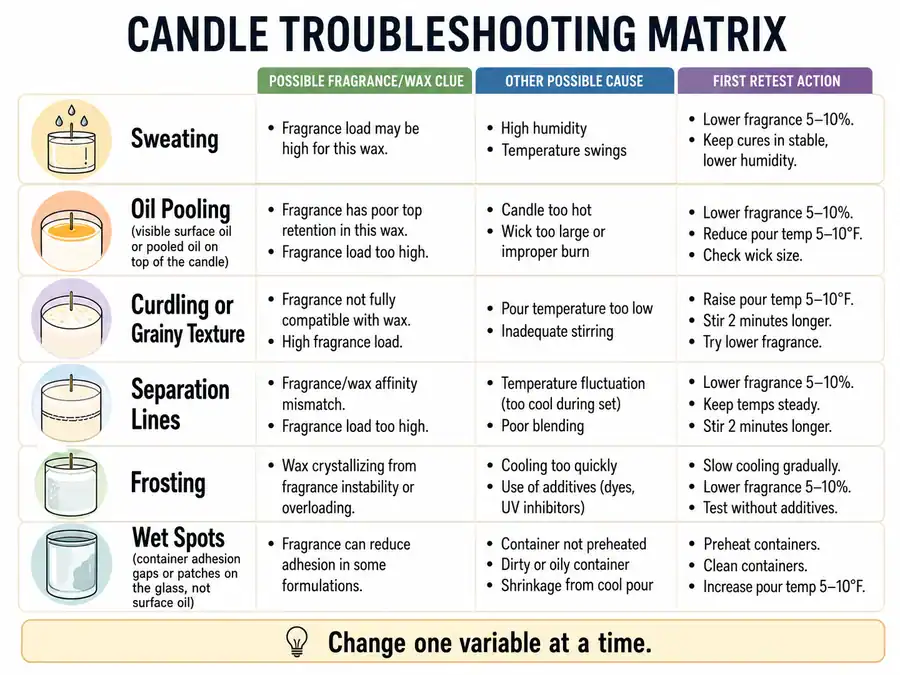
Methods note: Use the matrix as a sorting tool, not a final diagnosis. Record wax type, fragrance family, load percentage, fragrance-add temperature, cure days, room conditions, and the exact symptom before changing the next batch.
Sweating is not always fragrance incompatibility. It can come from excess load, warm storage, soft wax, temperature handling, or the wax formulation itself.
Wet spots are not the same as fragrance sweating. Wet spots usually describe adhesion or shrinkage patterns against the container wall, while sweating describes oily material appearing on the candle surface.
Oil pooling after cure is more serious than a faint surface sheen. Retest with one changed variable at a time before blaming the fragrance oil or replacing the wax.
How to Test One Fragrance Oil Across Different Waxes
A fair wax comparison changes one main variable at a time: the wax type.
Use the same fragrance oil, fragrance load, vessel, wick baseline, cure schedule, and scoring method so the wax is the main difference being tested. A controlled wax test does not prove universal compatibility. It shows how one fragrance behaves under your chosen candle-making conditions across the waxes you tested.
| Test ID | Wax type | Fragrance family | Load % | Add temperature | Cure days | Wick baseline | Cold throw score | Hot throw score | Surface issue | Burn note |
|---|---|---|---|---|---|---|---|---|---|---|
| A | Soy wax | Same oil | Same % | Recorded | Same schedule | Same starting wick | 1–5 | 1–5 | None / sweating / frosting | Flame, melt pool, scent |
| B | Paraffin wax | Same oil | Same % | Recorded | Same schedule | Same starting wick | 1–5 | 1–5 | None / sweating / wet spots | Flame, melt pool, scent |
| C | Beeswax | Same oil | Same % | Recorded | Same schedule | Same starting wick | 1–5 | 1–5 | None / texture / masking | Wax aroma effect |
| D | Coconut blend | Same oil | Same % | Recorded | Same schedule | Same starting wick | 1–5 | 1–5 | None / sweating / softness | Blend behavior |
| E | Other blend | Same oil | Same % | Recorded | Same schedule | Same starting wick | 1–5 | 1–5 | None / separation / adhesion | Compare to base wax |
Methods box:
Variables controlled: fragrance oil, fragrance load, vessel, wick baseline, cure schedule, scoring scale, and test room.
Variables recorded: wax type, fragrance family, load percentage, add temperature, cure days, cold throw, hot throw, surface change, and burn notes.
What the test can show: whether the same oil behaves differently across wax systems.
What the test cannot prove: supplier formula details, legal compliance, universal wax rankings, or final wick approval.
When to retest: retest when one wax shows weak throw, sweating, separation, masking, or burn behavior that differs from the others.
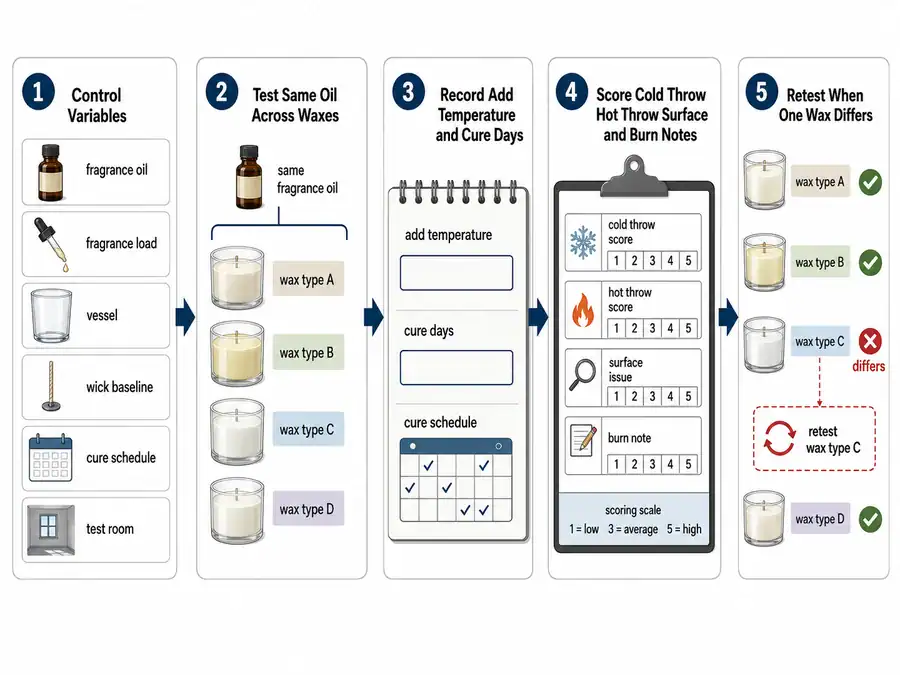
Use a 1–5 score only as an internal comparison scale. The score helps compare one test set against another; it does not create a public fragrance rating or proof that one wax is best for every candle.
Keep the first test small. The goal is to see whether the wax changes incorporation, cure behavior, throw, visible stability, or burn notes before you adjust load, wick, vessel, or supplier.
Fragrance Load and Saturation: Why More Oil Can Perform Worse
Fragrance load is fragrance oil as a percentage of wax weight, and more fragrance oil does not automatically mean stronger candle performance.
Fragrance oil polarity can affect how cleanly an oil interacts with wax, but fragrance load controls how much oil the wax must hold. When a wax reaches its practical saturation point, extra oil can cause sweating, seepage, weak burn behavior, muted throw, or poor surface stability.
Saturation means the practical point where the selected wax no longer holds or performs well with the selected fragrance oil under the maker’s test conditions. It is not one universal number for every wax, oil, vessel, wick, or room.
| Test comparison | What may happen | What it means |
|---|---|---|
| Lower test load | Cleaner surface, steadier burn, usable hot throw | The wax may be holding and releasing the oil well |
| Higher test load | Stronger cold smell but sweating, seepage, or poor burn | The wax may be overloaded or near saturation |
| Maximum supplier load | Upper use boundary under stated conditions | Not always the best-performing load |
| Best-performing load | Balanced throw, stability, and burn behavior | Must be found through testing |
Methods note: This is a limited example for load-versus-performance logic, not a formula table. Use the same wax, fragrance oil, vessel, wick baseline, cure point, and scoring method before comparing one load against another.
Adding more fragrance oil does not always make candles stronger. Too much oil can reduce stability, interfere with burn behavior, or make the candle look and perform worse.
Maximum fragrance load is not the same as best fragrance load. Maximum load means an upper supplier or wax-system limit under stated conditions. It does not mean the best-performing amount, the safest amount in every candle, or a guarantee of stronger hot throw.
Polarity can change how well a wax and fragrance interact, but supplier limits and controlled testing still guide the decision.
What Supplier Notes, SDS, and IFRA Documents Can and Cannot Tell You
Supplier documents can provide clues and constraints, but they do not prove wax compatibility or scent throw.
Supplier notes, SDS documents, and IFRA documents can help you understand use guidance, handling notes, and stated limits. They cannot prove that a fragrance oil will incorporate cleanly, cure well, throw strongly, or stay visually stable in soy, paraffin, beeswax, coconut wax, or blends.
| Document | Can tell you | Cannot prove |
|---|---|---|
| Supplier product notes | Suggested wax uses, general scent behavior, handling comments, or supplier warnings | That the oil will throw well in your exact wax and vessel |
| Technical data sheet | Product traits, handling ranges, or supplier test notes if provided | Universal compatibility across all candle waxes |
| SDS | Safety, handling, hazard, storage, and composition-related information | Hot throw, cold throw, cure behavior, or finished-candle scent performance |
| IFRA document | Use-category limits or restriction information | Whether the oil will bind, burn, or smell strong in a candle |
| Document date or revision | Whether the document may be current enough to review | That the formula or supplier guidance has never changed |
Methods box: Use the checklist as a documentation screen before performance testing. Confirm the document type, revision date, supplier guidance, stated use boundary, and any handling cautions. Then test the fragrance in the exact wax system you plan to use. Do not treat paperwork as a finished-candle performance result.
An SDS can help with handling and safety review, but it cannot tell you whether a candle will have strong hot throw. An IFRA document can help define use boundaries, but it does not replace wax testing, burn testing, or scent evaluation.
Document dates matter because supplier formulas, guidance, and certificates can change. Use the newest supplier-provided document available for review, then keep the candle performance test separate from the documentation check.
Performance proof still comes from testing the fragrance in the exact waxes you actually use.
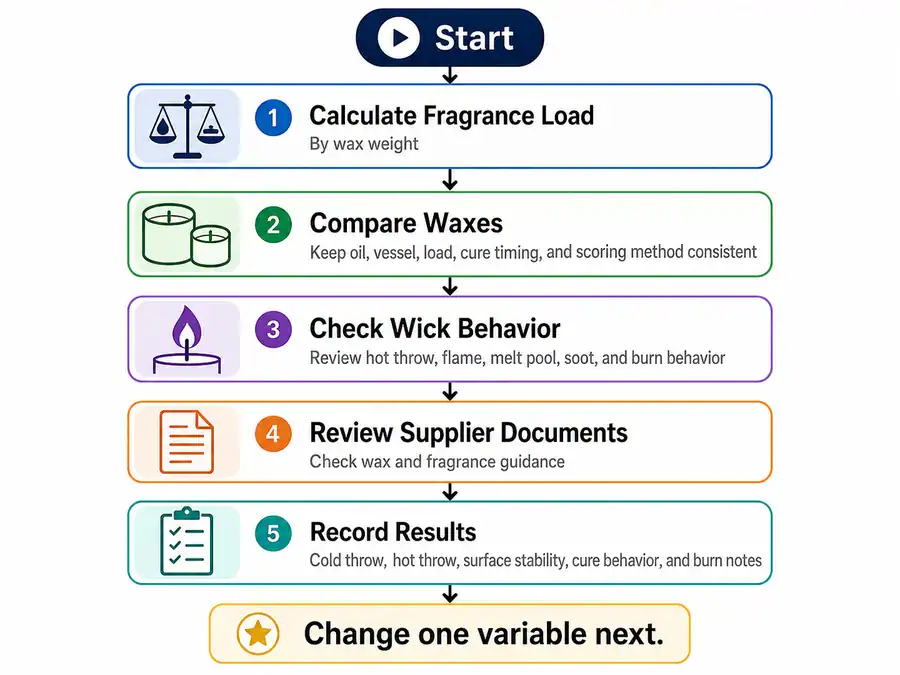
How to Choose the Next Test Variable
Test combinations step by step before changing more than one variable.
Fragrance oil polarity matters only as part of a full wax/fragrance system. A fragrance oil does not perform by polarity alone; soy, paraffin, beeswax, coconut wax, blends, load, cure time, wick behavior, and burn testing all shape the final candle result.
Start with one fragrance oil, one planned load, one vessel, one wick baseline, and one test log. Change the wax first. If the result is still weak, sweaty, unstable, or unclear, change only one next variable so the cause does not get buried.
Use these next steps:
- Calculate fragrance load by wax weight before testing.
- Compare waxes only after keeping fragrance oil, vessel, load, cure timing, and scoring method consistent.
- Check wick behavior when hot throw, flame size, melt pool, soot, or burn behavior changes the result.
- Review supplier documents for use guidance, handling notes, and stated limits before scaling a formula.
- Record cold throw, hot throw, surface stability, cure behavior, and burn notes across waxes.
The most reliable next test move is not to guess whether the fragrance oil is “strong enough.” Test the fragrance in the waxes you plan to use, record the result, and let the wax/fragrance behavior decide the next adjustment.