

Use this candle batch calculator to estimate total batch weight, fragrance oil weight, and net wax weight for one pour divided across multiple jars.
This calculator applies fragrance load to the finished wax-plus-fragrance batch weight, not as extra fragrance added on top of wax.
In candle making, multiple jars means several candle containers filled from the same batch. It does not mean mold cavities, product SKUs, wholesale cases, or inventory planning. Enter the jar count, each jar’s fill weight, fragrance load percentage, and weight unit so the batch can be split into fragrance oil and wax.
This calculator is for ingredient weight only. It does not calculate candle cost, wick size, burn time, wax choice, fragrance choice, scent throw, or production inventory.
Candle Batch Calculator for Multiple Jars
A candle batch calculator multiplies jar count by per-jar fill weight, then separates the finished batch into fragrance oil weight and net wax weight.
Use these inputs when you are filling several candle jars from one wax-and-fragrance batch.
| Input | What to enter | Unit | Why it matters |
|---|---|---|---|
| Jar count | Number of candle jars you will fill | Count | Scales the batch |
| Per-jar fill weight | Finished candle material for one jar | g or weight oz | Sets the base amount per container |
| Fragrance load | Chosen fragrance percentage | % | Splits the batch into fragrance oil and wax |
| Weight unit | Grams or weight ounces | g / oz | Keeps wax and fragrance outputs in the same unit |
| Optional overage | Extra material for residue or small losses | % | Adds a disclosed buffer |
| Mixed jar rows | Separate jar count and fill weight per size | g or weight oz | Sums different jar sizes before the fragrance split |
Formula box
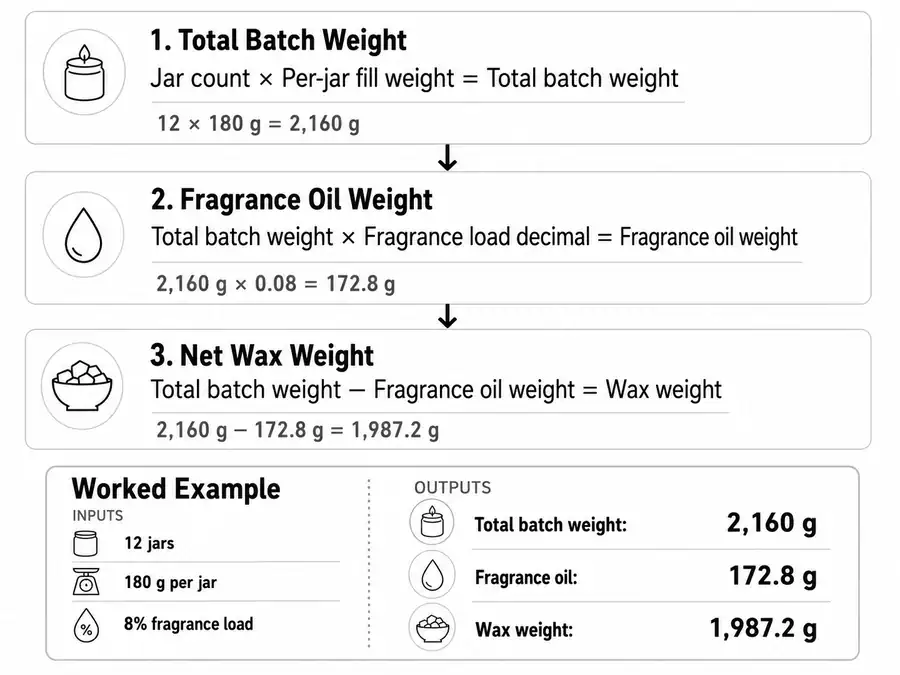
Total batch weight = jar count × per-jar fill weight
Fragrance oil weight = total batch weight × fragrance load decimal
Wax weight = total batch weight − fragrance oil weight
Worked example
For 12 jars at 180 g each:
12 × 180 g = 2,160 g total batch weight
At 8% fragrance load:
2,160 g × 0.08 = 172.8 g fragrance oil
2,160 g − 172.8 g = 1,987.2 g wax
| Result | Amount |
|---|---|
| Total finished batch weight | 2,160 g |
| Fragrance oil weight | 172.8 g |
| Net wax weight | 1,987.2 g |
Read the total batch weight as finished candle material before jars, lids, labels, and packaging. Use the fragrance oil result as the scent ingredient weight. Use the net wax result as the wax to melt.
| Output | Use it for | Do not use it for |
|---|---|---|
| Total finished batch weight | The full pour amount | Wax-only weight |
| Fragrance oil weight | Amount of candle-safe fragrance oil | Drops, teaspoons, or scent preference |
| Net wax weight | Wax to melt before adding fragrance | Packaged candle weight |
| Optional overage | Small extra material buffer | Raising fragrance load |
| Mixed row total | One batch with different jar sizes | SKU or wholesale planning |
Enter the Fill Weight for One Jar
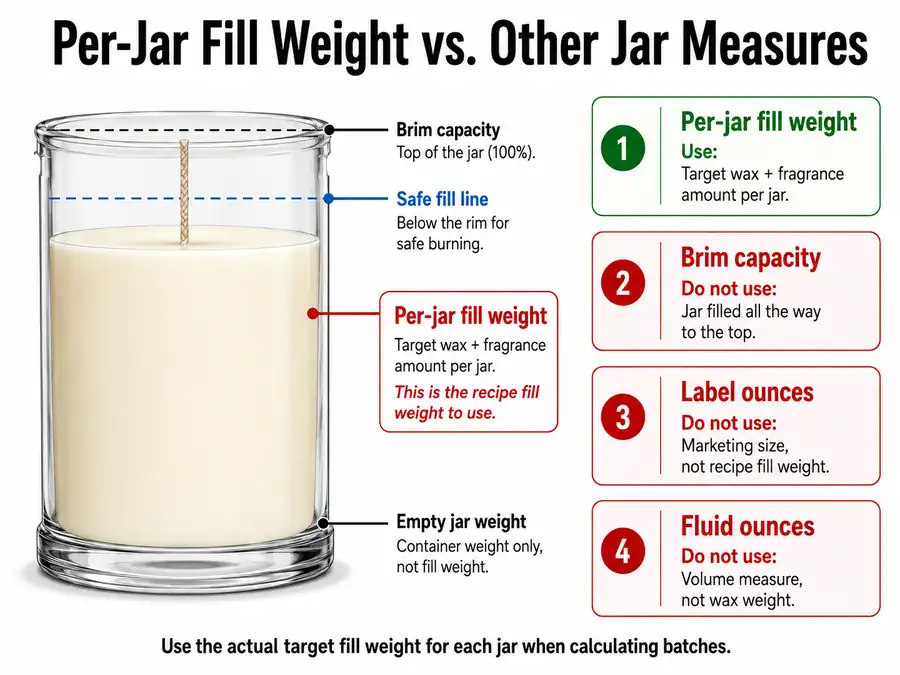
Per-jar fill weight is the target finished candle material for one jar, measured by weight before multiplying by jar count.
Do not treat the jar label size or brim capacity as the fill weight unless you have confirmed the real candle fill weight. An “8 oz jar” may not safely take 8 oz of finished candle material by weight.
| Term | Means | Do not use it as |
|---|---|---|
| Per-jar fill weight | Target wax-plus-fragrance material for one filled candle | Empty jar weight |
| Jar capacity | How much the container can hold under a given measuring method | Automatic candle fill weight |
| Brim capacity | Maximum fill to the top edge | Safe candle pour line |
| Label ounces | Product or container-size wording | Weight ounces unless verified |
| Fluid ounces | Volume measurement | Wax or fragrance weight |
To get a usable fill weight, weigh the finished material target for one jar in grams or weight ounces. Then multiply that number by the number of jars in the batch.
Example:
6 jars × 150 g fill weight = 900 g total batch weight
This 900 g is still the finished batch amount. The fragrance oil is calculated from that amount, and the remaining amount becomes the wax weight.
Total Batch Weight Formula
Total batch weight is the finished candle material needed for all jars before wax and fragrance oil are separated.
For this calculator, total batch weight includes both wax and fragrance oil. It excludes the empty jar, lid, label, box, shipping weight, and cost.
Formula
Total batch weight = jar count × per-jar fill weight
| Example input | Calculation | Total batch weight |
|---|---|---|
| 4 jars × 150 g | 4 × 150 g | 600 g |
| 8 jars × 180 g | 8 × 180 g | 1,440 g |
| 12 jars × 200 g | 12 × 200 g | 2,400 g |
Do not read this number as wax-only weight. If the total batch weight is 1,440 g, the full pour target is 1,440 g before it is split into fragrance oil and wax.
Calculation steps
- Start with the number of jars you will fill.
- Enter the fill weight for one jar.
- Multiply jar count by per-jar fill weight.
- Treat the result as finished candle material.
- Use that result as the base for the fragrance oil calculation.
Example:
8 jars × 180 g fill weight = 1,440 g total batch weight
This 1,440 g figure prepares the batch for the next step: choosing the fragrance load percentage and calculating how much of the finished material should be fragrance oil.
Choose a Fragrance Load Percentage
Fragrance load percentage is the selected share of the finished candle formula that becomes candle-safe fragrance oil.
In this calculator, fragrance load is an input, not a universal safety rule. Follow the wax maker’s and fragrance supplier’s limits before entering a percentage.
| Fragrance load input | Decimal used in formula | Meaning in this calculator |
|---|---|---|
| 6% | 0.06 | 6% of finished batch weight is fragrance oil |
| 8% | 0.08 | 8% of finished batch weight is fragrance oil |
| 10% | 0.10 | 10% of finished batch weight is fragrance oil |
Use fragrance load as a formula percentage, not as a loose scent-strength slider. A higher number does not automatically mean better hot throw, safer performance, or a better candle.
Which Percentage Method Does This Calculator Use?
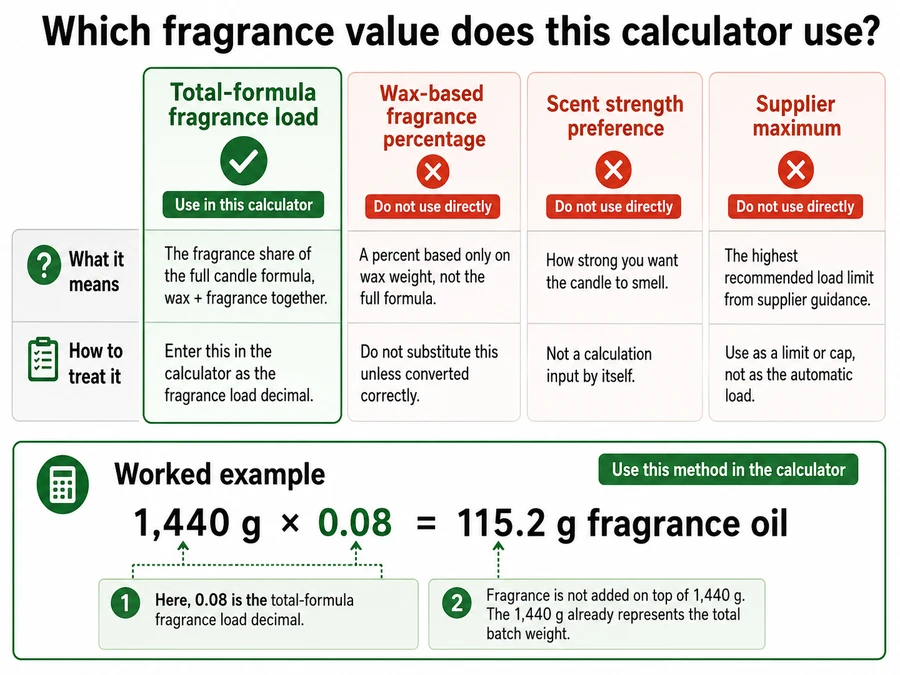
This calculator uses total-formula fragrance load, so the percentage applies to the finished wax-plus-fragrance batch weight. If your supplier gives a wax-based percentage, convert it before using the input.
Total-formula percentage vs wax-based percentage
| Percentage type | What it applies to | Calculator fit |
|---|---|---|
| Total-formula fragrance load | Finished candle batch weight | Use in this calculator |
| Wax-based fragrance percentage | Wax weight before fragrance | Convert before using this calculator |
| Scent strength preference | How strong the candle should smell | Not a calculator input by itself |
| Supplier maximum | Wax and fragrance compatibility limit | Check before choosing the input |
Example:
If the total batch weight is 1,440 g and the fragrance load is 8%, the fragrance oil amount is calculated from 1,440 g, not added on top of 1,440 g.
1,440 g × 0.08 = 115.2 g fragrance oil
The remaining batch weight becomes wax in the next step. This keeps the jar fill target stable instead of overfilling jars by adding fragrance oil after the full wax amount is already measured.
Fragrance load failure log
| Mistake | Why it matters | Better method |
|---|---|---|
| “I’ll use 10% for any wax.” | Wax and fragrance limits vary by supplier. | Check the wax and fragrance limits first. |
| “More fragrance always smells stronger.” | Too much oil can hurt candle performance. | Use a tested fragrance load. |
| “Fragrance load means scent preference.” | Preference is not a formula value. | Enter a real percentage. |
| “I can fix weak scent by raising the calculator number.” | Scent throw problems may come from wax, wick, cure time, or testing. | Keep performance troubleshooting outside this calculator. |
Fragrance Oil Amount Formula
Fragrance oil amount is the weight of candle-safe fragrance oil calculated from total batch weight and the selected fragrance load.
Formula
Fragrance oil weight = total batch weight × fragrance load decimal
| Total batch weight | Fragrance load | Calculation | Fragrance oil amount |
|---|---|---|---|
| 600 g | 6% | 600 × 0.06 | 36 g |
| 1,440 g | 8% | 1,440 × 0.08 | 115.2 g |
| 2,400 g | 10% | 2,400 × 0.10 | 240 g |
A fragrance load must be converted into a decimal before the formula runs. Use 6% as 0.06, 8% as 0.08, and 10% as 0.10.
Calculation steps
- Calculate total batch weight first.
- Choose a fragrance load that fits your wax and supplier limits.
- Divide the percentage by 100.
- Multiply total batch weight by that decimal.
- Read the result as fragrance oil weight.
Example:
1,440 g total batch weight × 8% fragrance load
1,440 g × 0.08 = 115.2 g fragrance oil
Do not measure this output in drops, teaspoons, tablespoons, or fluid ounces. This calculator treats fragrance oil as a weight-based candle ingredient, so the output should stay in grams or weight ounces.
Fragrance oil measurement failure log
| Mistake | Why it causes problems | Use this instead |
|---|---|---|
| Measuring fragrance oil by teaspoons | Volume does not match weight across oils | Weigh fragrance oil |
| Adding “a little extra” scent | Can exceed wax or supplier limits | Use the chosen percentage |
| Treating scent strength as the formula | Preference is not the same as load | Enter a fragrance load |
| Using perfume or aromatherapy dosage | Those are outside candle formula math | Use candle-safe fragrance oil |
This section gives the fragrance oil amount needed for the batch, not fragrance selection, scent throw troubleshooting, or essential-oil substitution advice.
Wax Amount After Subtracting Fragrance
Wax amount is the net wax weight left after fragrance oil is subtracted from the finished batch weight.
Formula
Wax weight = total batch weight − fragrance oil weight
| Total batch weight | Fragrance oil amount | Calculation | Net wax amount |
|---|---|---|---|
| 600 g | 36 g | 600 − 36 | 564 g |
| 1,440 g | 115.2 g | 1,440 − 115.2 | 1,324.8 g |
| 2,400 g | 240 g | 2,400 − 240 | 2,160 g |
This wax result is the amount to melt for the batch before pouring. It is not the same as total finished candle material, because the fragrance oil already takes up part of the jar fill weight.
Wax-only vs finished batch weight
| Output | Includes | Use it for |
|---|---|---|
| Total batch weight | Wax + fragrance oil | Finished fill target |
| Fragrance oil amount | Fragrance oil only | Scent ingredient weight |
| Net wax amount | Wax only | Wax to melt |
| Packaged candle weight | Candle, jar, lid, label, packaging | Not used in this calculator |
Example:
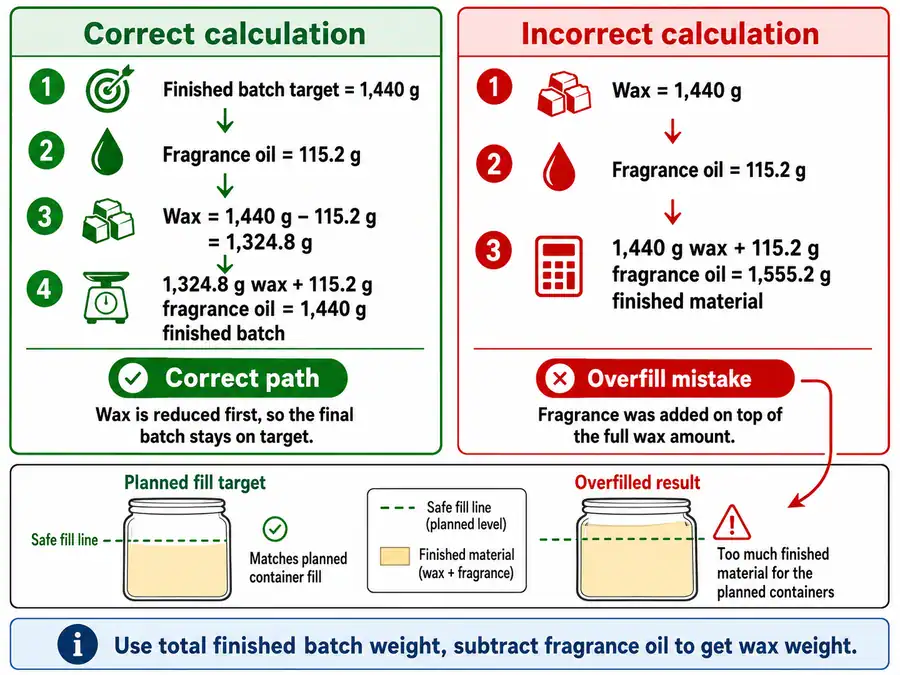
For a 1,440 g finished batch with 115.2 g fragrance oil:
1,440 g − 115.2 g = 1,324.8 g wax
If you melt 1,440 g of wax and then add 115.2 g of fragrance oil, the batch becomes 1,555.2 g. That adds fragrance on top of the jar fill target and can overfill the planned containers.
Wax calculation failure log
| Mistake | Result | Correct calculation |
|---|---|---|
| “I need 1,440 g, so I melt 1,440 g wax.” | Fragrance adds extra weight. | Subtract fragrance first. |
| “Wax needed means finished batch.” | Wax and total fill get mixed up. | Use net wax amount. |
| “I can adjust wax later by eye.” | Repeat batches become inconsistent. | Save the formula output. |
| “Fragrance is too small to subtract.” | Jars may overfill across larger batches. | Subtract every time. |
Check wax compatibility and supplier limits separately. Keep this calculator focused on ingredient weight: total batch, fragrance oil, and net wax.
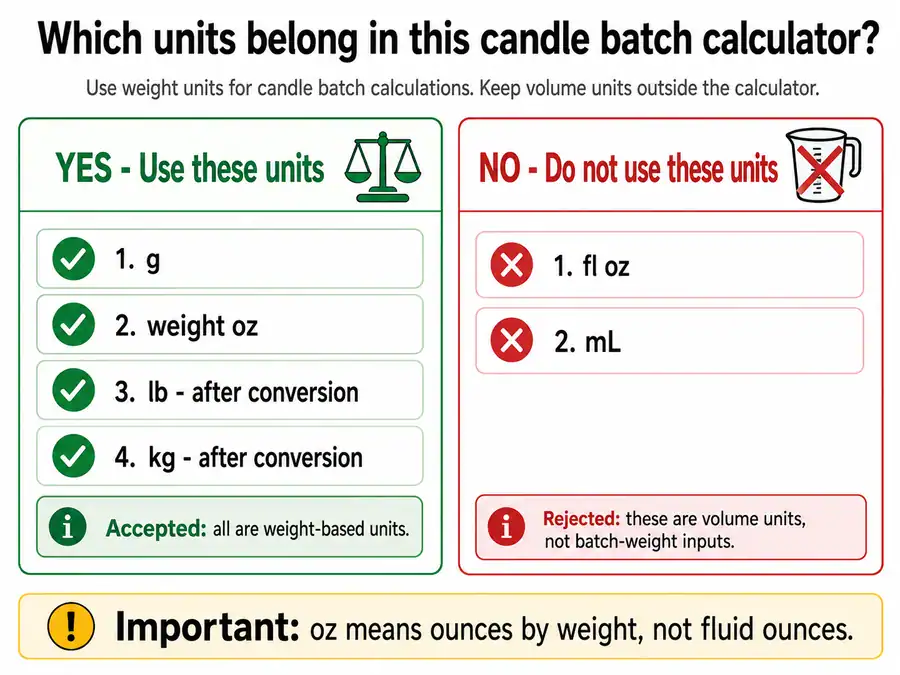
Use Weight Units Only
Weight units keep candle wax and fragrance oil calculations consistent across every jar in the batch.
For this calculator, oz means ounces by weight, not fluid ounces. Do not mix grams for wax with fluid ounces for fragrance oil, because the formula separates ingredients by weight.
| Unit label | Measurement type | Use in this calculator? | Notes |
|---|---|---|---|
| g | Weight | Yes | Best for small ingredient amounts |
| oz | Weight | Yes | Means weight ounces only |
| lb | Weight | Yes, after conversion | Better for larger wax amounts |
| kg | Weight | Yes, after conversion | Useful for larger batches |
| fl oz | Volume | No | Not the same as weight ounces |
| mL | Volume | No | Requires density conversion outside this calculator |
Convert all inputs into one weight unit before calculating. If your jar fill weight is in grams, keep fragrance oil and wax in grams. If your fill weight is in weight ounces, keep the whole batch in weight ounces.
Unit steps
- Choose grams or weight ounces before entering the batch.
- Convert every jar fill weight into that same unit.
- Enter fragrance load as a percentage, not a unit.
- Calculate total batch weight.
- Keep fragrance oil and wax outputs in the same unit.
Example:
If one jar fill weight is 180 g and you are making 10 jars, calculate the batch in grams:
10 × 180 g = 1,800 g total batch weight
At 8% fragrance load:
1,800 g × 0.08 = 144 g fragrance oil
1,800 g − 144 g = 1,656 g wax
Do not switch the fragrance output to teaspoons or fluid ounces after the formula.
Add a Small Overage
Overage is an optional extra material buffer added to the calculated batch for residue, spills, or small pouring losses.
In candle making, overage means extra prepared wax-and-fragrance mixture. It does not mean extra fragrance load, hidden padding, wholesale forecasting, or inventory planning.
| Overage input | What it changes | What it does not change |
|---|---|---|
| 0% | Keeps the base formula unchanged | Fragrance load |
| 2% | Adds a small disclosed material buffer | Wax safety limit |
| 5% | Adds more finished batch material for losses | Scent strength rule |
| 10% | Adds a large buffer for a small batch | SKU or inventory plan |
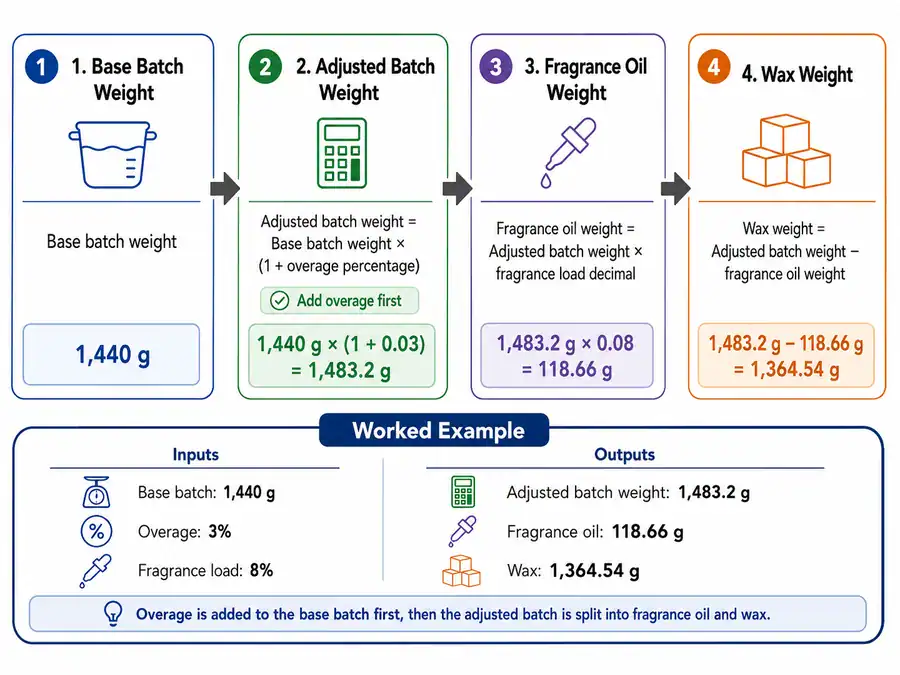
Add overage after the base total batch weight is calculated, then split the adjusted batch into fragrance oil and wax.
Formula
Adjusted batch weight = base batch weight × (1 + overage percentage)
Fragrance oil weight = adjusted batch weight × fragrance load decimal
Wax weight = adjusted batch weight − fragrance oil weight
Worked example
Base batch:
8 jars × 180 g = 1,440 g
Add 3% overage:
1,440 g × 1.03 = 1,483.2 g adjusted batch weight
At 8% fragrance load:
1,483.2 g × 0.08 = 118.66 g fragrance oil
1,483.2 g − 118.66 g = 1,364.54 g wax
| Output | Without overage | With 3% overage |
|---|---|---|
| Total batch weight | 1,440 g | 1,483.2 g |
| Fragrance oil | 115.2 g | 118.66 g |
| Net wax | 1,324.8 g | 1,364.54 g |
Use overage only when you want extra finished candle material for practical pouring. Do not use it to raise fragrance beyond the selected fragrance load or supplier limit.
Overage failure note
| Mistake | What happens | Better method |
|---|---|---|
| Adding overage as extra fragrance | Fragrance load changes without a real formula basis | Apply overage to the batch, then split wax and fragrance |
| Hiding overage in the jar count | The batch becomes hard to repeat | Use a visible overage percentage |
| Using overage for inventory planning | Ingredient math turns into production planning | Keep stock decisions outside this calculator |
| Using overage to fix poor scent throw | The scent problem may have another cause | Keep scent troubleshooting outside this calculator |
For production quantities, pricing, or inventory buffers, keep those decisions outside this ingredient formula.
Calculate Mixed Jar Sizes in One Batch
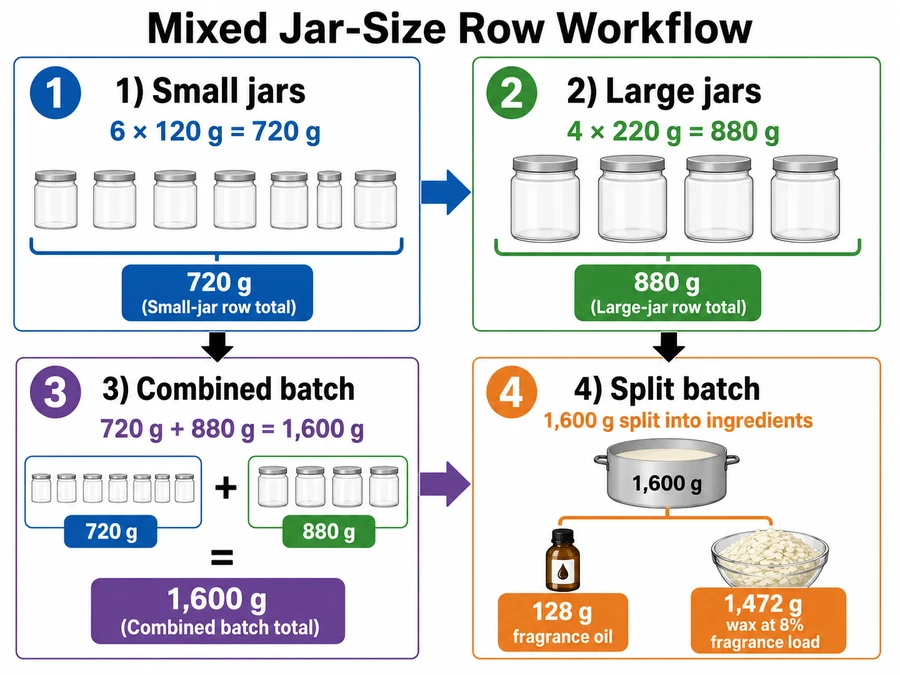
Mixed jar-size rows sum each container group before the calculator splits the combined batch into fragrance oil and wax.
Use mixed rows when one pour batch will fill different candle container sizes. Do not average the jar sizes, because each row has its own jar count and fill weight.
| Jar group | Jar count | Fill weight per jar | Row batch weight |
|---|---|---|---|
| Small jars | 6 | 120 g | 720 g |
| Large jars | 4 | 220 g | 880 g |
| Combined batch | — | — | 1,600 g |
Formula
Row batch weight = jar count × fill weight per jar
Combined batch weight = row 1 + row 2 + row 3
Fragrance oil weight = combined batch weight × fragrance load decimal
Wax weight = combined batch weight − fragrance oil weight
Worked example
Small jars:
6 × 120 g = 720 g
Large jars:
4 × 220 g = 880 g
Combined batch:
720 g + 880 g = 1,600 g
At 8% fragrance load:
1,600 g × 0.08 = 128 g fragrance oil
1,600 g − 128 g = 1,472 g wax
| Output | Amount |
|---|---|
| Combined finished batch weight | 1,600 g |
| Fragrance oil weight | 128 g |
| Net wax weight | 1,472 g |
Mixed jar-size failure log
| Mistake | What happens | Correct method |
|---|---|---|
| Averaging jar sizes | The batch can run short or leave extra material | Sum each row first |
| Counting SKUs instead of jars | Product planning replaces ingredient math | Count actual containers |
| Using one row for all sizes | Small and large jars lose their real fill weights | Use separate rows |
| Adding fragrance per row after totals | Formula becomes harder to check | Sum rows, then split fragrance and wax |
| Turning rows into a production plan | The calculator drifts into inventory forecasting | Keep production planning outside this calculator |
Use mixed rows only when the jars share the same wax, fragrance, fragrance load, and pour batch. If one jar size needs a different fragrance load, wax type, wick, or product plan, calculate that as a separate batch.