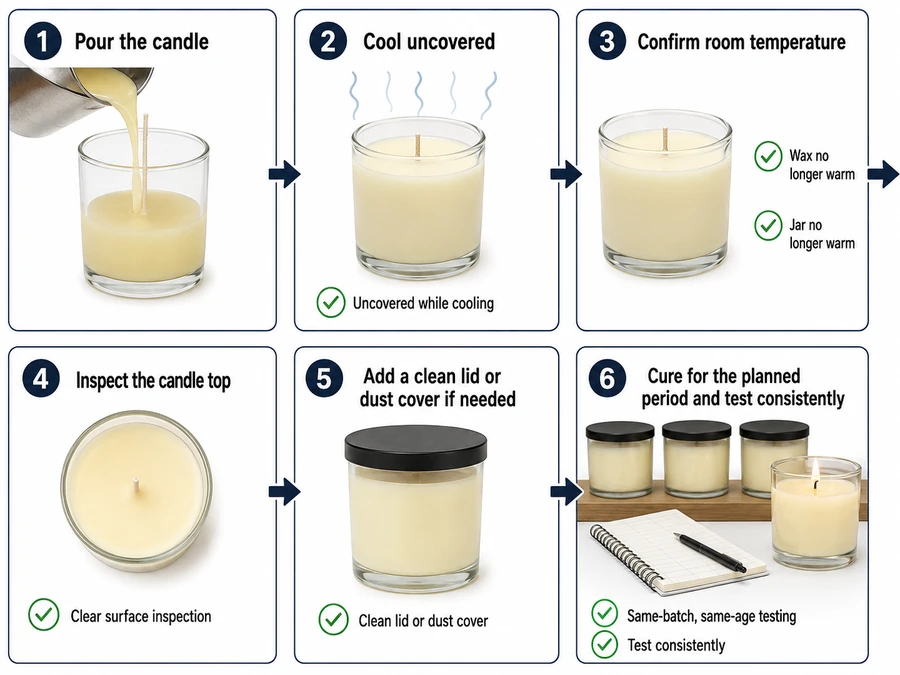

Candles should cool uncovered first, then lids can go on after the wax and jar reach room temperature. Candle curing means the post-pour resting period after a container candle has cooled, when wax structure and fragrance performance stabilize before testing or burning. The lid decision is stage-based: warm candles stay uncovered, cooled candles may be covered, and test candles should keep the same lid condition across samples. A lid can protect the cooled candle surface, but it does not make a candle cure faster or fix a weak scent by itself.
Should Candles Cure With Lids On or Off?
Candles should usually cool with lids off first, but lids can go on after the wax and jar reach room temperature if you need dust protection, clean storage, or consistent testing.
Candle curing means the post-pour resting period after a container candle has cooled, when wax structure and fragrance performance stabilize before testing or burning. In this article, “cure” does not mean drying, medical curing, immediate wax hardening, or a sealed aging process.
The easiest rule is stage-based: leave a warm candle uncovered, inspect it after cooling, then cover it only when the wax and jar are no longer warm. A lid protects the cooled candle surface from dust, lint, pet hair, and handling debris. It does not speed up cure chemistry, and it does not automatically fix weak scent throw.
| Candle stage | Lid status | Recommended? | Reason |
|---|---|---|---|
| Freshly poured or warm | Lid on | No | It can trap heat or moisture and hide surface issues. |
| Freshly poured or warm | Lid off | Yes | It lets the candle cool and makes the surface easier to inspect. |
| Fully cooled in a clean room | Lid off | Acceptable | The candle can cure uncovered if it is protected from debris. |
| Fully cooled in a dusty room | Lid on or dust cover | Recommended | It protects the cooled wax surface during cure storage. |
| Test candles | Same lid condition across samples | Required | It keeps lid status from changing the scent comparison. |
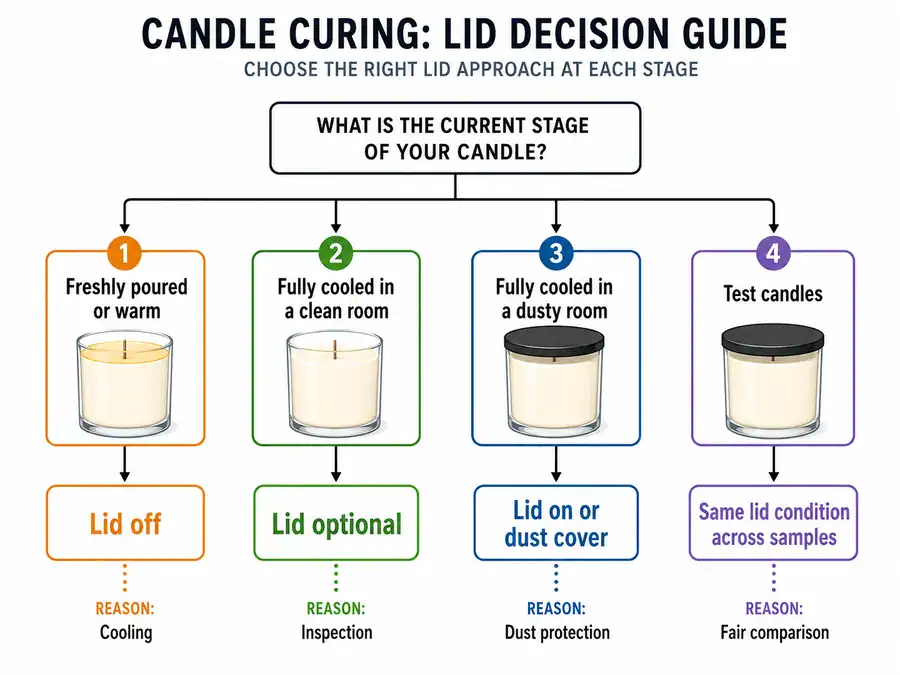
Lid handling and cure timing are separate decisions. Cure duration depends on wax type, fragrance load, and testing goals, so it should not be treated as the same question as lid placement.
Why Candles Should Cool Uncovered Before You Add Lids
Candles should cool uncovered because a warm candle is still releasing heat and may trap moisture or hide surface issues if it is covered too soon.
Cooling is the stage before cure storage, when the wax and container have not yet reached room temperature. Here, “off” means uncovered while the candle is warm or actively cooling. It does not mean every candle must stay uncovered for the entire cure period.
Covering too early can create a small warm airspace under the lid. In a humid room or with a tight lid, that trapped air can lead to condensation on the lid, jar, or wax surface. Early lidding can also hide cracks, sinkholes, debris, or other visible changes that happened during cooling rather than during cure storage.
Before you add a lid, check that:
- the wax is fully set;
- the jar is room temperature;
- no condensation is visible;
- the top surface can be inspected clearly;
- the lid or cover is clean before use.
Inspection is not the same as repair. If the main issue is a sinkhole, crack, frosting, wet spot, or contaminated surface, that repair question is outside this lid-timing decision.
When You Can Put Lids On After Candles Reach Room Temperature
Lids can be placed on candles after the wax and container have fully cooled to room temperature.
Room temperature means the jar and wax surface are no longer warm to the touch. At that point, the candle is no longer in the active cooling stage, so a clean lid, loose cover, or dust cover can be used for protection during cure storage.
Use this rule:
| Candle condition | Lid decision |
|---|---|
| Wax or jar still feels warm | Leave the lid off. |
| Wax and jar are room temperature in a clean room | Lid is optional. |
| Wax and jar are room temperature in a dusty room | Use a lid or dust cover. |
| Candles are being compared for scent | Keep the same lid condition for every sample. |
The lid protects the cooled candle surface from dust, lint, pet hair, and airflow debris. It does not make the candle cure faster. Long-term storage, finished packaging, and shipping are separate decisions from lid timing during cure.
Do Lids Help Candles Keep Their Scent While Curing?
Lids can help keep storage conditions consistent, but they do not automatically make a candle smell stronger while curing.
Scent performance means perceived cold throw or hot throw after the candle has rested for a consistent cure age. A lid may reduce exposure to room airflow, dust, or handling, but weak scent can come from wax choice, fragrance load, cure age, fragrance oil behavior, wick pairing, or testing method.
Lid status is a storage and testing variable because wax type, fragrance load, wick pairing, cure age, and test method can all change perceived scent.
Do not treat the lid as a fragrance fix. Treat it as one storage variable that must stay consistent when you compare candles.
| Lid condition | Cure age | Cold throw rating | Surface note | Interpretation |
|---|---|---|---|---|
| Lid off | Same age | 1–5 scale | Note dust, dryness, or visible changes | Valid only when compared with the same batch and same cure age. |
| Lid on after cooling | Same age | 1–5 scale | Note condensation, clean surface, or lid odor | Shows whether lid condition changed scent perception in this test. |
| Loose dust cover | Same age | 1–5 scale | Note debris protection without tight sealing | Helps separate dust protection from sealed storage. |
Method note: This table is sample-test guidance, not universal proof. Lid condition should be the only changed variable. Wax, fragrance load, jar, wick, cure age, room conditions, and evaluation timing should stay the same.
If the candle smells weak, the better next step is to check fragrance load, cure age, wax compatibility, and cold throw versus hot throw testing. Lid status alone cannot diagnose the whole scent problem.
How to Test Lid-On vs Lid-Off Candles Fairly
A fair lid-on vs lid-off test compares candles from the same batch at the same cure age while changing only the lid condition.
Same-batch and same-age testing means the formula, cure duration, storage room, and evaluation timing stay the same. The wax, fragrance load, wick, jar, pour date, and test day should match as closely as possible.
Use the lid as the only changed variable:
| Sample ID | Same batch? | Lid condition | Cure age | Cold throw rating | Surface note |
|---|---|---|---|---|---|
| A | Yes | Lid off | Same day count | 1–5 | Note dust, dryness, or surface changes. |
| B | Yes | Lid on after cooling | Same day count | 1–5 | Note clean surface, lid odor, or condensation. |
| C | Optional | Loose dust cover | Same day count | 1–5 | Note whether dust protection changed the result. |
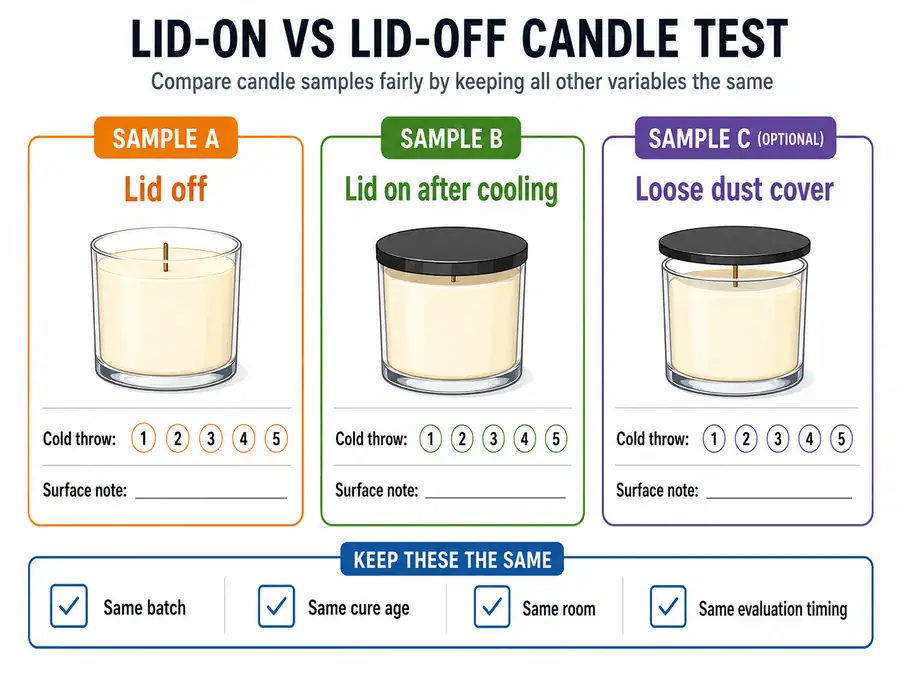
Smell each candle in the same room, at the same distance, and without burning other scented products nearby. Record the rating before you decide which storage condition worked better.
This is a small maker test, not a lab test. It can tell you whether lid status changed scent perception in your batch, but it cannot prove that every candle formula performs better with or without lids. Full cold throw, hot throw, and burn testing are broader performance-testing topics.
What Can Go Wrong If You Cover Candles Too Soon?
The main risk of covering candles too soon is trapping warm air or moisture under the lid before the candle has reached room temperature.
The risk condition is a warm container candle plus a lid or tight cover before room-temperature cooling is complete. That is different from covering a fully cooled candle for cure storage.
When a warm candle is covered, heat can stay near the wax surface and inside the jar. In a humid room, that trapped air may create condensation under the lid, on the glass, or near the wax surface. Early covering can also hide defects that formed during cooling, which makes it easy to blame the lid for a problem it did not cause.
| Mistake | Likely cause | What to check | What to do next |
|---|---|---|---|
| Lid placed on a warm candle | Warm air trapped under the cover | Condensation under the lid or on the jar | Remove the lid, let the candle fully cool, then inspect the surface. |
| Candle covered in a humid room | Moisture-prone storage area | Wet-looking surface or lid moisture | Move it to a stable room and check storage conditions. |
| Defect noticed after lidding | Defect may have formed during cooling | Sinkhole, crack, frosting, or wet spot | Do not treat lid status as the only cause. |
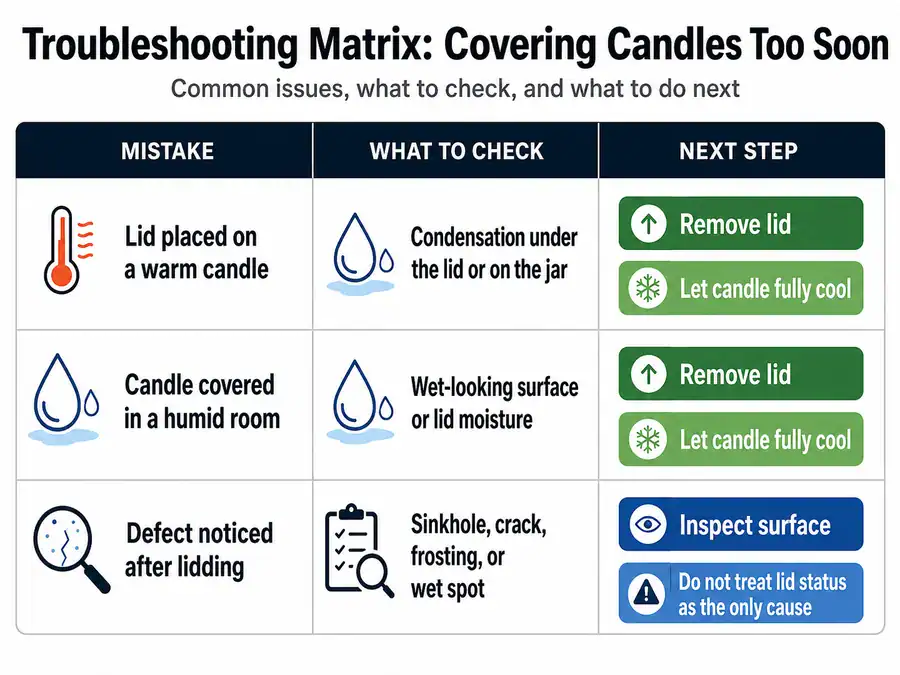
Condensation does not always mean the candle is ruined. First remove the lid, let the candle reach room temperature in a clean place, and inspect the surface. If the main issue is frosting, sinkholes, cracks, wet spots, or repeated moisture, that is a surface-defect or storage problem rather than a simple lid-on/lid-off question.
Inspect Candle Tops Before You Cover Them
Candle tops should be inspected after cooling and before lids are added.
The candle top is the visible wax surface of a cooled container candle. Checking it before lidding helps you avoid covering debris, moisture, or visible flaws that were already present after cooling.
Use this short check before adding a lid:
- the jar and wax are room temperature;
- the wax surface is fully set;
- no visible condensation is present;
- no obvious cracks, sinkholes, frosting, or debris are visible;
- the lid or dust cover is clean.
This step is only an inspection. It does not repair sinkholes, frosting, wet spots, cracks, or contaminated tops. If the candle top already has a visible defect, address that defect before blaming the lid or changing your cure routine.
What Changes the Lid Advice During Candle Cure?
Wax type can affect cure duration, but it does not change the basic lid rule: let candles cool uncovered first, then cover only after the wax and container reach room temperature.
Wax type means the candle’s wax material, such as soy, coconut, paraffin, beeswax, or a blend. Some waxes need more rest time before scent testing, but the first lid decision is still based on temperature, not wax name.
| Wax type | Lid rule impact | What belongs elsewhere |
|---|---|---|
| Soy | Cool uncovered first; lid after room temperature if needed. | Full soy cure timing. |
| Coconut | Use the same stage-based lid rule. | Full wax-specific cure guidance. |
| Paraffin | Use the same stage-based lid rule. | Wax comparison and cure duration. |
| Beeswax or blends | Use the same lid rule unless supplier guidance says otherwise. | Wax-type guidance. |
The same boundary applies to finished storage and lid fit. A lid can protect a cooled candle during cure storage, but it does not decide cure time, fragrance load, packaging quality, or selling readiness. Those topics answer different questions.
If wax-specific cure time becomes the main question, keep it separate from this lid-handling page. Wax type can change cure duration, but it does not change the basic cooling-before-lidding rule.
Curing Candles vs Finished Candles: What the Lid Means
A lid can be used during cure storage or finished-candle storage, but the lid itself does not prove that a candle is cured, tested, or ready to sell.
A curing candle is still in its rest or testing window. A finished candle has completed the maker’s cure and performance-check workflow. The same physical lid can serve different roles depending on the stage.
| Stage | Lid purpose | Testing status | What the lid does not prove |
|---|---|---|---|
| Curing candle | Storage consistency or dust protection | Still resting or awaiting evaluation | It does not prove cure is complete. |
| Finished candle | Storage, gifting, or packaging | Maker checks are complete | It does not prove legal compliance. |
| Retail-ready candle | Packaging and presentation | Requires separate compliance and labeling decisions | It does not belong in this article. |
Use the lid as a storage tool, not as a cure-completion marker. Final packaging, labels, shipping, and selling readiness are separate from deciding whether a curing candle should have a lid on or off.
Airtight Lids, Loose Lids, and Dust Covers During Cure
“Lid” can mean an airtight lid, a loose lid, a dust cover, or a decorative cover, and those covers do not behave identically during candle cure storage.
A candle lid is any cover used on a cooled container candle after the wax and jar have reached room temperature. Lid type affects protection, air exchange, odor transfer, and storage consistency, but it does not override the cooling-first rule.
| Cover type | Fit / air exchange | Best cure-stage use | Caution |
|---|---|---|---|
| Airtight lid | Lowest air exchange | After full cooling when consistent sealed storage is intended | Do not apply while warm. |
| Loose lid | Some air exchange | Dust protection after cooling | May not protect as fully as a tight lid. |
| Dust cover | Surface protection | Clean storage after cooling | Not the same as sealed storage. |
| Decorative lid | Varies | Finished look or light cover after cooling | Check for odor transfer or contact issues. |
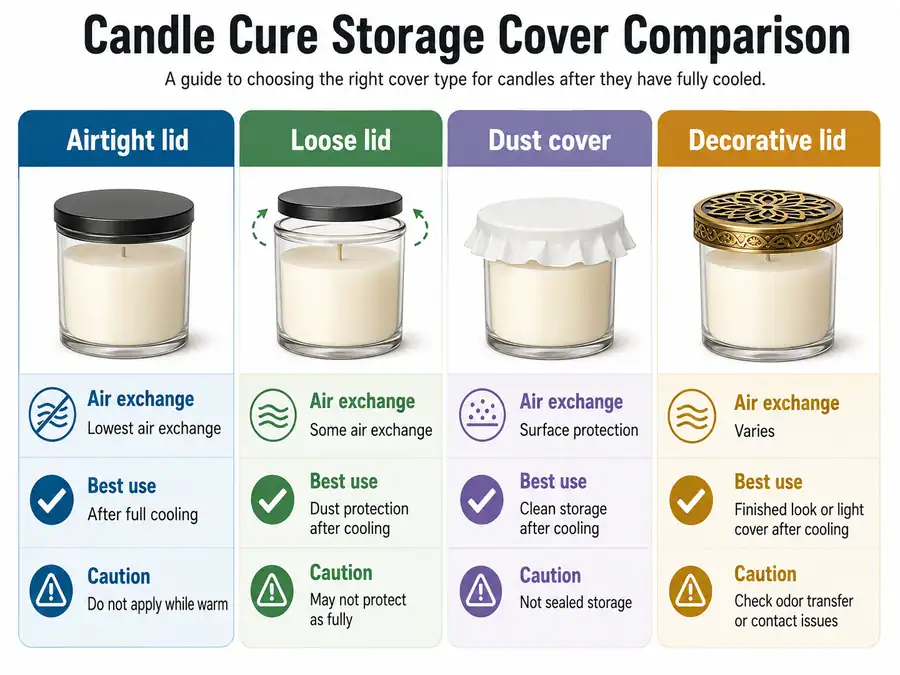
Method note: This comparison is a practical storage benchmark, not a product-buying guide. The cover type should be judged by cure stage, cleanliness, fit, odor risk, and test consistency rather than appearance alone.
If the question shifts to jar fit, lid material, sourcing, or retail presentation, that buying decision is outside this cure-stage lid article.
The Simple Lid Rule for Curing Candles
Let candles cool uncovered, then put lids on only after they reach room temperature if you need dust protection, cleaner storage, or consistent scent testing.
The practical candle-curing lid workflow is: pour, cool uncovered, confirm room temperature, inspect the candle top, cover if needed, cure for the planned period, then test consistently. This is a rule of thumb for typical container candles and small-batch makers, not a universal law for every wax, fragrance oil, climate, container, or production setup.
Use this workflow:
- Pour the candle.
- Let it cool uncovered.
- Confirm the wax and jar are room temperature.
- Inspect the candle top.
- Add a clean lid or dust cover if protection or storage consistency is needed.
- Cure for the planned period.
- Test lid-on vs lid-off only with same-batch, same-age candles.
- Keep cure duration, weak scent, full performance testing, packaging, and selling readiness separate from the lid-on or lid-off decision.
Method note: This workflow separates cooling, cure storage, and scent-testing variables for typical small-batch container candles.
The safest handling default is not “always cure with lids on” or “always cure with lids off.” The better answer is staged: warm candles stay uncovered, cooled candles can be covered, and test candles should use the same lid condition so the comparison stays fair.