
Gel wax candles are transparent container candles that need gel-compatible wax, fragrance, containers, wicks, scent load, embeds, and test-burn decisions to be safe.
Gel wax is a clear mineral-oil and polymer candle material. It behaves differently from soy, paraffin, and beeswax because it stays transparent, holds suspended decoration, and depends heavily on the container and fragrance system around it.
This page is safety decision support, not a full gel candle recipe. “Safety” here means construction and burn-system compatibility: the wax, fragrance, wick, container, scent percentage, decorative objects, and burn plan must work together.
A gel wax candle is not safe just because it looks clear, uses thick glass, or contains a candle fragrance oil. A clear candle can still have the wrong wick, an unsafe vessel, overloaded scent, or flammable decoration.
This guide covers gel wax candle safety rules, heat-safe containers, fragrance-oil compatibility, scent load, flash point, wick and container fit, embedded objects, cloudiness signals, and beginner pass/fail checks. It does not cover a full pouring tutorial, wax-type comparison, candle-selling law, medical fragrance claims, pet safety, child safety, or a broad home fire-safety guide.
Are Gel Wax Candles Safe? The Rules That Matter
Gel wax candles are safe only when they are built as a tested container-candle system with gel-compatible fragrance, a heat-safe vessel, controlled fragrance load, suitable wick, and burn-safe decoration.
They are not automatically safe or unsafe. The result depends on whether the materials and burn behavior match the candle’s container, fragrance, wick, and decorative layout.
Ordinary candle fire rules still apply: never leave a burning candle unattended, keep candles away from anything that can burn, and place them on a stable, heat-resistant surface. This section focuses on gel-wax construction safety, not full home fire-safety guidance.
| Decision Area | Safe Only If | Do Not Burn If |
|---|---|---|
| Container | The vessel is made or verified for candle use | The vessel is decorative, cracked, plastic, unstable, or unknown |
| Fragrance | The fragrance oil is confirmed for gel wax | The oil is generic, essential, perfume, soap, diffuser, or unverified |
| Fragrance load | The amount stays within the supplier limit | The candle sweats, pools oil, separates, or uses guessed measurements |
| Wick | The wick is tested in the actual vessel | The flame is too large, smoky, unstable, or overheating the container |
| Embeds | Decorations are nonflammable, heat-stable, and away from the flame path | Decorations include dried flowers, paper, plastic, fabric, wood, or unknown craft objects |
| Burn behavior | The test burn is stable | The glass cracks, overheats, separates, or shows abnormal flame behavior |
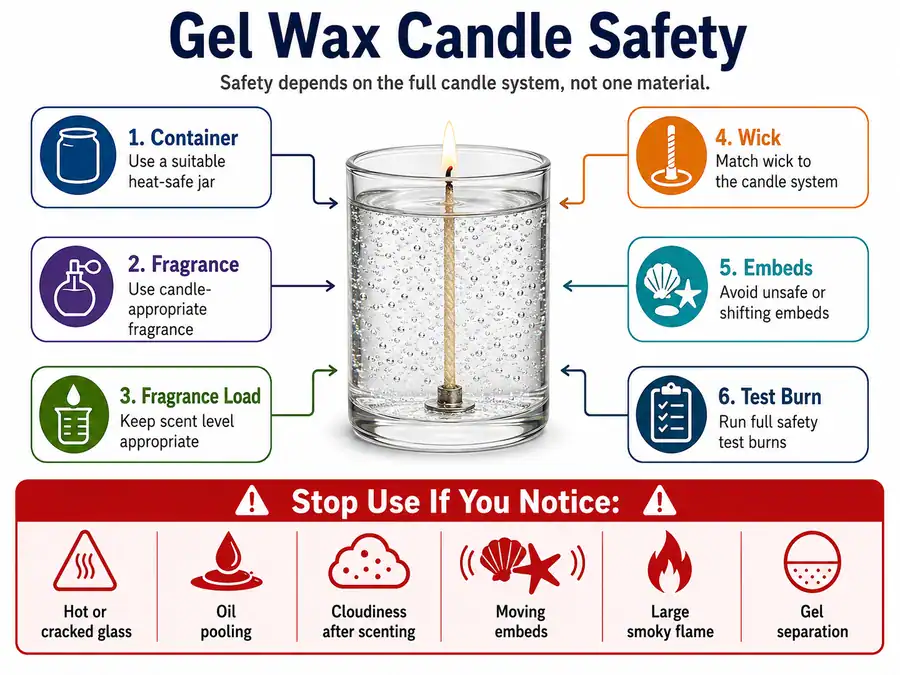
Method note: Treat a gel wax candle as a system check, not a single-material check. Verify the container, fragrance, fragrance load, wick, embeds, and test-burn behavior before repeated use or gifting.
| Failure Sign | Likely Safety Problem | Stop-Use Decision |
|---|---|---|
| Glass gets very hot or cracks | Wrong container or oversized wick | Extinguish and do not relight |
| Oil beads or pools on top | Excess fragrance or incompatible fragrance | Do not burn until reformulated |
| Gel turns cloudy after scenting | Possible fragrance or handling issue | Check fragrance compatibility before burning |
| Embed moves near the wick | Burn-zone risk | Remove, remake, or label display-only |
| Flame is large, smoky, or unstable | Wick and container mismatch | Stop and resize the burn system |
| Gel separates after cooling | Fragrance, dye, heat, or additive problem | Do not burn until the cause is found |
What Containers Are Safe for Gel Wax Candles?
Safe containers for gel wax candles are vessels made or verified for candle use, not decorative glass chosen only because it looks thick or attractive.
Gel wax candles are usually container candles, so the vessel is part of the safety system. A poor container can fail even when the wax and fragrance are correct.
A heat-safe container is a vessel rated, documented, or supplied for candle use under flame heat. It does not mean a recycled jar, drinking glass, vase, wine glass, or heavy decorative vessel that happens to hold wax.
| Container Type | Use for a Gel Wax Candle? | Main Risk | Safer Decision Rule |
|---|---|---|---|
| Candle jar made for container candles | Usually yes, if supplier-compatible | Still needs wick and test burn | Follow supplier guidance |
| Heat-safe candle glass | Verify | Heat stress if untested | Confirm candle-use rating |
| Recycled food jar | Avoid unless verified | Unknown thermal stress | Do not rely on past food use |
| Drinking glass | Avoid | Not designed for flame heat | Treat as display-only unless verified |
| Wine glass or vase | Avoid | Thin walls, shape stress, instability | Do not burn |
| Plastic container | Never use for burning candles | Melting or ignition risk | Reject for burnable candles |
| Porous ceramic | Verify or avoid | Cracking, leakage, heat retention | Use only if candle-safe and sealed |
Choose containers after the rejection rules are clear. A gel candle jar should be candle-use verified, stable, free from cracks, compatible with the wick plan, and suitable for the gel wax supplier’s instructions.
Method note: Container safety is not judged by thickness alone. The safer test is whether the vessel is made for candle heat, matched to the wick, stable during burning, and able to pass a controlled test burn without cracking or overheating.
A narrow mouth or mismatched diameter can put the flame closer to the glass, so test the container shape with the final wick and gel system.
How Wick Size and Container Fit Affect Gel Candle Safety
Wick size and container fit affect gel candle safety because the wick controls flame size and melt-pool heat inside the specific container.
The right wick is not the largest wick. It is the wick that burns safely in the exact gel wax, fragrance load, vessel, and embed layout.
A safe container can still become unsafe with the wrong wick. An oversized wick can create too much heat near the glass, too much flame, excess smoke, or unstable burn behavior.
| Wick and Container Check | Safer Signal | Unsafe Signal |
|---|---|---|
| Supplier starting point | Wick family matches gel wax and vessel diameter | Random wick chosen from a generic chart |
| Container diameter | Wick selected for the actual opening | Wick chosen without measuring the vessel |
| Fragrance load | Wick tested with the final scent percentage | Wick tested only in unscented wax |
| Embed layout | Flame path stays clear | Wick leans toward embeds or glass |
| Test burn | Flame stays stable and vessel heat remains controlled | Large flame, smoking, tunneling, or hot container |
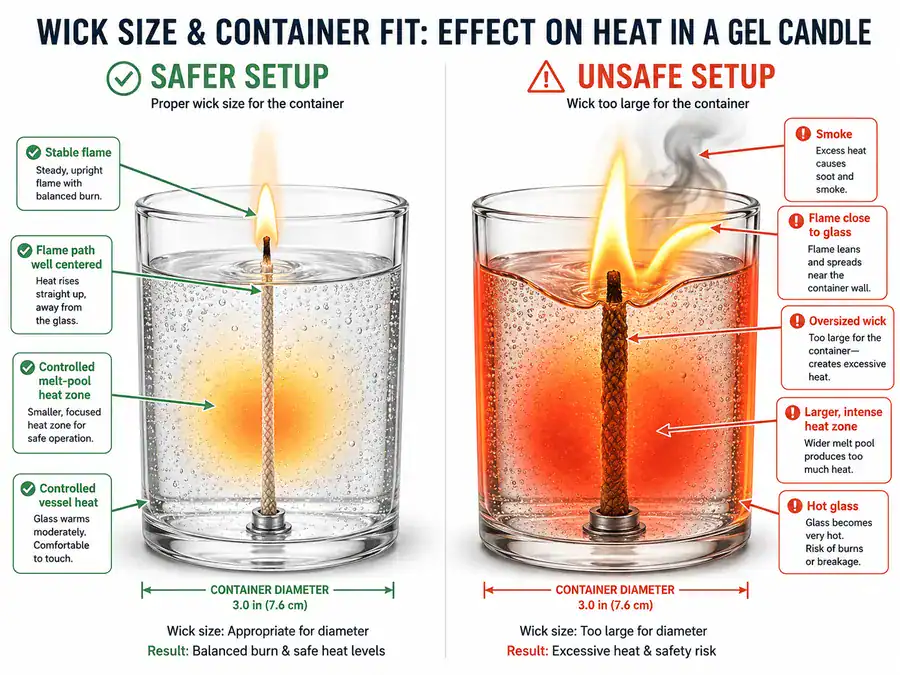
A bigger wick can make a gel candle less safe by increasing flame size, melt-pool heat, smoking, and container stress. Start with supplier wick guidance, test in the actual vessel, and stop using the candle if heat or flame behavior looks abnormal.
Method note: A wick chart can only give a starting point. The pass/fail decision comes from the actual candle system: gel wax, fragrance percentage, container shape, wick, dye, embeds, and test-burn behavior.
A controlled burn check should use the finished gel candle: final container, wick, fragrance load, dye, and embeds. Burn it on a stable, heat-resistant surface, watch flame size and smoke, check vessel heat, watch for separation or embed movement, and stop the test if the glass overheats, cracks, or the flame becomes unstable.
Which Fragrance Oils Are Compatible with Gel Wax?
Fragrance oils compatible with gel wax are candle fragrances specifically confirmed for gel wax use by the supplier or by reliable testing, not just any candle-safe fragrance oil.
A gel-compatible fragrance oil is an oil that can mix into gel wax without separation, clouding, sweating, or weakening the burn system. Gel wax needs this extra check because it behaves differently from ordinary opaque candle wax.
A non-polar fragrance oil is a fragrance that stays evenly mixed with the mineral-oil structure of gel wax instead of separating, beading, or weakening the gel. Non-polar status is a compatibility signal, not permission to skip supplier limits or burn testing.
“Candle-safe” means the oil may be suitable for candles in general. “Gel-safe” means it is suitable for gel wax specifically.
| Fragrance Check | Safer Signal | Unsafe or Uncertain Signal | Action |
|---|---|---|---|
| Supplier gel-wax claim | Explicitly marked gel-compatible | No gel wax mention | Do not use until confirmed |
| Candle-use suitability | Designed for candles | Perfume, soap, cosmetic, or diffuser-only oil | Reject for gel candle use |
| Solubility behavior | Supplier confirms gel compatibility | Separates, clouds, or pools | Stop and choose another oil |
| Flash point | Matches supplier guidance | Low or undocumented without guidance | Check supplier data |
| Load limit | Supplier-approved percentage given | No use-level guidance | Do not estimate |
| Test batch | Clear, stable, no sweating | Haze, separation, oil pooling | Remake or reject |
Essential oils should not be used in gel wax candles unless the supplier gives gel-specific compatibility proof. A pleasant scent is not enough because gel wax has to hold the oil in a transparent, stable burn system.
Skin-safe, soap-safe, diffuser-safe, perfume-grade, or natural does not answer the gel wax question. Those labels describe different uses and do not prove candle-gel compatibility.
Method note: Use supplier documentation first. If documentation is missing, treat the oil as unverified instead of testing a full candle. A small blend can reveal visible separation or clouding, but it does not replace burn testing for the final gel wax, wick, container, dye, fragrance load, and embed layout.
How Much Fragrance Oil Can You Use in Gel Wax?
The amount of fragrance oil you can use in gel wax is the percentage allowed by the specific gel wax and gel-compatible fragrance supplier, measured by wax weight.
Fragrance load is the fragrance oil weight divided by wax weight, usually shown as a percentage. The supplier limit controls the maximum. Do not copy soy, paraffin, or wax-melt percentages into gel wax.
Formula: fragrance oil weight = wax weight × fragrance load percent ÷ 100
Supplier limits can change by gel wax grade, so a published load range does not give permission to use that percentage in every gel wax.
| Wax Weight | Target Load | Fragrance Oil | Safety Note |
|---|---|---|---|
| 100 g | 3% | 3 g | Use only if the supplier allows 3% |
| 250 g | 3% | 7.5 g | Do not exceed the supplier maximum |
| 500 g | 2% | 10 g | A lower limit may be needed for some gel systems |
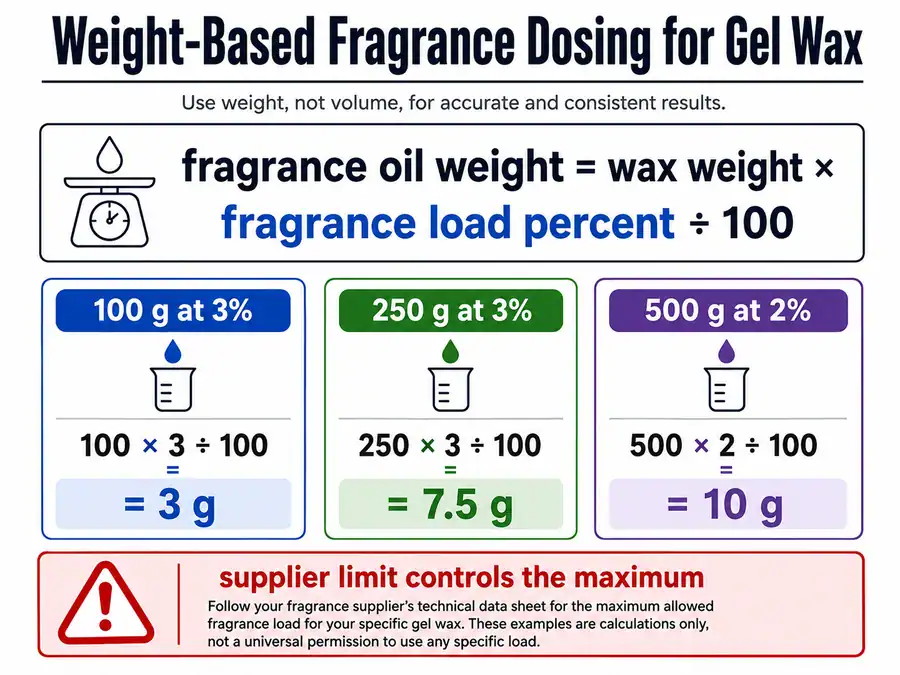
Measure fragrance by weight, not drops, teaspoons, or bottle caps. Gel wax needs weight-based dosing because overloading can cause sweating, oil pooling, separation, weak gel structure, poor burn behavior, or unsafe flame behavior.
A lower scent load may be safer than a stronger scent if the gel wax grade, fragrance oil, or container system does not support the higher amount.
Method note: The table uses the supplied formula as a static fallback, not permission to use those loads in every gel wax. The supplier maximum remains the upper boundary, and the target load must stay at or below it.
Does Flash Point Make a Fragrance Safe for Gel Wax?
Flash point is one safety input for fragrance oil in gel wax candles, but it does not prove that a fragrance is gel-compatible.
Flash point is the temperature at which a material can give off enough vapor to ignite under test conditions. It helps with fragrance handling decisions, but it does not tell you whether the fragrance will stay mixed in gel wax.
| Claim | What It Gets Wrong | Correct Rule |
|---|---|---|
| High flash point means gel-safe | Flash point does not prove solubility or gel compatibility | Check gel compatibility and supplier limit |
| Flash point equals pour temperature | They describe different things | Follow wax and fragrance procedure |
| Low flash point means instant fire | Risk depends on handling and the full candle system | Use supplier guidance and caution |
| Flash point replaces testing | It does not reveal clouding, separation, sweating, or wick behavior | Test the finished candle system |
A high flash point may reduce one kind of handling concern, but it does not prove the fragrance will remain stable in gel wax. A low or undocumented flash point is a warning sign, not a full diagnosis.
For Penreco-style candle gel guidance, a fragrance flash point of 170°F or higher is commonly treated as a preferred screening reference, but it still does not prove gel compatibility.
Check supplier documentation and the Safety Data Sheet, often called an SDS, when available. An SDS gives safety and handling information for a material, but it should not be treated as a candle recipe.
Method note: Use flash point as a screening variable, not a pass/fail certificate. Gel compatibility still depends on fragrance character, wax grade, scent load, mixing, wick choice, vessel shape, and test-burn results.
When Cloudiness Means a Gel-Fragrance Problem
Cloudiness in a gel wax candle matters most when it appears after fragrance, heat, dye, or embed decisions because it can reveal incompatibility.
Cloudiness means visible loss of gel clarity. In gel wax candles, it is a diagnostic signal, not a complete verdict.
A clear gel candle can still be unsafe if the wick, container, fragrance load, or embeds are wrong. A cloudy gel candle may be only a cosmetic or process issue, but oil pooling, sweating, or separation should be treated as a stop-use warning.
| Visual Symptom | Likely Cause | Safety Relevance | Next Action |
|---|---|---|---|
| Clouding after fragrance | Incompatible fragrance | Medium to high | Stop and verify gel compatibility |
| Oil pooling or sweating | Overload or incompatibility | High | Do not burn |
| Bubbles only | Pouring or handling issue | Low to medium | Troubleshoot separately |
| Haze after overheating | Heat handling problem | Medium | Review procedure and supplier limits |
| Clouding near embeds | Additive or contamination | Medium to high | Remove uncertain embeds or remake |
Cloudiness becomes more serious when it appears with oil beads, separation, sticky surface residue, or abnormal burn behavior. Those signs suggest the fragrance or additive system may not be stable in the gel.
Method note: Use this table only as safety triage. For scent-related haze, verify compatibility and scent load before burning.
What Can You Safely Put Inside Gel Candles?
You can safely put objects inside gel candles only when the objects are nonflammable, heat-stable, clean, positioned away from the wick path, and suitable for a candle that will be burned.
Embedded objects are decorative items placed inside the gel wax. If the gel candle is lit, the embed becomes part of the burn system, not just a visual design choice.
Decorative gel-candle inspiration can be unsafe when it treats a candle like resin art, aquarium decor, or a display craft. A burnable candle has different rules because flame, heat, wax movement, and container stress are involved.
| Embed or Add-In | Burnable Gel Candle? | Main Risk | Safer Rule |
|---|---|---|---|
| Candle-safe nonflammable decorative element | Possibly, if verified | Placement and heat behavior | Keep away from the wick path |
| Clean shells or mineral elements | Verify | Contamination, heat pockets, movement | Use only with caution and test |
| Dried flowers | Avoid for burning | Flammability | Use display-only or omit |
| Paper, fabric, or wood | Avoid | Ignition | Do not use in lit candles |
| Plastic decorations | Avoid | Melting or burning | Use display-only only |
| Food, glitter, or unknown craft objects | Avoid | Unknown heat behavior | Reject for burning candles |
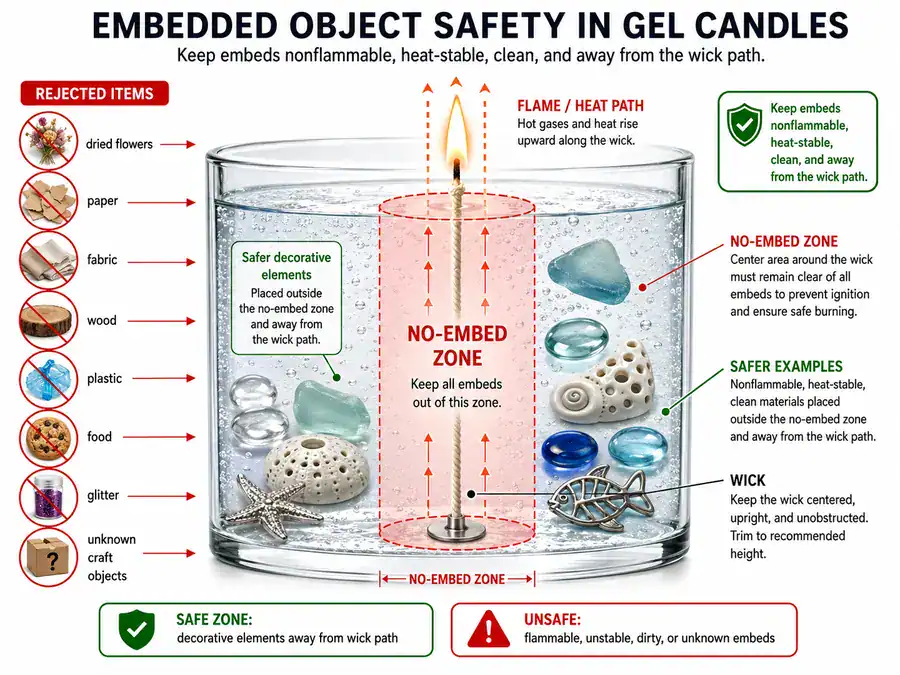
A display-only gel craft can use different design rules from a burnable candle, but it should be labeled and treated as display-only. A burnable gel wax candle needs safer materials, clear wick space, and test-burn behavior that does not move embeds toward the flame.
Display-only means the item is not intended to be lit, even once.
Do not assume an object is safe because it is small. Small dried botanicals, paper pieces, glitter, and plastic shapes can still create flame-path, melting, smoke, contamination, or movement problems.
Method note: Judge every embed by five questions: Can it burn? Can it melt? Can it move toward the wick? Can it contaminate the gel? Can it change heat behavior near the container? If the answer is unknown, do not use it in a burnable candle.
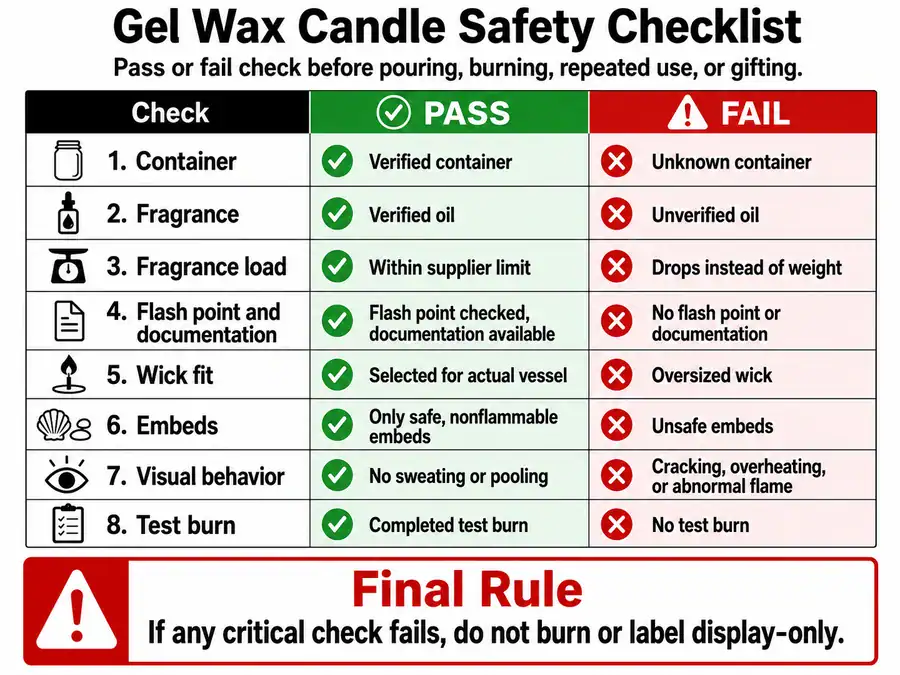
Beginner Gel Wax Candle Safety Checklist Before You Pour or Burn
A beginner gel wax candle is not ready to pour or burn until the container, fragrance oil, scent load, wick, embeds, and test-burn plan are all verified for the same system.
This checklist is pre-making and pre-burning decision support, not a full recipe. Use it before pouring, then again before repeated burning or gifting a candle.
| Check Item | Pass Condition | Fail Condition | Fix Action |
|---|---|---|---|
| Container | Candle-use verified and heat-safe | Decorative, unknown, cracked, or unstable | Use a candle-safe, heat-safe vessel |
| Fragrance | Confirmed gel-compatible | Generic, essential, perfume, soap, or unverified oil | Replace with a gel-compatible candle fragrance |
| Fragrance load | Within supplier limit | Exceeds limit or measured by drops | Recalculate by wax weight and supplier percentage |
| Flash point and documentation | Supplier data checked | No documentation or misunderstood threshold | Check supplier data before use |
| Wick fit | Selected for actual vessel and test burn | Bigger wick chosen only for stronger flame | Resize and test the wick in the final vessel |
| Embeds | Nonflammable and away from the wick path | Dried flowers, plastic, paper, or unknown craft item | Remove unsafe embeds or label display-only |
| Visual behavior | No sweating, pooling, separation, cracking, or overheating | Any failure signs appear | Do not burn until the cause is fixed |
| Test burn | Completed before gifting or repeated use | No test burn | Test the finished candle system before use |
Before you pour, block the project if the container, fragrance oil, fragrance load, wick choice, or embeds are unverified. Before repeated burning or gifting, block the project if there is sweating, oil pooling, separation, cracked glass, overheating, abnormal flame behavior, or no test burn.
Use this final pass/fail rule: if any critical check fails, the candle should not be burned until the issue is corrected or the project is labeled display-only.