

Candle Business Safety & Liability Basics (Testing, Warnings, Returns)
Candle business safety and liability basics are practical seller controls for testing candles, warning customers, keeping batch records, documenting defects, and handling safety-related returns.
For small candle sellers, safety means reducing product risk with testing, warnings, records, and clear return handling, not promising risk-free use. Liability here means lowering ambiguity with evidence and process, not giving legal advice, choosing insurance, or claiming legal immunity. This page covers pre-sale testing, burn observations, warning communication, batch traceability, stop-sell decisions, complaints, and safety-related returns. Start with testing because no candle should reach a customer before the seller has checked how it burns, records what happened, and decides whether it is ready to sell.
Test candles before selling, not after customer complaints
Pre-sale testing is the first candle business safety and liability control before any customer receives the product. Test every candle formula, vessel, wick, fragrance load, and meaningful supplier or batch change before listing it for sale. The decision path is simple: candle product → pre-sale testing → documented result → safer sale, retest, or no sale.
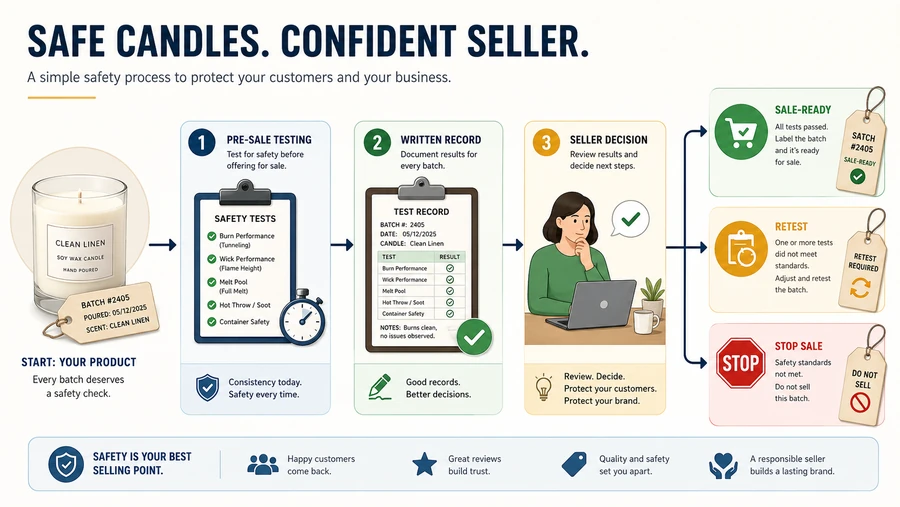
“Safe” here means tested under realistic use conditions with a written seller decision. It does not mean risk-free, legally approved, certified, or suitable for every customer and every setting. A single casual burn is not enough because it may miss near-end heat, soot patterns, vessel stress, wick drift, or changes caused by fragrance and additives. Use testing to answer three seller questions: is this candle ready, does it need another test, or should it be withheld?
| Test Result | Seller Meaning | Next Action |
|---|---|---|
| Consistent flame, stable vessel, acceptable soot, and complete record | Product appears sale-ready | Approve the batch and keep the record |
| Minor inconsistency, incomplete notes, or a changed supplier material | Evidence is incomplete | Retest before sale |
| Cracked vessel, excessive flame, unsafe heat, repeated soot, or unstable wick | Safety-related failure | Stop selling, correct the product, and test again |
| New vessel, wick, wax, fragrance, dye, or supplier lot | Prior evidence may no longer apply | Run a new test before listing |
| Customer-use warning changed after testing | Customer instructions may not match the tested product | Review warnings and update the batch file |
| Repeated failure across samples | Pattern may affect the whole batch | Hold the batch and review the formula or materials |
This table is a seller decision tool, not a certification record. Internal testing can support better judgment, but it should not be described as third-party approval unless that approval actually exists. Tested does not mean certified
| Risky Claim | Why It Creates Confusion | Safer Wording |
|---|---|---|
| Certified safe | Implies formal approval that may not exist | Burn tested in-house before sale |
| Safety certified | Blurs internal records with outside verification | Internally tested and documented |
| Guaranteed safe | Promises risk-free use | Tested under normal candle-use conditions |
| ASTM certified | May imply a formal certification claim | Designed with candle fire-safety guidance in mind |
| Non-toxic and safe for everyone | Overstates health and sensitivity claims | Fragrance and materials documented where supplier information is available |
Keep each test record tied to a batch ID, formula, vessel, wick, fragrance percentage, pour date, test date, observations, and seller action. If the candle fails repeatedly, the next step is not better wording. The next step is to hold the product, correct the issue, and retest before sale.
What to observe during burn testing
Burn testing creates evidence for whether a candle is ready to sell, needs retesting, or should be withheld. The test should record what the candle does during realistic use, not just whether it lights and smells good.
Watch the full candle system: wax, wick, vessel, fragrance, additives, label placement, and customer-use assumptions. A useful burn test connects each observation to an action, such as approve, monitor, retest, reformulate, reject the vessel, or stop selling the batch.
| Time / Stage | Condition to Check | Observation to Record | Result | Next Action |
|---|---|---|---|---|
| First burn | Flame height and stability | Flame is steady, high, flickering, or smoking | Pass / Retest / Stop | Approve, adjust wick, or hold batch |
| First burn | Melt pool | Melt pool reaches expected width without flooding | Pass / Retest | Continue test or adjust formula |
| Mid-burn | Container heat | Vessel feels hotter than expected or stays stable | Pass / Retest / Stop | Keep testing or reject vessel |
| Mid-burn | Soot and smoke | Light, heavy, repeated, or unusual soot appears | Pass / Retest / Stop | Adjust wick/fragrance or hold batch |
| Later burns | Wick movement | Wick stays centered or drifts toward glass | Pass / Retest / Stop | Retest setup or stop sale |
| Near-end burn | Vessel stress | Cracks, chips, overheating, or instability appear | Stop | Discard sample and hold batch |
| Repeated sessions | Pattern consistency | Same issue repeats across samples | Retest / Stop | Fix cause before listing |
| Final review | Written record | Notes clearly support ready, retest, or stop-sell | Pass / Incomplete | Approve or repeat test with better notes |
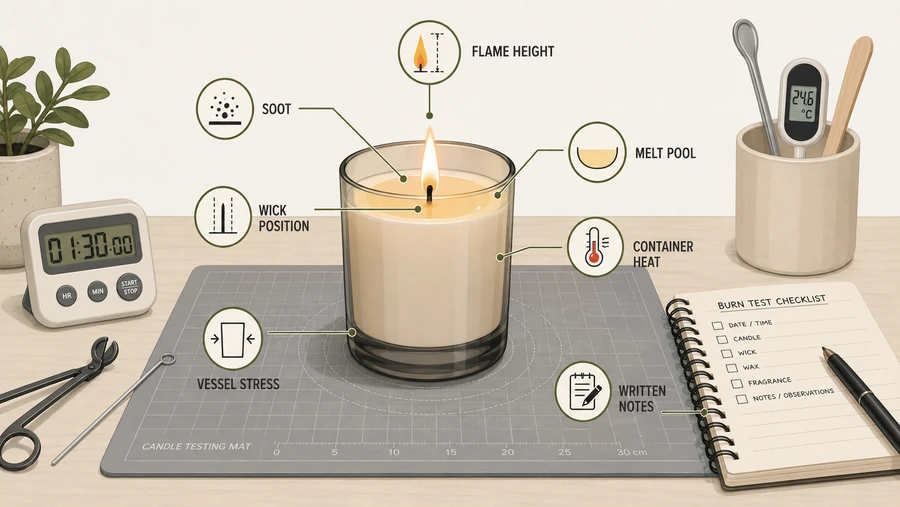
A burn test fails when the result changes the seller’s sale decision. Serious warning signs include cracking glass, extreme container heat, a flame that stays too high, repeated heavy soot, wick movement toward the vessel wall, or any pattern that cannot be explained and corrected. Record plain facts rather than guesses. “Jar cracked on third burn near the bottom” is more useful than “bad jar.” “Heavy soot after two sessions with 9% fragrance load” is more useful than “smoky candle.” Clear notes help the seller decide whether the issue belongs to the wick, vessel, fragrance load, burn instructions, or the whole batch.
Check containers and vessels before approving a candle
A candle vessel is part of the finished product’s safety profile and must be checked with the actual wax, wick, fragrance, and burn conditions. A jar, tin, or bowl is not safer because it looks thick, matches the brand, or feels sturdy in the hand. Seller approval depends on source, condition, heat behavior, and repeat test results.
A suitable candle vessel should come from a supplier or product line intended for candle use, then pass the seller’s own finished-product testing. Reused décor jars, thin glass, unknown containers, chipped vessels, and containers that change between supplier batches should be treated as new risk points. Use a vessel check before approving a batch.
| Vessel Check | What to Look For | Seller Decision |
|---|---|---|
| Supplier suitability | Vessel is sold for candle use or has relevant supplier guidance | Keep supplier notes with the batch file |
| Visible condition | No cracks, chips, bubbles near stress points, sharp edges, or loose lids | Reject damaged vessels |
| Wick and vessel fit | Wick stays centered and does not pull flame toward the wall | Retest or change the setup |
| Heat behavior | Container does not become unusually hot during full burn testing | Hold batch if heat seems unsafe |
| Near-end burn | Vessel stays stable as wax level gets low | Stop selling if cracks or stress appear |
| Supplier or size change | New lot, new shape, new glass weight, or new coating | Test again before sale |
| Returned product review | Cracked, chipped, melted, or uncertain vessel condition | Do not resell; document and review |
Vessel failure should change the sale decision. If the container cracks, overheats, leaks, tips, or shows stress during testing, the seller should hold that product and review the candle system before selling more units. Detailed glass engineering, supplier warranty disputes, and formal vessel standards are outside this seller-basics page. Keep this section focused on the finished candle: vessel choice, burn behavior, test records, and the decision to approve or reject the product.
Treat scent load and additives as test-and-claim risks
Scent load and additives are safety-liability basics only when they affect burn behavior, customer warnings, supplier documentation, or product claims. Fragrance is not just a scent-performance choice for sellers. It can change soot, flame behavior, wick performance, label wording, and the evidence needed to support product descriptions.
Record the fragrance percentage, supplier limit, additive type, batch ID, burn result, and any claim language tied to the candle. Supplier SDS or IFRA documents can support recordkeeping, but they should not be turned into broad health, safety, or chemical-compliance claims unless the seller has exact support.
| Claim or Record Item | Risk if Missing or Overstated | Safer Seller Action |
|---|---|---|
| Fragrance percentage | Seller cannot compare the batch to supplier guidance | Record the percentage in the batch file |
| Supplier maximum load | Formula may exceed supplier guidance | Save the supplier limit and test result |
| Dye, botanicals, glitter, or additives | Additives may affect burning or customer warnings | Test the finished candle and avoid unsupported claims |
| “Natural” | May imply safer without proof | State the material fact only when documented |
| “Clean” | Can sound like a health or purity claim | Use specific, supportable wording |
| “Non-toxic” | Can imply broad chemical or medical safety | Avoid unless exact support exists |
| “Safe for everyone” | Overstates customer sensitivity safety | Use cautious fragrance disclosure instead |
| “Tested with this fragrance” | Can be useful if records exist | Keep test notes tied to batch and scent load |
Natural, clean, non-toxic, and safe are bounded product claims. They should be supported by supplier documents, batch records, and burn results, not by marketing preference. A cautious seller can say what is in the candle, what was tested, and what care instructions apply without promising medical safety or universal suitability. Full toxicology, chemical classification, aromatherapy claims, and scent-throw tuning belong outside this page. For safety and liability basics, the practical rule is narrower: document the additive, test the finished candle, and make only claims the seller can support.
Know when to pause, retest, refund, or stop selling
A safety defect is a candle behavior or condition that should change the seller’s decision to sell, retest, refund, discard, or stop selling. Pause or stop selling when testing, returns, or complaints show repeated or serious safety-related failures. “Unsafe” here means enough evidence to take seller action, not a legal finding.
| Signal | Cosmetic or Safety-Related? | Seller Action |
|---|---|---|
| Frosting, minor surface flaw, or color variation | Usually cosmetic | Monitor or disclose if needed |
| Small label scuff with no safety information missing | Usually cosmetic | Correct packaging before sale |
| Heavy soot, high flame, or unstable wick | Safety-related | Fix and retest before selling |
| Vessel becomes unusually hot during testing | Safety-related | Hold batch and review vessel, wick, and formula |
| Cracked glass, leaking container, or distorted vessel | Serious safety signal | Stop selling and discard affected units |
| Repeated failure across test samples | Serious safety signal | Stop selling until corrected and retested |
| Customer reports burn issue with photos or batch code | Safety signal until reviewed | Document, quarantine, and investigate |
| Burned or damaged return | Safety signal until reviewed | Do not resell; refund, replace, discard, or review batch |
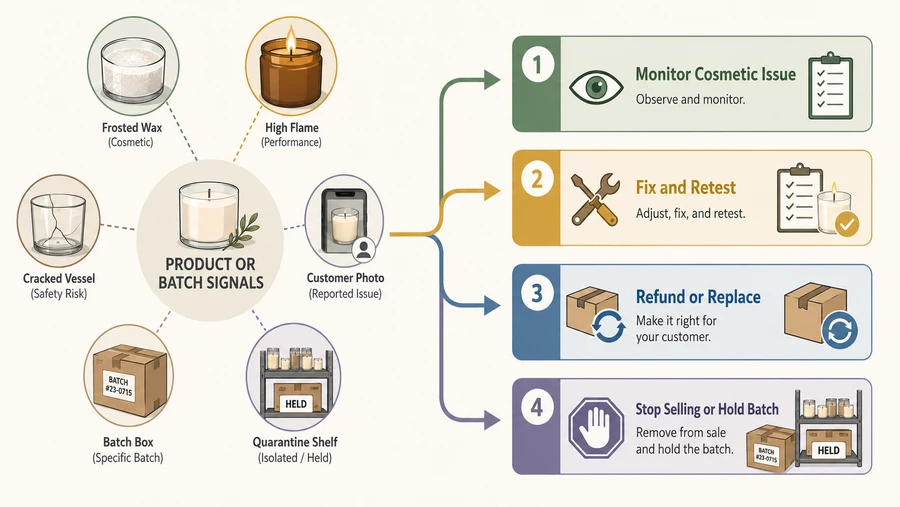
Cosmetic flaws affect appearance. Safety-related defects affect whether the candle should reach a customer. A frosted wax surface, slight color shift, or tiny label mark may be a quality issue, but a cracked vessel, repeated heavy soot, drifting wick, high flame, or overheating container should change the sale decision. Use action levels instead of vague judgment. Monitor minor non-safety issues. Fix and retest when the cause seems correctable. Refund or replace when a customer received a questionable product. Discard burned, broken, melted, contaminated, or uncertain returns. Stop selling when a pattern suggests the product is not ready. Do not treat a stop-sell decision as a legal recall plan or injury-response process. This section is about seller-controlled product decisions before a problem grows: pause the listing, hold the batch, review records, correct the cause, and retest before offering the candle again.
Give customers warnings they can actually use
Warning labels are customer-facing safety instructions, not proof that a candle is legally compliant, certified, or risk-free. Candle sellers should place clear warnings on the candle and repeat practical safe-use instructions where customers buy, open, and use the product. The goal is to reduce misuse and confusion, not decorate the packaging.
| Safety Message | Label | Care Card | Product Page | Email / Insert |
|---|---|---|---|---|
| Never leave a burning candle unattended | Yes | Yes | Yes | Optional |
| Keep away from children and pets | Yes | Yes | Yes | Optional |
| Burn on a heat-safe surface | Yes | Yes | Yes | Optional |
| Keep away from drafts and flammable items | Optional | Yes | Yes | Yes |
| Trim the wick before use | Optional | Yes | Yes | Yes |
| Do not burn for too long in one session | Optional | Yes | Yes | Yes |
| Stop use before wax is too low | Optional | Yes | Yes | Yes |
| Do not use damaged containers | Optional | Yes | Yes | Yes |
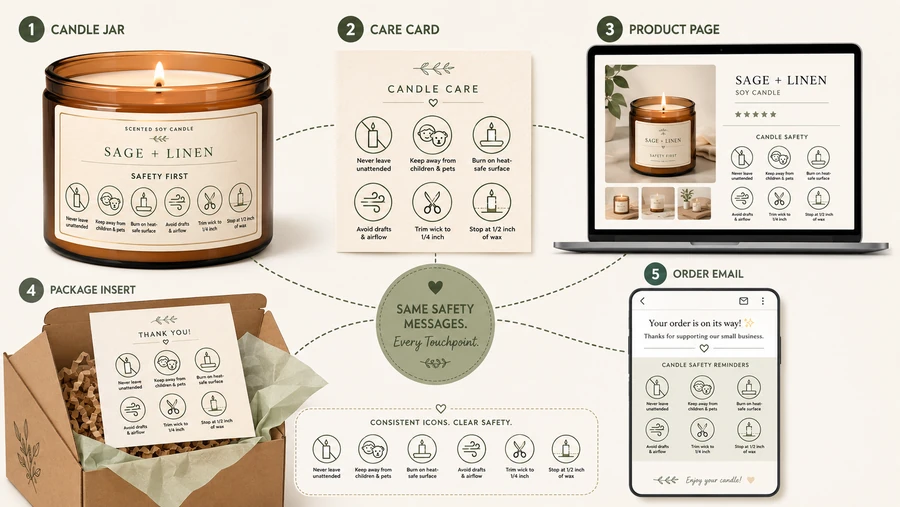
A warning tells customers what risk to avoid. A care instruction explains how to use the candle day to day. A product page sets expectations before purchase, while an insert or email repeats the message after purchase. These roles should support each other instead of hiding safety guidance in small print or lifestyle copy. Warn against common unsafe candle use
- Leaving a candle burning unattended.
- Burning near curtains, paper, shelves, or other flammable items.
- Placing the candle on an uneven or heat-sensitive surface.
- Burning near children or pets.
- Burning in a drafty area.
- Failing to trim the wick.
- Moving the candle while hot or while wax is liquid.
- Burning for too long in one session.
- Burning down to the very bottom of the vessel.
- Using a candle with cracked glass, loose wick, leakage, or missing warnings.
Misuse warnings should name common unsafe behaviors in plain language. They should not blame the customer, replace emergency guidance, or turn the article into legal doctrine. Do not overclaim sensitivity safety Do not promise that a candle is safe for pets, pregnancy, allergies, asthma, or sensitive people unless that exact claim is properly supported.
| Risky Phrase | Why It Creates Risk | Safer Direction |
|---|---|---|
| Pet safe | Sounds like veterinary safety advice | Provide ingredient or fragrance information instead |
| Safe during pregnancy | Sounds like medical advice | Avoid the claim and suggest professional guidance for personal concerns |
| Hypoallergenic | Implies allergy safety | Use factual fragrance disclosure only when supported |
| Asthma safe | Implies medical suitability | Do not make respiratory safety claims |
| Non-toxic for everyone | Overstates broad health safety | Use specific, supportable material information |
Customers may ask personal health or pet questions, but the seller should not answer them as a medical or veterinary authority. A safer path is to provide factual fragrance or material disclosure, repeat safe-use instructions, and avoid unsupported claims about sensitive people, animals, pregnancy, allergies, asthma, or health conditions.
Keep records that connect products, batches, and customers
Product documentation is the seller’s evidence chain connecting a candle to how it was made, tested, sold, and handled after customer feedback. Keep records that connect every sellable candle batch to its formula, materials, supplier documents, test results, warning version, order records, complaints, and return decisions. This makes a product issue traceable instead of dependent on memory.
SDS means Safety Data Sheet, a supplier document that describes material handling and hazard information. IFRA means International Fragrance Association, which may appear on fragrance certificates supplied by vendors.
| Record Item | Why It Matters | Link To |
|---|---|---|
| Batch ID | Identifies the product group | Label, order, batch log |
| Formula and pour date | Shows how the candle was made | Test record |
| Vessel, wick, wax, and fragrance load | Shows the tested candle system | Burn test and supplier notes |
| Supplier lot, SDS, or IFRA certificate | Supports material traceability where relevant | Supplier folder |
| Burn test result | Shows the pre-sale decision | Ready, retest, or stop-sell record |
| Label or warning version | Shows what the customer saw | Product page and package |
| Order number | Connects a sold candle to a buyer | Sales record |
| Complaint or return case | Shows the post-sale signal | Batch review and seller action |
Documentation here means safety traceability records, not bookkeeping, tax files, inventory valuation, or enterprise recall software. A useful record chain lets the seller answer: what materials went into this candle, how was it tested, which customer received it, what warning copy was shown, and what action happened after a return or complaint? Keep the record simple enough to use. A small seller can start with a spreadsheet, folder, and batch-code habit. The record only helps if the batch ID, materials, test result, order, and complaint notes can be found together when something goes wrong.
Link materials, supplier documents, and batch records
Supplier documentation matters for safety when it links materials, lots, batches, tests, and customer orders. A supplier invoice, SDS, IFRA certificate, vessel note, or material lot number is not useful if it sits in a folder with no connection to the candle batch that used it.
Traceability means material-to-batch-to-sale linkage. It does not mean procurement software, vendor contract management, accounting inventory, or full chemical-compliance interpretation.
| Supplier Record | What to Save | Why It Helps |
|---|---|---|
| Wax invoice or lot note | Supplier, purchase date, lot or order reference | Shows which wax was used in the batch |
| Fragrance SDS | Supplier safety document | Supports material records and cautious claim wording |
| IFRA certificate where supplied | Fragrance-use document | Helps record fragrance guidance without making broad health claims |
| Vessel specification or supplier note | Size, material, intended use, supplier guidance | Supports vessel screening and retest decisions |
| Wick supplier note | Wick type, size, coating, supplier | Links wick changes to burn-test outcomes |
| Supplier change record | New supplier, new lot, or changed material | Triggers retesting before sale |
| Batch log reference | Batch ID and pour date | Connects materials to finished candles |
| Complaint or return reference | Order number and issue notes | Helps review whether a material or lot may be involved |
Retest when a supplier changes, a material lot changes, a fragrance behaves differently, a vessel shape changes, or a customer complaint points back to a material pattern. The goal is not to interpret every supplier document like a compliance officer. The goal is to know which materials were used, where they went, and whether they need a new test before more candles are sold. Keep deeper supplier vetting, SDS interpretation, purchasing contracts, and inventory accounting separate from this safety-basics workflow. For this article, supplier records matter because they help the seller trace product risk and make better testing, warning, return, and stop-sell decisions.
Treat damaged returns as unsafe until reviewed
Shipping damage can turn a candle into a safety-related return if the product, vessel, wick, label, or packaging condition is uncertain. A damaged candle is not only a customer-service issue. It may affect whether the product can be replaced, discarded, reviewed against the batch record, or held for a wider product check.
Treat cracked glass, melted wax, leakage, loose wicks, broken lids, contaminated wax, distorted containers, missing warning labels, and unknown package damage as safety signals until reviewed.
| Damage Signal | Why It Matters | Seller Action |
|---|---|---|
| Cracked or broken glass | Vessel may no longer be safe to handle or burn | Do not resell; document and discard |
| Melted or leaked wax | Product condition has changed | Document, refund or replace, and review shipping conditions |
| Loose or shifted wick | Burn behavior may no longer match testing | Do not resell; review batch if repeated |
| Contaminated wax or debris | Product is not suitable for customer use | Discard and record the case |
| Missing or damaged warning label | Customer may not receive safety instructions | Replace only with corrected labeling if unused and safe |
| Distorted tin, jar, or lid | Container fit or burn setup may be affected | Quarantine and review |
| Repeated damage pattern | Packaging, vessel, or product choice may be failing | Pause shipment of affected setup and review cause |
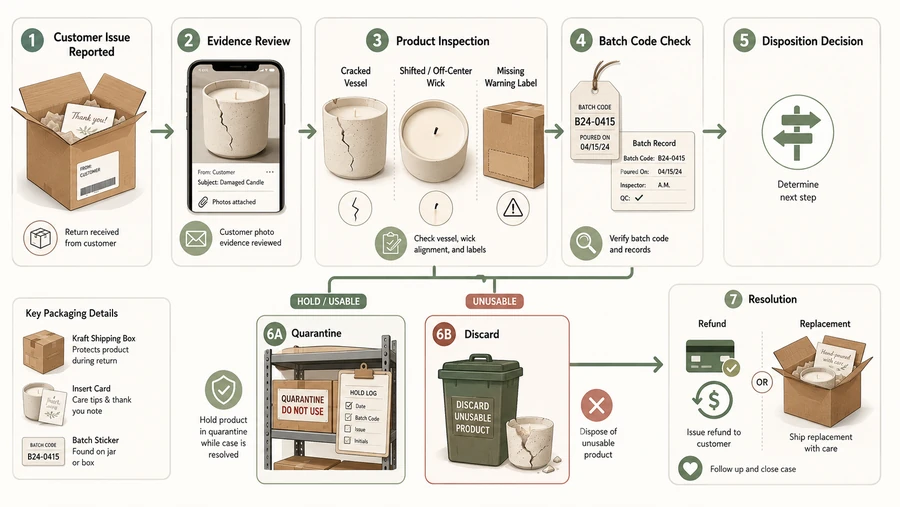
Ask the customer for clear photos, order number, batch code, product condition, package condition, and a short description of what happened. The seller can resolve the customer issue quickly while still keeping evidence for the product record. Burned, broken, melted, contaminated, or uncertain returned candles should not be resold. Carrier claims, shipping insurance, and package-claim deadlines are separate business processes. This section stays with product safety: document the damage, prevent unsafe resale, review the batch if needed, and correct repeated patterns.
Collect the right evidence before deciding what happened
Complaint intake is the seller’s process for collecting product-risk evidence before deciding on refund, replacement, quarantine, retest, or stop-sell action. The purpose is to understand the product signal before guessing whether the issue came from misuse, shipping damage, a batch defect, or unclear warnings.
Use a simple intake checklist for every safety-related complaint.
| Evidence Field | What to Ask For | Why It Helps |
|---|---|---|
| Order number | The customer’s order or receipt detail | Connects the case to the sale |
| Batch code | Code from label, box, or order record | Connects the case to the batch log |
| Product name and scent | Exact candle received | Confirms formula and fragrance record |
| Photos | Vessel, wick, wax, label, package, and damage | Shows visible product condition |
| Burn duration | How long the candle was burned per session | Helps review use conditions |
| Surface and room setup | Where and how the candle was used | Helps identify unsafe use conditions |
| Wick trimming | Whether the wick was trimmed before use | Helps interpret flame and soot issues |
| Timeline | When the issue appeared | Separates shipping, first use, and later burn issues |
| Customer request | Refund, replacement, advice, or return | Helps resolve the case clearly |
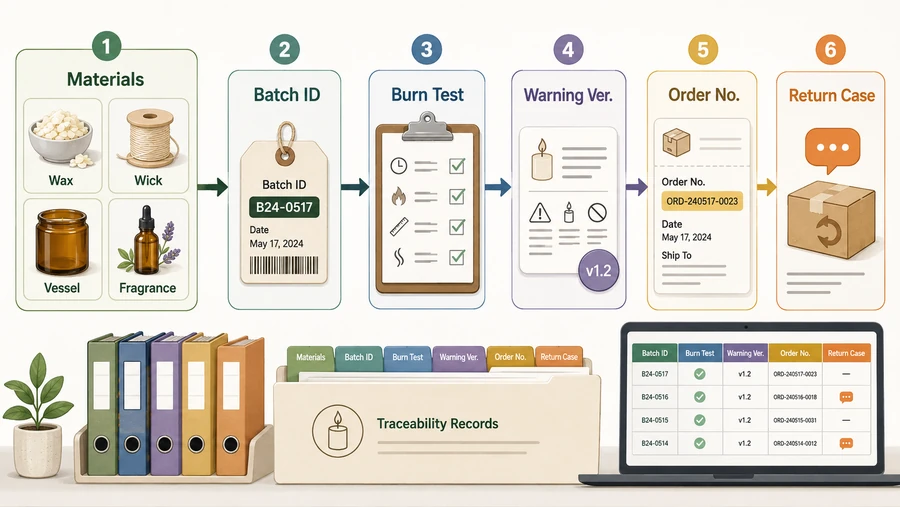
Keep the intake language factual. Do not decide what happened before reviewing photos, batch records, and use conditions. Do not make fault statements, ignore the batch code, resell a questionable return, or let customer messages stay outside the product record. An “incident” here means a customer-reported product issue. It does not mean a legal claim, professional investigation, or admission of fault. Injury, fire, insurance, litigation, and emergency response require qualified help outside this seller-basics process.
Write a burned-candle return rule that protects safety
A burned candle return is a used product and should not be treated as sellable inventory. It may be customer feedback, product evidence, a misuse signal, or a defect signal. The return rule should protect the customer experience while keeping questionable products out of resale stock.
A clear burned-return rule should say what the seller needs, what the seller may do, and what will not happen to the returned candle.
| Policy Situation | Practical Wording | Seller Action |
|---|
Write a burned-candle return rule that protects safety
A burned candle return is a used product and should not be treated as sellable inventory. It may be customer feedback, product evidence, a misuse signal, or a defect signal. The return rule should protect the customer experience while keeping questionable products out of resale stock.
A clear burned-return rule should say what the seller needs, what the seller may do, and what will not happen to the returned candle.
| Policy Situation | Practical Wording | Seller Action |
|---|---|---|
| Customer reports a burn issue | “Please send photos, the batch code, burn time, and a short description of what happened.” | Open a complaint record |
| Candle is partially burned | “Used candles are reviewed as product feedback and are not returned to sellable stock.” | Do not resell |
| Product appears defective | “We may refund or replace after reviewing the photos and batch details.” | Resolve customer issue and review batch |
| Candle is broken, melted, or contaminated | “For safety, damaged or uncertain candles are not resold.” | Discard or quarantine |
| Customer asks for ordinary preference return | “Unopened returns follow the ordinary return policy.” | Use normal policy flow |
| Repeated burned-return issue appears | “We review repeated product signals against batch and test records.” | Hold batch if needed |
The policy should not sound like a legal fault statement. It should stay practical: collect evidence, resolve the customer issue, keep the batch record, and prevent questionable stock from returning to sale. Useful return language is specific. Ask for photos of the vessel, wick, wax surface, label, and any damage. Ask for the batch code and order number. Ask how long the candle burned and where it was placed. These details help the seller separate ordinary dissatisfaction from a safety-related signal. Consumer-law return rights, marketplace dispute rules, insurance claims, and legal strategy sit outside this section. The seller-facing rule is narrower: burned candles are used products, possible evidence, and never normal resale inventory.
Build a minimum safety evidence kit before launch
A minimum safety evidence kit is the seller’s practical baseline for showing that testing, warnings, records, materials, claims, and returns have been considered before launch. It is not legal sufficiency, certification, insurance readiness, or full business setup. It is the evidence folder a small seller should have before listing candles for customers.
Before launch, the seller should be able to point to records that answer five questions: was the candle tested, were warnings prepared, can the batch be traced, are product claims supported, and is there a return or complaint process? Use this launch-readiness checklist before publishing a candle product.
| Evidence Item | Ready Means | If Missing |
|---|---|---|
| Burn-test records | Finished candle system was tested and recorded | Delay launch and test before sale |
| Vessel and formulation notes | Wax, wick, vessel, fragrance, and changes are documented | Complete records before listing |
| Warning label and care-card copy | Customer safe-use instructions are written and matched to the product | Finish warnings before shipping |
| Batch IDs and batch logs | Each sellable batch can be traced | Create batch codes and logs |
| Supplier documents | SDS, IFRA, invoices, lot notes, or vessel notes are saved where relevant | Save documents and link them to batches |
| Product claim review | Listing does not overstate safe, certified, non-toxic, pet-safe, or health claims | Rewrite unsupported claims |
| Return and complaint process | Seller knows what evidence to request and how to handle unsafe returns | Write the intake process before launch |
| Stop-sell decision rule | Seller knows when to retest, discard, refund, or hold a product | Define action levels before sale |
A simple decision rule keeps the kit usable.
- Ready: testing, warnings, batch records, supplier notes, claim review, and return handling are complete enough to support sale.
- Incomplete: one or more records are missing, but the product has not reached customers yet.
- Delay launch: testing failed, warnings are unclear, batch traceability is missing, claims are unsupported, or returns cannot be handled safely.
The evidence kit should stay focused on candle safety and liability basics. Business licensing, insurance, taxes, formal certification, legal compliance, pricing, inventory planning, and launch marketing may matter, but they are not part of this practical product-safety kit. A seller does not need a complicated system to start. A folder, spreadsheet, batch-code habit, warning copy file, supplier-document folder, and return-intake template can create enough structure to reduce guesswork. The key is that every candle offered for sale has a traceable path from materials and testing to warnings, customer order, complaint handling, and seller action.