
Vanilla fragrance oil, vanilla absolute, and products sold as “vanilla essential oil” are not interchangeable.
Candle suitability depends on a verified product identity, matching supplier documentation, and controlled testing, with no universal winner.
Vanilla fragrance oil is a formulated product, vanilla absolute is a botanical extract, and “vanilla essential oil” can refer to an absolute, CO₂ extract, oleoresin, dilution, blend, or fragrance preparation.
In this article, “works in candles” means the product has candle-use information and can be tested in its intended wax-and-wick system; it does not mean the product is natural, therapeutic, universally safe, universally compatible, or guaranteed to give strong throw.
This comparison examines identity, evidence, wax behavior, scent throw, appearance, sourcing, cost, and testing burden; it does not cover recipes, fragrance loads, mixing temperatures, cure schedules, or wick selection.
Vanilla Fragrance Oil vs Vanilla Absolute vs “Vanilla Essential Oil”: What Are They?
Vanilla fragrance oil, vanilla absolute, and products sold as “vanilla essential oil” belong to different material categories, and a product name alone does not prove candle suitability.
Vanilla fragrance oil is a fragrance product created by a supplier. It may contain synthetic aroma materials, natural extracts, essential oils, or any combination of these. Check the exact supplier listing and product files for its intended applications and restrictions.
Vanilla absolute is a concentrated aromatic material made through solvent extraction. It is not the same as a steam-distilled essential oil or a formulated candle fragrance oil.
“Vanilla essential oil” is an incomplete retail label. Depending on the seller, it can refer to a vanilla absolute, CO₂ extract, oleoresin, carrier-oil dilution, fragrance blend, or another aromatic preparation.
Vanilla is not normally available as a conventional steam-distilled essential oil; the retail label alone therefore cannot identify the material category.
Supplier listings show why the distinction matters. One vanilla absolute is identified as solvent extracted, while a vanilla CO₂ product is sold as a 30% extract diluted in 70% fractionated coconut oil. Another organic CO₂ preparation contains 10% vanilla CO₂ extract and 90% fractionated coconut oil. These products cannot be treated as equivalent only because each listing uses “vanilla” and “oil.”
| Product or listing label | Declared material category | Extraction or formulation claim | Carrier or diluent | Candle-use documentation | Classification verdict |
|---|---|---|---|---|---|
| Vanilla fragrance oil | Formulated fragrance product | Supplier-created fragrance formula | None stated or undisclosed | Matching candle guidance and product files | Identified fragrance product; review for testing |
| Natural vanilla fragrance oil | Formulated fragrance product | Supplier-defined natural-origin claim | Disclosed or undisclosed | Candle application stated | Clarify what the natural-origin claim covers |
| Vanilla absolute | Botanical absolute | Solvent-extracted vanilla material | None stated | Candle application or supplier guidance available | Identified absolute; review for testing |
| Vanilla absolute 50% | Diluted absolute | Absolute diluted to a stated percentage | Named carrier | No candle guidance | Identity is clear; defer until application support is supplied |
| Vanilla CO₂ 30% | CO₂ extract dilution | Carbon-dioxide extraction | 70% carrier disclosed | Product-specific guidance required | Classify as a diluted CO₂ extract, not an absolute |
| Vanilla oleoresin | Oleoresin | Concentrated solvent extract | None stated or unknown | No candle documents | Identified oleoresin; defer candle testing |
| Vanilla essential oil | Undisclosed preparation | No extraction or formulation statement | Not stated | None | Unclassified; request clarification |
| Pure vanilla essential oil | Ambiguous preparation | “Pure” is the only identity statement | Not stated | Generic use statements only | Defer as unverified |
| Vanilla essential oil blend | Blend or fragrance preparation | Blend disclosed | Carrier disclosed | Matching product files available | Classify as a blend and review its documents |
| Vanilla extract | Food-oriented hydroalcoholic extract | Alcohol-and-water extraction | Alcohol and water | No candle guidance | Outside this comparison; not a candle-fragrance substitute |
Methods — modeled classification matrix: The table classifies common supplier-disclosure patterns rather than laboratory-tested products. It does not authenticate composition. A changed label, carrier, formulation, or document can change the classification.
Labels such as “natural,” “pure,” “botanical,” and “essential oil” do not reveal the complete extraction method, carrier, concentration, formulation, or supported application. A clearly named category may qualify a product for document review, but it cannot prove wax compatibility, scent throw, color stability, or repeatability.
Vanilla extract, food flavoring, and vanilla-infused carrier oil fall outside this three-way comparison. None is a substitute for a documented candle fragrance, verified absolute, or identified aromatic preparation.
How to Verify a “Vanilla Essential Oil” Label Before Candle Use
Treat “vanilla essential oil” as incomplete until the extraction or formulation, carrier, product documents, candle-use support, and conflicting information have been checked.
Start with the exact product name and stock identifier. Keep files for similarly named products separate, and never assume that documents for one vanilla preparation apply to another.
Use this verification sequence:
- Record the exact product. Save the product name, supplier, stock identifier, package size, and document date.
- Identify the material category and production method. Look for an absolute, CO₂ extract, oleoresin, fragrance mixture, blend, infusion, dilution, or another named preparation, then record the declared extraction or formulation method.
- Record the carrier or supplied concentration. Note the carrier name and percentage when disclosed because an omitted carrier leaves the preparation strength unclear.
- Match every record to the same product. Confirm that the product identifier on the Safety Data Sheet, IFRA document, technical file, and listing agrees.
- Confirm candle-use support and resolve contradictions. Require a direct candle-use statement for the exact item and ask the supplier to resolve conflicting identity, carrier, composition, or application details before testing.
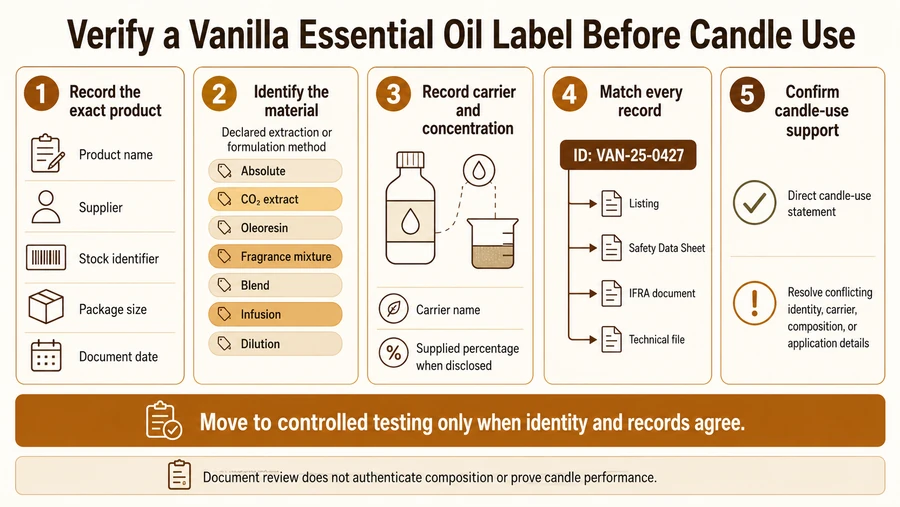
Methods — modeled verification sequence: This process evaluates disclosed identity and matching records; it does not authenticate composition or prove candle performance.
Move a product to controlled testing only when its identity and supporting records agree well enough to justify that step.
How to Check Whether a Vanilla Scent Material Is Suitable for Candles
A vanilla scent material should enter candle testing only when its identity, intended application, restrictions, and supplier documents are clear.
An SDS, IFRA document, or “candle-safe” label answers only part of the suitability question. Controlled testing is still needed to show how the identified material behaves in the intended wax-and-wick system.
A Safety Data Sheet (SDS) records product identification, hazards, composition information, handling, physical properties, stability, and related information. OSHA uses a 16-section SDS format and requires specified information in Sections 1–11 and 16. An SDS does not report cold throw, hot throw, wax dispersion, discoloration, or repeatability. Source note: OSHA Hazard Communication Standard, Appendix D.
An IFRA Certificate of Conformity states that a supplied fragrance mixture conforms to applicable IFRA Standards for a specified intended use. The certificate does not replace a safety assessment or local legal duties. IFRA also states that these certificates are generally not issued for raw materials such as individual botanical extracts. Source note: IFRA Certificate of Conformity guidance.
No single document proves every part of candle suitability.
| Evidence group | What it establishes | What it does not establish | Required maker action |
|---|---|---|---|
| Exact product identity | Which supplied item and identifier are being assessed | Composition, compatibility, or candle performance | Match every listing, file, and test record to the same item |
| Product description, extraction, carrier, and concentration | The declared material category and supplied preparation | Independent composition verification or wax behavior | Request any missing identity, carrier, or concentration field |
| SDS | Disclosed hazards, handling information, physical properties, and supplier identity | Candle performance or universal compatibility | Obtain the current product-specific SDS and verify the identifier |
| IFRA or raw-material conformity information | Relevant restrictions or conformity information for the stated material and use | Universal safety, legality, compatibility, or scent strength | Use the document type that matches the material category and stated application |
| Candle-use and technical supplier guidance | Whether the exact item is supported for candles and which operating limits are disclosed | Success in every wax, vessel, or wick system | Record the stated application, restrictions, carrier details, and supplier test notes |
| Controlled candle record | Observed behavior in the maker’s recorded system | Category-wide performance | Repeat comparable tests before accepting or rejecting the product |
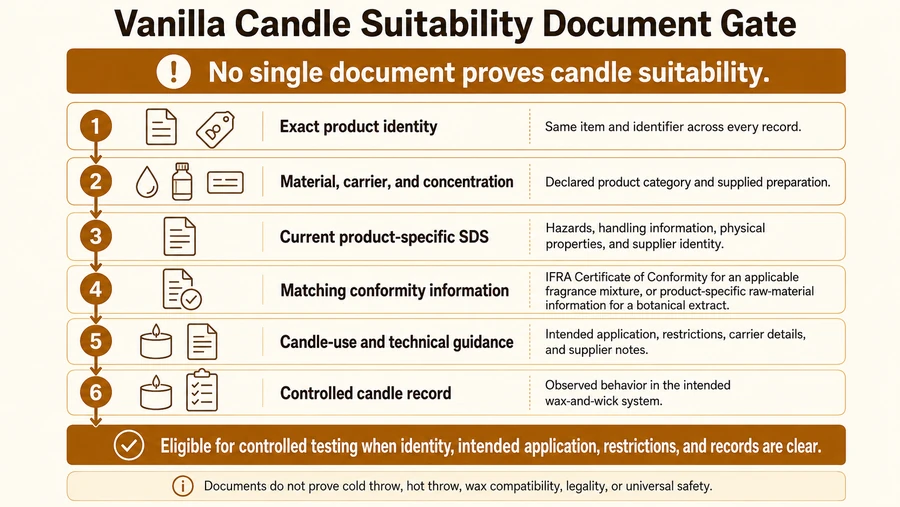
Methods — modeled document-purpose matrix: Each evidence group has a limited purpose and does not authenticate composition, issue legal approval, or predict candle performance. Recheck product files, application categories, and dates before testing because those records can change.
A common maker question is: “The seller says it is candle-safe, but there is no IFRA sheet. Should I test it?”
The correct answer depends on the material category. A formulated fragrance mixture may have an applicable IFRA Certificate of Conformity. A raw vanilla absolute may instead be supported by raw-material conformity information, a certificate of analysis, an SDS, or other product-specific files.
Either way, a marketing statement without matching identity, intended application, and technical evidence is not enough to pass the documentation gate.
Exact fragrance amounts, incorporation temperatures, cure periods, wick choices, and complete burn procedures are separate formulation decisions. Documentation only establishes eligibility to test; it does not establish the finished formula.
Which Vanilla Material Gives the Most Predictable Candle Performance?
No vanilla scent-material category is universally strongest or most predictable. Identified products must be compared under the same recorded candle conditions.
Cold throw is the scent perceived from an unlit candle. Hot throw is the scent perceived while the candle burns. Repeatability means that comparable tests produce reasonably similar results.
Cold and hot throw must be evaluated separately. CandleScience notes that the same fragrance can smell different cold and hot and that wax choice can change the result. Source note: CandleScience fragrance and wax testing guidance.
A documented vanilla fragrance oil is often the lower-uncertainty first test because the supplier may already provide candle-use and performance information. This is a tendency, not a guarantee for the whole category.
Vanilla absolute may produce an acceptable candle scent when the exact product has useful supplier information and performs acceptably in testing. A product labelled “vanilla essential oil” cannot be ranked until its actual material category, carrier, and formulation have been identified.
“Strong” must name cold throw, hot throw, or both. “Predictable” means repeatable under comparable conditions, not successful once. “Works better” must identify the measured outcome and the conditions under which the difference appeared.
| Material or evidence state | Assumption to avoid | Product-specific evidence required | Candle-system variables that must match | Outcome that may be compared | Repeatability requirement |
|---|---|---|---|---|---|
| Documented vanilla fragrance oil | Every fragrance oil gives strong throw | Exact identity, candle-use guidance, and current files | Wax batch, fragrance amount, vessel, wick system, cure period, room, and burn conditions | Cold throw, hot throw, and visible behavior | Comparable results across repeated tests |
| Vanilla absolute with candle-use support | Natural origin predicts weak or strong performance | Extraction, carrier, supplied concentration, intended use, and restrictions | The same variables used for the comparison product | Usable or unusable cold and hot throw | Repeat before making a decision |
| “Vanilla essential oil”-labelled product | The retail label identifies one standard material | Verified material category, carrier, formulation, and candle-use evidence | No comparison is valid until the product is identified | No ranking before verification | Testing starts after identity is resolved |
| Two products in the same category | Shared category means shared performance | Separate files and batch identifiers | Every candle variable must remain equivalent | Product-to-product differences | Differences must remain across repeat tests |
| One successful candle | One result proves predictable performance | Full test record for the supplied item | A repeat must preserve the recorded conditions | Initial observation only | Repeat comparable samples until the result is stable enough for the intended maker-level decision |
Methods — non-numerical evidence matrix: No comparable measured dataset covering the three material categories was supplied, so the table does not assign sensory scores or category rankings. Repeat testing must be sufficient for the maker’s stated decision and must not be represented as laboratory proof.
The National Candle Association advises keeping variables consistent and recording measurements and observations for each candle tested. Source note: National Candle Association candle-testing guidance.
Strong cold throw does not prove strong hot throw because each is observed in a different candle state. Cold throw comes from unlit wax; hot throw comes from scent released while the candle burns.
More fragrance does not guarantee a proportionally stronger hot throw. The observed result can change with wax behavior, wick performance, cure period, vessel geometry, room conditions, and the supplied fragrance preparation.
| Observed pattern | Maker question | What the result supports | Variables to check | Unsupported claim |
|---|---|---|---|---|
| Strong cold throw with weak hot throw | “Why does my vanilla candle smell strong cold but disappear when burning?” | The unlit and burning outcomes differ in the recorded candle | Wick system, burn conditions, wax, cure period, room, and product identity | The entire material category has poor hot throw |
| Weak cold and hot throw | “I added more fragrance and the hot throw is still weak. What variable am I missing?” | The recorded formula has weak performance under those conditions | Product identity, supplier limits, wax, fragrance amount, cure, and wick system | More fragrance must solve the problem |
| Results differ between batches | “Why did the same vanilla material perform differently this time?” | One or more inputs or supplied materials may have changed | Product lot, wax lot, vessel, wick, storage, cure, room, and test method | Either result alone represents the category |
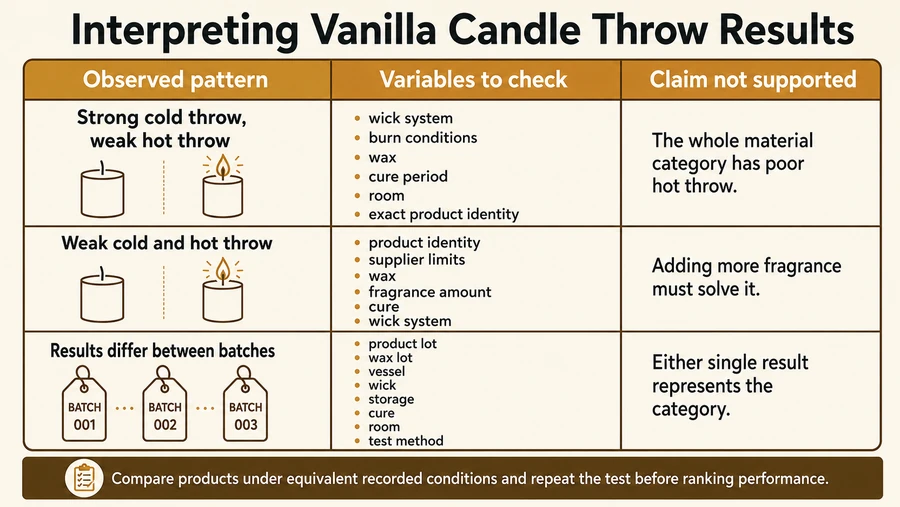
Methods — maker-question failure log: These questions represent recurring maker problems, not proof of a chemical cause. Each pattern needs supplier evidence and comparable candle records before it supports a product-level finding.
The most predictable choice is the verified product that gives repeatable cold-throw and hot-throw results under equivalent recorded conditions, not the category with the strongest marketing claim.
Why Vanilla Scent Materials Can Behave Differently in Wax
Vanilla scent materials may behave differently in wax because their formulation, carrier, concentration, viscosity, and interaction with the selected wax system vary.
Separation is a visible boundary between material phases. Sweating is liquid appearing on the candle surface. Uneven distribution means the scent material does not appear uniformly dispersed through the wax.
These conditions make a performance comparison less reliable because the tested candles may no longer contain equivalent, stable systems.
Supplier testing shows that waxes have practical limits. In one CandleScience test, a high amount of Very Vanilla fragrance oil produced uneven discoloration that indicated separation in parts of the wax, even though obvious surface leaching was not seen.
A vanilla fragrance oil may mix evenly with one wax yet produce surface oil in another. A vanilla absolute may behave differently because of its viscosity, extraction, supplied concentration, or carrier. A product sold as “vanilla essential oil” cannot be assessed until its preparation has been identified.
Record the exact product, supplier, lot, wax, wax lot, storage conditions, and observation time before comparing results.
| Observed condition | Comparison consequence | Required decision |
|---|---|---|
| Separation | The product-and-wax system is not physically equivalent to a stable comparison sample | Exclude the affected candle from ranking until the uncertain variable is identified |
| Surface oil or sweating | The recorded system has a physical-behavior problem, but the symptom does not prove one cause | Defer the product comparison until the product, wax, carrier, and storage conditions are reviewed |
| Uneven distribution | The candle may not contain a uniform scent-material distribution | Do not use the sample to support a cold-throw, hot-throw, or category-wide claim |
A repeated physical problem can rule out the exact product for that wax system. It does not automatically rule out every fragrance oil, absolute, CO₂ extract, or blended preparation.
Why Vanilla-Scented Candles Can Discolor
Vanilla-scented candles may darken because vanillin or other fragrance components can change color over time, while wax, heat, light, air, and storage affect the result.
Vanillin and ethyl vanillin can contribute to amber or brown darkening in some fragrance formulations. Supplier guidance notes that the degree and timing depend on the specific fragrance and base. The color change does not necessarily reduce scent throw.
Other fragrance components can affect color, so vanillin should not be treated as the only possible cause. CandleScience identifies Very Vanilla as containing more than 5% vanillin, while its wax testing has documented yellowing and uneven discoloration with that fragrance under specific test conditions.
A color shift does not by itself prove unsafe use, contamination, spoilage, or poor scent performance.
| Appearance result | What it supports | Selection consequence |
|---|---|---|
| Consistent and acceptable color change | The exact product produces a repeatable appearance that fits the intended candle design | The product may remain eligible when its other performance results are acceptable |
| Consistent but unacceptable color change | The appearance result conflicts with a white, pale, or color-stable design goal | Select another verified product or use the material only where the darkening is acceptable |
| Irregular or unexplained color change | The appearance cannot yet support a stable product ranking or a single-cause attribution | Defer the comparison until the product, wax, exposure, and test records are reviewed separately |
Methods — modeled appearance comparison: Appearance alone cannot establish a chemical cause.
Discoloration should affect the material choice when it conflicts with the intended candle appearance or varies too much for repeatable production.
A verified product that darkens consistently may still work for a dyed, amber, or opaque candle. The same product may not suit a candle that needs a stable white or pale finish.
Which Vanilla Option Should You Choose for Your Candle-Making Goal?
Base the first-test direction on the maker’s goal and the exact product evidence, not on a universal category ranking.
| Maker priority | Minimum evidence | Preferred first-test direction | Limitation | Disqualifying condition | Testing burden | Next action |
|---|---|---|---|---|---|---|
| Easiest documented starting point | Identified fragrance product, matching files, and stated candle application | Documented vanilla fragrance oil | Performance still varies by formula and candle system | Missing or mismatched product documents | Low to moderate | Compare a small sample under recorded conditions |
| Repeatable small-batch production | Product identity, stable supply, batch records, and repeat results | The verified product with the most consistent test record | Past consistency does not guarantee a new lot will match | Unexplained batch or formulation changes | Moderate | Qualify the current lot before production |
| Natural-origin priority | Verified extraction, botanical source, carrier, supplied concentration, and candle-use support | Documented vanilla absolute or CO₂ preparation | Natural origin does not prove compatibility or strong throw | No candle-use support or unresolved carrier information | High | Compare the exact preparation with a documented fragrance-oil control |
| Lowest appearance-change risk | Supplier appearance notes and controlled records in the intended wax | Product with the least unacceptable color change in comparable tests | A pale result in one wax may not transfer to another | Repeatable darkening conflicts with the intended design | Moderate | Compare samples over the same observation period |
| Strongest recorded hot throw | Matching identity and repeatable comparable candle samples | Product with the strongest repeatable hot-throw result in the maker’s system | Category names cannot predict the outcome | Only one successful candle or uncontrolled conditions | Moderate to high | Repeat before treating the result as dependable |
| Lowest initial sample cost | Clear identity, usable files, and a small package | Documented fragrance-oil sample is often the lower-cost first test | A cheap sample can create higher failure or retest costs | Missing evidence requires repeated qualification | Low to moderate | Calculate testing costs, not bottle price alone |
| Lowest requalification burden | Current documents, stable formulation, consistent sourcing, and lot history | Product with the fewest unresolved changes between purchases | Supplier formulas and files can change | New formulation, carrier, source, or identifier | Moderate | Recheck documents after a material change |
| Ambiguous “vanilla essential oil” listing | Extraction or formulation, carrier, identifier, and candle-use evidence | No recommendation until the product is classified | Seller wording may not identify the material | Identity remains unresolved | Unknown | Clarify the product or select a better-documented option |
| Advanced botanical comparison | Full identity records, application support, test plan, and acceptance criteria | Documented absolute or CO₂ preparation tested beside a fragrance oil | Higher material cost can increase the loss from failed trials | Products cannot be tested under equivalent conditions | High | Define the comparison outcome before buying larger quantities |
| Beginner prioritizing the lowest uncertainty | Clear category, matching documents, candle application, accessible sample, and supplier support | Start with documented vanilla fragrance oil | This is a lower-uncertainty direction, not a guaranteed winner | Unclear identity or missing documents | Low to moderate | Test one verified product before comparing another category |
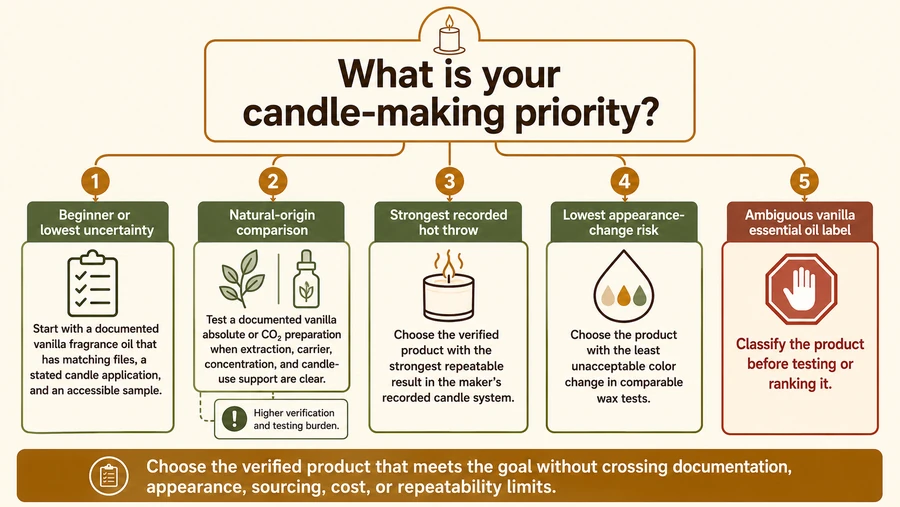
Methods — modeled goal-based decision matrix: The recommendations combine the identity, documentation, wax-behavior, appearance, performance, sourcing, and testing requirements discussed above. Every direction remains conditional on the exact supplied product and candle system.
For a beginner, a fragrance oil is usually the lower-uncertainty first test when the exact product has clear candle documentation and an accessible sample.
A documented vanilla absolute or CO₂ preparation is a better fit for a natural-origin comparison when the maker accepts higher verification and testing demands.
Natural origin describes sourcing, not candle suitability, scent strength, regulatory status, or finished-candle safety.
Do not rank an ambiguous “vanilla essential oil” listing until its identity has been established.
The best option is the verified product that meets the stated priority without crossing an appearance, documentation, sourcing, cost, or repeatability disqualifier.
How Sample Cost and Testing Burden Compare
The cheapest bottle may not be the most cost-effective candle option because missing documents, failed tests, unstable sourcing, and requalification can raise the total burden.
Total testing burden includes product verification, sample purchase, candle trials, failed materials, recordkeeping, supplier consistency, and retesting after a relevant product change.
Supplier prices checked on June 13, 2026 show a large difference between a small formulated fragrance-oil sample and concentrated or botanical vanilla preparations. CandleScience listed a 1-ounce bottle of Very Vanilla fragrance oil at US$3.49. Eden Botanicals listed a 15-milliliter Vanilla CO₂ 30% dilution at US$70.25, a 15-milliliter organic Vanilla CO₂ 10% dilution at US$40.00, and 15 grams of organic vanilla absolute at US$196.00. Source note: CandleScience and Eden Botanicals supplier listings, checked June 13, 2026.
| Product example | Price checked June 13, 2026 | Package basis | Material disclosure | Candle-use evidence | Expected qualification burden |
|---|---|---|---|---|---|
| Very Vanilla fragrance oil | US$3.49 | 1 oz bottle | Formulated fragrance oil | Candle application stated | Low to moderate |
| Vanilla CO₂ 30% | US$70.25 | 15 ml | 30% CO₂ extract in 70% fractionated coconut oil | Candle application listed; system testing still required | High |
| Organic Vanilla CO₂ 10% | US$40.00 | 15 ml | 10% CO₂ extract in 90% fractionated coconut oil | Candle application listed; system testing still required | High |
| Organic vanilla absolute | US$196.00 | 15 g | Solvent-extracted absolute | Candle application listed; system testing still required | High |
Methods — current-input and modeled-burden dataset: Prices and package sizes were taken from supplier pages on June 13, 2026. Testing-burden classifications are decision aids, not supplier ratings or measured production results. Shipping, tax, discounts, labor, wax, vessels, wicks, and failed-test materials are excluded.
Do not treat these prices as equal-cost comparisons by volume or weight. The products differ in concentration, carrier, material category, and package unit.
A lower bottle price does not make up for missing documents or poor test results. A higher-cost botanical material does not justify the added burden through natural origin alone.
For a beginner or small trial, the lowest total burden usually comes from a clearly identified, documented product sold in a small package. For an advanced natural-origin comparison, the budget must cover the material, evidence review, failed trials, and repeat qualification.
Recheck commercial inputs before buying or publishing. Prices, package sizes, formulations, product files, and stock can change.