
Make a vanilla-scented candle with a fragrance product documented for candle use, calculate its load on a stated basis, follow wax-specific temperature stages, cure to a named checkpoint, then approve it through controlled scent and burn testing.
This guide is for candle makers who want a repeatable vanilla candle rather than a universal recipe. Here, “vanilla-scented candle” means a wax, candle-safe fragrance, wick, vessel, process, cure, and test system—not wax scented with vanilla extract, food flavoring, or undocumented oil. You will calculate the load, control each temperature stage, cure to named checkpoints, test scent and combustion together, and record one-variable revisions. Begin by confirming that the fragrance is documented for candle use and can be tested with the wax.
What Materials and Tools Are Needed to Make a Vanilla-Scented Candle?
A vanilla-scented container candle requires identified wax, candle-use vanilla fragrance, a tested wick and vessel, accurate measuring tools, and equipment for controlled heating, mixing, pouring, and cooling.
Gather the following materials and tools before calculating the fragrance amount or heating the wax:
- Wax identified by product name and lot
- Vanilla fragrance identified by product name, supplier, product code, and lot
- Wick identified by family and size
- Heat-suitable candle vessel with recorded dimensions
- Digital scale that measures wax and fragrance in the same mass unit
- Wax-melting container and controlled heat source
- Checked thermometer
- Stirring tool and timer
- Wick adhesive or another tested securing method
- Wick-centering support
- Batch record for weights, temperatures, cure checkpoints, and test observations
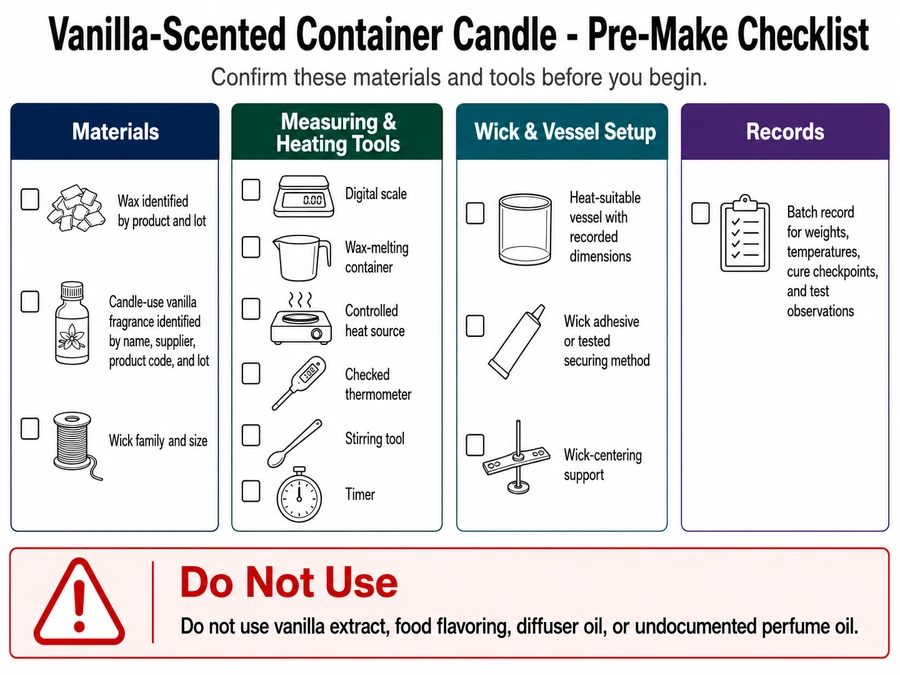
Do not substitute vanilla extract, food flavoring, diffuser oil, or an undocumented perfume oil for a fragrance product identified for candle use.
What Makes a Vanilla Fragrance Oil Suitable for Candle Use?
A suitable vanilla fragrance oil is documented for candle use and still requires testing with the chosen wax, wick, vessel, load, and process.
Here, candle-safe means the supplier identifies the exact fragrance product for candle use; it does not mean the product will perform well in every wax. Test a small sample under matched conditions before accepting the fragrance for a full vanilla candle batch.
Vanilla Fragrance Compatibility Checklist
A vanilla fragrance may proceed to load calculation only when its identity and candle-use documentation are confirmed and a controlled wax sample performs acceptably.
IFRA means the International Fragrance Association, which publishes standards and product-use documentation used by fragrance suppliers.
Check each item before calculating the fragrance load:
- Record the fragrance name, supplier, product code, and lot number.
- Confirm that the supplier documents the product for candle use.
- Read the applicable IFRA Certificate of Conformity or equivalent product-use document.
- Review the supplier’s Safety Data Sheet for handling and storage information.
- Check whether the supplier names usage conditions or a maximum percentage.
- Check the wax manufacturer’s fragrance-capacity and processing guidance.
- Reject the material when its identity or intended use cannot be confirmed.
- Make a small test batch even when all documents are present.
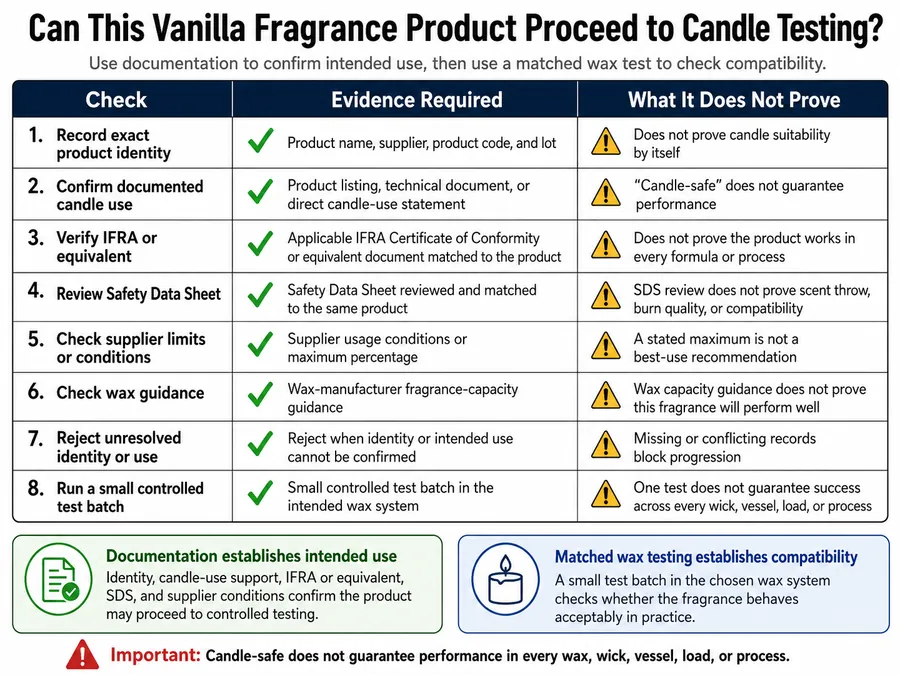
Supplier documentation establishes intended use, while the test batch shows whether the selected wax-and-fragrance system remains stable and produces an acceptable scent result.
| Term | Meaning in this article | What it does not prove |
|---|---|---|
| Candle-safe | The identified product is documented for candle use | Successful performance in every wax |
| Approved for candle use | The supplier permits candle use under stated conditions | That the chosen load, wick, or process will work |
| Compatible | The tested product performs acceptably in the selected wax system | Suitability for a different wax or vessel |
| Vanilla-scented | The finished candle carries a vanilla scent from the tested fragrance product | That any vanilla-smelling liquid can be added to wax |
Vanilla fragrance oil, vanilla essential-oil products, and vanilla absolute are distinct scent materials with different documentation and performance limits. This article covers a fragrance product documented for candle use; it does not teach formulations with vanilla extract, food flavoring, undocumented perfume oil, or diffuser oil.
Approve the fragrance for load calculation only after its documentation and controlled wax sample support the same decision.
How to Calculate Vanilla Fragrance-Oil Load on a Stated Basis
Fragrance-oil load is fragrance mass divided by wax mass here; multiply wax mass by the selected decimal to calculate the required oil mass.
State the wax-weight basis before every percentage, measure wax and fragrance in the same mass unit, and apply the lower wax or fragrance-product limit as the ceiling. That ceiling is not a required starting point or a promise of stronger hot throw.
Wax-Weight Formula
For this article, the percentage denominator is the wax weight:
Fragrance-oil weight = wax weight × fragrance-load decimal
The modeled example below uses 500 grams of wax and an 8% wax-weight load to show the arithmetic. Confirm any real capacity in the wax manufacturer’s technical data sheet and the fragrance supplier’s applicable product-use or IFRA documentation.
| Calculation item | Formula | Modeled result |
|---|---|---|
| Wax weight | Given value | 500 g |
| Fragrance-load decimal | 8 ÷ 100 | 0.08 |
| Fragrance-oil weight | 500 g × 0.08 | 40 g |
| Finished batch weight | 500 g + 40 g | 540 g |
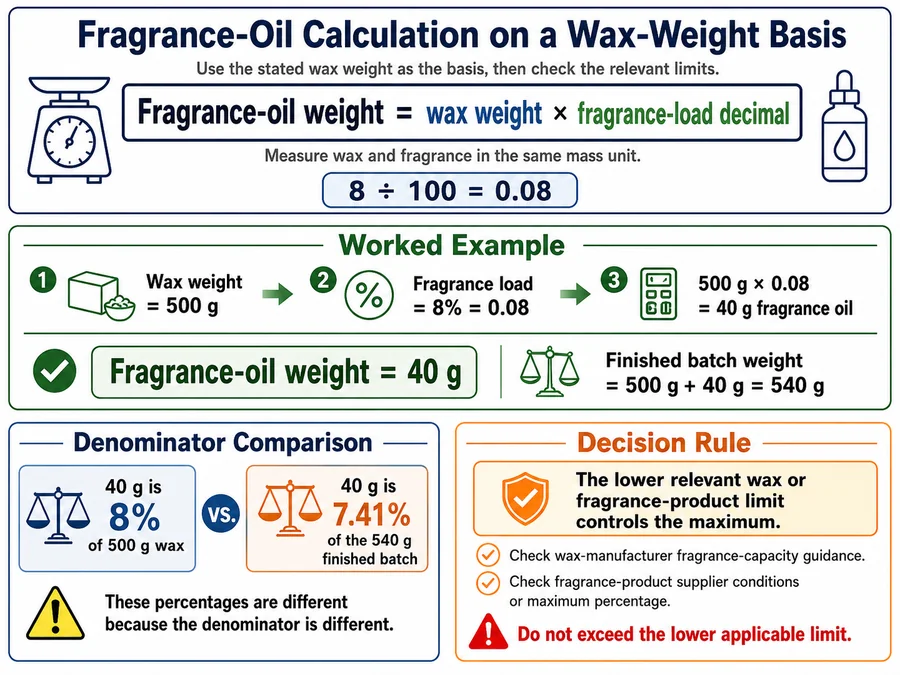
The example therefore requires 40 grams of fragrance oil for 500 grams of wax at an 8% wax-weight load.
Wax-Weight Basis and Finished-Batch Basis
A fragrance percentage is incomplete until its denominator states whether the value is based on wax weight or the complete finished batch.
In the modeled example, 40 grams of fragrance equals 8% of the 500-gram wax weight but 7.41% of the 540-gram finished batch. Do not copy a percentage from a calculator, supplier page, or discussion without checking its denominator.
Apply the Lower Product Constraint
The lower relevant wax or fragrance-product limit controls the maximum fragrance load for the tested formulation.
Apply the constraint in this order:
- Find the fragrance capacity or usage guidance for the chosen wax.
- Find the applicable usage limit for the identified fragrance product.
- Compare both limits on the same percentage basis.
- Treat the lower relevant value as the maximum for that formulation.
- Select a starting test point at or below that maximum.
For example, suppose a modeled wax document permits up to 10% on a wax-weight basis while the modeled fragrance document permits up to 8% on the same basis. The controlling ceiling is 8% of wax weight.
The 8% ceiling does not mean that 8% is the best starting point. A lower version may deliver equal or better hot throw while producing cleaner incorporation and steadier burn behavior.
Measure fragrance by mass rather than spoons, drops, or an unverified volume conversion. Grams are usually easier for small test batches, but ounces can be used when wax and fragrance are both measured in ounces throughout the calculation.
Adding more fragrance does not automatically increase hot throw. A higher load can produce sweating, poor incorporation, wick disruption, excess residue, or weaker burn performance, while the scent result may remain unchanged.
Carry the selected test load into the production process only after its percentage basis, calculation, and lower governing limit are recorded.
How to Make the Vanilla-Scented Candle Step by Step
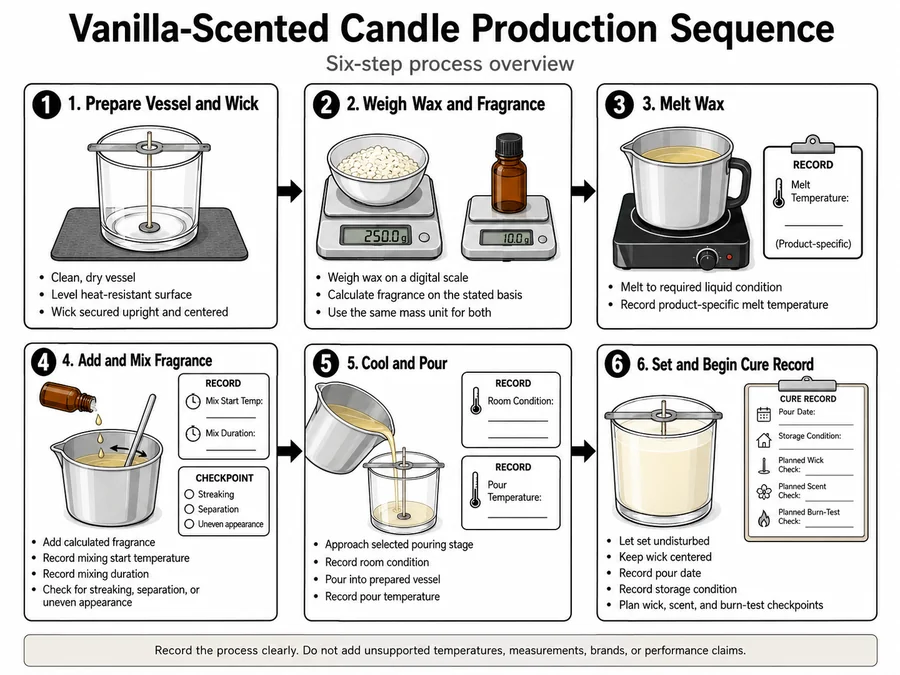
Prepare the vessel and wick, weigh the wax and fragrance, process the materials at product-specific stages, pour the candle, and begin the recorded cure interval.
Use separate, product-specific temperatures for melting, fragrance addition, mixing, cooling, and pouring; one universal candle temperature cannot control the full process.
Actual melt, fragrance-addition, mixing, cooling, and pouring values must come from the instructions for the selected wax and fragrance products.
Make the test candle in this order:
- Prepare the work area and vessel. Clean and dry the vessel, record its identifier and dimensions, and place it on a level heat-resistant surface.
- Secure and center the wick. Attach the wick using the tested securing method and hold it upright with a centering support.
- Weigh the wax. Record the wax product, lot, mass, and measurement unit.
- Calculate and weigh the fragrance. Apply the stated load basis and lower product constraint, then measure the fragrance in the same mass unit as the wax.
- Melt the wax. Follow the wax manufacturer’s instructions and record the temperature when the wax reaches the required liquid condition.
- Add the fragrance. Record the wax temperature immediately before adding the calculated vanilla fragrance amount.
- Mix the batch. Record the mixing start temperature, duration, and action, then note any streaking, separation, or uneven appearance.
- Cool the mixture. Track the wax as it approaches the selected pouring stage and record the room condition.
- Pour the candle. Record the wax temperature immediately before filling the prepared vessel.
- Keep the wick centered while the candle sets. Leave the vessel undisturbed and record the initial surface and wick condition after solidification.
- Begin the cure record. Record the pour date and time, storage condition, and planned wick, scent, and burn-test checkpoints.
Record the Product-Specific Temperature Stages
Each recorded temperature must identify the product system and the exact production stage it controls.
A process temperature is a measured value tied to a named production stage. Use the same thermometer method and temperature unit for every compared batch.
| Process stage | What the stage controls | Primary instruction source | Value to record |
|---|---|---|---|
| Melt | Brings the wax to the required liquid condition | Wax manufacturer’s technical data | ___ °F / ___ °C |
| Fragrance addition | Identifies when fragrance enters the wax | Wax and fragrance supplier instructions | ___ °F / ___ °C |
| Mixing | Distributes fragrance through the melted wax | Supplier instructions and fixed batch method | Start: ___ °F / ___ °C; duration: ___ minutes |
| Cooling | Tracks the change between mixing and pouring | Wax guidance and batch plan | Start/end: ___ °F / ___ °C |
| Pour | Identifies the temperature before vessel filling | Wax manufacturer’s technical data | ___ °F / ___ °C |
A note that says only “heated to 180°F” cannot show whether 180°F was the melt, fragrance-addition, mixing, or pouring reading.
Flashpoint Versus Processing Temperature
A fragrance flashpoint does not establish the correct fragrance-addition, mixing, or pouring temperature for a candle formulation.
| Term | What it means here | What it does not establish |
|---|---|---|
| Fragrance flashpoint | A tested property associated with vapor ignition under stated test conditions | The correct fragrance-addition temperature |
| Wax melting temperature | The stage used to bring the selected wax to the required liquid condition | The pouring temperature |
| Fragrance-addition temperature | The wax temperature when the fragrance is introduced | A universal value for every wax and fragrance |
| Pouring temperature | The wax temperature immediately before vessel filling | Proof that the candle will cure or burn correctly |
A fragrance flashpoint may be useful in transport, storage, or handling documentation, but it does not replace wax-specific processing instructions. The selected addition temperature must belong to the tested wax-and-fragrance process rather than being inferred from one unrelated material value.
How to Cure a Vanilla Candle to Named Wick and Scent Test Checkpoints
Cure time is the controlled interval from pouring to a named test checkpoint; a solid candle is not automatically ready for final scent evaluation.
Record the interval in hours or days, the storage temperature in degrees Fahrenheit or Celsius, the storage condition, and the planned test purpose. Wick screening, cold-throw scoring, and hot-throw evaluation may use different checkpoints.
Cooling changes the candle from liquid to solid. Curing continues after solidification and ends at the recorded evaluation point chosen for the selected wax, fragrance, and test purpose.
Cooling and Curing Are Different Stages
Cooling solidifies the poured wax, while curing continues until the candle reaches a named checkpoint for a permitted wick, scent, or burn evaluation.
| Stage | What has happened | Suitable decision | Decision that remains premature |
|---|---|---|---|
| Cooling | The poured wax is losing heat | Monitor movement, disturbance, and visible setting | Judge final scent or burn performance |
| Solidification | The candle appears firm | Record initial surface and wick condition | Treat appearance as proof of full cure |
| Early cure checkpoint | A product-dependent interval has elapsed | Perform a named early inspection or wick screen when permitted | Treat one early burn as the final scent verdict |
| Scent-and-burn checkpoint | The planned test interval has elapsed | Score scent and begin the planned burn test | Generalize the result to a different product system |
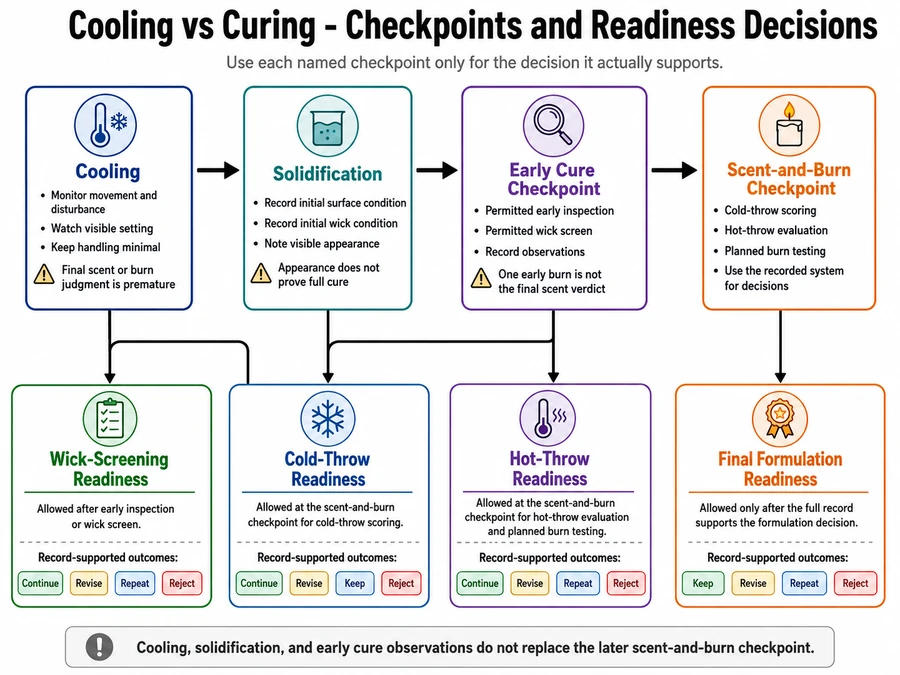
“Ready to test” is incomplete unless the record names what will be tested. A candle may be ready for an early wick screen without being ready for the planned hot-throw verdict.
Wick Readiness Versus Scent Readiness
Readiness for an early wick screen does not establish readiness for final cold-throw, hot-throw, or formulation approval.
| Readiness type | Main question | Valid outcome |
|---|---|---|
| Wick-screening readiness | Can the wick-and-vessel combination proceed to further testing? | Continue, revise, or repeat the screen |
| Cold-throw readiness | Can the unlit scent be compared at this checkpoint? | Recorded cold-throw score |
| Hot-throw readiness | Can the burning scent be judged under the planned test method? | Recorded hot-throw score with burn observations |
| Final formulation readiness | Has repeated evidence supported the formulation decision? | Keep, revise, or reject |
Strong cold throw at an early checkpoint does not prove later hot throw. Likewise, an early wick screen can identify a clear problem without settling the final scent result.
Conditions to Keep Fixed
Comparable cure and test results require the main material, storage, preparation, and observation conditions to remain unchanged.
- Exact wax and vanilla fragrance products
- Fragrance load and percentage basis
- Wick and vessel
- Pour date and storage condition
- Elapsed cure time and test purpose
- Scent-scoring method
- Wick preparation and burn method
A result becomes difficult to interpret when one candle cures uncovered in a warm room and another cures covered in a cooler room. Record such differences rather than treating the candles as matched samples.
Begin scent and burn evaluation only after the candle reaches the documented checkpoint assigned to that test purpose.
Test Cold Throw, Hot Throw, and Burn Performance in a Controlled Sequence
Testing means evaluating the cured vanilla candle’s scent and combustion performance together, not merely smelling the unlit candle.
The tested object is the full wax, vanilla fragrance, fragrance load, wick, vessel, production process, and cure system. One uncontrolled burn cannot support final approval.
Cold throw is the recorded scent of the unlit candle. Hot throw is the recorded scent while the candle burns under stated conditions. Burn performance covers wick, flame, melt pool, vessel, and post-burn observations.
Combined Scent-and-Combustion Acceptance Matrix
The tested vanilla candle passes only when scent and combustion evidence support the same decision.
| Evidence area | Pass | Revise | Reject current formulation |
|---|---|---|---|
| Unlit condition | Surface, wick, vessel, and fragrance incorporation meet the written rules | A repeat or one controlled change is needed | Separation, leakage, vessel damage, or another stop condition appears |
| Scent | Cold and hot throw meet the targets at their named checkpoints | Scent remains below target but further controlled testing is permitted | Scent distortion appears with unacceptable material or burn evidence |
| Combustion | Wick, flame, melt pool, residue, and vessel observations meet the written rules | One observation requires a matched retest | The test reaches a declared stop condition |
| Repeatability | Compared cycles support the same decision | One result conflicts with the remaining evidence | The same unacceptable condition recurs |
A pass means the recorded scent and combustion results meet every prewritten acceptance rule. Revise means one controlled change is justified. Reject means the current version should not proceed because it reaches a stop rule or repeats an unacceptable result.
Run the Test in This Order
Testing starts with batch confirmation, proceeds through unlit and controlled-burn observations, and ends with a recorded pass, revise, or reject decision.
- Confirm the batch identity. Record the wax, vanilla fragrance product and lot, load basis, wick, vessel, process version, and cure checkpoint.
- Inspect the unlit candle. Record the surface, wick position, vessel condition, sweating, separation, cracking, and any change from the control.
- Score cold throw. Use the same room, observer method, distance, and defined scoring scale for each compared version.
- Prepare the burn setting. Record room condition, airflow, wick preparation, vessel placement, and planned burn interval.
- Record scent and combustion together. Score hot throw while observing the wick, flame, melt pool, residue, visible smoke or soot, and vessel condition.
- Inspect and decide. After extinguishing and cooling, record the post-burn condition and assign pass, revise, or reject from the complete evidence.
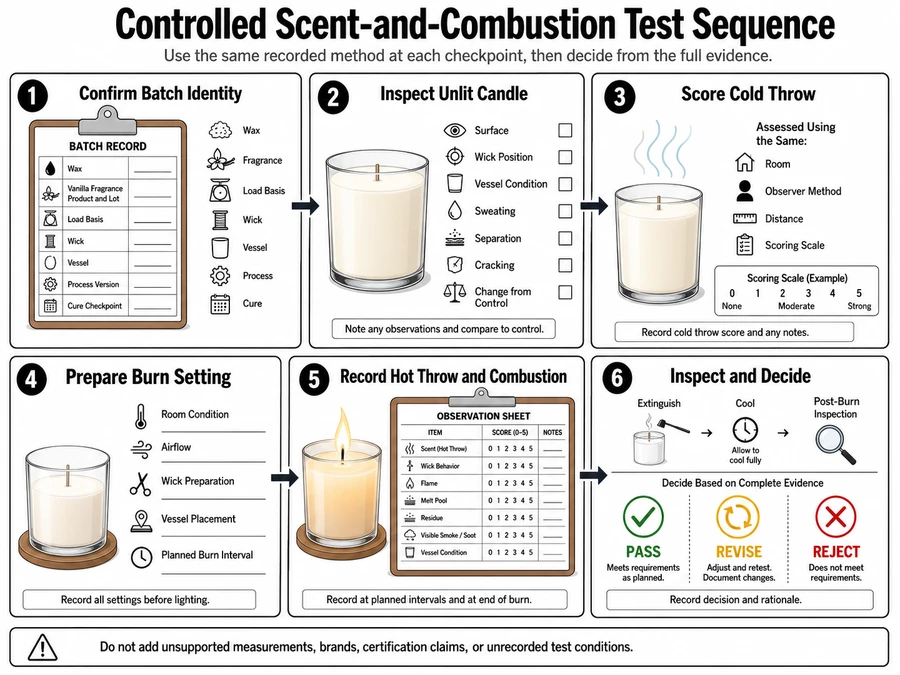
This maker-level sequence supports batch comparison. It does not certify the candle or replace product- and vessel-specific safety testing.
Read Mixed Test Results Correctly
One favorable scent or burn observation cannot represent the complete vanilla candle system when another required result fails.
| Test result | What the evidence supports | What it does not support |
|---|---|---|
| Strong cold throw and weak hot throw | The unlit fragrance is detectable, but burning scent remains below target | Adding more fragrance without another controlled test |
| Good hot throw and unacceptable flame behavior | The candle releases scent, but the current system does not pass | Approval based on scent alone |
| Acceptable combustion and weak scent | The burn observations pass, but scent performance requires review | An automatic wick or load change |
| Repeated failure under matched conditions | The current version requires revision or rejection | Changing several variables before another comparison |
A failed test should trigger a review of the exact failed observation. It should not automatically trigger a fragrance-load increase, wick change, temperature change, or longer cure period.
Change One Variable at a Time
One-variable adjustment means changing one documented formulation or process variable while holding every other comparison condition constant.
A control batch is the unchanged reference version. Compare each revised version with that control under the same production, cure, and test conditions.
| Failed observation | Check first | Possible single test variable | Keep fixed |
|---|---|---|---|
| Weak hot throw with acceptable combustion | Cure checkpoint, room, scale, fragrance identity, and process record | Fragrance load or one named process stage | Wax, wick, vessel, remaining stages, cure point, and test method |
| Excessive flame, soot, or unstable wick behavior | Stop rules, wick preparation, vessel identity, and load record | One wick specification or one formulation value | All other materials and test conditions |
| Sweating or visible separation | Load calculation, product limit, addition stage, mixing, and storage | Fragrance load or one process stage | Fragrance identity, wax, wick, vessel, and remaining stages |
| Inconsistent results between matched candles | Material lots, scale, thermometer, room, and handling | One identified production or test-method variable | The formulation until the source of variation is clearer |
Changing the wick, fragrance load, addition temperature, pour temperature, and cure checkpoint together invalidates the comparison. The next result cannot show which change caused the difference.
Any fragrance-load increase must remain at or below the lower applicable wax or fragrance-product constraint.
Why Can a Vanilla Candle Become Darker?
Some documented vanilla fragrance products may darken candle wax, but color alone does not establish acceptable performance or a failed formulation.
Compare the change with the fragrance supplier’s guidance, a matched control, the cure record, the scent result, and the burn observations. Separate even color change from oily migration, soot, residue, or heat-related staining.
| Observation | Initial interpretation | Required action |
|---|---|---|
| Gradual, even darkening with a dry surface | Potential fragrance- or cure-related variation | Compare with product guidance and the control, then continue testing if other rules pass |
| Oily beads or wet patches | Possible fragrance migration or separation | Check the load, mixing record, product limits, and storage condition |
| Black deposit near the wick or vessel rim after burning | Possible soot or combustion failure | Review the wick, flame, residue, and vessel observations |
| Darkening paired with distorted scent or failed combustion | The current version may require revision or rejection | Identify one test variable and repeat under matched conditions |
A brown candle is not automatically spoiled, and a lighter candle is not automatically successful. Supplier guidance and the complete test record must support either verdict.
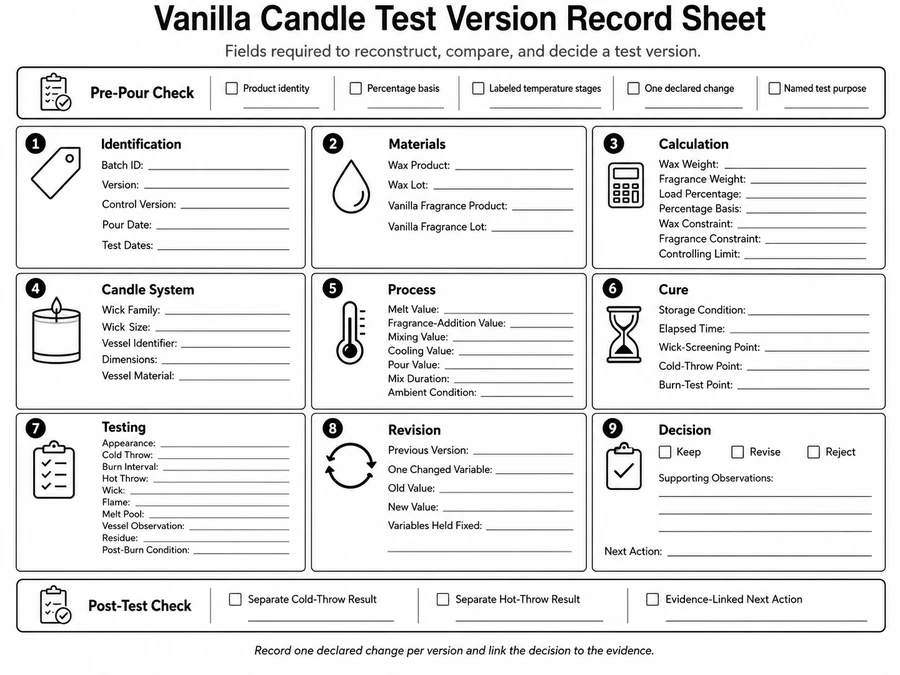
Maintain a Compact Vanilla Candle Batch and Test Record
Each batch record must identify the exact vanilla fragrance product and complete candle system used in that test version.
A repeatable comparison states the inputs, process conditions, cure point, changed variable, observations, and decision. Recipe notes are insufficient when material identity, percentage basis, or test evidence cannot be reconstructed.
A batch is one identified production group. A version is a recorded formulation or process state, while the control is the unchanged reference used to judge a revision.
Required Fields for a Reproducible Record
A reproducible record must identify the materials, calculation, candle system, process, cure checkpoints, test observations, revision, and final decision.
| Record group | Mandatory fields |
|---|---|
| Identification | Batch ID, version, control version, pour date, and test dates |
| Materials | Wax product and lot; vanilla fragrance product and lot |
| Calculation | Wax weight, fragrance weight, load percentage, percentage basis, wax constraint, fragrance constraint, and controlling limit |
| Candle system | Wick family and size; vessel identifier, dimensions, and material |
| Process | Melt, fragrance-addition, mixing, cooling, and pour values; mix duration; ambient condition |
| Cure | Storage condition, elapsed time, wick-screening point, cold-throw point, and burn-test point |
| Testing | Appearance, cold throw, burn interval, hot throw, wick, flame, melt pool, vessel observation, residue, and post-burn condition |
| Revision | Previous version, changed variable, old value, new value, and variables held fixed |
| Decision | Keep, revise, or reject; supporting observations; next action |
The record must connect every decision to an observation rather than to memory or a general impression.
Pre-Pour Completeness Check
Do not pour the planned version until its product identity, calculation basis, process stages, revision status, and test purpose are recorded.
| Check | Pass condition | Failure flag |
|---|---|---|
| Product identity | Wax and fragrance products and lots are named | Missing material identity |
| Calculation basis | Percentage and denominator are stated | Missing percentage basis |
| Process plan | Every temperature has a stage label | Unlabeled temperature |
| Revision control | One changed variable is declared | Multiple planned changes |
| Test purpose | Cure points and planned evaluations are named | Missing checkpoint purpose |
Post-Test Completeness Check
Do not assign a final decision until the scent, combustion, test-setting, revision, and next-action evidence is present.
- Cold-throw and hot-throw results are recorded separately.
- Wick, flame, melt pool, vessel, and post-burn observations are present.
- The test setting and burn interval are named.
- The revised version identifies one changed variable.
- Keep, revise, or reject is tied to written evidence.
- The next action is stated.
This compact record covers the formulation, production stages, cure points, testing, and one-variable revisions needed for the vanilla candle. It does not replace commercial inventory, regulatory records, accounting, or formal quality certification.
A vanilla candle formulation is ready to retain only when its ingredients and percentage basis are documented, its process is repeatable, and repeated tests show acceptable scent and combustion performance.