Fragrance-add temperature is the melted wax temperature used for mixing fragrance oil after the wax has melted and before the candle is poured.
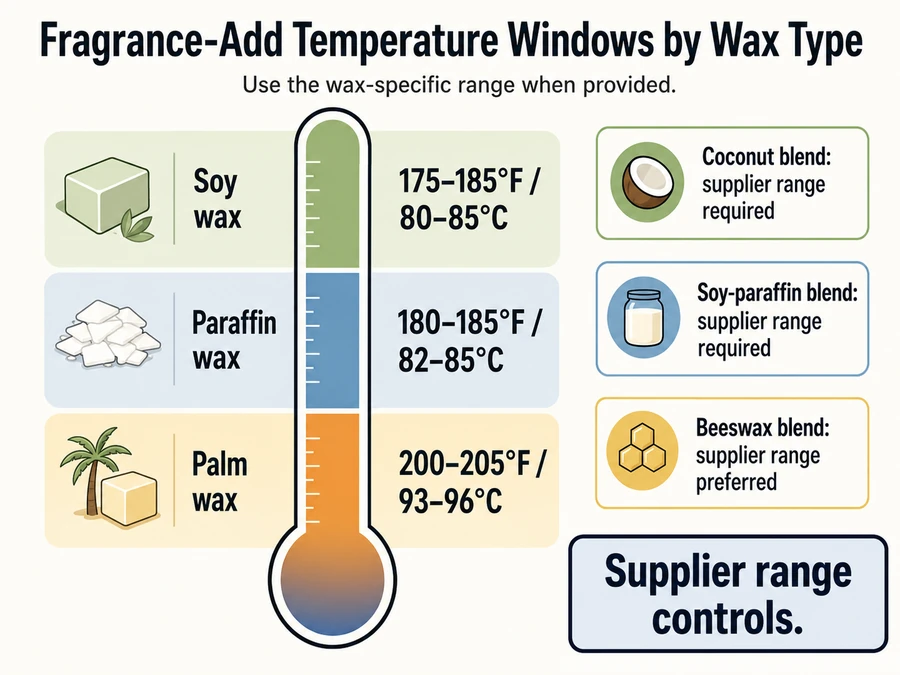
For many soy and paraffin candle waxes, a common fragrance-add starting range is about 175–185°F / 80–85°C, but the wax supplier’s range controls when it gives a different instruction.
Use the wax maker’s or supplier’s fragrance-add window when it is available. If the supplier gives a specific temperature range, that instruction controls the batch more than a generic wax-family chart.
This temperature is not the wax melt point, room temperature, flash point, cure temperature, storage temperature, or pour temperature. In candle making, each temperature role affects a different part of the batch, so treating them as the same number can lead to weak scent, poor dispersion, or inconsistent results.
Wax Temperature Windows for Adding Fragrance Oil
Use the wax supplier’s fragrance-add range first; if none is available, start with the wax-family window in the table below, not room temperature, melt point, flash point, or pour temperature.
In candle making, the fragrance-add window is the wax temperature at the mixing step. Wax type matters because soy, paraffin, coconut blends, beeswax, and proprietary blends can behave differently once melted.
Treat fragrance temperature as its own decision point before adjusting fragrance load, pour temperature, cure time, or wick testing.
| Wax type | Conservative starting add window when no supplier range is available | Supplier override note | Why it matters |
|---|---|---|---|
| Soy wax | 175–185°F / 80–85°C | Follow the soy wax maker’s range first | Soy can thicken as it cools, so timing affects dispersion |
| Paraffin wax | 180–185°F / 82–85°C | Follow the paraffin wax maker’s range first | Paraffin often stays fluid, but the supplier range still controls |
| Palm wax | 200–205°F / 93–96°C | Follow the palm wax maker’s range first | Palm formulas can need warmer handling during fragrance mixing |
| Coconut wax or coconut blend | Supplier range required | Use the blend-specific add window | Coconut blends vary widely by formula |
| Soy-paraffin blend | Supplier range required | Use the blend supplier’s guidance | A blend is not always handled like pure soy or pure paraffin |
| Beeswax or beeswax blend | Supplier range preferred | Use supplier guidance and small-batch notes | Beeswax can need warmer handling because of its texture and melt behavior |
| No supplier range is available | Use the closest wax-family starting window, then document the batch result | Do not treat the chart as stronger than a future data sheet | The first batch should become a repeatable note, not a guess |
A temperature window is a range, not a single magic number. The useful question is not “What temperature works for every candle?” but “What melted-wax temperature lets this wax receive and disperse this fragrance oil before pouring?”
A supplier spec sheet should sit beside your thermometer. It gives the wax-specific instruction that a generic chart cannot know, especially for blends, additives, and container-wax formulas.
Do not replace this decision with a fragrance-load chart. Fragrance load tells you how much oil to use; fragrance-add temperature tells you when the melted wax should receive that oil.
A pour-temperature chart belongs later in the process. Pour temperature controls when wax enters the vessel, while fragrance-add temperature controls when fragrance oil is mixed into the melted wax.
Batch Method for Testing an Add Window
Use one wax, one fragrance oil, one fragrance percentage, and one container style when testing an add window.
Change only the fragrance-add temperature between small batches. Record the mix behavior, surface result, cold scent, and hot scent after the normal cure period. If the result changes, your notes will show whether the add temperature was likely involved or whether another variable needs its own test.
Where Fragrance Addition Fits in the Candle-Making Sequence
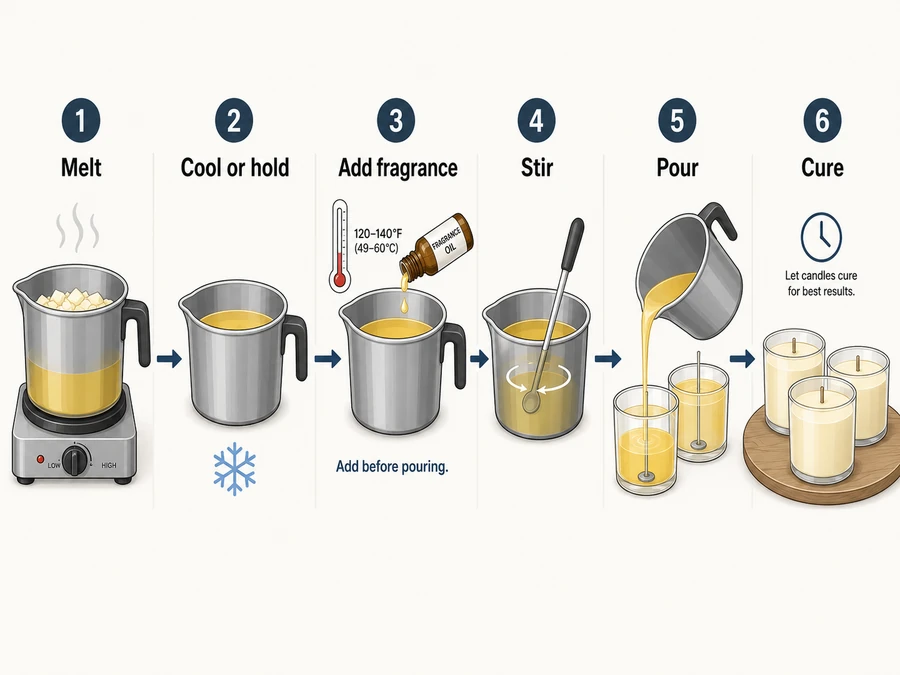
Add fragrance after the wax has melted and cooled or held inside the fragrance-add window, then stir before moving toward pouring.
The sequence is simple: melt the wax fully, let the melted wax reach the add window, add fragrance oil, stir until it is evenly dispersed, then continue toward the correct pour temperature.
| Step | What happens | Temperature role |
|---|---|---|
| Melt | Wax becomes fully liquid | Melt point or full melt temperature |
| Cool or hold | Melted wax moves into the fragrance-add window | Add-temperature control |
| Add fragrance | Fragrance oil enters the melted wax | Fragrance-add temperature |
| Stir | Fragrance disperses through the wax | Mixing consistency |
| Pour | Wax goes into the container or mold | Pour temperature |
| Cure | Finished candle rests before testing | Cure time, not add temperature |
Fragrance oil should not be added after the candle is poured. At that point, the wax is already setting in the container, so the oil cannot be mixed evenly through the melted wax.
This is why beginner candle-making instructions should separate the process into melt, add, pour, and cure. Those steps happen in order, but they do not all use the same temperature target.
Cure time by wax is a later testing factor. It can affect how a candle is evaluated, but it does not change the temperature at which fragrance oil should be added during the batch.
Pour temperature is also separate. A wax can be warm enough for fragrance mixing and still need to cool further before pouring, depending on the wax and container goal.
What Happens if Fragrance Oil Is Added Too Hot?
Adding fragrance above the wax or supplier add window can raise scent-performance risk, but it does not automatically mean the fragrance burned off.
Heat is one variable in the fragrance-add step. If melted wax is far above the wax maker’s add window, the batch may become harder to repeat, and scent performance may be less predictable. Flash point is a separate concept, so a too-hot batch should not be judged only by whether the wax passed the fragrance oil’s flash point.
| Maker report | Likely add-temperature issue | What to do next batch |
|---|---|---|
| “Did I add my fragrance oil too hot?” | Wax may have been above the supplier add window | Let the wax cool into the supplier range before adding fragrance |
| “My scent seems weaker than last time.” | Add temperature may have changed between batches | Record the exact wax temperature at fragrance addition |
| “I added above the flash point, so did I ruin it?” | Flash point is being confused with add temperature | Use the wax supplier’s add guidance and keep flash-point handling separate |
| “The same recipe worked before but not now.” | The batch may not have used the same add temperature | Repeat the recipe with the same wax temperature and stir time |
| “The fragrance seemed to disappear.” | Heat may be one factor, but not the only possible cause | Check add temperature first, then review load, cure, wick fit, and fragrance choice separately |
Log the next batch before changing the recipe. Record wax type, supplier add range, actual add temperature, fragrance oil, fragrance percentage, stir time, pour temperature, and finished-candle result.
Do not turn one hot batch into a full weak-scent diagnosis. Add temperature can contribute to poor results, but it is not the only reason a candle smells weak.
What Happens if Fragrance Oil Is Added Too Cool?
Wax below the usable mixing range can make fragrance disperse poorly and raise the risk of uneven mixing or separation.
Too-cool wax is usually a mixing problem before it is a scent problem. As wax cools, it thickens and starts moving toward setting, so fragrance oil may not spread through the melted wax as evenly as it would inside the proper add window.
| Sign | Likely issue | What to adjust next batch |
|---|---|---|
| Fragrance feels slow to blend | Wax is losing fluidity | Add fragrance earlier inside the supplier window |
| Oil streaks or uneven appearance | Fragrance did not disperse evenly | Stir at the correct add temperature |
| Batch feels rushed before pouring | Wax cooled too far before mixing | Prepare fragrance and tools before melting |
| Scent varies between candles | Fragrance distribution may be uneven | Keep temperature and stir time consistent |
| Fragrance oil seems to sit in the wax | Wax may be too cool for proper movement | Recheck the add window before the next batch |
Do not fix this by overheating the wax after fragrance has already been added unless the wax supplier allows that process. Reheating can create a new variable, which makes the batch harder to judge.
The safer habit is to prepare the fragrance oil before the wax reaches the add window. Then the candle maker can add and stir at the right time instead of chasing the temperature after the wax has already cooled too far.
Batch Method for Too-Cool Wax
If the wax gets too cool before fragrance is added, write down the temperature and pause before changing several things at once.
For the next batch, prepare the fragrance oil first, bring the wax into the supplier’s add window, stir the wax before taking the temperature, then add the fragrance once the reading is stable. If the same fragrance still mixes poorly, treat separation, load, wax type, and fragrance choice as separate checks.
How Stirring Helps Fragrance Oil Disperse Through Melted Wax
Add fragrance in the correct window and stir evenly so the fragrance disperses through the melted wax; temperature alone does not guarantee even scent.
Fragrance oil does not become evenly distributed just because it touches hot wax. It needs enough wax fluidity, enough contact time, and steady stirring to move through the melted wax rather than staying concentrated in one area.
| Mixing factor | What it controls | Batch result when it is consistent |
|---|---|---|
| Add temperature | How fluid the wax is during mixing | Fragrance can move through the melted wax |
| Stir time | How long the oil and wax stay in contact | Fewer unmixed pockets |
| Stir style | How evenly the batch moves | Less oil streaking or uneven scent |
| Batch size | How much wax must be mixed | Larger batches need more controlled movement |
| Fragrance readiness | Whether oil is measured before the window arrives | Less rushed mixing |
Stirring should be firm enough to move the whole melted batch, but not so rough that it creates avoidable bubbles. Scrape the sides and bottom of the pouring pitcher because fragrance oil can cling to cooler or less-moving areas.
Fragrance amount and mixing are separate decisions. The amount of oil controls load; stirring controls whether that oil is spread through the wax at the right point in the batch.
A repeatable candle-making note should record the wax, fragrance oil, fragrance percentage, add temperature, and stir time together. If one candle smells stronger than another, those notes help separate a mixing issue from a load, cure, wick, or fragrance-quality issue.
| Mistake | Why it causes confusion | Better habit |
|---|---|---|
| Adding fragrance at the right temperature but barely stirring | Temperature is correct, but distribution may still be uneven | Stir until the whole melted batch has moved evenly |
| Stirring only the center of the pitcher | Fragrance may stay near cooler sides or the base | Scrape the sides and bottom while mixing |
| Changing stir time and add temperature together | You cannot tell which change helped | Change one variable at a time |
| Blaming weak scent only on add temperature | Weak scent can have several causes | Confirm temperature and mixing before checking load, cure, wick, or fragrance choice |
Batch Method for Mixing Notes
For each test batch, write down the add temperature and the stir time together. A temperature note without a mixing note is incomplete because fragrance oil still has to move through the melted wax.
If you change the stir time, keep the wax, fragrance oil, fragrance percentage, container, and add temperature the same. That makes the mixing change easier to judge.
When Wax Blends and Supplier Instructions Override Generic Ranges
For blends and proprietary waxes, supplier instructions override generic wax-family ranges.
A soy-coconut wax, soy-paraffin wax, or paraffin container blend is not always handled like a single pure wax. The formula may include waxes, oils, additives, or container-wax modifiers that change the best fragrance-add window.
| Situation | Which instruction controls? | Why |
|---|---|---|
| Wax supplier gives a fragrance-add temperature | Supplier instruction | It is tied to that wax formula |
| Fragrance supplier gives only flash point | Wax supplier instruction | Flash point is not the add-temperature rule |
| Generic chart conflicts with wax data sheet | Wax data sheet | The chart cannot know the blend formula |
| Two makers report different temperatures | Your wax supplier plus your batch notes | Their wax, fragrance, room, and process may differ |
| No data sheet is available | Conservative wax-family starting point | Document the result and adjust one variable at a time |
The word “blend” is the main warning sign. A candle maker may call a wax “soy,” but the supplier may sell it as a soy blend with its own handling range. That blend-specific instruction should guide the fragrance-add step.
If a supplier gives a range, use the range rather than chasing a single degree. Add the fragrance inside that window, stir the same way each time, and record the batch result.
Do not widen this into a full scent-throw diagnosis. If the candle still smells weak after the add temperature and stirring are controlled, check fragrance load, cure time, wick fit, and burn testing as separate variables.
Supplier Guidance Worksheet
Use this worksheet whenever a generic chart and a supplier instruction disagree.
| Question | What to record |
|---|---|
| What wax name and formula are on the bag or product page? | Record the exact wax name, not just “soy” or “paraffin” |
| Does the supplier give a fragrance-add range? | Copy that range into your batch notes |
| Does the supplier separate add temperature from pour temperature? | Record both numbers separately |
| Is the wax a blend or proprietary formula? | Treat the supplier range as the controlling instruction |
| Did your last batch follow that range? | Compare the actual add temperature with the supplier range |
Flash Point vs Fragrance-Add Temperature
Flash point is not the same as fragrance-add temperature, and it should not replace the wax supplier’s mixing instructions.
Flash point is a fragrance-oil safety and handling property. Fragrance-add temperature is the melted wax temperature used when fragrance oil is mixed into candle wax. They answer different questions.
| Term | What it describes | What it should control |
|---|---|---|
| Flash point | A fragrance oil property | Storage, shipping, and safety handling guidance |
| Fragrance-add temperature | Melted wax temperature at mixing | When fragrance oil is added to wax |
| Pour temperature | Wax temperature at container filling | When the scented wax is poured |
| Melt point | When wax becomes liquid | Heating the wax, not scenting it |
| Cure temperature | Resting conditions after making | Finished candle storage and testing conditions |
| Myth | Better interpretation | What controls the candle batch? |
|---|---|---|
| “Fragrance always burns off above flash point.” | Flash point is not the same as candle add temperature | Wax supplier add guidance |
| “I must add every fragrance below its flash point.” | Not always; follow candle-making guidance from the wax or fragrance supplier | The supplier’s candle-use instructions |
| “Flash point tells me when to pour.” | Pour temperature is a separate wax-handling step | Wax pour guidance, not flash point |
| “Flash point explains every weak scent problem.” | Weak scent can involve load, mixing, cure, wick fit, wax type, or fragrance choice | Review each variable separately |
A fragrance oil with a lower flash point does not automatically mean the oil must be added below that number. Candle makers often get stuck here because “flash point” sounds like the scent will disappear above that temperature. That is not the same as the wax’s recommended fragrance-add window.
The wax supplier’s instruction controls the mixing step. The fragrance supplier’s flash point belongs to safety and handling notes unless the supplier gives a separate candle-making add-temperature instruction.
Flash point helps explain a common temperature mix-up, but it should not become the main rule for fragrance addition.
Fragrance-Add Temperature FAQ
Do I always have to add fragrance below flash point?
No. Flash point is not the same as the fragrance-add temperature for candle wax. Use the wax supplier’s fragrance-add window unless the fragrance supplier gives a separate candle-making instruction.
Can I add fragrance oil above its flash point?
In candle making, the better question is whether the melted wax is inside the approved add window. For safety data sheet, storage, shipping, or legal handling questions, use supplier safety documentation.
Batch Method for Flash-Point Confusion
When flash point causes confusion, write down two separate notes: the fragrance oil’s flash point and the wax supplier’s fragrance-add range.
Use the wax supplier’s range for the candle-making add step. Use flash-point information for storage, handling, shipping, or safety-document questions. Keeping those notes separate prevents one safety term from taking over the whole candle batch.
Thermometer and Adjustment Checklist
Use a thermometer to add fragrance oil inside the same wax-specific window each batch, then record the result before changing the process.
A repeatable candle-making process needs one measured add temperature, one stir method, and one batch note. Guessing by sight or waiting “until it feels right” makes weak scent, oil streaking, and batch variation harder to diagnose.
Fragrance-Add Thermometer Checklist
A fragrance-add thermometer checklist should confirm the supplier range, measure the melted wax consistently, and record the exact add temperature before any process change.
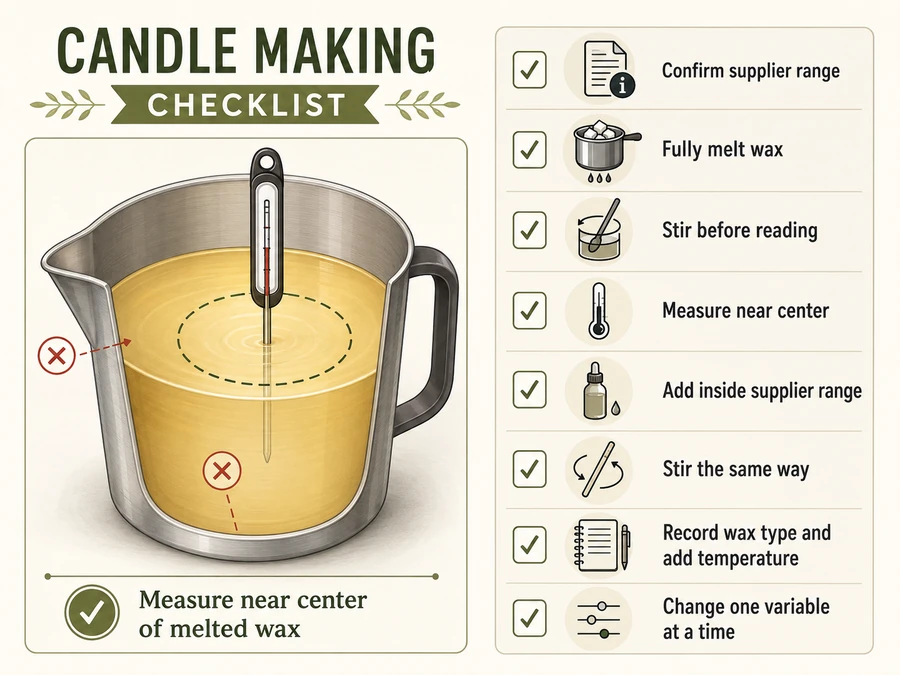
- Confirm the wax supplier’s fragrance-add range before heating the wax.
- Fully melt the wax before watching for the add window.
- Stir the melted wax before taking the temperature, so the reading is not taken from a hot or cool pocket.
- Measure near the center of the melted wax, away from the pitcher wall or base.
- Add fragrance oil only when the melted wax is inside the supplier’s range.
- Stir the same way for each test batch.
- Record wax type, fragrance oil, fragrance percentage, add temperature, stir time, pour temperature, and result.
- Change one variable at a time in the next batch.
| If this happens | Likely temperature issue | Next batch adjustment |
|---|---|---|
| Fragrance seems slow to mix | Wax may be too cool | Add earlier inside the supplier window |
| Batch varies each time | Add temperature may be inconsistent | Record the exact wax temperature at addition |
| Oil streaks appear | Wax may be too cool or under-stirred | Check add temperature and stir pattern |
| Scent seems weak | Temperature may be one factor | Check add temperature first, then load, cure, wick, and fragrance quality |
| Supplier chart conflicts with a generic chart | Generic range may not fit the wax | Follow the supplier chart |
Can You Reheat Wax if It Got Too Cool?
You can usually warm the wax back into the supplier’s working range before adding fragrance, but avoid creating extra heat cycles after fragrance has already been added unless the wax supplier allows it.
If the wax cooled before fragrance was added, warm the wax gently, stir it, recheck the temperature, and add fragrance once the melted wax is back inside the add window. If fragrance has already been added and the wax is setting too quickly, record the problem and follow the wax supplier’s guidance before reheating.
A thermometer does not solve every candle scent problem, but it removes one major source of uncertainty. Once the add temperature is controlled, the next decisions can stay separate: fragrance load, pour temperature, cure time, wick fit, and burn testing.