
A vanilla scent profile is the dominant olfactive direction of a vanilla-centered candle or home fragrance: gourmand is broadly dessert-like, bakery evokes specific baked goods, and woody is structured by wood, resin, smoke, earth, or dry notes.
This guide compares these three selected directions rather than every possible vanilla profile; floral, fresh, spicy, musky, and other vanilla directions fall outside its scope. This guide helps buyers and candle makers compare those directions by sweetness, food realism, woodiness, dryness, warmth, richness, and mood. Profile choice is separate from vanilla material type, fragrance-oil format, safety, fragrance load, candle throw, and supplier quality. Start by defining the three category boundaries, then compare their shared sensory traits before matching the result to your preferred atmosphere and resolving any overlap.
Gourmand vs Woody vs Bakery Vanilla: What Each Profile Means
Gourmand vanilla is broadly dessert-like, bakery vanilla evokes baked goods, and woody vanilla is structured by wood, resin, smoke, earth, or dry notes.
A vanilla scent profile is the overall olfactive direction of a vanilla-centered candle or home fragrance. These labels classify sensory character, not vanilla material type, product safety, fragrance load, candle throw, or supplier quality.
Use this five-point check:
- Identify the strongest supporting accord.
- Test for general edible character.
- Look for specific baked-product realism.
- Check whether wood, resin, smoke, or earth provides structure.
- Assign the profile that matters most to the choice.
The table is an editorial sensory-classification model rather than a regulated taxonomy.
| Profile | Defining cues | Insufficient cues alone | Likely overlap | Deciding question |
|---|---|---|---|---|
| Gourmand | Dessert, confectionery, cream, caramel, chocolate, praline | Sweetness or warmth | Bakery; sometimes woody-gourmand | Does it suggest food or dessert without requiring a baked item? |
| Woody | Wood, resin, smoke, moss, root, earth, dry amber | Dark packaging, amber, musk, low sweetness, or a gender label | Gourmand-woody; bakery-woody | Does wood or resin materially structure the vanilla? |
| Bakery | Cake, cookie, pastry, dough, crumb, butter, frosting, toasted sugar | Vanilla, caramel, sugar, or cream | Gourmand-bakery; bakery-woody | Does it evoke a specific baked product or baking process? |
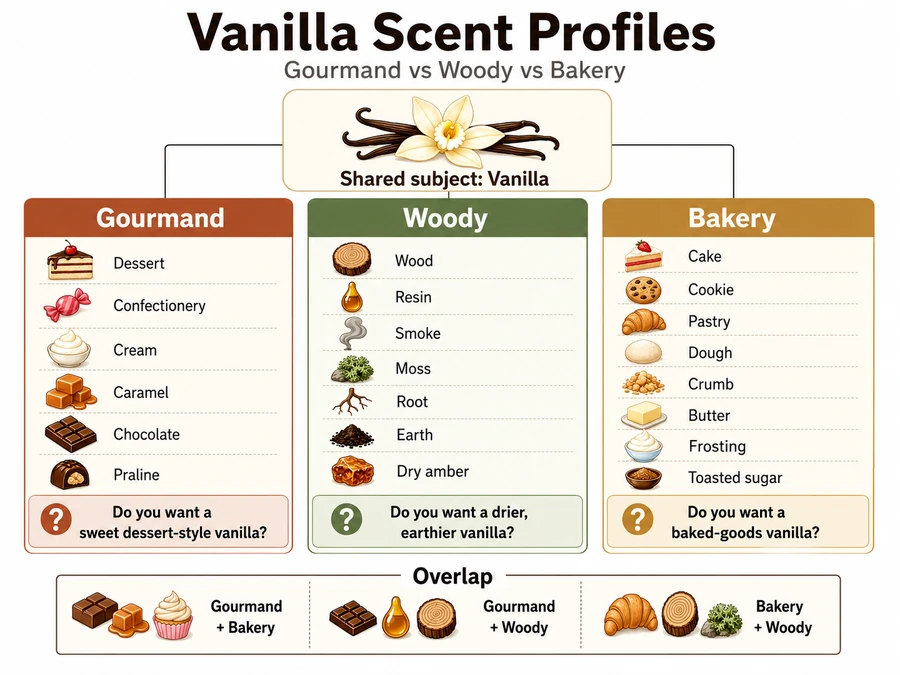
Bakery vanilla commonly sits within the broader gourmand family because both can smell edible. Bakery is narrower because it requires recognizable cake, cookie, pastry, dough, crumb, butter, frosting, or toasted-sugar cues.
Bakery vanilla can be gourmand because both profiles can have edible character. Use the bakery label when recognizable baked-product cues determine the choice.
Woody vanilla may still smell sweet, creamy, ambered, or softly edible when wood or resin remains the main structure. Sweetness alone does not prove gourmand status, and a general food association does not prove bakery status.
Michael Edwards’ Fragrances of the World and The Fragrance Foundation provide broader fragrance-family terminology. The three-profile model used here is editorial rather than authority-issued, regulated, or universally standardized. Overlap is valid, but one profile should remain primary before the shared sensory dimensions are compared.
Gourmand vs Woody vs Bakery Vanilla Comparison Matrix
Gourmand, woody, and bakery vanilla differ most clearly in sweetness, food realism, woodiness, dryness, warmth, and richness.
The 1–5 values show relative editorial tendencies, not measured product scores or fixed scientific ratings.
This matrix compares modeled olfactive tendencies in vanilla-centered candle and home-fragrance profiles. It does not score quality, safety, concentration, cold throw, hot throw, or wax performance.
Dimensions: Sweetness means sugary, creamy, syrupy, or confectionery character; food realism means resemblance to identifiable food; woodiness means structural wood, resin, smoke, moss, root, earth, or dry amber; dryness means less syrupy dominance; warmth means enveloping, toasted, resinous, or softly spiced character; richness means density or layering, not superiority.
Method: The family terms follow educational usage from Michael Edwards’ Fragrances of the World and The Fragrance Foundation. This 1–5 scale is an editorial model, not an authority-issued rating. Values describe category tendencies, not laboratory measurements, product tests, quality, or candle performance.
Scale: 1 = minimal, 3 = moderate or dependent on the scent, and 5 = strongly characteristic.
| Profile | Sweetness | Food realism | Woodiness | Dryness | Warmth | Richness | Most useful when |
|---|---|---|---|---|---|---|---|
| Gourmand | 5 | 4 | 1 | 1 | 4 | 4 | Broad dessert or confectionery character is wanted |
| Woody | 2 | 1 | 5 | 4 | 4 | 4 | Grounded, resinous, smoky, earthy, or less food-like vanilla is wanted |
| Bakery | 4 | 5 | 1 | 2 | 5 | 5 | Cake, cookie, pastry, butter, dough, or frosting realism is wanted |
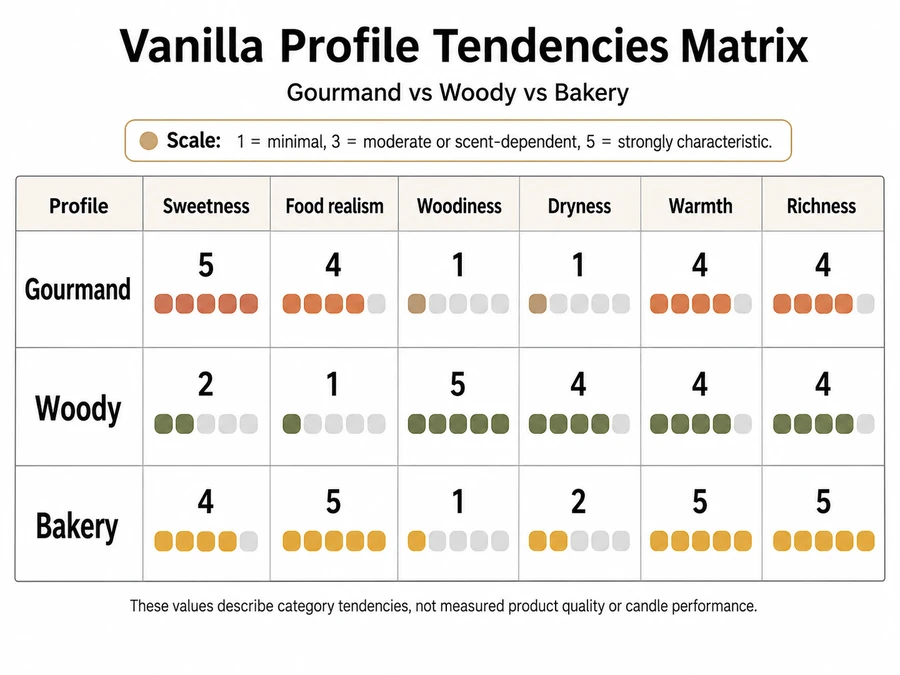
Read the matrix by choosing the two dimensions that matter most, removing the profile that conflicts most, and comparing the remaining profiles by defining cues.
High food realism plus pastry cues points to bakery. Broad dessert character without baked specificity points to gourmand. Low food association plus wood or resin structure points to woody.
Sweetness does not equal food realism, woodiness does not require complete dryness, and warmth can appear in all three profiles. The matrix narrows the choice before mood and sweetness preferences decide the final fit.
What Does Gourmand Vanilla Smell Like?
Gourmand vanilla is a vanilla-centered scent profile that evokes edible sweets or desserts through caramel, cream, chocolate, praline, custard, or marshmallow.
Edible association—not sweetness alone—defines the profile. Bakery vanilla overlaps with gourmand vanilla but requires recognizable baked-goods cues such as cake, pastry, dough, crumb, butter, or frosting.
A gourmand vanilla can smell creamy, caramelized, chocolate-like, nutty, milky, or confectionery. It does not have to be intensely sugary when the scent still suggests an edible dessert.
Gourmand cue card
| Cue family | Typical scent effect | Edible association | Bakery evidence |
|---|---|---|---|
| Caramel and burnt sugar | Syrupy, toasted, or browned sweetness | Strong | Low unless paired with baked cues |
| Cream, milk, or custard | Smooth, soft, and dairy-like | Strong | Low |
| Chocolate, cocoa, or praline | Rich, dark, or nutty dessert character | Strong | Low |
| Marshmallow, candy, or confectionery | Fluffy, powdered, or sugary character | Strong | Low |
| Nuts and nut pastes | Roasted, creamy, or marzipan-like character | Moderate to strong | Low |
| Tonka-like almond or cream | Soft, powdery, almond-like sweetness | Moderate | Low |
No single note settles the classification; the full fragrance must maintain a recognizable edible or dessert-like direction. Gourmand crosses into bakery when cake, cookie, pastry, dough, crumb, butter, frosting, crust, or toast becomes defining, while wood, resin, smoke, moss, or earth can move the profile toward woody vanilla.
Choose gourmand vanilla when you want creamy, caramelized, confectionery, chocolate-like, nutty, or broadly dessert-like character without requiring a specific baked product.
What Does Woody Vanilla Smell Like?
Woody vanilla is a vanilla-centered scent profile structured by perceptible wood, resin, smoke, moss, root, earth, or dry-amber notes.
It can smell dry, creamy, smoky, earthy, or resinous while still retaining sweetness. “Woody” describes scent structure, not gender, naturalness, quality, or candle strength.
| Woody cue | Likely sensory effect | Possible sweetness | Food association | Classification boundary |
|---|---|---|---|---|
| Cedar or timber | Dry, pencil-like, clean, or firm | Low | Low | The wood must remain perceptible beside vanilla |
| Sandalwood | Creamy, smooth, soft, or milky wood | Moderate | Low to moderate | Creaminess alone does not make it gourmand |
| Smoke or char | Dark, toasted, smoldering, or ashy | Low to moderate | Low | Smoky scent does not mean soot or poor combustion |
| Vetiver, patchouli, moss, or roots | Earthy, damp, grassy, or grounded | Low | Low | Earthiness must shape the profile rather than appear faintly |
| Incense, resin, oud-style woods, or dry amber | Resinous, balsamic, deep, or warm | Moderate | Low | Amber or musk alone does not prove woodiness |
Sandalwood vanilla counts as woody when its creamy wood character materially structures the scent. A sweet or ambered vanilla can remain woody because sweetness, dryness, and woodiness are separate traits.
One faint wood note is insufficient when the fragrance still smells mainly like cake, frosting, cookie dough, or another baked product. Amber and musk may deepen vanilla, but they do not establish a woody profile without clearer wood, resin, smoke, earth, moss, or root evidence.
Common misconceptions
- Woody does not mean masculine.
- Woody does not mean unsweetened or harsh.
- Woody does not mean natural.
- Woody does not predict strong cold throw or hot throw.
- Smoky describes an olfactive effect, not candle combustion.
Choose woody vanilla when wood or resin provides the main structure, even when the scent remains creamy, warm, moderately sweet, grounded, smoky, earthy, dry, or timber-like.
What Does Bakery Vanilla Smell Like?
Bakery vanilla is a vanilla-centered scent profile with recognizable cake, cookie, pastry, dough, crumb, butter, frosting, crust, or toasted-sugar cues.
It commonly overlaps with gourmand vanilla but is narrower because it evokes a specific baked item or baking process. Sweetness alone does not make a vanilla scent bakery-like.
| Cue family | Baked association | Sensory effect | Gourmand overlap | Deciding evidence |
|---|---|---|---|---|
| Cake and sponge | Vanilla cake, pound cake, sponge | Soft, airy, eggy, or moist | High | A recognizable cake structure |
| Cookie and biscuit | Sugar cookie, shortbread, biscuit | Buttery, crisp, browned | High | Cookie dough or baked-edge cues |
| Pastry and croissant | Pastry layers, croissant | Buttery, flaky, toasted | Moderate to high | Pastry or laminated-dough association |
| Dough and bread | Raw dough, brioche, sweet bread | Yeasty, soft, dense | Moderate | Dough or bread realism |
| Butter and browned butter | Melted or toasted butter | Rich, creamy, nutty | High | Butter materially shapes the scent |
| Frosting and icing | Buttercream, glaze, icing | Sugary, creamy, smooth | High | Frosted-product association |
| Crumb and crust | Cake crumb, cookie edge, pie crust | Dry, toasted, grain-like | Moderate | Baked crumb or crust character |
| Toasted sugar | Caramelized sugar, brûléed topping | Warm, browned, slightly bitter | High | Toasted sugar supports another baked cue |
Frosted vanilla emphasizes icing-like sweetness, while doughy vanilla feels denser and less polished. Crumb and crust cues add dryness; butter adds richness; pastry cues suggest flakiness; toasted sugar adds browned warmth.
Vanilla, cream, caramel, sugar, or tonka alone remains insufficient. At least one recognizable baked-goods cue should shape the overall candle or home-fragrance profile before the bakery label is applied.
Choose bakery vanilla when recognizable cake, cookie, pastry, bread, butter, dough, frosting, crumb, crust, or toasted-sugar realism matters more than broad dessert sweetness.
How to Choose a Vanilla Profile for Your Preferred Mood and Sweetness Level
Choose gourmand for broad dessert richness, woody for grounded or less food-like character, and bakery for recognizable baked-goods realism.
The best profile is the one that matches your declared sweetness tolerance, food association, and desired atmosphere. “Too sweet” describes personal tolerance rather than an objective scent defect.
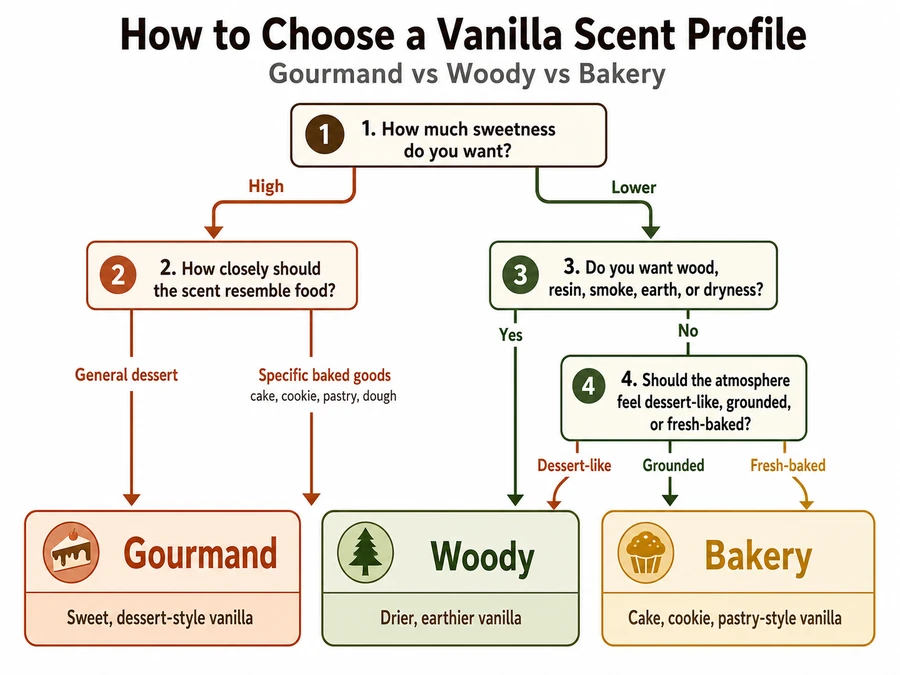
Use four questions:
- How much sweetness do you want? High sweetness often favors gourmand or bakery; lower sweetness often favors woody.
- How closely should the scent resemble food? General dessert character favors gourmand, while literal cake, cookie, pastry, or dough realism favors bakery.
- Do you want wood, resin, smoke, earth, or dryness? A clear preference for those cues favors woody vanilla.
- Should the atmosphere feel broadly dessert-like, grounded, or fresh-baked? Match those outcomes to gourmand, woody, or bakery respectively.
| Preference | Primary profile | Why | Avoid when | Possible secondary profile |
|---|---|---|---|---|
| Creamy, caramelized, confectionery | Gourmand | Broad edible richness without requiring one baked item | Edible character feels cloying | Bakery |
| Sweet but distinctly cake-like | Bakery | Specific baked-product realism | Literal food association is unwanted | Gourmand |
| Warm with little food realism | Woody | Wood or resin supplies warmth without dessert emphasis | Dry or resinous structure feels severe | Gourmand |
| Toasted pastry with a dry base | Bakery | Pastry remains the deciding association | Crumb, butter, or crust cues are unwanted | Woody |
| Sweet vanilla with clear cedar or resin | Woody | Structural wood remains primary | Woodiness is unwanted | Gourmand |
| Dessert-like vanilla with cookie edges | Gourmand | Broad dessert character leads | A specific cookie identity dominates | Bakery |
“Cozy” should be translated into actual cues such as creamy sweetness, toasted warmth, soft woods, or baked nostalgia. “Nostalgic” may point to bakery when it recalls cookies or cake, but it can also point to woody vanilla when the association is smoke, timber, or resin.
Method note: These recommendations match sensory preference rather than rank product quality, safety, scent throw, wax behavior, or value.
Avoid gourmand when broad edible character is unwanted, woody when dry or resinous structure is unwanted, and bakery when literal baked-goods realism is unwanted.
After choosing a primary direction, use the note list to confirm whether the scent reinforces or shifts that choice.
Which Supporting Notes Reinforce Each Vanilla Profile?
Supporting notes can reinforce or shift a vanilla scent profile, but one isolated note does not determine the final classification.
Read the full fragrance structure rather than assigning a category from one ingredient name.
| Supporting note family | Example cues | Primary profile effect | Possible secondary profile | Boundary note |
|---|---|---|---|---|
| Creamy confectionery | Cream, custard, chocolate, praline, marshmallow | Reinforces gourmand character | Bakery | Edible character is not automatically baked-goods realism |
| Woods and earth | Cedar, vetiver, patchouli, moss | Reinforces woody structure | Gourmand | A faint wood note does not outweigh a dominant dessert accord |
| Baking cues | Butter, dough, crumb, cake, cookie, pastry, frosting | Reinforces bakery realism | Gourmand | Specific baked-product association should remain noticeable |
| Tonka and nuts | Tonka, almond, hazelnut, nut pastes | Often reinforces gourmand character | Woody or bakery | Tonka may feel dry and woody; nuts may feel confectionery, pastry-like, or dry |
Use this five-step reading process:
- Confirm that vanilla remains central.
- Identify the strongest supporting family.
- Separate general edible character from baked-specific cues.
- Check whether wood, resin, smoke, moss, root, or earth supplies the structure.
- Assign one primary profile and record only a meaningful secondary overlap.
This map describes olfactive relationships. It does not provide formulas, ratios, safety approval, wax compatibility, dosage advice, or performance guarantees.
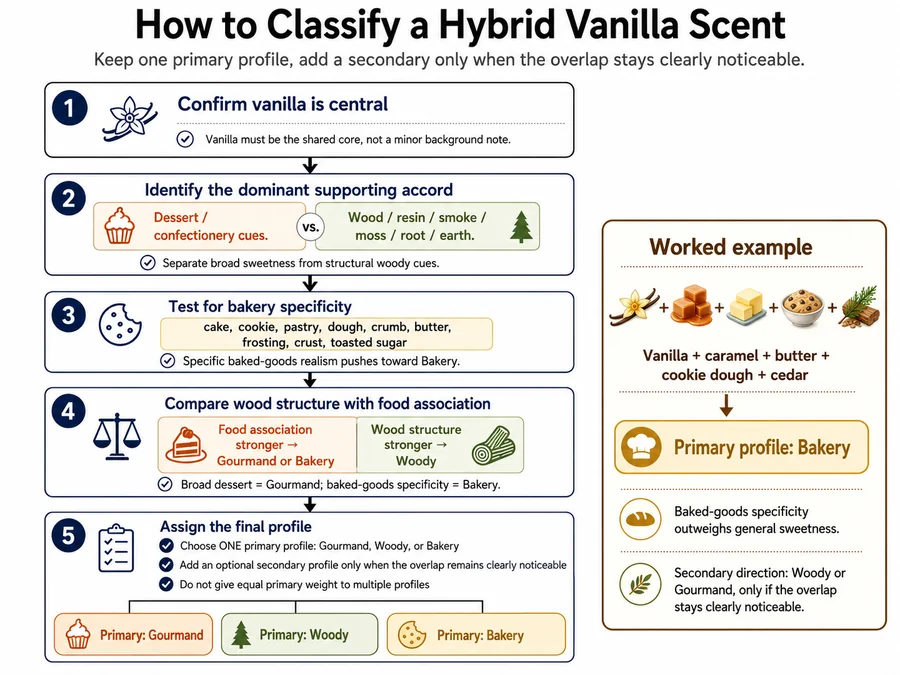
How to Classify a Hybrid Vanilla Scent in 5 Steps
A hybrid vanilla scent is vanilla-centered, contains meaningful cues from more than one comparison direction, and still needs one primary classification.
The hybrid label applies when at least two profile directions are materially present and the overlap affects the choice. One isolated note, a long ingredient list, or a product name is insufficient evidence.
Hybrid does not create a fourth profile in this guide. Gourmand, woody, and bakery remain its three comparison directions.
- Confirm vanilla is central.
Vanilla must remain the main olfactive subject rather than a minor background note. A fragrance with faint vanilla beneath dominant florals or fruit falls outside this classification method. - Identify the dominant supporting accord.
Broad dessert, cream, caramel, chocolate, praline, or confectionery cues support gourmand. Wood, resin, smoke, moss, root, or earth supports woody. - Test for bakery specificity.
Look for cake, cookie, pastry, dough, crumb, butter, frosting, crust, or toasted-sugar realism. Specific baked-goods evidence outweighs broad sweetness when assigning bakery as the primary profile. - Compare wood structure with food association.
Ask whether the scent is mainly grounded by wood or mainly defined by edible realism. The answer separates woody-gourmand, bakery-woody, and gourmand-bakery cases. - Assign one primary and an optional secondary profile.
The primary label names the dominant decision-relevant outcome. Add a secondary label only when the second direction remains clearly noticeable.
Worked example: A scent lists vanilla, caramel, butter, cookie dough, and cedar. Butter and cookie dough provide bakery evidence, caramel adds gourmand character, and cedar supplies woody structure. The primary label is bakery vanilla because baked-goods specificity outweighs general sweetness. Woody or gourmand may appear as a secondary label only when that effect remains materially noticeable.
Avoid these classification errors:
- Classifying from the product name
- Treating every long note list as hybrid
- Assigning all three labels equal weight
- Ignoring the dominant sensory outcome
- Confusing one supporting note with the whole profile
- Using “hybrid” to avoid choosing a primary label
“Complex” means multiple notes are present; it does not prove hybrid status. “Balanced” means more than one direction is noticeable; it does not mean equal measured proportions.
Choose one primary profile for the dominant decision-relevant character, and add a secondary label only when the overlap remains meaningful.