

Yes, you can reuse some incorrectly burned candles after checking safety and choosing whether to relight, repair, melt, repurpose, or discard them.
Here, an incorrectly burned candle means one with tunneling, an uneven melt pool, wick trouble, soot, fast burning, or wax left on the sides. It does not mean a fire-damaged, contaminated, cracked, or overheated candle, because those conditions can make reuse unsafe.
In this article, reuse means choosing the safest remaining use for the candle parts: burning the original candle, using clean wax without a flame, cleaning the jar, or discarding unsafe material.
This guide helps candle makers and candle users decide whether the candle, wax, wick, jar, or repoured material is still worth saving. Start by separating safe performance problems from stop-reuse conditions before choosing a recovery method. <!– Meta description: Learn when an incorrectly burned candle can be reused, repaired, melted down, turned into wax melts, salvaged as a jar, or safely discarded. –>
Check Whether the Candle Is Safe Before You Reuse It
A badly burned candle is reusable only if the jar, wax, wick, and burn behavior show no unsafe damage.
Direct answer: Do not relight, melt, or repour a candle with cracked glass, contaminated wax, heavy soot, a loose wick, scorched material, or signs that the container overheated. In those cases, the safer choice is to stop using the candle and salvage only parts that are clean and intact.
| Safety check | Safe enough to keep working on | Stop reusing if you see this |
|---|---|---|
| Jar or container | No cracks, chips, bulges, or heat stress | Cracked glass, loose metal seams, warped tins, or popping sounds |
| Wax surface | Clean wax with normal discoloration only | Debris, mold, unknown residue, burned material, or water inside the wax |
| Wick | Centered enough to burn without touching the jar | Wick leaning into glass, buried too deeply, loose, or breaking apart |
| Flame behavior | Flame stays controlled after trimming | Tall flame, repeated smoking, sputtering, or flame near the container wall |
| Soot | Light soot on the rim that can be cleaned | Thick black buildup, smoky smell, or soot mixed into the wax |
| Heat history | Candle only burned poorly | Candle overheated, scorched nearby surfaces, or was involved in a fire event |
Before any heat-based fix, trim only a stable wick, keep the candle on a heat-resistant surface, avoid drafts, and wait until the wax cools before handling the container.
A tunneled or uneven candle can often be repaired because the problem is usually wax memory, burn time, or wick care. A damaged candle is different: the problem is no longer poor performance but unsafe burning conditions.
If the jar is damaged, do not melt wax inside that same jar. If the wax is dirty or smells scorched, do not turn it into wax melts or a new candle. If the wick is unstable, do not relight it to “see what happens,” because the next burn may pull heat toward one side of the container.
Use this order before any fix:
- Let the candle cool fully.
- Remove loose soot from the rim.
- Check the container from all sides.
- Look for debris, water, or scorched wax.
- Check whether the wick is centered and stable.
- Decide whether you are saving the candle, the wax, the jar, or nothing.
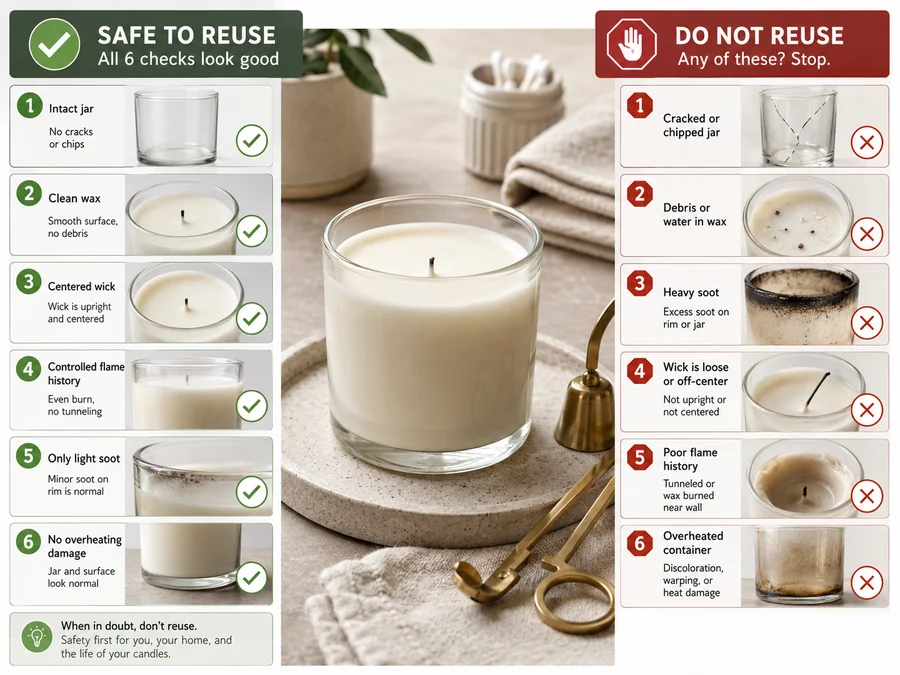
The outcome should be clear before you use heat. If the candle passes the safety screen, move to identifying the burn problem. If it fails, skip repair and choose disposal or jar salvage only when the jar is clean and undamaged.
Identify What Went Wrong With the Burn
The reuse method depends on the burn problem: tunneling, uneven wax, wick trouble, soot, fast burning, or leftover side wax each need a different fix.
Direct answer: A badly burned candle is not one single problem. Identify the symptom first so you do not melt, relight, trim, or repour a candle that needs a safer or simpler recovery route.
| Burn problem | What it looks like | Likely reuse route |
|---|---|---|
| Tunneling | A deep hole burns down the center while wax remains on the walls | Relight with a full melt pool attempt, foil wrap, or surface reset |
| Uneven melt pool | One side melts faster than the other | Rotate placement, correct wick position if safe, or reset the top layer |
| Drowning wick | Melted wax covers or nearly covers the wick | Remove a small amount of softened wax and expose the wick |
| Mushrooming wick | Black carbon ball forms at the wick tip | Trim the wick after cooling before the next burn |
| Sooting | Black smoke or soot appears on the jar | Stop if heavy; otherwise trim wick and shorten future burns |
| Burning too fast | Wax disappears faster than expected | Avoid relighting until wick height, draft exposure, and container heat are checked |
| Wax stuck on walls | Side wax remains after the candle burns down | Use remaining wax as melts or remove it for repurposing |
| Off smell after burning | Scent smells burnt, smoky, or harsh | Do not repour for fragrance quality; consider disposal |
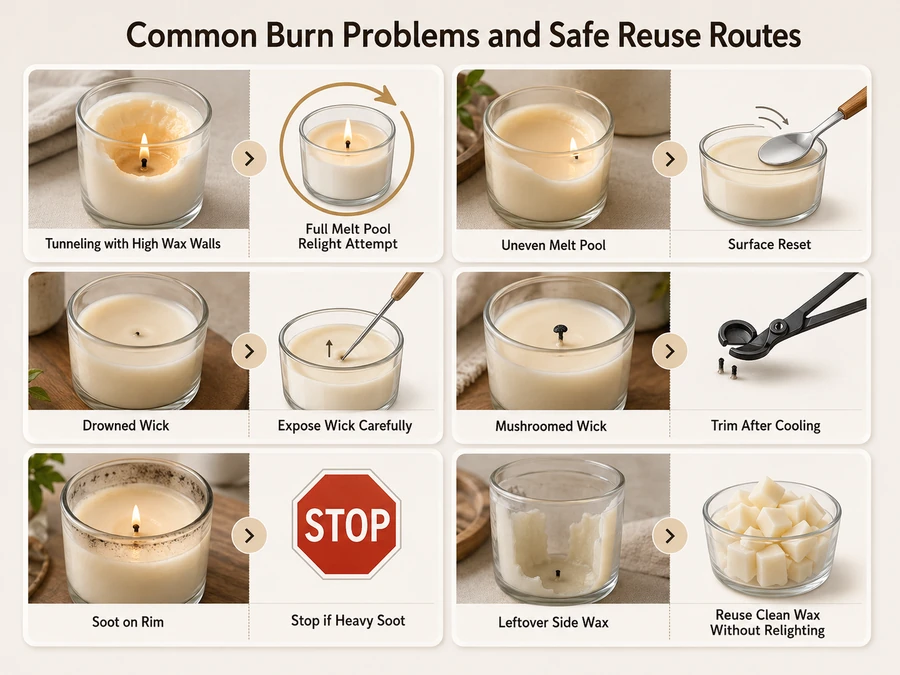
Tunneling is one of the most fixable burn problems because the candle may still have clean wax, a stable wick, and an intact jar. The goal is to widen the melt pool without overheating the container.
Wick problems need a narrower decision. A wick that is too long, mushroomed, or slightly buried may be recoverable. A wick that has shifted against the jar, detached, split badly, or burned too low may make normal relighting impractical.
Soot changes the decision because it can be cosmetic or a warning sign. A little rim soot after a long burn may be cleaned before reuse. Heavy soot mixed through the wax means the remaining wax may smell smoky and perform poorly.
Fast burning should not be treated as a simple reuse problem. It can point to wick size, drafts, fragrance load, container heat, or burn habits. For this page, the recovery decision is simple: do not keep relighting a candle that burns aggressively or gets unusually hot.
Once the symptom is named, choose the smallest safe fix. Repair the original candle when the jar and wick are sound. Reuse the wax when the candle shape cannot be saved. Discard the candle when safety or contamination is the problem.
Choose the Right Way to Fix or Reuse the Candle
The right reuse method is the safest method that saves only the usable part: the original candle, the remaining wax, the wick path, or the container.
Direct answer: Use the least aggressive fix that solves the actual burn problem. Relight a safe candle only when the wick is usable, repair surface wax when tunneling is the issue, melt or repour only when the original candle cannot burn well anymore.
| Candle condition | Best reuse method | Expected outcome |
|---|---|---|
| Light tunneling with a visible wick | Relight long enough to reach a full melt pool | Candle may burn more evenly on the next use |
| Deep tunneling with wax walls | Foil wrap or careful top-surface reset | Wax near the edges softens and rejoins the melt pool |
| Wick slightly buried | Remove a small amount of softened wax | Wick has enough exposed height to relight safely |
| Mushroomed wick | Trim after the candle cools | Flame becomes smaller and cleaner |
| Wax left after wick is gone | Remove wax for melts or warmer use | Wax is reused without rebuilding the candle |
| Clean wax in a failed candle | Melt and repour only with safe equipment and realistic expectations | New candle may be usable but not identical to the original |
| Dirty, scorched, or smoky wax | Do not reuse for burning or fragrance | Disposal is safer than salvage |
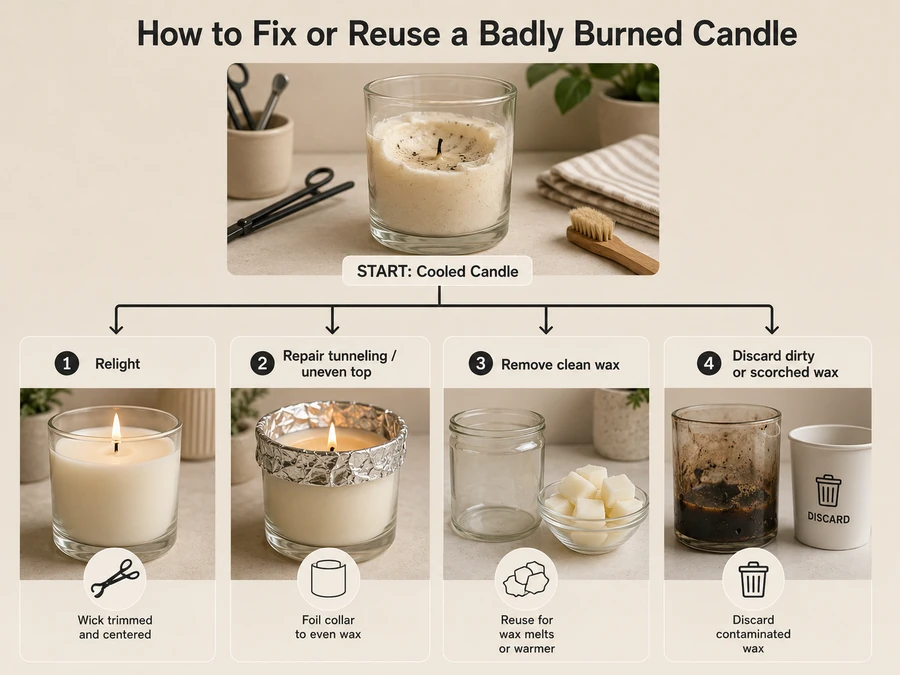
A small repair is usually better than a full reset. If the candle only tunneled once, you may be able to recover it by giving the next burn enough time to melt across the full surface. If the wax walls are thick, a foil wrap can help hold heat near the top, but it should never cover the flame or make the jar unusually hot.
A heat tool can flatten an uneven wax surface, but it does not fix unsafe glass, contaminated wax, or a badly placed wick. Treat surface resetting as a cosmetic and melt-pool correction, not as a way to make every damaged candle safe again.
When the Wick Can Still Be Saved
A wick can still be saved when it is stable, centered enough to burn safely, and exposed above the wax.
Direct answer: Trim a long or mushroomed wick, expose a slightly buried wick, and stop if the wick has shifted, detached, crumbled, or burned too close to the container. Wick recovery should make the next flame safer, not force a damaged candle to keep burning.
Do not create a replacement wick from paper, matches, string, or loose material, because an improvised wick can change flame size, heat direction, and container risk.
A long wick usually needs trimming after the wax cools. A buried wick may need a small amount of softened wax removed from around it. A leaning wick is more serious because it can pull the flame toward the jar wall and heat one side of the container.
Do not dig deeply into hardened wax with a sharp tool while the candle is cold. That can crack wax, loosen the wick tab, or damage the vessel. Warm the top layer gently only if the candle passed the safety screen first.
The wick is not worth saving when the candle cannot keep a controlled flame. At that point, reuse the clean wax without relighting, or discard the candle if the wax is smoky, dirty, or overheated.
When Melting Down or Repouring Makes Sense
Melting down or repouring makes sense only when the wax is clean and the original candle cannot be recovered by normal burning or surface repair.
Direct answer: Repour a badly burned candle only if the wax is clean, the scent has not turned smoky, and you are prepared for lower performance than a fresh candle. Reusing wax is not the same as restoring the original candle.
Do not microwave a jar candle, heat a cracked vessel, or repour wax that contains soot, water, debris, or scorched residue.
Melt-and-repour can help when the wick is gone, the container is no longer useful, or the remaining wax is too uneven to burn safely. It is not the right method for wax with debris, water, scorched material, or heavy soot.
Repoured wax may not smell or burn exactly like it did before. Some fragrance may weaken, some wax may darken, and the new wick may not match the old wax blend or container size. That means a repoured candle should be treated as a salvage project, not a guaranteed rebuild.
For a safer boundary, separate the goal before melting:
- Save clean wax for a warmer or wax melts.
- Repour only into a heat-safe candle container.
- Use a suitable wick only if making a new candle.
- Stop if the wax smells burnt or looks contaminated.
- Do not melt wax in a cracked or damaged jar.
Use the Remaining Wax Without Relighting the Candle
Remaining candle wax can often be reused without burning it again, especially when the wick or jar makes relighting impractical.
Direct answer: Clean leftover wax can become wax melts, warmer wax, small poured pieces, or decorative non-burning material. Do not reuse leftover wax for heat or scent if it contains soot, debris, water, scorch marks, or a smoky smell.
| Remaining wax condition | Safer reuse option | Avoid |
|---|---|---|
| Clean scented wax | Wax melts or warmer use | Adding a wick without checking container and wick fit |
| Clean unscented wax | Small utility wax pieces or craft use | Assuming it will smell like a new candle |
| Wax with light surface marks | Remove the marked layer if practical | Mixing dirty wax into clean wax |
| Wax with heavy soot | Disposal | Wax melts, repouring, or fragrance reuse |
| Wax from a damaged jar | Remove only if safe and fully cooled | Heating the damaged jar |
| Wax with unknown debris | Disposal | Burning, melting for scent, or gifting |
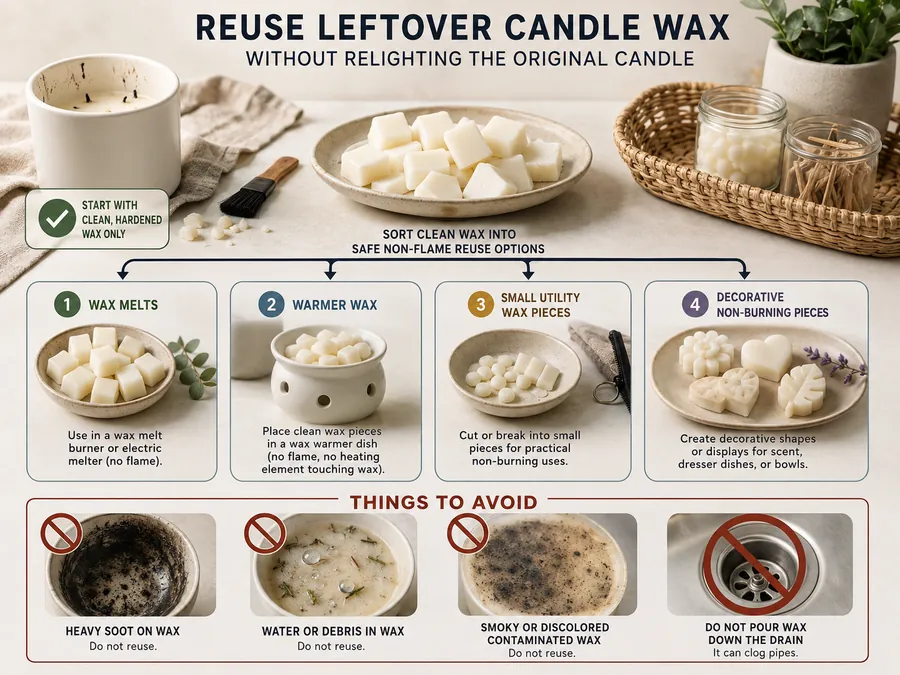
Let removed wax harden before disposal, and do not pour melted wax into a sink or drain.
Using wax without a flame is often the best route when the original candle failed but the wax is still clean. Wax melts or a warmer let you use fragrance without depending on a damaged wick path.
Small repurposed wax pieces can work for non-burning uses, but keep the scope narrow. A badly burned candle is not a reason to create a new candle-making project unless the wax is clean, the container is safe, and the new wick choice is handled separately.
Do not turn questionable wax into gifts or new candles for other people. If you would not relight it in your own space because of smoke, dirt, or overheating concerns, do not reuse it in a form that hides those problems.
Know When to Stop Reusing the Candle
Stop reusing a burned candle when the wax, wick, jar, or burn history makes the next use unsafe or low quality.
Direct answer: Throw away the wax if it is dirty, scorched, smoky, wet, or contaminated. Stop burning the original candle if the jar is cracked, the wick is unstable, or the candle keeps overheating, smoking, or burning unevenly after a careful fix.
| Stop-reuse condition | What to stop using | What you can still save |
|---|---|---|
| Cracked glass or damaged container | The full candle as a burning candle | Clean wax only if it can be removed without heating the damaged jar |
| Heavy soot mixed into wax | Wax for melting, repouring, or scent use | Possibly the cleaned jar, if undamaged |
| Scorched or smoky smell | Wax for fragrance use | Jar only, after full cleaning |
| Water, debris, or unknown residue in wax | Wax and wick | Jar only, if clean and intact |
| Wick shifted toward the wall | Original candle burn | Clean wax for non-burning reuse |
| Wick detached or buried too low | Relighting the candle | Wax melts, warmer wax, or disposal |
| Container gets unusually hot | Any further burning | None until the candle is fully cooled and assessed |
| Failed repair attempts | Original candle shape | Remaining clean wax, if quality is still acceptable |
Stop burning before the wax is nearly gone; use ½ inch of remaining wax as the practical stop point for container candles.
A candle can be reusable without being worth relighting. That distinction matters because the original candle, leftover wax, wick, and jar do not carry the same risk. The wax might still work in a warmer while the wick path is no longer safe. The jar might be reusable after cleaning while the wax should be discarded.
Stop trying to save the candle when the fix requires guessing. If the smell has changed, the wick will not stay centered, or the container shows damage, the recovery path has moved past normal candle maintenance.
Do not hide unsafe wax inside a new project. Repouring dirty or smoky wax into a fresh container can make the candle look better without improving the burn quality. If the wax would make the next candle smell burnt, smoke heavily, or burn unpredictably, disposal is the cleaner decision.
For jar reuse, wait until the candle is fully cool, remove wax without forcing heat into a damaged vessel, and clean away soot or residue. A jar with cracks, chips, stress marks, or metal seam damage should not be reused for a new candle.
The final decision is simple: reuse clean wax when the problem is only poor burn performance, repair the candle when the jar and wick are still sound, and stop when damage or contamination becomes part of the candle.