

Candle burn time is the estimated total number of hours a candle can burn based on usable wax amount and wax consumed per hour.
Use this calculator to estimate total candle hours from usable wax or fill weight and burn rate. The basic formula is estimated burn time = usable wax weight ÷ burn rate per hour. Enter size as wax weight, not jar diameter, vessel volume, label size, or total container weight. Treat the result as a planning estimate across multiple burn sessions, not a guaranteed rating or one safe continuous burn.
Candle Burn Time Calculator
The candle burn time calculator estimates total burn hours by dividing usable wax weight by the candle’s burn rate per hour.
| Calculator input | What to enter | Accepted unit type | Do not enter |
|---|---|---|---|
| Usable wax weight | Wax available to burn | oz, g, lb, kg | Jar diameter |
| Burn rate | Wax consumed per hour | oz/hour or g/hour | Flame height |
| Unit system | Matching weight units | Same unit family | Mixed units |
| Result | Estimated total burn time | Hours | Safe continuous burn time |
Formula:
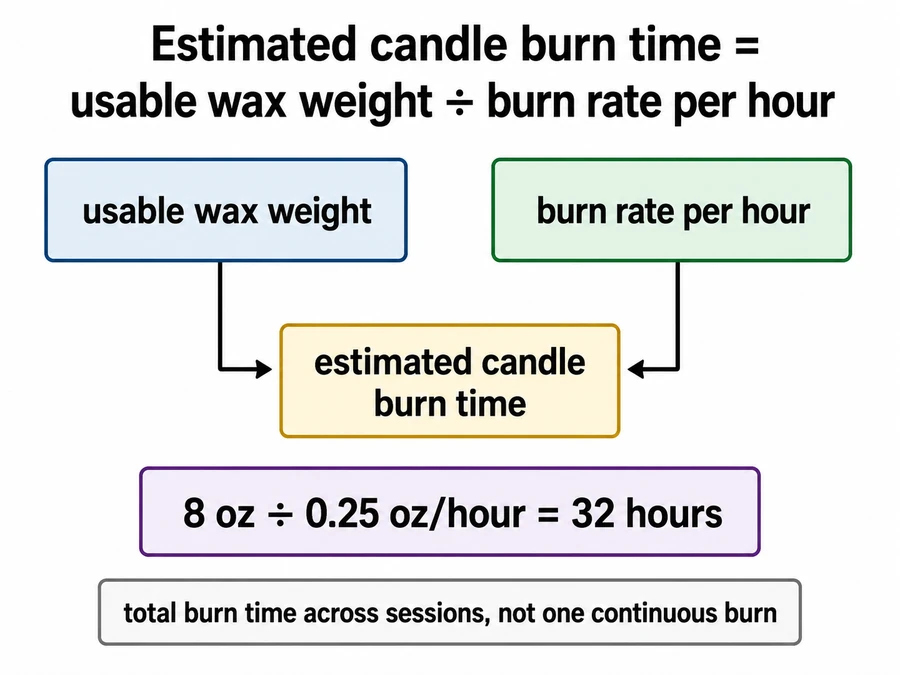
Estimated candle burn time = usable wax weight ÷ burn rate per hour
Worked example:
An 8 oz candle with a burn rate of 0.25 oz per hour has an estimated burn time of 32 hours.
8 oz ÷ 0.25 oz/hour = 32 hours
Output interpretation rules:
| Result type | What it means | How to use it |
|---|---|---|
| Higher hour estimate | Wax is consumed more slowly | Plan more burn sessions |
| Lower hour estimate | Wax is consumed faster | Expect fewer total hours |
| Result from measured burn rate | More useful for that exact candle | Use for planning or labeling checks |
| Result from assumed burn rate | Rough planning number | Confirm with a real burn test |
| Total burn time | Lifetime estimate across sessions | Do not treat as one long burn |
How the Candle Burn Time Calculator Works
A candle burn time calculator works by turning wax amount and burn rate into an estimated number of total burning hours.
The calculator needs two values: how much usable wax the candle has and how much wax it loses per hour. When those units match, the calculation is simple: divide wax weight by hourly wax use.
| Step | Calculator action | Example |
|---|---|---|
| 1 | Read usable wax weight | 200 g |
| 2 | Read burn rate | 6 g/hour |
| 3 | Divide wax weight by burn rate | 200 ÷ 6 |
| 4 | Return estimated burn time | 33.3 hours |
The result is an estimate because candles do not burn at the exact same rate in every session. Wick size, wax blend, vessel shape, room airflow, and how long each burn session lasts can change the actual total.
Enter Candle Size as Usable Wax Weight
Candle size means usable wax weight for this calculator, not the jar’s outside size, label size, or vessel volume.
The value to enter is the amount of wax that can actually be burned. For a finished candle, this is usually the fill weight, such as 8 oz of wax in a jar. For a homemade candle, it is the wax weight poured into the vessel, minus any wax that cannot safely burn at the bottom.
| Candle “size” label | What it may mean | Calculator-ready? |
|---|---|---|
| 8 oz candle | Often fill weight, but check label | Yes, if it means wax weight |
| 10 oz jar | Vessel capacity or jar size | No, unless converted to wax weight |
| 3-inch candle | Diameter | No |
| 200 g fill weight | Usable wax weight | Yes |
| 12 oz total product weight | Jar, wick, wax, and packaging | No |
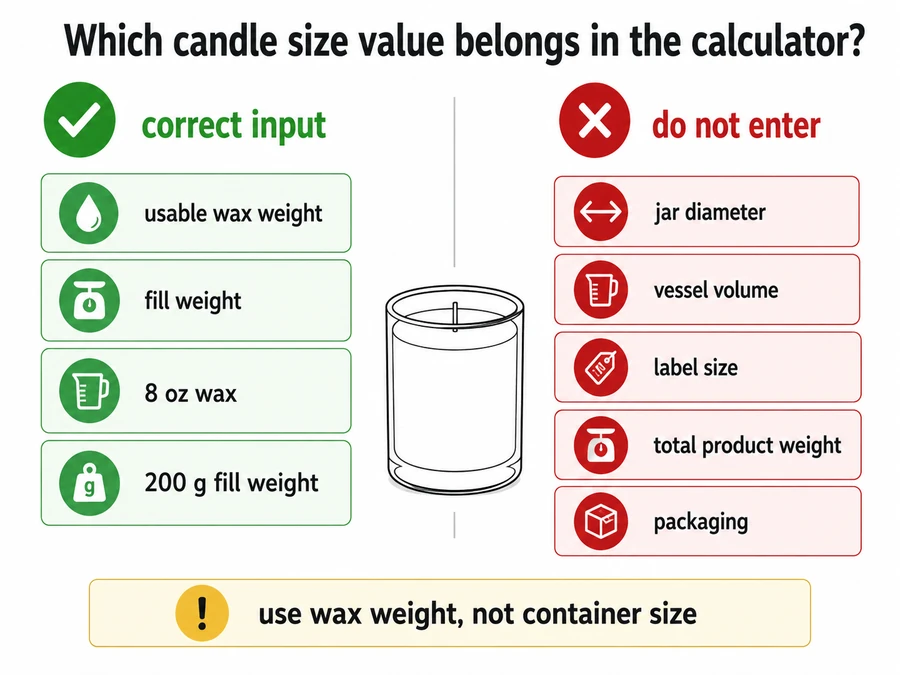
For the best estimate, weigh the candle before burning and subtract the empty vessel weight after the candle is finished. That gives a closer usable wax weight than the jar size printed on a product page.
Enter Burn Rate as Wax Consumed per Hour
Burn rate is the amount of wax a candle uses in one hour, usually measured in ounces per hour or grams per hour.
For burn time estimates, burn rate is not flame brightness, scent strength, heat output, or wick speed. It is a weight-based value. A lower burn rate gives a longer estimated burn time, while a higher burn rate gives a shorter estimate.
| Burn rate input | Meaning | Example result with 8 oz wax |
|---|---|---|
| 0.20 oz/hour | Slow wax use | 40 hours |
| 0.25 oz/hour | Moderate wax use | 32 hours |
| 0.35 oz/hour | Faster wax use | 22.9 hours |
| 0.50 oz/hour | Fast wax use | 16 hours |
Small changes in burn rate can change the estimate by many hours. That is why a measured burn rate gives a better estimate than a guessed number.
Measured vs Assumed Burn Rate
A measured burn rate comes from weighing the candle before and after a timed burn session.
Use a measured burn rate when you want the estimate to match a specific candle. Use an assumed burn rate only for early planning, rough comparisons, or checking whether a candle size seems reasonable.
| Burn rate type | How it is found | Best use | Confidence level |
|---|---|---|---|
| Measured burn rate | Weigh before and after burning | Estimating one tested candle | Higher |
| Assumed burn rate | Use a rough planning value | Early candle planning | Lower |
| Brand-stated burn rate | Based on maker or product data | Comparing listed claims | Medium, if method is clear |
| One-session estimate | Based on a single burn | Quick check only | Limited |
A simple measured burn rate uses this formula:
Burn rate = wax lost during test ÷ hours burned
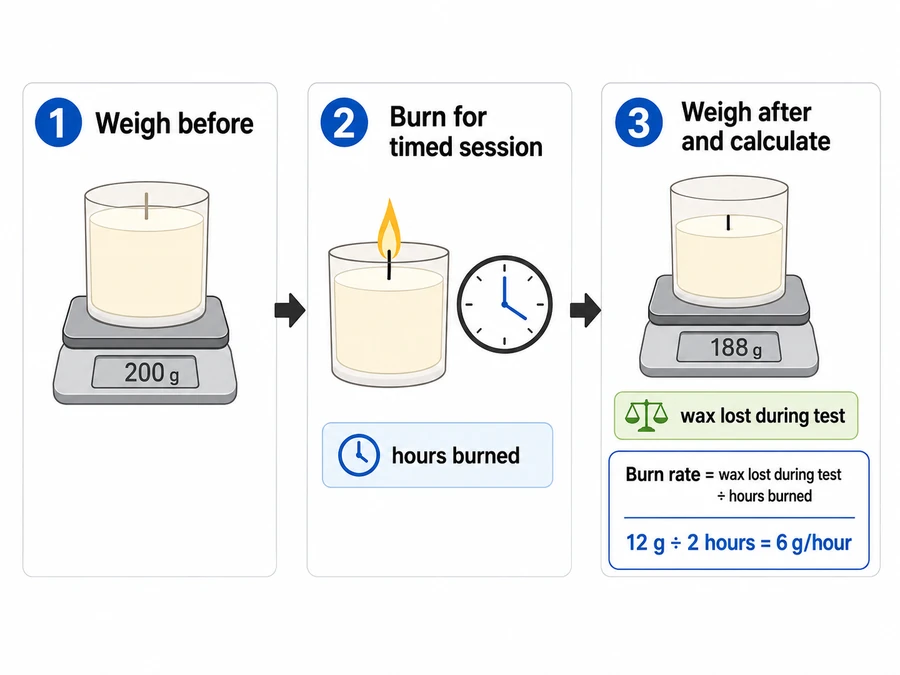
Example: if a candle loses 12 g of wax during a 2-hour test, the burn rate is 6 g/hour.
Use Matching Weight Units
The wax weight and burn rate must use matching units before the calculator result makes sense.
If wax weight is in grams, the burn rate should be grams per hour. If wax weight is in ounces, the burn rate should be ounces per hour. Mixing grams with ounces per hour creates the wrong burn time.
| Wax weight entered | Burn rate entered | Correct? | What to fix |
|---|---|---|---|
| 200 g | 5 g/hour | Yes | Nothing |
| 8 oz | 0.25 oz/hour | Yes | Nothing |
| 200 g | 0.25 oz/hour | No | Convert one unit |
| 8 oz | 5 g/hour | No | Convert one unit |
| 0.5 lb | 0.25 oz/hour | No | Convert pounds to ounces |
Do not use fluid ounces unless you have converted the candle’s wax volume into wax weight. Burn time is based on how much wax is consumed by weight, not how much liquid volume a container can hold.
Example Candle Burn Time Estimates
Example candle burn time estimates show how wax weight and burn rate change the total hour result.
These numbers are sample calculations, not guaranteed candle ratings. Use them to check whether a result looks reasonable before you rely on a measured burn test.
| Usable wax weight | Burn rate | Estimated burn time |
|---|---|---|
| 4 oz | 0.20 oz/hour | 20 hours |
| 4 oz | 0.30 oz/hour | 13.3 hours |
| 8 oz | 0.25 oz/hour | 32 hours |
| 8 oz | 0.35 oz/hour | 22.9 hours |
| 12 oz | 0.30 oz/hour | 40 hours |
| 12 oz | 0.45 oz/hour | 26.7 hours |
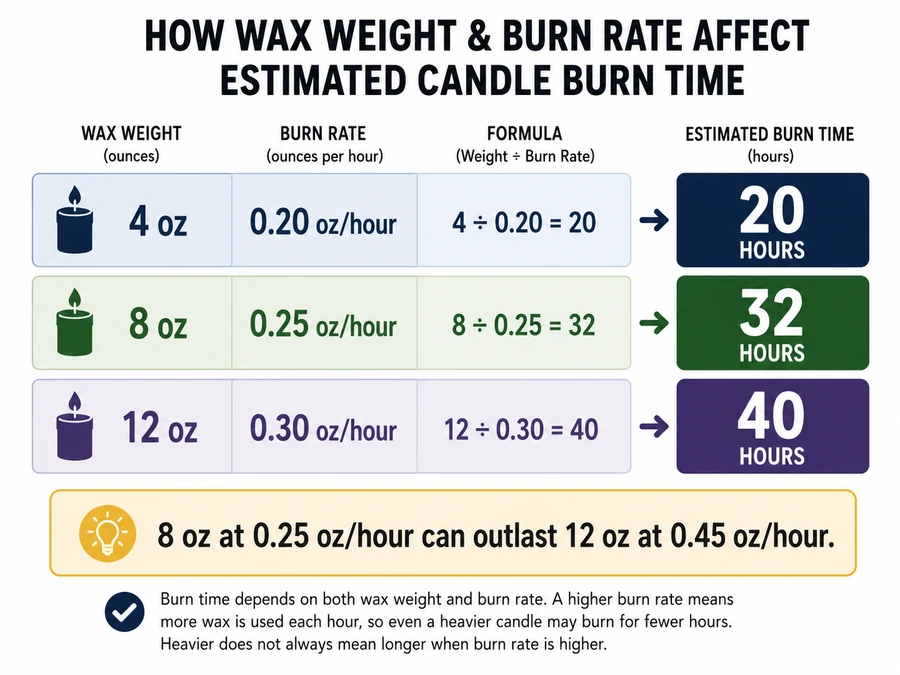
A heavier candle does not always burn longer if its burn rate is higher. An 8 oz candle burning at 0.25 oz/hour can outlast a 12 oz candle burning at 0.45 oz/hour.
Why the Actual Burn Time Can Vary
Actual candle burn time can vary because the calculator uses fixed inputs, while real candles burn under changing conditions.
Wick size, wax blend, vessel shape, fragrance load, airflow, room temperature, and burn-session length can change how much wax is consumed each hour. The estimate becomes more useful when the burn rate comes from the same candle design and similar burn conditions.
| Variable | How it can affect burn time |
|---|---|
| Wick size | A larger flame may consume wax faster |
| Wax blend | Different waxes melt and feed the flame differently |
| Vessel shape | Heat retention can change melt-pool behavior |
| Airflow | Drafts can make the flame less stable |
| Burn-session length | Short sessions and long sessions may not consume wax evenly |
| Remaining wax depth | Burn behavior can change near the end of the candle |
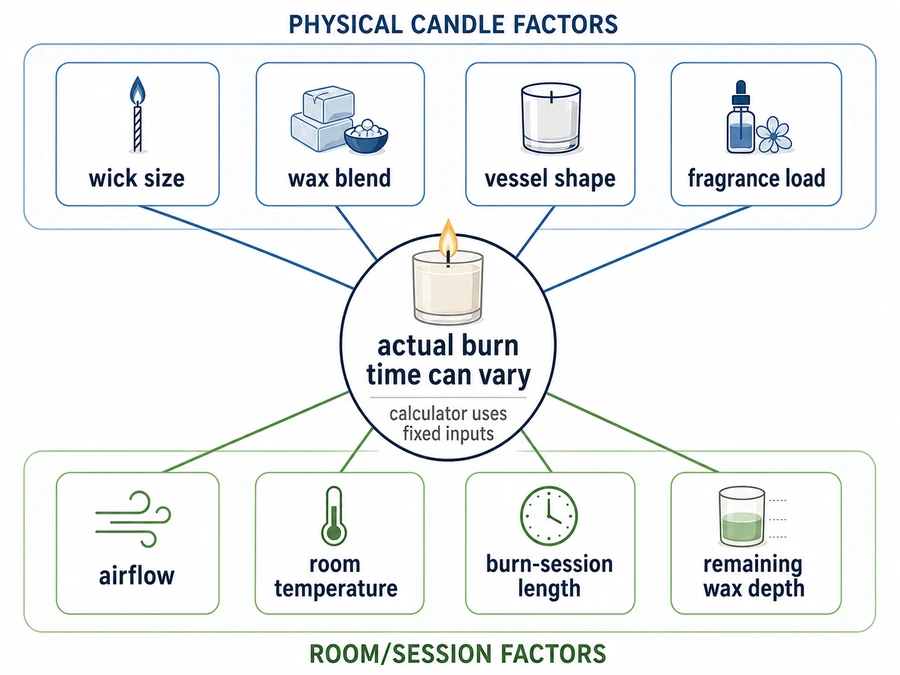
The calculator should be treated as a planning tool. It can estimate total hours, compare candle designs, or check a label claim, but it cannot promise the exact number of hours a candle will burn in every room.
Total Burn Time Is Not One Safe Burn Session
Total burn time means the candle’s estimated lifetime across many burn sessions, not the amount of time it should burn without stopping.
A 32-hour estimate does not mean the candle should burn for 32 hours at once. Use the result to plan several sessions, and follow the candle label or maker’s safety directions for each session.
| Calculator result | Safe interpretation |
|---|---|
| 20 total hours | Plan multiple shorter sessions |
| 32 total hours | Treat as lifetime estimate, not one burn |
| 40 total hours | Expect many sessions if the candle burns normally |
| Lower-than-expected result | Check burn rate, wick behavior, and wax weight |
| Higher-than-expected result | Confirm with testing before using as a rating |
Stop burning if the flame becomes unstable, the vessel overheats, the wick shifts, or the candle shows unsafe behavior. Those signs are safety issues, not calculator errors.
When the Calculator Result Needs More Checking
Recheck the calculator result when the wax weight, burn rate, unit choice, or safe interpretation may be wrong.
If the estimate seems too high, too low, or unsafe to apply, check the input that most likely caused the difference. Keep the calculator focused on total burn hours, then review the candle condition separately when the issue is no longer a math problem.
| After-calculator question | What to check |
|---|---|
| The estimate seems too high | Confirm the burn rate with a timed test |
| The estimate seems too low | Check whether the entered wax weight excludes the jar |
| The burn rate changes between sessions | Compare wick behavior, airflow, and session length |
| The result is being used for product planning | Repeat the test before treating it as a rating |
| The candle burns unevenly | Treat it as a performance issue, not only a burn-time issue |
| The vessel feels too hot | Stop burning and follow safety directions |
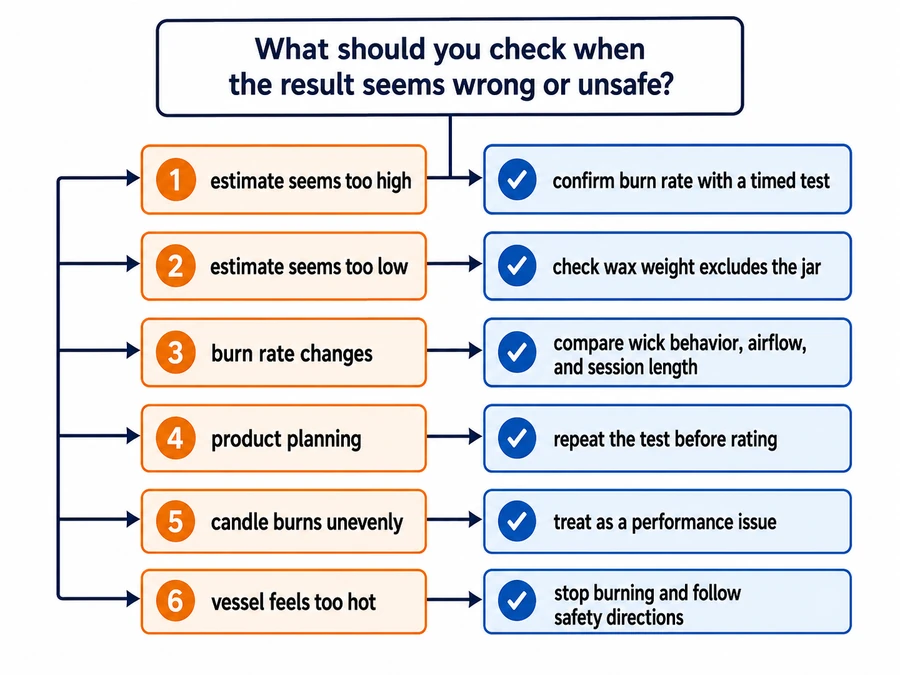
Use the calculator result as the starting number. A separate check is needed when the next question is about testing, value, safety, wax choice, or wick behavior.
FAQs About Candle Burn Time Estimates
These answers clarify the calculator inputs, formula, units, accuracy, and safe interpretation of total burn time.
What is candle burn time?
Candle burn time is the estimated total number of hours a candle can burn across its usable life.
For calculator use, it is based on usable wax weight divided by burn rate per hour. It is not the same as safe continuous burn time.
How do you calculate candle burn time?
Calculate candle burn time by dividing usable wax weight by wax consumed per hour.
For example, 8 oz of usable wax divided by 0.25 oz/hour equals 32 estimated burn hours.
Does candle size mean jar size or wax weight?
Candle size means usable wax weight when calculating burn time.
Jar diameter, vessel volume, and total product weight can mislead the estimate because they may include glass, packaging, empty space, or wax that cannot safely burn.
What burn rate should I use?
Use a measured burn rate from the same candle when accuracy matters.
An assumed burn rate can help during planning, but it should be treated as a rough estimate until a timed burn test confirms how much wax the candle uses per hour.
Can I use grams instead of ounces?
Yes, grams work if the burn rate is also in grams per hour.
The unit rule is simple: wax weight and burn rate must match. Use grams with grams per hour, or ounces with ounces per hour.
How accurate is a candle burn time calculator?
A candle burn time calculator is as accurate as the wax weight and burn rate entered.
Measured inputs produce a closer estimate. Assumed inputs produce a planning number that can change when wick, wax, vessel, airflow, and burn-session conditions change.
Can I burn a candle for the full calculated time?
No, the calculated time is a total lifetime estimate, not one safe burn session.
A 32-hour result means the candle may burn for about 32 total hours across many sessions. Follow the candle’s safety directions for each session.