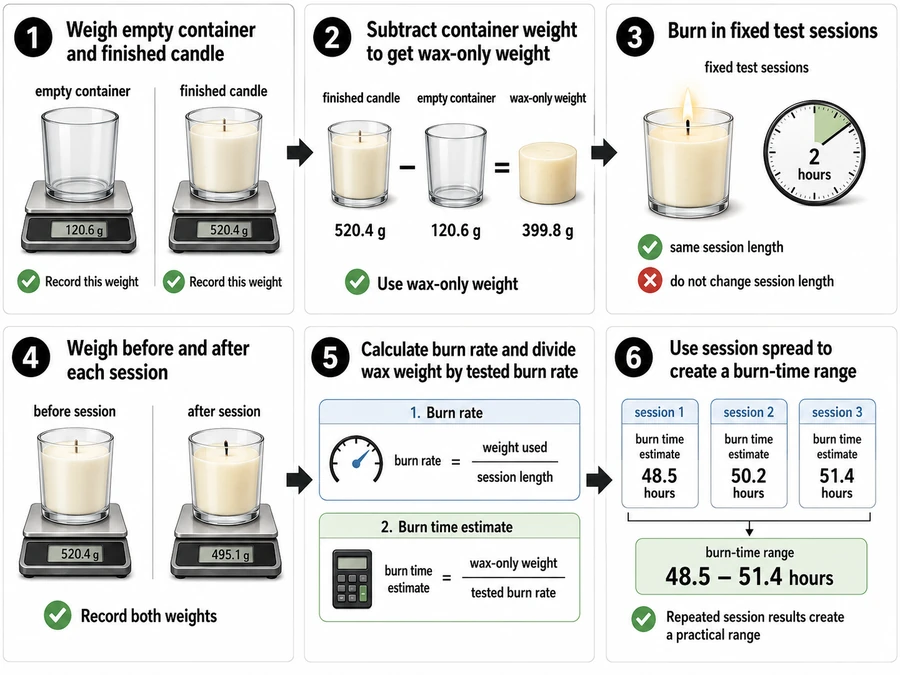

Estimated candle burn time equals wax-only weight divided by measured hourly burn rate, then validated as a practical range with controlled burn testing.
In candle making, burn time means the usable candle duration under defined burn-test conditions. Use wax-only weight, not jar or packaging weight, as the formula input. The estimate is a predicted range, not a guaranteed exact number of hours.
Start by defining burn time clearly, then measure the candle inputs before running the formula.
Quick Candle Burn-Time Estimator Inputs
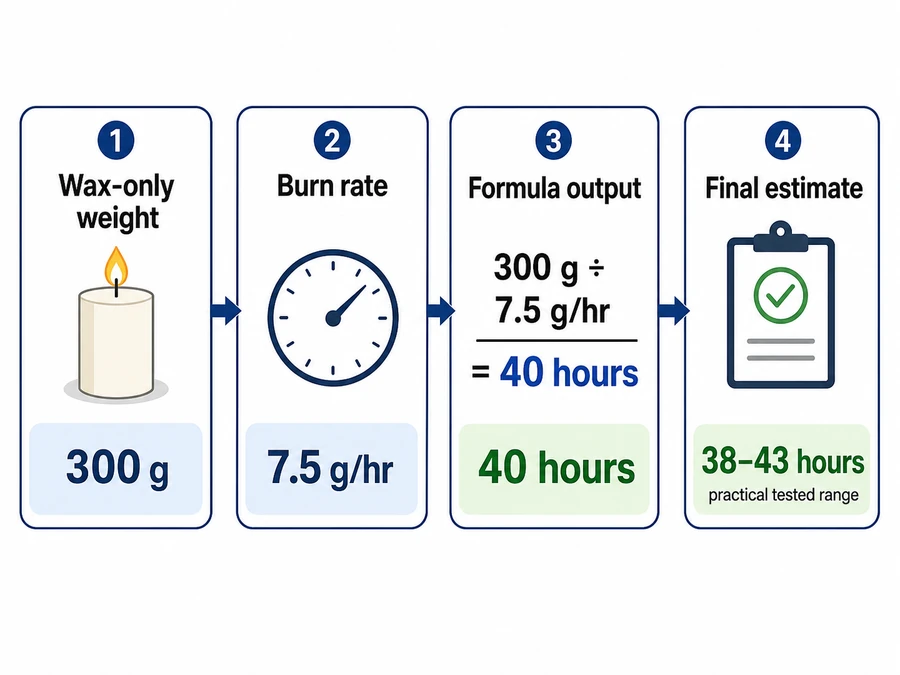
A candle burn-time estimate needs wax-only weight, measured burn rate, and a range decision based on repeated test sessions.
| Input | What to use | Example |
|---|---|---|
| Wax-only weight | Filled candle weight minus empty container weight | 300 g |
| Burn rate | Wax lost during a test session divided by burn hours | 7.5 g/hr |
| Formula output | Wax-only weight divided by burn rate | 40 hours |
| Final estimate | Range based on repeated session spread | 38–43 hours |
What Candle Burn Time Means in Candle Making
Candle burn time is the usable number of hours a finished candle burns under measured test conditions.
For candle makers, burn time is not a guess based on jar size or wax type alone. It is a tested estimate based on how much wax the candle contains and how quickly that wax is consumed during a burn session.
A burn-time estimate helps set realistic expectations before a candle is labeled, gifted, sold, or compared with another test candle. A finished candle may burn longer or shorter than the estimate if the wick, container diameter, wax blend, fragrance load, or room conditions change.
A useful burn-time estimate should answer one practical question: “About how many usable hours can this candle provide when it is burned under repeatable conditions?”
| Term | Meaning for burn-time estimation | Why it matters |
|---|---|---|
| Burn time | Estimated usable candle duration | Sets the expected hour range |
| Wax weight | Wax-only mass inside the candle | Main formula input |
| Burn rate | Wax consumed per hour | Divides wax weight into hours |
| Test conditions | Session length, rest time, container, wick, and environment | Keeps results comparable |
Burn time should be treated as a range because real candles do not burn at one fixed rate from first light to final use. A safer estimate might be “about 35–40 hours” rather than a single claim such as “40 hours.”
Measure Wax-Only Weight Before Using the Formula
Wax-only weight is the mass of candle wax inside the vessel, excluding the jar, lid, label, wick tab, and packaging.
This matters because the burn-time formula depends on how much usable wax can burn. Total candle weight will overstate the estimate when it includes glass, ceramic, metal, or outer packaging.
Use this formula when the container is empty before pouring:
Wax-only weight = filled candle weight − empty container weight
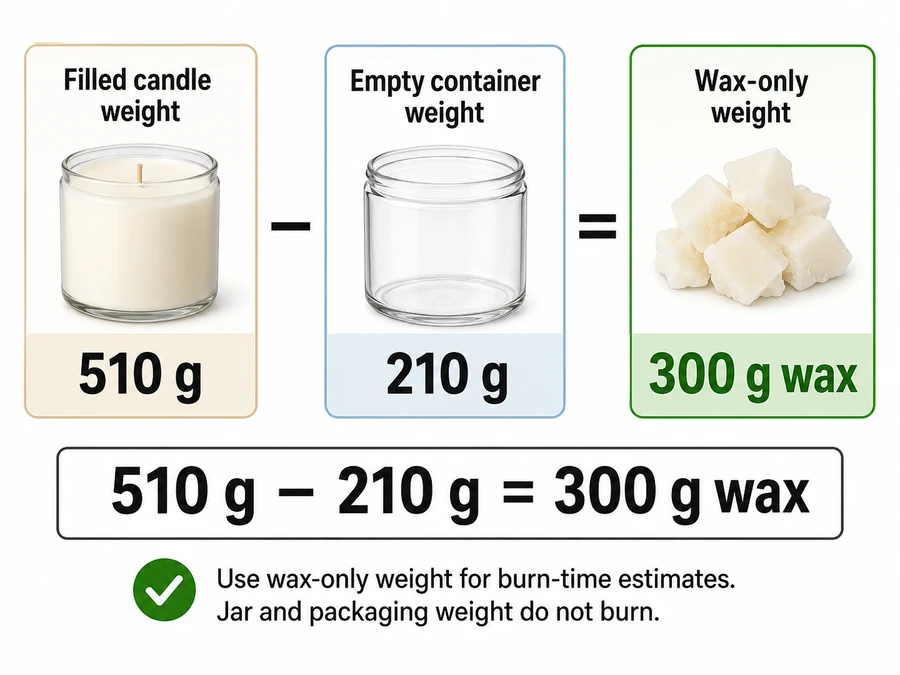
For a candle that weighs 510 g after pouring and uses a 210 g empty jar, the wax-only weight is:
510 g − 210 g = 300 g wax
That 300 g is the number used in the burn-time formula. The 510 g total candle weight is not the correct input because most of it does not burn.
| Measurement | Includes | Use in burn-time formula? |
|---|---|---|
| Filled candle weight | Jar, wax, wick, label if attached | No |
| Empty container weight | Jar or vessel only | No |
| Wax-only weight | Usable wax mass | Yes |
| Packaging weight | Box, lid, wrap, shipping material | No |
For container candles, weigh the empty vessel before pouring and record it in the batch notes. For pillar candles, wax-only weight is usually closer to the full candle weight, but decorations, embeds, and non-wax parts should still be excluded when they do not burn like the main wax body.
Use the Burn Time Formula: Wax Weight ÷ Burn Rate
The candle burn-time formula is wax-only weight divided by measured hourly burn rate.
Use this formula:
Estimated burn time = wax-only weight ÷ burn rate per hour
The units must match. If wax weight is measured in grams, burn rate should be grams per hour. If wax weight is measured in ounces, burn rate should be ounces per hour.
| Formula input | What to enter | Unit example | Mistake to avoid |
|---|---|---|---|
| Wax-only weight | The amount of usable wax in the candle | 300 g | Do not enter jar weight |
| Burn rate | Wax consumed per hour during testing | 7.5 g/hr | Do not guess from jar size |
| Estimated burn time | Formula output | 40 hours | Do not treat as a guarantee |
Example:
300 g wax ÷ 7.5 g/hr = 40 hours
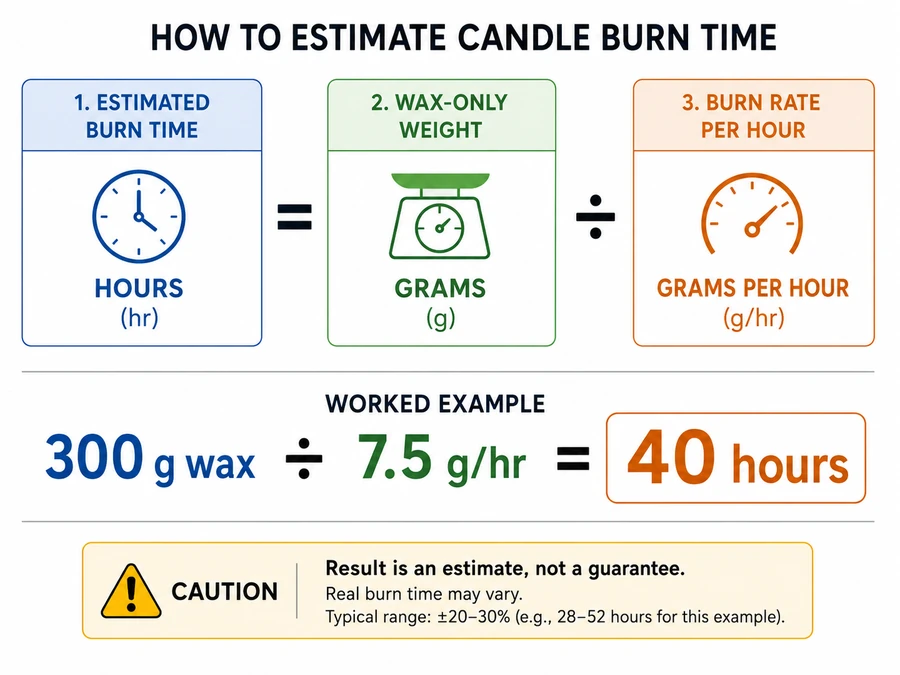
That result means the candle may provide about 40 usable burn hours if the test conditions stay similar. It does not mean every customer, room, wick trim, or burn session will produce exactly 40 hours.
For a safer candle-making estimate, convert the single result into a range after testing more than one burn session. A candle calculated at 40 hours may be stated internally as about 38–42 hours if the repeated sessions stay close.
| If the formula result is… | Treat it as… | What to do next |
|---|---|---|
| Based on one test session | A rough first estimate | Test again before relying on it |
| Based on repeated sessions | A stronger estimate | Compare session burn rates |
| Much higher than expected | A possible measurement issue | Recheck wax weight and burn rate |
| Much lower than expected | A possible test-condition issue | Review wick, diameter, and session length |
Measure Burn Rate in Grams or Ounces Per Hour
Burn rate is the amount of candle wax consumed per hour during a measured burn session.
In candle making, burn rate connects the real candle test to the burn-time formula. A lower hourly burn rate produces a longer estimate, while a higher hourly burn rate produces a shorter estimate.
Use this formula:
Burn rate = weight lost during the session ÷ burn session length
Example:
A candle weighs 420 g before a test session and 390 g after the session. The session lasts 4 hours.
420 g − 390 g = 30 g lost
30 g ÷ 4 hours = 7.5 g/hr
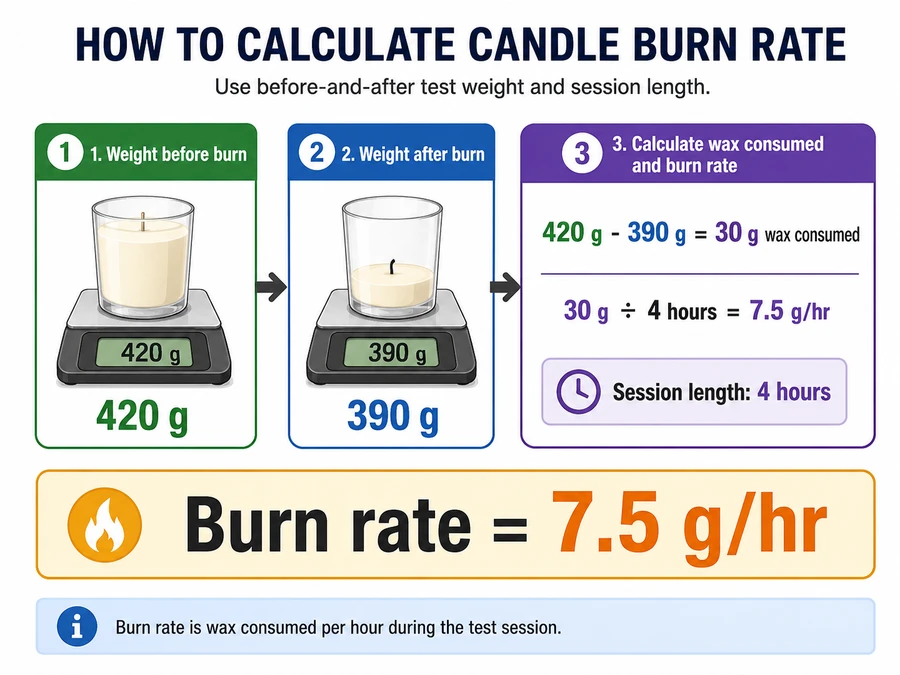
That 7.5 g/hr becomes the burn-rate input for the burn-time formula.
| Test record | Example value | Why it matters |
|---|---|---|
| Weight before burn | 420 g | Starting point |
| Weight after burn | 390 g | Ending point |
| Wax consumed | 30 g | Difference between before and after |
| Session length | 4 hours | Time used to divide weight loss |
| Burn rate | 7.5 g/hr | Formula input |
Burn rate should not be read as wick performance by itself. A large flame, wide container, soft wax blend, or long session can change wax consumption, but this section only uses burn rate to estimate candle hours.
Repeat the burn-rate measurement across more than one session before making a final estimate. If one session burns 6.8 g/hr and another burns 8.2 g/hr, the candle’s final burn-time estimate should reflect that spread instead of using only the best-looking number.
Run a Controlled Burn Test to Validate the Estimate
A controlled burn test checks whether the formula estimate matches the candle’s real wax consumption over repeated sessions.
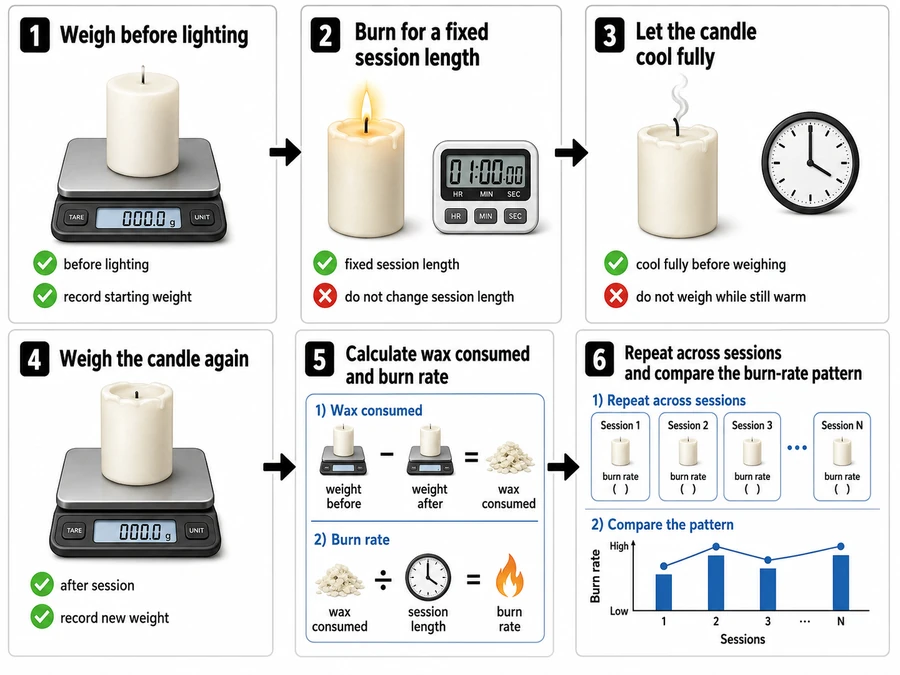
The goal is repeatability. Test the same candle under similar conditions, record the weight loss, calculate burn rate, and compare each session before trusting the final burn-time range.
A burn-time test is not a full candle safety certification. It only validates whether the candle’s wax weight and measured burn rate support a realistic hour estimate.
For a more comparable test record, use the same burn cycle and cooling period each time. Many candle test protocols use repeated burn sessions with a full cooling period between cycles, so the rate is compared under similar conditions.
| Step | What to do | What to record |
|---|---|---|
| 1 | Weigh the candle before lighting | Starting weight |
| 2 | Burn for a fixed session length | Start time and end time |
| 3 | Let the candle cool fully | Rest period |
| 4 | Weigh the candle again | Ending weight |
| 5 | Calculate wax consumed | Starting weight minus ending weight |
| 6 | Divide by burn hours | Burn rate per hour |
| 7 | Repeat across sessions | Burn-rate pattern |
Can You Estimate Burn Time Without Burning the Whole Candle?
You can make a preliminary candle burn-time estimate from a partial burn test, but a full-life burn test gives stronger evidence.
A partial test can calculate hourly burn rate from one or more measured sessions. A full-life test checks whether that rate changes as the candle burns lower, the vessel warms differently, and the wick behavior changes.
Use the partial result as an early estimate, then widen the range or complete more test cycles before using the number for labels, listings, or batch comparisons.
Example test sequence:
Session 1: 30 g lost over 4 hours = 7.5 g/hr
Session 2: 28 g lost over 4 hours = 7 g/hr
Session 3: 32 g lost over 4 hours = 8 g/hr
The candle is not burning at one perfect rate. A realistic estimate should use the tested spread instead of choosing only the slowest burn session.
Keep Session Length and Rest Time Consistent
Consistent burn sessions make candle burn-rate results easier to compare.
If one test session lasts 2 hours and another lasts 6 hours, the wax pool, vessel heat, flame behavior, and wax consumption pattern may differ. That makes the burn-rate estimate less reliable.
Choose a repeatable session length and use it across the test. Many makers use the same session length for every round because the point is comparison, not getting the best-looking number.
| Test variable | Keep consistent because… |
|---|---|
| Session length | Burn rate changes when session time changes |
| Rest period | Hot containers and soft wax can affect weighing |
| Wick trim habit | Flame size changes wax consumption |
| Room conditions | Drafts and temperature can shift burn behavior |
| Scale timing | Weighing too soon can distort repeat records |
Let the candle cool before the next weighing. The rest period matters because hot wax, a warm container, or a partly liquid melt pool can make the next test less comparable.
Record Container Diameter as a Test Condition
Container diameter is a burn-time test condition because candle width affects melt pool size and wax consumption.
A wider container can expose more wax surface during the burn. A narrower container may burn through wax differently, even when the wax-only weight looks similar.
This does not mean container diameter alone predicts burn time. It means diameter should be recorded beside the burn-rate data so later candles are compared fairly.
| Candle detail | Example entry | Why to record it |
|---|---|---|
| Container diameter | 3 in / 7.6 cm | Helps explain burn-rate differences |
| Wax-only weight | 300 g | Main formula input |
| Wick used | CD 12 | Test variable, not a full wick guide |
| Burn session length | 4 hours | Keeps rate comparison fair |
| Burn rate | 7.5 g/hr | Formula input |
A 300 g candle in a narrow jar and a 300 g candle in a wide jar should not be treated as identical just because the wax weight matches. Record the container size so the estimate stays tied to the candle that was actually tested.
Treat Wax Type as a Burn-Rate Qualifier
Wax type can change the burn-rate estimate, but it should not replace real burn testing.
Soy, paraffin, beeswax, coconut blends, and gel candles may consume wax at different rates because each wax behaves differently when heated. The formula still needs measured wax weight and measured hourly burn rate.
Use wax type as a note beside the test result, not as a shortcut to the final hour claim.
| Wax type or blend | How to use it in the estimate |
|---|---|
| Soy wax | Record it as the tested wax, then calculate from measured burn rate |
| Paraffin wax | Compare only with paraffin candles tested under similar conditions |
| Beeswax | Do not assume long burn time without weighing and testing |
| Coconut blend | Treat the full blend as the tested material |
| Gel candle | Keep separate from regular wax examples because behavior differs |
A soy candle and a paraffin candle with the same wax weight can still produce different burn-time results. The practical answer is not “soy always lasts X hours.” The practical answer is: test the actual candle and record the wax type with the burn-rate result.
Turn the Formula Result Into a Realistic Burn-Time Range
A candle burn-time estimate should become a range when test sessions show normal variation.
A single formula result gives one number. Repeated burn-rate results show whether that number is stable enough to use or whether the estimate should be widened.
Example:
| Test session | Burn rate | 300 g wax estimate |
|---|---|---|
| Session 1 | 7.5 g/hr | 40 hours |
| Session 2 | 7 g/hr | 42.9 hours |
| Session 3 | 8 g/hr | 37.5 hours |
The tested estimate is not exactly 40 hours. A more honest internal estimate is about 38–43 hours, because the candle burned at different rates across the test sessions.
Use this decision logic:
| Result pattern | Better estimate choice |
|---|---|
| Sessions stay close together | Use a narrower range |
| Sessions vary widely | Use a wider range or retest |
| One session looks unusual | Check the log before using it |
| Only one session was tested | Treat the result as preliminary |
| Wick, wax, or container changes | Retest instead of reusing the old estimate |
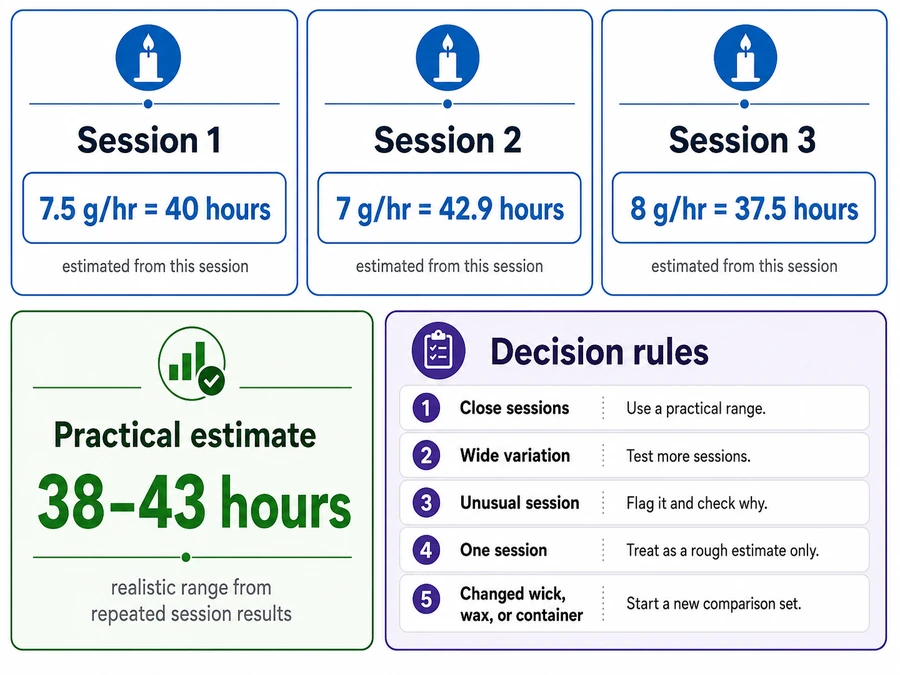
The range protects the candle maker from overclaiming. It tells the reader, buyer, or tester that the number came from measured burn behavior, not a perfect-hour promise.
Use a Burn-Time Test Log to Record Sample Data
A burn-time test log records the measurements that support the final candle burn-time estimate.
The log should show wax weight, session length, weight lost, burn rate, and notes that explain why one session may differ from another. Without those records, the final hour range is hard to check.
| Session | Start weight | End weight | Burn length | Wax lost | Burn rate | Notes |
|---|---|---|---|---|---|---|
| 1 | 420 g | 390 g | 4 hr | 30 g | 7.5 g/hr | Clean flame |
| 2 | 390 g | 362 g | 4 hr | 28 g | 7 g/hr | Similar room conditions |
| 3 | 362 g | 330 g | 4 hr | 32 g | 8 g/hr | Slightly larger melt pool |
For this sample candle, the tested burn rate ranges from 7–8 g/hr. If the candle contains 300 g of wax, the estimated burn-time range is:
300 g ÷ 8 g/hr = 37.5 hours
300 g ÷ 7 g/hr = 42.9 hours
That supports a practical estimate of about 38–43 hours under similar test conditions.
Use the same log format for every test candle. The goal is not to make the number look longer; the goal is to make the estimate easier to repeat, compare, and defend.
Check Common Burn-Time Estimation Mistakes Before Retesting
Most inaccurate burn-time estimates come from using the wrong weight, guessing burn rate, or treating one test as final.
Before retesting, check the formula inputs and test notes. A small recording mistake can change the final hour estimate by several hours.
| Mistake | Why it weakens the estimate | Better correction |
|---|---|---|
| Using total candle weight | Includes jar or packaging weight | Use wax-only weight |
| Guessing burn rate | Removes the test evidence | Weigh before and after each session |
| Using one session only | Misses normal variation | Repeat sessions and compare |
| Changing session length | Makes burn rates harder to compare | Keep test timing consistent |
| Ignoring container diameter | Hides a major test condition | Record jar width with the log |
| Treating the result as exact | Overstates certainty | Convert the result into a range |
| Reusing old data after changing wax or wick | The candle is no longer the same test item | Retest the changed candle |
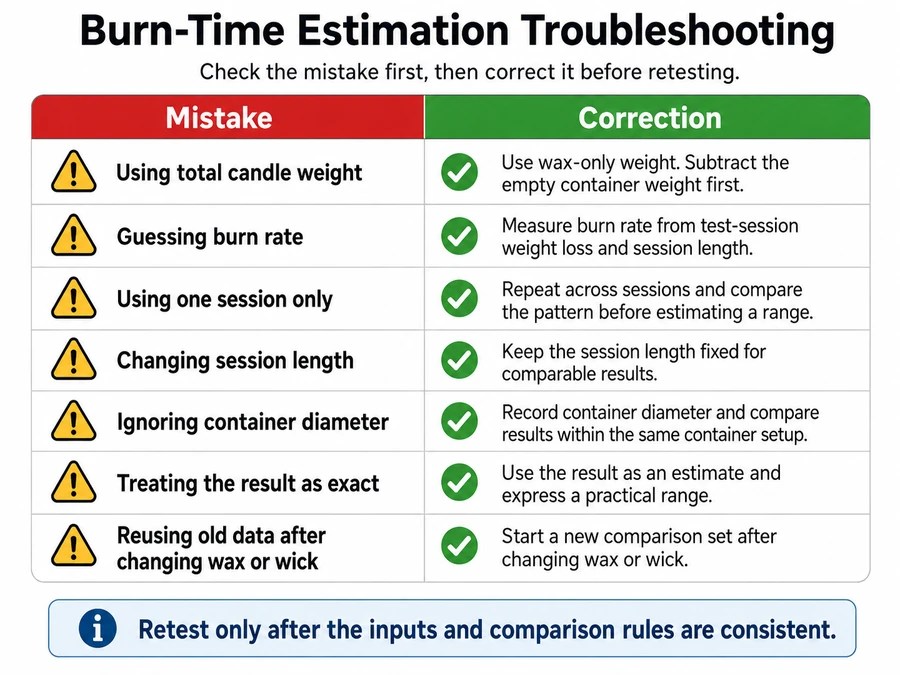
A fast-burning candle does not automatically mean the burn-time formula failed. It may mean the wax-only weight was wrong, the burn rate was measured during an unusual session, or the candle design changed after the first test.
Keep the mistake check narrow. Wick sizing, tunneling, soot, and full safety testing are separate candle-making tasks. For burn-time estimation, the priority is accurate weight, measured burn rate, repeatable sessions, and a clear range.
Final Burn-Time Estimate Workflow
Estimate candle burn time by measuring wax-only weight, calculating hourly burn rate, and turning repeated test results into a realistic range.
The cleanest workflow is:
- Weigh the empty container.
- Weigh the finished candle.
- Subtract container weight to get wax-only weight.
- Burn the candle in fixed test sessions.
- Weigh before and after each session.
- Calculate burn rate per hour.
- Divide wax weight by tested burn rate.
- Use the session spread to create a burn-time range.
A candle with 300 g of wax and a tested burn rate of 7–8 g/hr should not be treated as exactly 40 hours. It is better recorded as about 38–43 hours under similar test conditions.
That range gives candle makers a clearer expectation than a guessed hour claim, while still leaving room for real-world variation in wax, wick, container diameter, and burning conditions.