
Finished candles usually do not expire like food, but they can lose scent, color, wax quality, wick reliability, and burn readiness during storage.
On this page, “expire” means quality decline in a finished candle, not food-like spoilage. A candle can still be burnable after its scent weakens, but poor wax, wick, container, or odor changes can make replacement safer.
Storage conditions decide how slowly a candle ages, especially heat, sunlight, dust, moisture, and loose packaging. Use the checks below to decide whether an old candle is worth burning, keeping, gifting, selling, or discarding.
Do Candles Expire or Just Lose Quality?
Candles usually do not expire like food, but finished candles can lose quality over time.
A finished candle is a wax product with a wick. On this page, “expire” means practical quality decline: weaker scent, discoloration, wax changes, wick problems, contamination, container damage, or lower confidence for gifting.
A candle can be past its best quality and still burn. Age alone does not make every candle unusable, but age plus poor storage can move a candle from “still good” to “use soon,” “gift with caution,” “replace,” or “discard.”
| User wording | What it means for finished candles | Best next check |
|---|---|---|
| “Do candles expire?” | Usually quality decline, not food-like spoilage | Check scent, wax, wick, container, and storage history |
| “Did my candle go bad?” | The candle may have lost scent, changed texture, picked up debris, or stored poorly | Look for warning signs before burning |
| “How long do candles last?” | On this page, storage shelf life | Do not confuse this with burn hours |
| “Did the scent expire?” | Fragrance strength may have faded | Compare cold throw and hot throw |
| “Can I still gift it?” | Giftability depends on scent, appearance, packaging, and confidence | Inspect more strictly than for personal use |
| “Is it safe?” | Safety means no clear warning signs after inspection, not a guarantee | Check container, wick, surface debris, odor, and wax condition |
If by “last” you mean how many hours a candle burns while lit, that is burn-time duration. This article stays focused on storage shelf life and quality loss in finished candles.
How Long Candles Usually Last in Storage
Candle shelf life is a quality-retention estimate for a finished candle in storage, not a guaranteed expiration date.
Shelf life means the candle still has acceptable scent, appearance, wick readiness, and container condition. Fragrance, wax type, dye, packaging, heat, sunlight, air exposure, and dust all affect how quickly that quality declines.
Many candles can stay usable for years, but scented quality often declines before the candle becomes physically unusable. An old candle with weak scent may still work for ambiance, while a candle with container damage, contamination, or a compromised wick needs a stricter decision.
Methods note: The ranges below are conservative quality windows, not manufacturer guarantees. They model finished-candle condition under typical home storage and should be checked against the actual candle’s scent, wax, wick, packaging, and container.
If the candle maker provides a use-by, best-before, or storage recommendation, use that instruction before a general shelf-life estimate.
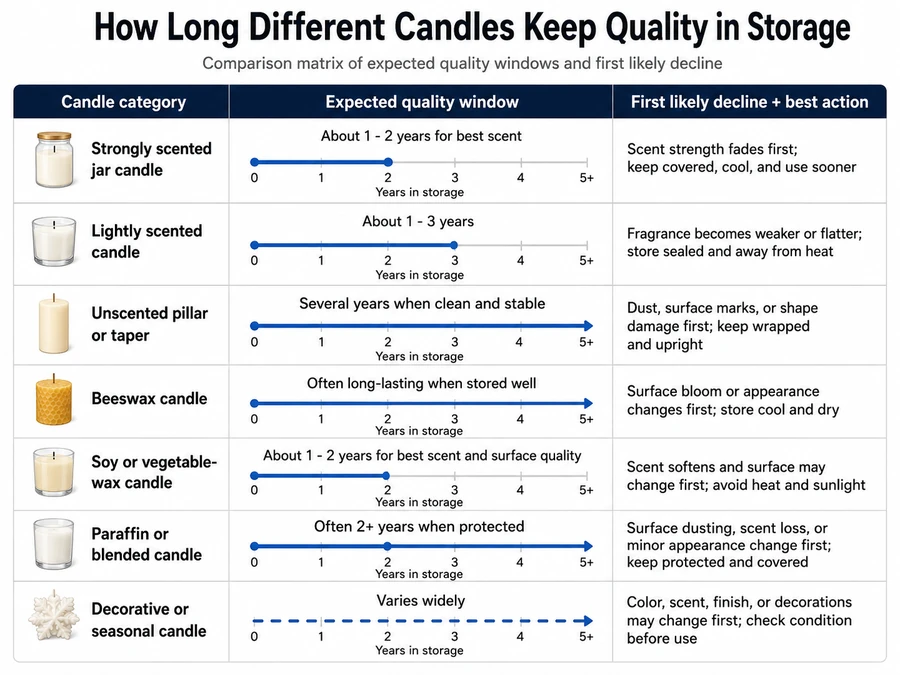
| Candle category | Expected quality window | First likely decline | Storage caveat | Best action |
|---|---|---|---|---|
| Strongly scented jar candle | About 1–2 years for best scent | Weaker cold throw or hot throw | Lasts better with lid, shade, and stable room temperature | Use sooner if scent matters |
| Lightly scented candle | About 1–3 years | Subtle fragrance fade | Weak scent may be hard to notice until burning | Burn for ambiance if wax and wick look normal |
| Unscented pillar or taper | Often several years if clean and stable | Color change, dust, surface marks, bending, or wick dryness | No fragrance value to lose | Keep if shape, wick, and surface are sound |
| Beeswax candle | Often long-lasting when stored well | Surface bloom, dust, or mild color shift | Natural surface changes may be cosmetic | Keep if wick and shape remain usable |
| Soy or vegetable-wax candle | About 1–2 years for best scent and surface quality | Frosting, sweating, scent fade, or texture change | More sensitive to heat and temperature swings | Use soon if scent or surface quality is declining |
| Paraffin or blended candle | Often 2+ years when protected | Scent fade, dye fading, dust, or surface dullness | Fragrance and dye still age even if wax is stable | Inspect, then keep or use |
| Gel candle | Condition varies by container and fragrance | Cloudiness, fragrance change, debris, or container concern | Must be inspected carefully because the container is part of usability | Discard if container or contents look abnormal |
| Decorative, gift, or seasonal candle | Varies widely | Fading, label wear, dust, bent shape, stale scent | Display exposure shortens gift quality | Keep for display or avoid gifting if presentation declined |
Unopened or boxed candles often age more slowly because packaging limits light, dust, and air exposure. Sealed or covered does not mean permanent freshness; it only lowers exposure.
Why Old Candles Lose Scent Before They Become Unusable
Old scented candles often lose fragrance strength before the wax or wick becomes unusable.
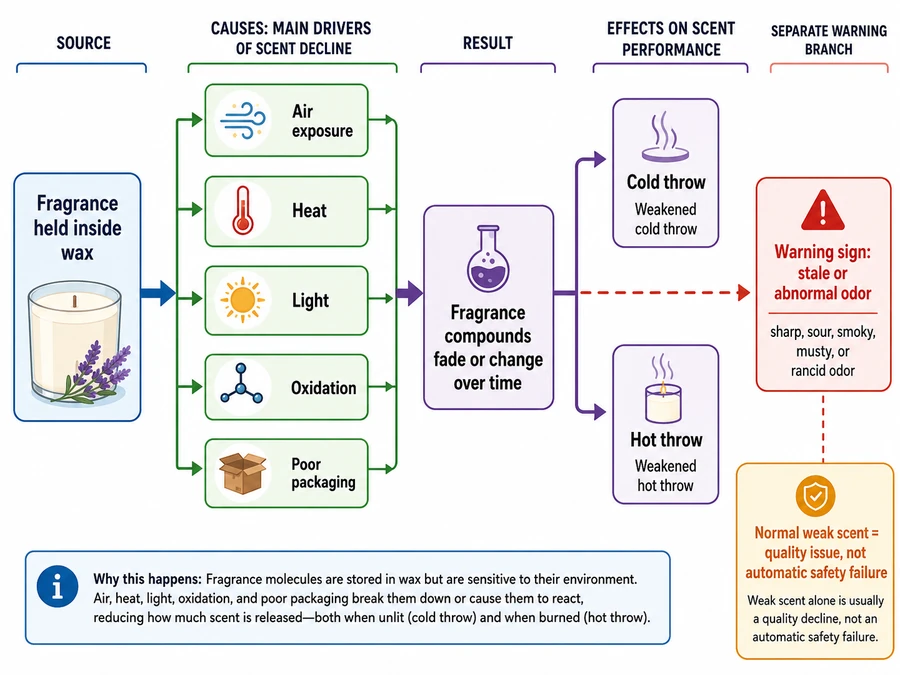
A scented candle relies on fragrance held inside the wax. Over time, scent can weaken through air exposure, heat, light, oxidation, and poor packaging, so the candle may still burn but smell lighter than expected.
Scent loss can show up in two ways. Cold throw is the smell of an unlit candle. Hot throw is the smell released while the candle burns. A candle can smell faint in the jar but still release some scent when lit, or it can smell good cold and perform weakly once burning.
| Scent change | What it usually means | Does it mean the candle expired? | Best action |
|---|---|---|---|
| Weak smell before lighting | Fragrance has faded from the wax surface or air-exposed area | Not always | Burn soon if the wax and wick look normal |
| Weak smell while burning | The candle may have lost hot throw or was lightly scented to begin with | Quality decline | Use for light ambiance or replace if scent matters |
| Different or stale fragrance | Fragrance may have changed during storage | Possible quality failure | Avoid gifting; burn only if no other warning signs appear |
| No scent left | Fragrance value is mostly gone | Scent has passed its best quality | Keep only as an unscented candle if safe to burn |
| Sharp, sour, smoky, or musty odor | The candle may be contaminated or fragrance may have degraded poorly | Strong discard signal | Do not burn if the odor seems abnormal |
Heat matters because it can soften wax and make fragrance move, evaporate, or separate faster. Sunlight matters because light can fade dye and weaken fragrance. Loose lids, missing boxes, or open storage expose the candle to air and household odors.
A faded scent does not automatically make a candle unsafe. The real decision depends on the full condition: scent, wax surface, wick, container, contamination, and storage history.
Soy, Paraffin, Beeswax, Coconut, Gel, and Blended Candle Shelf Life
Different candle waxes age differently, but storage conditions usually matter more than the wax name alone.
Wax type affects texture, scent retention, color stability, and visible aging signs. Still, a covered candle stored in a cool, dark place often ages better than a premium wax candle left in heat, sun, dust, or humidity.
| Candle type | Common aging pattern | What to check first | Practical condition note |
|---|---|---|---|
| Soy candle | Frosting, sweating, texture change, scent fade | Surface texture and scent strength | Prioritize scent strength, surface stability, and heat-exposure signs |
| Paraffin candle | Scent fade, dye fading, dust, surface dullness | Fragrance, color, wick, and container | Judge fragrance, color, and container condition before assuming storage quality |
| Beeswax candle | Bloom, dust, mild color change | Wick, shape, surface debris, and natural smell | Natural bloom can be acceptable when the wick, shape, and surface stay clean |
| Coconut wax candle | Softening, sweating, scent change | Heat exposure and surface condition | Treat softening or sweating as a heat-storage warning |
| Gel candle | Cloudiness, debris, scent change, container issues | Container integrity and contents clarity | Discard if the gel, decorations, or container look unsafe |
| Blended wax candle | Mixed signs depending on formula | Scent, wax surface, dye, wick, and jar | Judge by condition rather than the blend name |
Soy frosting is often cosmetic. Beeswax bloom can be cosmetic too. Wax sweating, severe separation, odd odor, debris around the wick, or container damage deserves more caution because those signs affect use, not just appearance.
For shelf life, “soy vs paraffin” is less useful than this question: has the finished candle been protected from heat, sunlight, air, moisture, and dust? A well-stored candle with a plain formula can outlast a poorly stored candle with a better label.
Scented vs Unscented Candle Shelf Life
Scented candles usually lose best quality sooner than unscented candles because fragrance is the first feature to fade.
An unscented candle can stay useful as long as the wax, wick, shape, and container remain in good condition. A scented candle has one more quality layer to protect: the fragrance held in the wax.
| Candle type | Main quality risk over time | What “expired” usually means | Best decision |
|---|---|---|---|
| Scented candle | Weak scent, changed scent, stale odor, lower hot throw | Fragrance quality has declined | Use soon, replace if scent is the main reason for owning it |
| Unscented candle | Dust, bent shape, wick damage, wax cracking, container problems | Burn or appearance quality has declined | Keep if clean, stable, and burn-ready |
| Decorative scented candle | Scent fade plus color or surface changes | Display and fragrance value may both decline | Avoid gifting if it looks or smells tired |
| Emergency unscented candle | Wick, shape, dust, and storage damage | Function may be reduced | Keep only if it lights cleanly and is not contaminated |
This is why an old unscented taper may still feel useful after years, while an old scented jar candle may feel disappointing after one warm summer in a cabinet. The scented candle has not necessarily become unsafe; it has lost the feature the user expected.
If the candle is for atmosphere, weak scent may be acceptable. If the candle is for fragrance, gifting, selling, or product quality, scent fade matters much sooner.
What Wax, Color, Wick, and Contamination Changes Mean
Visible candle changes can be cosmetic, quality-related, or a warning sign.
A finished candle should be judged by the combined condition of the wax body, color, wick, container, surface, and smell. One small change may be harmless, but several changes together lower confidence.
| Change in an old candle | Usually cosmetic | Quality concern | Strong discard signal |
|---|---|---|---|
| Light surface frosting | Yes | Sometimes | Rarely |
| Mild color fading | Yes | Sometimes | Rarely |
| Dust on the wax surface | Sometimes | Yes | If near or stuck to the wick |
| Weak scent | No | Yes | If scent smells sour, musty, smoky, or rancid |
| Wax sweating | Sometimes | Yes | If heavy, sticky, separated, or paired with odd odor |
| Cracked wax | Sometimes | Yes | If it exposes wick problems or unstable structure |
| Bent taper or warped pillar | No | Yes | If it cannot stand safely |
| Loose, buried, dirty, or broken wick | No | Yes | Yes |
| Cracked glass or damaged container | No | Yes | Yes |
| Moisture, mold-like growth, pet hair, or debris | No | Yes | Yes |
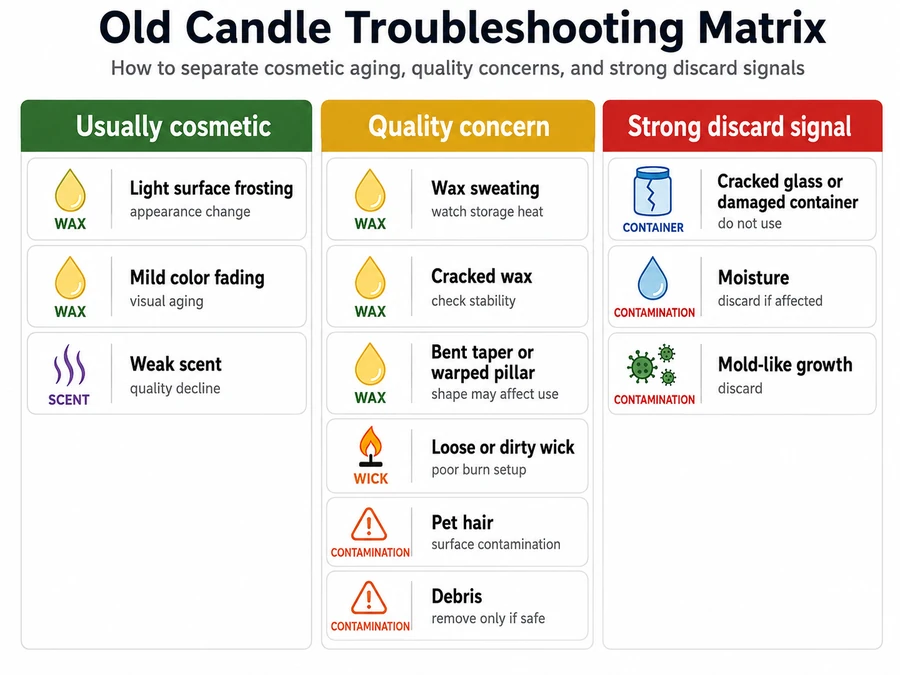
A cosmetic change affects appearance more than usability. A quality concern affects scent, burn behavior, gifting value, or product confidence. A discard signal means the candle should not be burned because the wick, container, surface, or odor no longer supports a safe, predictable use decision.
The safest practical rule is simple: keep or burn a candle only when the wax looks stable, the wick is clean and centered enough to light, the container is intact, and the candle smells normal.
Wax Frosting, Sweating, Cracking, and Texture Changes
Wax texture changes do not always mean a candle is unusable, but they show how storage and age affected the finished candle.
Frosting, sweating, cracking, bloom, and separation each point to a different condition. Judge the candle by severity, smell, wick condition, and container stability rather than the surface change alone.
| Wax change | What it means | Burn decision |
|---|---|---|
| Light frosting | A pale, crystal-like surface change, often seen in vegetable waxes | Usually fine if the wick, scent, and container are normal |
| Surface bloom | A pale film or powdery look, often seen on beeswax | Usually fine if the candle is clean and smells normal |
| Minor cracking | Wax has contracted, dried, or shifted during storage | Often usable if the wick is intact and the candle is stable |
| Wax sweating | Oil or fragrance appears on the surface | Use caution; heat exposure or fragrance movement may have changed quality |
| Sticky surface | Wax or fragrance may have softened, separated, or collected dust | Avoid gifting; burn only if clean, stable, and normal-smelling |
| Heavy separation | Wax and fragrance no longer look evenly held together | Replace or discard, especially if paired with odor or wick problems |
| Warped shape | Heat or pressure changed the candle body | Do not burn if it cannot sit or stand safely |
A light cosmetic change matters less than a burn-readiness problem. A candle with mild frosting can still be useful, while a warped pillar, sticky surface, or separated jar candle deserves a stricter decision.
If the wax smells normal, the wick is clean, and the candle sits safely, a surface change may only reduce appearance quality. If the wax looks oily, dirty, unstable, or unusually soft, the candle is past the point where “old but fine” is a safe assumption.
Color Fading, Yellowing, and Discoloration
Color change in an old candle is often cosmetic, but it can signal heat, sunlight, dye aging, or fragrance change.
A finished candle may fade, yellow, darken, or develop uneven patches during storage. Light and heat are the main causes, especially when a candle sits near a window, on a shelf, or in a warm cabinet.
| Color change | Likely cause | What it changes | Best action |
|---|---|---|---|
| Faded outer surface | Sunlight or display exposure | Appearance and gift quality | Keep for personal use if it smells and burns normally |
| Yellowing | Wax, fragrance, dye, or age-related change | Appearance and product confidence | Avoid gifting if the change is obvious |
| Dark spots | Dye shift, debris, oxidation, or contamination | Appearance and possible usability | Inspect the surface, wick, and odor before burning |
| Uneven color bands | Heat, temperature swings, or partial sun exposure | Appearance | Use only if the candle remains stable and clean |
| Discoloration near the wick | Dust, residue, fragrance movement, or prior handling | Burn-readiness concern | Be stricter because the wick area affects flame behavior |
| Color plus strange odor | Possible fragrance breakdown or contamination | Quality and safety confidence | Discard rather than burn |
Color fading alone does not make a candle unsafe. A decorative candle can look older and still burn normally if the wax, wick, container, and scent remain acceptable.
Discoloration matters more when it appears with a stale smell, sticky wax, debris, moisture, or wick damage. In that case, the color change is no longer just an appearance issue; it becomes part of the discard decision.
Wick Problems in Old Candles
A candle with an aged or damaged wick may light poorly, burn unevenly, or become unsafe to use.
The wick controls ignition, flame size, melt pool behavior, and how the candle consumes wax. An old candle can look fine on the surface but still perform badly if the wick is buried, loose, bent, dirty, wet, or contaminated.
| Wick condition | What it means | Burn decision |
|---|---|---|
| Clean, visible, centered wick | The candle is more likely to light normally | Trim if needed, then burn with caution |
| Long, dusty wick | Dust or storage residue may affect the flame | Trim and remove debris before use |
| Buried wick | Wax has covered the wick or the wick is too short | Do not dig aggressively; replace if it cannot be exposed safely |
| Loose wick | Wick may have separated from the wax or tab | Do not burn because flame position may shift |
| Bent wick near container wall | Flame may heat the container unevenly | Avoid burning, especially in glass |
| Wet, oily, or sticky wick | Fragrance movement, moisture, or contamination may be present | Discard if it smells abnormal or will not trim cleanly |
| Blackened wick on an unused candle | Prior lighting, residue, or contamination may be present | Treat as used; inspect before burning |
| Wick with pet hair, dust clumps, or debris | Foreign material may burn unpredictably | Remove only loose debris; discard if stuck into wax or wick |
A wick problem is more serious than mild color fading because the wick affects the flame. When the wick no longer looks clean, stable, and properly placed, the candle is not just past its best appearance; it may be unreliable.
Do not add oils, scrape deeply around the wick, microwave the candle, or remelt it as a quick fix. Those fixes can make a weak candle less predictable.
How Storage Conditions Change Candle Shelf Life
Storage conditions decide how quickly a finished candle loses scent, color, wax stability, and burn readiness.
A candle ages slowly when it stays cool, dark, dry, covered, and away from temperature swings. It ages faster when heat, sunlight, dust, moisture, air exposure, or loose packaging reach the wax, fragrance, wick, or container.
| Storage factor | What it can do to a candle | Best storage choice |
|---|---|---|
| Heat | Softens wax, speeds scent fade, increases sweating, and can warp pillars or tapers | Store at stable room temperature |
| Direct sunlight | Fades dye, weakens scent, and heats one side of the candle | Keep in a dark cabinet, drawer, or box |
| Air exposure | Lets fragrance fade and household odors settle into the wax | Use a lid, box, wrap, or dust cover |
| Dust | Collects on wax and can settle near the wick | Cover the candle between uses or during storage |
| Moisture | Can affect the wick, label, packaging, and surface cleanliness | Store in a dry place, not a damp basement or bathroom |
| Temperature swings | Expand and contract wax, which can lead to cracking, sweating, or separation | Avoid attics, cars, garages, and sunny shelves |
| Pressure or leaning | Warps tapers, pillars, and soft wax candles | Store upright or flat, depending on candle shape |
| Strong nearby odors | Can dull or change the fragrance profile | Keep away from smoke, cleaners, spices, and pet areas |
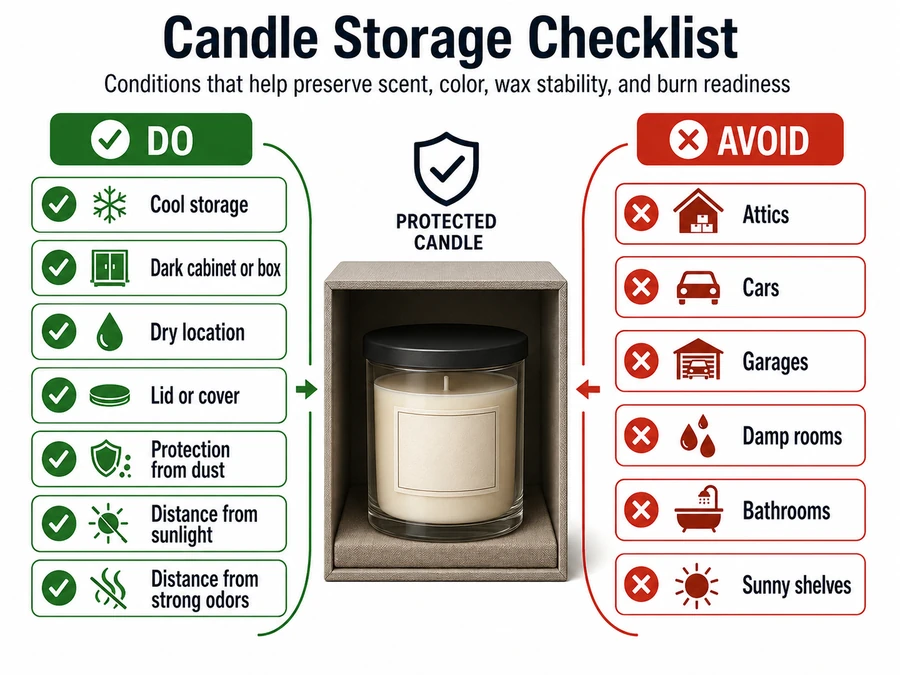
Proper storage does not make a candle last forever. It slows quality loss so the candle keeps its scent, shape, color, wick condition, and gift value for longer.
Do not refrigerate or freeze candles as a default storage method. Cold storage can create condensation, cracking, or fragrance problems when the candle returns to room temperature.
Lids, Boxes, Dust Covers, and Packaging
Packaging helps candles last longer by limiting air, dust, light, and odor exposure.
A lid, box, tin, dust cover, or fitted wrap does not seal in freshness forever, but it protects the wax and fragrance from the main storage problems. This matters most for scented candles, gift candles, handmade inventory, and decorative candles kept for months.
| Packaging type | Best use | Limitation |
|---|---|---|
| Jar lid | Protects scented jar candles from dust and scent loss | Does not reverse fragrance fade after poor storage |
| Original box | Shields from light, dust, and display damage | Weak boxes can absorb moisture or odors |
| Dust cover | Keeps debris off the wax surface | Offers less protection from heat and air than a lid |
| Tin container | Reduces light exposure and helps protect scent | Can dent or hold heat if stored poorly |
| Cellophane or fitted wrap | Helps protect unused gift candles from dust | Can trap odor or moisture if the candle was not clean and dry |
| Drawer or cabinet storage | Adds darkness and temperature stability | Still needs spacing so candles do not warp or pick up odors |
Packaging matters for resale and gifting because buyers judge a candle by scent, surface condition, label quality, and cleanliness. A dusty, faded, or stale candle may still burn, but it no longer feels like a fresh product.
For handmade candle inventory, keep lids or covers on after curing, store finished candles away from heat and sunlight, and inspect scent, wax surface, wick, label, and container before selling.
Is It Safe to Burn an Old Candle?
An old candle may be safe to burn if the wax, wick, container, surface, and smell all look normal.
Safety does not come from age alone. It comes from the candle’s current condition and how predictable it is when lit. A finished candle that was stored cleanly, stayed dry, kept its shape, and still has an intact wick is very different from one exposed to heat, dust, moisture, or container damage.
Before lighting any old candle, trim the wick, use a stable heat-resistant surface, keep it away from flammable items, and never leave it unattended.
| Safety check | Looks acceptable | Do not burn if |
|---|---|---|
| Container | Glass, tin, or holder is intact and stable | Glass is cracked, chipped, loose, or heat-damaged |
| Wick | Wick is visible, clean, centered enough, and trimmable | Wick is loose, buried, wet, dirty, or leaning into the container wall |
| Wax surface | Surface is clean or has only mild cosmetic changes | Wax is sticky, contaminated, separated, mold-like, or full of debris |
| Shape | Pillar, taper, or jar candle sits safely | Candle is warped, leaning, unstable, or softened from heat |
| Smell | Scent is normal, weak, or simply faded | Odor is sour, musty, smoky, rancid, or chemical-like |
| Storage history | Stored cool, dry, covered, and away from sunlight | Stored in a hot car, damp room, dusty shelf, or direct sun |
| Flame expectation | Candle appears able to burn in a predictable position | Wick or wax condition could make the flame shift or flare |
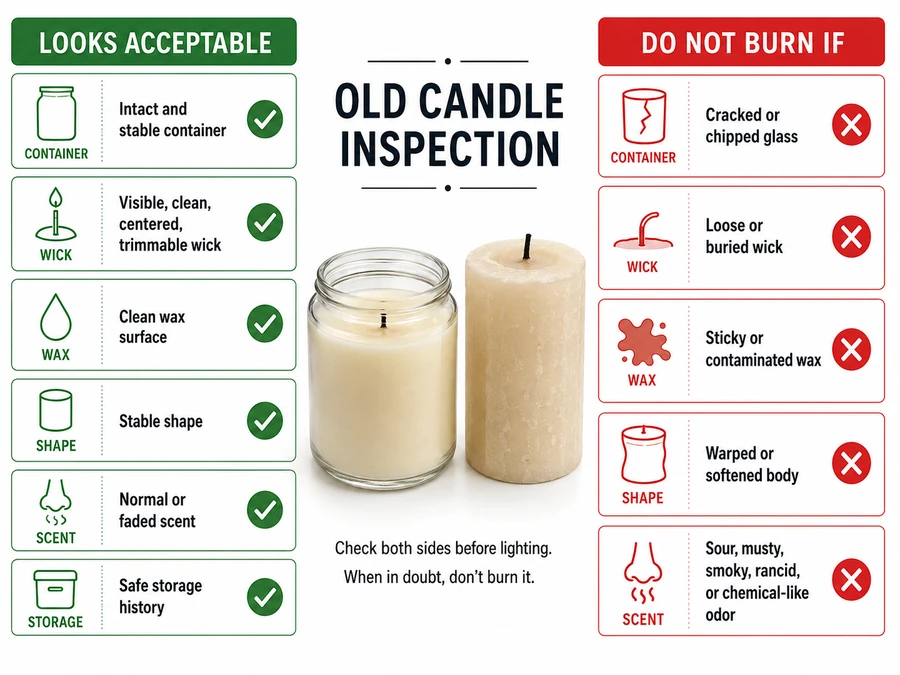
A weak scent is usually a quality problem, not a safety problem. A damaged container, dirty wick, wet surface, strange odor, or unstable candle body is different because those signs affect burning conditions.
When a candle is old but looks normal, burn it only in a proper holder, on a heat-safe surface, and within sight. If the candle gives you any reason to doubt the container, wick, wax, or smell, discard it instead of testing it.
Dust, Debris, Moisture, and Odor Contamination
Contamination can make an old candle less predictable, even when the wax itself has not expired.
Dust, pet hair, smoke residue, moisture, and household odors can settle on the wax surface, wick, lid, or container. Some contamination is only cosmetic, but contamination near the wick matters more because it can affect ignition and flame behavior.
| Contamination sign | What it means | Best action |
|---|---|---|
| Light dust on outer glass or lid | Storage residue, not candle failure | Wipe the container before use |
| Light dust on wax surface | Surface exposure during storage | Remove only loose dust if it is away from the wick |
| Dust clumps near the wick | Foreign material may burn with the wick | Do not burn if debris cannot be removed cleanly |
| Pet hair on wax | Household contamination | Discard if hair is embedded or near the wick |
| Moisture on wick or wax | Damp storage or condensation | Do not burn until fully dry; discard if odor or texture changed |
| Musty smell | Possible damp storage or odor absorption | Avoid burning and do not gift |
| Smoke or cooking odor | Candle absorbed surrounding odors | Use only if mild and not near the wick; avoid gifting |
| Mold-like spots | Possible contamination, not normal aging | Discard |
Do not scrape deeply into wax to “clean” an old candle. Surface cleaning can remove loose dust from a container or lid, but digging around the wick can damage the candle and make the burn less stable.
For personal use, a slightly dusty candle may still be acceptable after light cleaning. For gifting or selling, contamination is a stronger failure because the candle no longer looks or smells like a fresh, well-kept product.
Old Candle Checklist: Keep, Use Soon, Gift, or Discard
An old candle should be kept, used soon, gifted, sold, or discarded based on scent, wax condition, wick condition, container integrity, and storage history.
Use a stricter standard for gifting or selling than for personal use. A candle with weak scent may be fine for your own shelf, but it may feel stale, neglected, or low quality as a gift.
| Candle condition | Keep | Use soon | Do not gift or sell | Discard |
|---|---|---|---|---|
| Smells normal but weaker than before | Yes | Yes | Maybe | No |
| No scent left, but wax and wick look normal | Yes, as unscented | Yes | Yes | No |
| Mild frosting or beeswax bloom | Yes | Maybe | Maybe | No |
| Light color fading | Yes | Maybe | Maybe | No |
| Dust only on the outside of the jar | Yes | No | Clean before gifting | No |
| Dust or debris on wax away from wick | Maybe | Maybe | Yes | If embedded |
| Stale, sour, musty, smoky, or rancid smell | No | No | Yes | Yes |
| Sticky, oily, separated, or heavily sweating wax | No | Maybe | Yes | If severe |
| Buried, loose, dirty, wet, or off-center wick | No | No | Yes | Yes |
| Cracked glass, damaged tin, or unstable holder | No | No | Yes | Yes |
| Warped taper, leaning pillar, or softened candle body | No | No | Yes | Yes |
| Moisture, mold-like spots, pet hair, or stuck debris | No | No | Yes | Yes |
The decision should match the job you want the candle to do. For scent, replace a candle when fragrance is weak, stale, or gone. For display, keep it only if the wax, color, label, and shape still look acceptable. For burning, the wick, container, surface, and smell matter most.
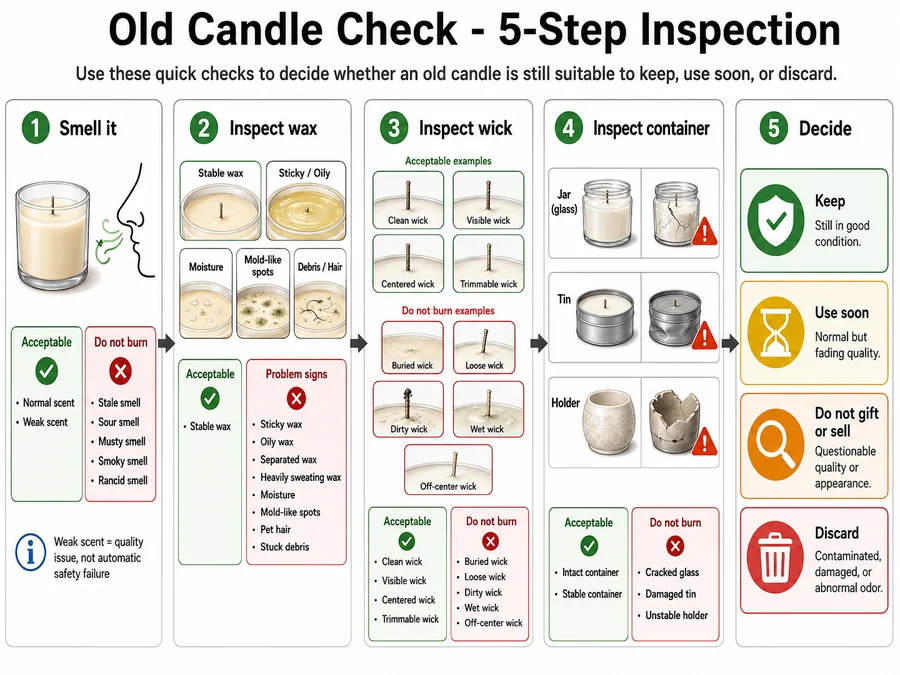
A simple final check works well: smell it, inspect the wax, inspect the wick, inspect the container, then decide. If one warning sign affects flame behavior or container stability, do not burn it.
Can You Refresh, Gift, or Sell Old Candles?
Old candles can sometimes be cleaned or used soon, but lost scent and poor storage damage usually cannot be fully reversed.
A finished candle is not a blank wax supply. Once fragrance fades, dye changes, wax separates, or the wick becomes unreliable, quick fixes can create more risk than value.
| Goal | What you can do | What you should not do |
|---|---|---|
| Make a dusty jar candle usable | Wipe the outside and remove loose surface dust away from the wick | Dig into wax or disturb the wick area |
| Use a candle with weak scent | Burn it for light ambiance if all safety checks pass | Add fragrance oil to the wax |
| Improve presentation | Clean the container, replace a dusty lid, or keep it for personal use | Pretend old inventory is fresh |
| Handle mild frosting or bloom | Accept it as mostly cosmetic if the candle is otherwise normal | Heat the whole candle as a default fix |
| Deal with a buried or damaged wick | Replace the candle if the wick cannot be exposed safely | Gouge wax, pull the wick loose, or microwave the candle |
| Handle stale or strange odor | Discard the candle | Burn it to “test” whether the odor goes away |
Refreshing should mean light cleaning and better storage, not rebuilding the candle. Adding oils, microwaving, remelting, or forcing the wick back into place can change how the candle burns.
For gifting, selling, or handmade inventory, the standard is higher. The candle should smell normal, look clean, have intact packaging, show no container damage, and have a clean, usable wick.
Can You Refresh an Old Candle?
You can refresh an old candle only when the problem is surface-level, such as dust on the jar or loose debris away from the wick.
Do not treat scent loss, wick damage, wax separation, strange odor, or container damage as simple refresh problems. Those issues affect candle quality or burn confidence, not just appearance.
| Old candle issue | Refresh option | Limit |
|---|---|---|
| Dusty jar or tin | Wipe the outside with a dry or slightly damp cloth, then dry fully | Do not let moisture reach the wick or wax |
| Dusty lid | Clean and dry the lid before replacing it | Do not trap moisture under the lid |
| Loose dust on wax | Remove only loose surface dust away from the wick | Do not scrape deep wax or disturb the wick |
| Mild surface bloom | Leave it alone or buff lightly if appropriate for the candle type | Do not heat the whole candle just for appearance |
| Weak but normal scent | Use soon if the candle passes safety checks | Scent strength will not fully return |
| Poor storage smell | Do not refresh | Odor absorption can make burning unpleasant |
| Damaged wick or container | Do not refresh | Replace or discard |
A refresh should make a good candle cleaner, not make a poor candle seem safe. If the candle needs major fixing before you trust it, it is usually better to replace it.
Can You Gift or Sell an Old Candle?
An old candle should be gifted or sold only when it still looks, smells, and burns like a well-kept finished candle.
Gift and resale decisions need a higher standard than personal use. A candle can be fine for your own shelf but still feel too faded, dusty, stale, or uncertain for someone else.
| Candle condition | Personal use | Gift | Sell |
|---|---|---|---|
| Normal scent, clean wax, intact packaging | Good candidate | Good candidate | Good candidate if accurately represented |
| Slightly weaker scent, clean surface | Use soon | Maybe, if disclosed informally | Usually not ideal at full price |
| No scent left | Use as unscented if safe | Not ideal | Do not sell as a scented candle |
| Faded color or worn label | Fine for personal use | Only if presentation still looks acceptable | Discount or avoid selling |
| Dusty jar, clean wax, intact wick | Clean before use | Clean before gifting | Clean and inspect before sale |
| Stale or strange odor | Do not use | Do not gift | Do not sell |
| Sticky wax, wick issue, or container damage | Do not burn | Do not gift | Do not sell |
| Unknown storage history | Inspect carefully | Avoid gifting if uncertain | Avoid selling if confidence is low |
A gift candle should feel fresh enough that the receiver does not need to question it. For resale, the buyer expects the candle to match its scent, appearance, packaging, and condition description.
Do not rely on age alone. A one-year-old candle stored in heat may be worse than a three-year-old candle stored cool, covered, dry, and dark.
What Makers Should Check Before Selling Old Inventory
Makers should treat old finished candle inventory as a quality-confidence issue, not an automatic failure.
A handmade candle that has sat in storage may still be sellable if the scent, wax, wick, container, label, and packaging remain acceptable. The check should stay practical and condition-based rather than turning into legal, tax, marketplace, or lab-testing guidance.
| Inventory check | Pass sign | Action if it fails |
|---|---|---|
| Scent | Smells normal and matches the product name | Do not sell as fresh scented stock |
| Wax surface | Clean, stable, and free from heavy sweating or separation | Hold back, discount only if safe and honestly described, or remake if appropriate |
| Wick | Clean, centered enough, visible, and trimmable | Do not sell |
| Container | No cracks, chips, leaks, rust, or loose parts | Do not sell |
| Label | Accurate, clean, attached, and not faded or stained | Relabel only if the product remains accurate |
| Packaging | Clean, dry, odor-free, and presentable | Replace packaging or hold back |
| Storage history | Cool, dry, covered, and away from sun | Inspect more strictly |
| Batch age | Known and recorded | Separate from newer stock before deciding |
| Test sample | A retained sample still smells and burns normally | Review the whole batch before sale |
| Customer expectation | Product still matches the quality promised | Discount, disclose, or remove from sale |
Old inventory becomes a problem when the candle no longer matches the quality a buyer expects. Weak scent, stale odor, worn packaging, surface contamination, wick damage, and container defects all reduce buyer confidence.
A maker can keep older candles for testing, samples, personal use, or discounted clearance when the candle is still safe and accurately represented. If the candle needs explanation before a buyer would trust it, it should not be sold as normal stock.