

Candle burn memory is the burn pattern a candle tends to repeat after earlier burns shape the wax pool.
It matters because a small uneven ring can turn into wasted wax, tunneling, weak flame behavior, or unsafe rescue attempts. Home users can use burn memory to decide whether a candle needs a better first burn, a simple correction, or retirement. Here, safe means the flame is stable, the vessel is not cracked or overheated, the candle is watched, and label burn-time limits are followed. Candle makers can use the same signs as secondary evidence when checking wick size, wax type, vessel shape, fragrance load, cure time, and test-burn results.
Image caption: A candle with a raised memory ring shows a ringed wax edge, while a candle with an even melt pool shows wax melted close to the container edge.
What Is Candle Burn Memory?
Candle burn memory is the burn pattern a candle tends to follow after earlier burns shape the wax pool.
A melt pool is the liquid wax around the wick during burning. In candle burning and usage, “memory” means the wax may keep melting along a previous uneven edge instead of reaching the container wall. That pattern can waste wax, shorten useful burn life, and make later correction harder.
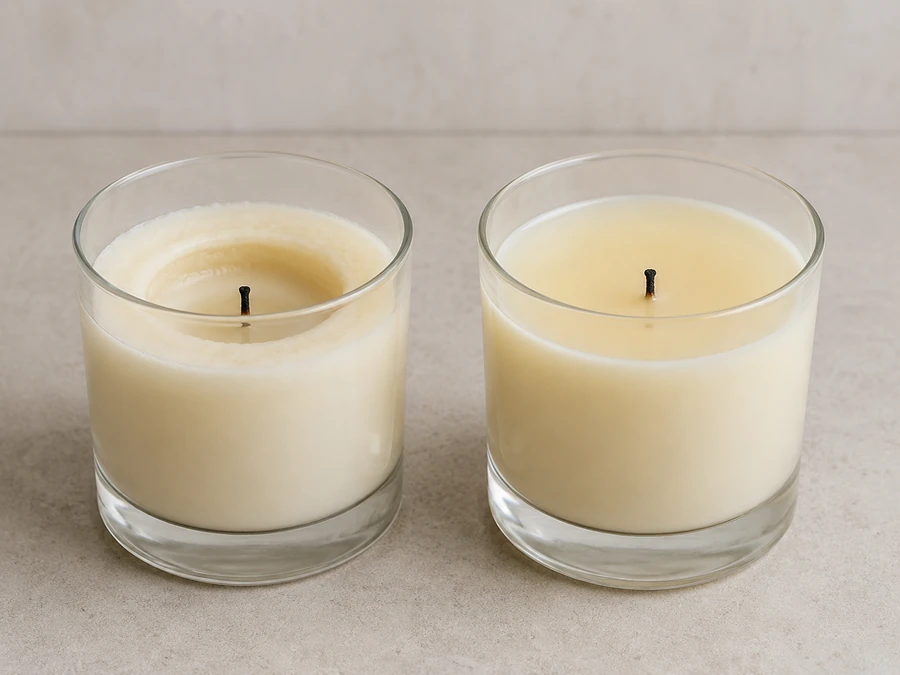
Use this quick check:
- The wax melts in the same inner circle after relighting.
- A firm outer rim remains after a normal burn.
- The candle is not yet a deep tunnel, but the uneven edge is repeating.
- The same ring appears under safe, still-air conditions.
| If you see | Treat it as | First action |
|---|---|---|
| Shallow repeated ring | Early burn memory | Try safe next-burn behavior |
| Deep center hole | Tunneling | Do not treat it as simple burn memory |
| Tall smoky flame | Combustion problem | Extinguish, cool, trim, and reassess |
| Hot or cracked vessel | Safety failure | Retire the candle |
| Frosting or wet spots before burning | Surface appearance issue | Judge after a controlled burn |
A memory ring is an early burn pattern, not proof that the candle is ruined. The next question is whether the first burn left enough unmelted rim wax to shape that pattern.
How Burn Memory Forms on the First Burn
A short first burn can leave cooler rim wax that later burns struggle to melt evenly.
During the first burn, the flame heats wax outward from the wick. If the session ends before the liquid wax reaches near the container edge, the outer wax cools as a firmer rim. On later burns, the flame may re-melt the softer center faster than the rim, so the same smaller pool repeats.
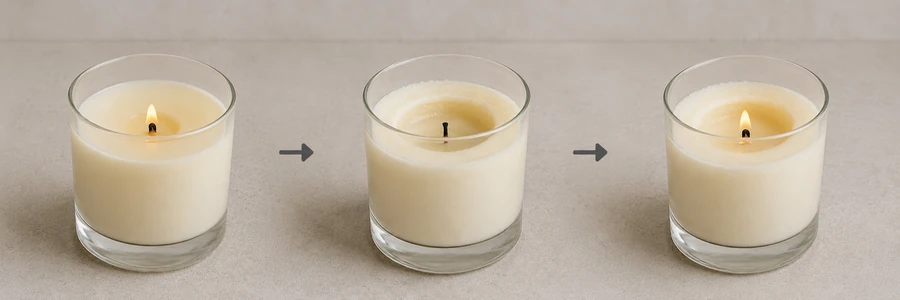
Image caption: A melt-pool progression shows a small center pool, a cooled outer rim, and a repeated smaller pool after relighting.
| First-burn condition | Later burn effect |
|---|---|
| Melt pool reaches close to the edge | Later burns have a better chance of even wax use |
| Melt pool stops far inside the rim | The candle may repeat the smaller melt pattern |
| Room is drafty or cold | Heat spreads less evenly across the wax surface |
| Wick is too small for the vessel | The flame may not supply enough heat to widen the pool |
This is why first-burn advice should stay tied to safety. The first burn strongly influences later candle behavior, but wick size, wax type, vessel shape, and room conditions can still change the result.
First-Burn Rule: Melt-Pool-to-Diameter Guidelines
The first burn should melt wax close to the container edge without exceeding the candle’s safe burn-time limit.
A melt-pool-to-diameter guideline means matching burn time to candle width, not forcing every candle to liquefy fully at any cost. For many container candles, a common planning rule is about 1 hour per inch of vessel diameter, while stopping earlier if the label gives a shorter maximum session.
Methods note: The diameter rule is a workshop rule of thumb, not a safety standard. Use it as a planning range, then check the candle label, flame height, soot, vessel heat, and wax behavior before extending a burn.
| Candle diameter | First-burn planning range | What to watch |
|---|---|---|
| 2 inches | About 2 hours | Pool reaches near the edge without a hot jar |
| 3 inches | About 3 hours | Rim softens evenly with no heavy soot |
| 4 inches | About 4 hours | Stop if the label or vessel heat says sooner |
| Wide or multi-wick vessel | Test by wax behavior, not time alone | Uneven pooling between wicks or overheated glass |
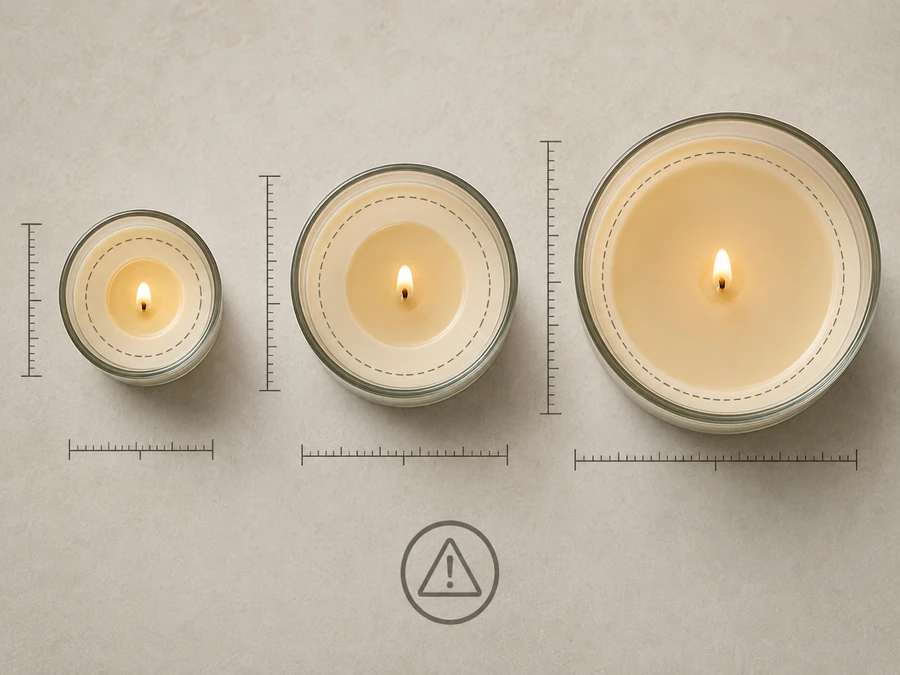
The goal is not a perfect liquid surface every time. The safer goal is an even, controlled melt pool that reduces early rim formation without overheating the candle.
Wick Size and Wick Type Effects on Burn Memory
Wick size and wick type affect burn memory by controlling flame heat, melt-pool width, and wax consumption.
A wick is the fuel path that draws melted wax to the flame. If the wick is too small, the melt pool may stay narrow and create a repeating memory ring. If the wick is too large, the candle may burn too hot, soot, mushroom, or consume wax faster than the vessel can handle.
| Wick condition | Burn-memory effect | Visible sign |
|---|---|---|
| Undersized wick | Melt pool stays too narrow | Thick rim wax remains after normal burning |
| Oversized wick | Wax melts too fast or too hot | Large flame, soot, hot vessel, fast wax loss |
| Correctly matched wick | Melt pool widens at a controlled rate | Even wax use with stable flame behavior |
| Wood wick | Heat spread depends on width and trimming | Crackle, broad flame, or weak flame if poorly matched |
| Cotton braid wick | Heat depends on braid, coating, and gauge | Steadier flame when matched to wax and vessel |
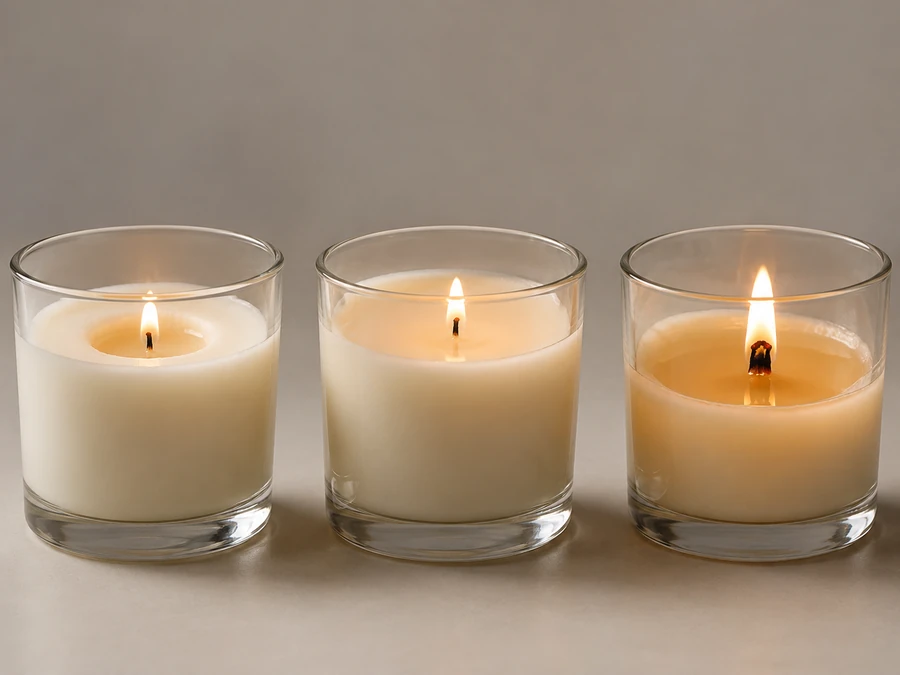
Wick type does not work alone. Soy, beeswax, paraffin, blends, fragrance load, dye, jar width, and room airflow can all change how the same wick behaves. For home users, the useful test is visible: a steady flame and widening melt pool usually signal a better wick match than a struggling flame or sooty oversized flame.
A wick should be judged by the burn pattern it creates inside that specific candle, not by wick size alone.
Wax Type Impact: Soy, Beeswax, Paraffin, and Blends
Wax type affects burn memory because each wax melts, cools, and holds heat differently.
Wax viscosity means how thick or fluid melted wax feels. Soy wax often melts more slowly and can hold a soft rim if the wick is weak. Paraffin usually melts faster and spreads heat more readily. Beeswax has a higher melt point, so it often needs stronger heat control. Blends sit between their ingredients.
| Wax type | Burn-memory tendency | What it can mean |
|---|---|---|
| Soy wax | May show slower edge melting | Needs the right wick and enough first-burn time |
| Beeswax | May resist full-width melting | Needs careful wick and vessel matching |
| Paraffin | Often melts and spreads faster | Can overheat if the wick is too strong |
| Soy-paraffin blend | More balanced melt behavior | Still depends on wick, fragrance, and vessel |
| Coconut or soft blends | May melt easily | Can pool fast if over-wicked |
Wax type does not cause burn memory by itself. The burn pattern appears when wax behavior meets flame size, jar width, room temperature, and the length of the burn session.
Vessel Diameter and Shape Considerations
Vessel diameter and shape affect burn memory by changing how far heat must travel from the wick to the container wall.
A vessel is the candle container, such as a jar, tin, tumbler, or glass. A narrow jar gives the flame less distance to heat. A wide jar needs more heat spread, sometimes from a larger wick, different wick series, or multiple wicks. Tall, shouldered, or thick-walled vessels can also change surface heat.
| Vessel feature | Burn-memory risk | Useful check |
|---|---|---|
| Wide diameter | Higher risk of edge hang-up | Watch whether the melt pool reaches close to the wall |
| Narrow diameter | Lower edge-distance demand | Watch for overheating instead |
| Tall container | Heat may concentrate downward later | Check vessel temperature and flame behavior |
| Shouldered jar | Wax near the curve may melt unevenly | Watch the upper rim during early burns |
| Multi-wick vessel | Uneven spacing can leave islands | Check whether pools join cleanly |
A vessel that is too wide for the wick often looks like a candle with “bad memory,” but the deeper cause may be heat coverage. The fix is not always a longer burn; sometimes the candle needs a better wick match or a different vessel design.
Ambient Conditions: Drafts, Temperature, and Altitude
Room conditions affect burn memory because airflow and temperature change how evenly heat spreads across the wax.
A draft is moving air from a fan, vent, window, doorway, or people walking nearby. Drafts bend the flame, so one side of the melt pool may heat faster than the other. Cold rooms can slow edge melting. High altitude can change flame behavior because combustion has less oxygen available than at sea level.
| Condition | What it can do | Visible sign |
|---|---|---|
| Draft from a vent or fan | Pushes flame heat to one side | Crescent-shaped melt pool |
| Cold room | Slows wax softening near the wall | Raised rim after a normal burn |
| Hot room | Softens wax faster | Larger pool or loose surface wax |
| High altitude | May weaken or alter flame behavior | Smaller flame, slower melt, uneven pool |
| Uneven surface | Tilts melted wax | Wax gathers on one side |
Move the candle away from vents, open windows, and heavy foot traffic before judging burn memory. A candle that burns poorly in a draft may behave normally in still air.
Fragrance Load and Dyes: Effects on Combustion
Fragrance load and dyes can affect burn memory by changing how wax fuels the wick and how cleanly the flame burns.
Fragrance load means the amount of fragrance oil mixed into the wax. Too much fragrance can make the wick work harder, slow wax movement, or create a larger, less stable flame. Dyes can change burn behavior too, especially when used heavily or paired with a weak wick.
| Additive factor | Possible burn effect | What to look for |
|---|---|---|
| High fragrance load | Wick may struggle to draw fuel cleanly | Weak flame, soot, or uneven pool |
| Heavy dye use | Burn may become less stable | Dark residue or slower melt |
| Poor fragrance-wax fit | Wax may not release fuel evenly | Patchy melt or smoking |
| Weak wick with additives | Heat may not reach the edge | Repeating memory ring |
| Strong wick with additives | Candle may burn too hot | Soot, mushrooming, hot vessel |
Additives do not automatically make a candle bad. The issue appears when fragrance, dye, wax, and wick are mismatched. For home users, the safest response is to watch flame behavior: a steady flame with light wax movement is better than a tall, smoky, or struggling flame.
Cure Time and Wax Crystallization Influences
Cure time affects burn memory because fresh wax may not burn the same way as wax that has finished setting.
Cure time is the rest period after pouring, when wax, fragrance, and the wick settle into a more stable burn state. Soy and other plant-based waxes can change as their crystal structure firms. If a candle is burned too soon, the melt pool may behave differently from the final tested burn.
For candle makers, cure time should be part of the test-burn record. For home users, the key point is simpler: a newly made candle may need normal storage and careful early burns before its behavior is easy to judge.
Surface Defects: Frosting and Wet Spots vs Burn Memory
Surface defects change how a candle looks, while burn memory changes how the candle melts.
Frosting is a pale, crystal-like surface effect often seen in soy wax. Wet spots are areas where wax pulls away from the container wall and looks patchy through glass. These marks can be cosmetic, while burn memory shows up as a repeated melt boundary after burning.
| Issue | What it affects | How to tell |
|---|---|---|
| Frosting | Surface appearance | Pale or cloudy marks before burning |
| Wet spots | Glass adhesion appearance | Patchy areas between wax and jar |
| Burn memory | Melt pattern | Same inner wax ring appears after relighting |
| Tunneling | Wax consumption depth | Deep center hole forms while edge wax remains |
| Soot | Combustion behavior | Black residue appears near jar or flame |
Do not treat every surface mark as burn memory. A frosted candle can still burn evenly, and a clear-looking candle can still develop a memory ring. The test is the melt pool after a controlled burn, not the surface appearance before lighting.
Tunneling vs Burn Memory: Key Differences
Burn memory is a repeated melt pattern, while tunneling is a deeper wax channel that leaves thick unused wax on the sides.
Tunneling is a vertical hole that forms when the candle keeps burning down the center instead of melting outward. Burn memory can come before tunneling, but they are not the same problem. A memory ring may still be shallow enough to correct; a tunnel means the candle has already lost more usable wax area.
| Sign | Burn memory | Tunneling |
|---|---|---|
| Shape | Shallow ring or repeated melt edge | Deep center channel |
| Timing | Often appears after early short burns | Usually develops after repeated uneven burns |
| Wax left behind | Raised rim near the edge | Thick side walls |
| Fix difficulty | Often easier to correct early | Harder once the hole is deep |
| Main risk | Pattern repeats | Wick may drown, flame may weaken |
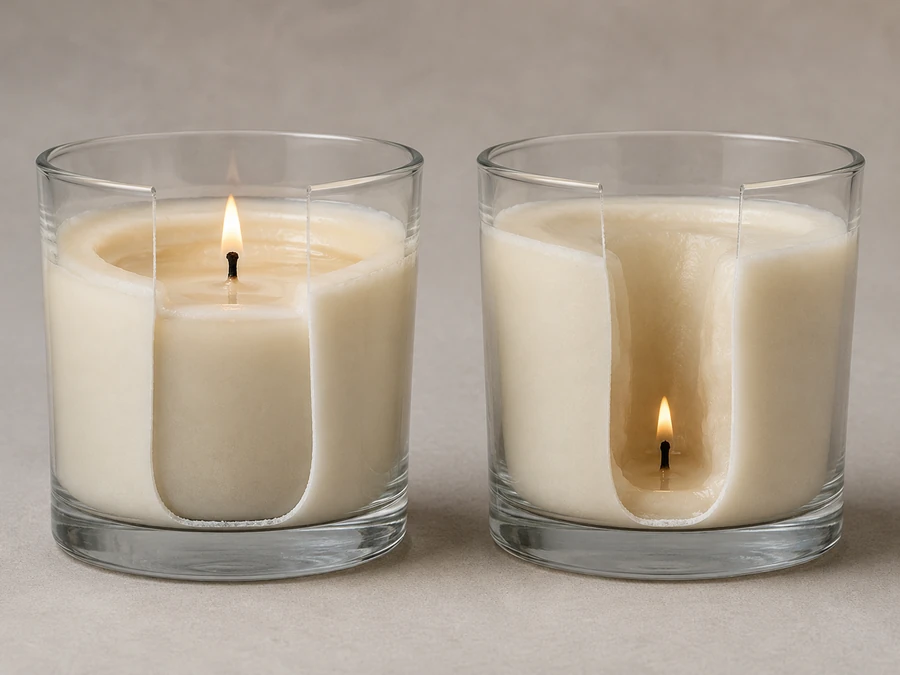
A candle can have burn memory without severe tunneling. The difference matters because early memory calls for gentle correction, while deep tunneling may need a stronger rescue method or may not be worth saving.
Common Question: Did I Ruin My Candle by Burning It for Only One Hour?
A short first burn can create a memory ring, but one short session does not always ruin the candle.
Let the candle cool, trim the wick, burn it in still air, and watch whether the melt pool widens safely on the next session. If the same small pool keeps repeating, treat it as early burn memory. If a deep center hole forms, treat it as tunneling instead.
Mushrooming and Soot: Signals of Poor Burn Behavior
Mushrooming and soot are burn-behavior signals, not the same thing as candle burn memory.
Mushrooming is a carbon buildup at the wick tip that looks like a small black cap. Soot is black residue from less complete combustion. Either sign can appear with a poor wick match, high fragrance load, long burn session, draft, or poor trimming.
Soot and mushrooming can make burn memory worse because they change flame size and heat delivery. Still, the fix is different: trim and stabilize the wick first, then judge the melt pool after a cleaner burn.
How to Fix Burn Memory: Foil Method Steps
The foil method can help a shallow memory ring by reflecting heat back toward the wax edge.
Foil method means placing a loose aluminum-foil collar around the top of the container so trapped heat softens the raised rim. It is only for container candles with a stable flame, enough wax, and no cracked, overheated, or unsafe vessel.
| Use foil when | Do not use foil when |
|---|---|
| The ring is shallow | The glass is cracked |
| The flame is steady | The vessel feels too hot |
| Wax remains above the wick base | The wick is drowning |
| You can watch the candle the whole time | The candle is near drafts, curtains, or clutter |
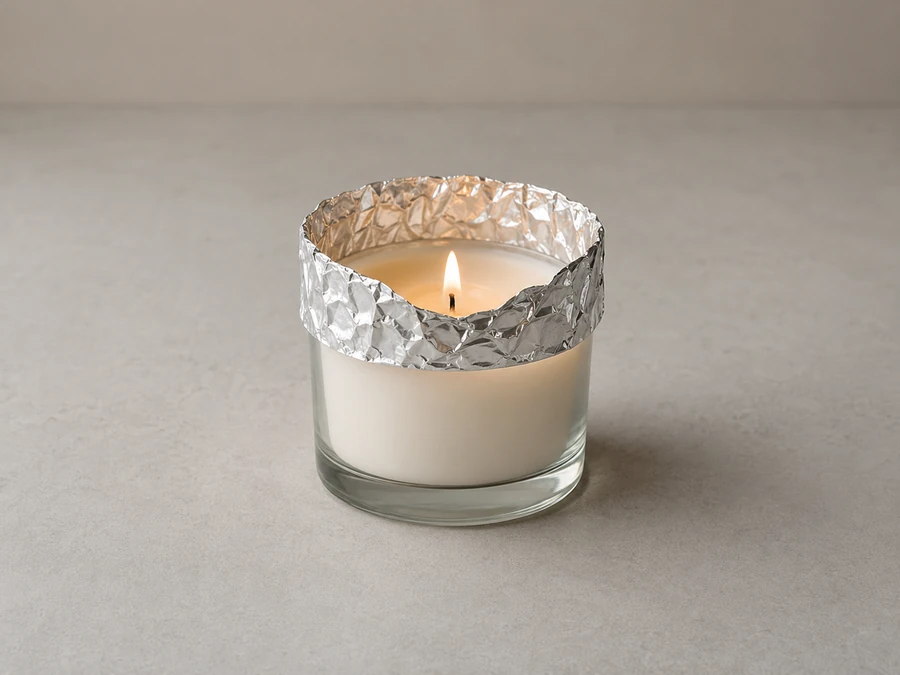
The foil method is a correction, not a normal burning habit. If the same ring returns after correction, the cause may be wick size, vessel width, wax behavior, or room conditions.
Heat-Gun Rescue: Safe Usage and Limits
A heat gun can relevel surface wax, but it cannot fully repair poor wick sizing or deep tunneling.
A heat-gun rescue means applying controlled surface heat to soften uneven wax near the top. It can smooth a raised ring before the next burn, but it does not change the wick, wax blend, fragrance load, or vessel geometry that caused the weak melt pool.
Use heat only as a surface correction on an unlit candle, keep heat away from labels and stressed glass, and let the wax reset before relighting. If the same ring returns, the safer conclusion is that the burn system needs a different fix.
Re-Wicking or Partial Re-Pour: Last-Resort Fixes
Re-wicking or partial re-pouring is a maker-level last resort, not a normal home-user fix for burn memory.
Re-wicking means replacing or adjusting the wick so the flame can create a better melt pool. Partial re-pour means removing problem wax and resetting part of the candle. These fixes involve heat, tools, wick placement, and vessel risk.
For a home user, the safer choice is often to stop using a candle that repeatedly tunnels, overheats, smokes heavily, or has damaged glass. For a maker, re-wicking belongs in a test process, not as a casual customer fix.
A last-resort fix should solve the cause. If the same wick, wax, vessel, and fragrance setup remains unchanged, the burn memory may return.
Prevention Checklist for New Candles
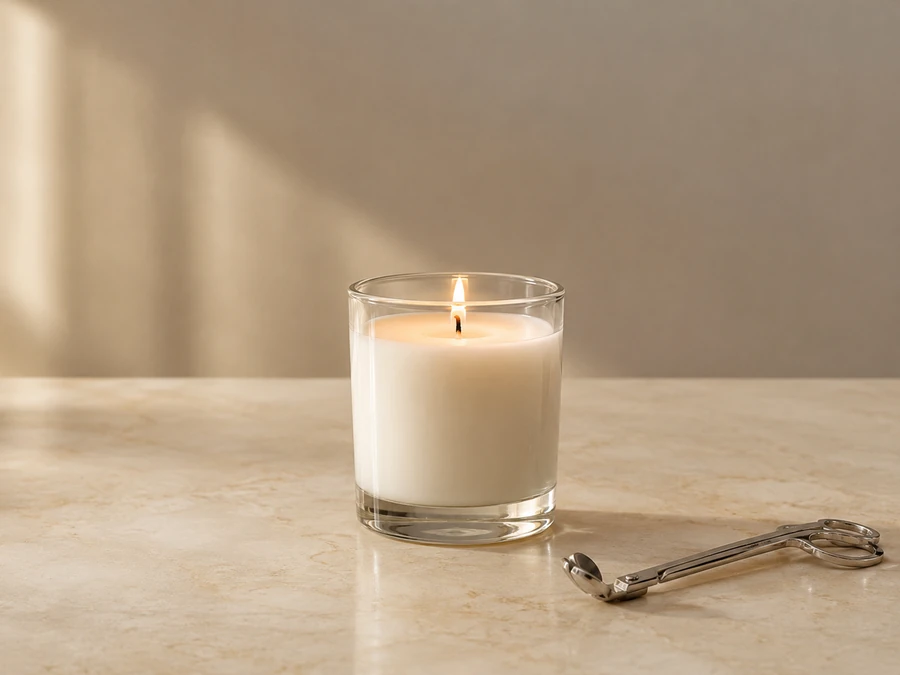
Preventing burn memory starts with a clean first burn, stable room conditions, and wick care before each relight.
Use this checklist when lighting a new container candle:
- Read the label for maximum burn time before the first use.
- Place the candle on a stable, heat-safe surface.
- Keep it away from vents, fans, open windows, curtains, and clutter.
- Trim the wick only when the candle is cool.
- Let the first melt pool widen close to the container edge without overheating the vessel.
- Stop if the flame gets too tall, smoky, unstable, or the jar becomes too hot.
- Let the wax cool and harden fully before relighting.
- Repeat steady burn habits instead of using long rescue burns.
| Do | Avoid |
|---|---|
| Burn in still air | Burning beside moving air |
| Watch the first melt pool | Leaving the candle unattended |
| Follow label limits | Forcing a full pool past safe time |
| Trim before relighting | Relighting a long or mushroomed wick |
| Let wax reset between burns | Moving the jar while wax is liquid |
Prevention works because it protects the first melt pattern. Once the candle has an even early burn history, later burns have a better chance of using wax evenly.
Test-Burn Protocol: Diameter, Intervals, and Logs
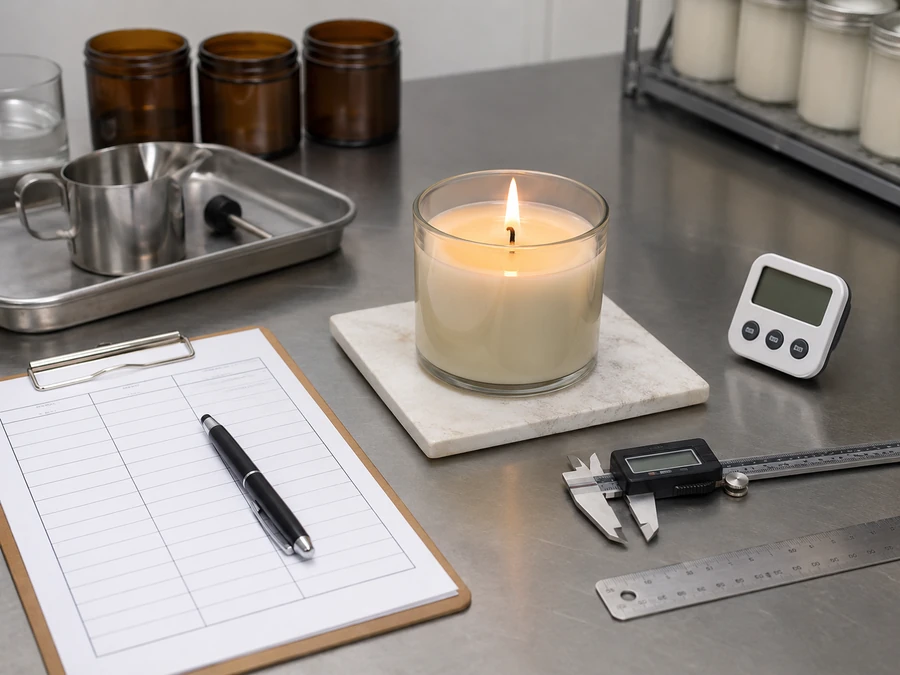
A test burn is a maker validation step for checking whether burn memory repeats under controlled, recorded conditions.
A test-burn protocol is a repeatable candle check using the same vessel, wax, wick, room setup, and time intervals. It helps makers separate true burn memory from one-off user habits, drafts, poor trimming, or an under-wicked test jar.
A useful maker test is not one long burn. Repeated controlled sessions show whether the same narrow melt pool returns under stable conditions, which points to design-related causes rather than user error.
Safety Standards and Burn-Time Limits: ASTM F2417 and EU CLP
Safety limits override burn-memory fixes when a candle shows overheating, soot, damaged glass, or label warnings.
ASTM F2417 is a fire-safety specification for candles and candle ensembles. ASTM describes the specification as setting minimum safety requirements for normal candle use, while noting that it does not replace supervision, safe placement, and other fire-safety practices.
Standards note: The EU CLP Regulation covers classification, labelling, and packaging for chemical products, but this page uses labeling only as a burn-safety boundary: do not force a memory correction when the candle shows unsafe behavior.
| Safety issue | What to do |
|---|---|
| Label gives a maximum burn time | Follow the label before trying to force a full melt pool |
| Jar feels too hot | Extinguish the flame and stop the rescue attempt |
| Glass is cracked or stressed | Stop using the candle |
| Flame is tall, smoky, or unstable | Extinguish, cool, trim, and reassess |
| Wax is nearly gone | Retire the candle instead of burning lower |
| Multiple candles are close together | Space them apart to reduce heat transfer |
The National Candle Association advises trimming the wick to ¼ inch before each use, avoiding drafts, never leaving a burning candle unattended, stopping when ½ inch of wax remains, and keeping multiple candles at least 3 inches apart.
A full melt pool is never worth a fire risk. If safety guidance and burn-memory advice conflict, the safe burn limit wins.
Myth-Busting: “Memory Ring” Misconceptions
A memory ring is a useful warning sign, but it does not mean every candle is ruined or that one rule fixes every case.
Memory ring usually describes the visible wax edge left by an earlier melt pool. The mistake is treating that ring as a single-cause problem. A short first burn can create it, but wick size, wax type, vessel width, fragrance load, drafts, and burn-time limits can all shape the same symptom.
| Myth | More accurate view |
|---|---|
| “Every candle must burn one hour per inch.” | That is a planning rule, not permission to ignore label limits or overheating. |
| “A full melt pool always means a good candle.” | A candle can reach the edge and still soot, overheat, or burn too fast. |
| “Tunneling and burn memory are identical.” | Burn memory is the repeated pattern; tunneling is the deeper center channel. |
| “Foil fixes all memory rings.” | Foil may help shallow edge wax, but it cannot correct every wick or vessel mismatch. |
| “Surface frosting means bad burn memory.” | Frosting is usually visual; burn memory is judged by the melt pattern after burning. |
The useful test is repeat behavior. If the candle keeps melting in the same narrow circle under safe, stable conditions, the pattern matters. If the surface only looks uneven before lighting, it may not be burn memory at all.
Maintenance: Trimming and Relighting Best Practices
Good candle maintenance keeps the flame stable so the wax pool can widen evenly after each relight.
Wick trimming means cutting the cooled wick to a short, clean length before burning again. A long or mushroomed wick can create soot, excess heat, flicker, and uneven wax use. A wick cut too short can struggle, drown, or fail to melt the wax outward.
| Maintenance habit | Why it helps |
|---|---|
| Let wax cool fully before relighting | The candle resets before the next melt pattern starts |
| Trim the wick before each new session | Flame height starts under better control |
| Remove loose wick debris | Debris can act as extra fuel or darken the wax |
| Burn away from drafts | Heat spreads more evenly across the surface |
| Stop when the label limit is reached | Safety stays ahead of forcing a full pool |
| Retire unsafe candles | Cracked glass, heavy soot, or overheating is not a memory problem to fix |
Relighting should repeat the same safe setup: stable surface, still air, trimmed wick, and watched burn session. That routine helps prevent a shallow memory ring from becoming a deep tunnel.