Common candle additives help adjust scent, color, opacity, hardness, adhesion, or storage performance, but the right choice on this page means the additive that fits your wax, candle type, and the exact defect or goal after process checks.
In candle making, common additives are the frequently encountered materials makers add to wax to change scent throw, color, texture, burn behavior, adhesion, or shelf life. Here, “common” means additive categories beginner and intermediate makers run into often, not every specialty chemistry option, not a full dosage guide, not a full safety guide, and not every decorative material that can be dropped into wax. The safest way to use additives on this page means process-first, one-variable testing inside the candle-making setup, not a blanket compliance or burn-safety approval.
Common candle additives at a glance (what they do + when to use them)
Common candle additives can help, but they work best after you check melt temperature, cooling speed, cure time, container choice, and wick fit first.
Use additives to solve one clear problem at a time. Start with the Candle Making hub for your base process, then use this page to decide whether the issue really needs an additive or whether a process change is more likely to fix it. For broader material choices, review Candle Wax Types before changing your formula, because soy, paraffin, coconut blends, and pillars do not respond the same way.
| Additive | What it usually helps with | Best fit | Main tradeoff | First process check before using |
| Fragrance oil | Stronger, more repeatable scent | Most scented container and pillar candles | Sweating, soot, overload | Confirm wax load limit, cure time, wick fit, and room size |
| Essential oil | Softer natural-leaning scent goals | Light-scent candles and smaller spaces | Weak hot throw, heat fade | Check whether the oil is candle-suitable and whether the scent goal is realistic |
| Candle dye or colorant | Adding or deepening color | Batches where repeatable color matters | Streaks, specks, wick issues with particulates | Check full melt, full dispersion, and batch notes |
| Opacifier or whitener | A more opaque or whiter look | White pillars, pastel tones, cloudy effects | Rough burn, clogged wick if overused | Check whether white dye or a different wax would get you there first |
| Polymer binder | Fragrance binding or texture shifts in some blends | Paraffin and some blends after process checks fail | Muted throw, excess opacity, brittleness | Recheck cure, wick, and whether the wax already holds the load |
| Stearic acid or stearin | More hardness and opacity | Pillars, molded candles, firmer blends | Shrink, cracking, hotter burn | Recheck cooling profile and plan to re-test wick size |
| Microcrystalline wax | Adhesion, smoother tops, reduced pull-away | Repeating jar or surface issues | Cloudier look, altered burn | Recheck jar temperature, room temperature, and cooling speed |
| Soy or vegetable crystal modifier | Less frosting or a smoother top in some waxes | Soy-heavy candles with repeat frosting | Chasing an additive when process is the real issue | Check pour temp, cool-down, and storage conditions first |
| UV inhibitor | Slower light-driven fading or yellowing | Display candles and bright retail spaces | False expectations about what it can fix | Check storage, packaging, and direct-light exposure first |
| Antioxidant or stabilizer | Slower oxidation-related yellowing or odor shift | Batches that change in storage or after reheats | Misdiagnosing the real cause | Check material age, heat cycles, and storage first |
| Mottling additive | Decorative mottled paraffin look | Paraffin-only decorative effects | Off-topic for most makers, wax-specific behavior | Confirm you want the look before treating it like a defect |
| Decorative add-ins | Visual effect only, with caution | Usually better outside the burn area | Fire, soot, clogging, debris | Ask whether the effect belongs on the jar, label, or packaging instead |
Use this table to classify the additive family first, not to replace full dosage, safety, or troubleshooting pages. For broader additive navigation, see Additives & Enhancers, for selection by candle setup see How to Choose the Best Candle Additives, and for usage rates see How Much Additive Should You Use in Candles?.
When the same symptom can come from more than one cause, such as weak scent, soot, rough tops, wet spots, or pull-away from the jar, use a troubleshooting page before changing the formula again. Start with Fixing Weak Scent Throw in Candles for scent issues and Why Candles Frost, Crack, or Get Wet Spots for finish and cooling problems. Follow supplier SDS and usage notes for any additive, and test-burn again after every formula change.
If you only remember one rule, use this one: change one variable, write it down, then test-burn before changing anything else.
Fragrance additives
Fragrance additives affect scent throw, stability, and burn, but weak scent often starts with wick choice, cure time, room size, or wax choice before oil choice.
Use the Candle Making hub for your base setup, then use this section to match your scent goal to the right material. In many batches, the real fix is longer cure, a different wick, or a better wax-fragrance match rather than a higher oil percentage. That is why fragrance decisions should stay tied to wax type, candle type, and the result you are trying to improve.
Fragrance oils (FO): load %, mixing, and “sweating” fixes
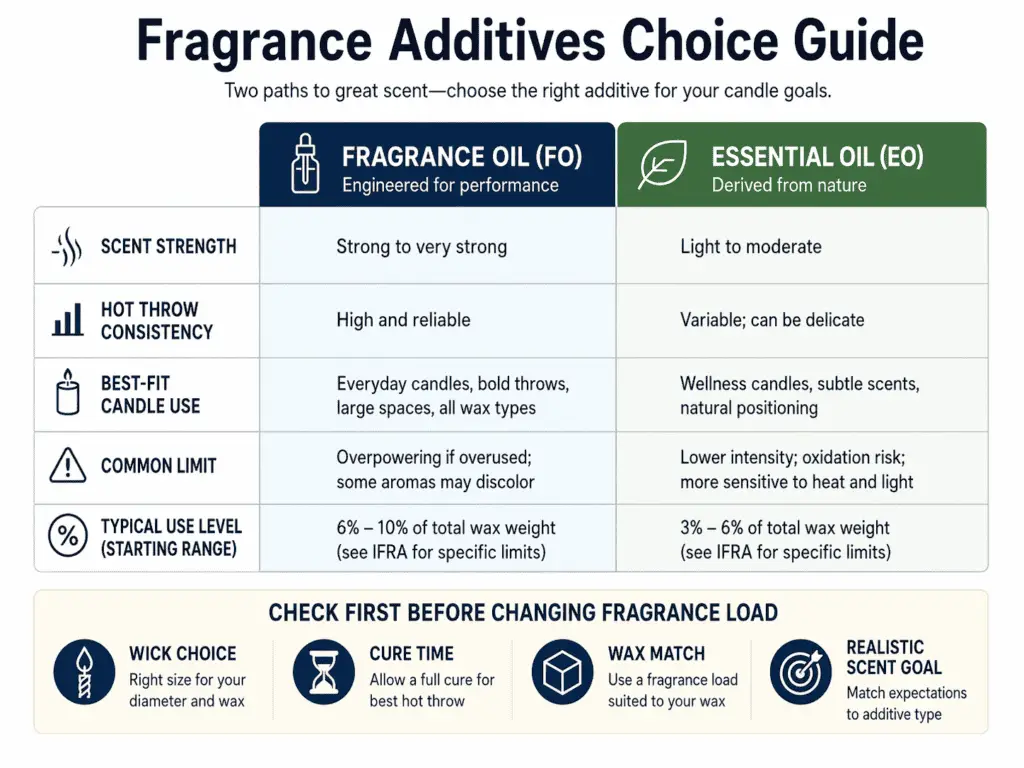
Use fragrance oil (FO) at your wax maker’s recommended load, measured as a percentage of wax weight.
On this page, FO belongs as a role summary rather than a full dosage block. Use FO when the goal is stronger and more repeatable scent, then route exact usage rates to How Much Additive Should You Use in Candles?, weak burn-time scent to Fixing Weak Scent Throw in Candles, and wick-related scent failures to Wick Types and Sizing.
Essential oils (EO) in candles: FO vs EO, limits, and best-use cases
You can use essential oil (EO) in candles, but hot throw is usually lighter and less repeatable than FO.
EO candles fit soft scent goals and smaller spaces better than strong room-filling goals. Heat stability varies by oil, so expectations need to stay realistic from the start.
For a full selection comparison, use How to Choose the Best Candle Additives and keep wick diagnosis with Wick Types and Sizing before treating EO alone as the cause of weak hot throw.
Color & appearance additives
Color additives work best when your melt, mix, and cooling routine is already steady, because many color flaws come from process drift rather than the colorant itself.
Start from the Candle Making hub if your pouring routine still changes from batch to batch. Before blaming the dye, check Candle Wax Types, because soy, paraffin, and blends can show the same color differently. If the candle starts sooting or the melt pool changes after coloring, recheck Wick Types and Sizing before adding more dye. For fading after storage or display, move to Using UV Inhibitors in Candles: Rates & Best Practices instead of trying to overpower the problem with darker color.
Candle dyes & colorants: types + exact add/stir steps to avoid spots
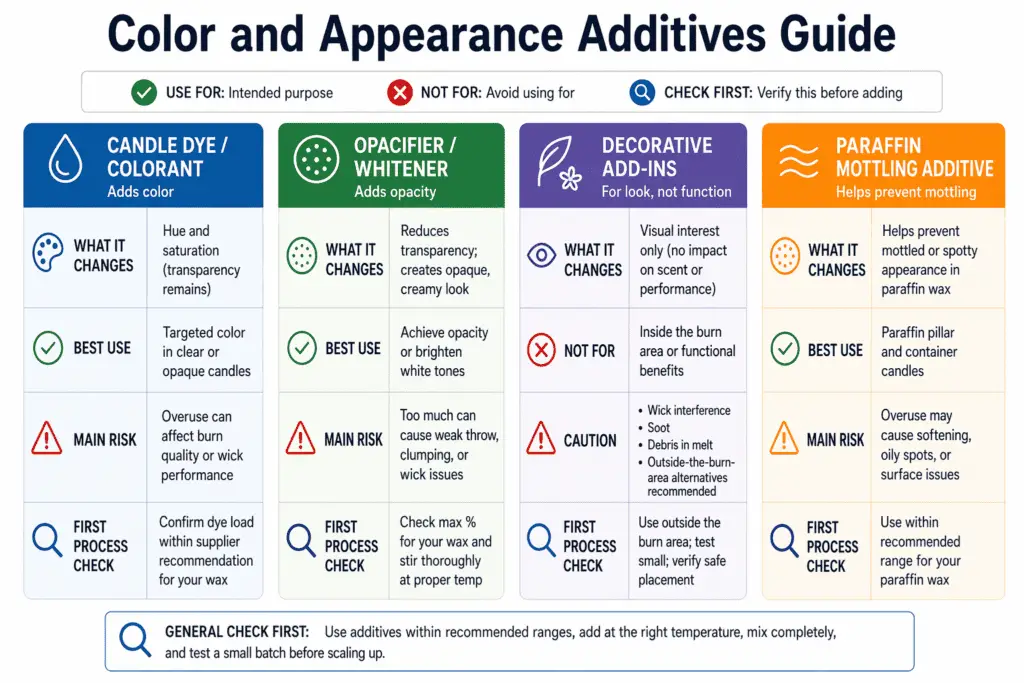
Melt the wax, add dye while the wax is hot enough to dissolve or disperse it, stir until the color looks even, then add fragrance and pour.
That order solves many streaking and spotty-color problems before you touch the formula again. Keep the batch small, weigh what you add, and record wax type, dye form, and batch ID so you can repeat the result.
A dye colors the wax itself. A pigment is a solid particle that stays suspended in the wax. That difference matters because particulates can affect the wick and melt pool faster than a dissolved dye can.
If the real problem is light-driven fade, route it to Using UV Inhibitors in Candles: Rates & Best Practices. If the flame or melt pool changes after coloring, recheck Wick Types and Sizing before treating the colorant as the only cause.
Opacifiers and whiteners: when white dye is not enough
An opacifier or whitener is for changing how solid or white the candle looks, not for fixing weak color mixing.
These materials are usually discussed when a maker wants a denser white, a cloudier finish, or a less translucent look. They overlap with dye decisions, but they are not the same thing. White dye changes color. An opacifier changes how much light passes through the wax. That means the visual result can be useful, but the burn effect needs attention.
On this page, “better first move” means the smallest change that matches the visual goal. Compare wax choice first with Candle Wax Types, then keep wick retesting with Wick Types and Sizing if opacity changes affect burn behavior.
Decorative add-ins: what to treat as a caution, not a default
Decorative add-ins are not default-safe candle additives just because they look pretty in wax.
Mica, glitter, dried botanicals, coffee grounds, shells, and other loose materials can interfere with the wick, add soot, or create debris in the melt pool. That does not mean every decorative idea fails, but it does mean you should not treat these materials like normal fragrance or color additives. The safer first question is whether the effect belongs on the outside of the candle instead.
On this page, “safe” means a limited burn-zone caution, not a full compliance or toxicology judgment. For decorative burn-area decisions, use Embedding Botanicals & Objects Safely in Candles and Are Candle Additives Safe? instead of treating this overview as an approval list.
Keep this page on the candle-additive decision itself: decorative materials are a caution topic here, not an approval list.
Paraffin mottling: decorative effect, not a default fix
Mottling additives are for a chosen paraffin look, not for fixing an ordinary defect in most candles.
If you are working with paraffin pillars and you want a mottled finish on purpose, a mottling additive can be part of that look. If you are not trying to create that specific finish, mottling is usually not a problem this page needs to solve in depth. That is why the useful question here is simple: do you want the effect, or are you trying to remove it?
This keeps paraffin mottling in scope without turning it into its own page inside this article.
Performance modifiers
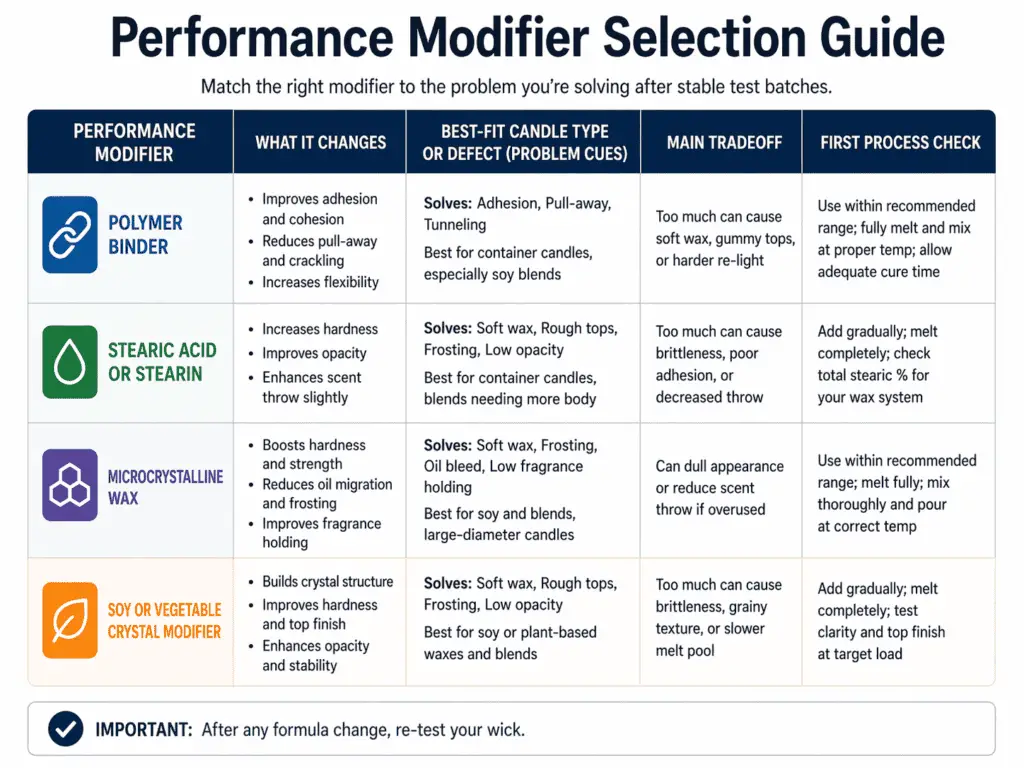
Use performance modifiers after you have repeated the same defect across controlled test batches, not as the first response to one bad pour.
These additives change how the wax behaves, so they can solve a real problem and create a new one at the same time. Open the Candle Making hub for your base method first, then treat modifiers as the second move after stable pouring, stable cooling, and stable cure time. Check Candle Wax Types before adding anything that changes structure, because some waxes already solve the problem on their own. Any formula change can alter burn behavior, so return to Wick Types and Sizing after each change.
Polymer additives (Vybar-type): when to use, pros/cons, and compatibility
A polymer binder is not a magic fix. Use it when you have confirmed the issue is not wick, temperature, cure time, or a poor wax-fragrance match.
Polymer binders are usually discussed for paraffin and some blends because they can help hold fragrance, shift texture, and change opacity. The main question is not “Can I add one?” but “Do I still need one after process checks?” If your wax already holds the fragrance load cleanly, a binder may add complication without solving anything.
If the real problem is sweating or weak throw, route it first to Fixing Weak Scent Throw in Candles and How Much Additive Should You Use in Candles?. If the real choice is binder versus stearic, use Stearic Acid vs Vybar: Differences and Best Uses instead of expanding this overview.
Stearic acid / stearin: what it changes (hardness, opacity) + how to dose
Stearic acid or stearin hardens wax and raises opacity, especially in pillars, but it can increase shrink and change burn rate, so re-test your wick.
Stearic is a structure modifier. It changes how the wax sets up and how it burns, which is why it makes more sense when you need more structure than when you only want to hide a small surface flaw. It often helps pillars and molded candles more than containers, though some makers test it in blends for a specific reason.
Use stearic when the goal is more structure or opacity, use microcrystalline wax when the problem is mainly adhesion or surface behavior, and use a polymer binder when the issue is more about binding or texture behavior in some blends. For the direct comparison between stearic and binder logic, use Stearic Acid vs Vybar: Differences and Best Uses.
Microcrystalline wax: adhesion, texture, and fixing sinkholes/pull-away
Microcrystalline wax is a process-second fix for jar adhesion, rough tops, and some sinkhole or pull-away problems after you have already checked pouring and cooling.
Use it when the same defect keeps repeating under stable conditions, not when one batch cooled badly near a draft or cold jar. Microcrystalline wax can help with adhesion, texture, and top appearance, but it can also change opacity and burn behavior.
Microcrystalline wax is not the same tool as stearic or a polymer binder. Stearic is more about hardness and opacity. A binder is more about binding and texture shifts in some blends. Microcrystalline wax is usually the better fit when you are trying to address wet spots or reduce pull-away rather than harden the candle. For cooling-related root causes, use Why Candles Frost, Crack, or Get Wet Spots and How to Preheat Candle Jars to Reduce Wet Spots and Adhesion Issues.
Soy and vegetable wax crystal modifiers: frosting control vs process control
A soy or vegetable crystal modifier can help in some waxes, but frosting and rough tops often start with wax behavior, cooling, and storage before an additive becomes necessary.
This is one of the easiest places to drift into the wrong topic. Frosting control sits close to wax choice, pour technique, room temperature, and storage habits, so a modifier should stay the second move, not the first. If your soy candle frosts, the useful question is not “Which additive fixes it fastest?” but “Have I proved this is not simply how the wax behaves under my conditions?”
Keep this bounded. The goal here is not a full soy anti-frosting deep dive. The goal is to help you decide whether the issue belongs to process, wax choice, or a narrow additive test. If the problem keeps repeating, use Fixing Common Problems with Soy Wax Candles instead of reopening the full troubleshooting path here.
Stability & shelf-life additives
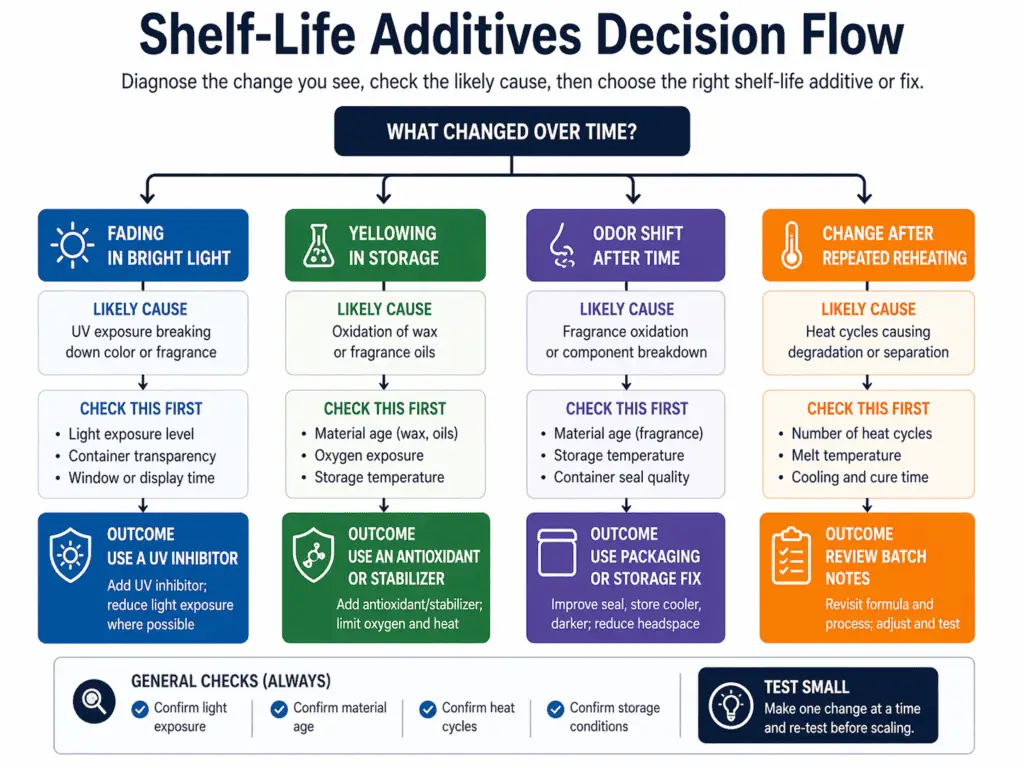
Stability additives matter when a candle changes over time from light, storage, repeated reheating, or fragrance-driven discoloration, not when a fresh batch simply needs better pouring control.
Start with the Candle Making hub if your base process still changes from batch to batch. For long-term changes, check Storage Conditions for Finished Candles, light exposure, container sealing, and material age before buying another additive. Use Candle Batch Record Sheet Template notes for date labels, heat-cycle tracking, and side-by-side testing.
UV inhibitors: when they matter and how to prevent fade/discoloration
UV inhibitors can slow light-driven dye fading and some yellowing, but they will not stop fragrance-driven discoloration or poor storage effects.
Use them when candles sit in sunlight, strong window light, or bright display lighting. A UV inhibitor is a fade-slowing additive, not a permanent shield.
For actual usage rates and testing detail, use Using UV Inhibitors in Candles: Rates & Best Practices. If packaging and storage are the real issue, route that work to Storage Conditions for Finished Candles and your batch notes.
If the candle sits in a bright shop or sunny room, packaging often matters more than another formula change. An opaque box, a covered display, or a darker storage area can slow fading without changing the wax blend.
Antioxidants & stabilizers: when to use and what problems they prevent
Antioxidants and stabilizers can help with oxidation-driven yellowing, off smells, and scent shift over time, but storage and heat-cycle control come first.
This is for repeatable shelf-life problems, not one odd batch. An antioxidant or stabilizer is meant to slow breakdown in some formulas during storage, shipping, or long hold times. It does not replace clean containers, fresh materials, or better storage habits.
Use the Candle Making hub for your base method, then keep the diagnosis narrow. Oxidation comes from time, oxygen, heat, and storage stress. UV fade comes mainly from light. Fragrance-driven discoloration often comes from the fragrance itself, especially when the formula browns or shifts even in stable storage. For storage control, use Storage Conditions for Finished Candles and Candle Batch Record Sheet Template. For light-driven fade, use Using UV Inhibitors in Candles: Rates & Best Practices.
Common additive questions (quick answers)
Common candle additive questions usually have a process answer first, then an additive answer second.
Use the Candle Making hub when the defect is still broad or you have changed more than one variable at once.
How much fragrance oil can I add?
Add fragrance oil based on the wax maker’s stated load limit, not a universal number. Use How Much Additive Should You Use in Candles? for the math, then confirm wick fit with Wick Types and Sizing.
Why does my candle sweat oil?
Oil sweating usually means the wax cannot hold the fragrance load, the fragrance and wax are a poor match, or the batch needs a process check first. Start with How Much Additive Should You Use in Candles?, then recheck wick, cure time, and room conditions with Wick Types and Sizing.
Can I use essential oils and get strong hot throw?
You can use essential oils, but strong and repeatable hot throw is less common than with fragrance oils. Use How to Choose the Best Candle Additives for selection depth and Fixing Weak Scent Throw in Candles for symptom diagnosis.
Why is my candle color streaky or patchy?
Streaky or patchy color usually comes from incomplete dye dispersion, uneven melting, or inconsistent cooling. Recheck the dye section here, then use Why Candles Frost, Crack, or Get Wet Spots if the defect keeps repeating.
When should I use an opacifier instead of more white dye?
Use an opacifier when the issue is translucency rather than color depth. If the candle is white enough but still looks too see-through, compare wax choice with Candle Wax Types before changing the formula again.
Are mica, glitter, or botanicals safe inside candles?
They are not default-safe additives just because they look decorative. Use Embedding Botanicals & Objects Safely in Candles and Are Candle Additives Safe? for the safety decision instead of treating this FAQ as an approval list.
Do UV inhibitors stop vanilla discoloration?
No. UV inhibitors can slow light-driven fading and some yellowing, but vanilla discoloration is usually a different mechanism. Compare Using UV Inhibitors in Candles: Rates & Best Practices with your storage checks before treating UV inhibitors as the only answer.
Why did my wax or candle turn yellow in storage?
Yellowing in storage often points to oxidation, old materials, repeated reheating, fragrance interaction, or poor storage conditions. Start with Storage Conditions for Finished Candles and Candle Batch Record Sheet Template, then compare light-driven change with Using UV Inhibitors in Candles: Rates & Best Practices.
Do I need a soy additive for frosting?
Not always. Frosting is often tied to wax behavior and cooling before it becomes an additive problem. Check Fixing Common Problems with Soy Wax Candles before adding another variable.