

A candle mold is a reusable shaping tool for poured wax. It forms pillar candles, tapers, embeds, decorative shapes, or other molded candle styles after the wax cools.
This page compares reusable candle molds, not candle tins, jars, containers, wax supplies, fragrance, labels, packaging, labor, taxes, marketplace fees, or total candle-business startup costs.
“ROI” here means mold payback only: how many successful candles, pours, or selling cycles it takes for the mold to justify its cost.
How Much Do Candle Molds Usually Cost?
Candle mold cost varies by material, size, cavity count, shape complexity, and use frequency. Basic reusable molds may start near $5–$15, while larger, detailed, multi-cavity, or specialty molds can move into higher price bands.
These ranges cover molds only, not wax, fragrance, packaging, labor, or a full candle-business budget. Supplier examples include aluminum pillar molds in the single-digit to low-teens dollar range, an aluminum round pillar mold at $9.95, a 4″ × 6″ aluminum mold at $11.95, and silicone or detailed candle molds ranging from low-cost small molds to detailed designs above $50.
Pricing note: Supplier examples were checked against current mold and mold-release listings. Treat them as buying examples, not fixed market averages.
A candle mold is a reusable wax-shaping tool. It is not a candle jar, tin, container, wax supply, or finished candle. A broader Candle Making Supplies Checklist should cover wax, fragrance, dye, labels, packaging, and tools separately.
| Mold Type | Common Use | Typical Price Band | Cost Driver | Replacement / ROI Note |
|---|---|---|---|---|
| Small silicone molds | Wax melts, embeds, mini shapes | $5–$20 | Simple cavities, small wax volume | Low entry cost, but payback needs repeat use. |
| Detailed silicone molds | Sculptural or decorative candles | $15–$60+ | Fine detail, undercuts, wall thickness | Worth more when easy release prevents broken candles. |
| Multi-cavity silicone molds | Batches of melts or small shapes | $10–$50+ | Cavity count and silicone thickness | Cost per piece falls when all cavities release cleanly. |
| Basic metal pillar molds | Standard pillar candles | $5–$20 | Metal type, diameter, height, seam quality | Strong value for repeated standard shapes. |
| Metal taper molds | Tapers and dinner candles | $20–$70+ | Length, tube count, metal construction | Better payback when used for repeated batches. |
| Large-format metal molds | Tall or wide pillars | $15–$40+ | Wax capacity and wall rigidity | Denting, rust, or seam damage can shorten useful life. |
| Specialty molds | Seasonal, novelty, or niche shapes | $20–$80+ | Low-volume design and detail level | Payback depends on demand and successful pours. |
These bands are buying ranges, not product recommendations. Check supplier specifications for material, dimensions, cavity count, and wax capacity before comparing two molds. Lone Star Candle Supply lists a 4″ × 6″ seamless aluminum mold as rigid aluminum with about 35 ounces of wax capacity, showing why size and construction affect the real budget.
Candle molds are reusable, but they are not always a one-time purchase. Silicone can tear, stretch, or distort. Metal can dent, rust, or lose clean release if it is poorly sealed or stored. A mold becomes cheaper per candle only when it produces enough usable candles before replacement.
Full pricing and product-margin questions belong in a Candle Pricing Formula or Candle COGS Calculator because those pages need wax, fragrance, packaging, labor, fees, and margin assumptions. This section stays limited to reusable mold price and mold-specific cost.
What Makes Silicone Candle Molds Cheaper or More Expensive?
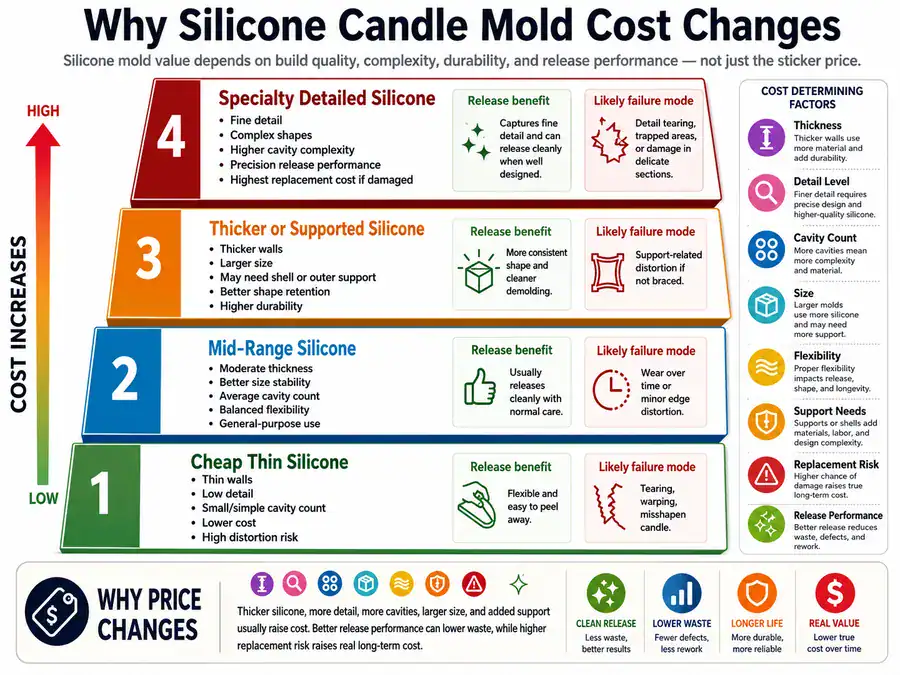
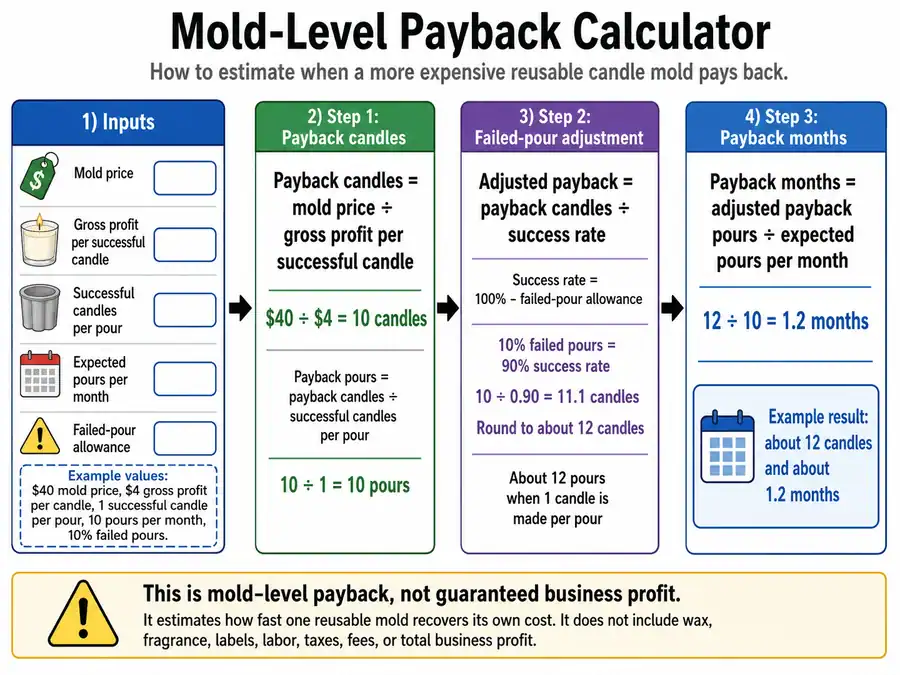
Silicone candle mold cost depends on thickness, detail level, cavity count, size, flexibility, support needs, replacement risk, and release performance.
A silicone candle mold is a flexible reusable wax-shaping tool, and its value comes from clean release plus enough usable pours before tearing or distortion.
Silicone often costs more when the mold has deeper detail, sharp edges, undercuts, tall walls, large cavities, or a supported outer shape. Supplier price bands can place silicone moulds under $25, $25–$50, and $50–$75, while other detailed candle-mold suppliers list sculptural silicone designs around $48.50–$57 or higher.
| Silicone Mold Type | Upfront Cost | Release Benefit | Likely Failure Mode | Best Use Case |
|---|---|---|---|---|
| Cheap thin silicone | Low | Easy release for simple shapes | Tears near edges or stretches after forceful demolding | Hobby tests, embeds, one-off shapes |
| Mid-range silicone | Medium | Better shape hold and detail | Gradual wear at corners or thin points | Repeat small batches |
| Thicker or supported silicone | Higher | Better support for heavier shapes | Higher purchase price; less forgiving if the design is poor | Small sellers or frequent reuse |
| Specialty detailed silicone | Higher | Captures fine sculptural detail | Breakage during release if undercuts are tight | Decorative candles with enough demand |
Cheap silicone can be worth it for testing a shape before committing to a stronger mold. It becomes expensive when thin walls, weak edges, or soft sides cause failed pours.
The real comparison is not “cheap vs expensive”; it is purchase price plus usable pours, replacement risk, and release success.
Release aids may matter when sticking raises the reject rate, but product choice and application steps belong in a dedicated Candle Mold Release Guide. Demolding technique belongs in How to Use Silicone Candle Molds because a full pour, cure, and release tutorial would broaden this cost section.
What Makes Metal Candle Molds Cost More or Less?
Metal candle mold cost depends on material, size, wall rigidity, seam quality, shape, release requirements, sealing needs, dent risk, rust risk, and repeated production use.
A metal candle mold is a rigid reusable wax-shaping tool, not a candle tin, jar, or container.
Metal molds often cost less per use when the shape is standard and the maker repeats the same pillar or taper size. Supplier listings show why construction matters: a 4″ × 6″ seamless aluminum mold is described as rigid aluminum, made in the USA, and able to hold about 35 ounces of wax.
| Metal Mold Type | Main Cost Driver | Best Use Case | Long-Term Cost Note |
|---|---|---|---|
| Basic metal pillar mold | Diameter, height, aluminum thickness, wick hole | Standard pillar candles | Good value when the same size is poured many times. |
| Higher-quality metal mold | Seam quality, rigid walls, cleaner release surface | Repeat production or cleaner finish needs | Higher checkout price can be cheaper if dents and release issues are reduced. |
| Metal taper mold | Length, tube count, handle or rack design | Repeated taper batches | More cavities can lower mold cost per candle when every cavity is used. |
| Specialty or large-format metal mold | Size, shape, metal type, construction complexity | Tall pillars, wide pillars, less common shapes | Higher wax capacity raises the cost of failed pours. |
Metal-specific extras can include mold release, mold sealer, wick pins, plugs, careful drying, and replacement after denting or seam damage.
Release aids belong in a Candle Mold Release Guide. Full rust prevention and cleaning steps belong in How to Clean Candle Molds.
Metal is not automatically the longest-lasting or cheapest mold choice. It can be a better value for repeated standard shapes, but a poor fit for detailed shapes that need flexible release.
Candle tins and jars belong in Container Candles vs Molded Candles because they are packaging or finished-candle vessels, not reusable shaping molds.
Silicone vs Metal Candle Molds: Which Costs Less Per Candle?
The cheaper candle mold is the one with the lower mold cost per successful finished candle, not the lower checkout price.
Silicone can win for detailed shapes and easier release, while metal can win for repeated standard production.
Cost per use means spreading the mold purchase price across successful pours or finished candles. It does not include wax, fragrance, packaging, labor, marketplace fees, taxes, or full business profit.
| Calculation | Formula | Use It For |
|---|---|---|
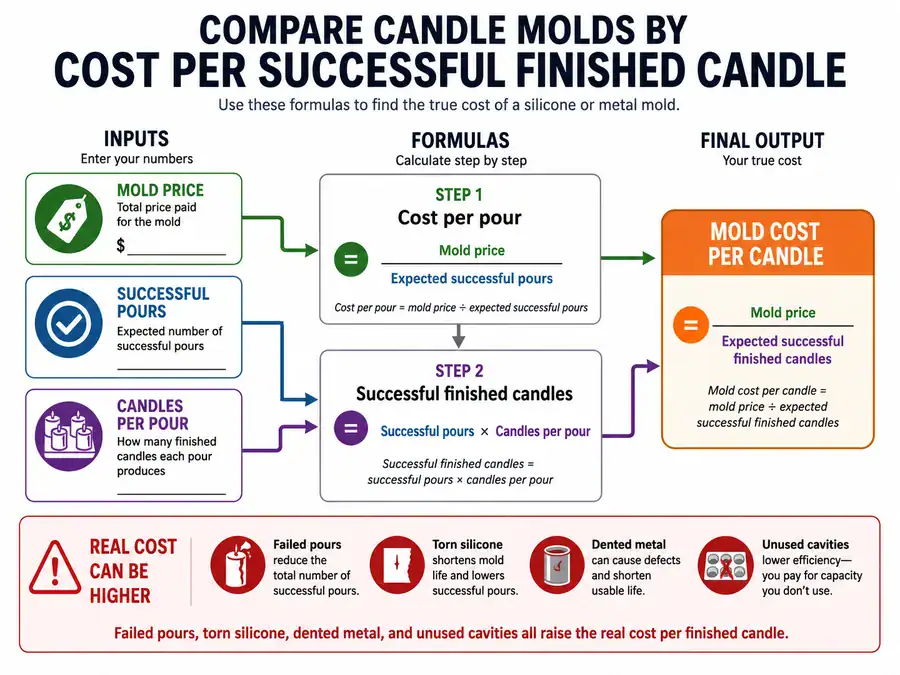
| Cost per pour | Mold price ÷ expected successful pours | Comparing one-cavity molds or batch molds. |
| Mold cost per candle | Mold price ÷ expected successful finished candles | Comparing silicone vs metal by finished output. |
| Successful finished candles | Successful pours × candles per pour | Adjusting for cavity count and failed pours. |
| Mold Type | Mold Price | Expected Successful Pours | Candles per Pour | Estimated Mold Cost per Candle | Best-Fit Use Case |
|---|---|---|---|---|---|
| Thin silicone detail mold | $12 | 25 | 1 | $0.48 | Testing a decorative shape. |
| Thicker silicone mold | $35 | 75 | 1 | $0.47 | Repeated detailed candles. |
| Multi-cavity silicone mold | $24 | 50 | 6 | $0.08 | Small shapes, embeds, wax melts. |
| Basic metal pillar mold | $11 | 100 | 1 | $0.11 | Repeated standard pillars. |
| Four-cavity metal taper mold | $45 | 100 | 4 | $0.11 | Repeated taper batches. |
These are modeled examples, not product recommendations. The table assumes the mold reaches the listed successful pours before replacement.
Failed pours, torn silicone, dented metal, poor release, or unused cavities raise the real mold cost per candle.
Silicone may cost less per candle when it prevents broken detailed candles. Metal may cost less per candle when a maker pours the same standard shape many times.
Supplier data supports this comparison method because mold listings separate material, dimensions, capacity, and cavity format, which are the variables that change finished output.
Gross profit, product price, and full candle cost belong in a Candle Pricing Formula or Candle COGS Calculator.
This page uses cost per successful candle only to compare reusable molds, then uses that number for mold-level payback later.
Hidden Mold Costs to Budget For
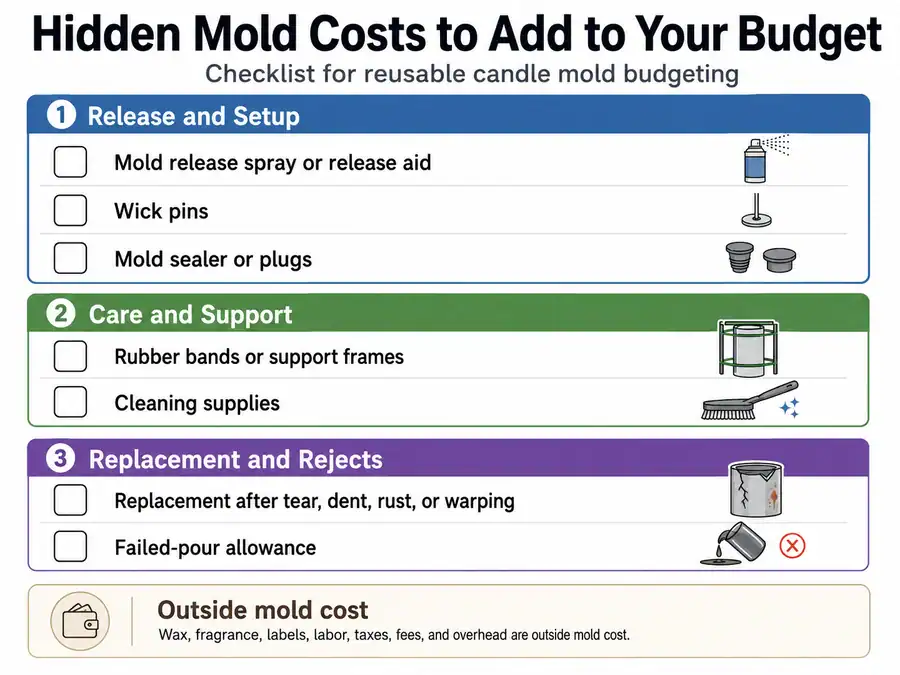
Hidden mold costs are mold-specific accessories and failed-pour risks. They are not the full supply, labor, tax, fee, or overhead costs of running a candle product.
Supplier examples show mold-release products around $14.65 from Candlewic, and another candle mold release spray listed at €5.92–€29.58. These examples show why the mold’s checkout price can understate the real mold budget.
| Hidden Cost Item | Applies To | Why It Matters | Typical Cost Band | Include in Mold Budget? |
|---|---|---|---|---|
| Mold release spray or release aid | Silicone, metal, plastic, polycarbonate | Helps reduce sticking when shape or material makes release harder. | $5–$30 | Yes, when release is not reliable. |
| Wick pins | Mostly metal pillar molds | Help form a clean wick channel in molded candles. | Low add-on cost | Yes, if the mold setup needs them. |
| Mold sealer or plugs | Metal molds with wick holes | Helps prevent hot wax from leaking through the mold base. | $4–$30 | Yes, for leaky or wick-hole molds. |
| Rubber bands, clips, or support frames | Soft silicone molds | Helps tall or flexible molds hold shape during pouring. | Low to medium | Yes, if the mold distorts. |
| Cleaning supplies | Silicone and metal | Residue, wax buildup, and poor drying can shorten useful life. | Low recurring cost | Yes, but only as a mold-care allowance. |
| Replacement after tear, dent, rust, or warping | Silicone and metal | A damaged mold raises cost per successful candle. | Mold-dependent | Yes. |
| Failed-pour allowance | Silicone and metal | Broken, stuck, or distorted candles reduce usable output. | Percentage allowance | Yes, especially for sellers. |
For silicone molds, the hidden costs usually come from soft walls, tall shapes, fine detail, and tear risk.
A cheap silicone mold may need outside support, gentler demolding, or earlier replacement if thin edges stretch or rip.
For metal molds, hidden costs often come from release, sealing, wick pins, plugs, drying, and replacement after dents or seam damage.
Candlewic’s mold release spray instructions say to spray molds every six uses, which shows that release cost may recur when sticking affects output.
Full supply costs belong in a complete candle making supplies checklist because wax, fragrance, dye, labels, packaging, tools, and equipment go beyond mold-specific budgeting.
Hidden mold costs adjust the price range, cost-per-candle math, replacement timing, and mold-level payback.
How Long Do Silicone and Metal Candle Molds Last?
Candle mold durability means successful pours before replacement becomes cheaper than continued use.
Lifespan depends on material, construction quality, candle shape, demolding force, cleaning, drying, storage, production frequency, and failure mode.
Durability is part of mold cost because replacement timing changes cost per candle.
A low-price mold can become expensive if it fails after a small number of usable pours. A higher-price mold can become cheaper when it survives repeated successful batches.
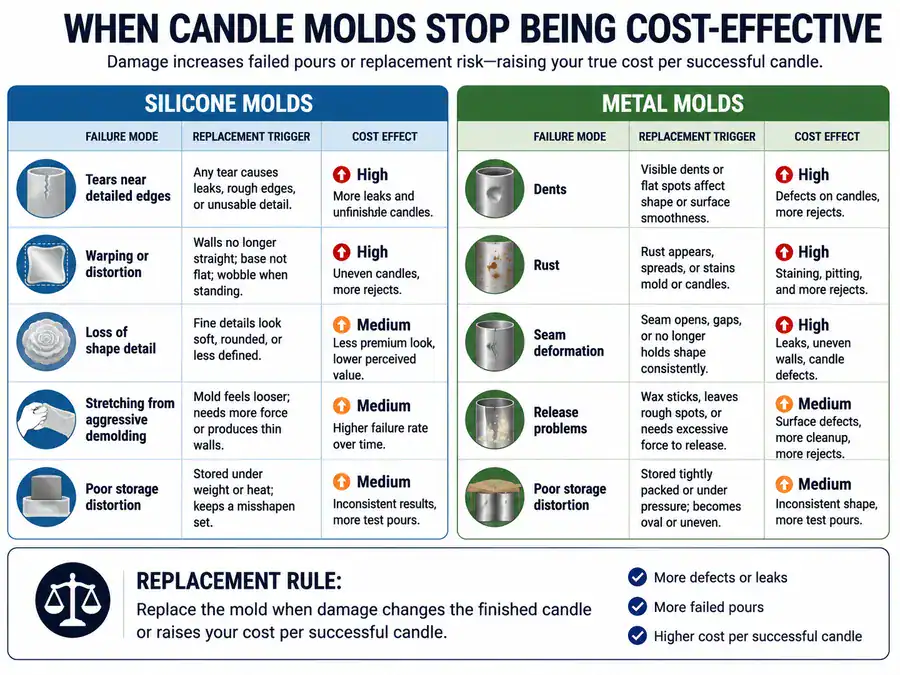
| Mold Material | Failure Mode | Replacement Trigger | Cost Effect | Prevention Summary |
|---|---|---|---|---|
| Silicone | Tears near detailed edges | Wax catches, edges rip, or the shape no longer releases cleanly | Raises failed-pour rate and replacement frequency | Use the mold for shapes it can release without heavy pulling. |
| Silicone | Warping or distortion | Tall or heavy candles lean, bulge, or lose intended shape | Reduces sellable output | Support soft molds when shape stability affects finished candles. |
| Silicone | Loss of shape detail | Fine lines, corners, or sculpted areas become rounded or damaged | Lowers product quality | Retire the mold when detail loss affects the finished candle. |
| Silicone | Stretching from aggressive demolding | Mold no longer returns to its intended shape | Makes each later pour less predictable | Treat demolding force as a cost factor, not only a technique issue. |
| Metal | Dents | The finished candle shows dents or uneven sides | Turns a reusable mold into a reject source | Replace when dents affect the candle surface. |
| Metal | Rust | Rust marks, roughness, or surface damage contact the wax | Can ruin finish and shorten mold life | Keep drying and storage tied to lifespan, not a full care tutorial. |
| Metal | Seam deformation | Wax leaks or the candle releases with seam defects | Adds sealing work and failed pours | Replace when sealing no longer fixes the problem. |
| Metal | Release problems | Candles stick, crack, or require forceful removal | Raises reject rate and slows production | Review mold release options for candle molds when sticking affects cost. |
| Metal | Poor storage distortion | Mold becomes out of round or uneven | Reduces consistency across batches | Store rigid molds where they will not be crushed or bent. |
Silicone does not always wear out faster, and metal does not always last longer.
A thick, well-supported silicone mold used for simple shapes may outlast a thin metal mold that dents or rusts. A rigid metal pillar mold may beat silicone for repeated standard production when release and sealing are under control.
Replace a candle mold when damage changes finished candles, increases failed pours, creates leaks, or makes the mold cost per successful candle rise above a better replacement.
Cleaning candle molds to extend mold life belongs in a dedicated care guide because this page only treats cleaning, drying, and storage as lifespan cost factors.
Lifespan changes both cost per candle and payback speed. A mold that lasts longer spreads its price across more successful candles, while a mold that tears, dents, rusts, or warps early raises the real cost of every usable candle.
When Does a More Expensive Candle Mold Pay for Itself?
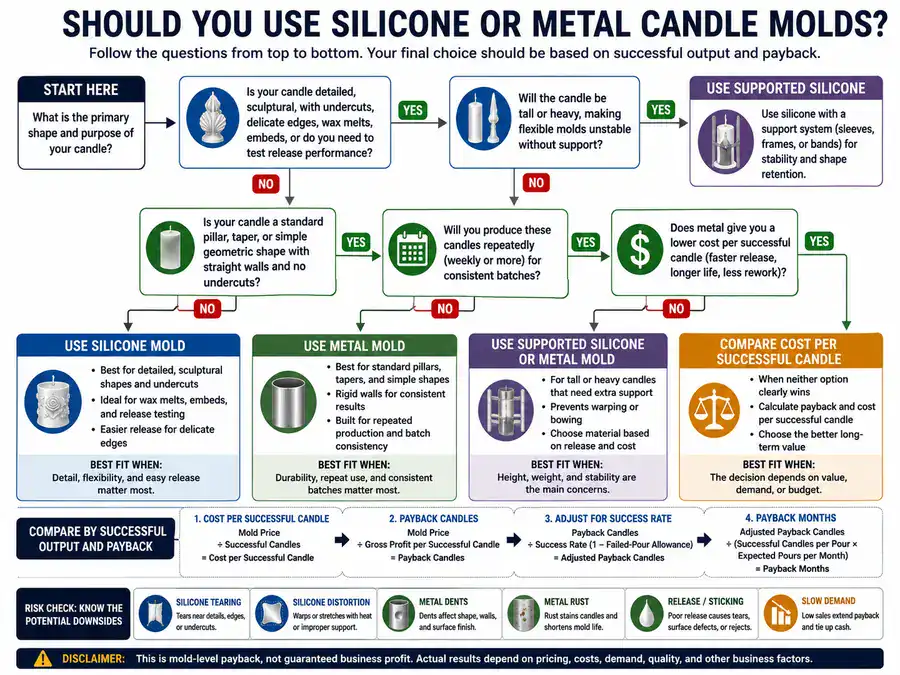
A more expensive candle mold pays for itself when gross profit from successful finished candles covers the mold cost.
This is mold-level payback, not guaranteed business profit, sales volume, or full candle pricing math.
Gross profit per candle means the amount left from one candle sale after the direct product cost you already track.
Use a Candle Pricing Formula or Candle COGS Calculator for full pricing, wax, fragrance, packaging, labor, fees, taxes, and margin.
| Input | What to Enter | Example |
|---|---|---|
| Mold price | What you paid for the reusable mold | $40 |
| Successful candles per pour | Sellable candles from each use | 1 |
| Gross profit per candle | Profit before counting the mold payback | $4 |
| Expected pours per month | Realistic repeated use | 10 |
| Failed-pour allowance | Expected rejects or broken candles | 10% |
| Payback Calculation | Formula | Example Result |
|---|---|---|
| Payback candles | Mold price ÷ gross profit per successful candle | $40 ÷ $4 = 10 candles |
| Payback pours | Payback candles ÷ successful candles per pour | 10 ÷ 1 = 10 pours |
| Adjusted payback with failed-pour allowance | Payback candles ÷ success rate | 10 ÷ 0.90 = 12 candles, rounded up |
| Payback months | Adjusted payback pours ÷ expected pours per month | 12 ÷ 10 = about 1.2 months |
These are modeled examples. The result changes when mold price, successful candles per pour, failed pours, selling rhythm, or gross profit per candle changes.
| Buyer Type | When the Mold Is Usually Easier to Justify | When It Is Harder to Justify |
|---|---|---|
| Hobby maker | The mold gives a shape you want and will reuse often. | The mold is for one project or a novelty shape you may not repeat. |
| Testing a new design | The lower-cost mold helps test demand before buying higher-grade versions. | The mold is expensive before you know whether the candle shape sells. |
| Small-batch seller | The mold creates repeatable sellable candles with few rejects. | The mold has a high price, slow demand, or frequent failed pours. |
| Multi-cavity production | Several sellable candles come from each pour. | Cavities sit unused or releases are inconsistent. |
| Detailed candle seller | Better release reduces broken details and replacement. | The shape is fragile, slow to demold, or not priced high enough to cover rejects. |
An expensive mold is not automatically a poor buy.
It becomes a poor buy when it does not produce enough successful candles before damage, replacement, or loss of demand.
It becomes a better buy when it lowers failed pours, holds shape longer, or produces multiple sellable candles per batch.
Should You Buy Silicone or Metal Candle Molds?
Choose silicone or metal based on candle shape, detail level, release difficulty, production frequency, durability needs, and cost per successful candle.
There is no universal winner.
| Use Case | Better Fit | Why It Fits | Main Cost Risk |
|---|---|---|---|
| Detailed sculptural candles | Silicone | Flexible release helps protect fine details and undercuts. | Thin silicone may tear or distort. |
| Standard pillar candles | Metal | Rigid walls support repeatable shapes. | Dents, rust, sticking, or sealing issues can raise rejects. |
| Tall or heavy molded candles | Metal or supported silicone | Shape support matters more than material label. | Soft molds can bulge; metal can be harder to release. |
| Wax melts or small embeds | Multi-cavity silicone | Several pieces can come from one pour. | Low-quality cavities may tear or lose detail. |
| Repeated taper production | Metal taper mold | Multiple straight cavities can support batch work. | Higher upfront cost needs repeated use. |
| Beginner testing | Lower-cost silicone or basic metal | The goal is learning fit before buying many molds. | Buying too many shapes before knowing use rate. |
| Small-batch selling | The mold with lower cost per successful candle | Payback depends on usable output, not material alone. | Failed pours and slow demand delay payback. |
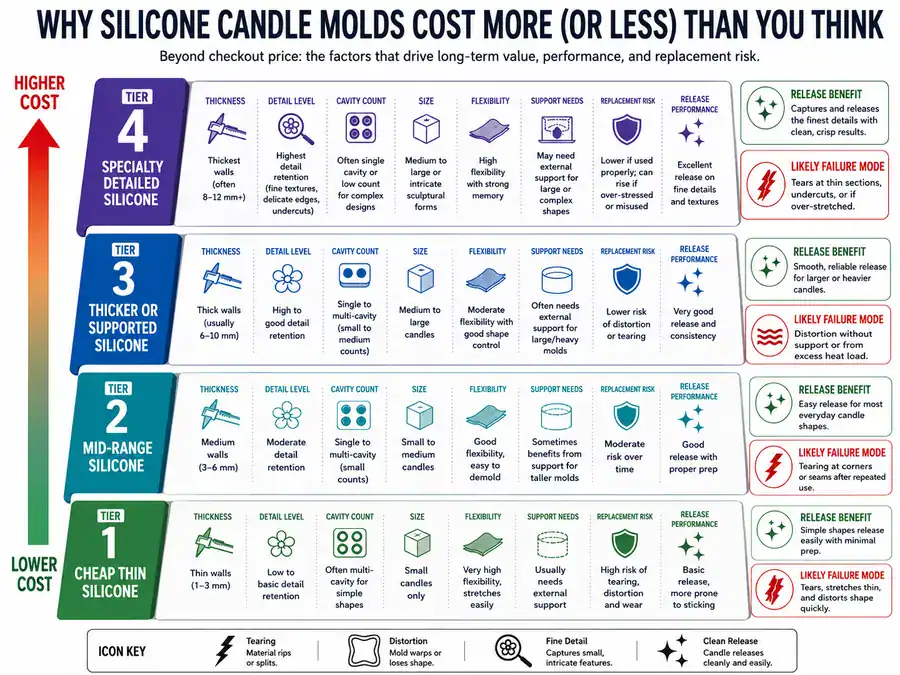
Choose silicone if the candle has fine detail, undercuts, delicate edges, or a shape that would break during rigid release.
Silicone is often the safer test choice when the main question is whether the shape releases cleanly.
Choose metal if the candle is a standard pillar, taper, or repeated shape where rigidity, long use, and batch consistency matter more than flexible release.
Metal is often the stronger value when sealing and release are manageable.
Beginners should not pick by material name alone. A beginner buying decision belongs in Best Candle Molds for Beginners when the question becomes product selection, size choice, or starter mold lists.
Specific silicone picks belong in Best Silicone Candle Molds, while demolding steps belong in How to Use Silicone Candle Molds.
The best mold is the one that matches candle style, use frequency, release needs, and realistic payback.
Silicone can be cheaper for detailed candles that break in rigid molds.
Metal can be cheaper for repeated standard production when it lasts through enough successful pours.
FAQ
Are candle molds the same as candle tins?
No. A candle mold is a reusable shaping tool for poured wax, while a candle tin is usually a finished candle container.
Mold cost covers reusable shaping equipment. Tin, jar, and container costs belong in container candle budgeting, not silicone vs metal mold ROI.
Are silicone candle molds always cheaper than metal molds?
No. Silicone molds can have a lower checkout price, especially for small or simple shapes, but they are not always cheaper per candle.
Metal can cost less over time when it lasts through repeated standard pours. Compare purchase price, successful candles, failed pours, and replacement timing.
Do you need mold release for silicone and metal candle molds?
Not every candle mold needs release aid.
Mold release depends on material, shape detail, wax behavior, and how easily the candle comes out without damage.
If sticking raises failed pours, count release aid as a mold-specific cost and use a candle mold release guide for product and application details.
How many candles does it take to pay back a mold?
Divide the mold price by gross profit per successful candle.
A $40 mold with $4 gross profit per finished candle needs about 10 successful candles to pay back before failed-pour adjustments.
This is mold-level payback, not a full pricing formula or guaranteed business profit.
Should beginners buy silicone or metal candle molds?
Beginners should choose by candle shape and repeat-use plans, not material name alone.
Silicone is often easier for detailed shapes and release practice. Metal can be better for simple pillars or tapers.
For product lists, use beginner candle mold recommendations instead of treating this cost guide as a roundup.
What is not included in candle mold cost?
Candle mold cost does not include wax, fragrance, dye, labels, packaging, labor, taxes, marketplace fees, rent, or full business overhead.
This page only counts reusable mold price, mold-specific add-ons, replacement risk, failed-pour allowance, cost per successful candle, and mold-level ROI.