

The best wax for most candle molds is pillar paraffin wax or a tested pillar/mold wax blend because it releases cleanly, holds shape, and captures detail.
A pillar, mold, or freestanding wax is wax designed to harden enough for a candle that stands outside a container. Candle mold wax compatibility means how a wax behaves after cooling in a shaped mold.
A good mold wax should:
- Release without tearing
- Stay firm outside a container
- Hold surface detail
- Remain practical for the maker’s skill level
Here, “best” means best-performing for candle molds, not cheapest, most natural, safest overall, strongest scent throw, or best for container candles.
Soy, paraffin, beeswax, and blends will be compared by:
- Release
- Firmness
- Shrinkage
- Detail retention
- Finish quality
- Beginner reliability
Quick Answer: The Best Wax for Candle Molds Depends on Mold Performance
Pillar paraffin wax or a tested pillar/mold wax blend is usually the best starting point for candle molds.
These waxes are reliable because they balance release, firmness, detail, and beginner handling better than soft container waxes. Beeswax, pillar soy, and soy-based blends can still work when your goal is a natural-leaning candle, a specific finish, or a molded shape with less fragile detail.
| Mold goal | Best wax choice | Why it fits |
|---|---|---|
| Best overall | Pillar paraffin or tested pillar/mold blend | Releases well, stays firm, and captures detail reliably. |
| Best beginner choice | Pre-blended pillar/mold wax | Reduces guesswork around hardness, shrinkage, and release. |
| Best detail | Pillar paraffin or firm mold blend | Holds sharper edges and fine surface lines. |
| Easiest release | Pillar paraffin or shrink-friendly mold blend | Slight, controlled shrinkage can help the candle separate from the mold. |
| Best natural-leaning option | Beeswax or soy-beeswax blend | Offers firmness with a more natural ingredient preference. |
| If you prefer soy | Pillar soy or soy blend | Works better than soft container soy for freestanding candles. |
| Avoid for molds | Soft container soy wax | Usually too soft for candles that must stand outside a jar. |
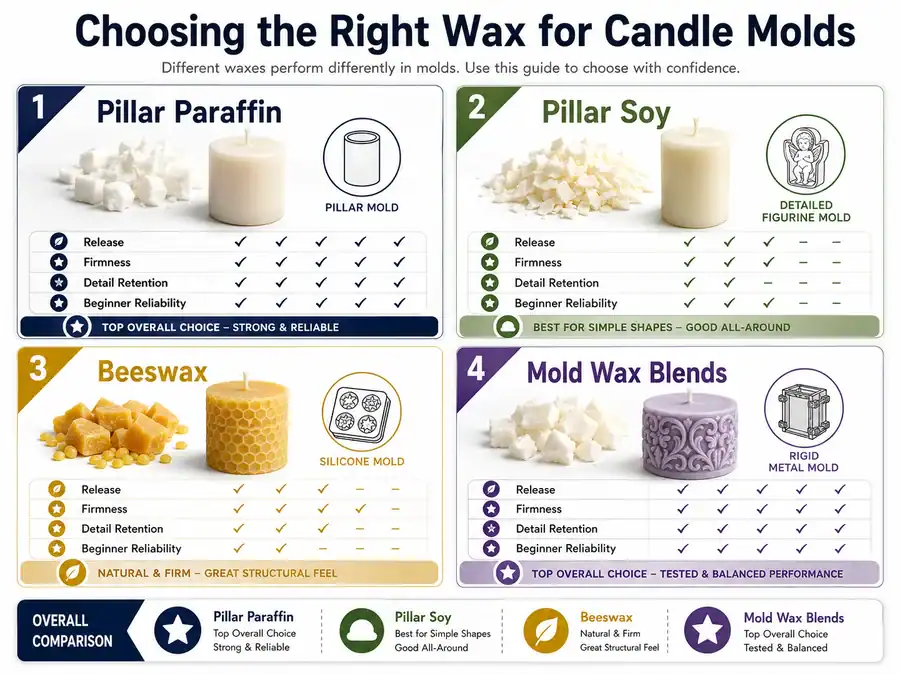
The main mistake is choosing wax by ingredient name alone. A wax can be “soy,” “paraffin,” or “beeswax” and still perform poorly if it is too soft, too brittle, or not intended for molded candles.
Exact formulas, wick sizing, and brand selection should be handled after the wax category is chosen because those choices depend on the mold shape, candle size, and burn goal.
Soy vs Paraffin vs Beeswax vs Blends: Which Wax Works Best in Candle Molds?
Pillar paraffin and tested pillar/mold blends usually perform best for candle molds, while beeswax and soy blends fit narrower goals.
| Wax type | Release from molds | Freestanding firmness | Detail and finish | Beginner fit | Best mold use |
|---|---|---|---|---|---|
| Soft container soy | Poor to limited | Low | Can frost, dent, or lose shape | Weak for molds | Avoid unless blended for pillar use. |
| Pillar/mold soy | Moderate | Moderate to good | Softer detail than paraffin in some molds | Moderate | Simple shapes and soy-preference projects. |
| Pillar paraffin | Good | Good | Often clean, sharp, and smooth | Strong | Detailed molds, rigid molds, and beginner molded candles. |
| Beeswax | Moderate | High | Can hold shape well but may be brittle in delicate designs | Moderate | Natural-leaning molded candles and sturdy shapes. |
| Soy-paraffin blend | Good | Good | Balanced detail and finish | Strong | General molded candles with easier handling. |
| Soy-beeswax blend | Moderate to good | Good | Firm, natural-leaning finish with better structure than soft soy | Moderate | Natural-leaning shapes that need more firmness. |
Soft container soy is usually not ideal for freestanding molded candles because it is made to sit inside a jar, not support itself after release. Pillar soy or a soy blend is the better soy route when the finished candle must stand on its own.
Paraffin pillar wax is often the most forgiving mold wax because it can combine clean release, firmness, and detail capture. That does not make it the best wax for every maker; it means it usually answers the mold-performance problem with less formulation work.
Beeswax can work well when firmness and natural ingredient preference matter. Its tradeoff is handling: it may be less forgiving in delicate molds, and it can be more rigid than some shapes need.
Blends often make the most sense because they can balance what single waxes struggle to do alone.
How Do Soy, Paraffin, Beeswax, and Blends Release from Candle Molds?
Paraffin and mold-ready blends usually release more cleanly than soft soy because they cool into firmer candles with helpful shrinkage.
Release matters because a molded candle has to separate from the mold without tearing, denting, cracking, or losing surface detail.
Soft container soy is the weakest release choice because it can cling to mold walls and deform during removal. Pillar soy performs better, but it still needs the right mold shape and enough structure to avoid dents.
Paraffin often releases cleanly because it can contract enough as it cools to separate from the mold wall. That shrinkage is useful when it helps removal, but it becomes a flaw if it creates gaps, sink marks, or weak edges.
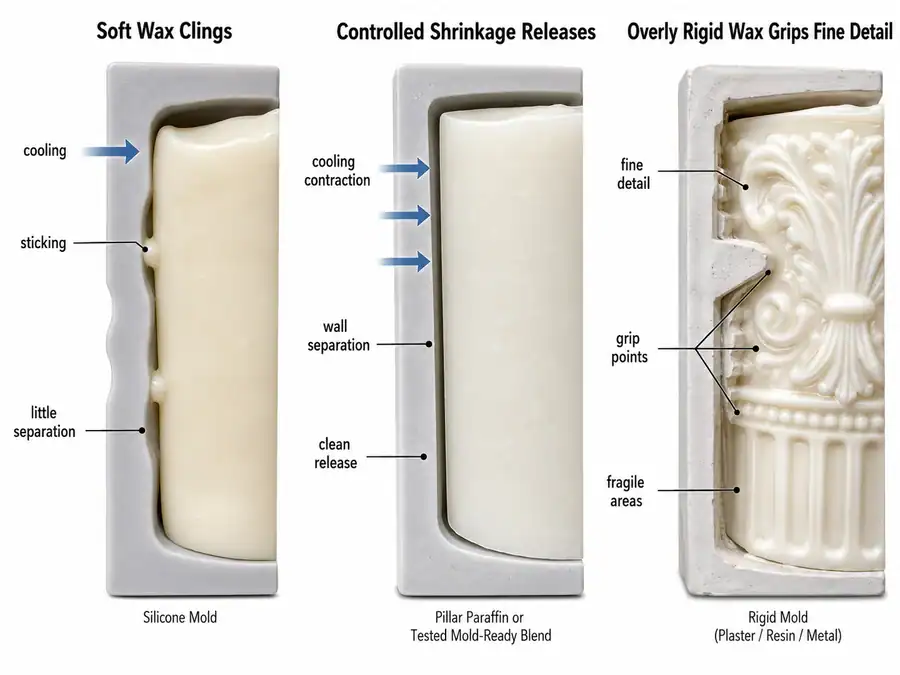
Beeswax is firm and sturdy, but it can grip fine mold detail and may feel less forgiving in narrow or delicate molds.
Blends are often the safest middle path. A soy-paraffin blend can improve release while keeping a softer finish than straight paraffin. A soy-beeswax blend can make soy firmer and more mold-friendly without moving fully away from natural-leaning wax choices.
What Makes a Wax Firm Enough for Freestanding Molded Candles?
A mold wax is firm enough when the finished candle can stand on its own without slumping, denting, bending, or losing edges.
Firmness is the main difference between molded candles and container candles. A container candle can rely on the jar for support, but a molded candle has to support its own walls, base, corners, and surface details after release.
Soft soy container wax is usually a poor fit because it is designed for adhesion and jar use rather than freestanding structure. That does not mean all soy is wrong for molds. It means the soy wax needs to be a pillar soy, a mold-specific soy, or part of a firmer blend.
Paraffin pillar wax is usually strong in this category because it sets into a stable body and handles edges, ridges, and freestanding shapes well.
Beeswax is naturally firm, which makes it useful for sturdy molded candles. The tradeoff is that high firmness can feel rigid in delicate shapes.
Blends help when a single wax is too soft, too brittle, or too hard to remove cleanly.
For beginners, the safest rule is simple: choose wax labeled for pillar, molded, or freestanding candles. Avoid wax that is marketed only for jars unless the supplier clearly states it can be used in molds.
How Well Do Different Waxes Hold Mold Detail and Surface Finish?
Paraffin and firm mold blends usually hold sharper mold detail, while beeswax and pillar soy can work better in simpler shapes.
Detail retention means the cooled wax keeps the mold’s edges, raised patterns, grooves, faces, petals, or texture without rounding off or tearing during release.
Surface finish means how clean, smooth, frosted, glossy, matte, or marked the outside of the candle looks after demolding.
| Detail or finish goal | Better wax choice | Wax to avoid |
|---|---|---|
| Sharp edges | Pillar paraffin or firm mold blend | Soft container soy |
| Fine raised detail | Pillar paraffin or soy-paraffin blend | Brittle or overly soft wax |
| Smooth finish | Pillar paraffin or tested blend | Poorly matched wax with sink marks or drag lines |
| Natural-leaning finish | Beeswax or soy-beeswax blend | Soft soy if the candle must stand alone |
| Simple matte shapes | Pillar soy or soy blend | Container soy unless approved for molds |
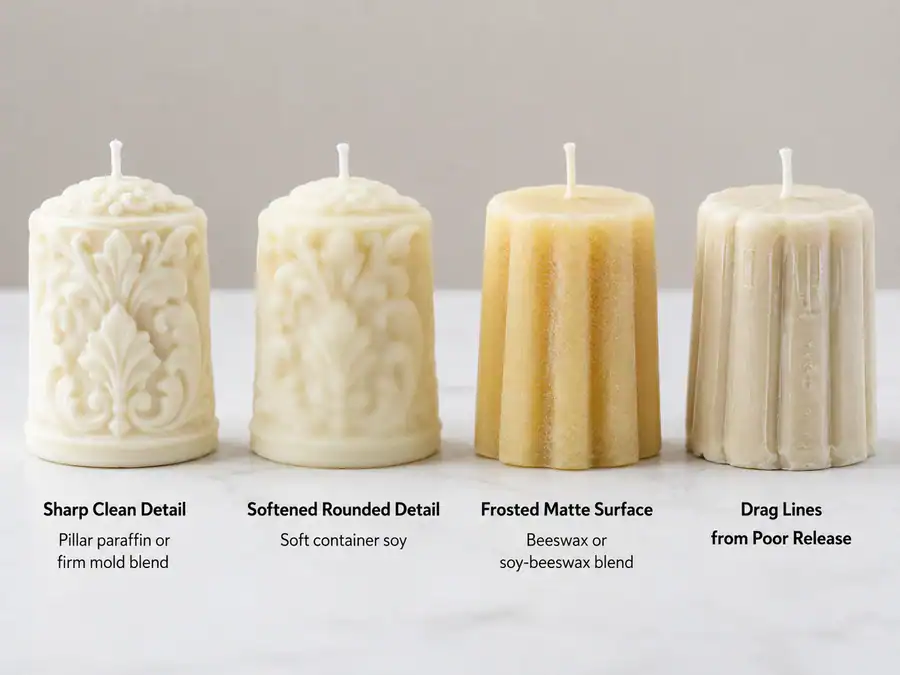
What Wax Should Beginners Use for Candle Molds?
Beginners should use a pre-blended pillar or mold wax instead of soft container soy or an untested homemade blend.
A beginner mold wax should reduce the number of variables that can go wrong at once. The wax should be firm enough to stand alone, release without force, tolerate basic pouring technique, and give a usable finish without advanced additives.
Pre-blended pillar/mold wax is the safest beginner choice because it is already designed for freestanding candles.
Pillar paraffin is often the easiest single-wax route for beginners who want clean release and sharp detail. The tradeoff is that it does not satisfy every natural-wax preference.
Pillar soy or a soy-based mold blend is a better beginner choice than container soy when the maker wants a soy-forward candle.
Beeswax can suit beginners using simple, sturdy molds, but it is not always the easiest first wax for detailed shapes.
How Does Mold Shape Change the Best Wax Choice?
Simple molds tolerate more wax types, while detailed or narrow molds need firmer wax with cleaner release.
| Mold shape | Better wax choice | Why it works |
|---|---|---|
| Simple pillar | Pillar paraffin, pillar soy, beeswax, or mold blend | The shape has enough mass and fewer fragile details. |
| Detailed figurine | Pillar paraffin or soy-paraffin blend | Clean release and sharper detail matter more. |
| Thin taper or narrow shape | Firm pillar wax or tested mold blend | The candle needs strength without snapping. |
| Floral or fine-detail mold | Pillar paraffin or firm blend | Raised detail can tear if the wax is too soft. |
| Chunky geometric mold | Pillar soy, paraffin, beeswax, or blend | Strong shapes give more wax flexibility. |
| Silicone mold with flexible walls | Pillar/mold blend | Flexibility helps release, but the wax still needs structure. |
| Rigid plastic or metal mold | Paraffin or shrink-friendly blend | Controlled shrinkage can make release easier. |
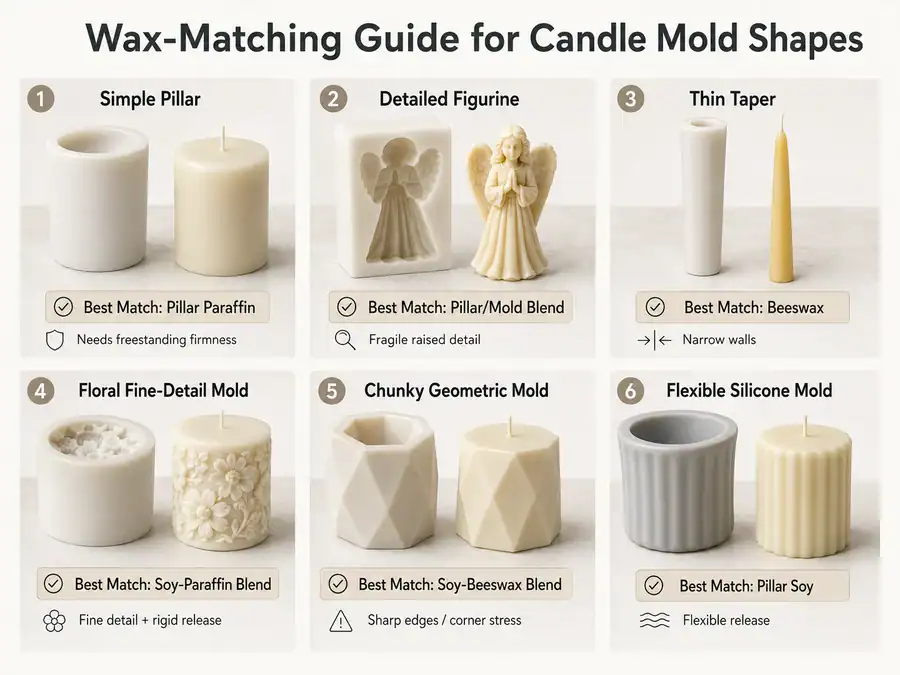
Silicone can make demolding easier because the mold wall flexes, but silicone does not replace wax structure. A soft wax can still dent, slump, or lose detail after release.
The best match is the wax that supports the weakest part of the shape.
Why Do Wax Blends Often Work Better in Candle Molds?
Wax blends often work better because they balance firmness, release, detail, and finish better than one wax can alone.
| Blend type | Main benefit in molds | Best use |
|---|---|---|
| Soy-paraffin blend | Better release and structure than soft soy | General molded candles with cleaner detail |
| Soy-beeswax blend | More firmness than soy alone | Natural-leaning molded candles |
| Pillar/mold wax blend | Balanced structure, release, and finish | Beginner and repeatable mold work |
| Paraffin blend with additives | Cleaner detail and adjusted hardness | Detailed or rigid molds |
Blends are not automatically better in every mold. A poor blend can still be too soft, too brittle, or too hard to remove cleanly.
The useful question is whether the blend fixes a specific molded-candle problem:
- Weak structure
- Poor release
- Rough finish
- Lost detail
Is the Most Natural Wax Always the Best Wax for Candle Molds?
The most natural wax is not always the best wax for candle molds because mold performance depends on structure, release, and detail.
Naturalness is an ingredient preference. Mold compatibility is a performance requirement.
| Priority | Better wax direction | Main tradeoff |
|---|---|---|
| Most natural-leaning | Beeswax or soy-beeswax blend | Can be less forgiving in fragile detail. |
| Best mold performance | Pillar paraffin or mold blend | Less natural-leaning than beeswax or soy. |
| Soy preference | Pillar soy or soy blend | Needs mold-ready structure. |
| Lowest guesswork | Pre-blended pillar/mold wax | Less control over custom formula. |
Which Wax Should You Choose for Your Candle Mold Goal?
Choose pillar paraffin or a mold-ready blend for the best overall mold performance, and choose beeswax or soy blends for narrower ingredient goals.
| Candle mold goal | Choose this wax | Avoid this wax |
|---|---|---|
| Best overall performance | Pillar paraffin or tested pillar/mold blend | Soft container soy |
| Sharp detail | Pillar paraffin or soy-paraffin blend | Overly soft soy |
| Natural-leaning molded candle | Beeswax or soy-beeswax blend | Container soy used alone |
| Soy-forward molded candle | Pillar soy or soy mold blend | Jar soy without mold approval |
| Simple sturdy shape | Beeswax, pillar soy, paraffin, or blend | Wax that dents after release |
| Beginner molded candle | Pre-blended pillar/mold wax | Untested homemade blend |
| Rigid mold release | Paraffin or shrink-friendly blend | Wax that clings without contraction |
| Flexible silicone mold | Pillar/mold blend | Wax too soft to hold shape |
If you want one safe starting choice, use a pre-blended pillar or mold wax. It gives the best balance of firmness, release, and handling without requiring formula-level adjustments.
If you want the cleanest detail, start with pillar paraffin or a soy-paraffin blend.
If you want a more natural-leaning candle, start with beeswax or a soy-beeswax blend in a simple mold.
If you want soy, choose pillar soy rather than soft container soy.
What Should You Do After Choosing Wax for Candle Molds?
After choosing wax, match the wick, test the burn, and troubleshoot release problems before scaling the candle design.
Wax choice solves only one part of molded candle performance. The candle still needs:
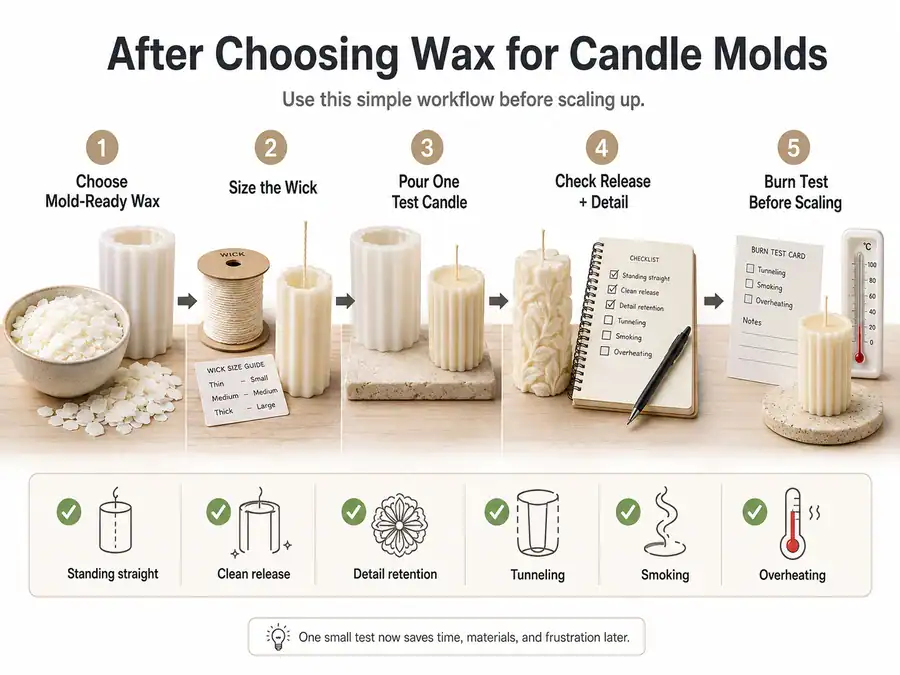
- A wick that fits the final diameter
- A safe burn pattern
- A release process that works with the mold material and shape
Start with wick sizing for molded candles after the wax category is chosen.
Next, test one candle before making a batch. Check whether it:
- Releases cleanly
- Stands straight
- Holds detail
- Burns without tunneling, drowning, smoking, or overheating the shape
If the candle sticks, cracks, dents, or loses detail, move to a candle mold release guide.
FAQ
Can I use soy wax in candle molds?
Yes, you can use soy wax in candle molds if it is pillar soy, mold soy, or part of a firmer soy blend.
Soft container soy is the risky choice because it is made for jars. It may dent, stick, slump, or lose shape after demolding.
Is paraffin wax good for candle molds?
Yes, pillar paraffin wax is one of the most reliable waxes for candle molds.
It releases well, holds detail, and stays firm enough for many freestanding shapes. It is especially useful for beginners, rigid molds, and detailed designs.
Is beeswax good for candle molds?
Yes, beeswax can be good for candle molds, especially simple pillars, sturdy shapes, and natural-leaning candles.
Its main tradeoff is rigidity. Beeswax may be less forgiving in thin, fragile, or highly detailed molds where release and fine edges are harder to control.
Are wax blends better than pure wax for molds?
Wax blends are often better for molds when one wax alone is too soft, brittle, sticky, or hard to release.
A soy-paraffin blend can improve release and detail. A soy-beeswax blend can add firmness to soy while keeping a natural-leaning wax direction.
What wax is best for silicone candle molds?
A pillar or mold-ready wax blend is usually best for silicone candle molds.
Silicone can flex during release, but the wax still needs enough firmness to stand, hold detail, and avoid dents after removal.
What wax should beginners use for molds?
Beginners should start with a pre-blended pillar or mold wax.
That choice reduces problems with softness, sticking, weak structure, and inconsistent finish. After the first successful mold, beginners can compare soy, paraffin, beeswax, and blends for more specific goals.