

This calculator scales a known wax weight for one candle mold cavity across cavities, identical molds, and optional reserve wax to return wax-only melt weight.
Use it when one cavity’s wax weight is already known and you need the total wax amount for a repeatable molded-candle batch. It does not measure mold capacity from dimensions, water volume, or water weight.
Reserve wax means extra wax added after the base mold-batch amount so you do not run short while pouring. Fragrance oil is calculated separately after the wax-only amount is known.
Candle Mold Batch Calculator
Enter wax per cavity, unit, cavities per mold, number of molds, and optional reserve wax. The calculator returns base wax before reserve, reserve wax amount, and total wax needed.
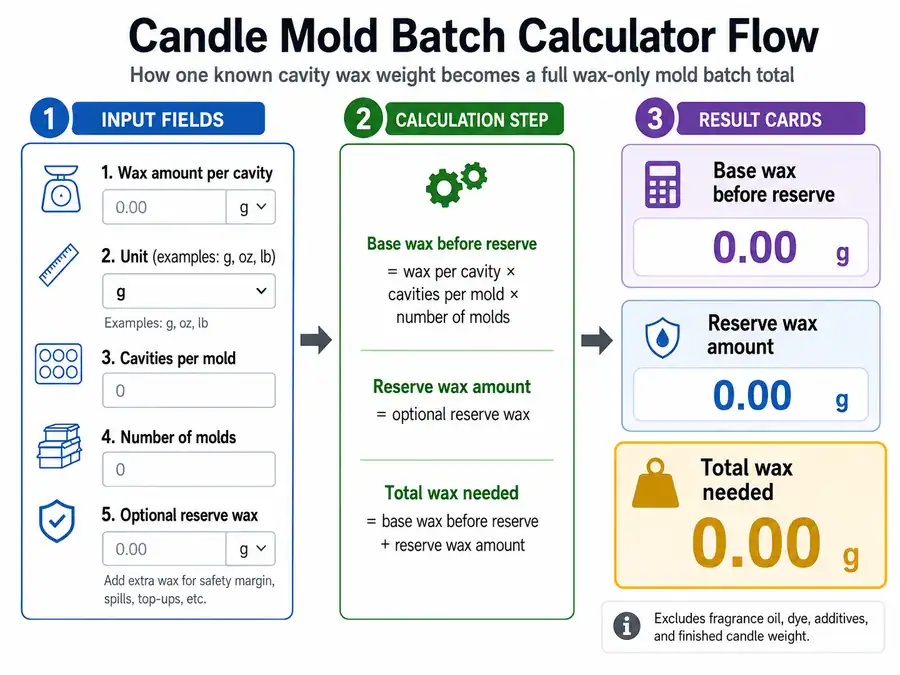
For the broader mold setup, Candle Molds & Shapes is the parent guide. If you do not know how much wax one cavity holds yet, use How Much Wax Will My Candle Mold Hold? first, then return to this calculator.
| Calculator field | What to enter |
|---|---|
| Wax amount per cavity | The known wax weight for one filled cavity |
| Unit | Grams or weight ounces |
| Cavities per mold | Fillable candle-forming spaces in one mold |
| Number of molds | Identical or capacity-matched molds in this batch |
| Reserve type | None, percentage, or fixed weight |
| Reserve amount | The percent or same-unit wax weight added after base wax |
| Filled cavities override | Only for planned partial batches |
| Result | Meaning |
|---|---|
| Base wax before reserve | Wax per cavity × cavities counted × number of molds |
| Reserve wax amount | Extra wax added after the base wax is calculated |
| Total wax needed | Wax-only amount to melt for this mold batch |
| Result note | Fragrance oil, dye, additives, finished candle weight, and purchase quantity are not included |
Method: The calculator first scales one cavity into the planned mold setup, then adds reserve wax. It does not measure mold capacity, calculate fragrance load, size wicks, price the batch, or diagnose mold problems.
Enter the Wax Amount for One Cavity
Wax amount per cavity means the wax weight required to fill one individual candle mold cavity once. Use the wax weight for one filled cavity, not the whole mold, finished candle, or full batch.
This calculator uses the known wax weight for one candle mold cavity as the starting point. If one cavity takes 40 g of wax, enter 40 in the wax-per-cavity field.
| If you know this | Enter this |
|---|---|
| One cavity takes 40 g | 40 g |
| A 6-cavity mold takes 240 g total | 40 g per cavity, not 240 g |
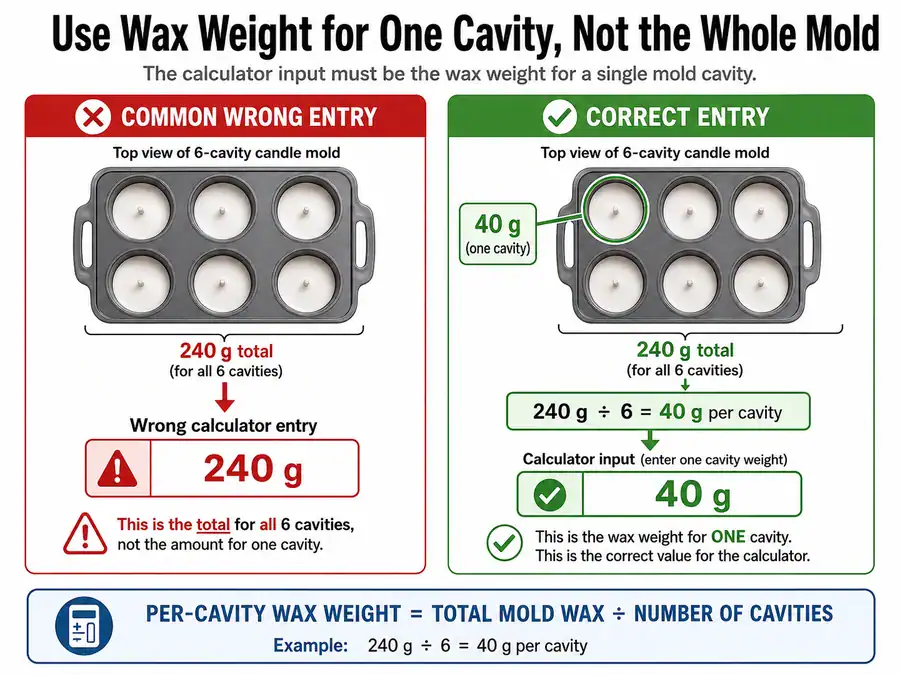
If the whole mold total is known and every cavity is the same size, divide the mold’s total wax weight by the number of cavities before entering the per-cavity amount.
Use the same unit through the calculator. Grams and weight ounces are both fine, but do not mix grams with ounces in the same calculation.
This field is wax weight only, so do not enter fragrance oil, dye, additive weight, finished candle weight, water volume, or mold dimensions.
If the number is unknown, measure or confirm the mold’s single-cavity wax weight on the candle mold capacity guide before using this batch calculator.
Count the Cavities You Will Fill
Cavities per mold means the number of individual candle-forming spaces you plan to fill in one mold. A cavity is one fillable candle-forming space inside the mold.
Use this field for cavities in one mold or tray, not total cavities across all molds and not final candle count.
Decorative recesses, raised details, surface lines, and design impressions do not count as separate cavities.
Example:
40 g per cavity × 6 cavities = 240 g for one full mold.
If you are filling only some spaces in the mold, use the partial batch option instead of entering the full cavity count.
Add the Number of Identical Molds
Number of molds means how many identical or capacity-matched molds you are pouring in this calculation. Mold count is different from cavity count.
Cavities per mold counts spaces inside one mold. Number of molds counts how many repeated molds are included in the same pour plan.
Example:
40 g per cavity × 6 cavities × 3 molds = 720 g before reserve.
Use one calculation line only when the molds are identical or hold the same wax amount per cavity.
If you are using different mold styles or different cavity sizes, calculate each mold type separately or use a mixed-mold planning guide. This keeps the result from blending unequal mold capacities into one unclear wax total.
Partial Batch: Fill Fewer Cavities
A partial batch means you intentionally fill fewer cavities than the mold setup allows. Use filled cavities instead of total available cavities before adding reserve wax.
This option fits planned test pours, small batches, or batches where you only want some cavities filled.
It does not apply to failed pours, underfilled cavities, leftover wax reuse, or defect correction.
Partial batch formula:
Effective cavity count = filled cavities
Adjusted base wax = wax per cavity × filled cavities
Total wax = adjusted base wax + reserve wax
Example:
If a 6-cavity mold has 40 g cavities but you only fill 4 cavities, the adjusted base wax is:
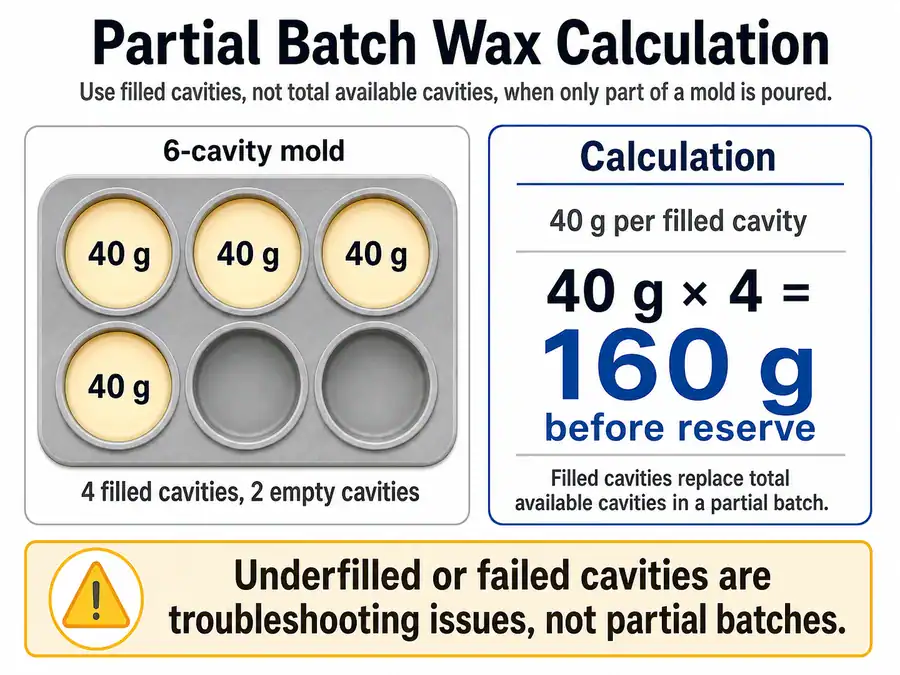
40 g × 4 = 160 g before reserve.
If a cavity was supposed to be filled but came out short, treat that as an underfilled mold problem, not a partial batch.
How to Add Reserve Wax Without Changing the Recipe
Reserve wax means extra wax added to the wax-only batch total after the mold and cavity amounts are calculated.
It is a planned wax-only buffer, not fragrance oil, dye, additives, shrinkage correction, sinkhole repair, second-pour technique, or inventory stock.
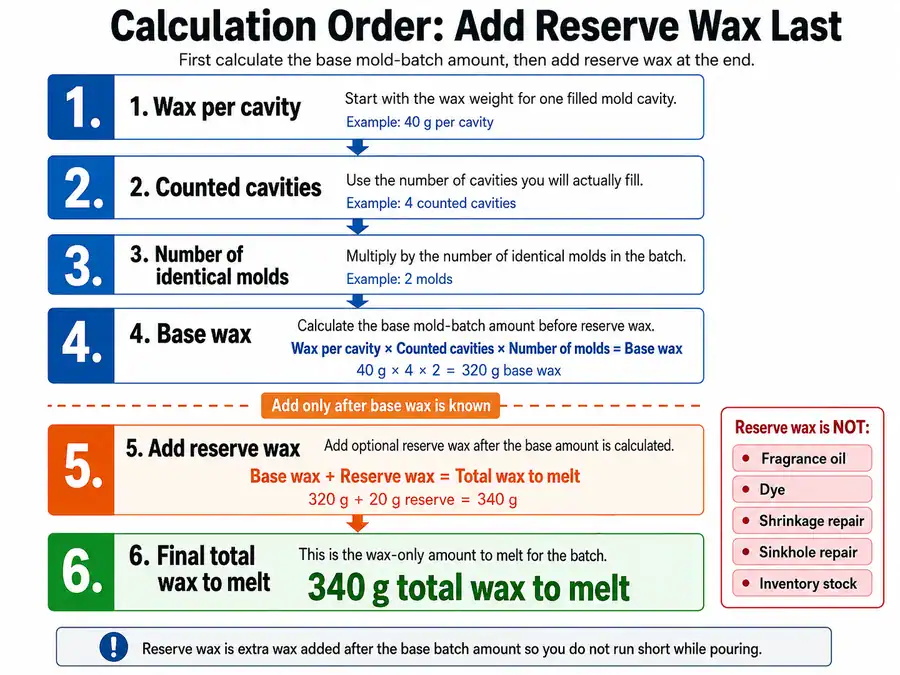
Add reserve after the base wax is calculated:
Base wax + reserve wax = total wax to melt
Apply reserve to the whole base batch, not to each cavity separately, unless you are intentionally calculating each cavity as its own batch.
This order matters because the calculator first scales the known per-cavity wax amount by filled cavities and identical molds. Reserve wax comes last so it does not change the recipe’s cavity count, mold count, or per-cavity starting amount.
| Reserve entry | What it means |
|---|---|
| No reserve | Melt only the base wax amount |
| Percentage reserve | Add a percentage of the base wax amount |
| Fixed reserve | Add a set same-unit wax weight |
| Not reserve wax | Fragrance oil, shrinkage repair, sinkhole repair, dye, or additives |
For fragrance oil, calculate wax-only weight first, then use the fragrance-load calculator. For sinkholes, shrinkage, or second-pour repair, use the troubleshooting guide; reserve wax here is only a planned extra melt amount.
Percentage Reserve vs Fixed Reserve
A percentage reserve scales with the batch size, while a fixed reserve adds the same same-unit wax weight after the base batch amount is calculated.
Percentage reserve changes when the batch changes; fixed reserve does not.
| Reserve type | How it behaves |
|---|---|
| Percentage reserve | Adds a percent of base wax before reserve |
| Fixed reserve | Adds the same extra wax weight every time |
| 5% reserve on 500 g | Adds 25 g |
| 25 g fixed reserve | Adds 25 g whether the batch is 500 g or 900 g |
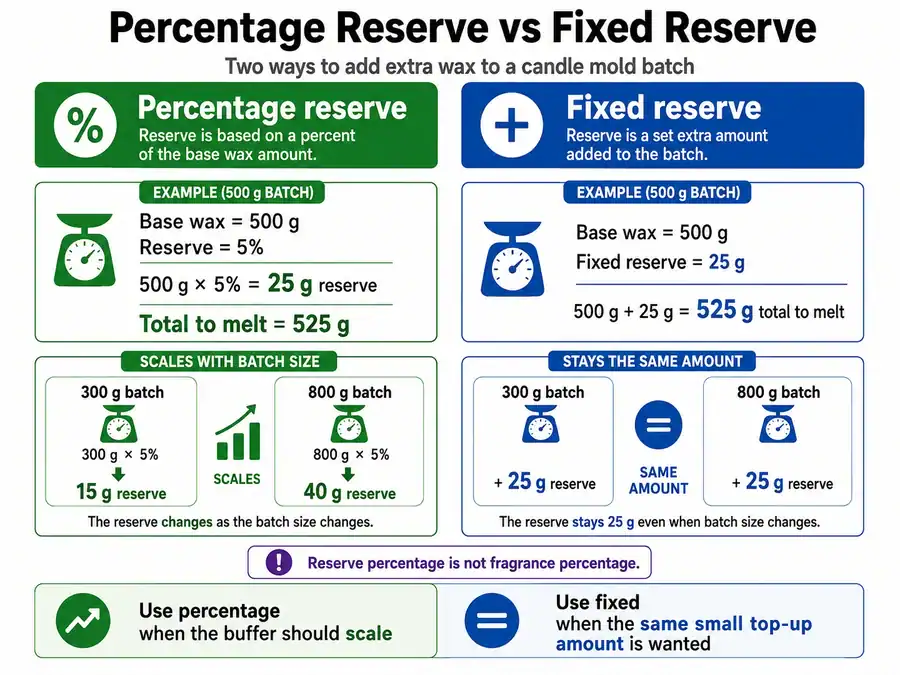
Use percentage reserve when you want the extra wax to rise or fall with the batch. Use fixed reserve when you want the same small amount held back for topping up the pour.
Reserve percentage is not fragrance percentage. It only adds wax after the mold-batch amount is known, so it should not be used for fragrance load, dye percentage, yield modeling, pricing buffer, or inventory planning.
Candle Mold Batch Formula
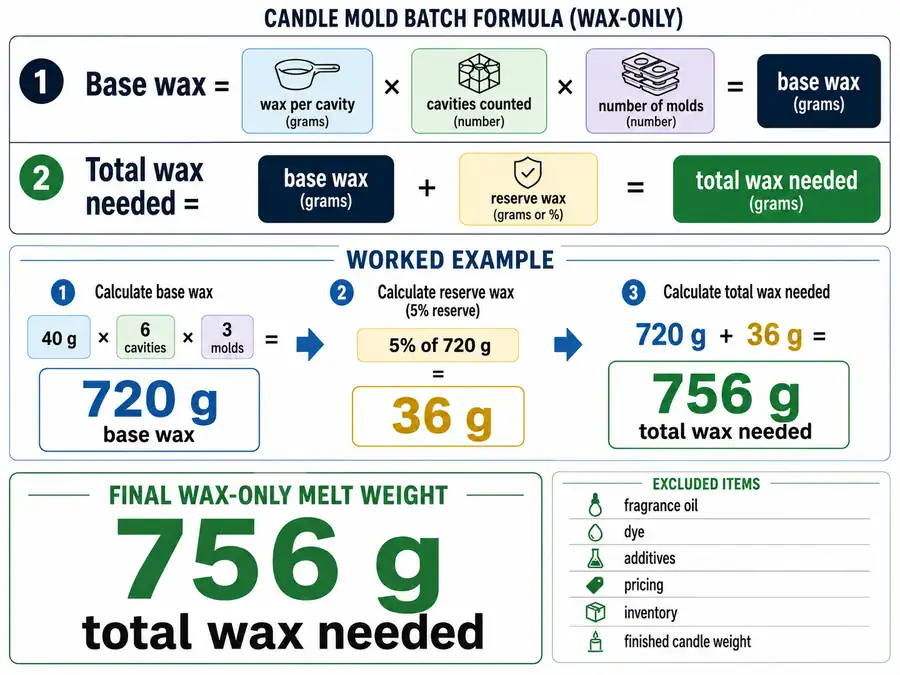
Base wax = wax per cavity × cavities counted × number of molds.
Total wax needed = base wax + reserve wax.
| Step | Formula |
|---|---|
| Base wax | Wax per cavity × cavities counted × number of molds |
| Percentage reserve | Base wax × reserve percentage |
| Fixed reserve | Same-unit reserve weight entered by the maker |
| Total wax needed | Base wax + reserve wax |
Methods Box
Start with the known wax weight for one filled cavity.
Use the counted cavities for the planned pour. For a partial batch, counted cavities means filled cavities, not all available cavities.
Multiply by the number of identical or capacity-matched molds.
Add reserve wax after the base wax is calculated.
Read the result as wax-only melt weight, not finished candle weight or full recipe weight.
Example:
40 g per cavity × 6 cavities × 3 molds = 720 g base wax.
A 5% reserve adds 36 g.
720 g + 36 g = 756 g total wax needed.
This formula does not include fragrance oil, dye, additives, pricing, inventory quantity, label weight, or finished candle weight.
Use the broader Candle Wax Calculator for vessel or container math, and use the Fragrance Load Calculator after this wax-only number is known.
Use One Weight Unit: Grams or Ounces
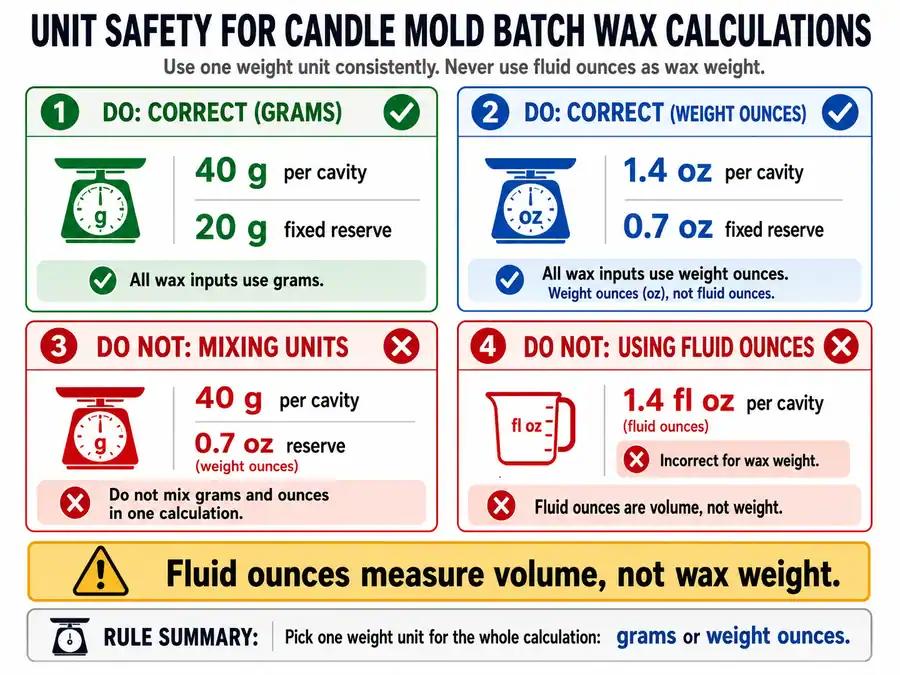
Use one weight unit for every wax input in this calculator: grams or weight ounces.
Same-unit reserve means the reserve uses the selected wax unit. Fluid ounces measure volume, so they should not be entered as wax weight.
The selected unit applies to wax amount per cavity, fixed reserve weight, reserve wax output, and total wax needed.
You can use grams or weight ounces, but the same unit must stay in every wax field.
| Do | Do not |
|---|---|
| Use 40 g per cavity and 20 g fixed reserve | Use 40 g per cavity and 1 oz fixed reserve |
| Use weight ounces for wax weight | Use fluid ounces as wax weight |
| Confirm wax weight before calculating the batch | Use container label ounces as mold wax weight |
If you measured mold capacity by water volume, convert or confirm the wax weight before using this batch calculator.
Use the Candle Mold Capacity Guide for water-volume or mold-capacity measurement, then return here with the wax weight.
Use the Result as a Wax-Only Melt Plan
The calculator result is the wax-only amount to melt for the selected cavity, mold, and reserve setup.
It is not the finished candle weight, recipe weight, purchase quantity, or label weight.
Use the total wax needed as your melt amount for this molded-candle batch. If your recipe includes fragrance oil, dye, or additives, calculate those after the wax-only result is known.
| Result includes | Result excludes |
|---|---|
| Wax per cavity | Fragrance oil |
| Selected cavity count or filled-cavity count | Dye |
| Number of identical molds | Additives |
| Reserve wax | Finished candle weight |
| Wax-only melt amount | Label weight, pricing, inventory, or purchase quantity |
For repeat batches, save the wax-only result with the mold name, cavity count, mold count, reserve type, and unit in your Candle Batch Record Sheet Template.
Use the Fragrance Load Calculator next only if the recipe includes fragrance oil.
FAQs About Candle Mold Batch Wax Calculations
These FAQs close common calculator boundary questions without turning the page into mold measuring, fragrance math, troubleshooting, pricing, or inventory planning.
What if I do not know how much wax one cavity holds?
This calculator requires a known per-cavity wax weight first. Use the Candle Mold Capacity Guide or How Much Wax Will My Candle Mold Hold? before calculating a full mold batch.
Does the total wax include fragrance oil?
No. The total wax needed is wax-only. Use the Fragrance Load Calculator after this result if your recipe includes fragrance oil.
Should I add reserve before or after multiplying cavities and molds?
Add reserve after the base wax is calculated. First multiply wax per cavity by counted cavities and mold count, then add percentage or fixed reserve wax.
Can I calculate different mold styles together?
Only if each mold line uses the correct per-cavity wax amount. If the molds have different cavity sizes or capacities, calculate them separately or use mixed-mold planning.
Are ounces the same as fluid ounces?
No. Ounces in this calculator means weight ounces for wax. Fluid ounces measure volume and should not be entered as wax weight.
Is reserve wax the same as second-pour wax?
No. Reserve wax is a planned wax-only buffer for the pour. Sinkholes, shrinkage, and second-pour repair belong in the troubleshooting guide, not this calculator.