
Candle wax should be colored only with a colorant intended or validated for the selected wax, then added under material-specific conditions, mixed evenly, judged after full cooling, and tested in the complete candle before broader use.
A candle-wax-compatible colorant is a dye or coloring system intended or validated to disperse in candle wax without an incompatible carrier. Here, natural describes source and synthetic describes manufacture; neither label proves wax compatibility, combustion suitability, safety, color strength, or visual color stability under recorded conditions. This guide covers selection, preparation, addition, mixing, cooling, visual evaluation, basic incompatibility screening, and small-batch recordkeeping. It does not provide universal dosage, temperature, mixing-time, decorative-effect, toxicology, wick-sizing, or production-formula rules.
What Counts as a Candle-Wax-Compatible Colorant?
A candle-wax-compatible colorant is intended or validated to spread through candle wax without adding a material that conflicts with the wax system.
Changing the wax’s color does not prove that the material is suitable for a wicked candle. The finished wax, colorant, fragrance, and wick combination still requires controlled testing. Carrier means the liquid or medium that delivers a colorant into the wax; it must suit the wax rather than separate from it.
Candle-Colorant Compatibility Checklist
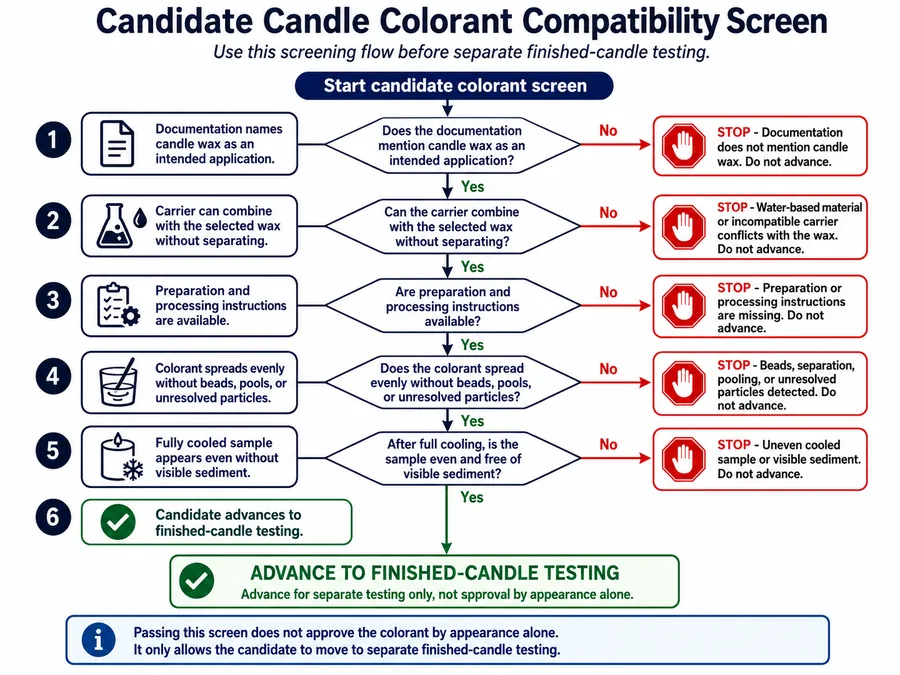
A candidate should advance only when its documentation, carrier, dispersion, and cooled appearance support further testing in the selected wax.
- The documentation names candle wax as an intended application.
- The carrier can combine with the selected wax without separating.
- The preparation and processing instructions are available.
- The colorant spreads evenly without beads, pools, or unresolved particles.
- The cooled sample has an even appearance without visible sediment.
- The formula advances to finished-candle testing rather than being approved by appearance alone.
| Observed sign | First-pass interpretation |
|---|---|
| Colorant beads, pools, or separates | The carrier may not combine with the wax, or the incorporation method may be unsuitable. |
| A water-based material spits or destabilizes the mixture | Water is conflicting with the wax system, so the test should stop. |
| Visible particles remain after mixing | The material may contain insoluble solids that were not removed or dispersed. |
| The documentation does not mention candle wax | Candle suitability has not been established and should not be inferred. |
Can You Use Food Coloring, Crayons, Mica, or Soap Dye in Candles?
Food coloring, crayons, mica, and soap dye should not be treated as candle colorants unless documentation identifies the exact material as suitable for wicked candle wax.
Water-based food coloring should not be treated as candle dye because it usually does not combine with oil-based wax. A soap-only dye is not suitable by default; it needs separate documentation that identifies candle-wax use.
Cosmetic pigments, resin colorants, paints, textile dyes, and general-purpose colorants follow the same rule. Their ability to color another material does not show that they belong in a wicked candle.
Which Form of Candle Dye Should You Use?
Use the candle-dye form that matches the selected wax, batch size, preparation method, and repeatability needs after compatibility has been established.
Repeatability means producing comparable observations across matched samples under recorded conditions; it does not prove scale-up or transfer to another wax, wick, container, or formula.
The table compares common forms by handling and preparation rather than treating any form as proof of candle suitability.
| Colorant form | Typical handling characteristic | Main preparation concern | Repeatability tendency | What must be verified |
|---|---|---|---|---|
| Liquid dye | Can be added in small measured amounts | The carrier must combine with the selected wax | Can be easier to repeat when the amount and product remain fixed | Carrier compatibility, dispersion, and cooled shade |
| Chips or blocks | Require consistent cutting or mass measurement | The solid material must dissolve or disperse under documented conditions | Depends on consistent piece mass and incorporation | Complete incorporation and cooled evenness |
| Flakes | Can be measured by mass and distributed through melted wax | Uneven addition can leave concentrated areas | Depends on measured mass and complete incorporation | Uniform dispersion and absence of residue |
| Prepared powder or extract | May require pre-dispersion, filtration, or particle control | Insoluble solids or an unsuitable carrier can remain in the wax | May vary with preparation and source material | Wax suitability, residue, sediment, and cooled appearance |
Physical forms such as liquids, chips, blocks, and powders affect handling and preparation, but form alone does not establish compatibility. This checklist is only a preliminary material screen; it does not replace a complete safety assessment or finished-candle burn test.
Once a candidate passes this boundary, the next question is how its source and formulation affect application behavior and cooled appearance.
How to Color Candle Wax Step by Step
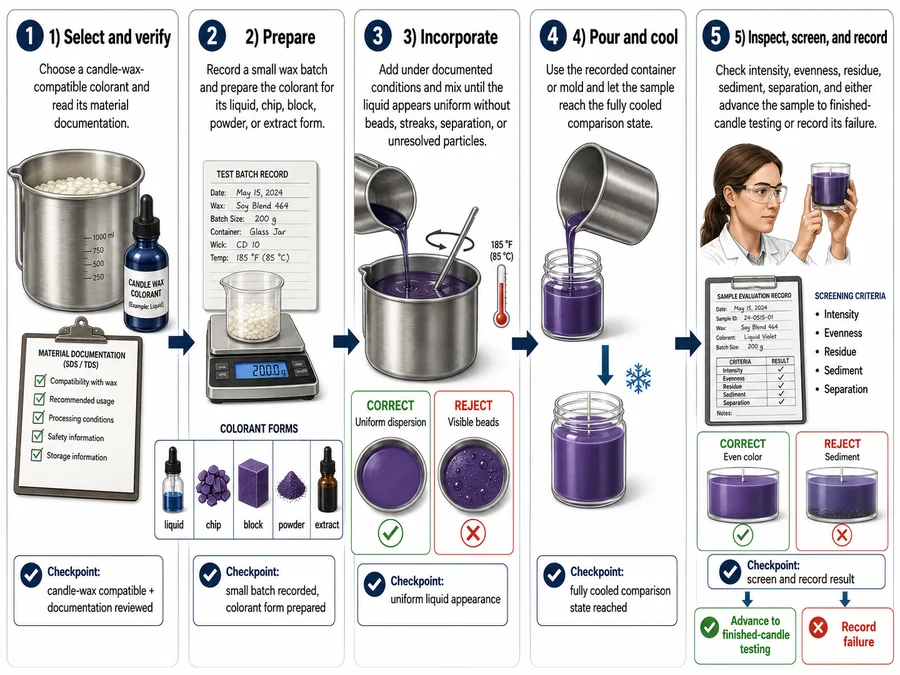
Coloring candle wax is a controlled process of selecting, preparing, incorporating, cooling, and evaluating a wax-compatible colorant.
There is no universal dye amount, addition temperature, or mixing time for every wax and colorant combination. Material-specific instructions and controlled test results must supply those details.
- Select a candle-wax-compatible colorant.
Choose a material intended or documented for use in the named wax. Decide whether the target is a muted, translucent, pastel, deep, or even shade. - Read the material documentation.
Check the intended wax, carrier, preparation method, processing conditions, and any stated use or testing limits. Do not transfer instructions from food, soap, resin, textile, or cosmetic coloring. - Prepare a small wax batch.
Record the wax identity and mass before adding color. Keep the container, fragrance status, cooling area, and other test variables unchanged. - Prepare the colorant for its material form.
A powder, extract, concentrated liquid, chip, or block may require a different preparation method. Do not assume every natural-source material can be added directly to melted wax. - Add the colorant under the documented conditions.
The correct stage and temperature depend on the wax, colorant form, carrier, and supplier or test instructions. Avoid using one addition temperature for unrelated materials. - Mix until the specified incorporation condition is reached.
Stirring time depends on the formula and colorant. Look for a uniform liquid appearance without beads, streaks, separation, or unresolved particles, but do not treat visual evenness as proof of finished-candle suitability. - Pour the controlled sample.
Use the recorded container or mold and avoid changing unrelated variables during the comparison. - Let the sample cool fully.
Fully cooled means the same recorded comparison state used for every matched sample, not one universal cooling time for every wax. Judge the primary shade only after the wax has solidified and reached that state. Hot liquid wax can look darker or clearer than the finished candle. - Inspect the cooled result.
Record color intensity, evenness, visible residue, sediment, separation, surface variation, and early changes from the poured state. - Screen and record the finished candle.
Move a swatch with no visible separation, sediment, unresolved solids, or material deviation from the recorded comparison into suitable finished-candle testing before increasing the batch size. Record the result even when the sample fails.
Material-category difference: A purpose-formulated synthetic candle dye may follow a supplier-defined incorporation method. A natural-source material may need extra preparation, filtration, dispersion work, or particle screening before it can be considered for a candle test.
The universal stages are selection, verification, preparation, incorporation, pouring, cooling, evaluation, screening, and recording. The amount, temperature, mixing duration, and preparation details remain specific to the wax and colorant being tested.
Natural vs Synthetic Candle Colorants: How Do They Behave Differently in Wax?
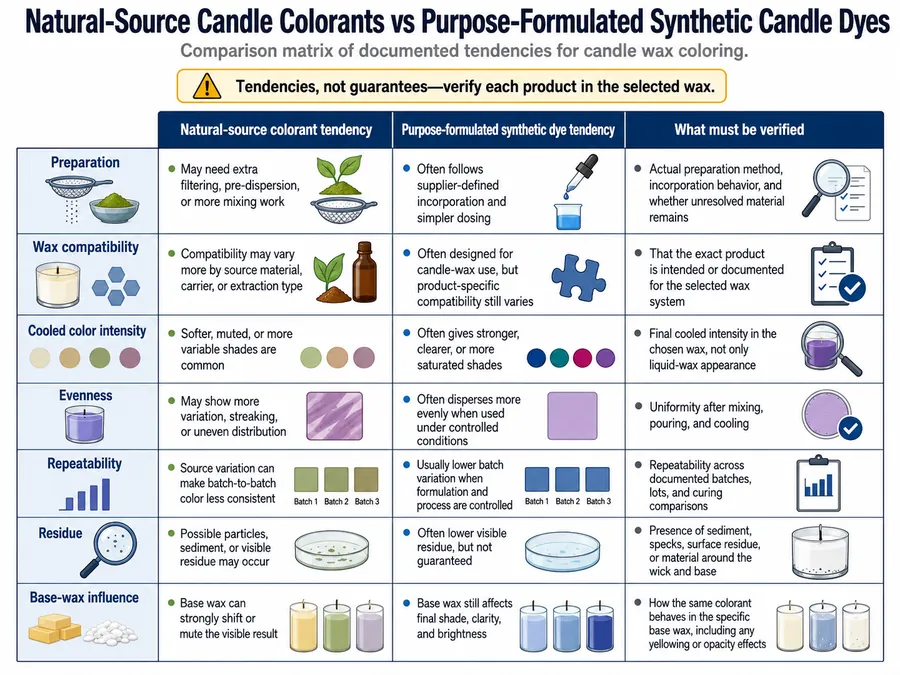
Purpose-formulated synthetic candle dyes usually provide more controlled dispersion and repeatability, while natural-source colorants vary more by material, preparation, and batch.
Natural-source colorants come primarily from naturally occurring materials. Purpose-formulated synthetic candle dyes are manufactured color systems designed or documented for candle wax. The useful comparison is how each candidate behaves in a named wax under matched preparation, cooling, and observation conditions.
| Decision factor | Natural-source colorant tendency | Purpose-formulated synthetic dye tendency | What the candle maker must verify |
|---|---|---|---|
| Preparation | May require filtering, extraction, grinding, or pre-dispersion | Often follows a supplier-defined incorporation method | Whether the preparation suits the selected wax |
| Wax compatibility | Varies widely and cannot be inferred from origin | More likely to have candle-wax documentation when sold for candles | Named compatible waxes and processing limits |
| Cooled color intensity | May produce muted, earthy, or variable tones | Often produces deeper or clearer shades | Appearance in the fully cooled test candle |
| Evenness | May vary when particles or natural compounds remain | Often spreads more evenly when fully incorporated | Streaks, sediment, specks, or uneven areas |
| Repeatability | May change with source material and preparation | Often has lower batch variation when the formulation is controlled | Variation among matched cooled samples |
| Residue | May leave visible solids if preparation is incomplete | Soluble candle dyes often leave less visible residue | Unresolved material in the wax or container |
| Base-wax influence | White, yellow, or opaque wax can alter the result | The same wax effects still apply | Results in the exact wax being tested |
| Testing requirement | Requires material-specific screening | Requires supplier-specific and finished-candle testing | Compatibility, stability, and burn behavior |
Natural does not mean cleaner-burning, non-toxic, environmentally harmless, or automatically candle-safe. Synthetic does not mean unsafe, inferior, or compatible with every candle wax.
Purpose-formulated synthetic dyes are often easier to reproduce because their composition and application instructions are more controlled. Natural-source materials may require more preparation and can vary between batches, but neither tendency applies to every product or material.
Muted Natural Tones vs Stronger Synthetic Shades: What Results Should You Expect?
Natural-source colorants often produce softer or more variable shades, while purpose-formulated synthetic dyes more often produce stronger and more repeatable color. Stronger color means greater visible depth in the fully cooled candle; it does not establish safety, quality, stability, or burn performance.
Natural-source colorants may produce soft, muted, earthy, or translucent results, especially in pale vegetable waxes. Purpose-formulated synthetic dyes often produce stronger or more uniform shades, but the result still depends on the dye, wax opacity, base color, preparation, and tested amount.
A controlled comparison should use:
- The same named wax and wax mass.
- The same container or mold.
- The same cooling conditions.
- The same cooled observation point.
- Material-appropriate preparation recorded for each candidate.
- Multiple matched samples with the sample count recorded before describing the result as repeatable.
Record the cooled intensity, evenness, visible residue, and sample-to-sample variation. Do not judge the final shade from melted wax because cooling can make the candle appear lighter, cloudier, less saturated, or otherwise different.
A natural-source colorant can sometimes produce a vivid shade, and a synthetic dye can produce a muted one. These are tendencies rather than category guarantees. Strong color is not automatically high-quality color, muted color is not automatically a failed result, and an even cooled swatch is not proof of long-term stability or burn performance that meets the selected finished-candle test method.
Natural-source candidates may suit a muted or earthy palette when their candle-wax compatibility is documented. Purpose-formulated synthetic dyes may suit projects that require stronger color and easier repetition. The final choice should follow the tested result in the selected wax rather than the natural or synthetic label alone.
Why Does Wax Type Change the Finished Candle Color?
Finished candle color comes from a specific colorant interacting with a specific wax base, not from the dye alone.
Wax opacity, original tint, and cooled appearance influence the visible shade separately. The same colorant may look softer in an opaque vegetable wax, clearer in a paraffin-rich wax, or warmer in naturally yellow beeswax.
The color shown in melted wax is not the final result. Liquid wax often looks darker or more translucent because light passes through it differently. As the wax cools and solidifies, its structure can scatter more light, making the shade appear lighter, cloudier, or less saturated.
Controlled Multi-Wax Comparison Checklist
A multi-wax comparison is valid only when the colorant stays constant and each cooled result is observed under comparable conditions.
- Use the same colorant lot for every sample.
- Record the identity of each wax.
- Keep the mold or container type comparable.
- Hold preparation and cooling conditions constant where the materials permit.
- View each sample under the same lighting conditions.
- Compare only after every sample has cooled fully.
- Do not assume that the same amount produces the same shade in every wax.
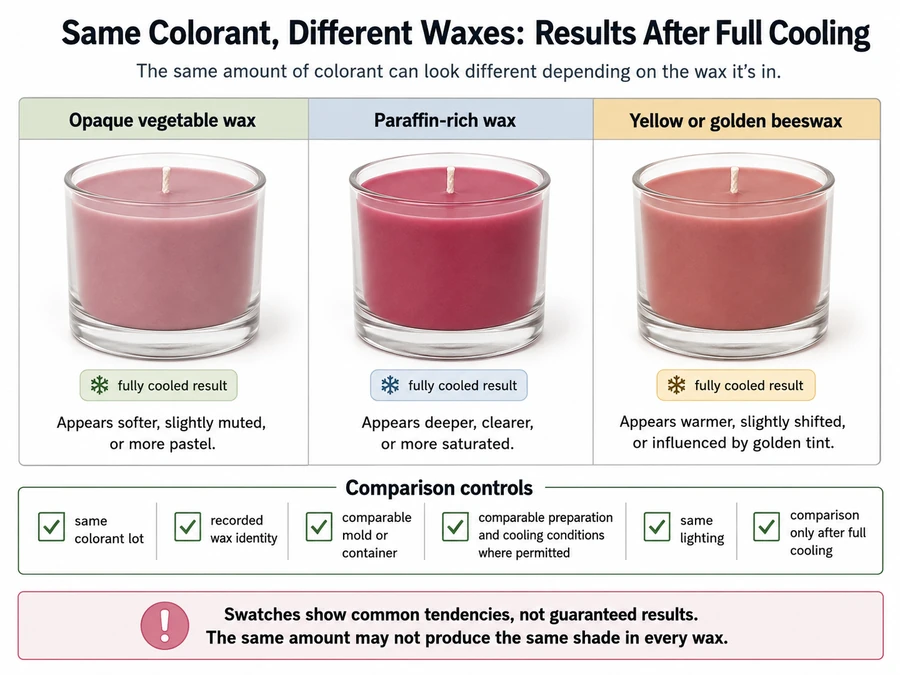
A soy or other opaque vegetable wax may soften a color and produce a pastel appearance. A clearer paraffin-rich wax may display a deeper or brighter-looking shade under matched conditions. These are common tendencies rather than guaranteed outcomes.
Beeswax begins with a yellow, golden, or amber tint that can combine visually with the added color. A blue colorant, for example, may appear greener or duller than it would in a white wax because the base color remains part of the result.
Wax blends need separate evaluation because changing their composition can alter opacity, tint, cooling behavior, and colorant dispersion. A colorant may be compatible with several waxes without producing the same intensity or requiring the same tested amount in each one.
Compatibility can sometimes transfer between documented wax systems, but an exact shade formula should not be copied unchanged. A new wax or blend creates a new colorant-and-wax combination that needs its own cooled sample.
Treat every wax change as a new color test, even when the colorant remains the same.
Why Candle Color Changes After Cooling or Storage
Candle color can change after pouring because melted wax cools into a different visual state or because light, fragrance, wax yellowing, or uneven dispersion alters the later appearance.
A cooling shift happens as melted wax solidifies. Later change must be compared against the first fully cooled baseline before it is labeled as fading or blamed on the colorant.
| Possible cause | Distinguishing observation | Controlled comparison |
|---|---|---|
| Cooling shift | The shade changes between liquid wax and the fully cooled candle | Compare the poured appearance with the first cooled baseline |
| Light or fragrance effect | An exposed or scented sample changes differently from its matched comparison | Compare protected and exposed samples or scented and unscented samples |
| Wax yellowing | The base wax becomes warmer or more yellow | Compare colored and uncolored samples from the same wax lot |
| Uneven dispersion | Streaks, specks, sediment, or patchy color appear | Review preparation and incorporation observations |
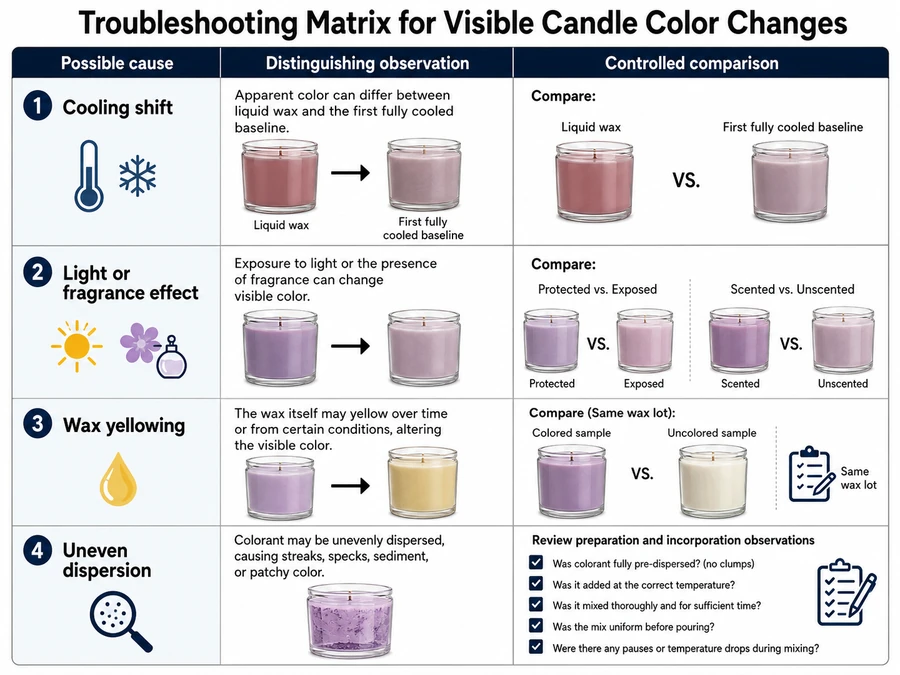
Stable means that a sample shows no material visual change beyond a stated tolerance during the recorded observation period and conditions. It does not mean that the candle will remain unchanged under every light level, temperature, fragrance formula, storage location, or use condition.
Do not label every later color change as fading or blame the colorant before comparing the wax, fragrance, cooling state, and storage conditions.
How to Screen a Colored Candle for Visible Incompatibility
A preliminary screen should reject a colored candle that shows separation, unresolved solids, abnormal residue, or a material change from an otherwise matched control.
This screen can reject an unsuitable sample, but it cannot certify that a candle is safe or ready for sale. A smooth cooled surface and attractive color do not prove that the full candle system will meet the selected finished-candle test method.
Preliminary Rejection Checklist
The preliminary checklist identifies visible reasons to stop the current combination before it advances to a separate finished-candle testing method.
- Confirm that the colorant is intended or documented for candle wax.
- Inspect the cooled wax for separation, streaks, specks, sediment, or concentrated color pockets.
- Check the surface, container bottom, and wax around the wick for unresolved material.
- Reject any sample that contains moisture, spits while being prepared, or shows signs of an incompatible carrier.
- Compare the sample with an uncolored control made from the same wax when possible.
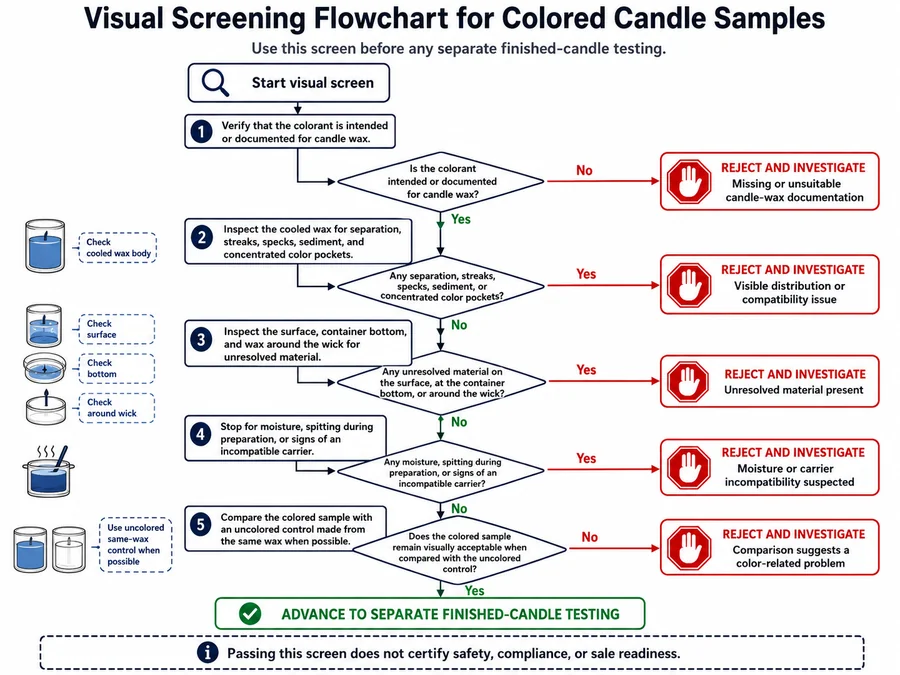
A new difference in the colored sample identifies the colorant or its preparation as a variable to investigate, but it does not prove a single cause.
Acceptable means that no material deviation from the selected test method or matched control was observed under the recorded conditions. It does not mean that the candle has been certified as safe, compliant, or ready for commercial production.
Formal wick selection, combustion assessment, certification, toxicology, and regulatory review remain outside this preliminary screen.
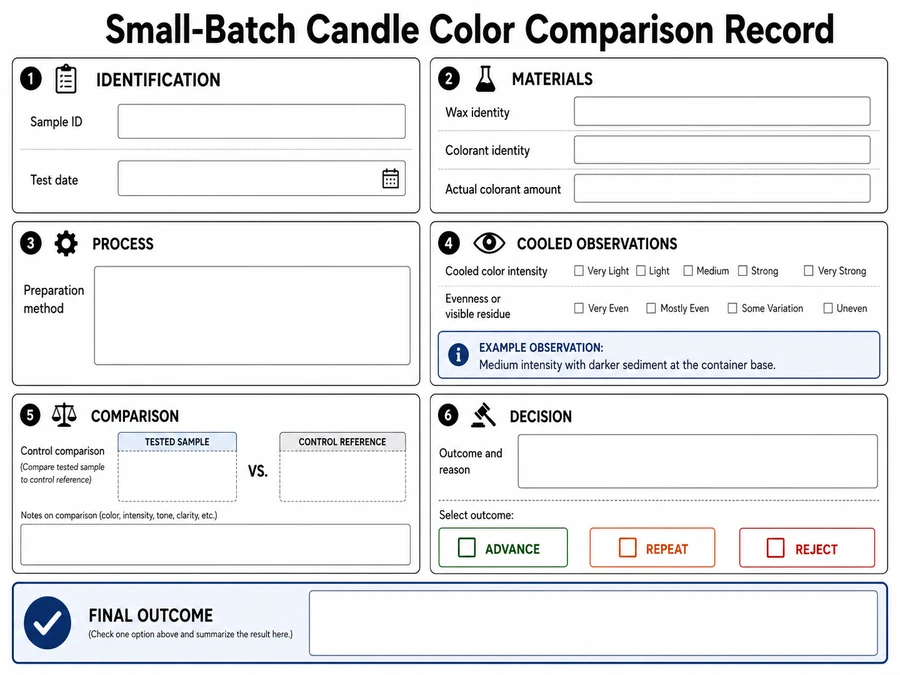
How to Record a Small-Batch Candle Color Test
A small-batch record identifies the materials, preparation, process conditions, cooled result, control comparison, and outcome so one test can be compared with another.
The record documents a controlled comparison, not a production-ready formula. One successful sample does not establish long-term stability, commercial consistency, or performance that meets the selected finished-candle test method across different waxes, fragrances, wicks, containers, or batch sizes.
Record these ten fields for each small-batch color comparison.
| Record field | Entry |
|---|---|
| Sample ID | |
| Test date | |
| Wax identity | |
| Colorant identity | |
| Actual colorant amount | |
| Preparation method | |
| Cooled color intensity | |
| Evenness or visible residue | |
| Control comparison | |
| Outcome and reason | Advance / repeat / reject, with the observed reason |
Use observable descriptions. “Medium intensity with darker sediment at the container base” is more useful than “color was wrong.” “Colored sample self-extinguished while the matched uncolored control remained lit” is more useful than “wick failed.”
Repeatable means that multiple matched samples produced comparable observations under recorded conditions. Record the sample count, and do not treat the result as proof that it will transfer to another wax lot, wick, container, batch size, or production process.
A record should preserve what happened rather than force a favorable result. Mark the sample as failed when it separates, leaves unresolved material, produces an unacceptable cooled appearance, changes unexpectedly, or shows a material deviation from the selected finished-candle test method or matched control.
The completed record closes the application cycle: select a wax-compatible colorant, apply it under documented conditions, judge the cooled candle, screen the complete system, and retain the result for the next controlled decision.