

CD and ECO are cotton wick families for single-wick container candles, and on this page “better” means the safer first family to test for your jar, wax, and fragrance load: ECO suits many soy jars, while CD fits setups that clearly need more heat.
This page is for candle makers choosing between CD and ECO in single-wick container jars. It shows which family to test first, how sizing differs, and what burn cues matter most. Jar diameter, wax type, and fragrance load all change how much heat the wick must deliver. The quick decision table below turns those variables into a safer first comparison.
This comparison stays on single-wick container candles and does not replace full sizing charts, multi-wick guides, wax-specific wick guides, or full burn-test instructions.
Choose CD wicks when you need stronger heat and faster melt pools, and ECO wicks when you want cooler, cleaner burns in most soy jars.
CD and ECO are two popular cotton wick families for container candles, but they burn differently in real jars. Those differences show up in flame height, melt pool speed, soot, and mushrooming as wax type and fragrance load change. The wrong family can cause tunneling, overheated jars, or weak hot throw that wastes materials. This article compares build, sizing, and test results so you can choose a safer, cleaner wick.
Quick decision table: CD vs ECO wicks
ECO is the better first test for many standard soy jars, while CD is the better choice when a jar or formula clearly needs more heat.
Start with ECO when the jar already burns easily and you want a steadier flame with more control. Start with CD when repeated testing shows the same jar, wax, or fragrance load needs more heat to reach a full melt pool.
| Decision point | CD wick | ECO wick |
| Best fit | Wider jars, harder blends, or formulas that need more heat | Most standard soy and soy–coconut container jars |
| Flame behavior | Stronger and taller | Smaller and steadier |
| Melt pool speed | Faster | Slower but easier to control |
| Soot and mushrooming | More likely if oversized | Usually lower when sized correctly |
| Hot throw support | Helpful when the formula struggles to open up | Good when the jar already burns easily |
| Safety margin | Narrower | Wider |
| Main risk | Overheating, deep melt pool, soot | Tunneling or weak edge reach |
| First adjustment | Size down if the flame gets wild | Size up if hang-up remains |
In practice, ECO is the better first test for many soy jars, while CD is the better option when a jar, wax blend, or fragrance load clearly needs more heat. Important: CD and ECO sizes do not map 1:1 across families, so use the quick chart below as a starting range within each family instead of comparing same-number wicks.
An ECO 8 is not the same size as a CD 8, so compare sizes only within one family before you switch families.
If your first test misses, move one size up or down within the same family before switching families, because CD and ECO numbers do not track each other across the series.
Sizing by jar diameter & wax load: CD vs ECO quick chart
Use ECO for most mid-sized soy jars and step up to stronger CD sizes when jars get wider, wax gets harder, or fragrance loads increase.
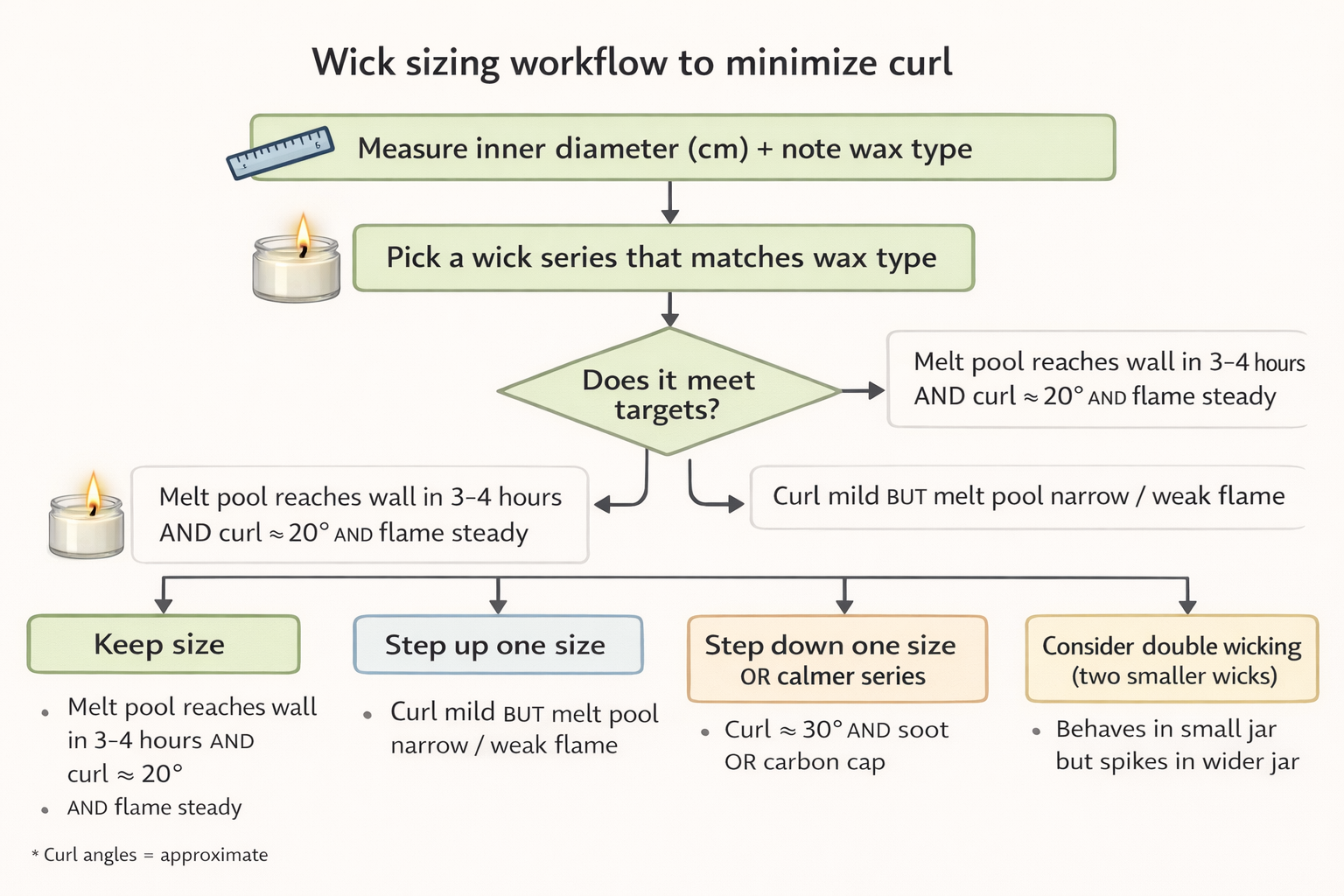
This flowchart shows how jar diameter, wax type, and fragrance load set a starting wick size.
Think of wick sizing as a quick equation: jar diameter + wax type + fragrance and dye load = starting wick size. Most supplier charts list suggested ECO and CD sizes for a given jar diameter, and they are a strong starting point before you run your own tests. For example, some supplier charts list an ECO 6 for jars roughly 1.5–2.5 in (about 4–6.5 cm) in diameter, assuming a typical container wax and normal fragrance loads.
Here is a conservative starting chart for single-wick soy or soy–coconut jars with moderate fragrance and no heavy dye. Use it to choose your first test candle only, not your final production wick. An ECO 8 and a CD 8 are different wick families, so compare within a family first instead of assuming the numbers are interchangeable.
| Jar diameter (approx.) | Typical jar size | ECO starting point | CD starting point |
| 2.0–2.5 in (5–6.5 cm) | Small tumbler / tin | ECO 4–6 | CD 4–6 |
| 2.75–3.0 in (7–7.5 cm) | Standard 8–10 oz jar | ECO 6–8 | CD 6–10 |
| 3.25–3.5 in (8–9 cm) | Large 3-wick style (single wicked) | ECO 8–10 | CD 10–14 |
Use it like this: measure the inside diameter at the top of the jar, pick the wick family you want to test (CD or ECO), then choose the smallest size in the suggested range and pour a test candle. If the candle tunnels badly after a few long burns, bump the wick up one size in the same family; if the container runs very hot or flames look tall and wild, step one size down. A wick size estimator can narrow the first test range faster when you swap jar diameter or wax blend often. Supplier charts repeatedly stress that dyed or heavily fragranced candles often need a larger wick than the basic recommendations, so treat any chart as a first draft only.
A few fast rules of thumb: going from a lighter fragrance (5–6%) to a heavy one (9–10%) usually nudges you up a wick size; swapping from a soft soy blend to a harder wax may also require more power. When moving from ECO to CD in the same jar, many makers use a slightly smaller CD as a cautious first comparison because CD often runs hotter per step. Above about 3.5 in (9 cm) diameter, you will often get better results with two smaller wicks instead of one huge one, regardless of family, to keep the heat more even and the glass temperature under control.
Methods: The diameter ranges and starting sizes in this chart blend typical recommendations from major wick suppliers with practical burn tests in single-wick soy and soy–coconut containers at 7–9% fragrance. They are intended only as conservative starting points; you should always confirm or adjust them with your own test burns in your exact jars, wax blends, and fragrance formulas.
CD vs ECO: how they differ (wick construction & series logic)
CD and ECO wicks differ mainly in how they are braided, how stiff they feel, and how their series numbers scale the heat they put out.
That makes CD the stronger family per step in many tests, while ECO is usually the easier family to control in typical soy containers.
For the broader hierarchy of wick families, materials, and size logic, see the candle wick types and sizing guide.
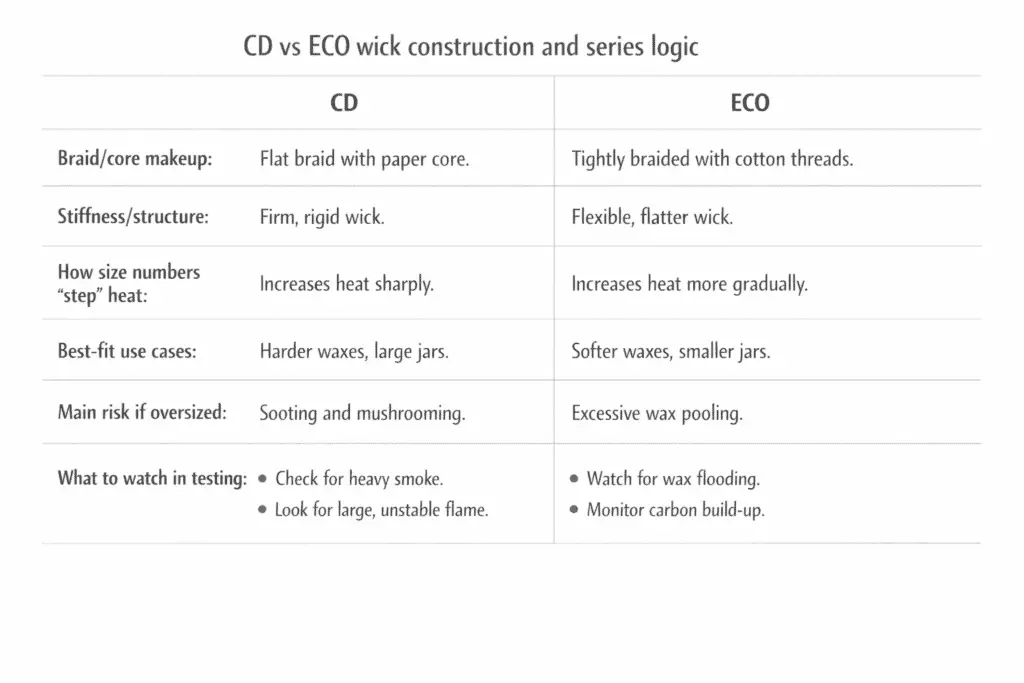
This diagram shows how CD and ECO wick construction affects rigidity and series behavior.
CD wicks are a flat braided cotton wick with extra tension threads woven in, which typically makes them feel a bit stiffer and helps them stay upright in deeper melt pools during testing. ECO wicks are a coreless flat braid made from cotton with paper filaments, and they are commonly used when makers want a cooler, more controlled burn in many soy containers. Because of that softer structure, ECO often pairs well with softer, natural waxes where control matters more than extra heat.
In the CD series, the numbers (like CD 4, 8, 10, 12, 18, and more) reflect jumps in thickness and fuel delivery, so each step up usually means a hotter flame and faster melt pool. The spacing between sizes is relatively aggressive, which is why moving one CD size up or down can make a big difference in burn behavior. ECO series numbers (ECO 1, 2, 4, 6, 8, 10, and more) also represent heat and size increases, but the line is tuned toward cooler, controlled burns in container candles. As you climb the ECO series, you gain enough extra power to open the melt pool without making the setup run hotter than it needs to.
Practically, CD often behaves like a stronger wick family you reach for when you need help with harder wax, wide containers, or heavy fragrance loads. ECO behaves more like a control-focused family built for smoother surfaces, steadier flames, and cleaner sides in typical soy or soy-blend jars. Knowing that series logic helps you decide whether you are solving a power problem with CD or a control problem with ECO before you pour your test batch.
Burn behavior: flame, melt pool, soot & mushrooming (CD vs ECO)
In real burns, CD wicks usually produce a stronger flame and faster melt pool, while ECO wicks tend to give a calmer flame with less soot and mushrooming.
As a rough checkpoint, a steady flame around 1 in (2.5 cm) tall and a melt pool around 1/4–1/2 in (6–13 mm) usually point to a workable range. A deeper pool with a tall, flickering flame points to too much heat.
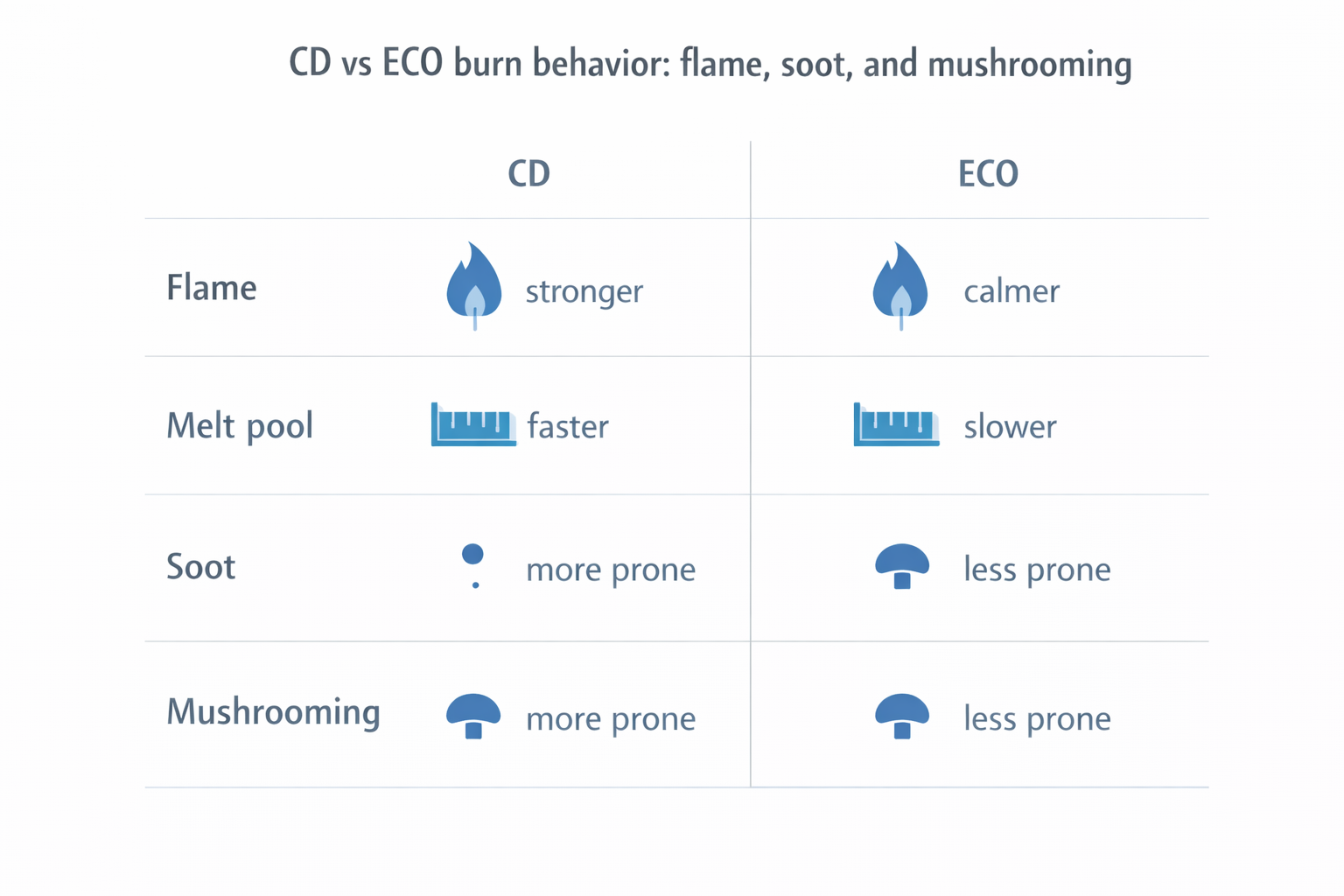
This comparison shows how CD and ECO wicks differ in flame strength, soot risk, and mushrooming during test burns.
With a correctly sized CD wick, you can often expect a bright, energetic flame that opens the melt pool quickly and handles tougher conditions like higher fragrance loads or harder wax blends. That extra power is what can help prevent tunneling in large-diameter jars, but it also means CD will show its temper if you oversize it: flames may get tall and active, melt pools can run deep and hot, and jars may run warmer than you want. CD can also be more prone to forming carbon “mushrooms” at the wick tip, especially with strong fragrance oils or long burn sessions, so regular trimming between burns matters.
ECO wicks, when sized correctly, usually burn with a more modest, controlled flame that still reaches a full melt pool but may take a bit longer to get there. That cooler burn often leaves cleaner glass, with fewer soot streaks up the side and less visible smoke when the candle is extinguished. That kind of result matters most when clean-burning wax and wick setups are part of the product goal. Because ECO is tuned for self-trimming behavior, mushrooms are often smaller or absent, and the flame may shrink slightly as the session goes on instead of getting wilder. The trade-off is that if you underwick with ECO, you’ll often see tunneling or a stubborn ring of unmelted wax around the perimeter.
From a safety and aesthetics standpoint, CD gives you bigger performance swings, which is useful when you need more heat but riskier when you overshoot. ECO usually gives you a wider comfort zone of cooler, steadier burns. Many makers start testing ECO for everyday container candles where clean sides and low soot matter most, then reach for CD when a specific jar, wax, or scent refuses to open up with gentler wicks.
| What you see in testing | What it usually means | More often the issue with | What to test next |
| Small flame and heavy wax hang-up after repeated burns | Not enough heat for this jar or formula | ECO | Go up one ECO size before changing families |
| Fast full melt pool, deep wax, and a very hot jar | Too much heat for the setup | CD | Drop one CD size |
| Early mushrooming and faint soot streaks | Wick is too aggressive for the formula or burn length | CD | Trim between burns and test one size down |
| Clean glass but weak throw and slow edge reach | Safer burn, but not enough heat yet | ECO | Test one size up or compare against a small CD |
Methods: The comparisons in this section assume like-for-like test burns: same jar, wax blend, fragrance load, dye level, and burn time, with only the wick family and size changed. Observations about flame shape, soot, and mushrooming come from repeated burns of each wick under calm, draft-free conditions.
Which wick should you choose in real jars?
Choose ECO first for most standard soy container candles, and move to CD when the jar or formula clearly needs more heat.
- Choose ECO first when you are making a standard soy or soy–coconut container candle and want a calmer flame, cleaner glass, and lower mushrooming.
- Choose CD first when a wider jar, harder blend, or heavier fragrance load needs more heat to avoid tunneling.
- Stay with ECO when both families reach a full melt pool but CD runs hotter, mushrooms faster, or starts leaving soot.
- Move to CD when ECO still looks underwicked after a sensible one-step size increase in the same jar and formula.
If both families reach a full melt pool, keep the smaller, cooler, cleaner-running wick family that still stays stable in repeated burns.
If you make only soy jars, compare this first-family choice against best wicks for soy candles next so you can narrow the final size range faster.
Wax compatibility: soy and soy–coconut first, paraffin and beeswax as rough comparison points
ECO is usually the cleaner first pick for soy and soy–coconut containers, while CD is more useful when the wax or load needs extra heat.
In practice, soy and soy–coconut behavior should guide the first choice here, while paraffin and beeswax are only rough comparison points that still need fresh testing.
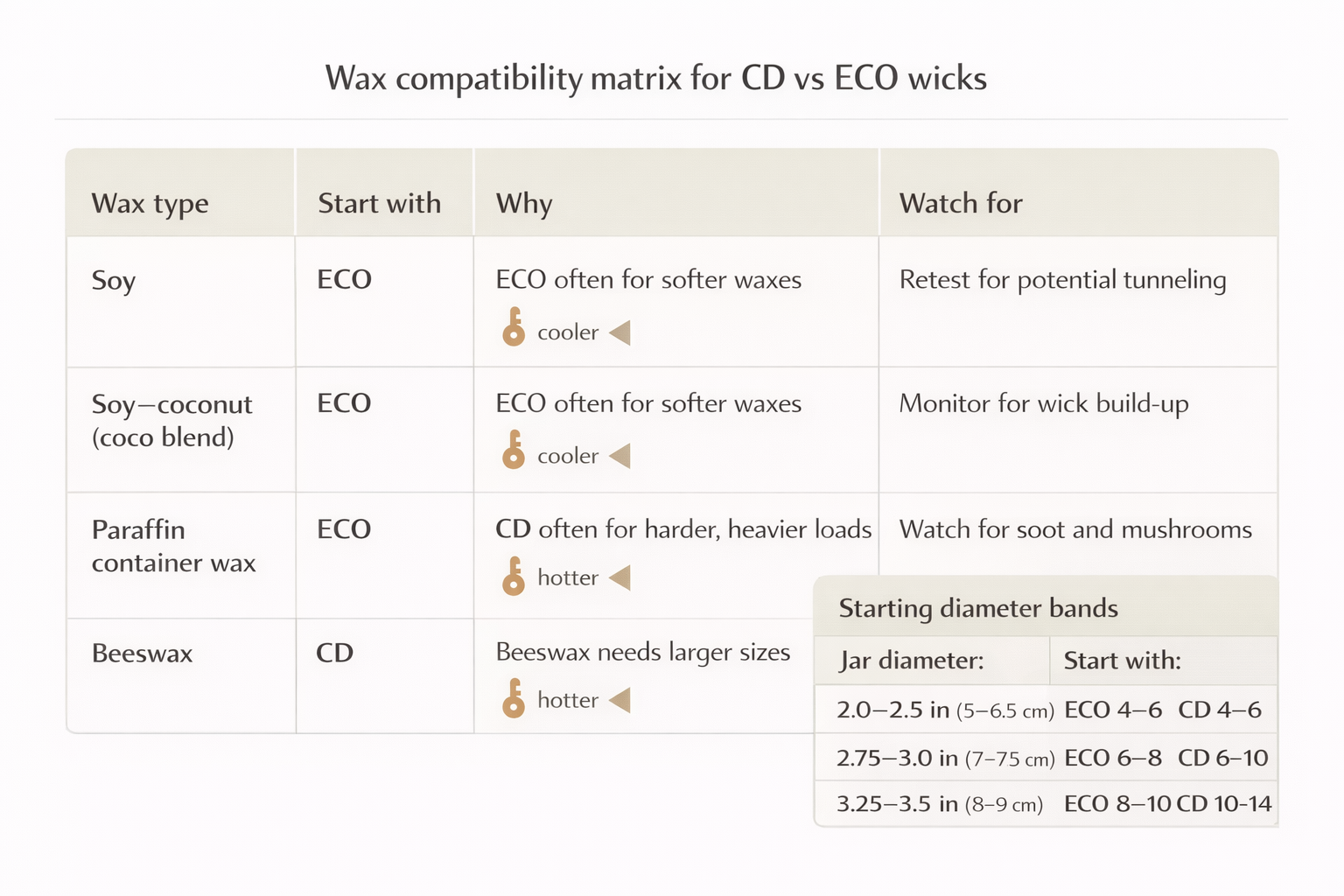
This matrix shows which wax systems usually lean ECO and which ones more often need CD.
Use soy and soy–coconut as the main comparison here. ECO is often the cleaner first test in those container waxes, while CD is the better comparison when the same jar, blend, or fragrance load still needs more heat after sensible sizing changes.
Treat paraffin and beeswax as rough reference points only, because they can shift wick behavior enough that soy-based starting results should not be carried over without fresh tests. Keep wax-specific selection work on broader wax or wick pages instead of extending this page beyond the CD-vs-ECO comparison.
Methods: These notes are limited to single-wick container comparisons and are not a substitute for fresh testing when you change wax type, blend ratio, fragrance percentage, or jar shape.
Choose your wick: a 5-test decision flow (CD or ECO?)
Use five simple test stages to decide whether CD or ECO is the safer, better-performing wick for each jar.
If you need the full safety testing method behind these checkpoints, use the candle burn test page for the room setup, measurements, and pass/fail notes this comparison does not fully repeat.
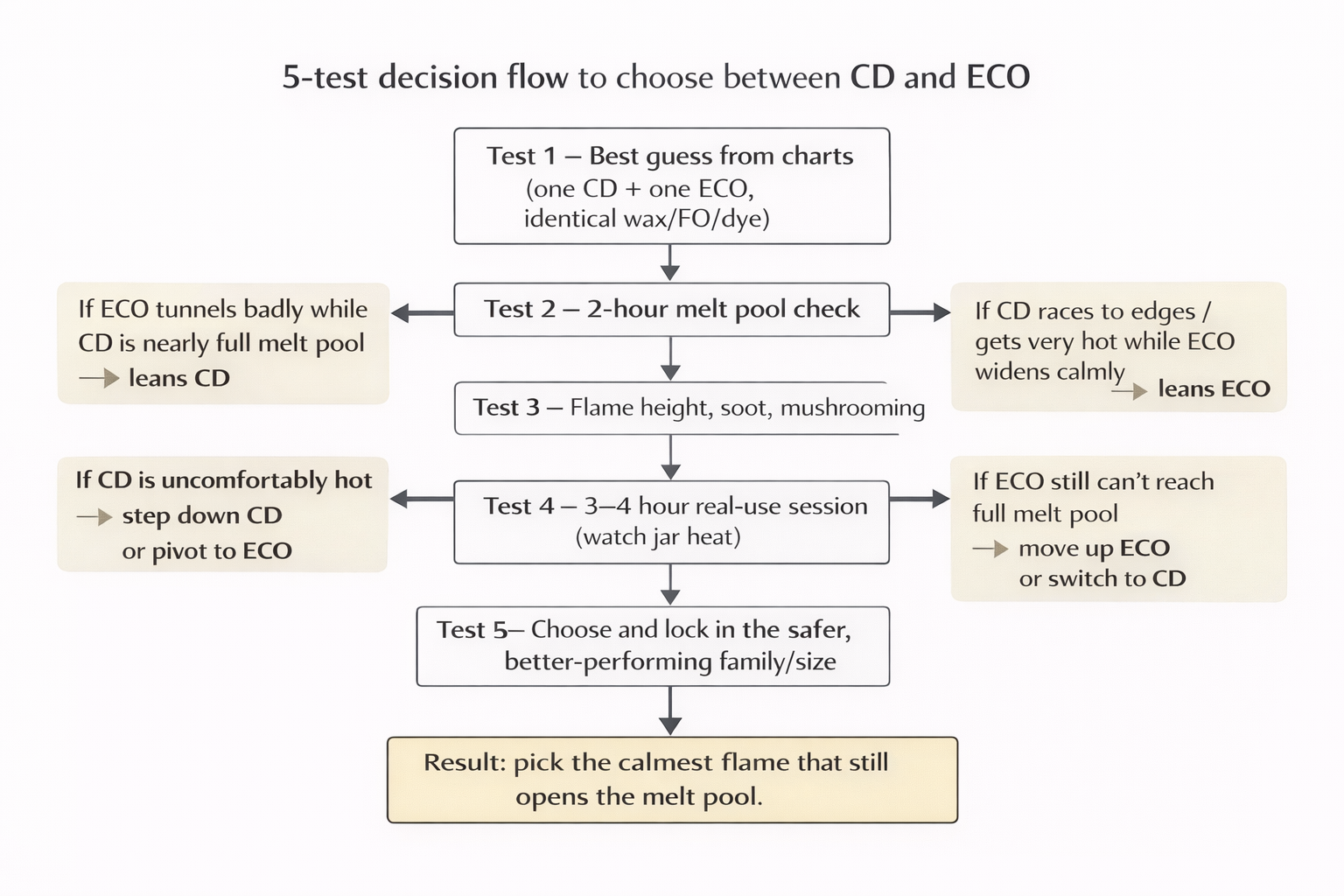
This flow shows the five test stages used to choose between CD and ECO in the same jar.
Test 1 – Start with a “best guess” from charts
Begin with one ECO and one CD size that supplier charts suggest for your jar diameter and wax type. Pour matched test candles with the same wax, fragrance load, and dye, and label them clearly so the only real variable is the wick family and size.
When should you change size before switching families?
Change size first when the burn looks close but not quite right, such as moderate hang-up with otherwise clean glass or a full melt pool with slightly more heat than you want. Switch families after a sensible one-step size change in the same series still leaves the candle clearly underwicked or overwicked in matched tests.
Test 2 – The 2-hour melt pool check
After your candles have cured, run the first burn for about two hours. Check how quickly the melt pool forms and how far it reaches toward the glass. If the ECO candle tunnels badly while the CD has a healthy, nearly full melt pool, that jar is leaning toward CD. If the CD is already racing to the edges while the ECO is widening more calmly, ECO is probably the better first path.
Test 3 – Flame height, soot, and mushrooming
Watch how each flame behaves during the same session. A CD wick with early mushrooming and visible soot streaks may be oversize or simply too aggressive for that setup. An ECO wick that stays steady with little mushrooming and clean glass is often a better fit for everyday container candles. But if ECO looks weak and struggles to stay above the melt pool while CD looks stable, CD is likely the stronger option.
Test 4 – The 3–4 hour “real use” session
Next, run a longer burn of three to four hours, like a typical evening session. This is where container temperature matters most, so use a thermometer if you can and compare jars consistently instead of relying on touch alone. If the CD candle runs unusually hot or the melt pool looks deep and soupy, step down a CD size or pivot to ECO. If the ECO candle still leaves heavy hang-up wax by the end of the session, move up one ECO size or compare it against a small CD. If that pattern repeats after sensible size changes, move to a guide that shows how to fix common candle wick problems before changing multiple variables at once.
Test 5 – End-of-life and overall verdict
Finally, burn each test candle through several sessions until it reaches the last third of the jar. Late-stage burns are where poor wick choices often show up with leaning flames, excess mushrooming, soot on the glass, or jars that run too hot. If ECO stays tidy and controlled all the way down, you have likely found your everyday wick for that setup. If ECO keeps struggling while CD maintains a stable flame at acceptable temperatures, CD becomes the better choice for that particular combination.
Bottom line
Start with ECO for most standard soy container candles, and move to CD when your jar, wax blend, or fragrance load needs more heat.
Keep the smallest wick that still gives you a full melt pool, stable flame, and safe container temperature across repeated test burns. That approach helps you avoid both underwicking and overheating, no matter which family you choose first.
Methods: This five-test flow assumes fully cured candles, draft-free conditions, and matched test pairs where the only variable is the wick family and size. It works best when you document each burn session, including duration, jar temperature, flame observations, and melt pool behavior, so you can confidently choose the smallest wick that still passes your safety and performance checks.