

Before scaling candle production, record the supplier-assigned dye lot, exact quantity and unit, formula basis and version, finished-batch ID, wax and fragrance lots, color observations, retained evidence, storage dates, and lot-change decision.
A candle dye lot is the supplier-assigned batch of raw colorant, not the seller’s finished-candle production batch. Each dye entry should connect that raw-material identity to the formula, co-material lots, production run, operator, and dated results. Here, scaling means increasing repeatable production volume, production runs, wholesale orders, sales channels, or staff participation. This dye-centered record supports color consistency and traceability but does not replace a complete batch record, quality-release system, inventory program, or legal compliance procedure.
What Is a Candle Dye Lot, and Which Identifiers Should You Record?
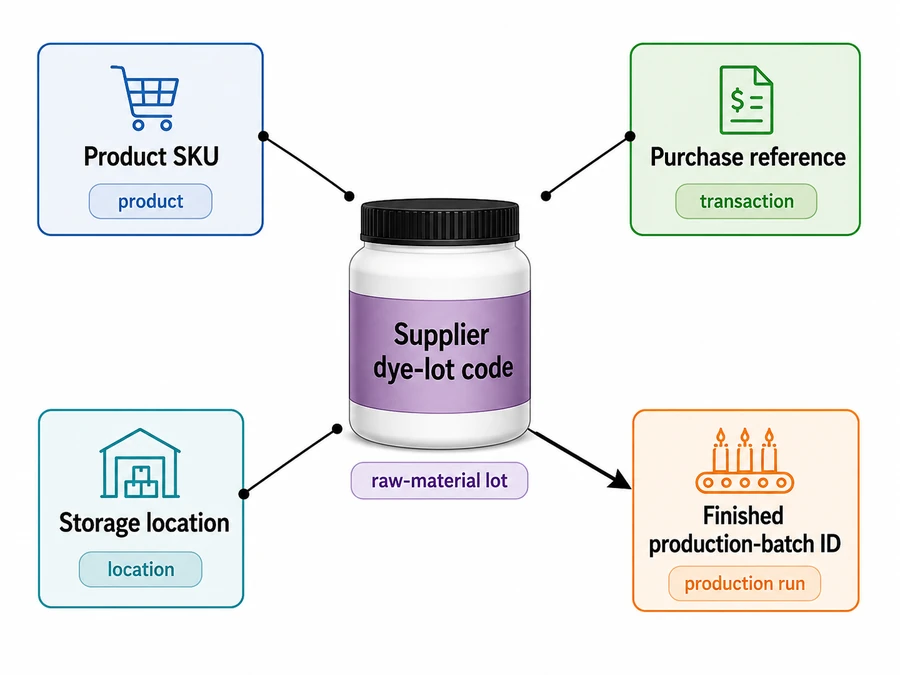
A candle dye lot is the supplier-assigned batch of raw candle colorant, not the seller’s finished-candle production batch.
Preserve the supplier dye-lot code separately from the product name, stock-keeping unit (SKU), purchase reference, storage location, and finished production-batch ID. A color name or SKU identifies a product, but it may not identify the specific supplier dye lot used in production.
| Identifier | Assigned by | Identifies | Does not identify | Required in the dye-lot record |
|---|---|---|---|---|
| Supplier dye-lot code | Dye supplier | A specific supplier batch of raw colorant | The seller’s finished production run | Yes |
| Product SKU or code | Dye supplier or seller | The dye product or package type | A specific supplier dye lot unless the supplier states otherwise | Yes |
| Purchase reference | Seller or supplier | The order, invoice, or transaction | The exact raw-material lot by itself | Supporting field |
| Inventory-location code | Seller | Where the dye is stored | The supplier dye lot or product formula | Supporting field |
| Finished production-batch ID | Candle seller | A specific candle production run | The supplier batch that produced the raw dye | Yes, when the dye is used |
The minimum identity record should preserve each unique material, source, transfer, and production reference in one field set.
| Field | Modeled entry | Record purpose |
|---|---|---|
| Supplier | Example Supplier A | Names the source of the raw candle colorant |
| Product name | Deep Red Liquid Candle Dye | Identifies the supplier’s named dye product |
| Product code or SKU | LD-RED-25 | Distinguishes the product or package type from the supplier lot |
| Color name | Deep Red | Records the supplier’s stated color identity |
| Dye form | Liquid | States whether the material is liquid, block, chip, powder, or another form |
| Supplier-assigned dye-lot code | SL-240318-B | Identifies the specific supplier batch of raw colorant |
| Date received | May 12, 2026 | Records when the material entered the seller’s stock |
| Source-document reference | Label photo LP-0512-01 and invoice INV-1048 | Preserves the label, invoice, or other verified source record |
| Storage container | Original bottle | Identifies the container currently holding the material |
| Transfer reference | Not transferred | Carries the original supplier dye-lot identity forward after any container transfer |
| Finished production-batch ID | PB-2026-0617-04 | Links the raw-material lot to the separate candle production run that used it |
| Identity status | Confirmed from readable supplier label | States whether the material identity is confirmed, incomplete, unreadable, mixed, or unknown |
Methods note: This dataset is modeled to demonstrate retrieval and traceability. It is not measured production evidence, a compliance certificate, or proof that the finished candles passed release checks.
Copy the supplier dye-lot code exactly as printed. Do not reconstruct a missing code from memory, a product name, an invoice date, or the order in which containers arrived.
Use the following exception entries when the raw-material identity is incomplete:
| Exception | What to record | Action |
|---|---|---|
| No visible supplier dye-lot code | “Unknown—no visible code,” inspection date, container description, and source reference | Contact the supplier or isolate the material under an internal exception reference |
| Unreadable label | “Unreadable,” a photograph, date observed, and any legible product details | Preserve the damaged label and request confirmation |
| Two supplier dye lots mixed | Both supplier dye-lot codes, quantities used, mixing date, and receiving container | Do not invent one replacement code |
| Material transferred to another container | Original supplier dye-lot code, transfer date, new container ID, and operator | Carry the original supplier identity forward |
| Source cannot be verified | “Unknown source,” reason, date, and action taken | Keep the uncertainty visible in every related production entry |
Purchasing and stock records may carry the same supplier dye-lot code, but reorder planning, valuation, purchasing analysis, and supplier scoring fall outside this dye-centered record. The immediate goal is to identify the raw candle colorant before linking it to formula quantities and production results.
How to Record Candle Dye Amount, Usage Rate, and Measurement Units
Record every candle dye amount with its unit and the exact wax-weight or formula basis used to calculate the usage rate.
A candle dye usage rate is the weight of a named dye divided by a declared formula basis. The numerator is the dye weight; the denominator is usually the declared wax weight, unless the record explicitly names another basis. A bare entry such as “5” or “10 drops” cannot reproduce the formula without a unit, measurement method, dye identity, and denominator.
Dye usage rate (%) = dye weight ÷ declared wax-weight basis × 100
Modeled Calculation
A modeled record using 2.50 g of dye and a 1,000 g wax basis produces a recorded usage rate of 0.25%.
- Supplier dye-lot code: SL-240318-B
- Formula version: RED-V3
- Original dye weight: 2.50 g
- Declared wax-weight basis: 1,000 g
- Measurement method: Digital scale
- Recorded scale resolution: 0.01 g
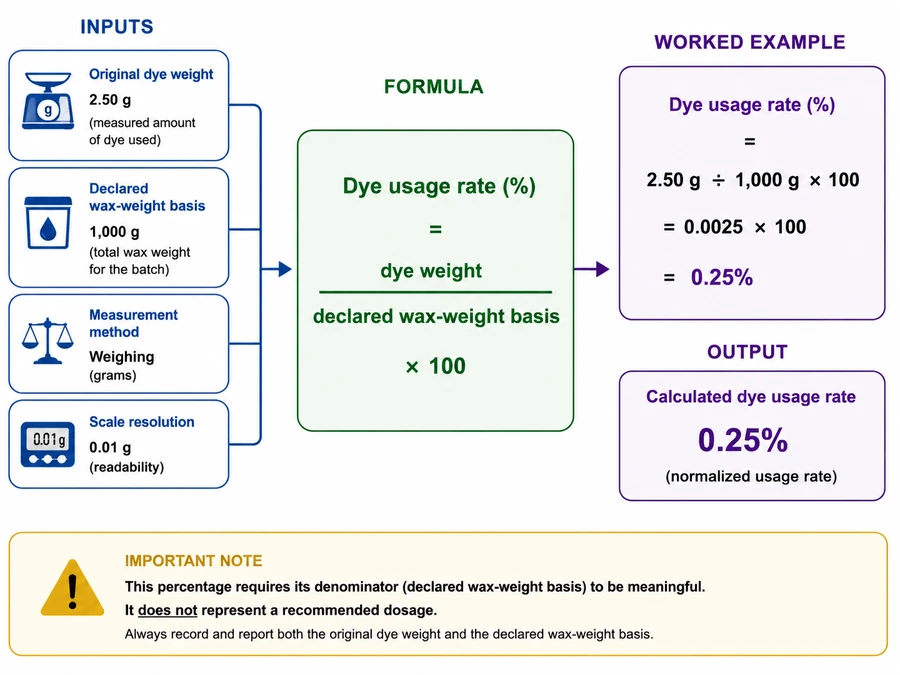
Calculation:
2.50 g ÷ 1,000 g × 100 = 0.25%
Record both the original value of 2.50 g and the normalized value of 0.25%. The example uses total wax weight as the declared denominator and displays the result to two decimal places. It demonstrates the recording method, not a recommended dye dosage.
Candle Dye Lot-Tracking Worksheet with Usage-Rate Calculator
| Worksheet field | Entry |
|---|---|
| Supplier dye-lot code | __________ |
| Dye product and color | __________ |
| Formula version | __________ |
| Original dye weight | __________ g |
| Declared wax-weight basis | __________ g |
| Measurement method | __________ |
| Scale resolution | __________ g |
| Calculated usage rate | __________ % |
| Displayed decimal places | __________ |
| Rounding rule used | __________ |
| Finished production-batch ID | __________ |
Calculator rule
Dye weight in grams ÷ wax weight in grams × 100
The calculator must reject a zero wax-weight denominator, missing units, and nonnumeric entries. It must retain the entered wax and dye weights with the calculated percentage. It must not generate a recommended dosage, acceptance threshold, release decision, shelf-life claim, or legal conclusion.
Which Measurement Should the Record Preserve?
Preserve the original mass measurement and its normalized percentage whenever both are available; the original value supports reproduction, while the percentage supports scaling.
| Measurement | Fields to preserve | Recordkeeping limit | Use in the dye-lot record |
|---|---|---|---|
| Grams by mass | Dye weight, unit, scale resolution, weighing method, formula version, and wax-weight basis | The result remains tied to the recorded scale and its resolution | Primary quantity record |
| Drops | Drop count, dropper identity, dye product, operator, and measurement conditions | Drop size may change with the dropper, temperature, viscosity, and operator | Supporting entry when no measured mass exists |
| Percentage | Numerator, denominator, formula basis, decimal places, and rounding rule | A percentage without its original measurement and denominator is incomplete | Normalizing a recorded formula for another declared production quantity |
| Original value plus normalized rate | Original measurement, unit, denominator, calculated percentage, and rounding rule | The calculated amount must remain distinguishable by the recorded scale | Preferred record for repeat production |
Drops are not automatically equivalent to grams. A drop count may remain in the record as supporting information, but it should not be converted to mass without a documented measurement for that dye, dropper, and measurement condition.
A percentage without its denominator is incomplete. For example, “0.25%” must state whether it was calculated against total wax weight or another named formula basis. Changing the denominator changes the meaning of the result.
Preserve the measured value before rounding. Record the decimal places shown in the normalized rate, and do not silently round a scaled quantity to an amount the production scale cannot distinguish. When the calculated amount falls outside the scale’s recorded resolution, flag the measurement limitation rather than presenting the rounded amount as exact.
Supplier dosage guidance is product-specific. This dye-lot record preserves an existing formula relationship and does not choose a target shade, prescribe a recommended dose, calculate fragrance load, or set production cost.
The normalized rate becomes useful when the same dye quantity, formula version, and denominator are connected to a separate finished production-batch ID—the next relationship in the record chain.
How to Link a Candle Dye Lot to the Finished Production Batch
Link each supplier dye-lot code to a separate finished production-batch ID, the active formula version, measured dye entry, co-material lots, product, date, operator, and exception status.
Production-batch linkage is the recorded relationship between distinct raw-material identifiers and one finished-candle production run. The supplier dye-lot code identifies the raw colorant, while the finished production-batch ID identifies the candle run that used it. One code must not represent both entities.
Modeled Dye-Centered Material-Genealogy Record
Material genealogy is the recorded path connecting raw-material lots, formula details, and the finished production run.
| Finished production-batch ID | Supplier dye-lot code | Dye amount and basis | Formula version | Wax lot | Fragrance lot | Product or SKU | Production details | Exception status |
|---|---|---|---|---|---|---|---|---|
| PB-2026-0617-01 | SL-240318-B | 2.50 g per 1,000 g wax | RED-V3 | WX-260501-A | FO-260410-C | RC-08 | June 17, 2026; Operator KL | None |
| PB-2026-0617-02 | SL-240318-B | 5.00 g per 2,000 g wax | RED-V3 | WX-260501-A | FO-260410-C | RC-08 | June 17, 2026; Operator MN | None |
| PB-2026-0618-01 | SL-240318-B | 2.50 g per 1,000 g wax | RED-V3 | WX-260507-D | FO-260410-C | RC-08 | June 18, 2026; Operator KL | Wax lot changed |
| PB-2026-0619-01 | SL-240318-B and SL-240602-A | 1.00 g plus 1.50 g per 1,000 g wax | RED-V3 | WX-260507-D | FO-260410-C | RC-08 | June 19, 2026; Operator MN | Mixed supplier dye lots |
The first row shows one supplier dye lot used in one finished production batch. The next rows show the same supplier dye lot used across several runs without reusing the production-batch ID.
The fourth row preserves a mixed-lot exception. Both supplier dye-lot codes and their separate quantities remain visible. Combining the materials does not create a new supplier code, and neither code should be deleted.
Methods note: This dataset is modeled to show a retrievable dye-centered record. It is not measured production evidence, a release decision, or proof that a specific material caused a later result.
Link the Dye Lot to Production in Eight Steps
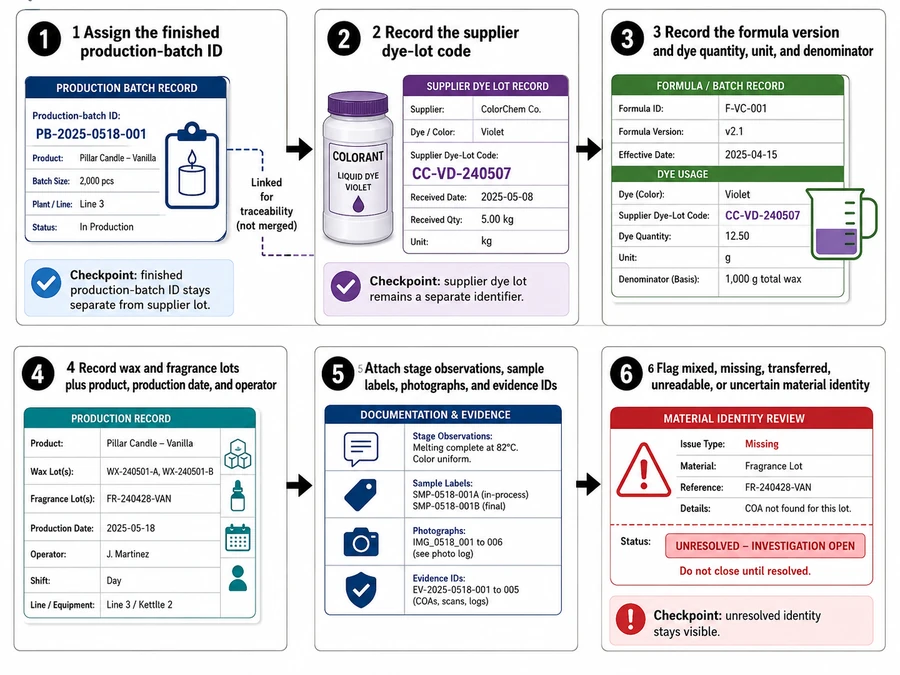
Create the production link by assigning one finished-batch ID and attaching the dye lot, formula version, measured amount, co-material lots, evidence, and exceptions.
- Assign or retrieve the finished production-batch ID.
Give each production run its own stable identifier. Do not use a product SKU, calendar date alone, or supplier dye-lot code as the production-batch ID. - Record the supplier dye-lot code.
Copy the code from the original supplier label or verified material document. Keep “unknown,” unreadable, transferred, and mixed identities visible as exceptions. - Record the active formula version.
State which formula version governed the run. Do not write only a recipe name when several versions may exist. - Record the dye quantity, unit, and denominator.
Preserve the original amount, such as 2.50 g, and the declared basis, such as 1,000 g of wax. A percentage alone is incomplete without its denominator. - Record the wax and fragrance lots.
These references help separate a dye-lot change from another material change during a later review. They add production evidence but do not replace the supplier dye-lot code. - Record the product, production date, and operator.
Identify what was made, when it was made, and who entered or performed the production work. - Attach later observations and evidence to the same identifiers.
Reuse the supplier dye-lot code, formula version, and production-batch ID on color observations, sample labels, photographs, and later comparison entries. - Flag unresolved material identity.
Mark mixed, missing, or uncertain supplier dye-lot details instead of assigning an invented code or merging them into a clean record.
Rules That Keep Identifiers Usable
Do not reuse a finished production-batch ID for another run. Do not change the identifier pattern without recording when the new pattern began. Preserve the supplier’s original material code after transferring dye to another container.
A product SKU may repeat across many production runs and supplier dye lots. It identifies the product being made or used, not the exact material batch or finished production run.
When a color difference appears, retrieve the linked supplier dye lot, measured quantity, formula version, wax lot, fragrance lot, operator, date, and stage-specific observations. This comparison may narrow the possible variables, but it does not prove that the dye caused the difference.
A full manufacturing record may contain equipment settings, process times, packaging, yield, release checks, and other fields. The dye-lot record keeps only the relationships needed to trace the candle colorant through production.
How to Record Corrections, Batch Deviations, and New Formula Versions
Keep the original formula entry visible and classify every later change as a record correction, one-batch deviation, or approved formula revision.
A record correction fixes an inaccurate entry without automatically changing the active formula. A one-batch deviation applies only to a named production batch. An approved formula revision changes the standard formula and receives a new version identifier and effective status.
| Change type | Purpose | Original entry retained? | New formula version required? | Effect on later batches | Minimum record |
|---|---|---|---|---|---|
| Record correction | Fix an inaccurate written entry | Yes | Not automatically | None unless the approved formula itself changes | Original value, corrected value, reason, date, person, affected record |
| One-batch deviation | Record an intentional exception for one production run | Yes | No | Does not change the standard formula | Standard value, deviated value, reason, affected batch and dye lot, date, person |
| Approved formula revision | Change the standard formula for later use | Yes | Yes | Applies from the recorded effective point | Prior version, new version, changed value, reason, status, date, person |
Do not use one generic “change” label for these events. The label must tell a later operator whether the record was wrong, one batch departed from the formula, or the standard formula changed.
A correction does not require a new formula version when it only repairs an inaccurate entry. A deviation does not change the standard formula because it belongs to one named production batch. A revision requires a new version because it changes what later operators are expected to use.
Mark one formula version as active and retain earlier versions as superseded. Do not mark a superseded version as deleted when past production batches still reference it.
This record preserves the approved result of a formula change. Technical shade correction, full batch-release review, formal document approval, electronic signatures, and legal retention periods fall outside this dye-centered change history.
How to Record Candle Color Results from Melted Wax Through Burn Testing
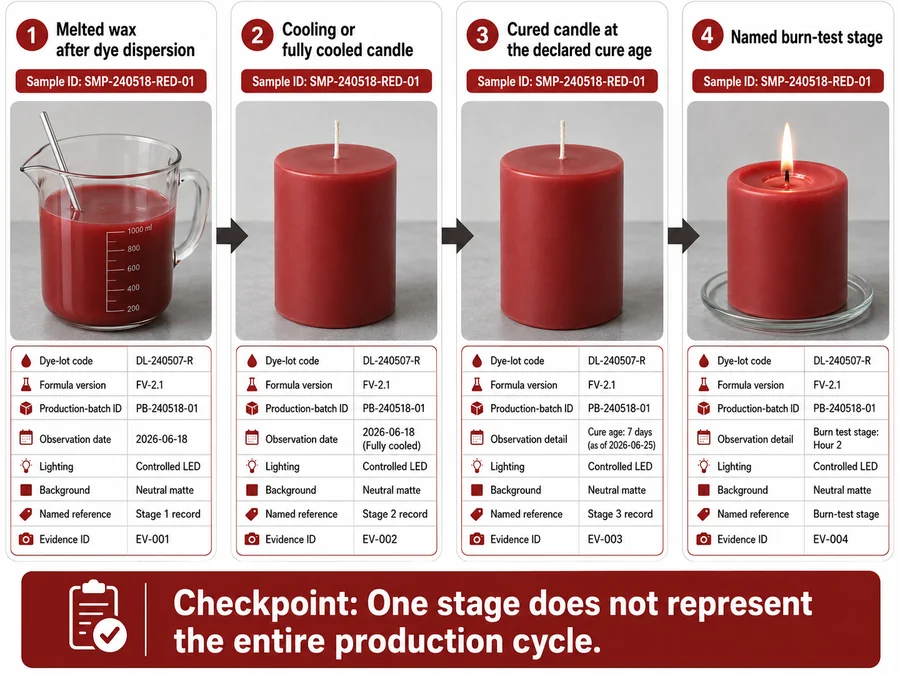
Record candle color separately at the melted, cooled, cured, and relevant burn-test stages because one observation cannot represent the entire production cycle.
A color result is the documented appearance of a named candle dye lot at a stated production stage and under stated viewing conditions. Each entry must identify the supplier dye-lot code, formula version, finished production-batch ID, observation stage, date or cure age, lighting, background, and evidence reference.
The dye identity, measured formula, and production-batch linkage establish what was used. Stage-specific observations establish what was seen and when it was seen.
Melted wax does not predict the final cured appearance. A candle may look different while cooling, after becoming fully solid, after its declared cure interval, and while burning. Record these stages separately rather than replacing them with one description such as “dark red,” “good,” or “off.”
| Observation stage | When to record | Required viewing details | What the entry may support | What it cannot prove |
|---|---|---|---|---|
| Melted wax after dye dispersion | After the dye appears dispersed and before pouring | Vessel or sample ID, lighting, background, formula version, dye-lot code, and temperature only when already recorded | Whether the melted mixture appeared uniform and how its molten color compared with a named reference | The final cooled or cured shade |
| Freshly poured or cooling candle | At a named interval after pouring | Time since pour, production-batch ID, lighting, background, and visible surface condition | How the color appeared during cooling | The final appearance after full cooling or curing |
| Fully cooled candle | After the candle has become fully solid | Observation date, elapsed cooling time, lighting, background, and sample ID | The initial solid appearance of the batch | The appearance after the declared cure interval |
| Candle after a declared cure interval | At the exact recorded cure age | Cure age, observation date, lighting, background, named reference, and evidence ID | Comparison with another sample observed under matching conditions | A universal acceptable shade or the appearance at every later age |
| Burning candle at a named test stage | During a recorded burn-test point when color evidence matters | Burn stage, elapsed test time, sample ID, lighting, background, and production-batch ID | A limited visual record of the candle during that test stage | Wick performance, flame safety, soot, melt-pool quality, or full burn-test acceptance |
Modeled Stage-Observation Record
| Field | Modeled entry |
|---|---|
| Supplier dye-lot code | SL-240602-A |
| Formula version | RED-V4 |
| Finished production-batch ID | PB-2026-0622-01 |
| Observation stage | Cured candle |
| Production date | June 22, 2026 |
| Observation date | July 6, 2026 |
| Cure age | 14 days |
| Lighting | North-facing indirect daylight, no overhead lamp |
| Background | Matte neutral-gray card |
| Named reference | Accepted sample RS-RED-V3-014 |
| Visual description | Slightly lighter and less blue than the accepted reference |
| Evidence ID | EV-PB0622-CURED-01 |
| Limitation | Reference sample was produced with a different wax lot |
This is a modeled entry, not measured evidence. It demonstrates how an observation can remain tied to the dye lot, formula, production run, stage, viewing conditions, and comparison limit.
Replace Vague Color Notes with Traceable Descriptions
Replace a vague color note by naming the direction of the difference, reference, observation stage, cure age, and viewing conditions.
Slightly lighter than retained reference RS-RED-V3-014 at the 14-day cured stage under indirect daylight.
Do not write:
Looks a little off.
The first description names the relative difference, reference, stage, cure age, and viewing condition. The second leaves a later operator to guess what changed, when the difference appeared, and what comparison was used.
Useful observation terms include:
- Lighter or darker than a named reference
- Warmer or cooler in appearance
- More red, yellow, blue, gray, or brown relative to the reference
- Even or visibly uneven across the sample
- Similar at one stage but different at another
- Unable to compare because the lighting, background, cure age, or sample identity differed
Do not state that the dye lot caused a color difference merely because two batches used different supplier dye lots. Wax lot, fragrance lot, formula version, process conditions, cure age, sample geometry, and viewing conditions may differ at the same time.
Observation Method
Record the lighting, background, sample identity, observation stage, cure interval, camera position, comparison interval, and any limits beside each evidence item.
| Method field | What to state |
|---|---|
| Lighting | Light source and whether other lights were present |
| Background | Surface color and finish |
| Sample labeling | Evidence ID and production-batch ID visible or recorded beside the image |
| Observation stage | Melted, cooling, fully cooled, cured, or named burn-test stage |
| Cure interval | Exact elapsed time rather than “after curing” |
| Camera position | Approximate distance, angle, and framing when photographs will be compared |
| Comparison interval | Whether samples were viewed during the same session or at different times |
| Limitations | Any difference in light, background, wax, fragrance, process, stage, or cure age |
Photographs taken under materially different lighting, backgrounds, framing, or cure ages should not be compared as though the conditions matched. Keep them as records, but mark the comparison as limited or uncontrolled.
Burn-stage entries on this page record color evidence only. Safety, wick behavior, flame size, soot, mushrooming, melt-pool development, and container temperature belong in the complete burn-test record.
Observed differences may later support formula work, but this section does not prescribe color corrections or universal shade tolerances. It records the evidence needed to identify the stage at which a difference appeared.
How to Label Retained Samples, Swatches, and Candle Color Photos
A retained candle sample, swatch, or photograph is usable dye-lot evidence only when its label or filename links it to the dye lot, formula version, production batch, date, and observation conditions.
An evidence ID is a stable code that connects a physical item or image file to its written observation entry. Physical samples preserve material for later viewing, while photographs preserve a recorded appearance under stated conditions. Neither remains traceable when that connection is missing.
A reference sample is a traceable physical comparison baseline. An unlabeled leftover candle, showroom sample, marketing image, or disconnected photograph is not a controlled reference.
The evidence record should distinguish what each retained item can show and what may limit a later comparison.
| Evidence type | What it preserves | Main limitation | Minimum identity fields |
|---|---|---|---|
| Retained finished candle | The finished object for later physical viewing | Appearance may change with age, handling, dust, heat, light, or storage | Evidence ID, dye-lot code, formula version, production-batch ID, production date, stage, cure age, storage location, and reference status |
| Wax or color swatch | A smaller physical sample of the recorded formula | Thickness, surface, cooling pattern, and geometry may differ from the finished product | Evidence ID, dye-lot code, formula version, production-batch or test ID, production date, stage, cure age, and storage location |
| Controlled photograph | A dated visual record made under stated conditions | Camera processing, display settings, light, background, and framing can alter appearance | Evidence ID, dye-lot code, formula version, production-batch ID, date, stage, cure age, lighting, background, and filename |
A photograph does not replace a physical sample in every case. A physical sample can be viewed later, but its condition may change. A photograph preserves the appearance recorded at one moment, but it depends on the stated photographic conditions.
Use one evidence ID across the physical label, written observation, and photograph record. Preserve the dye-lot code, formula version, production-batch ID, production date, stage, cure age, storage or file location, viewing conditions, named reference, and comparison limits.
Commercial product images do not replace controlled dye-lot evidence unless they carry the required identity and observation details. Their lighting, editing, background, and purpose may differ from a production comparison.
Missing or damaged evidence does not justify deleting its record. Keep the evidence ID and mark the object as incomplete, unavailable, damaged, discarded, or uncontrolled.
One retained sample does not prove that every candle in the production batch is identical. It represents the identified item and the recorded observations attached to it.
Long-term retention periods, warehouse controls, disposal rules, legal requirements, and formal evidence custody fall outside this dye-centered record. The minimum requirement is to preserve the identity link for as long as the evidence object or its observation record is used.
Accepted Dye Lot vs New Dye Lot: What Should You Compare Before Scaling?
Compare the accepted and new supplier dye lots while holding the formula, process, cure interval, observation stage, and viewing conditions constant or documented.
An accepted dye lot is a previously documented supplier lot used as a comparison baseline under stated formula, production, cure, and viewing conditions.
A useful candle dye lot comparison identifies the one intended change and records every other difference that could affect the result. “Scaling-ready” means the new lot has traceable evidence supporting use under the stated production conditions; it does not mean guaranteed consistency, finished-product release, regulatory approval, or general business readiness.
Modeled Controlled Comparison
| Comparison factor | Accepted lot | New lot | Controlled or different | Evidence reference | Interpretation limit |
|---|---|---|---|---|---|
| Comparison ID | CMP-2026-0701 | CMP-2026-0701 | Controlled | Comparison record | Identifies this review only |
| Supplier dye-lot code | SL-240318-B | SL-240602-A | Intended difference | Supplier labels | Confirms identity, not performance |
| Dye product and color | Deep Red Liquid Dye | Deep Red Liquid Dye | Controlled | Label records | Product names do not prove equal results |
| Formula version | RED-V4 | RED-V4 | Controlled | Formula record | Applies only to this version |
| Dye quantity and basis | 2.40 g per 1,000 g wax | 2.40 g per 1,000 g wax | Controlled | Weighing records | Does not account for scale error |
| Wax type and lot | Wax A; WX-260507-D | Wax A; WX-260507-D | Controlled | Material record | Same lot reduces one competing variable |
| Fragrance and lot | Fragrance C; FO-260410-C | Fragrance C; FO-260410-C | Controlled | Material record | Does not prove fragrance had no effect |
| Process conditions | Same recorded mixing and pouring sequence | Same recorded mixing and pouring sequence | Controlled as recorded | Production records | Unrecorded operator differences may remain |
| Container configuration | Same container model | Same container model | Controlled | Product record | Applies only to this configuration |
| Cure interval | 14 days | 14 days | Controlled | Observation records | Modeled interval, not a universal requirement |
| Observation stages | Fully cooled and 14-day cured | Fully cooled and 14-day cured | Controlled | EV-ACC-014; EV-NEW-014 | Other stages were not compared |
| Lighting and background | Indirect daylight; neutral-gray card | Indirect daylight; neutral-gray card | Controlled as recorded | Photo records | Camera processing may still differ |
| Recorded result | Accepted reference | Slightly lighter than accepted reference | Different | Written observations and photos | Difference does not identify its cause |
| Initial decision | Accepted baseline | Retest | Different | Decision record | No universal tolerance was applied |
Methods note: This comparison is modeled rather than measured. It shows which variables were held constant, which variable changed, which evidence IDs were reviewed, and why the initial decision was limited to retesting. No universal shade tolerance or supplier-lot acceptance limit is implied.
Compare the Two Dye Lots in Eight Steps
Compare dye lots by holding the formula and production conditions constant where feasible, documenting every difference, matching observation stages, and recording a bounded outcome.
- Select a traceable accepted reference.
Use a retained sample, swatch, or controlled photograph whose dye-lot code, formula version, production-batch ID, cure age, and observation details remain available. - Identify the new supplier dye lot.
Copy its supplier-assigned lot code and confirm the dye product, color, and form. Do not identify the new material by product name or SKU alone. - Hold the formula and production conditions constant where feasible.
Use the same formula version, dye usage-rate basis, wax, fragrance, process sequence, and container or mold configuration. - Document every variable that differs.
A wax-lot change, fragrance-lot change, operator change, process change, container change, or altered cure interval must remain visible in the comparison record. - Produce traceable comparison samples.
Give each production run and evidence object its own identifier. Keep the accepted and new supplier dye-lot codes separate. - Record results at matching stages.
Compare like with like: cooled with cooled, cured with the same declared cure age, and burn-stage evidence with the same named test stage. - Review the evidence and uncontrolled variables.
State which samples, photos, observations, formula records, and production records support the decision. Mark missing or nonmatching evidence rather than treating it as controlled. - Record the outcome and rationale.
Choose accept, retest, adjust, or escalate, then state why that outcome applies and which production conditions bound it.
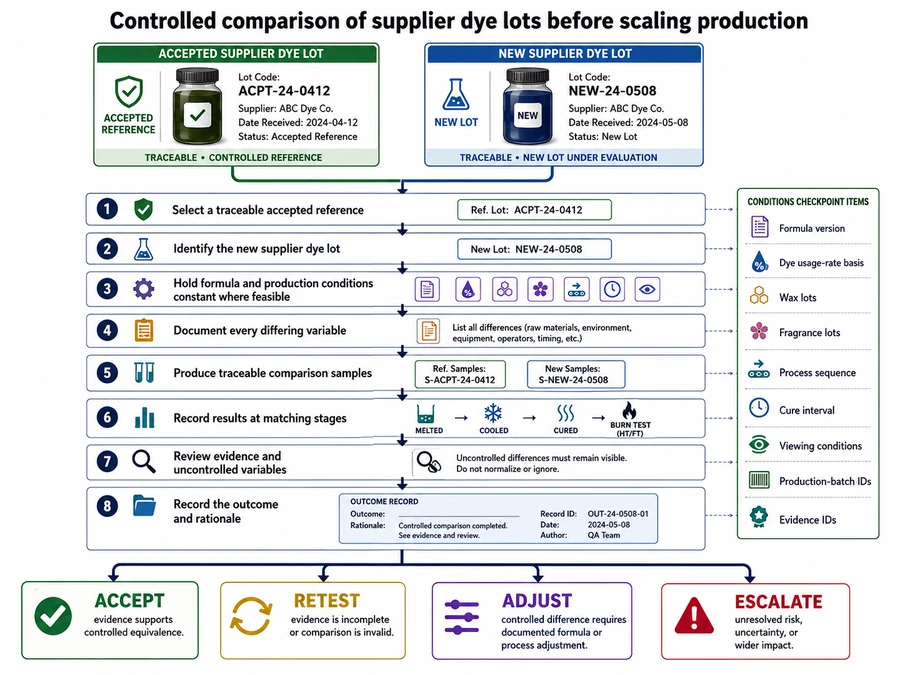
Decision Matrix for a New Candle Dye Lot
| Outcome | Use when | Required record | What the outcome supports | What it does not prove |
|---|---|---|---|---|
| Accept | The comparison is traceable, relevant conditions match, and the recorded result supports the intended use | Compared lots, formula, production conditions, evidence IDs, observations, limitations, and decision rationale | Use under the stated formula and production conditions | Universal consistency or release of every finished batch |
| Retest | Evidence is missing, viewing conditions differ, results conflict, or another material changed | Evidence gap, uncontrolled variable, new test plan, and material status | Another controlled comparison before reliance on the result | That the supplier lot failed |
| Adjust | The evidence supports evaluating a documented formula or process change | Original formula, changed value, reason, affected lot and batch, and revision status | A named trial or approved revision after further testing | Silent alteration of the existing formula |
| Escalate | A discrepancy persists, material identity is uncertain, condition concerns remain, or wider testing is required | Evidence reviewed, failed comparisons, unresolved variables, and assigned next review | Transfer of the unresolved issue for deeper technical, supplier, burn-test, or release review | A cause, rejection, or legal finding by itself |
An accepted result applies only to the named dye product, supplier lots, formula, materials, production conditions, cure interval, and observation method. A later change may require another comparison.
Start a new comparison when:
- A new supplier dye lot enters production
- The dye supplier, product, form, or color identity changes
- The formula version or usage-rate basis changes
- Wax or fragrance changes may affect the color result
- Production equipment, operators, or process steps change materially
- A retained reference is lost, damaged, or no longer comparable
- Storage or container condition raises doubt about either compared lot
- A color difference persists after a repeat test
- Higher-volume or wholesale production will rely on evidence from a smaller run
A controlled dye-lot comparison can support a bounded production decision. It does not replace complete batch release, supplier qualification, burn-performance approval, safety review, or formal quality controls.
How Storage, Opening Date, and Container Condition Affect a Dye-Lot Review
Record a candle dye container’s received date, opened date, storage history, and condition because those details may qualify a lot comparison, but they do not by themselves prove that the dye caused a color change.
The received date records when the seller obtained the material; the opened date records when the container was first accessed. Dye age means the documented time since receipt or opening, interpreted with the dye form, supplier instructions, container history, formula, production variables, and observed condition.
Storage-age interpretation becomes material when dye remains in use across several production runs, is repeatedly opened, is transferred, shows a visible condition change, or is compared with a newly received supplier lot. It is not a universal expiration model.
Use one compact record to separate verified identity and handling facts from the bounded status assigned to the material.
| Record area | What to record | How it affects the dye-lot review |
|---|---|---|
| Material identity | Supplier dye-lot code, product, color, form, and transfer-container reference | Shows which raw material is being reviewed and whether its original identity remains traceable |
| Dates | Supplier date when provided, seller’s received date, first-opened date, transfer date, and last result-check date | Separates time since receipt, opening, transfer, and last recorded use |
| Container and material condition | Storage location, orientation, closure condition, leakage, clogging, separation, crusting, moisture, contamination signs, and any unknown history | Identifies handling or condition differences that may limit a comparison without proving causation |
| Verified supplier guidance | Label or technical-document reference for the named product and lot where available | Prevents the seller from inventing universal storage, expiry, handling, or disposal rules |
| Last acceptable result | Production-batch ID, evidence ID, formula version, and observation date for the last recorded acceptable use | Provides a dated prior result without treating it as proof of present condition |
| Use | Date, reviewer, intended production use, and supplier-instruction reference where available | Means the identity is traceable, no recorded condition concern blocks the stated task, and the status applies only to that task |
| Retest | Unresolved variable, proposed comparison, fixed conditions, and evidence plan | Means another controlled comparison is required before relying on the material |
| Isolate | Reason, date, container ID, affected batches, and access status | Means identity, contamination, leakage, closure, or condition concerns prevent reliable use or comparison |
| Route to applicable disposal guidance | Supplier guidance and jurisdiction-specific requirements consulted | Records that the material should not return to use without stating a universal disposal method |
Received date and opened date are not interchangeable. An older received date does not automatically make the dye unusable, and a recent received date does not prove that storage and container handling were suitable.
Methods note: Record what was observed before assigning risk. Compare the container history with supplier information, dye form, formula, wax, fragrance, production process, cure age, and viewing conditions. When handling history is unknown, state that uncertainty rather than reconstructing it from memory.
A questionable older container and a newly received supplier lot do not form a clean supplier-lot comparison when their storage and opening histories differ. Retest or isolate the questionable material before assigning the difference to the supplier lot.
Complete warehouse design, environmental monitoring, stock valuation, universal shelf-life rules, hazardous-material classification, and legal disposal procedures fall outside this dye-lot record. Applicable supplier instructions and local requirements control handling or disposal decisions beyond the recorded status.
The complete dye-centered record chain identifies the supplier lot, measured formula, formula version, production batch, stage-specific result, evidence object, lot-change decision, and storage record. Use or print the lot-tracking worksheet so each production decision remains tied to the material and evidence reviewed.
A dye-lot log supports batch records, finished-product release review, supplier evaluation, color diagnosis, and compliance work, but it does not replace those separate processes.