
Retest a candle colorant when a supplier, lot, formulation, concentration, carrier, or format change could alter dose, dispersion, cured color, burn behavior, migration, or shelf stability.
A candle colorant is the active dye or pigment together with its formulation, concentration, carrier or diluent, physical form, delivery system, and dose basis in a defined candle formula. A material change can affect finished-candle performance, while a new label, package size, reseller, or SKU alone is administrative when the underlying manufacturer, specification, and production lot remain unchanged. This page helps candle makers and sellers classify the change, verify equivalence evidence, compare the incoming colorant with an approved control, select appearance, burn, or stability checks, and decide whether to release, hold, reject, or escalate. It does not cover full dye-conversion formulas, complete burn-test or shelf-life procedures, or a full lot-tracking system.
What Counts as a Material Candle Colorant Change?
A material candle colorant change is a supplier, manufacturer, lot, formulation, concentration, carrier, or format change that could alter dose, dispersion, cured color, combustion, migration, or shelf stability.
The evaluated candle colorant includes the active dye or pigment, formulation, concentration, carrier or diluent, physical format, and delivery system. The change is material when one or more of those features could alter the finished candle, rather than only its packaging or commercial description.
A new supplier does not automatically require full retesting because a new reseller may supply the same verified manufacturer, formulation, and lot. A new lot does not automatically require a burn test when its identity, concentration, carrier, dispersion, and application results remain consistent with the approved colorant.
Administrative vs Material Candle Colorant Change Matrix
This matrix classifies each colorant change by what changed, the evidence needed, the properties at risk, and the minimum next action.
| Change event | What actually changed | Evidence required | Potentially affected properties | Initial risk | Minimum next action |
|---|---|---|---|---|---|
| New reseller or distributor | Seller only | Manufacturer, product code, lot, formulation, and specification match | Usually none when identity is verified | Low | Confirm records and inspect the incoming material |
| New package, label, bottle, or SKU | Presentation only | Written confirmation that the colorant and lot are unchanged | Usually none | Low | Record the administrative change |
| New production lot | Manufacturing batch | Lot code, certificate, specification, concentration, and carrier | Shade, dispersion, dose response, or stability | Low to medium | Compare appearance and cured color; expand testing when evidence or results differ |
| New manufacturer | Production source | Manufacturer identity, formulation code, concentration, carrier, and format | Dose, dispersion, color, combustion, migration, and stability | High | Treat as material and run a controlled comparison |
| Reformulation | Composition | Revised technical documents and a change notice | All colorant-related properties | High | Re-establish application performance |
| Concentration or dilution change | Active colorant strength | Declared concentration and dose-conversion basis | Effective dose, color strength, combustion, and stability | High | Correct the dose basis before matched testing |
| Carrier change | Diluent or delivery medium | Carrier declaration and wax-compatibility information | Dispersion, residue, wick behavior, migration, and stability | High | Add checks for the properties the carrier may affect |
| Liquid, chip, block, or powder substitution | Physical format and possibly concentration or carrier | Format, strength, carrier, and dose-basis records | Dose accuracy, dissolution, dispersion, combustion, and stability | High | Complete the dose conversion before comparison testing |
| Undocumented product change | Change cannot be verified | Missing or contradictory records must be identified | Unknown until identity is established | High uncertainty | Hold the substitution and obtain evidence or test at the broader level |
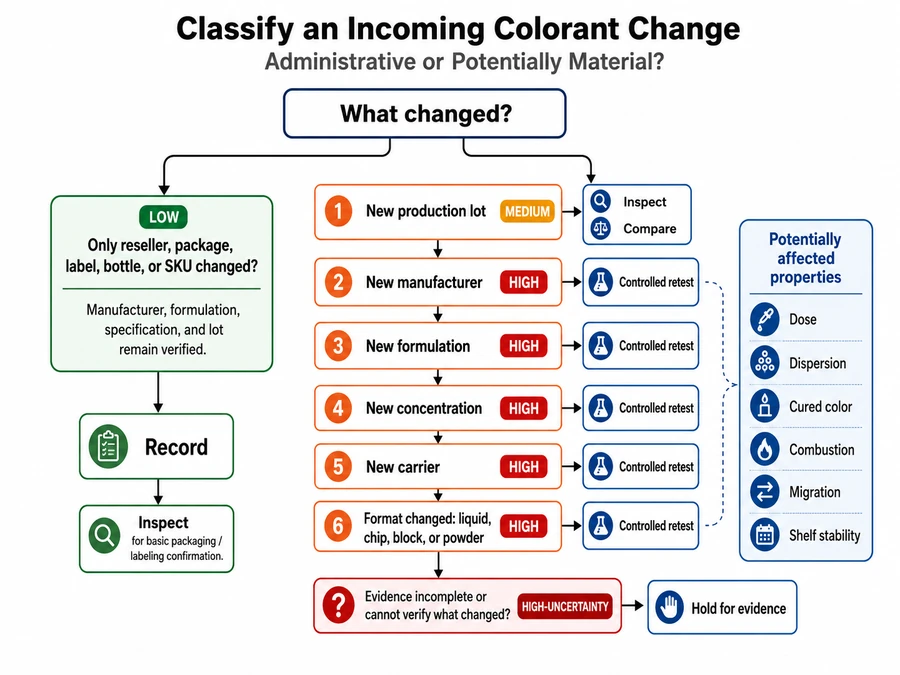
The low, medium, and high labels are screening categories, not universal pass-or-fail thresholds. A company’s approved specifications, prior production records, and acceptance limits should decide whether a particular difference is acceptable.
Missing documentation raises uncertainty but does not prove that the incoming colorant will fail. In the same way, matching shade names or supplier descriptions do not prove that the formulation, concentration, carrier, or production source is unchanged.
Methods note: This modeled matrix classifies risk from product identity, formulation, concentration, carrier, lot status, dose, dispersion, and possible burn or storage effects. Company-specific testing records and predefined acceptance criteria take priority over these generalized examples.
Once a change is classed as potentially material, verify what the records prove before deciding which application checks are needed.
How Do Supplier and Lot Records Show Whether a Candle Colorant Is Equivalent?
Supplier and lot records can show whether an incoming colorant matches the approved manufacturer, formulation, concentration, carrier, format, specification, and production lot, but not its finished-candle performance.
A supplier or reseller sells the product, while the manufacturer produces it. The product or formulation code identifies the material more reliably than a shade name, and the production-lot code identifies the specific manufacturing batch.
Documentary equivalence means that the manufacturer, formulation, concentration, carrier, format, specification, and lot status have been checked. It does not mean that equal cured color, dispersion, combustion, migration resistance, or storage stability has been demonstrated in the candle formula.
Evidence record checklist
- Identity: Record the previous and current suppliers, manufacturer, product or formulation code, and shade name.
- Lot: Record the approved and incoming production-lot codes.
- Composition: Compare declared concentration, carrier or diluent, and physical format.
- Documents: Compare specification and technical-document versions, lot-certificate status, and any reformulation notice.
- Gaps: Record missing documents, contradictory values, or unexplained code changes.
- Decision: Assign the resulting uncertainty level and the required application checks.
Supplier and Lot Evidence Hierarchy
This hierarchy separates identity evidence, raw-material conformance, and finished-candle performance, so each record supports only the decision it can prove.
| Evidence item | What it can confirm | What it cannot confirm | Effect on retest scope |
|---|---|---|---|
| Manufacturer and product or formulation code | Whether the incoming material has the same declared producer and product identity | Whether the current lot performs identically in the candle | A verified match may lower initial uncertainty |
| Concentration, carrier, and format declaration | The declared strength and delivery system | Actual dose response, dispersion, or combustion in the formula | Differences make the change material |
| Technical Data Sheet (TDS) | Declared format, concentration, carrier, dose basis, and application instructions when listed | Finished-candle color, burn behavior, or storage performance | Version changes may trigger broader testing |
| Safety Data Sheet (SDS) | Identity, composition ranges, hazards, and handling details when disclosed | Exact formulation or finished-candle performance | Use as supporting identity evidence, not approval evidence |
| Lot-specific Certificate of Analysis (COA) or conformance record | Whether the lot meets the manufacturer’s listed raw-material specification | Equal cured color, dispersion, combustion, migration, or stability | A passing record lowers lot uncertainty but does not remove application checks |
| Manufacturer change notice | Reformulation, concentration, carrier, source, or production changes | The size of the effect in a particular candle | A declared material change broadens the retest scope |
| Retained approved control | The accepted appearance and condition of the approved candle system | Whether production conditions were matched in a new trial | Supplies a direct comparison reference |
| Controlled finished-candle comparison | Performance under the tested wax, fragrance, wick, vessel, dose, process, and cure conditions | Performance in untested candle systems | Provides the strongest application-specific evidence |
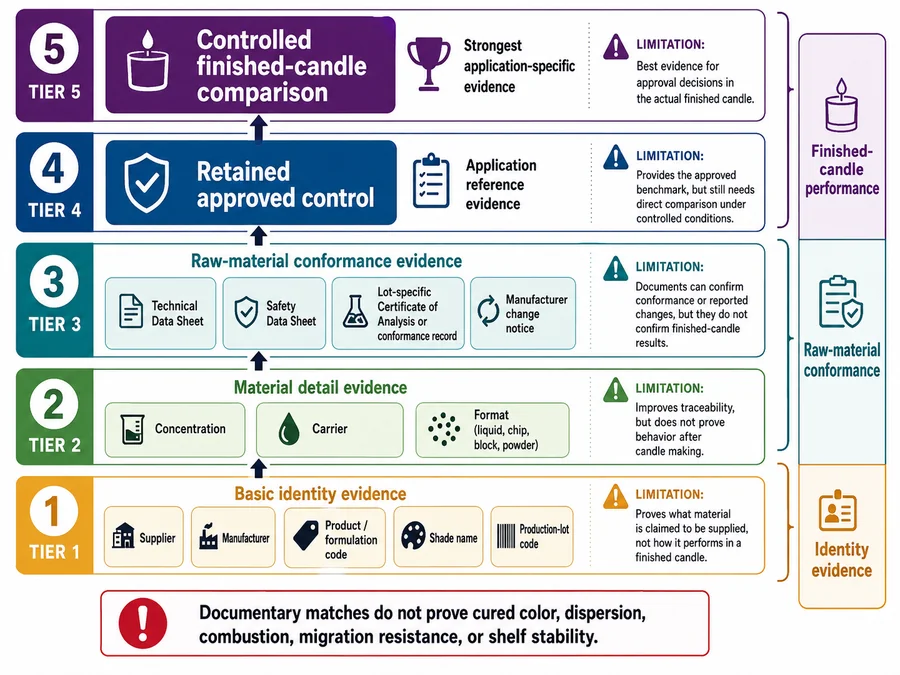
A new reseller is not a new manufacturer when the manufacturer, product code, formulation, concentration, carrier, format, and lot remain verified. By contrast, an unchanged supplier name does not prove equivalence when the manufacturer, formulation, or product code has changed.
The same product name is weak evidence because shade names can remain unchanged across different concentrations, carriers, or formulations. A lot-specific COA gives stronger raw-material evidence, but it still cannot replace testing in the approved candle system.
Missing or contradictory records increase uncertainty rather than proving automatic failure. For example, a new lot under an unchanged specification may need appearance and cured-color comparison first, while an unexplained concentration or carrier conflict supports a broader retest scope.
Methods note: This evidence hierarchy separates product identity, declared raw-material conformance, and application-specific performance. Missing or conflicting identity, concentration, carrier, format, or lot information raises the initial risk classification because documentary evidence alone cannot establish burn or shelf-stability equivalence.
Verified records may lower initial uncertainty, but the assigned finished-candle checks still control the release decision.
How Do Candle Dye Format, Concentration, and Carrier Changes Alter Retesting Needs?
A candle-dye format change expands retesting when concentration, carrier, dilution, dispersion, delivery method, or effective dose changes; equal weights, drops, chips, or shade names do not prove equivalence.
The evaluated colorant system includes the active dye or pigment, its concentration, carrier or diluent, physical format, delivery system, and dose basis. A format change means a change among liquid, chips, blocks, powder, dilution levels, concentration levels, carriers, or delivery systems. A bottle, label, package size, or SKU change remains administrative when the underlying colorant and production lot are verified as identical.
Liquid dye, pre-diluted liquid, concentrated liquid, chips, blocks, powders, granules, and pellets describe physical forms. They do not identify a standardized strength. Equal product mass does not establish equal active-colorant mass, and equal product volume does not establish equal concentration.
Format, Concentration, Carrier, and Dose-Basis Comparison Matrix
This matrix shows how format, concentration, carrier, and dose-basis changes alter comparison uncertainty and the conversion work required before testing.
| Source format | Replacement format | Concentration comparison | Carrier comparison | Dose-basis change | Main uncertainty | Conversion prerequisite |
|---|---|---|---|---|---|---|
| Pre-diluted liquid | Concentrated liquid | Different unless verified and recalculated | May match or differ | Drops, volume, or product mass → active-colorant-equivalent dose | High effective-dose uncertainty | Establish the active-colorant dose before testing |
| Concentrated liquid | Different concentrated liquid | May differ despite similar appearance | May differ | Product mass or volume → verified equivalent dose | Concentration and carrier uncertainty | Compare supplier declarations before calculating the test dose |
| Liquid dye | Dye chips | Not interchangeable by equal mass unless verified | Liquid carrier versus solid matrix | Drops, volume, or mass → calculated active-dose basis | High dose and process uncertainty | Complete format conversion before matched testing |
| Dye chips | Dye blocks | Strength may differ even within solid formats | Solid matrices may differ | Chip count or mass → verified mass-based equivalent | Portion size and concentration uncertainty | Do not substitute equal counts or fractions without a verified basis |
| Solid dye | Powder | Concentration may differ substantially | Binder-free or different carrier system | Product mass → verified active-dose basis | High handling, dispersion, and residue uncertainty | Establish concentration, handling, and dispersion requirements first |
| Same format | Different declared concentration | Material difference | May match | Existing product mass, volume, or drops → recalculated equivalent dose | High effective-dose uncertainty | Recalculate before producing comparison samples |
| Same concentration | Different carrier | Strength may match | Material difference | Existing dose basis → same active dose with a carrier-adjusted process | Compatibility and performance uncertainty | Verify wax compatibility and application instructions |
| Identical verified product and lot | New package or label | Unchanged | Unchanged | Unchanged | Minimal | Record the administrative change |
This is a modeled comparison matrix, not a universal dosing table. Supplier-declared concentration and carrier information must be checked before selecting an equivalent dose. A drop count is unsuitable as a universal dose unit because drop volume can vary with the dispenser, viscosity, temperature, and handling method.
A similar cured shade does not establish an identical effective dose. Two products may reach a similar visual depth while differing in concentration, carrier load, dispersion, residue, or interaction with the candle system.
Appearance and cured-color checks may be sufficient when the formulation, concentration, carrier, dose basis, and process behavior are verified as unchanged. The comparison must show no meaningful dispersion difference and no identified reason to expect a combustion or storage effect.
Add burn checks when a concentration, carrier, effective dose, dispersion pattern, residue level, or process requirement could affect the wick or flame. Add shelf-stability checks when the replacement introduces an unverified carrier, migration tendency, delayed fading risk, or storage-related color change.
Dose conversion must be completed before producing matched test candles. Complete conversion mathematics and universal dosing ratios remain outside this article because the correct calculation depends on product-specific concentration and supplier information.
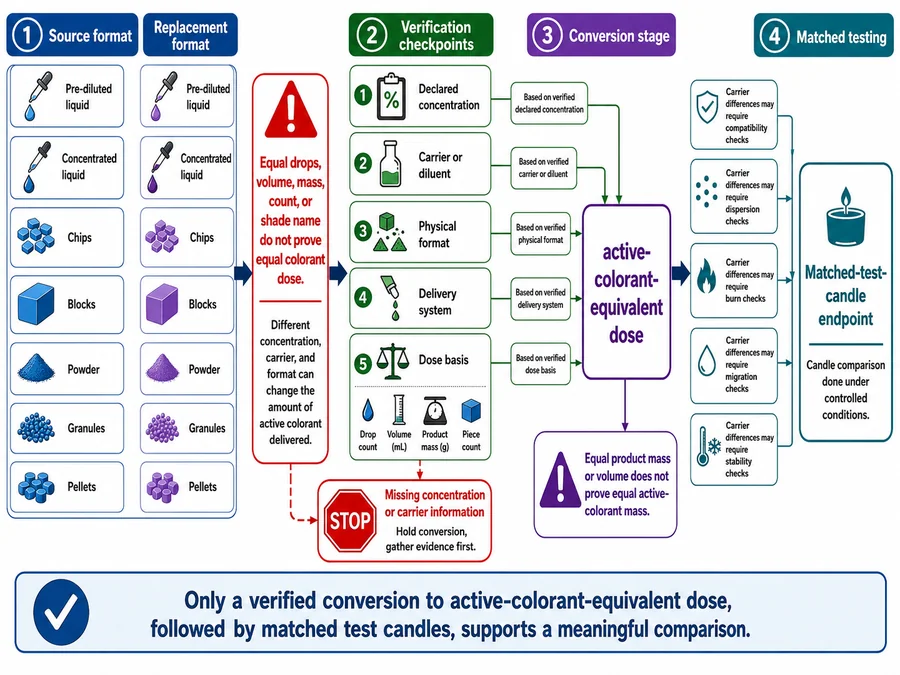
Methods note: Record the supplier-declared concentration, carrier, dose units, conversion assumptions, wax and fragrance system, production conditions, dispersion observations, and untested properties. State whether each comparison is based on documentation, modeled assumptions, or finished-candle observations.
How Should a Changed Candle Colorant Be Compared With an Approved Control Batch?
Compare the changed colorant with an approved retained control in otherwise matched candles, with the colorant as the only intended changed variable.
An approved control is a retained candle, retained sample, approved color standard, or verified formula-and-process record representing the accepted candle system. It should identify the approved colorant’s supplier, manufacturer, lot, concentration, carrier, format, and dose basis.
A retained physical candle normally provides stronger visual evidence than a written recipe alone. The retained sample preserves the actual cured appearance and may reveal production effects that a formula record does not capture. A written record remains necessary for reproducing the approved wax, fragrance, wick, vessel, dose, and process.
Controlled Candle Colorant Comparison Checklist
This checklist keeps the changed colorant as the only intended variable so the control comparison can support a valid conclusion.
- Identify the retained control, approved standard, or verified reference batch.
- Identify the incoming or changed colorant.
- Record the supplier and manufacturer for both colorants.
- Record each lot, format, concentration, carrier, and dose basis.
- Keep the wax and wax-production lot matched where practical.
- Keep the fragrance identity and fragrance load matched.
- Keep the wick series and size matched.
- Keep the vessel or mold matched.
- Keep the batch size and colorant dose basis matched.
- Keep melt, colorant-addition, mixing, pouring, cooling, and storage conditions matched.
- Label every control and changed-colorant sample before curing.
- Use the same cure interval and evaluation conditions.
- Compare appearance and dispersion before completing any triggered burn or stability checks.
- Record every deviation from the planned comparison.
- Invalidate and repeat a comparison when an unmatched variable could explain the result.
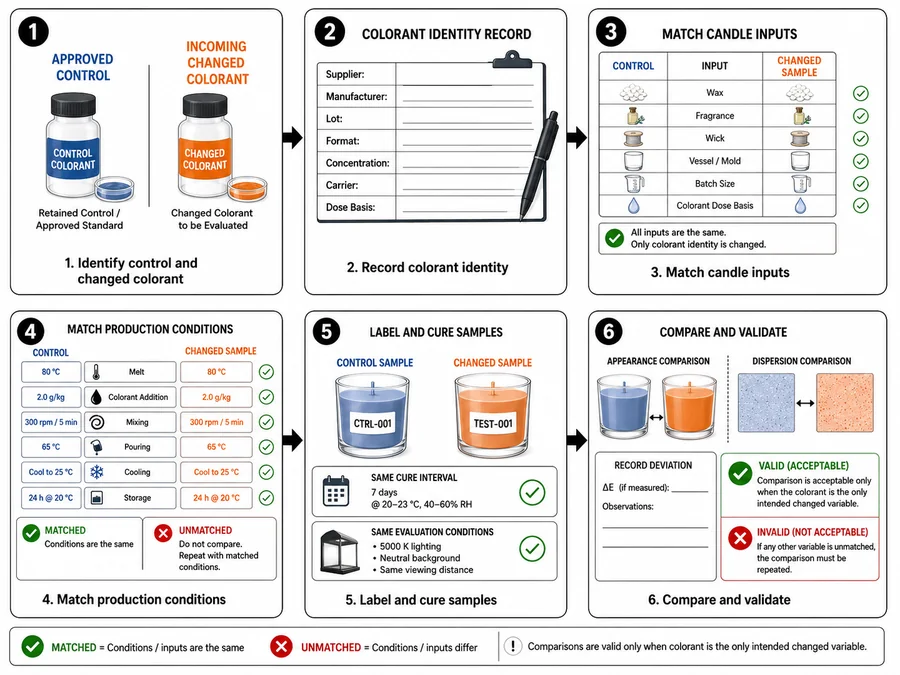
“Matched conditions” means the samples use the same wax, fragrance, wick, vessel, dose basis, processing temperatures, mixing method, cooling conditions, cure interval, and viewing or test environment. The changed colorant should be the only intended input difference.
Different cure intervals can invalidate a visual comparison because candle color may continue to settle or change after pouring. Different dose units can invalidate a format comparison because equal drops, pieces, volumes, or product weights may contain different amounts of active colorant.
Control-versus-Changed-Sample Benchmark Table
This benchmark records the control and changed sample side by side so every matched condition and remaining difference is visible.
| Comparison field | Approved control | Changed-colorant sample | Validity requirement |
|---|---|---|---|
| Sample ID | Unique control code | Unique test code | Every sample is traceable and clearly labeled |
| Colorant identity | Approved manufacturer and product code | Incoming manufacturer and product code | Difference is documented |
| Production lot | Approved lot | Incoming lot | Both lots are recorded |
| Format | Approved liquid, chip, block, powder, or other form | Replacement form | Any format difference is declared |
| Concentration | Approved declared strength | Replacement declared strength | Dose conversion is completed when strengths differ |
| Carrier or diluent | Approved carrier | Replacement carrier | Any carrier difference is treated as material |
| Wax | Approved type and lot where practical | Same type and matched lot where practical | No unexplained wax change |
| Fragrance | Approved identity and load | Same identity and load | No fragrance substitution or load change |
| Wick | Approved series and size | Same series and size | No simultaneous wick change |
| Vessel or mold | Approved item | Same item | Geometry remains matched |
| Colorant dose | Approved dose and units | Converted or matched dose and units | Dose basis is comparable |
| Process temperature | Approved recorded range | Same planned conditions | Deviations are recorded |
| Mixing and cooling | Approved method | Same method | No unexplained process difference |
| Cure interval | Approved evaluation age | Same evaluation age | Samples are compared at matched ages |
| Appearance result | Accepted reference | Recorded comparison | Lighting and viewing method are matched |
| Dispersion result | Accepted reference | Recorded comparison | Specks, streaks, residue, or settling are documented |
| Triggered performance result | Approved record where available | Burn or stability result when required | Every test triggered by the change is completed |
| Comparison validity | Valid reference | Valid, invalid, or limited | Unmatched variables are disclosed |
A comparison is invalid when another changed variable could reasonably explain the difference. Examples include changing the fragrance load, wick, vessel, wax, dose basis, mixing method, cooling conditions, or cure interval at the same time as the colorant.
A written recipe cannot fully replace a retained candle when the decision depends on visual similarity. It may serve as the control record when no retained sample exists, but the limitation must be stated, and the resulting confidence is lower.
Samples should carry distinct identifiers rather than labels such as “old” and “new” alone. The record should connect each identifier to the supplier, manufacturer, lot, concentration, carrier, format, dose, production conditions, and evaluation date.
Methods note: Document the control source, changed sample, variables held constant, formula, process conditions, cure interval, viewing or measurement method, observation count, deviations, and test limitations. Approval applies only to the tested candle system and cannot be assumed for a different wax, fragrance, wick, vessel, dose, or process.
How Do You Choose a Proportionate Retest Scope After a Candle Colorant Change?
Choose a proportionate retest scope by matching the colorant change to every candle property it could affect. Proportionate means the smallest evidence package that covers each plausible appearance, burn, or stability effect, not the cheapest, fastest, easiest, broadest, or most conservative test program.
A retest scope is a selectable combination of documentation, incoming-material inspection, appearance comparison, cured-color comparison, burn testing, shelf testing, and isolated investigation. Several evidence components may be required when one change affects more than one property. One visual comparison or successful ignition cannot close unrelated evidence requirements.
Colorant Change × Affected Property × Minimum Retest-Scope Matrix
This matrix connects each colorant change and evidence state to the minimum appearance, burn, stability, and disposition checks it triggers.
| Change event | Evidence available | Dose risk | Dispersion risk | Appearance check | Cured-color check | Burn test | Shelf-stability test | Minimum disposition |
|---|---|---|---|---|---|---|---|---|
| New distributor; same verified manufacturer, product, and lot | Complete identity records | Low | Low | Incoming-material check | Not normally triggered | Not triggered by distributor change alone | Not triggered by distributor change alone | Record and accept the administrative change |
| New manufacturer | New source with incomplete performance history | High | High | Required | Required | Required | Required when migration, fading, or carrier behavior is unverified | Hold until required checks pass |
| New lot; unchanged documented specification | Lot record and matching specification | Low to medium | Low to medium | Required | Required | Conditional on observed residue, wick effects, or prior lot sensitivity | Conditional on prior instability or changed storage behavior | Compare before routine release |
| New lot with a specification deviation | Declared deviation or conflicting certificate | Medium to high | Medium to high | Required | Required | Required when dose, composition, residue, or wick exposure may differ | Required when formulation or stability properties may differ | Hold and test the affected properties |
| Documented reformulation | Manufacturer change notice | High | High | Required | Required | Required | Required | Treat as a new material approval |
| Concentration change | Declared old and new strengths | High | Medium | Required | Required | Required when effective load or wick exposure changes | Conditional on formulation and storage risk | Recalculate dose, then test |
| Carrier change | Declared carrier difference | Medium to high | Medium to high | Required | Required | Required when deposits, flame, soot, or melt-pool behavior could change | Required when migration, bleeding, or delayed fading could change | Hold until carrier-related checks pass |
| Liquid-to-solid format conversion | Format and product records | High | High | Required | Required | Required | Conditional on formulation, carrier, and storage evidence | Complete dose conversion, then run matched tests |
| Pre-diluted-to-concentrated conversion | Concentration and carrier records | High | Medium to high | Required | Required | Required | Conditional on carrier and stability evidence | Establish the active-dose basis before testing |
| Package-only change | Written confirmation of identical product and lot | Low | Low | Incoming inspection | Not normally triggered | Not triggered | Not triggered | Record as administrative |
| Missing documentation | Identity or specification cannot be confirmed | Unknown | Unknown | Required but not sufficient | Required but not sufficient | Required when combustion effects cannot be excluded | Required when stability effects cannot be excluded | Hold pending evidence or broader testing |
| Stacked changes | Colorant changed with wax, fragrance, wick, vessel, or process | Unknown | Unknown | Results may be confounded | Results may be confounded | Results may be confounded | Results may be confounded | Isolate variables and repeat |
| Invalid control | Retained control is damaged, untraceable, unmatched, or differently cured | Unknown | Unknown | Invalid comparison | Invalid comparison | Invalid comparison | Invalid comparison | Replace or rebuild the control before testing |
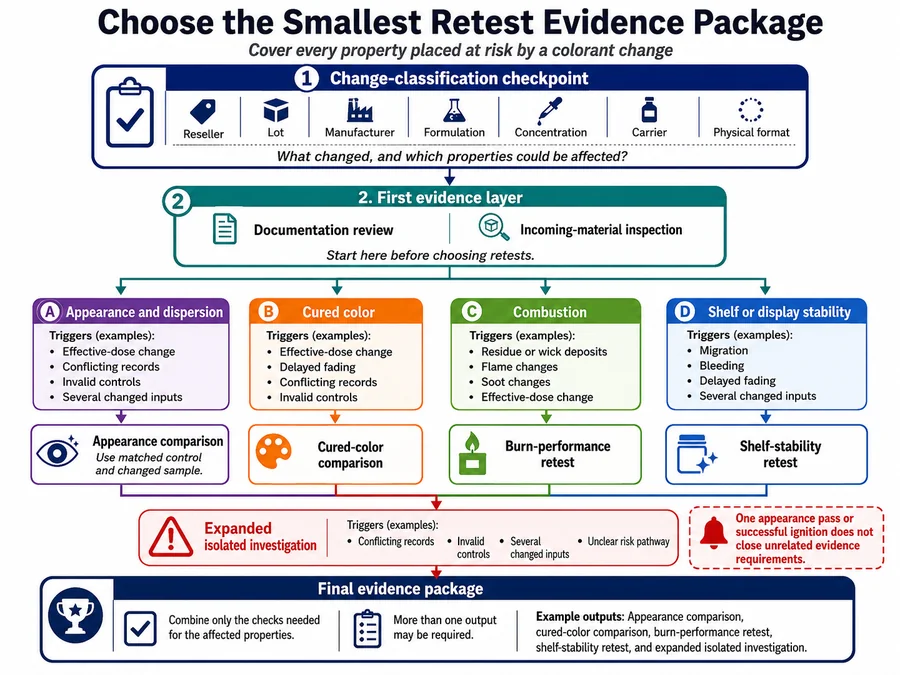
This modeled matrix assigns the minimum starting scope, not an automatic approval. Company specifications, retained samples, production records, supplier instructions, and prior controlled test results may require broader checks.
Seven Retest Evidence Components
These seven evidence components can be combined, so the retest scope covers every property placed at risk by the change.
- Documentation confirmation: Verify the manufacturer, product code, formulation, concentration, carrier, format, lot, and specification.
- Incoming-material or preparation check: Inspect the colorant for unexpected appearance, separation, residue, damage, contamination, or preparation differences.
- Appearance and dispersion comparison: Compare the poured sample for streaks, specks, settling, residue, uneven color, or preparation differences.
- Cured-color comparison: Compare the changed sample with the approved control after the same cure interval and under the same viewing or measurement conditions.
- Burn-performance retest: Check combustion when the change may affect effective dye load, wick deposits, flame behavior, soot, melt-pool behavior, or extinguishing.
- Shelf or display-stability retest: Check delayed fading, bleeding, migration, heat response, storage response, or display-exposure behavior when those properties may differ.
- Expanded isolated investigation: Separate variables and repeat the comparison when records conflict, controls are invalid, several inputs changed, or results disagree.
When Appearance-Only Retesting May Be Enough
Appearance and cured-color checks may provide the required application evidence when all of these conditions apply:
- The manufacturer and formulation are verified.
- The concentration and carrier are unchanged.
- The dose basis is unchanged.
- The new lot remains within the approved specification.
- Preparation and dispersion behavior remain unchanged.
- The candle formula and production conditions are matched.
- No residue, wick deposit, flame, migration, fading, or storage concern appears.
- Previous records do not identify lot-sensitive burn or stability behavior.
A cured-color comparison is normally required when a new lot, supplier arrangement, or preparation difference could alter the finished shade even though the declared formulation remains unchanged. An incoming-material inspection alone cannot show how the colorant appears after wax cooling and curing.
When a Burn Retest Is Required
Add burn-performance testing when the change involves or produces:
- A different concentration or effective dose.
- A different formulation or carrier.
- A liquid, solid, powder, chip, or block conversion.
- New residue, sediment, particles, or wick deposits.
- A changed flame, melt pool, soot pattern, or extinguishing response.
- An unexplained difference during preparation or dispersion.
- A same-shade result without evidence that combustion remains acceptable.
A new lot does not require the same test scope as a format conversion in every case. A documented lot within an unchanged specification may begin with appearance and cured-color comparison. A format conversion normally changes dose calculation, preparation, dispersion, carrier exposure, or residue risk, so it supports broader testing.
When Shelf-Stability Testing Is Required
Repeat shelf or display-stability testing when the replacement introduces:
- A new carrier or formulation.
- An unverified migration or bleeding tendency.
- A delayed-fading concern.
- A prior history of storage instability.
- A different response to heat, light, windows, markets, or retail displays.
- A concentration or dose change that may affect long-term color behavior.
A short cured-color pass cannot show delayed migration or fading. Those effects require observation over the company’s defined storage or display period.
An invalid control prevents a defensible comparison. Replace the control with a traceable retained sample or rebuild it from an approved formula and process record before assigning a pass or failure to the changed colorant.
Methods note: This matrix is a modeled decision aid based on change class, available evidence, affected-property assumptions, dose risk, dispersion risk, and possible appearance, burn, or storage effects. It supplies no universal legal, laboratory, color, burn, or stability threshold. Predefined company criteria and product-specific records take priority.
Why Does a Same-Shade Result Not Prove Candle Colorant Equivalence?
A same-shade result proves only that the changed colorant meets the approved cured-color tolerance under matched conditions. It does not prove equal formulation, concentration, carrier, combustion behavior, migration resistance, or shelf stability.
“Same shade” means acceptable cured visual similarity under a predefined company tolerance and matched viewing or measurement conditions. It does not mean identical composition, dose, dispersion, burn behavior, or long-term performance.
Same-Shade vs Full Colorant Equivalence Table
This table separates visual, formulation, combustion, and stability evidence so a pass in one layer is not mistaken for full equivalence.
| Evidence layer | What was tested | What a pass proves | What remains unknown | Further-check trigger | Release implication |
|---|---|---|---|---|---|
| Appearance equivalence | Cured hue, color strength, visible uniformity, and surface or body-color consistency | The sample meets the approved visual tolerance under the stated conditions | Formulation, concentration, carrier, combustion, migration, and storage behavior | Any underlying material change or unresolved performance property | Closes only the appearance requirement |
| Formulation equivalence | Manufacturer, product code, active-colorant basis, concentration, carrier, format, and specification | The documented material identity matches the approved description | Actual finished-candle appearance, burn response, and storage response | Missing, conflicting, revised, or incomplete records | Lowers uncertainty but does not approve performance |
| Combustion equivalence | Flame behavior, wick deposits, soot, melt pool, extinguishing, and post-burn discoloration | Burn performance meets the company’s criteria in the tested candle | Delayed fading, migration, bleeding, and untested candle formulas | Concentration, carrier, dose, residue, or format change | Closes the burn requirement only for the tested candle |
| Stability equivalence | Fading, migration, bleeding, heat response, storage response, and display exposure | The tested sample meets the company’s stability criteria for the stated period and conditions | Longer periods, harsher exposure, and different candle formulas | New carrier, formulation, migration profile, or instability history | Closes the tested stability requirement |
A valid same-shade result requires:
- An approved retained control or documented visual standard.
- Matched wax, fragrance, wick, vessel, and colorant dose basis.
- Matched preparation, pouring, cooling, and curing.
- The same cure interval.
- Defined lighting, background, viewing angle, timing, or measurement method.
- A predefined company tolerance.
- Separate records for appearance, burn, and stability findings.
Two dyes can match visually but burn differently. A concentrated product may use less total product mass to reach the same visual depth, while a diluted product may require more. The resulting carrier exposure, residue, or wick contact can differ even when the cured candles appear similar.
Equal color can conceal different concentrations because visual shade is an outcome rather than a measurement of product strength. A lower dose of a stronger colorant may resemble a higher dose of a weaker product without establishing equal composition or performance.
Different carriers may produce similar cured color while behaving differently during storage or burning. One carrier may disperse cleanly in the wax, while another may increase residue, migration, bleeding, delayed fading, or wick deposits.
Equal shade names are weaker evidence than manufacturer, formulation, concentration, carrier, and lot records. Product names describe a commercial color identity and do not establish identical composition or active-colorant strength.
Appearance alone is sufficient only when the classified change has no remaining burn or stability trigger. An appearance pass cannot cancel a burn failure, a shelf-stability failure, missing material evidence, or an invalid control.
Record the evidence layers separately:
- Appearance: pass, fail, or inconclusive.
- Formulation records: matched, changed, incomplete, or contradictory.
- Burn performance: passed, failed, not triggered, or not tested.
- Stability: passed, failed, not triggered, in progress, or not tested.
A release record should never convert “not tested” into “equivalent.” Approval depends on every property triggered by the material change, not the visual result alone.
Methods note: Record the approved control, changed sample, candle formula, process, cure interval, appearance method, company tolerance, burn observations, stability observations, untested properties, and limitations. Do not apply a universal visual or ΔE threshold; use the company’s predefined acceptance method.
How Do You Decide Whether to Release, Adjust, Hold, Repeat, Reject, or Escalate a Changed Candle Colorant?
Release a changed candle colorant only when the control comparison is valid, the required documentation is complete, and the colorant meets the predefined appearance criteria plus every burn or stability check triggered by the change.
A pass means the candle meets its approved appearance criteria and every additional performance or stability requirement assigned to the classified change. Approval applies only to the tested wax, fragrance, wick, vessel, colorant dose, production process, cure interval, and evaluation conditions, not to every candle formula that might use the colorant.
The possible dispositions are:
- Release: Approve the changed colorant for the tested candle system.
- Release with adjustment: Approve a documented dose or process adjustment only after the applicable comparison checks pass.
- Hold: Prevent production use while evidence, criteria, or test results remain incomplete.
- Repeat: Run an invalid or inconclusive test again under corrected conditions.
- Reject: Decline the changed colorant after a valid, isolated, repeatable failure.
- Escalate: Send an unresolved appearance, combustion, migration, stability, or causal issue into a focused investigation.
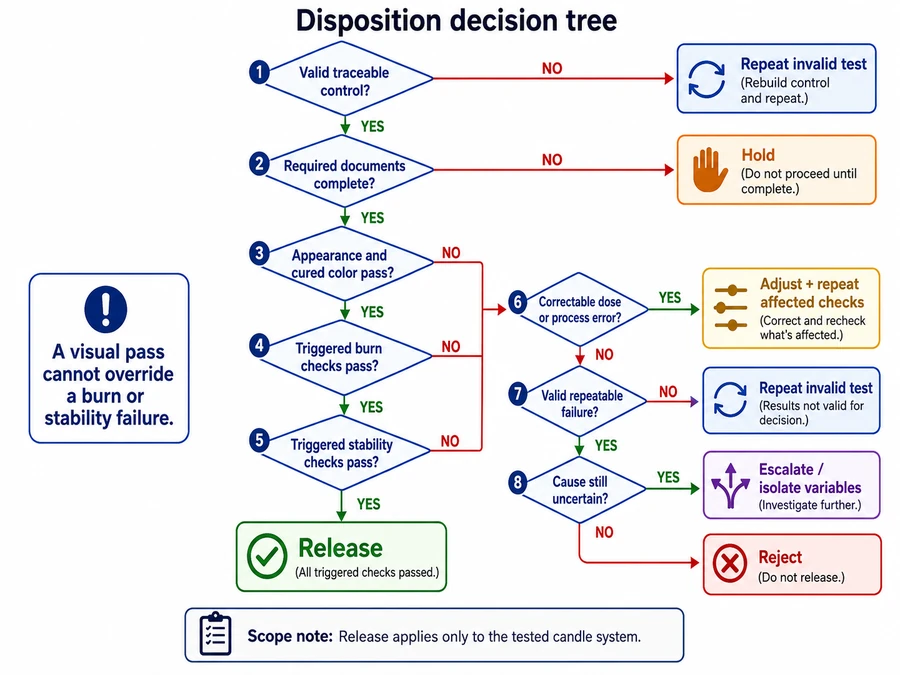
Release / Adjust / Hold / Repeat / Reject / Escalate Decision Tree
This decision tree assigns the disposition from control validity, documentation status, test results, and unresolved causal uncertainty.
| Decision point | Result | Disposition | Required action |
|---|---|---|---|
| Is the approved control valid and traceable? | No | Hold and repeat | Rebuild or replace the control, match the test conditions, and repeat the affected comparison |
| Is the required supplier, manufacturer, lot, formulation, concentration, carrier, format, and dose documentation complete? | No | Hold | Obtain the missing evidence or apply broader testing to the unknown properties |
| Do appearance, dispersion, and cured color meet the predefined criteria? | No | Hold or adjust | Review dose, dispersion, preparation, cure, and the approved color criterion before repeating |
| Does appearance fail while all triggered performance checks pass? | Yes | Hold or adjust | Do not release until the appearance requirement passes or the approved criterion is formally changed |
| Does appearance pass while a triggered burn check fails? | Yes | Hold and escalate | Treat the burn result as blocking; a visual match cannot override it |
| Does appearance pass while a triggered stability check fails? | Yes | Hold and escalate | Treat migration, bleeding, fading, or storage failure as blocking |
| Is the difference linked to a correctable dose or preparation error? | Yes | Adjust and repeat | Document the change and repeat every check affected by the adjustment |
| Was the failed test invalid because of an unmatched variable, damaged control, labeling error, or process deviation? | Yes | Repeat | Correct the invalid condition and repeat the affected test |
| Did a valid isolated test produce the same failure more than once? | Yes | Reject or escalate | Stop repeating the same test without a new adjustment or evidence-based hypothesis |
| Did every required check pass under valid conditions? | Yes | Release | Record the evidence, decision basis, production scope, and any operating limits |
| Is causal attribution still uncertain? | Yes | Hold and isolate | Separate the changed variables before assigning fault or approving production |
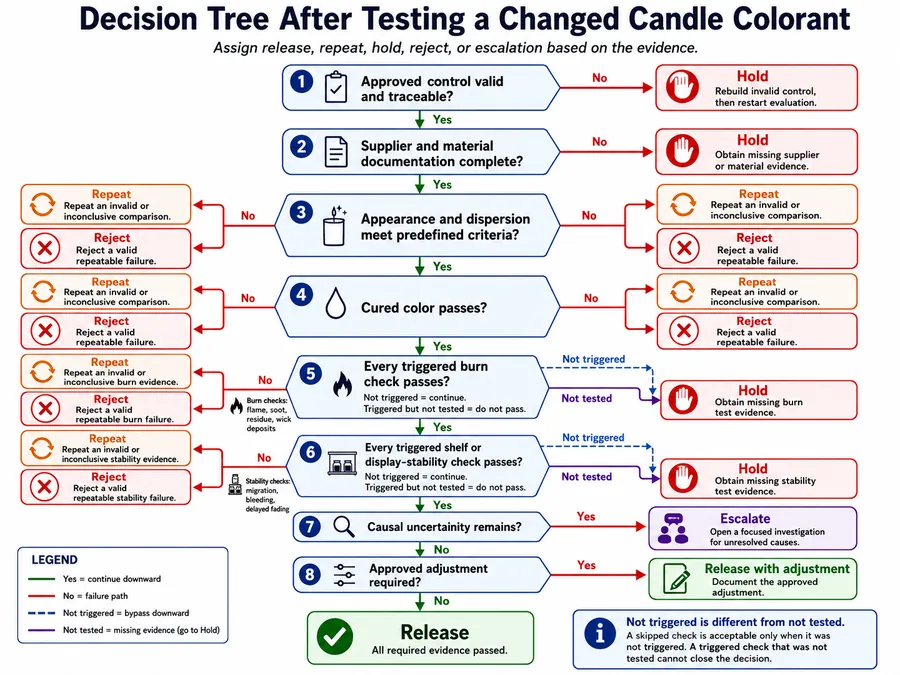
The disposition sequence is:
- Confirm that the approved control is valid.
- Confirm that required documentation is complete.
- Review appearance and dispersion.
- Review the cured-color result.
- Review every burn check triggered by the change.
- Review every shelf or display-stability check triggered by the change.
- Compare the results with predefined company criteria.
- Assign release, adjustment, hold, repeat, rejection, or escalation.
- Record the rationale and the affected production scope.
A failed test should be repeated when the comparison was invalid or when a documented adjustment created a new test condition. A valid, isolated, repeatable failure should not be repeated indefinitely in the hope of obtaining a passing result.
Rejection is supported when the changed colorant repeatedly fails a required criterion under valid, controlled conditions and no approved adjustment resolves the failure. Escalation is more suitable when the failure mechanism remains uncertain, several variables may be involved, or the result belongs to a separate combustion, stability, color-drift, or formula investigation.
Missing acceptance criteria prevent release because “looks close enough” is not a defined pass condition. The company must identify the approved visual, burn, and stability basis before an ambiguous result can support production use.
Compact Colorant Retest Failure Log
This log records the evidence state, deviation, disposition, and follow-up for each changed-colorant comparison.
| Field | What to record |
|---|---|
| Test ID | A unique identifier for the control and changed-colorant comparison |
| Candle system | Wax, fragrance, wick, vessel, colorant dose, process, and cure interval |
| Colorant change | Supplier, manufacturer, lot, formulation, concentration, carrier, or format difference |
| Control validity | Valid, invalid, or limited, with the reason |
| Documentation status | Complete, incomplete, conflicting, or pending |
| Appearance result | Pass, fail, inconclusive, or not run |
| Burn result | Pass, fail, inconclusive, not triggered, or not run |
| Stability result | Pass, fail, in progress, not triggered, or not run |
| Deviation | Any unmatched input, process difference, labeling error, or test departure |
| Disposition | Release, adjust, hold, repeat, reject, or escalate |
| Follow-up | Evidence, adjustment, repeat, or focused investigation required |
| Evidence owner | Person or role responsible for completing and approving the record |
The failure log should separate “not triggered” from “not tested.” “Not triggered” means the change classification did not require that evidence category; “not tested” means a required or potentially relevant check remains incomplete.
Methods note: This decision tree is a modeled business-disposition aid. The acceptance basis must come from the company’s approved color standard, release specification, controlled comparison records, and any burn or stability criteria triggered by the change. No universal visual, combustion, migration, or storage tolerance is assumed.
A defensible release decision requires valid evidence for every property placed at risk by the colorant change.
How Do You Fix a Confounded or Mixed-Result Candle Colorant Retest?
Hold a confounded or mixed-result candle colorant retest until the control is validated, the changed variables are identified, and the colorant is either isolated or supported by repeatable evidence.
A stacked change occurs when two or more material, formula, process, or evaluation variables change during the same comparison. An invalid control is a sample or test condition that cannot supply a defensible reference. A mixed result occurs when one applicable evidence category passes while another fails or remains unresolved.
A mixed result cannot support release when any applicable requirement failed. For example, an appearance pass combined with a burn failure remains a failed approval package, while an appearance failure combined with acceptable burn behavior remains blocked by the appearance criterion.
Identify every changed material, formula, process, and evaluation variable. If the control is damaged, untraceable, unmatched, or differently cured, replace or rebuild it before repeating the affected comparison.
A stacked change should be separated by restoring as many approved variables as possible. Change only the colorant in the next comparison where practical. When this is impossible, record every remaining difference and treat the causal conclusion as limited.
A result should be repeated when the control was invalid, the samples were mislabeled, the cure intervals differed, the dose basis was incorrect, or another documented deviation weakened the comparison. Repetition is not a substitute for a new hypothesis after a valid isolated failure has already occurred more than once.
An unresolved mixed result remains on hold until valid evidence supports release, adjustment, rejection, or a focused investigation.
A changed candle colorant should not enter production solely because its product name or first cured shade resembles the approved material. The retest scope must follow the materiality of the supplier, lot, formulation, concentration, carrier, or format change, and release requires a valid control comparison plus every appearance, burn, and stability check triggered by that change. Unresolved conversion, combustion, storage, color-drift, or tolerance questions should be handled separately rather than expanded inside the release decision.