

Candle-specific dye is the default choice for coloring wicked candle wax; reject ordinary food coloring and unverified soap dye, while cosmetic pigments require product-specific evidence and testing.
A candle colorant is any material added to the wax–wick–fragrance system to change how a wicked candle looks. This comparison distinguishes candle dye, soap dye, ordinary water-based food coloring, and cosmetic pigment by intended medium, wax behavior, particle state, wick impact, and finished-candle performance. Here, “food coloring” means ordinary water-based liquid or gel food coloring; oil-based, powdered, and other specialty food-use colorants require exact product classification and candle-use evidence. In this comparison, “safe” and “candle-suitable” mean technically supported wax incorporation, wick transport, and finished-candle performance in the named system, not edible, cosmetic, soap, toxicological, legal, environmental, universal fire-safety, or every-formula approval.
| Colorant category | Preliminary verdict for bulk coloring wicked candles |
|---|---|
| Candle dye | Default choice when intended for the named candle-wax system |
| Soap dye | Reject unless the manufacturer explicitly supports candle use |
| Ordinary water-based food coloring | Reject for bulk wax coloring |
| Cosmetic pigment | Conditional; requires composition-specific documentation and controlled testing |
Candle Dye vs Soap Dye vs Food Coloring vs Cosmetic Pigment: What Each Is Made For
Because candle dye, soap dye, food coloring, and cosmetic pigment are designed for different media, they are not interchangeable in wicked candle wax.
Candle-specific dye is the default because candle wax is its intended application. Soap dye, ordinary water-based food coloring, and cosmetic pigment each need separate evidence; a label for another use does not prove candle suitability.
| Colorant category | Intended medium or purpose | Typical material behavior | Preliminary verdict for wicked candles |
|---|---|---|---|
| Candle dye | Coloring candle wax | Designed to dissolve or incorporate into a stated wax system | Choose, subject to supplier instructions and finished-formula testing |
| Soap dye | Melt-and-pour, cold-process, or other soap systems | May use carriers or colorants selected for soap rather than wax | Reject by default unless the manufacturer explicitly supports candle use |
| Ordinary food coloring | Water-based food and beverage applications | Commonly separates, beads, or settles in wax | Reject for bulk coloring candle wax |
| Cosmetic pigment | Adding color, opacity, or sparkle to cosmetic products | Usually remains as solid particles rather than dissolving | Qualify carefully for a narrow, documented application |
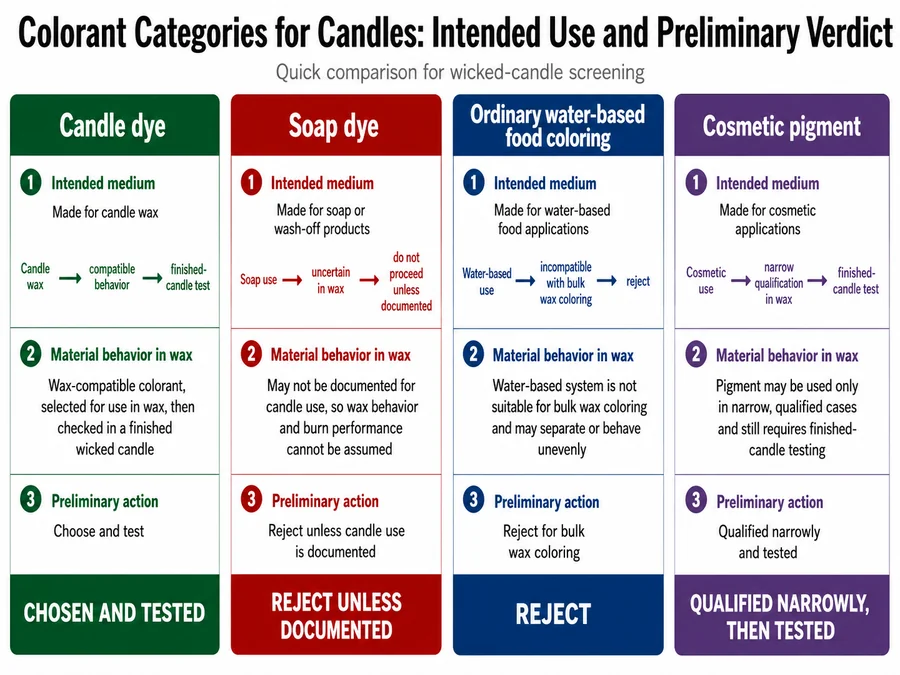
Hydrophobic means candle wax resists mixing with water-based liquids. This explains why ordinary liquid food coloring may look temporarily distributed after stirring but later separate from the wax.
Soap dye should not be treated as candle dye because of its name, appearance, or ability to withstand soap processing. Use it only when the manufacturer identifies candles as an intended application and the complete wax, wick, fragrance, and colorant formula passes controlled testing.
Cosmetic pigments form a broad material category. Mica, iron oxides, titanium dioxide, and other pigment classes can differ in particle density, opacity, coatings, settling behavior, and wick exposure. Results from one product cannot establish a verdict for the entire category.
A candle-use label establishes intended application, not universal suitability. Wax type, fragrance, wick, vessel, colorant concentration, and manufacturing conditions can still change the finished candle’s appearance and burn behavior.
Methods note: This category benchmark compares declared intended use, material form, and candle-use documentation. It reports no private product trial or laboratory measurement. Each verdict remains product- and formula-specific.
For bulk coloring a wicked candle, begin with documented candle dye and treat every substitute as unapproved until its intended use and finished-system behavior are established.
What Is the Difference Between Dissolved Dye and Dispersed Pigment?
Candle dye dissolves or incorporates into a compatible wax system, whereas pigment remains as solid particles dispersed through the wax.
A dissolved colorant becomes part of a continuous colored wax phase. A dispersed pigment remains physically separate, which can affect uniformity, sediment, melt-pool appearance, and wick exposure.
Suspension means solid particles remain temporarily distributed without dissolving. Stirring and heat can delay settling, so hot wax can look uniform even when the colorant later separates or forms sediment.
What Are Straight Dyes, Lakes, and Insoluble Pigments?
Straight dyes, lakes, and insoluble pigments are different colorant subtypes, so a shared color name cannot predict how a product behaves in candle wax.
A straight color has not been fixed onto an insoluble supporting material, whereas a lake combines a color with an insoluble substratum. This classification identifies material form; it does not establish candle suitability.
| Colorant subtype | Behavior in wax | Wicked-candle verdict |
|---|---|---|
| Candle dye documented for wax | Dissolves or incorporates under its stated use conditions | Use within supplier instructions and test the finished formula |
| Straight dye without candle-use support | May dissolve in another solvent without dissolving in wax | Do not approve until candle-wax use is documented |
| Lake | Remains attached to an insoluble supporting material | Treat as particulate material rather than dissolved candle dye |
| Insoluble pigment | Disperses or suspends as solid particles | Qualify narrowly because particles can settle or enter the wick pathway |
Soluble means capable of forming a uniform solution in a named medium. A material described as soluble in water, oil, alcohol, or another carrier is not automatically soluble in candle wax.
Insoluble means the material remains physically separate as particles. Smaller particles may look evenly mixed while the wax is hot, but their size does not convert them into dissolved dye.
Identify the subtype before giving a candle verdict. A shared shade name, cosmetic grade, food-use status, or powder form cannot replace candle-use documentation and finished-formula testing.
Wax-Compatible Candle Dye vs Water-Based or Particulate Colorants
A wax-compatible candle colorant incorporates into a named wax without persistent separation, clumps, or sediment; ordinary water-based food coloring generally does not.
Hydrophobic means candle wax does not readily mix with water. A water-based colorant can bead, separate, or collect below the wax, while particulate material can appear distributed when stirred and later settle during cooling or remelting.
| Candidate colorant | Expected interaction with wax | Preliminary action |
|---|---|---|
| Candle dye documented for the named wax | Incorporates without visible particles under the stated use conditions | Test in the finished formula |
| Ordinary water-based food coloring | Commonly separates from hydrophobic wax | Reject for bulk wax coloring |
| Lake or insoluble pigment | Remains as dispersed particles | Qualify narrowly or reject for bulk use |
| Soap dye without a candle-use statement | Carrier and solubility remain unverified | Reject until candle use is documented |
| Observation | What it can indicate | Verdict at this stage |
|---|---|---|
| Droplets or beads in hot wax | Carrier separation | Stop and reject the trial |
| Specks after mixing | Incomplete incorporation or undissolved material | Investigate before pouring |
| Bottom sediment after curing | Settling particles or separated colorant | Do not approve |
| Sediment after remelting | Unstable particulate dispersion | Do not treat as wax-compatible |
| Uniform hot, cured, and remelted wax | No visible incorporation failure | Continue to controlled burn testing |
Visible specks can indicate incompletely incorporated dye, but the cause remains product- and process-specific. A wax-formulated liquid dye may incorporate without visible particles, while an unsuitable liquid can still separate because of its carrier.
Particulate colorants can produce a different pattern. Mica particles may remain suspended while wax is solid and settle after melting, changing the appearance of the liquid wax. A wickless-use example does not establish approval for bulk coloring a wicked candle.
Compatibility-screening record
Named wax: Record the manufacturer, product name, and batch.
Colorant: Record the product, subtype, carrier, lot, and declared use.
Conditions: Keep wax amount, heating, mixing, cooling, cure, and remelting conditions unchanged.
Controls: Compare an undyed sample with a verified candle-dye sample.
Observations: Record droplets, specks, clumps, sediment, and color uniformity while hot, cured, and remelted.
Limitation: Visible incorporation does not prove acceptable wick transport or combustion performance.
Wax compatibility is a verdict for a named system, not a property inferred from color, grade, powder fineness, or success in soap, food, cosmetics, or wickless wax.
How the Same Dye Looks in Soy, Paraffin, Beeswax, and Wax Blends
Base-wax hue and opacity can change the cured appearance of the same candle dye without proving that the dye is incompatible.
The wax provides the visual background behind the colorant. An opaque, creamy wax can mute or lighten a shade, while a clearer wax can show greater depth. Naturally yellow wax can shift the visible hue. Judge the result in the named wax rather than carrying it over from another formula.
| Wax category | Typical visual effect on the same dye load | Required interpretation |
|---|---|---|
| Soy wax | Often produces softer, lighter, or more pastel cured shades | A muted shade does not by itself show poor incorporation |
| Refined paraffin | Can display deeper or brighter-looking color | Greater color depth does not prove better candle performance |
| Yellow beeswax | Can warm, dull, or shift the target hue | Judge the result against the wax’s natural base color |
| Wax blend | Can differ from either component wax | Test the exact commercial blend rather than predicting by name |
The best dye result for a wax means the target shade was reached in that exact tested formula. It does not mean one wax category always produces stronger color or that an equal dye amount will transfer unchanged between soy, paraffin, beeswax, and blends.
Liquid Candle Dye vs Blocks, Chips, Flakes, and Powders
Liquid dye allows small, adjustable measurements, blocks and chips make solid portioning easier, and powders need careful identity and solubility checks; format alone does not establish candle suitability.
Format affects measurement, portioning, carrier exposure, mixing, and batch repeatability. Candle qualification still depends on intended application, composition, carrier, concentration, wax behavior, and finished-candle testing.
| Format | Main handling implication | What remains unresolved |
|---|---|---|
| Liquid candle dye | Supports small adjustments and custom color ratios | Carrier, concentration, and measurement repeatability |
| Dye block or chip | Supports planned solid portioning | Product concentration and reliable measurement for small batches |
| Dye flake | Provides smaller solid pieces with more exposed surface | Chemical identity and concentration |
| Dye powder | Requires controlled weighing and product identification | Whether the material is wax-soluble candle dye |
| Pigment powder | Disperses as particles rather than becoming dissolved dye | Settling and wick-pathway exposure |
A liquid format may be convenient without being the most repeatable choice for a given production system. A block may suit larger batches but be awkward for very small trials. Chips and flakes can make portioning easier, while powders require added care in classification and measurement.
The right choice is the candle-qualified format that the maker can record and reproduce in the named formula.
How to Diagnose Settling, Clumping, and Sediment in Colored Wax
Sediment or clumps indicate incomplete, incompatible, or unstable incorporation; a fine powder does not prove solubility or wick compatibility.
Sediment is colorant or carrier material that collects at the bottom of cured or remelted wax. Clumping is visible aggregation that remains separate from the surrounding wax. These signs require investigation rather than an automatic diagnosis.
| Observation stage | Failure signal | Preliminary decision |
|---|---|---|
| Hot wax | Powder, streaks, beads, or clumps remain visible | Verify product identity and incorporation instructions before pouring |
| Cured wax | Specks, sediment, cloudy zones, or uneven shade appear | Do not approve the sample |
| Remelted wax | Particles settle or collect below the liquid wax | Treat the material as an unstable particulate colorant |
| Wick zone | Colored deposits or concentrated particles appear near the wick | Compare the colored formula with a matched undyed candle |
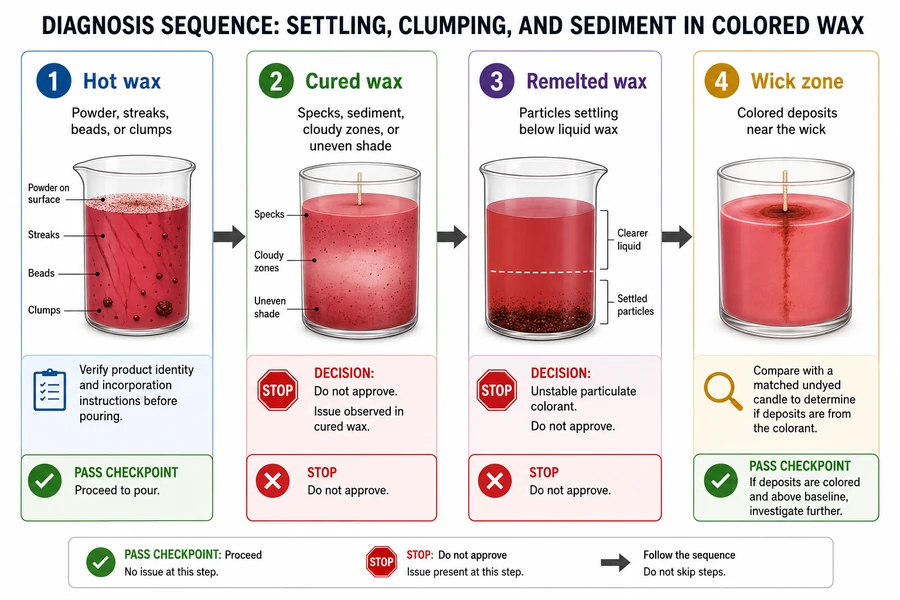
A fine powder can settle more slowly and look smoother than a coarse powder, but smaller particle size does not convert an insoluble pigment into a dissolved dye. Attractive cured wax can hide material that becomes visible only after remelting.
When sediment, clumps, or separation recur under matched conditions, reject the candidate for bulk coloring until its identity and intended candle use support a different verdict.
How Colorant Type Can Affect Wick and Burn Performance
Particulate or excessive colorant may restrict wick fuel flow, but a matched undyed control is needed because other formula variables can cause the same symptoms.
Capillary action is the wick’s movement of liquid wax toward the flame. Too little fuel can make a flame shrink, sputter, or extinguish. Wax, wick, fragrance, colorant, vessel size, and manufacturing conditions can all influence that fuel supply.
| Symptom | Possible colorant mechanism | Competing causes | Comparison needed |
|---|---|---|---|
| Flame becomes smaller | Particles or excessive colorant may reduce fuel movement | Wick choice, fragrance load, wax properties, or vessel geometry | Compare with an otherwise identical undyed candle |
| Flame sputters or self-extinguishes | The wick may receive insufficient liquid fuel | Wick damage, contamination, poor centering, or unsuitable wick size | Compare undyed, lower-colorant, and target-color samples |
| Dark material collects near the wick | Particles may concentrate in the wick zone | Fragrance residue, wick treatment, char, or debris | Record the deposit before assigning a cause |
| Melt-pool development changes | The colored formula may have altered fuel delivery | Wax change, room conditions, vessel differences, or wick mismatch | Hold every non-color variable constant |
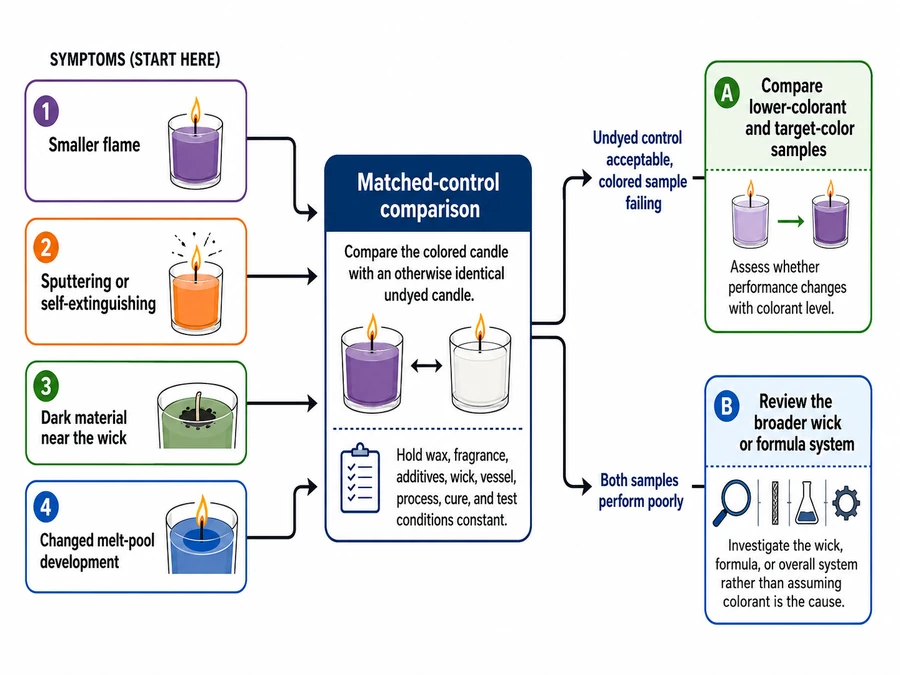
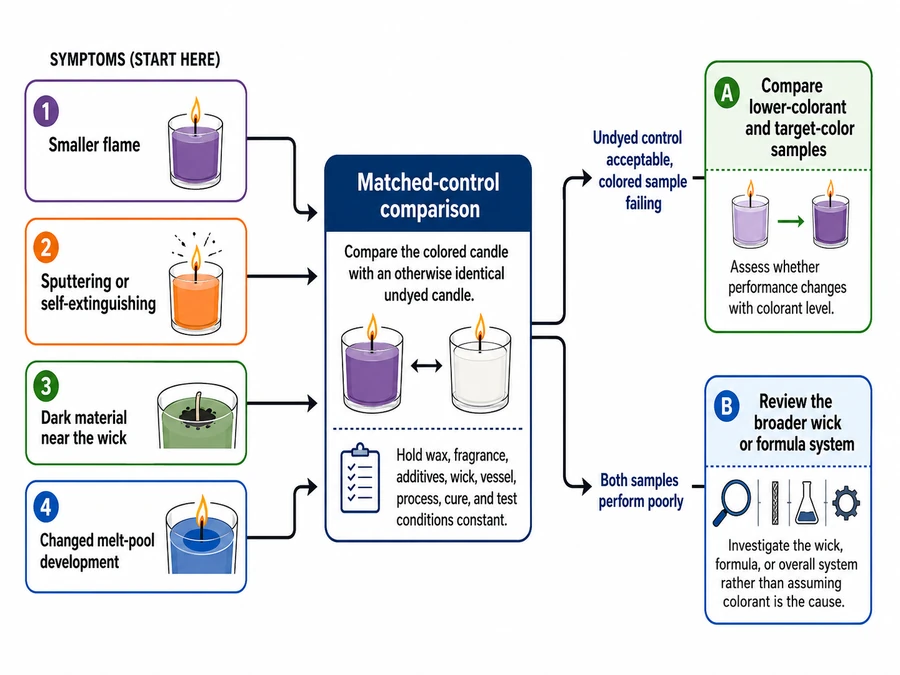
In this comparison, “safe” means acceptable performance in the tested wax–wick–fragrance–colorant system. It does not mean a colorant has universal approval for every candle formula.
A failed colored candle points toward the colorant only when the undyed control performs acceptably under the same conditions and the failure follows the colorant level or particle exposure. When both candles perform poorly, the broader wick or formula system remains unresolved.
Remove or reduce the suspected colorant variable only after matched controls show that the wick problem appears in the colored formula rather than across the entire candle system.
How to Maintain Color and Burn Performance with Fragrance and Other Additives
Maintain color and burn performance by testing the exact colored, fragranced formula against colored-unscented and undyed-fragranced controls.
Finished-system compatibility means the named wax, wick, fragrance, colorant, additives, vessel, and process work acceptably together. A colorant that appears uniform in unscented wax still requires comparison in the complete fragranced formula.
| Matched sample | Variable present | What to compare |
|---|---|---|
| Colored, unscented control | Colorant only | Cured hue, uniformity, sediment, flame behavior, and wick residue |
| Colored, scented sample | Same colorant plus named fragrance | Color shift, sediment, flame behavior, melt-pool development, and wick residue |
| Additive comparison, when used | One recorded additive added to both formulas | Whether the additive changes the result consistently |
| Undyed fragranced reference | Fragrance without dye | Whether discoloration appears without the colorant |
Some fragrance components can shift a finished candle toward yellow, tan, or brown. A color difference in the fragranced sample should not automatically be assigned to the dye.
A successful unscented trial supports only the unscented formula, not every scented version that uses the same colorant.
A colorant remains suitable only when the complete fragranced candle retains the intended appearance without unacceptable separation, residue, wick restriction, or burn changes.
No universal candle-dye amount applies. Begin with the exact supplier guidance for the named product, then use the lowest recorded amount that reaches the cured color target without changing matched-candle wick or burn performance.
Compare the target-color formula with a matched undyed control and a lower-colorant sample while keeping wax, fragrance, additives, wick, vessel, process, cure, and test conditions constant. A repeated difference supports only a formula-specific verdict; a complete burn-testing procedure is outside this comparison’s scope.
Transparent Candle Dye vs Opaque or Sparkling Pigment in Solid Wax and the Melt Pool
Dye creates dissolved color, whereas pigment creates particulate opacity or sparkle that may change after the wax melts.
A candle dye generally produces a translucent tint throughout compatible wax. A pigment remains as microscopic particles, which can make solid wax look opaque, pearlescent, or sparkling while producing a different result in the liquid melt pool.
| Paired view | Dissolved candle dye | Particulate pigment |
|---|---|---|
| Fully cured solid wax | Usually shows a uniform tint influenced by the wax’s natural hue and opacity | May show opacity, shimmer, sparkle, or a paint-like visual effect |
| Same wax after remelting | Color should remain visually distributed when the product is compatible and properly incorporated | Particles may move, settle, or leave the upper melted wax less colored |
| Bottom of remelted sample | No visible particle layer is expected from fully dissolved dye | Sediment or concentrated sparkle may become visible |
| Wick zone | Color remains part of the liquid fuel mixture | Suspended particles may enter or collect near the fuel pathway |
| Suitability verdict | Appearance supports continued formula testing | Appearance alone cannot approve bulk use in a wicked candle |
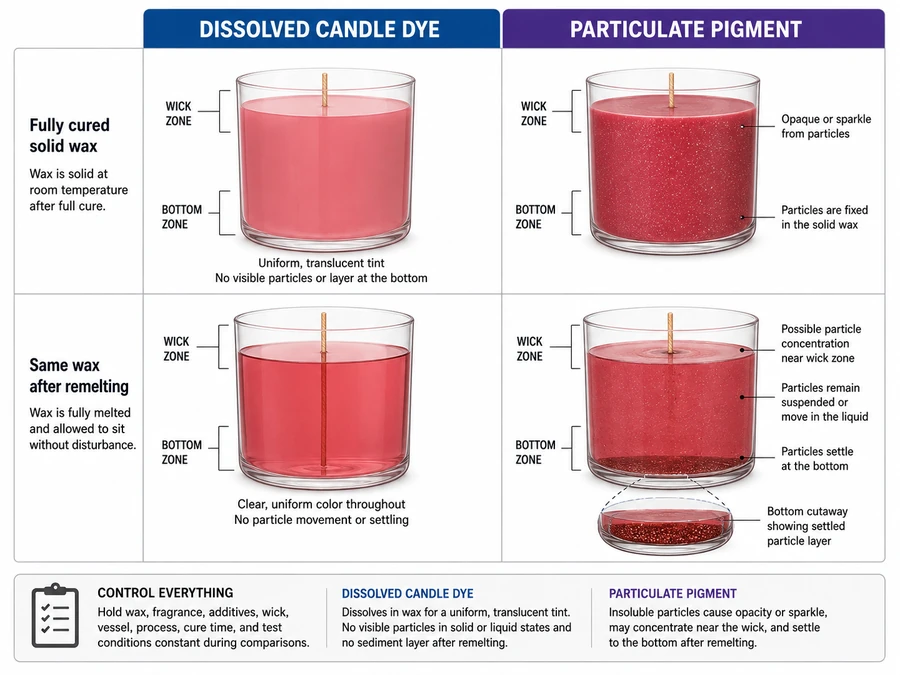
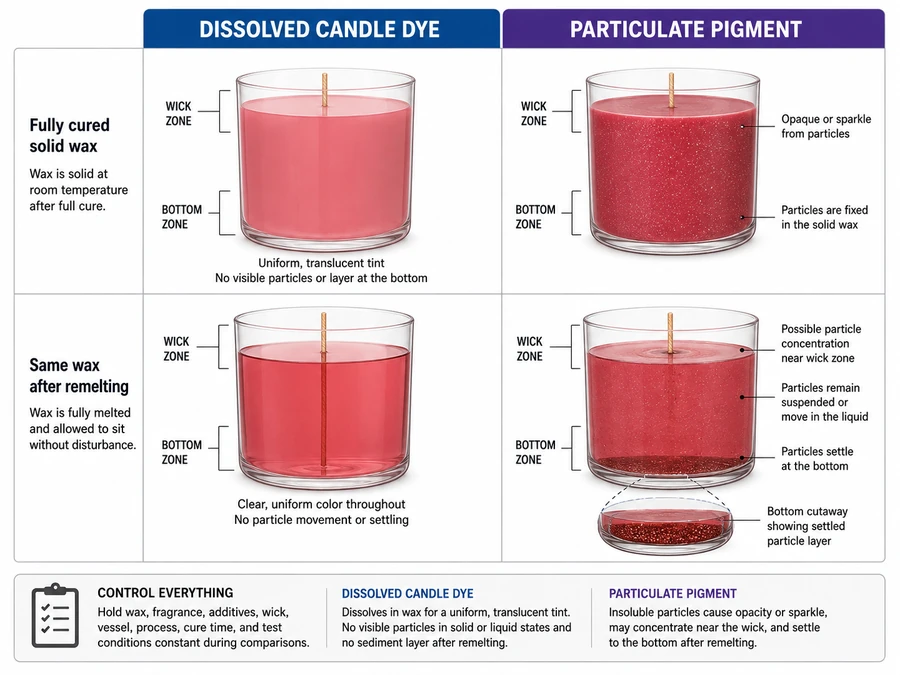
Dyes used throughout candle wax create a translucent tint, while suspended pigments can produce a more opaque wall of color. Particulate material can place a greater burden on a burning wick when mixed throughout the candle’s fuel mass.
A sparkling solid candle can give a false impression of stable incorporation. The solid wax structure may hold particles in place, while melting lets gravity and fluid movement reveal settling that was not visible after cure.
Mica-colored wax melts can remain sparkling while solid and then develop sediment after melting. This wickless example demonstrates the visual mechanism but does not establish suitability for a wicked candle.
Paired-observation method: Photograph the same dye and pigment samples after a recorded cure period and again after controlled remelting. Keep the wax, colorant amount, vessel, camera position, lighting, background, and viewing angle unchanged. Record top-surface appearance and bottom sediment separately.
Transparent means light can pass through the colored wax sufficiently to preserve visual depth. Opaque means the material blocks more light, while sparkle results from particles reflecting light rather than from stronger dissolved color.
Neither opacity nor sparkle proves better color strength. A pigment can look vivid in solid wax yet settle in the melt pool, while a less opaque dye can remain distributed and impose less particulate burden on the wick.
For bulk coloring a wicked candle, choose documented candle dye for uniform tint and treat an opaque or sparkling pigment effect as conditional until melt-pool behavior and comparative burn testing both support it.
Judge candle color strength after cure under controlled conditions; strength means a repeatable tinting effect, not the darkest possible wax. Choose the lowest recorded level that repeatedly reaches the cured target and still behaves like the matched burn control.
Test heat, light, fragrance, bleeding, and migration separately against matched references. A stable candle color passes only the named stressor and observation period; passing one test does not prove stability under another condition.
Surface decoration and bulk incorporation expose colorant differently to the melt pool, wick pathway, and candle fuel mass. A narrow exterior application does not prove that the same material belongs throughout a wicked candle.
How to Choose the Right Candle Colorant: Final Selection Matrix
Use candle-specific dye for bulk coloring a wicked candle; reject ordinary food coloring and unverified soap dye; qualify cosmetic pigments narrowly.
Here, “right” and “best” mean the colorant category that fits the intended visual effect, has documented candle-use support, and performs acceptably in the named wax–wick–fragrance system. They do not mean the cheapest, darkest, most natural, edible, cosmetic-grade, or universally safest option.
| Candidate | Intended medium | Wax behavior to expect | Wick concern | Evidence needed | Final action |
|---|---|---|---|---|---|
| Candle-specific dye | Candle wax | Should incorporate according to its stated wax application | Usually lower particulate concern than pigment | Supplier candle-use statement plus finished-formula testing | Choose and test |
| Soap dye without candle-use support | Soap systems | Carrier and wax behavior remain unverified | Unknown until product and formula are tested | Explicit manufacturer support for candle use | Reject by default |
| Ordinary water-based food coloring | Food and beverages | Likely to bead, separate, or settle in hydrophobic wax | Separated material may create an unstable formula | Candle-specific evidence would be required | Reject for bulk wax coloring |
| Cosmetic pigment or mica | Cosmetic color effects | Remains particulate and may settle after melting | Particles may enter or obstruct the wick pathway | Composition-specific candle documentation and controlled testing | Qualify narrowly or reject |
| Product with vague “multi-use” wording | Unclear | Cannot be predicted from marketing language | Unresolved | Manufacturer application statement, technical data, and full product identity | Do not approve yet |
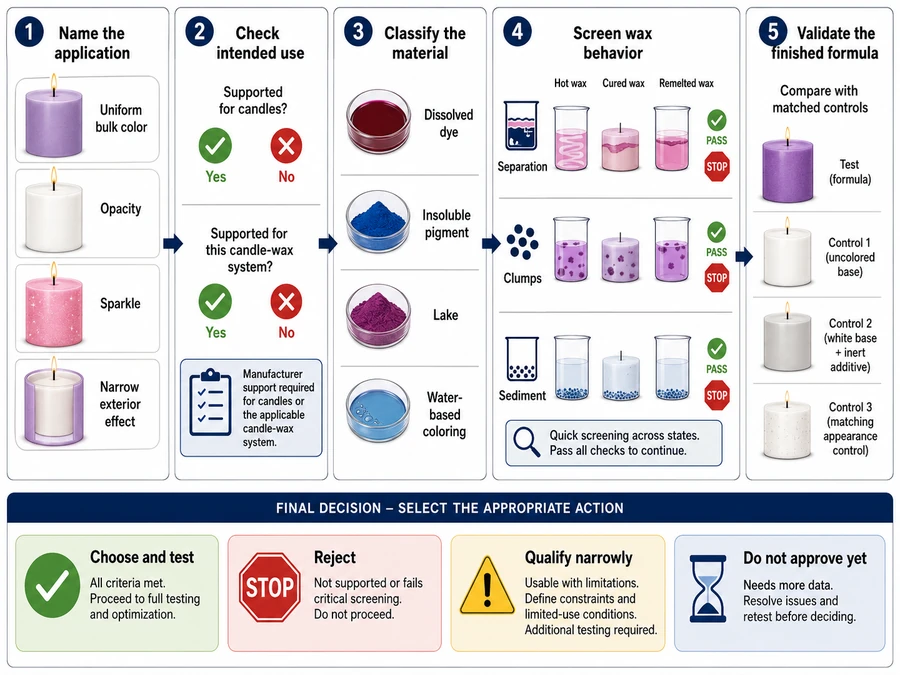
This matrix combines intended use, wax behavior, particle state, wick exposure, and evidence quality. It gives an explicit choose, reject, qualify, or test result instead of making the candle maker infer a verdict.
- Name the application. Decide whether the goal is uniform bulk color, opacity, sparkle, or a narrow exterior effect.
- Check intended use. Confirm that the manufacturer names candles or the applicable candle-wax system.
- Classify the material. Determine whether it is dissolved dye, an insoluble pigment, a lake, or a water-based coloring.
- Screen wax behavior. Inspect hot, cured, and remelted samples for separation, clumps, or sediment.
- Validate the finished formula. Compare the colored candle with matched controls before issuing a product-specific verdict.
Decision-matrix method: The verdicts combine declared application, expected wax behavior, particle state, wick exposure, and evidence level. A product-specific exception requires manufacturer candle-use support and matched finished-formula observations. No category verdict certifies every candle, wax, wick, fragrance, or colorant amount.
A manufacturer application statement, technical sheet, and Safety Data Sheet (SDS) provide different evidence; none alone proves finished-candle performance. Wickless success does not transfer to wicked candles, grade labels do not establish candle suitability, and one pigment product cannot represent every mica, iron oxide, titanium dioxide, or composite pigment.
Choose documented candle dye as the starting category for bulk coloring, then approve the individual product only after the named finished formula performs acceptably.