
Batch-to-batch candle color drift is an unintended appearance difference that remains visible between comparably cured batches made to the same approved formula and judged against the same approved appearance standard.
This guide helps candle makers decide whether a mismatch is real, correctable, releasable, or grounds for a batch hold. Finished color depends on wax, dye, fragrance, additives, heat, mixing, cooling, curing, and inspection conditions. Color drift does not include intentional shade changes, mottling within one batch, long-term fading, hot-versus-cold differences, or lighting and photography artifacts. Confirm the difference, isolate the changed variable, apply one matched control, verify repeatability, then choose color-only verification or broader retesting and disposition.
What Counts as Batch-to-Batch Candle Color Drift?
Batch-to-batch candle color drift is confirmed when comparably cured candles still differ under matched viewing conditions and against the same approved appearance standard.
The difference is genuine only after viewing conditions are matched and the shade still differs from the approved standard. It does not include intentional shade changes, within-batch mottling, long-term fading, hot-versus-cold wax differences, or differences created by photography and room lighting.
A retained reference is an approved cured candle kept as the appearance standard for later production batches.
The appearance standard may be a retained approved candle or a documented visual or instrumental specification. If neither exists, record the result as unresolved rather than approving or rejecting the batch from memory.
Treat the difference as suspected drift until a controlled comparison confirms it.
How to Compare Two Candle Batches Under Controlled Conditions
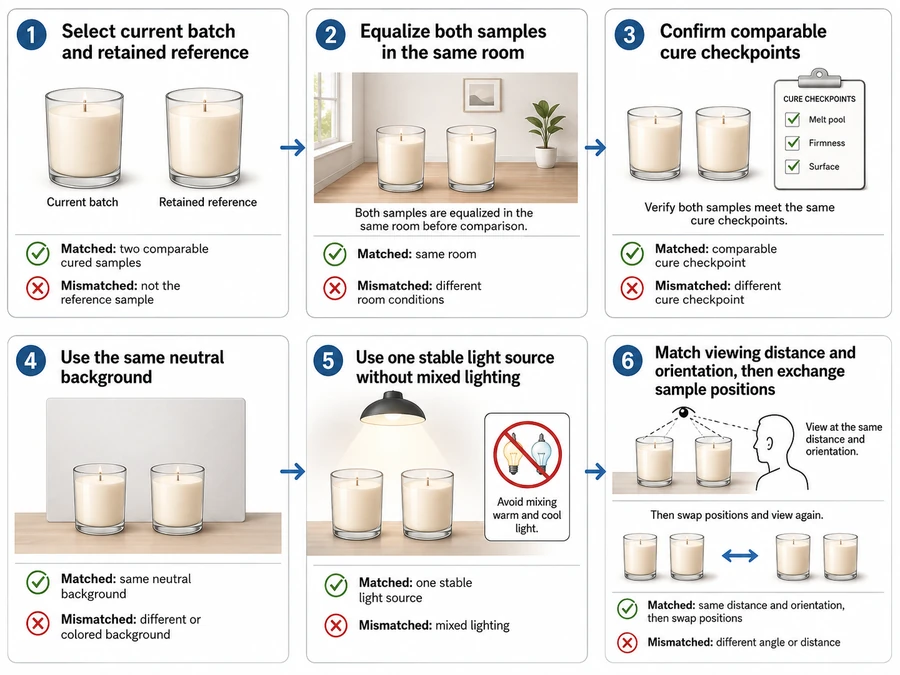
Confirm candle color drift only after cure state, sample temperature, lighting, background, position, orientation, and viewing distance are reasonably equivalent.
Cure state means the comparable post-pour condition at which both samples are stable enough for a fair visual check.
- Select a representative candle from the current batch and the retained reference.
- Bring both samples to the same room and allow their temperatures to equalize.
- Confirm that both candles are being checked at comparable cure checkpoints.
- Place both samples against the same neutral background.
- View them under one stable light source without mixed daylight and artificial light.
- Keep the viewing distance and orientation equal, then exchange the samples’ positions and compare them again.
| Comparison point | Matched setup | Mismatched setup |
|---|---|---|
| Cure condition | Both samples have comparable cure states | One sample is checked earlier |
| Sample temperature | Both samples are at a similar temperature | One sample is warmer or colder |
| Lighting | One stable light source illuminates both samples | Mixed or changing light affects one sample |
| Background | Both samples use the same neutral background | Different surfaces change perceived shade |
| Position and orientation | Samples are aligned and positions are exchanged | One sample remains closer to the light |
| Viewing distance | Both samples are viewed from the same distance | Distance or angle changes between checks |
| Decision | A remaining difference supports a drift finding | A disappearing difference indicates an inspection artifact |
The table separates a true repeat-batch mismatch from a difference created by the inspection setup.
Methods note: This comparison uses two nominally identical batches and holds cure state, sample temperature, lighting, background, position, orientation, and viewing distance constant. The approved product standard, not this protocol, sets the pass-or-fail tolerance.
If the mismatch disappears after the conditions are matched, record an inspection artifact rather than production color drift.
Why Does the Same Candle Formula Produce a Different Color?
The same candle formula can produce another shade when material lots, measured quantities, heat history, mixing, pouring, cooling, curing, or viewing conditions differ.
A nominally identical formula uses the same named ingredients and target quantities, but those labels do not prove that every production variable remained equal. Two batches can share one recipe while differing in raw-material composition, measurement accuracy, dye dispersion, thermal exposure, cooling rate, or inspection conditions.
Start with the variables that can be verified from records. Do not change the dye dose merely because the finished shade looks wrong; an unsupported adjustment can hide the original cause and create a second mismatch.
| Cause category | Evidence to compare | Finding that supports the cause | Matched control |
|---|---|---|---|
| Wax lot | Supplier, product code, lot, receipt record, and appearance | The suspect batch used another wax lot or undocumented wax source | Run a small comparison with the approved wax-and-dye combination |
| Dye lot or format | Dye product, color code, format, lot, and storage condition | The lot, format, or product identity changed | Compare one controlled sample using the retained dye lot or approved replacement |
| Fragrance lot | Fragrance identity, lot, amount, and raw color | Fragrance lot or measured amount differs between batches | Hold wax, dye, process, and cure checkpoint constant while comparing fragrance lots |
| Additives | Additive identity, lot, and measured amount | An additive was added, removed, substituted, or recorded differently | Restore the approved additive set before changing colorant |
| Recorded quantities | Actual wax, dye, fragrance, and additive masses | Target values match, but recorded production values or units do not | Repeat the measurement with the approved units and suitable scale resolution |
| Heat and mixing | Addition sequence, recorded temperatures, mixing time, and visible dispersion | Dye was added or mixed under different recorded conditions | Repeat the approved sequence without altering another variable |
| Pouring and cooling | Pour sequence, container conditions, room conditions, and cooling pattern | The suspect batch cooled or was handled differently | Compare test samples under matched pouring and cooling conditions |
| Cure checkpoint | Pour date, inspection date, and sample temperature | The batches were judged at different stages or temperatures | Recheck both samples at a comparable cure state and temperature |
| Viewing setup | Light source, background, orientation, position, and distance | The apparent difference changes when the samples exchange positions | Repeat the controlled visual comparison before classifying production drift |
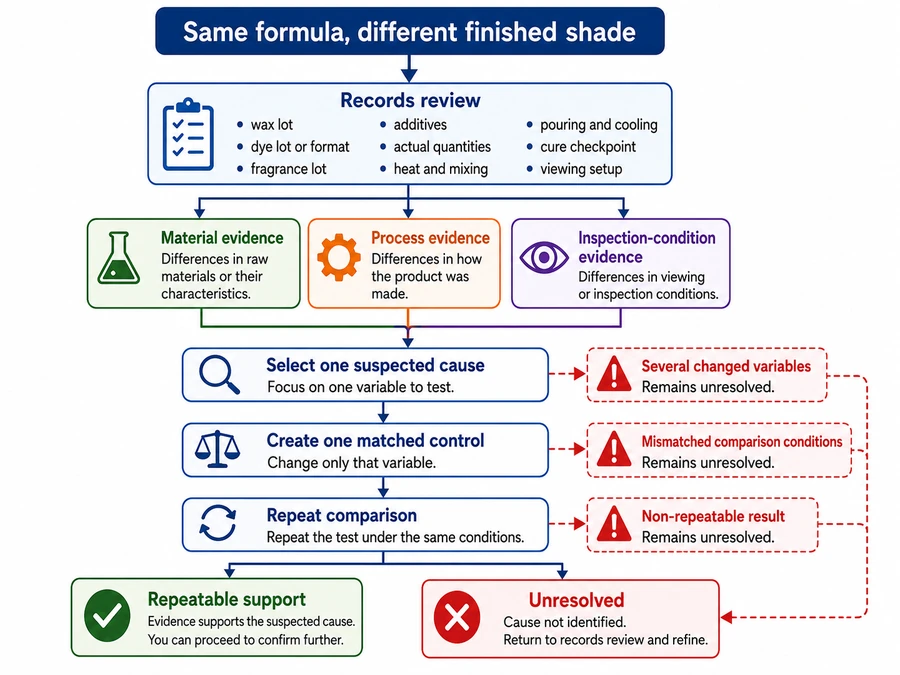
This matrix separates material evidence from process evidence. A changed lot points toward material variation, while identical lots combined with different heat, mixing, pouring, cooling, or cure records point toward process variation. When neither category explains the mismatch, keep the batch unresolved rather than assuming dye quantity is the cause.
Methods note: Production records and a controlled comparison identify possible causes, but only an isolated test can support one variable as the cause. Material behavior must be checked against product-specific technical documentation.
What Records Reveal What Changed Between Candle Batches?
A color-drift investigation needs the formula version, material lots, recorded quantities, process conditions, cure checkpoint, retained reference, retest result, and final disposition.
A batch record is the production evidence tied to one identified candle batch. Its purpose here is limited to finding which material, process, or observation variable differed; it is not a full inventory or manufacturing-management system.
| Minimum record | What to capture | Diagnostic value |
|---|---|---|
| Batch identity | Batch code and production date | Keeps samples, records, and decisions tied to the correct production run |
| Formula version | Approved formula identifier or revision | Shows whether both batches were intended to follow the same formula |
| Wax record | Product identity, supplier, and lot | Reveals a wax substitution or lot change |
| Dye record | Product identity, color code, format, supplier, and lot | Reveals a dye-lot, product, or format change |
| Fragrance record | Product identity, supplier, lot, and recorded amount | Reveals a fragrance change that may alter the finished appearance |
| Additive record | Identity, lot, and recorded amount | Reveals an added, removed, or substituted material |
| Actual quantities | Recorded masses and units for each formula component | Separates the approved target from what was actually measured |
| Process conditions | Addition order, recorded temperatures, mixing, pouring, and cooling notes | Separates material variation from production variation |
| Cure checkpoint | Time since pouring and sample temperature at inspection | Prevents early-versus-late or warm-versus-cold comparisons |
| Reference used | Retained sample identity and its approval status | Identifies the appearance standard used for the decision |
| Controlled comparison result | Difference present, absent, or unresolved after matched viewing | Distinguishes production drift from an inspection artifact |
| Retest result | Variable changed, variables held constant, and observed result | Shows whether the suspected cause was supported |
| Disposition | Hold, release, adjust, reject, or escalate, with reason | Records the decision without implying a universal threshold |
Missing evidence changes the decision. When lot identities or actual quantities are unknown, material variation cannot be separated reliably from process variation. When cure and viewing records are absent, the visible difference may still be an inspection artifact. In either case, the cause remains unresolved.
Methods note: This record set is limited to color-drift diagnosis and disposition. It does not provide numerical tolerances, inventory controls, or a complete production-record design.
Why Can the Same Dye Amount Produce a Different Shade?
The same dye amount can produce another candle shade because dye quantity is only one part of the finished color-forming system.
Wax composition, dye lot or format, fragrance, additives, heat exposure, dispersion, cooling, curing, and observation conditions can change how the color appears. An unchanged dye mass proves only that the recorded quantity stayed equal; it does not prove that the materials, process, or finished appearance remained equal.
Controlled substitution benchmark
| Test pair | Change only | Hold constant | Result that supports the suspected cause |
|---|---|---|---|
| Wax check | Wax lot | Dye, fragrance, additives, process sequence, cure checkpoint, and viewing setup | The color difference appears with one wax lot and disappears with the other |
| Dye check | Dye lot or format | Wax, fragrance, additives, measured dye amount, process sequence, cure checkpoint, and viewing setup | The shade follows the dye lot or format |
| Fragrance check | Fragrance lot | Wax, dye, additives, recorded fragrance amount, process sequence, cure checkpoint, and viewing setup | The shade follows the fragrance lot |
| Process check | One recorded process condition | All materials, quantities, cure checkpoint, and viewing setup | The color difference appears only when that process condition changes |
A result is unresolved when several variables change together, the test outcome cannot be repeated, or the comparison conditions differ. In that case, changing the dye amount would add another variable without identifying the original cause.
Methods note: Each paired test changes one material or process variable while holding the remaining formula, cure, and viewing conditions constant. The result may support a suspected cause but cannot prove that all products will behave the same way.
Treat unchanged dye quantity as one recorded fact, not proof that the two candle batches were equivalent.
How to Correct Candle Color Drift Without Creating Another Variable
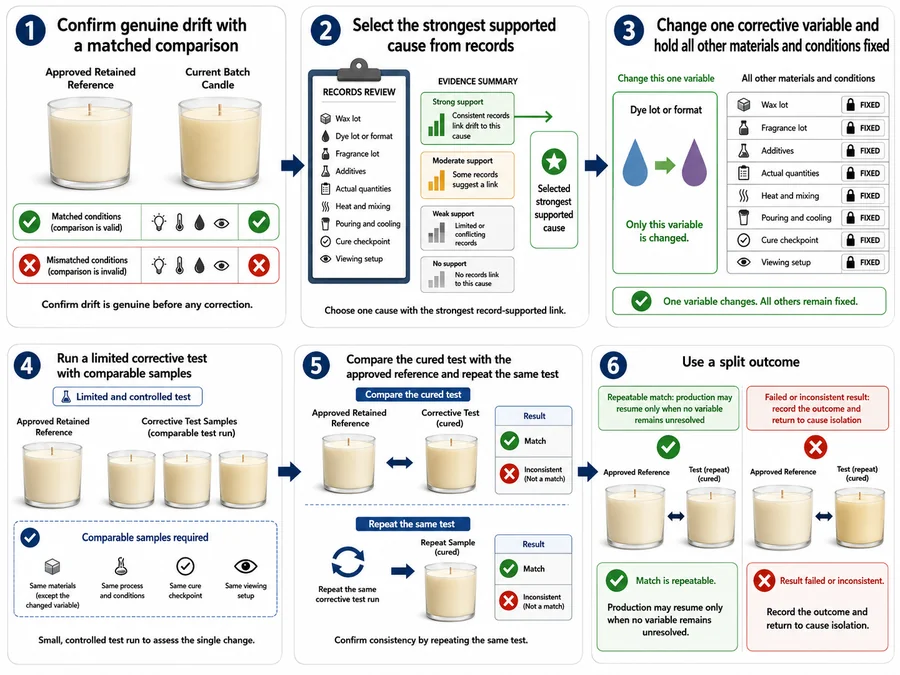
Correct candle color drift by changing only the evidence-supported variable while keeping the remaining materials, process conditions, cure checkpoint, and viewing setup constant.
Compare the finished corrective test with the approved reference, then repeat the test before production resumes. An adjustment that matches once but cannot be repeated has not established process control.
- Confirm that the difference is genuine. Repeat the matched comparison before changing materials or process settings.
- Select the strongest supported cause. Use lot records, actual quantities, heat history, mixing, pouring, cooling, curing, and observation notes.
- Choose one corrective variable. Replace, restore, or amend only the material or process condition supported by the evidence.
- List the variables that must remain fixed. Keep the other materials, quantities, process sequence, cure checkpoint, and viewing conditions unchanged.
- Run a limited corrective test. Produce enough comparable samples to judge the selected correction without committing the full production batch.
- Compare and repeat. Check the cured test against the approved reference, then repeat the same test to confirm that the result can be reproduced.
- Record failure instead of stacking corrections. When the result remains wrong or changes between repeats, log the outcome and return to cause isolation.
| Evidence-supported finding | Single correction to test | Variables held constant | Verification result | Failure-log entry |
|---|---|---|---|---|
| Wax lot is the only recorded material change | Test the approved or previously matched wax lot | Dye, fragrance, additives, quantities, process, cure checkpoint, and viewing setup | Repeated samples match the approved reference | Record whether the mismatch remained, changed direction, or varied between samples |
| Dye lot or format changed | Test the approved dye identity, lot, or format | Wax, measured dye amount, fragrance, additives, process, cure checkpoint, and viewing setup | The same correction produces a repeatable match | Record dispersion issues, unequal samples, or a non-repeatable match |
| Recorded quantity differs from the approved formula | Restore the documented quantity using the approved unit and measurement method | Material lots, process sequence, cure checkpoint, and viewing setup | Repeated samples return to the approved appearance | Record the actual quantity, corrected quantity, and observed result |
| Heat or mixing record differs | Restore the documented addition and mixing sequence | Material lots, quantities, pouring, cooling, cure checkpoint, and viewing setup | Repeated samples show the intended shade and even dispersion | Record any remaining shade difference or visible dispersion variation |
| Cooling or cure comparison differs | Match the approved cooling setup or comparison checkpoint | Formula, material lots, quantities, earlier process stages, and viewing setup | The apparent difference disappears under matched conditions | Record the earlier comparison as an observation-condition failure |
| No single cause is supported | Do not make a color adjustment | Preserve the suspect batch and all available records | No release decision is made from guesswork | Record unresolved variables and the next isolated test |
The correction fails verification when it does not remove the difference, creates a different mismatch, or produces inconsistent repeat samples. Do not compensate for that failure by changing dye, heat, mixing, and cooling together because the combined change prevents cause attribution.
Methods note: This correction method tests one variable against an approved retained reference and assumes the remaining variables can be held reasonably equal. It does not create a universal salvage or release threshold.
Resume production only after the selected correction produces a repeatable match without leaving another material or process variable unresolved.
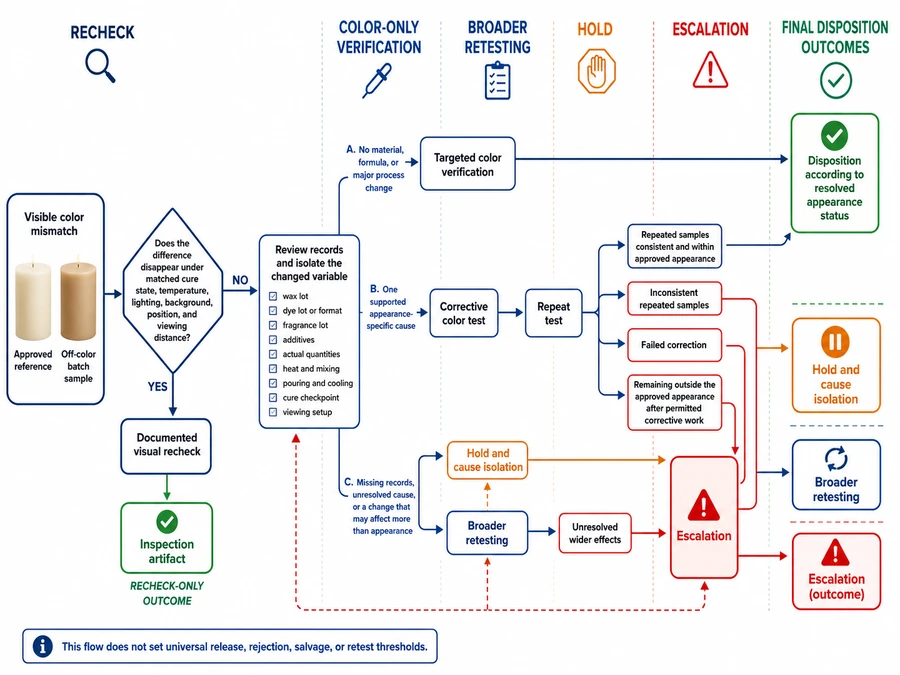
When Should an Off-Color Batch Be Rechecked, Retested, Held, or Escalated?
Use the narrowest check that resolves uncertainty, and hold an off-color batch whenever the cause is unknown or the change may affect more than appearance.
A batch hold prevents release, adjustment, or further production use until the remaining uncertainty has a documented resolution. Observation is enough when the apparent mismatch disappears under matched comparison conditions. A difference that remains under matched conditions requires targeted color verification, cause isolation, or broader testing according to what changed.
| Investigation finding | Verification depth | Batch status during verification | Disposition condition | Escalation trigger |
|---|---|---|---|---|
| The difference disappears after cure state, temperature, lighting, background, position, and viewing distance are matched | Documented visual recheck | Follow the normal batch status unless another issue remains | Release may proceed when the batch meets its other approved requirements | Escalate only if the mismatch returns under controlled conditions |
| The difference remains under matched conditions, but records show no material, formula, or major process change | Targeted color verification against the approved reference | Hold until the comparison is complete | Release when the cured result matches the approved appearance and the finding is repeatable | Escalate when repeated samples disagree |
| One appearance-specific variable has a supported cause and an approved correction | Corrective color test followed by a repeat test | Hold the affected batch | Adjust or release only after the correction produces a repeatable approved appearance | Escalate when the correction fails, changes direction, or creates uneven results |
| Material lots, actual quantities, or process records are missing | Cause isolation before retesting | Hold | Do not release based on appearance alone while the cause remains unknown | Escalate when records cannot separate material variation from process variation |
| Wax, fragrance, additive, dye format, or another formula component changed in a way that may affect product behavior | Broader candle retesting selected for the affected characteristics | Hold | Release follows the approved change-control and testing decision | Escalate beyond color verification because appearance is not the only possible effect |
| A process deviation may have affected more than color | Targeted investigation followed by the applicable broader checks | Hold | Release only after the affected characteristics have been evaluated | Escalate when heat history, mixing, pouring, or cooling may have altered performance |
| Corrective test batches remain inconsistent | Repeat cause isolation rather than another stacked correction | Hold | No release or formula adjustment until one cause and one repeatable control are established | Escalate when no single-variable test resolves the mismatch |
| The batch remains outside the approved appearance after permitted corrective work | Final disposition review | Hold | Reject, reclassify, or otherwise handle the batch under the business’s approved procedure | Escalate when disposition requires decisions outside appearance verification |
This decision matrix does not create a universal release, rejection, salvage, or retest threshold. The approved product standard, documented formula, retained reference, identified change, and unresolved risk determine the disposition.
Methods note: Use the least extensive check that resolves the remaining uncertainty. Product-specific procedures govern any wider testing beyond color verification.
Keep the batch on hold when the evidence does not support a cause, the correction cannot be repeated, or the changed variable may influence characteristics beyond color.
Color-Only Verification vs Broader Candle Retesting
Color-only verification checks approved appearance; broader candle retesting evaluates other characteristics when the identified change may affect more than color.
Color-only verification compares a cured test sample with the approved appearance reference under matched observation conditions. It answers whether the batch color is acceptable and repeatable. It does not validate burn behavior, wick performance, fragrance behavior, safety, or stability.
Broader candle retesting examines the other characteristics that a material, formula, or process change could have altered. It is warranted when the investigation identifies more than an appearance-specific correction or cannot rule out a wider effect.
Broader testing should be considered when:
- the wax, fragrance, additive, dye format, or formula composition changed;
- a process deviation may have altered structure, combustion, or fragrance behavior;
- the corrective test changes a variable linked to characteristics beyond appearance;
- the cause remains unresolved after controlled color testing.
A visible mismatch alone does not automatically require complete candle retesting, and an acceptable color match does not prove that unrelated characteristics remained unchanged.
Methods note: Test depth follows the scope of the identified change. The affected product characteristic and approved procedure determine any wider checks; this section does not prescribe complete testing protocols.
A release decision is supportable only when the chosen verification matches the identified change and no relevant variable remains unresolved.