
Candle additives usually add an additive-only material cost measured in cents per candle and, in modeled 1,000 g batches, from a few cents to low dollars depending more on additive type and use rate than package price.
Candle additives are secondary formula modifiers added to wax to change performance, appearance, stability, or handling, rather than the wax, fragrance oil, dye, container, or full pricing model. Here, cost and benefit mean the extra material spend at realistic use rates compared with the candle result gained, not labor, packaging, shipping, overhead, or retail margin. For most beginner, hobby, and small-business formulas, the real question is whether a specific additive earns its place by fixing a real problem or improving a result that matters. That keeps the page focused on additive selection by type instead of drifting into full candle pricing, process steps, or safety rules. For the main guide, see candle making.
Within candle additives and enhancers, this page stays limited to additive-only material cost by type. For a broader additive-type list, use what are common additives used in candle making. Exact use rates, mixing steps, safety questions, narrow pair comparisons, and full candle COGS belong on their own pages.
The fastest cost check is to compare additive job, modeled rate band, and how quickly that rate changes batch spend.
| Additive type | Modeled rate band | Additive-only cost effect | When the spend usually makes sense |
| UV or stability modifier | 0.1% to 0.5% | Usually small per batch because the rate stays low | When shelf display, light exposure, or color hold matters |
| Scent-support modifier | 0.5% to 2% | Rises steadily as dose rises | When scent behavior is the actual bottleneck in the formula |
| Hardness or opacity modifier | 1% to 6% | Changes batch spend faster because the rate is higher | When firmness, finish, release, or opacity is part of the product goal |
| Specialty modifier | Formula-dependent | Varies with the problem and the rate needed to correct it | When one repeat issue keeps appearing in the same formula |
Calculate Candle Additive Cost Per Candle and Per Batch
Enter wax weight, additive usage rate, package price, batch size, selling price, and defect reduction. The calculator estimates additive cost, batch cost, cost per 1% usage, and whether the additive is financially worth testing.
Additive Cost Per Candle
Use this when you know the additive package price and the usage rate. It shows the real cost per candle and how many candles the package can support.
Cost Per Candle Result
Compare Two Additives
Use this when choosing between two additives or two suppliers. The calculator compares cost per gram, cost per candle, and cost per 100 candles.
Comparison Result
Additive Batch Budget
Use this to estimate the additive budget for a planned production run, including test candles and failed candles.
Batch Budget Result
Is the Additive Worth It?
Use this to test whether an additive creates enough value. Value can come from fewer failures, a higher selling price, better repeat purchases, or lower defect waste.
Worth It Result
What Candle Additives Actually Do by Type
Candle additives are secondary formula modifiers that change performance, appearance, stability, or handling, so they make more sense by function before they make sense by price.
Within candle additives and enhancers, the useful first split is by job, not by supplier catalog. Candle additives are not the wax, fragrance oil, dye, jar, or the finished candle price; they are added in smaller amounts to change how the candle behaves. Here, “type” means functional class, not brand lineup, so candle additives for beginners should start with what problem the additive is meant to solve. A no-additive formula can still be the better choice when the base wax already gives the result you want.
| Additive type | Main job | Common example | What it may change | When makers usually consider it | Value question |
| Hardness modifier | Makes the wax feel firmer | Stearic acid | Body, release, surface feel | Pillar candles, firmer tops, cleaner mold release | Is firmness the real issue, or is the wax choice the issue? |
| Opacity modifier | Makes the candle look less translucent | Stearic acid or similar additives | Visual density, finish, color appearance | Candles that look too see-through or uneven | Does the visual gain matter enough to pay for it? |
| Scent-support modifier | Helps fragrance behave more predictably in some formulas | Vybar | Scent hold or consistency in certain systems | When scent performance feels weak or uneven | Is the additive helping, or is the wax/fragrance match the limit? |
| UV or stability modifier | Slows light-related fading or discoloration | UV inhibitor | Color hold, shelf appearance | Candles that sit in light or on display | Will the candle be exposed to enough light for this to matter? |
| Specialty modifier | Targets a narrow formula issue | System-specific additive | One repeat problem in one formula | Repeated testing problems with a clear pattern | Is the problem common enough to justify buying another ingredient? |
The table matters because “benefit” gets vague fast when it is not tied to a named candle result. A hardness modifier is trying to change firmness or finish. A UV additive is trying to protect appearance over time. A scent-support additive is trying to improve a scent-related result in a formula that can respond to it. Once the job is clear, the cost question becomes easier.
A second useful split is optional versus function-led use. Some additives are bought because a maker wants a more polished look. Others are bought because a formula keeps missing a target. That difference shapes the value decision. Paying for a small visual improvement is a different decision from paying to stop a repeat problem.
| Decision frame | What it sounds like | Usually easier to skip | Usually easier to justify |
| Appearance-led | “I want this candle to look more solid or polished.” | Small hobby batches, casual gifts, test pours | Retail-facing candles where look matters to the product |
| Performance-led | “I need the formula to behave differently.” | Early testing when several variables are still changing | Repeat batches where one clear weakness keeps showing up |
| Stability-led | “I need the candle to hold up better over time.” | Candles used quickly or stored away from light | Candles on shelves, in markets, or in brighter display settings |
That is why stearic acid vs vybar is not the first question to ask. They are not interchangeable just because both sit in the additive category. The better first question is what result you want to change, and whether that result is important enough to pay for.
A simple no-additive baseline helps here. If the candle already burns, smells, and looks good enough for its purpose, adding more materials may only add cost and another variable to test. If the candle misses a clear target, an additive may be worth reviewing. Real cost only becomes clear once the additive’s job is tied to how much you actually use.
How Use Rate Changes What You Really Pay
Real additive cost comes from dose, not shelf price, because a small-use additive can be cheap per batch even when the package looks expensive.
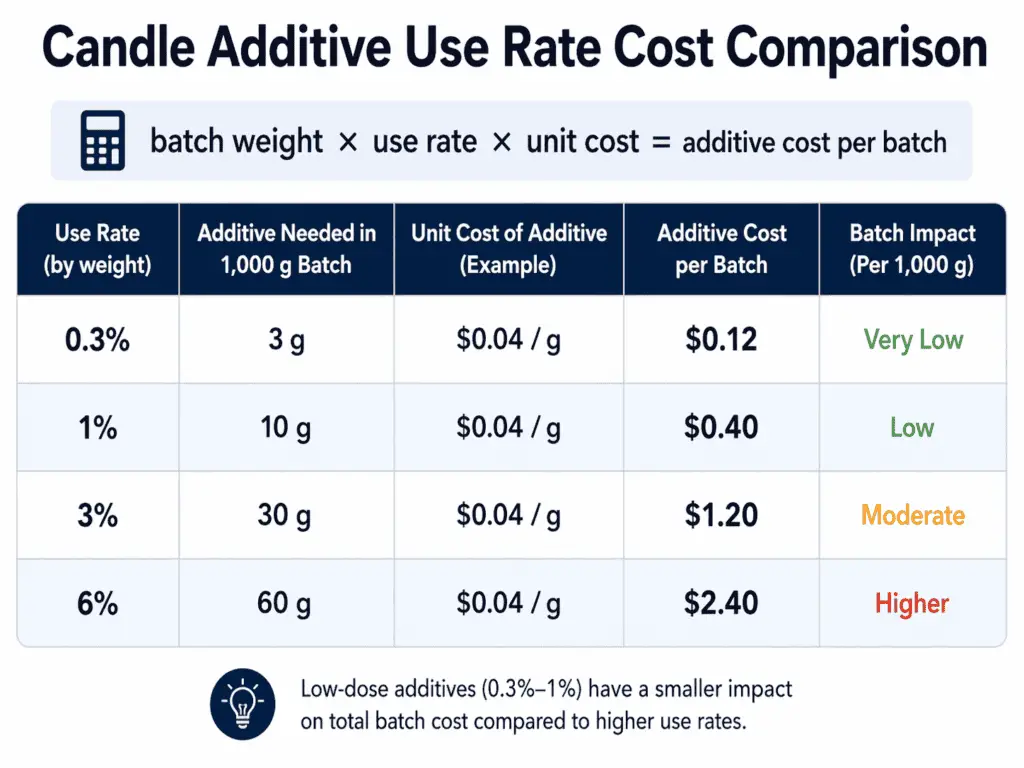
Across candle additives and enhancers, cost here means rate-adjusted additive spend inside a wax formula, not full candle pricing. A candle additive changes cost only when you connect three things: batch size, use rate, and unit cost. The quick formula is batch weight × use rate × unit cost = additive cost per batch. That is why a higher shelf price does not always mean a higher real cost, and a bigger dose does not always mean a better result.
For a simple comparison, use modeled example bands rather than treating any one percentage as universal.
| Additive class | Low example rate | Mid example rate | High example rate | Cost pattern |
| UV or stability modifier | 0.1% | 0.3% | 0.5% | Small rate, so package price can overstate real batch impact |
| Scent-support modifier | 0.5% | 1% | 2% | Mid-range rate, so cost rises steadily as dose rises |
| Hardness or opacity modifier | 1% | 3% | 6% | Higher rate, so the same unit price moves the batch budget faster |
That difference matters more than many beginners expect. If two additives cost the same per gram but one is used at 0.3% and the other at 3%, the second one changes the formula cost much faster. The package on the shelf does not tell the whole story. The use rate does.
Here is a quick side-by-side view using the same notional unit cost.
| Use rate | Additive needed in a 1,000 g batch | Cost at $0.04/g |
| 0.3% | 3 g | $0.12 |
| 1% | 10 g | $0.40 |
| 3% | 30 g | $1.20 |
| 6% | 60 g | $2.40 |
That table shows why low-dose additives can look expensive on the shelf while adding little to a batch, and why higher-dose additives deserve a harder value check because they change the batch budget faster.
Use rate matters in another way too: it changes the penalty of failed testing. If you test at a high additive rate and the batch still misses the goal, the wasted cost is bigger. That is one reason optional additives deserve more caution in early trials than function-critical ones.
The cleanest way to think about use rate is this:
- Low rate can mean higher shelf price but low real batch cost.
- Mid rate often creates the most ordinary, repeatable cost pattern.
- High rate turns a small ingredient into a noticeable formula expense.
These example bands are comparison math, not fixed supplier rules. Exact rates vary by additive class, wax family, and the result you want, so more additive does not automatically create more value.
Compare dose first, then price per gram or per pound, then the candle result you expect. Exact rate questions belong with how much additive should you use in candles, and process questions belong with how to properly mix candle additives into wax, because mixing steps and use-rate math are related but not the same decision.
How Much Candle Additives Add Per Batch and Per Candle
Candle additives add an additive-only material cost per batch and per candle, not a full candle cost that includes labor, packaging, shipping, overhead, or margin.
Within candle additives and enhancers, the useful math starts after you isolate the additive from the rest of the formula. Here, the question is not what the whole candle costs to make or sell; it is what the additive alone adds at a realistic use rate and unit cost. That distinction matters because a package price can look high while the actual per-candle impact stays small.
Use this quick math block for additive-only cost:
Additive grams = batch weight × use rate
Additive cost per batch = additive grams × unit cost
Additive cost per candle = additive cost per batch ÷ number of candles
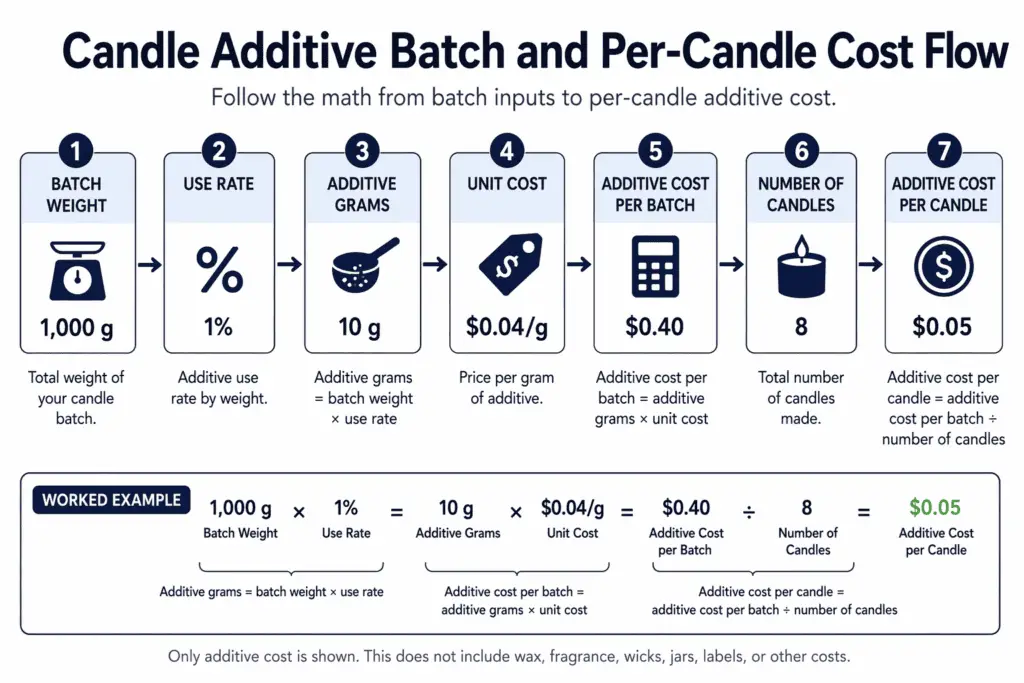
Modeled example: a 1,000 g wax batch using a 1% additive rate needs 10 g of additive. If that additive costs $0.04 per gram, the additive cost is $0.40 for the batch. If the batch makes 8 candles, the additive adds $0.05 per candle.
| Additive class | Modeled unit cost | Typical rate | Cost per 1,000 g batch | Cost per candle |
| UV or stability support | $0.08/g | 0.3% | $0.24 | $0.03 |
| Scent-support modifier | $0.04/g | 1% | $0.40 | $0.05 |
| Hardness or opacity modifier | $0.04/g | 3% | $1.20 | $0.15 |
Those figures are not supplier promises. They are comparison math meant to show why low-dose additives can add pennies while higher-dose additives move the batch budget faster. The same additive can feel wasteful in a tiny test pour and easy to absorb in a repeat run with fewer failed candles.
It helps to look at the same math through a decision lens.
| Additive-only cost per candle | Usually feels like | Common decision |
| A few cents | Easy to test if the expected gain is clear | Often worth trialing |
| Around five to ten cents | Small but noticeable | Usually depends on repeatability of the result |
| More than ten cents | Material enough to review closely | Needs a stronger payoff or a clearer problem solved |
That does not mean a higher per-candle cost is bad. It means the expected result has to earn it. An additive that fixes a repeat issue in production may be worth more than an additive that creates a mild visual improvement in a hobby batch.
Another useful comparison is additive-only cost versus failure cost. If a repeat problem leads to poor tops, uneven appearance, weak scent support, or wasted test batches, an additive can be cheap compared with repeated misses. But if the candle already meets its goal, the same additive can become pure overhead.
If changing the base wax removes the same problem without another ingredient, a wax change is often the cheaper fix because it avoids extra additive spend and one more test variable. Use the additive when the wax is otherwise the right fit and one narrow result still needs correction.
Method note: These figures are modeled examples using fixed batch size, fixed candle count, and rounded unit costs so the math stays readable. The point is to compare additive-only impact, not to set a universal rate or quote a live supplier price.
A good cross-check is to ask whether the same candle goal can be met without the extra spend. That is where can you make candles without any additives becomes a useful baseline question instead of a separate pricing model. Once you need labor, packaging, and overhead, move from additive-only math to how to calculate candle cogs.
Why Batch Size Changes Whether the Cost Feels Worth It
The same candle additive can feel expensive in a one- or two-candle test batch and easy to justify in a repeatable small-business run.
That difference matters because this page is still judging additive-only material cost, not labor, packaging, overhead, shipping, or margin. Here, “expensive” is relative to testing volume, failure risk, and how many candles the batch produces. A low-use additive can still feel costly when a tiny trial batch fails, while a higher-priced additive may feel reasonable when the same batch logic is spread across repeatable production.
| Segment | Typical batch situation | Why the cost feels different | Likely decision pattern |
| Beginner tester | 1 to 2 candles | A failed test wastes a larger share of the additive spend | Skip optional additives unless they solve a clear problem |
| Hobby maker | Small trial batches with a few revisions | Re-testing makes the same additive cost repeat several times | Test only the additive most likely to change the result |
| Small seller | Repeatable batches across more units | The additive cost spreads across more candles and waste falls | Keep the additive when the result is consistent and useful |
A beginner often feels additive cost more sharply because each test batch is small and every failed change feels personal and visible. A small seller may judge the same additive very differently because the cost is spread across more units and the payoff can show up in more consistent output. That does not make one view right and the other wrong. It means batch size changes the meaning of “worth it.”
A simple way to frame it is:
- In very small tests, optional additives should clear a higher bar.
- In repeated production, useful additives can justify themselves faster.
- In uncertain formulas, each new additive should solve one clear problem.
This qualifier does not replace the main cost math. It narrows the “worth it” question so the same additive is not judged by the same standard in every batch situation. That is why candle additives and enhancers should be judged by both function and batch situation, not by shelf price alone.
When the decision is still driven by first-purchase caution, start with candle additives for beginners. When the question shifts from additive-only cost to full production math, move to how to calculate candle cogs.
Which Benefits Actually Justify the Extra Cost
A candle additive justifies its extra cost only when it creates a named candle outcome that matters more than the tradeoff it introduces.
Inside candle additives and enhancers, benefit does not mean a vague improvement or a general sense that the candle is “better.” It means a specific candle result such as firmer structure, more opacity, better light stability, or more predictable scent support in the right wax system. For candle additives for beginners, that usually means buying only when the additive solves a clear formula problem or supports a clear product goal.
| Additive job | Named outcome | Common tradeoff | When the extra cost makes sense |
| Hardness modifier | Firmer candle body or cleaner release | Can change texture or feel overbuilt in a formula that was already stable | When softness, release, or finish is the real problem |
| Opacity modifier | More solid look and less translucency | Can add cost without helping burn or scent | When appearance is part of the product standard |
| Scent-support modifier | More predictable scent behavior in some systems | Can disappoint when the wax system was the real limit | When scent support is the actual bottleneck |
| UV or stability modifier | Slower fading or better display stability | Adds cost to candles that may never face strong light exposure | When shelf display or color hold matters |
| Specialty modifier | Targeted formula correction | Narrow payoff and easier misuse | When the same weakness repeats across test batches |
The strongest value case usually comes from one of three situations:
- The additive fixes a repeated weakness.
- The additive protects a visible product standard.
- The additive reduces wasted testing by making the result more predictable.
The weakest value case usually looks different:
- The candle already performs well enough.
- The additive is being used because it seems common, not because it solves a real need.
- The formula still has larger unresolved variables, such as wax choice or scent match.
That is why benefit should be measured against a clear target. “Better” is too broad. “Firmer,” “less translucent,” “more stable in light,” or “more predictable in this wax system” are specific enough to judge.
Method note: This matrix is a decision benchmark, not a performance guarantee. It compares likely payoff and likely tradeoff so the spend can be judged against a specific candle goal instead of a broad promise.
When to Buy the Additive—and When to Skip It
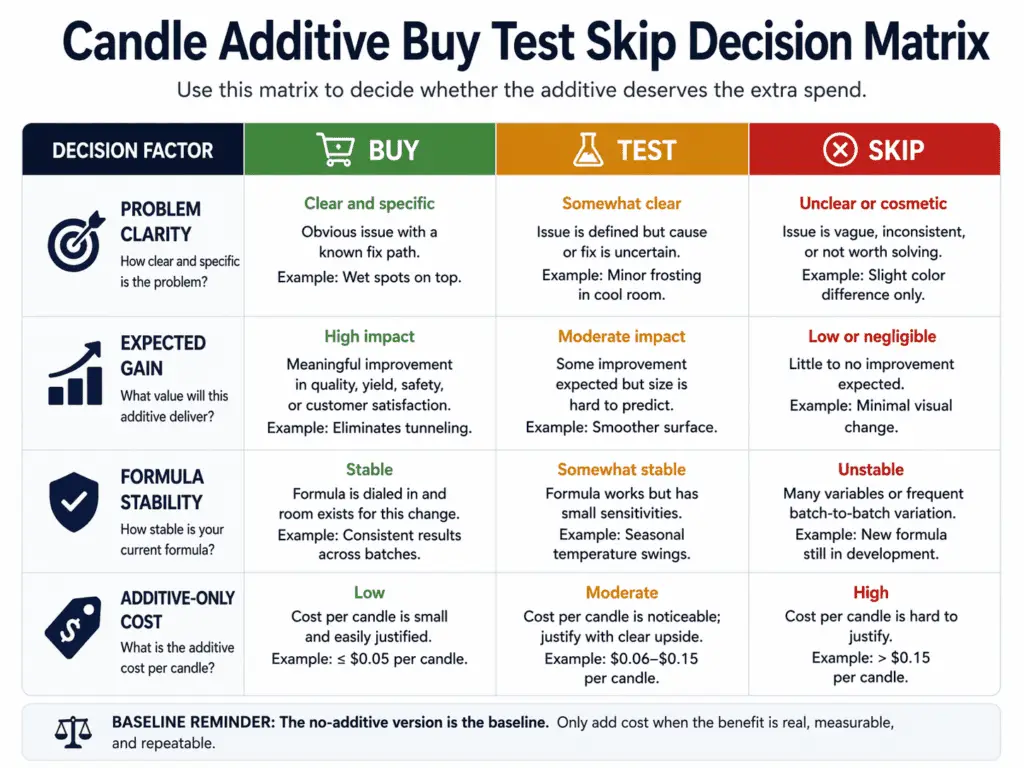
Buy the additive when the function clearly matches the problem, the expected gain is visible or repeatable, and the additive-only spend is small enough to make sense for the batch.
A simple threshold is buy, test, or skip. On this page, “worth it” means the additive creates a named candle outcome that matters enough to justify its additive-only material cost in that batch, not a broader gain in labor, packaging, shipping, overhead, margin, or retail pricing. Buy when the formula has a clear weakness and the additive targets that exact weakness. Test when the gain seems likely but the candle is still in trial mode or the wax system may be the bigger variable. Skip when the candle already meets the goal well enough without it.
| Decision | When it fits | What it looks like in practice |
| Buy | The problem is clear and repeatable | “This candle stays softer than I want across repeated batches.” |
| Test | The additive might help, but the formula still has moving parts | “The result may improve, but I am not sure the additive is the main lever.” |
| Skip | The result is already good enough or the payoff is too small | “This would add cost, but not enough useful change to matter.” |
This buy/test/skip frame helps keep spending tied to a purpose. It also lowers the chance of collecting additives just because they appear in supplier catalogs or forum posts. For narrow pair decisions, stearic acid vs vybar is a better comparison than treating all additives as interchangeable.
Additive vs No Additive: Use a Baseline Before You Spend
A candle additive earns its place only when it beats the no-additive version of the same candle at the same goal.
That baseline matters because some formulas already perform well enough without extra modifiers. The cleaner test is to compare the same wax, fragrance, wick, and target result with and without the additive, then decide whether the change is large enough to matter. That is why can you make candles without any additives is not an anti-additive position; it is the control that tells you whether the spend changed anything useful.
This baseline is useful for three reasons:
- It shows whether the additive changed a result you can actually name.
- It keeps the formula from growing more complex without a reason.
- It helps separate real improvement from expectation bias.
The no-additive version does not have to win. It only has to exist as a fair comparison. If the additive version gives a clearly better result that matters to the candle’s purpose, the spend may be justified. If the difference is tiny, inconsistent, or only visible in ideal conditions, the additive may not have earned its place.
When the question shifts to light stability only, using UV inhibitors in candles belongs with that narrower decision. Safety questions belong with are candle additives safe, first-purchase questions belong with candle additives for beginners, and additive-free path questions belong with can you make candles without any additives.
PATCH SUMMARY:
Applied: 6
Skipped: 0