

The best candle types for beginners are simple single-wick jar or tin candles because they are easy to pour, repeat, and test.
Here, a candle type means the practical format you choose to make, such as a jar, tin, tealight, votive, pillar, taper, or rolled beeswax candle. Best means easiest to make and test successfully, not most decorative, profitable, luxurious, scented, or suitable for every wax and wick combination.
The lowest-failure beginner choice is usually a small, simple, single-wick container format that shows burn feedback without demanding molds, freestanding structure, or multiple variables. Start by separating candle format from wax, wick, fragrance, and container details, because those choices come after the beginner type is clear.
What Counts as a Candle Type for Beginners?
A candle type is the practical format a beginner chooses to make and test, such as a jar, tin, tealight, votive, pillar, taper, or rolled beeswax candle.
This page compares candle formats, not wax families, fragrance styles, wick series, jar suppliers, or selling niches. That boundary matters because a beginner can choose an easy candle type first, then choose a beginner wax, wick, vessel, and scent plan after the format is settled.
| Choice area | What it means here | Keep it on this page? |
|---|---|---|
| Candle type | The format or structure, such as jar, tin, tealight, votive, pillar, taper, or rolled beeswax | Yes |
| Wax type | Soy, paraffin, beeswax, coconut, palm, blends, or gel | No, choose a beginner wax after selecting the candle type |
| Wick type | Wick size, wick series, wick material, and burn-test adjustment | No, size the wick after choosing the candle format |
| Fragrance choice | Unscented, scented, fragrance oil load, scent throw, and scent testing | Only as a beginner variable |
| Container choice | Glass jar, metal tin, cup, holder, or vessel safety | Only as it affects beginner difficulty |
| Selling angle | Pricing, labels, compliance, packaging, profit, and launch planning | No |
For a first poured candle, the easiest candle type is usually a small single-wick container candle because the vessel supports the wax while the maker learns pouring, cooling, and burn testing. A jar or tin candle gives clearer feedback than a molded candle because most beginner problems show up in the wax surface, flame behavior, melt pool, and container heat.
Rolled beeswax candles are even easier as a craft because they do not require melting wax. They are weaker as a poured-candle learning test, though, because they do not teach pouring temperature, adhesion, cooling behavior, or wick testing in a container.
The key contrast is format versus formula. Candle type answers “What structure am I making?” while wax, wick, fragrance, and vessel choices answer “How will this version perform?” For the wax decision after the format choice, use a beginner wax guide. For the wick decision after the format choice, use a beginner wick guide.
How to Choose the Easiest Candle Type to Make and Test
Beginners should choose a candle type by comparing equipment simplicity, process forgiveness, defect visibility, repeat cost, testing speed, and next-step value.
Best means easiest to make and test successfully, not prettiest, most premium, strongest smelling, longest burning, or most profitable. Easiest means the format has fewer moving parts, gives visible feedback, and can be repeated without buying a large mold set, complex wick range, or advanced pouring setup.
| Beginner criterion | What to look for | Better beginner choice | Riskier beginner choice |
|---|---|---|---|
| Equipment simplicity | Fewer tools, fewer specialty parts, and no mold release step | Jar, tin, tealight, rolled beeswax | Pillar, taper, carved, layered, oversized |
| Process forgiveness | The format tolerates small pouring and cooling mistakes | Small container candle | Tall freestanding candle |
| Defect visibility | Mistakes are easy to see during testing | Clear jar or open tin | Hidden holder setups or complex molds |
| Repeat cost | A failed test is cheap enough to remake | Small jar, tin, tealight, sample-size candle | Large pillar or multi-wick container |
| Testing speed | The maker can compare results without committing too much wax | Small single-wick format | Large scented or multi-wick format |
| Variable control | One change can be tested at a time | Unscented single-wick candle | Scented multi-wick candle with color and additives |
| Progression value | The first type teaches skills used later | Jar or tin candle | Novelty shape with limited carryover |
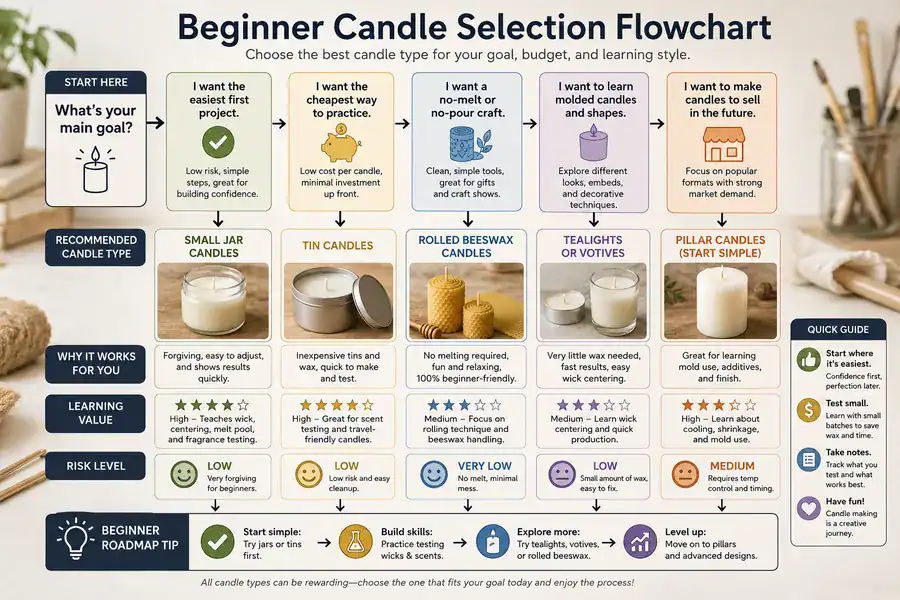
A good first candle type should teach one clear lesson at a time. A small single-wick jar or tin teaches pouring, cooling, basic adhesion, melt-pool reading, flame observation, and repeat testing without the added burden of mold release or freestanding structure.
The simplest action path is:
- Choose a small container format before choosing a decorative or molded format.
- Use one wick, one wax, and one container size for the first test.
- Start unscented when the goal is clean test feedback.
- Repeat the same format before changing scent, color, wick family, or container size.
- Move to votives, pillars, tapers, or layered designs only after the first format gives stable results.
Supplies should follow the type, not lead the decision. Once the candle type is chosen, buy supplies for the candle type you chose instead of buying a broad kit that includes molds, dyes, scents, and accessories you will not test yet.
Beginner Candle Type Ranking Matrix
The easiest beginner candle type is usually a small single-wick jar or tin candle because it balances simple setup, low remake cost, and readable burn-test feedback.
This ranking is a beginner decision model, not a lab-measured performance test. It ranks candle types by how easy they are to make, repeat, inspect, and improve when a maker is still learning the first format.
| Rank | Candle type | Beginner fit | Why it ranks here | Main limitation |
|---|---|---|---|---|
| 1 | Small single-wick jar candle | Best first poured choice | The jar supports the wax, the process is familiar, and most test results are visible | Still needs the right wax, wick, and jar match |
| 2 | Small tin candle | Best low-breakage test choice | The tin is light, forgiving, and useful for small batches | It hides side adhesion and some visual defects |
| 3 | Tealight candle | Best cheap practice choice | It uses little wax and lets beginners practice pouring small amounts | It does not fully predict larger candle behavior |
| 4 | Rolled beeswax candle | Easiest no-melt craft | It needs no melting, pouring, or container setup | It teaches less about poured candle testing |
| 5 | Votive candle | Later beginner choice | It is small and useful for learning molded formats | It needs a mold, release step, and proper holder |
| 6 | Pillar candle | Delayed beginner choice | It teaches structure and mold handling | It is less forgiving because it must stand and burn evenly |
| 7 | Taper candle | Advanced beginner choice | It is simple in shape but sensitive to straightness and equipment | It can be harder to keep even and stable |
| 8 | Gel, layered, carved, oversized, or multi-wick candle | Avoid first | These formats add several variables at once | Mistakes are harder to isolate |
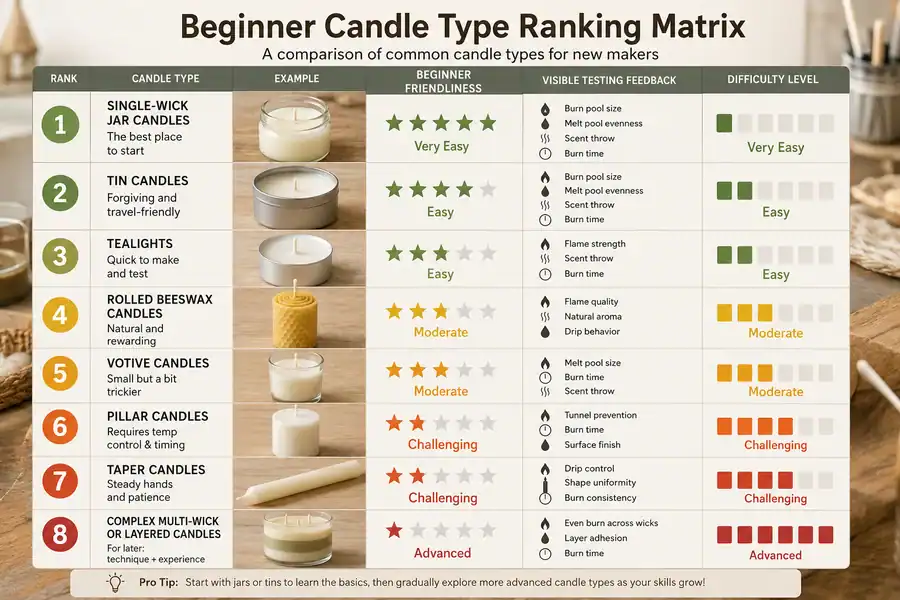
Method note: This matrix scores beginner suitability by format difficulty, tool burden, repeat cost, visible feedback, and ability to change one variable at a time. It does not rank luxury value, scent strength, selling potential, or decorative impact.
| Decision shortcut | Choose this type |
|---|---|
| You want the safest first poured project | Small single-wick jar candle |
| You want a small batch that is easy to repeat | Small tin candle |
| You want the cheapest way to practice pouring | Tealight candle |
| You want a no-melt craft | Rolled beeswax candle |
| You want to learn molded candles later | Votive, then pillar |
| You want a slim dinner candle shape | Taper, after basic tests |
| You want scent testing | Start with an unscented jar or tin, then repeat with scent |
| You want to sell later | Learn jar or tin candles first, then move selling details to a business plan |
The main reason jar and tin candles rank first is not that they always burn better. They rank first because they reduce early failure points. A container gives structure, a single wick keeps the test readable, and a small size lets the maker repeat the same setup without wasting much wax.
A beginner should not use this table as a shopping list for every format. Pick one first type, repeat it, and then use a testing checklist before changing wax, wick, scent, color, or container size.
Best Beginner Candle Type by Goal
The best beginner candle type changes by goal, but small single-wick jars and tins are the safest default for learning poured candles.
A beginner goal is the reason the maker is choosing a first candle format, such as learning the process, making a gift, testing scent, practicing cheaply, or building toward selling later. The goal should narrow the candle type without turning the first project into an advanced plan.
| Beginner goal | Best candle type | Why it fits | What to avoid first |
|---|---|---|---|
| Learn poured candle basics | Small single-wick jar | Teaches pouring, cooling, wick reading, and burn testing | Pillars, tapers, layered candles |
| Repeat cheap practice tests | Small tin or tealight | Uses less wax and lowers remake cost | Large containers or multi-wick candles |
| Make a simple gift | Small jar or tin | Feels finished without complex shaping | Heavy decoration before burn testing |
| Try a no-melt craft | Rolled beeswax | Needs very little equipment | Treating it as a full poured-candle test |
| Test scent later | Small jar or tin after a plain baseline | Keeps the scent change easy to compare | Starting with scent, dye, new wax, and new container together |
| Learn molded candles next | Votive | Small step into mold work | Large pillars as the first molded project |
| Learn freestanding forms | Pillar, then taper | Builds structure skills after containers | Starting with tall, thin, or carved forms |
| Sell candles later | Small jar or tin as a learning base | Builds repeatable making and testing habits | Pricing, labels, and product lines before stable tests |
The safest first choice is still a plain small jar or tin candle. It gives the beginner a real poured-candle test without the structure burden of pillars or tapers. It also creates a clearer path into scent testing, gifting, or later selling.
Selling later is only a future path here. A beginner should first learn a repeatable candle type, test it, and keep notes. Pricing, labeling, compliance, packaging, and launch planning belong in a candle business guide after the maker has a stable product candidate.
Best First Poured Candle Type: Container or Jar Candles
A small single-wick container candle is usually the best first poured candle because the vessel supports the wax while the beginner learns pouring and burn testing.
A container candle is a candle poured into a vessel and burned inside that vessel. A jar candle is the most familiar version. This makes it easier than a pillar or taper because the candle does not need to release from a mold, stand on its own, or keep a narrow freestanding shape.
| Beginner factor | Why jar candles help | What still needs testing |
|---|---|---|
| Structure | The jar holds the wax in place | The vessel still needs to be suitable for candle use |
| Pouring | The maker pours directly into the container | Pour temperature and cooling still affect the surface |
| Wick reading | One centered wick is easy to watch | Wick size still needs a burn test |
| Defect visibility | Surface flaws, melt pool shape, and flame behavior are visible | Side adhesion may vary by wax and glass |
| Repeatability | The same jar size can be repeated in small batches | Results can change with wax, wick, and fragrance |
| Cost control | Small jars reduce wasted materials | Buying too many jar styles too early can confuse tests |
A jar candle is easiest when it stays small, plain, and single-wick. The first goal is not a perfect gift candle. The first goal is to see whether the wax cools acceptably, the wick burns steadily, the melt pool behaves predictably, and the container stays suitable during a test burn.
Container candles still have boundaries. This section does not replace a jar safety guide, wick sizing guide, or full jar candle tutorial. Choose a suitable vessel before pouring, size the wick after choosing the candle format, and follow a step-by-step tutorial when the format decision is finished.
A good first jar-candle plan is simple:
- Pick one small jar size.
- Use one wax and one wick family.
- Make one unscented test candle first.
- Burn test before adding scent or changing the jar.
- Repeat the same setup before buying more containers.
This order lowers wasted supplies because every new test answers one question. Changing the jar, wax, wick, and fragrance at the same time makes the result harder to read.
Tin Candles vs Glass Jars for Beginners
Tin candles are easier for low-breakage test batches, while glass jars are better when beginners need to see more visual feedback through the container.
A tin candle is a container candle poured into a metal tin instead of a glass jar. It is still part of the container-candle family, but it behaves differently for learning, gifting, storage, and visual inspection.
| Comparison point | Tin candle | Glass jar candle |
|---|---|---|
| Breakage risk | Lower during handling and storage | Higher if dropped or packed poorly |
| Visual feedback | Surface is visible, sides are hidden | Surface and side behavior are easier to inspect |
| Beginner confidence | Forgiving for small practice batches | Better for learning how the candle looks from all sides |
| Gift use | Easy for casual gifts and samples | Often feels more finished or premium |
| Testing clarity | Good for flame, melt pool, and surface checks | Better for side adhesion and container appearance checks |
| Buying risk | Too many tin sizes can still confuse testing | Too many jar shapes can confuse wick choice |
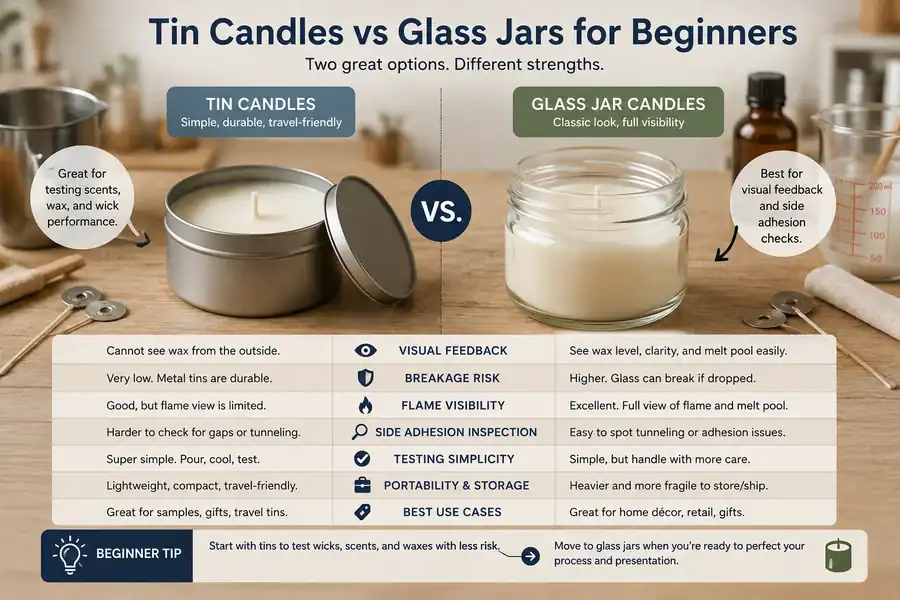
Tins are a strong beginner choice when the maker wants small, repeatable test batches without worrying about broken glass. They also hide some cosmetic flaws, which can be helpful for confidence but less helpful for learning every visual issue.
Glass jars are better when the maker wants to inspect side adhesion, frosting, wet spots, or the full finished look. They can feel more polished, but they also make vessel choice more important.
The practical choice is simple: choose tins for low-stress practice and glass jars for fuller visual feedback. Do not buy many tin and jar sizes at once. One small tin or one small jar is enough for a first test set.
Tealight Candles: Cheap Practice, Limited Testing Value
Tealights are useful low-cost practice candles, but they do not prove how a larger jar, tin, or container candle will burn.
A tealight candle is a small candle poured into a thin cup, usually made for short burns in a holder or warmer. It is beginner-friendly because it uses little wax, cools in a small space, and lets a maker practice pouring without risking a large batch.
| Beginner question | Tealight answer | Limit |
|---|---|---|
| Is it cheap to repeat? | Yes, each test uses little wax | Low material use can hide problems that appear in larger candles |
| Is it easy to pour? | Yes, the cup is small and low | Overfilling and wick placement still matter |
| Is it good for first practice? | Yes, especially for pouring control | It does not teach jar adhesion or container heat checks |
| Is it good for scent testing? | Only for rough scent impressions | It cannot fully predict scent throw in a larger candle |
| Is it easy to inspect? | The top surface and flame are easy to see | Side behavior is limited by the small cup |
| Is it a final beginner product? | It can be, if the goal is small candles | It is weaker for learning full container-candle performance |
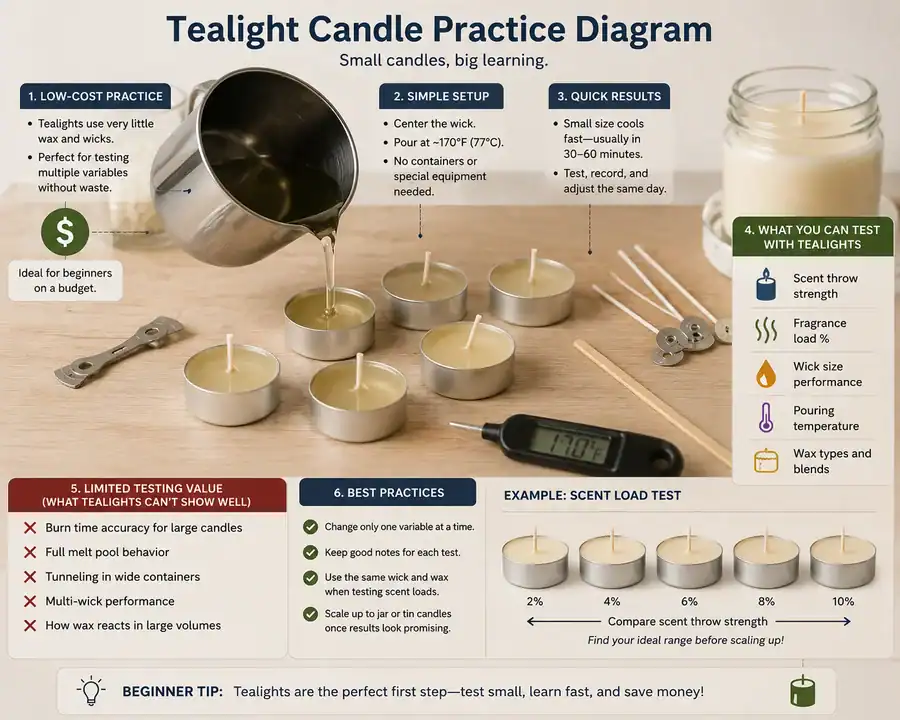
Tealights are best when the goal is practice, not full validation. They help a beginner learn how melted wax behaves, how quickly small pours set, and how a centered wick affects a tiny melt pool.
They are weaker when the goal is to judge a future jar or tin candle. A tealight has less wax mass, a shorter burn path, and a different heat pattern than a larger container candle. A candle testing checklist is still needed before changing several variables or assuming the result will scale up.
A useful beginner path is to make tealights only as a low-risk warm-up, then move to one small jar or tin for the real baseline test.
Votive Candles: Small but Not Always First-Project Easy
Votives are small, but they are usually harder than tealights or jar candles because they need a mold and a suitable holder.
A votive candle is a small molded candle that is burned inside a holder. That makes it different from a tealight, which stays in its own cup, and different from a jar candle, which is poured and burned in the same vessel.
| Votive factor | Beginner benefit | Beginner risk |
|---|---|---|
| Small size | Uses less wax than a large pillar | Still needs a mold process |
| Molded shape | Teaches freestanding wax handling | Can stick, crack, or release poorly |
| Holder use | Gives support during burning | Must match the candle and heat safely |
| Testing value | Helps learners move beyond containers | Adds mold and holder variables at once |
| Finished look | Can look more polished than tealights | Surface and shape defects are more visible |
| Repeat cost | Lower than large molded candles | Higher burden than a small jar or tin |
Votives are a good second-stage beginner candle, not the safest first poured candle for most people. They are small enough to test without wasting much wax, but the mold and holder add decisions that a first jar or tin candle avoids.
The main beginner mistake is assuming “small” means “easy.” A votive may use less wax than a pillar, but it still asks the maker to handle mold release, shrinkage, surface finish, and proper holder use. Those variables make the result harder to read than a single-wick jar or tin.
Use votives after one container format gives stable results. For mold release, cracking, and shape problems, use a candle mold guide or candle troubleshooting guide rather than turning this page into a molded-candle repair manual.
Pillar Candles: Better as a Later Beginner Project
Pillar candles are harder first projects because they must release from a mold, stand without a container, and burn evenly as freestanding candles.
A pillar candle is a molded candle made to stand on its own while burning. That structure makes it more demanding than a jar, tin, or tealight because the candle body has to support itself, release cleanly, and keep a stable burn shape.
| Pillar factor | Why beginners like it | Why it is harder first |
|---|---|---|
| Freestanding shape | Looks finished without a jar | Must hold its form while burning |
| Mold use | Teaches molded candle skills | Adds release, shrinkage, and surface risks |
| Larger wax mass | Feels like a serious candle project | Costs more to repeat after a failed test |
| Burn behavior | Teaches structure and melt control | Uneven burning is harder to correct |
| Finished look | Can be decorative without a container | Flaws are more visible than in a tin |
| Learning value | Useful after container basics | Too many new variables for a first poured candle |
Pillars are not bad beginner candles. They are delayed beginner candles. A maker who already understands a small jar or tin candle will read pillar problems more clearly because the basics of pouring, cooling, wick behavior, and burn testing are already familiar.
The beginner risk is structure. A jar candle can have minor surface flaws and still teach useful lessons. A pillar has to release from the mold, keep its sides clean, stand upright, and burn without losing shape too quickly.
Try pillars after a stable single-wick container candle. For mold release, cracking, side flaws, or uneven freestanding burns, use a candle mold guide or troubleshooting guide instead of treating pillar repair as part of first-type selection.
Taper Candles: Simple-Looking but Less Forgiving
Taper candles look simple, but they are less forgiving for beginners because their thin freestanding shape depends on straightness, handling, and holder fit.
A taper candle is a slim candle made to burn in a candle holder. Tapers can be dipped or molded, and both methods add control points that a first jar or tin candle avoids.
| Taper factor | Beginner appeal | Beginner difficulty |
|---|---|---|
| Simple shape | Looks minimal and familiar | Small bends or uneven sides are easy to see |
| Thin form | Uses less wax than many pillars | Less margin for wick and shape errors |
| Holder use | No jar is needed | Must fit and stand safely in a holder |
| Dipping option | Feels traditional and craft-based | Needs repeated layers and steady handling |
| Molded option | Can look more uniform | Still adds mold and release steps |
| Testing value | Teaches freestanding burn behavior | Less useful as a first poured-container test |
Tapers are better as an advanced beginner project than a first candle type. Their narrow shape gives less room for error, and the finished candle depends on a holder rather than a built-in container.
The main selection rule is this: choose tapers when the goal is learning slim freestanding forms, not when the goal is the easiest first candle test. A small jar or tin gives clearer feedback with fewer handling problems.
Move to tapers after one container format is stable and repeatable. If the goal is to learn dipping, straightening, or molded taper setup, use a taper-making guide after the beginner type decision is complete.
Rolled Beeswax Candles: Easiest Craft, Weaker Poured-Candle Test
Rolled beeswax candles are the easiest beginner craft candle, but they do not teach the same testing skills as poured jar or tin candles.
A rolled beeswax candle is made by wrapping a beeswax sheet around a wick instead of melting wax and pouring it into a container or mold. That makes it low-risk for assembly, but weaker for learning poured-candle behavior.
| Beginner factor | Rolled beeswax candle | Poured jar or tin candle |
|---|---|---|
| Heat required | No melting needed | Wax must be melted and poured |
| Setup burden | Very low | Low to moderate |
| Craft success | Fast and forgiving | Depends on wax, wick, pour, and cooling |
| Testing value | Limited for poured-candle learning | Stronger for burn-test practice |
| Defect feedback | Mostly shows rolling, wick, and burn issues | Shows surface, melt pool, flame, adhesion, and container behavior |
| Next-step value | Good for confidence and basic wick placement | Better for learning repeatable candle testing |
Rolled beeswax is best when the goal is a low-mess craft, a quick handmade candle, or a first project that avoids hot wax. It is not the best choice when the goal is to learn how poured candles cool, adhere, scent, tunnel, or respond to wick changes.
The main comparison is craft ease versus test value. Rolled beeswax can be the easiest candle to finish, while a small jar or tin is usually the better first candle for learning repeatable poured results.
Choose rolled beeswax if you want the least equipment and fastest assembly. Choose a jar or tin if you want to learn the poured candle process. For beeswax-specific melting, wick behavior, and burn differences, use a beeswax candle guide after the beginner format decision is clear.
When Should Beginners Add Scent to a Candle Type?
Beginners should add scent after one plain jar or tin candle already burns clearly and repeatably.
An unscented candle contains no added fragrance oil, so it gives cleaner feedback on the chosen candle type. A scented candle adds fragrance oil or another approved candle scent material, which makes the test harder to read if the format, wax, and wick are still unproven.
| Scent stage | Better beginner order | Why it helps |
|---|---|---|
| First candle | Make a plain small jar or tin | Shows whether the format, wax, and wick behave without scent |
| Repeat test | Use the same type again if the first result is unclear | Keeps the baseline readable |
| First scented candle | Repeat the same type with one scent added | Keeps the test focused on the fragrance change |
| Scent strength | Keep the first scented version modest | Reduces the chance of blaming every issue on the candle type |
| Trouble signs | Route scent issues out | Weak scent throw, oil seepage, and fragrance compatibility need a fragrance guide |
Starting unscented does not mean scented candles are too hard for beginners. It means the first test should answer the smallest number of questions possible. If an unscented jar candle tunnels, smokes, overheats, or forms an uneven melt pool, the maker knows the issue is not caused by fragrance.
Use scent as the next test, not the first source of complexity. For fragrance load, compatibility, and scent throw fixes, use a fragrance oil guide or scent throw troubleshooting page after the beginner candle type has a working baseline.
Why Small Single-Wick Candles Are Easier to Test
Small single-wick candles are easier to test because one flame, one container, and less wax make each result easier to repeat and compare.
A single-wick candle has one wick in the candle body or container. A sample-size candle is a smaller version of the format you plan to repeat, such as a small jar, small tin, or small test container.
| Test choice | Beginner effect | Best use |
|---|---|---|
| Single-wick jar | Easiest full container burn pattern to read | First poured baseline |
| Single-wick tin | Easy small-batch testing with low breakage risk | Repeat tests and casual samples |
| Single-wick tealight | Cheap pouring and flame practice | Warm-up before larger tests |
| Small sample-size candle | Lower remake cost and faster comparison | Testing one change at a time |
| Multi-wick container | Several flames interact and make diagnosis harder | Delay until one-wick testing is stable |
| Oversized candle | Higher failure cost and slower comparison | Delay until testing habits are steady |
Single-wick formats do not remove the need for wick sizing. They make the result easier to read. If the flame is too large, too small, smoky, unstable, or leaving too much unmelted wax, the beginner can focus on one wick rather than several flames affecting each other.
Small tests work best when the beginner keeps the format stable. Make two or three small candles in the same jar or tin before changing scent, dye, container size, wick count, or wax type.
For diameter, wick series, and burn-test adjustments, use a wick sizing guide after choosing the candle format. For a fuller repeat-test sheet, use a candle testing checklist after the first batch is made.
Which Candle Types Give the Clearest Failure Feedback?
Clear glass jars, tins, tealights, and rolled beeswax candles give different feedback, but small jar candles show the most complete poured-candle test signals.
Failure feedback means the visible clues that help a beginner notice what went wrong and connect it to a likely test variable. It does not mean fixing every candle defect on this page.
| Candle type | Equipment burden | Feedback speed | What beginners can usually see | Main caution |
|---|---|---|---|---|
| Clear glass jar candle | Low to medium | Fast to moderate | Melt pool, flame size, surface finish, side-wall behavior, and container response | Needs a suitable jar and wick match |
| Tin candle | Low | Fast | Flame, melt pool, top surface, and heat behavior | Side-wall appearance is hidden |
| Tealight | Low | Fastest | Flame, tiny melt pool, centering, and quick burn behavior | Weak predictor for larger candles |
| Rolled beeswax | Lowest | Fast | Assembly, wick placement, rolling tightness, and burn line | Does not test poured-candle skills |
| Votive | Medium | Moderate | Shape, surface, flame, and holder behavior | Adds mold and holder variables |
| Pillar | Medium to high | Slow to moderate | Side shape, melt path, cracking, and leaning | Failed tests cost more wax and time |
| Taper | Medium to high | Moderate | Straightness, dripping, leaning, and holder fit | Thin shape gives less room for error |
| Layered or novelty candle | High | Slow | Appearance, layer behavior, and detail flaws | Too many variables for a first test |
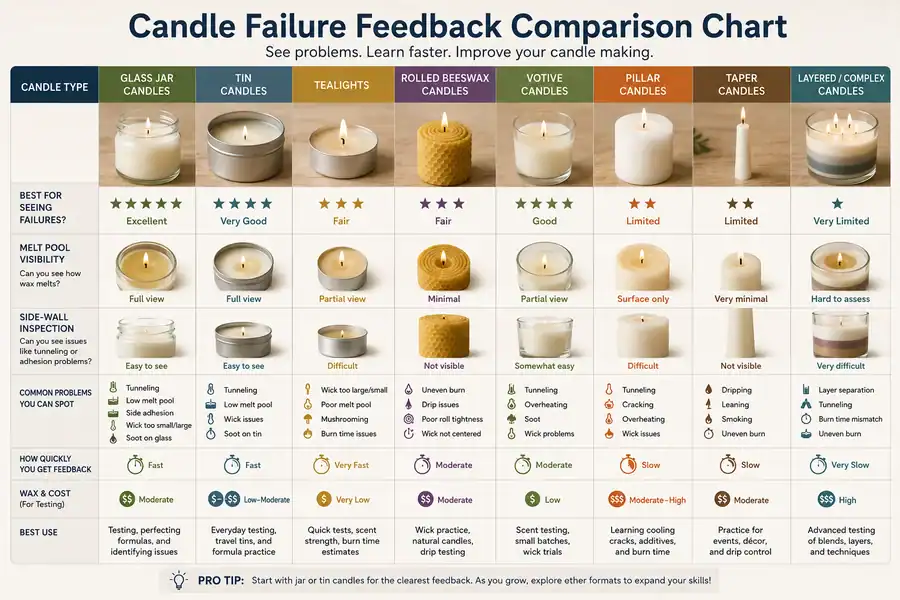
A small glass jar gives the most visible beginner feedback because it shows the top, sides, flame, melt pool, and general container behavior. A tin is still beginner-friendly, but it hides some side-wall clues. A tealight is easy to inspect, but it is too small to prove how a larger candle type will behave.
Fast feedback does not mean skipping rest time or burn testing. It means choosing a candle type small enough to remake, compare, and improve without wasting a full bag of wax or a large set of containers.
Keep the defect work narrow here. For fixes to tunneling, sinkholes, cracking, weak scent, smoking, or uneven burns, use a candle troubleshooting guide after choosing the beginner candle type.
Candle Types Beginners Should Avoid First
Beginners should usually delay gel, layered, carved, novelty-shaped, oversized, and complex multi-wick candles because they add variables that make first tests harder to read.
Avoid means delay, not never. These candle types can be worth learning later, but they are poor first projects when the main goal is easy making, low waste, and readable test feedback.
| Candle type to delay | Why it is harder first | Better first step |
|---|---|---|
| Gel candles | Material behavior, container suitability, and design choices add risk | Learn a small jar or tin candle first |
| Layered candles | Each layer adds timing, cooling, adhesion, and color decisions | Make one plain container candle first |
| Carved candles | Requires special shaping skill and timing | Learn pillar basics later |
| Novelty-shaped candles | Shape detail can hide or add burn problems | Try a plain votive or pillar after containers |
| Oversized candles | Failed tests waste more wax and time | Start with small jars or tins |
| Multi-wick candles | Several flames interact and make problems harder to isolate | Learn one wick in one container first |
| Heavy dye or additive candles | Extra materials can change cooling and burn behavior | Add one variable after the baseline works |
| Highly decorative gift candles | Appearance can distract from burn testing | Make a plain test candle before decorating |
The common problem is variable stacking. A beginner who starts with a scented, dyed, layered, oversized, multi-wick candle has too many possible causes if the candle tunnels, smokes, overheats, cracks, or burns unevenly.
A better first project removes those variables. Use one small container, one wick, one wax, and no scent for the first baseline. After that baseline works, add one new feature at a time.
Advanced candle types belong later in the learning path. Use an advanced candle types guide, gel candle guide, layered candle guide, or multi-wick candle guide after the beginner format is repeatable.
First Candle, Second Candle, and What to Try Later
The best beginner progression is jar or tin first, repeat if needed, then add scent, small molded formats, pillars, tapers, or advanced designs later.
This progression keeps the first candle type easy to make and easy to test. It also stops a beginner from treating every attractive candle format as an equal first project.
| Stage | Candle type | What it teaches | Move on when |
|---|---|---|---|
| First candle | Small unscented single-wick jar or tin | Pouring, cooling, wick centering, flame reading, and basic burn testing | The burn result is readable and repeatable |
| Repeat test | Same jar or tin, same setup | Whether the first result was a one-off mistake | Two similar tests give similar results |
| First variation | Same type with one scent added | How fragrance changes the same baseline candle | The scented version still burns acceptably |
| Cheap practice side path | Tealight or small sample-size candle | Low-cost pouring and small-format comparison | The maker understands its limits |
| First molded step | Votive candle | Mold handling, holder use, and small molded burn behavior | Container basics already feel stable |
| Freestanding step | Pillar candle | Structure, mold release, and freestanding burn control | The maker is ready for higher waste risk |
| Shape-control step | Taper candle | Thin-form handling, straightness, and holder fit | Molded or dipped work is the learning goal |
| Advanced later step | Gel, layered, carved, oversized, or multi-wick candle | Complex design and multi-variable testing | One-variable testing habits are already strong |
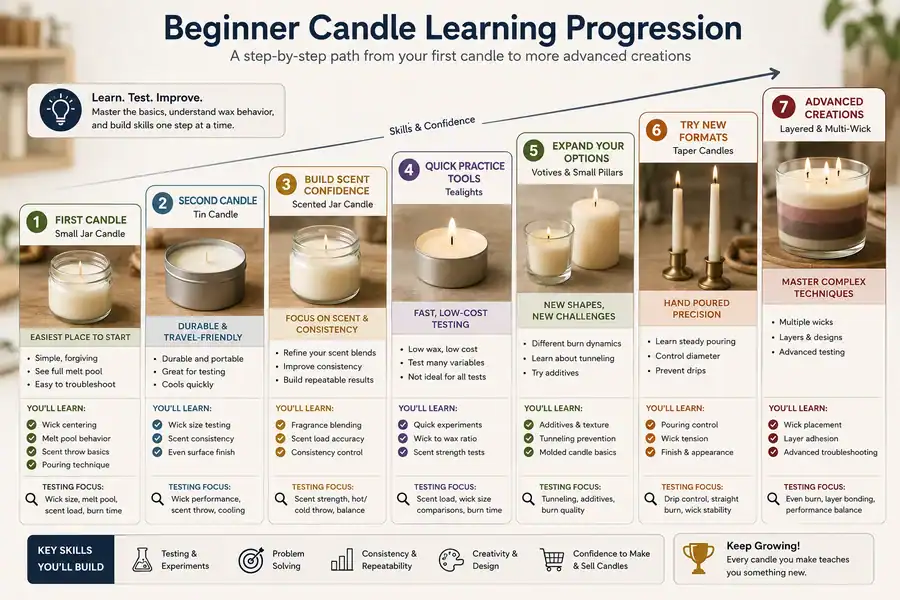
The first candle should answer one question: can this beginner make and test a plain, small, single-wick container candle without adding unnecessary variables? If the answer is unclear, the best next candle is not a harder format. It is the same format again.
The second candle should either repeat the first setup or add one controlled change. For most beginners, that change is fragrance after a plain baseline works. Changing scent, wax, wick, color, container size, and candle type in the same second batch makes the result harder to understand.
Move into votives, pillars, and tapers after the container format gives stable notes. These formats are useful, but they add molds, holders, structure, or shape control. They are better as skill-building steps than as the first poured candle.
Advanced formats belong at the end of the ladder. Gel, layered, carved, novelty-shaped, oversized, and multi-wick candles can be rewarding later, but they should not replace the first low-failure learning path.