

A candle format is the physical form of a candle, such as a container, pillar, tealight, or taper. Large container candles and large pillar candles usually burn the longest; tapers are moderate, and tealights are usually shortest for one candle. This page compares format, not wax blend, wick material, scent, color, or brand.
In this comparison, “longest” means practical total burn duration under normal indoor use. The ranking compares one candle unit against one candle unit, not one large candle against a pack of smaller candles. Size, usable wax volume, wick setup, drafts, and burn habits can still change which candle lasts longer in real use.
Which Candle Format Burns the Longest?
Large container candles and large pillar candles usually burn the longest; tapers usually sit in the middle, and tealights are usually shortest for one candle. This ranking is about candle format, not wax type, wick material, scent strength, or brand. It assumes normal indoor use, one candle unit, and practical total burn duration.
| Rank | Candle format | Practical burn-duration tendency | Why it ranks there | Main exception |
|---|---|---|---|---|
| 1 | Large container candle | Usually among the longest | The vessel holds wax and keeps melted wax contained. | A small jar or multi-wick jar may burn faster than expected. |
| 1 | Large pillar candle | Usually among the longest | The freestanding wax mass can provide long burn potential. | Tunneling, short burn sessions, or narrow diameter can waste wax. |
| 3 | Taper candle | Usually moderate | The candle is tall but narrow, so total wax fuel is limited. | A tall, thick taper may outlast smaller candles. |
| 4 | Tealight | Usually shortest for one candle | The small cup holds limited wax. | A multipack changes value math, not the one-candle ranking. |
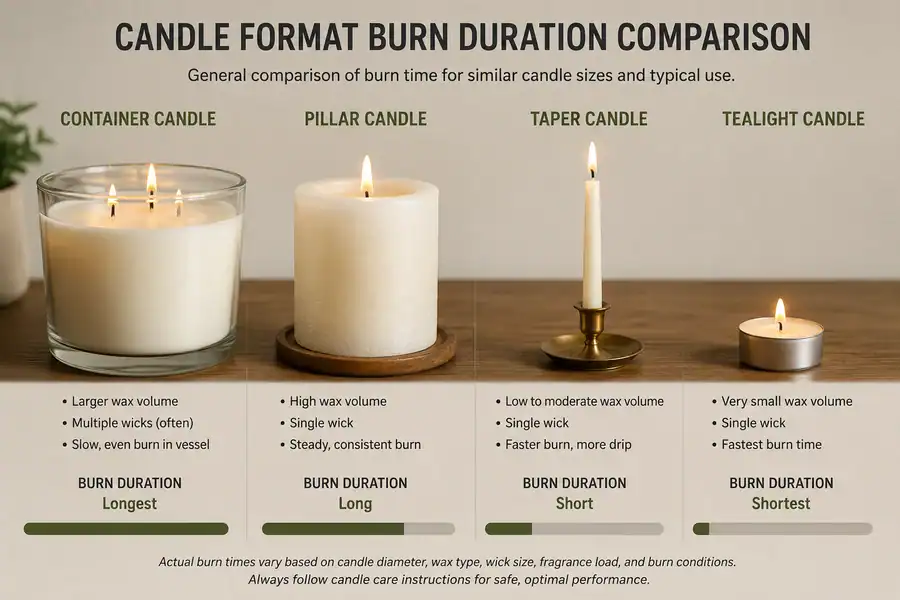
If two candles are similar in wax weight and wick setup, format changes how forgiving the burn is. If the candles are different sizes, usable wax volume usually matters more than format.
Container candles and pillar candles can switch positions depending on size, fill weight, diameter, wick count, and tunneling. A large pillar can outlast a small jar, while a large single-wick container can outlast many medium tapers.
This ranking is practical buyer guidance, not a fixed rule for every candle product. Wax type, wick setup, and product size can change the result, so read the wax, wick, or burn-time calculator guides when you need material-specific or product-specific estimates.
Container vs Pillar vs Tealight vs Taper Burn-Time Snapshot
Large container and pillar candles usually have the strongest long-burn potential, while tealights usually have the weakest one-candle duration. Candle format means physical form: container, pillar, tealight, or taper. It does not mean wax blend, wick material, scent, color, or brand.
| Candle format | Typical burn-time tendency | Why it ranks there | Main caveat |
|---|---|---|---|
| Container candle | Long, especially in larger jars | The vessel holds melted wax and can support a steady usable burn area. | Small jars and multi-wick jars may not last as long as large pillars. |
| Pillar candle | Long when wide and burned well | The molded wax body can contain substantial fuel. | Tunneling can leave unused wax and reduce real burn duration. |
| Taper candle | Moderate | The candle may be tall, but its narrow shape limits wax volume. | Drafts and holder setup can make it burn unevenly or faster. |
| Tealight | Short for one candle | The small cup holds a limited amount of wax. | A multipack may offer more total hours, but that is a value comparison. |
The likely practical order is simple: large container candles and large pillar candles usually last longest, tapers sit in the middle, and tealights are usually shortest for one candle. The order can change when candle size, usable wax volume, wick setup, and burn conditions are not similar.
This page treats wax type and wick setup only as modifiers because the main comparison is container, pillar, tealight, and taper format.
Why Size and Wax Volume Can Change the Winner
Candle size and usable wax volume can override the format-based ranking. Format is the candle’s physical shape or container style, while wax volume is the usable fuel inside that format. A small container candle does not automatically outlast a large pillar just because jar candles often rank high.
| Comparison | What changes the result | Burn-time takeaway |
|---|---|---|
| Small container vs large pillar | The pillar may hold more usable wax. | The large pillar may burn longer. |
| Tall taper vs wide pillar | The taper has height, but the pillar may have more wax mass. | The wide pillar may last longer. |
| One tealight vs larger formats | The tealight has a small wax cup. | The tealight usually burns for less time. |
More usable wax gives a candle more possible burn time, but size must be judged with shape and wick setup. A wide pillar with a good melt pool can burn for many sessions, while a small jar can finish faster than expected.
A bigger candle does not always burn longer in real use. A large candle with too many wicks, strong drafts, or poor burn habits can consume wax faster or waste wax around the edges.
For exact estimates, use a burn-time calculator or the product’s own burn-hour claim. This page explains the comparison logic, not a full burn-time formula.
How Candle Shape Changes Burn Rate
Burn rate by candle format means how the candle’s shape, vessel, exposed wax area, and wick setup affect wax consumption. Burn rate is not the same as total burn duration. A candle can burn slowly but still have fewer total hours if it contains less wax.
| Format feature | Burn-rate effect | Caveat |
|---|---|---|
| Container vessel | Holds melted wax in place and can support an even burn area. | Multi-wick jars may consume wax faster. |
| Pillar diameter | Wider pillars can hold more wax and form a larger melt pool. | Short sessions can cause tunneling and wasted wax. |
| Small tealight cup | Limits both wax volume and burn cycle length. | Multipacks change value, not one-candle duration. |
| Narrow taper shape | Uses less wax across a small diameter. | Drafts can make the flame burn faster or unevenly. |
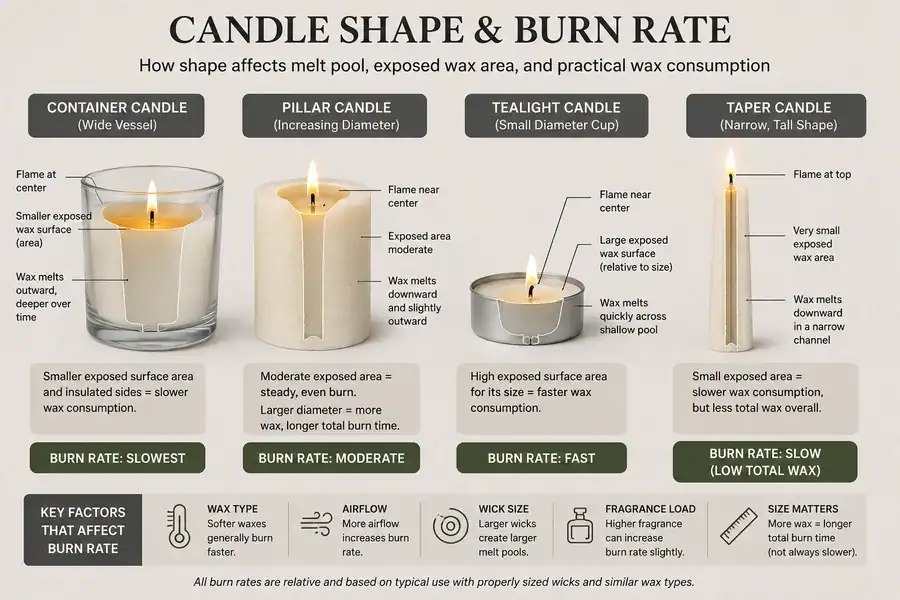
A slower burn rate can help, but total hours still depend on how much usable wax the candle has. That is why a narrow taper may burn slower than a wide candle in the moment but still provide fewer total hours overall.
Wick and wax choices also affect burn rate, but those are separate technical comparisons. This page uses them only as modifiers because the main comparison is container versus pillar versus tealight versus taper.
Container Candles: Usually Long-Burning, Especially in Larger Jars
Container candles are candles poured or placed inside a jar, tin, glass, or other vessel, and larger container candles are often among the longest-burning home formats. Jar size, fill weight, and wick count still matter. A large single-wick jar can last a long time, while a small or multi-wick jar may burn through wax faster.
Container candles often rank high because the vessel holds melted wax and keeps the burn area contained. This can make the candle easier to use over repeated sessions compared with freestanding formats that may drip, tunnel, or lose wax at the edge.
| Caveat | Why it matters for burn time |
|---|---|
| Small jar size | Less usable wax can make a jar lose to a larger pillar. |
| Multiple wicks | More flames can melt and consume wax faster. |
| Wide vessel | The candle may need longer sessions to reach an even melt pool. |
| Product label variation | Claimed burn hours can differ by wax, wick, and product design. |
Container candles do not always beat pillar candles. A large, well-burned pillar can outlast a smaller jar, especially when the jar has multiple wicks or less fill weight.
For making or choosing safe containers, read the container candle guide. This section only compares burn duration.
Pillar Candles: Long Burn Potential With Tunneling Caveats
Pillar candles are freestanding molded candles with strong long-burn potential, especially when they are large and burned evenly. Their real usable burn time depends on diameter, wax mass, and burn-session length. Short sessions can cause tunneling, which leaves unused wax around the sides and reduces practical burn duration.
Pillars can rival or beat container candles when they have enough width and are burned long enough to form a proper melt pool. Height alone is not enough. A tall, narrow pillar may contain less usable wax than a shorter, wider pillar.
| Issue | Cause | Quick prevention | Route for deeper help |
|---|---|---|---|
| Tunneling | The melt pool does not reach wide enough across the candle. | Burn the candle long enough for an even melt pool when safe. | Candle tunneling guide |
| Wasted outer wax | The flame consumes the center while the sides remain solid. | Choose the right diameter and follow burn-session guidance. | Candle care guide |
| Faster-than-expected burn | Flame is too large, room is drafty, or the candle is poorly matched to its wick. | Keep the candle away from drafts and trim the wick as directed. | Wick trimming guide |
| Misleading height | The candle looks tall but has limited diameter. | Compare wax mass and diameter, not height alone. | Pillar candle guide |
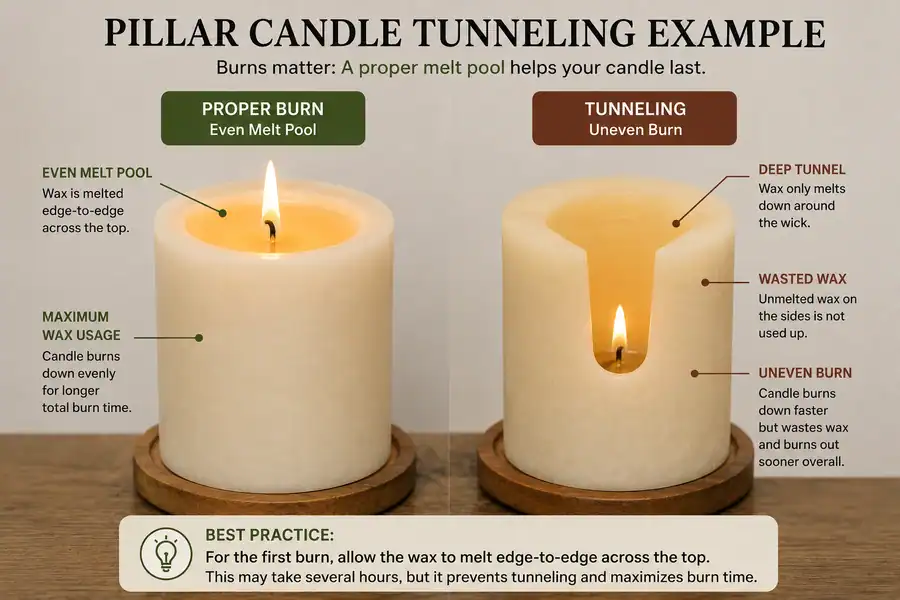
A pillar candle can last a long time, but it is less forgiving than a jar candle if the burn pool is poor. If the issue is tunneling or uneven burn, read the candle tunneling guide; this page only explains how that caveat affects format comparison.
Tealights: Short Single-Candle Burns
Tealights are small cup candles with limited wax volume. In a one-candle comparison, one tealight usually burns for less time than one container candle, one pillar candle, or one taper. This comparison is one tealight against one candle, not a full multipack against one larger candle.
Tealights still fit short-use situations. They work well for brief accent lighting, warmers, short events, and small decorative setups where a long burn is not the main goal.
Does a pack of tealights change the comparison?
A pack of tealights can provide more total burn hours across many small candles, but that is a value or quantity comparison. It does not make one tealight a longer-burning candle format than one larger candle.
Tealight multipacks may be economical, but a multipack value comparison is different from a single-candle burn-duration comparison.
Taper Candles: Moderate Burn Time, Sensitive to Drafts
Taper candles are narrow candles designed for holders. They usually provide moderate burn time because their height is offset by narrow diameter and draft exposure. A taper may last longer than a tealight, but it usually does not beat a large container candle or a wide pillar candle.
Taper height can mislead buyers. A tall taper may look long-lasting, but its slim shape limits total wax fuel compared with wider candle formats.
| Comparison | Usual burn-time result | Why |
|---|---|---|
| Taper vs tealight | Taper usually lasts longer. | The taper usually has more wax than one small tealight. |
| Taper vs pillar | Pillar usually lasts longer when it is wide and burned well. | The pillar can hold more wax mass. |
| Taper vs container | Large container usually lasts longer. | The jar may hold more wax and protect the melt area better. |
Tapers are useful for dinners, table settings, and ceremonies when moderate duration and holder fit matter. For holder safety or drip-prevention details, read a taper or candle-care guide; this section only compares burn duration.
Best Candle Format by Burn-Time Use Case
The best candle format depends on how long the candle needs to burn and where it will be used. Best means best fit for burn duration, not best scent, design, brand, or price. The longest-burning candle is not always the right choice if the setting only needs a short, controlled burn.
| Use case | Best candle format | Why it fits | Avoid if | Better guide if needed |
|---|---|---|---|---|
| Long home ambience | Large container or large pillar | Both can hold enough wax for longer burn sessions. | You only need a short accent candle. | Container or pillar guide |
| Dinner table | Taper | It gives moderate burn time and fits holders. | The room is drafty or the holder is unstable. | Taper or holder guide |
| Short décor or accent lighting | Tealight | It suits short sessions without committing to a large candle. | You want one candle to last for many hours. | Tealight guide |
| Long visual display | Pillar | A wide pillar can give long burn time and visible presence. | You burn it in very short sessions that cause tunneling. | Pillar or tunneling guide |
| Value-conscious comparison | Any format with low cost per burn hour | Price and claimed burn hours matter more than format alone. | You are comparing one candle against a multipack without adjusting the math. | Candle buying guide |
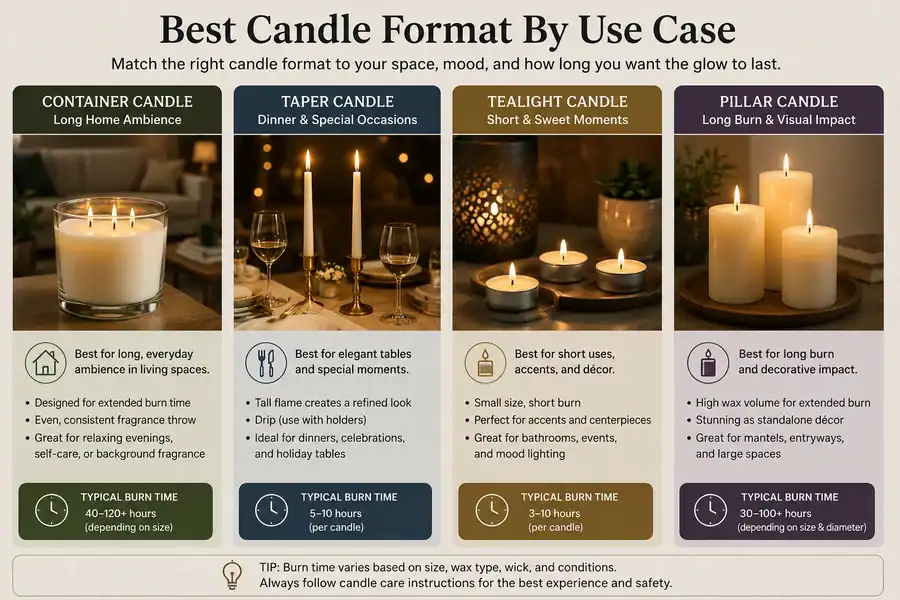
For long evenings, a large container candle or a large pillar is usually the most practical choice. For dinner or table settings, a taper may be better because it gives enough duration without the size of a large jar or pillar. For short décor, a tealight can be the right fit even though it does not burn the longest.
Use this matrix to choose by burn duration. If the main goal is scent, décor, event styling, or a specific product recommendation, read the dedicated fragrance, décor, or buying guide instead.
How to Help Any Candle Burn Closer to Its Expected Time
Burn conditions can make any candle format burn faster, unevenly, or less reliably than expected. These habits help the format comparison hold in real use. This is not a full candle-care guide; it only covers the habits that affect burn duration.
| Problem | Likely effect on burn time | Simple prevention | Route if deeper help is needed |
|---|---|---|---|
| Long or mushroomed wick | Larger flame can consume wax faster. | Trim the wick before burns according to the candle’s label. | Wick trimming guide |
| Drafty placement | Flame can flicker, burn unevenly, or use wax faster. | Keep the candle away from vents, fans, and open windows. | Candle care guide |
| Short sessions on wide candles | Wax may tunnel down the center. | Let the melt pool develop properly when the candle format calls for it. | Candle tunneling guide |
| Repeated uneven burns | Usable wax can be left behind. | Follow burn-session guidance and correct uneven burning early. | Candle care guide |
| Excessive burn sessions | Heat and flame behavior can become unsafe. | Stop burning within the product’s stated guidance. | Candle safety guide |
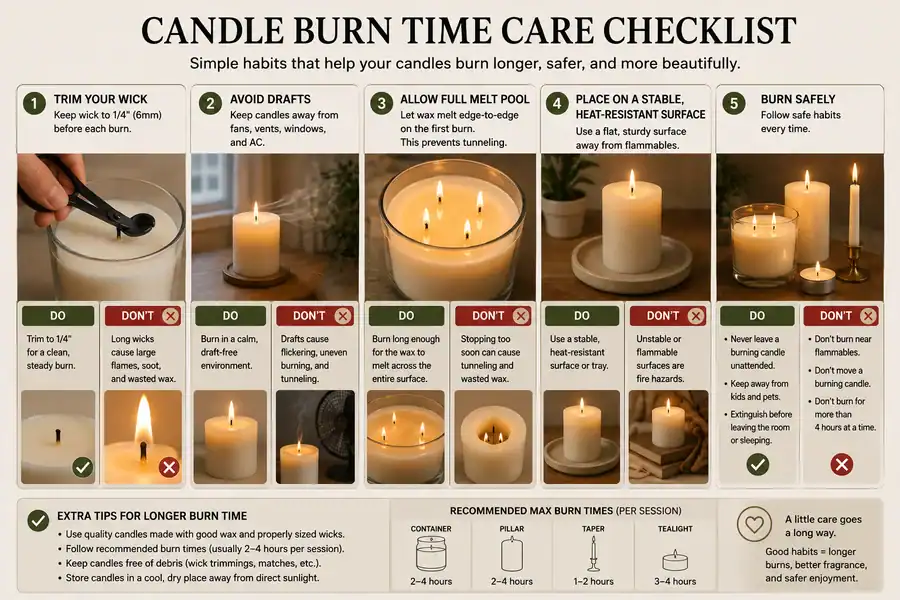
Trimming the wick can help a candle burn closer to its expected time because an oversized flame may consume wax faster. Drafts can also shorten burn time by making the flame unstable. Wider candles, especially pillars, may need longer sessions so the wax pool does not stay trapped in the center.
These habits help the comparison hold in real use. For complete safety rules or tunneling fixes, read the candle care and tunneling guides.
Factors That Can Override Candle Format
Candle format gives a burn-time baseline, but wax, wick, size, formulation, and room conditions can override the expected result. These factors belong in this article only as caveats. Deeper wax, wick, testing, and care questions should move to their own guides.
| Factor | How it can change burn time | Keep here or route elsewhere | Suggested guide |
|---|---|---|---|
| Wax type | Some wax blends may burn slower or faster than others. | Keep as a short caveat. | Wax burn-time guide |
| Wick size or wick count | A larger flame or multiple flames can consume wax faster. | Keep as a modifier. | Wick burn-time guide |
| Candle diameter and wax volume | More usable wax can change which format lasts longer. | Keep in the format comparison. | Candle size or calculator guide |
| Formulation and additives | Product design can change how wax melts and burns. | Route if the question becomes technical. | Candle-making or product guide |
| Drafts and room conditions | Air movement can make the flame unstable and shorten usable burn time. | Keep as a use condition. | Candle care guide |
| Burn-session habits | Short or poor burn sessions can waste wax. | Keep as a practical caveat. | Tunneling or care guide |
Wax type can matter, but wax is not the same as candle format. Wick setup can matter, but wick setup is not the same as container, pillar, tealight, or taper format. That is why this article ranks candle formats first, then names the factors that can change the outcome.
If the question is about wax or wick performance rather than candle format, read the wax or wick burn-time guide. This page stays focused on container, pillar, tealight, and taper formats.
Is the Longest-Burning Candle the Best Value?
Cost per burn hour is a buying metric, not a burn-duration metric. The candle format that lasts longest may not be the cheapest per hour. A long-burning candle can still cost more if its price is high compared with its claimed or expected burn hours.
Formula:
Candle price ÷ claimed or estimated burn hours = cost per burn hour
Example:
| Candle | Price | Claimed or estimated burn hours | Cost per burn hour |
|---|---|---|---|
| Candle A | $20 | 40 hours | $0.50 per hour |
| Candle B | $12 | 15 hours | $0.80 per hour |
In this example, Candle A costs more upfront but costs less per burn hour. That is why the longest-burning candle and the best-value candle are related, but not identical.
Tealight multipacks can distort the comparison. A pack of tealights may provide more total burn hours than one large candle, but each tealight is still a short-burn candle unit. Claimed burn hours can differ from real-world use because drafts, wick condition, burn sessions, and product design affect the final result.
For current prices or brand-specific comparisons, read a buying guide. This page only explains the value formula that helps compare burn duration fairly.
FAQs About Longest-Burning Candle Formats
These FAQs answer the common burn-duration questions inside the candle-format comparison. Wax, wick, care, value, and calculator questions stay brief because they need separate guides.
Which candle format usually burns the longest?
Large container candles and large pillar candles usually burn the longest. The winner depends on candle size, usable wax volume, wick count, diameter, and burn habits.
Do pillar candles burn longer than container candles?
Pillar candles can burn longer than container candles when they are large, wide, and burned evenly. Container candles can outlast pillars when the jar has more usable wax or when the pillar tunnels and wastes wax.
Do taper candles burn longer than tealights?
Taper candles usually burn longer than one tealight. A taper has more height and often more wax than a single tealight, but it usually does not outlast a large container or pillar candle.
Does wax type affect which candle burns longest?
Wax type can affect burn time, but wax type is a separate comparison from candle format. This page compares physical formats: container, pillar, tealight, and taper.
Does wick size affect candle burn time?
Wick size can affect candle burn time because it changes flame size, melt behavior, and wax consumption. Wick setup can change the result, but it is not the same as candle format.
Is the longest-burning candle always the best value?
The longest-burning candle is not always the best value. Compare price against claimed or estimated burn hours with the cost-per-burn-hour formula before treating burn duration as a value signal.