

Container candles are usually easier for beginners, while pillar candles are better for freestanding décor, reusable molds, and sculptural presentation.
Container candles are poured and burned inside a heat-safe vessel, while pillar candles are molded to stand and burn without a container. This comparison treats “easier” as lower setup effort, fewer specialty supplies, lower beginner failure risk, and simpler repair. It treats “safer” as lower practical risk with the right wax, wick, vessel or mold, burn surface, and supervision. “Better” depends on your goal: beginner success, home fragrance, décor, gifting, budget, or repeat small-batch making.
| If your main goal is… | Choose… | Why |
|---|---|---|
| First candle project | Container candle | It has fewer specialty steps and a more forgiving format. |
| Everyday home fragrance | Container candle | The vessel makes placement, storage, and relighting easier. |
| Lower setup effort | Container candle | You do not need mold release, base finishing, or freestanding structure control. |
| Simple gifting | Container candle | The vessel already supports labeling, lidding, and packaging. |
| Freestanding décor | Pillar candle | The candle body becomes the visual shape. |
| Reusable mold work | Pillar candle | The mold can be reused after the process is stable. |
| Learning wax structure | Pillar candle | The format teaches hardness, release, wall strength, and burn balance. |
| Unsure or making your first batch | Container candle | It usually gives the lowest beginner failure risk. |
What’s the Difference Between Container and Pillar Candles?
Container candles burn inside a heat-safe vessel, while pillar candles are freestanding molded candles that burn without a container.
That format difference changes the tools, risks, cost pattern, burn behavior, and beginner learning curve. A container candle depends on the vessel to hold the wax pool, while a pillar candle depends on wax structure, mold release, and stable freestanding shape.
| Factor | Container candles | Pillar candles |
|---|---|---|
| Basic format | Wax is poured into a jar, tin, ceramic vessel, or other heat-safe container. | Wax is poured into a mold, removed, and burned as a freestanding candle. |
| Burn support | The vessel holds melted wax during burning. | The candle body must hold its own shape as it burns. |
| Main beginner appeal | Simpler setup and easier presentation. | More decorative shape control and reusable molds. |
| Main beginner challenge | Safe vessel choice, wick centering, wet spots, sinkholes, tunneling. | Mold release, cracking, dripping, wax firmness, wick fit, surface finish. |
| Typical use | Home fragrance, gifts, everyday room use. | Décor, centerpieces, unscented or lightly scented display candles. |
| Format misunderstanding | A container candle is not just “any scented candle”; it is defined by its vessel. | A pillar candle is not just “a large candle”; it is defined by its freestanding structure. |
A container candle is usually the more forgiving first format because the vessel hides some surface and shape issues. It still needs a safe container, a fitting wick, and burn testing, so “container” does not mean “risk-free” or “no testing.”
A pillar candle asks more from the wax and the maker. The candle must release from the mold, stand straight, resist cracking, and burn without the help of a jar wall. That makes pillars more flexible for décor but less forgiving for a first batch.
This article compares candle types by format, not by wax type, scent family, brand, or size. A soy container candle and a paraffin pillar candle may behave differently because of wax, but the core comparison here is vessel-contained versus freestanding.
For a wider candle format overview, use the Candle Types guide. For more detail on vessel-based candles, see What Are Container Candles and Why Are They So Popular? For the freestanding format, use the pillar candle explainer before choosing molds or wax.
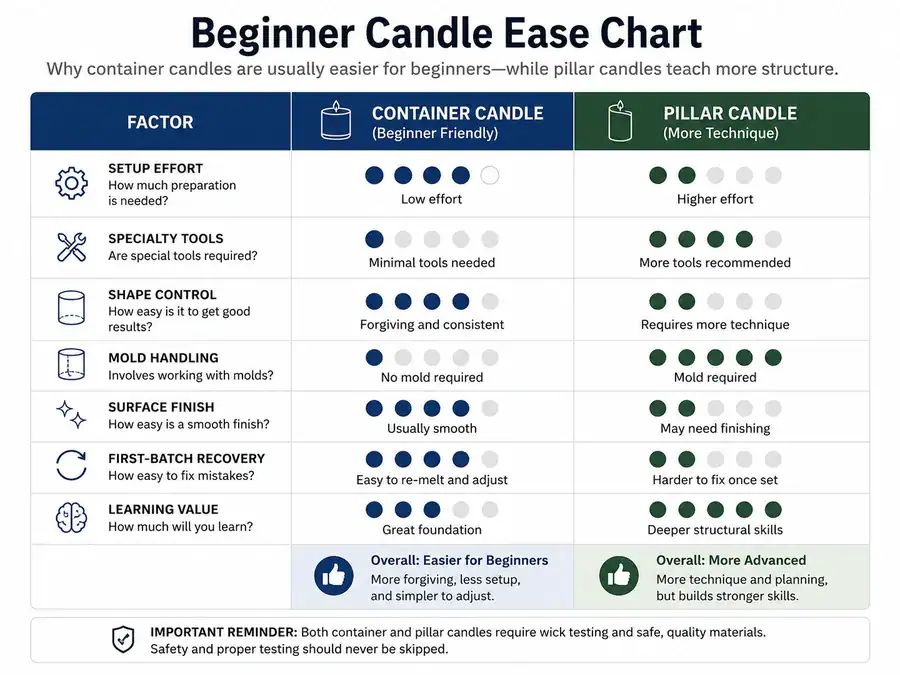
Which Is Easier for Beginners: Container or Pillar Candles?
Container candles are easier for most beginners because they need fewer specialty tools and have simpler shape requirements.
“Easier” means easier to set up, pour, finish, troubleshoot, and repeat. It does not mean container candles skip safety checks, curing, wick testing, or basic burn testing.
| Ease factor | Easier format | Why it matters for beginners |
|---|---|---|
| First setup | Container candle | You can start with jars or tins, pre-tabbed wicks, wax, fragrance, dye if used, and basic pouring tools. |
| Shape control | Container candle | The vessel supports the candle, so the wax does not need to stand alone. |
| Mold handling | Container candle | No mold release step is needed. |
| Surface finish | Container candle | Minor side-wall flaws are hidden by the vessel. |
| Wick placement | Slight edge to container candle | Wick centering still matters, but the candle body is easier to handle while setting. |
| First-batch recovery | Container candle | Many surface issues can be topped, reheated lightly, or accepted if the burn is safe. |
| Decorative shape range | Pillar candle | Pillars win when the goal is a freestanding shape, carved look, or molded décor. |
| Learning value | Pillar candle | Pillars teach more about wax hardness, mold technique, shrinkage, and structure. |
Comparison method: this beginner score is based on setup steps, specialty tools, likely visible defects, recovery difficulty, and how many variables a first-time maker must control at once.
Container candles usually win for first-time makers because the vessel reduces shape pressure. The maker still needs to choose a heat-safe vessel, center the wick, measure wax and fragrance, pour at a temperature that fits the wax, and test the burn. But compared with pillars, the candle does not have to survive unmolding or hold its own wall during the burn.
Pillar candles have a steeper learning curve because the mold and wax structure matter more. A beginner has to think about wax firmness, mold preparation, wick threading, release, surface finish, cracking, and dripping. Those steps are manageable, but they add more points of failure before the candle is ready to burn.
A simple way to choose is to ask what you want from the first project. Choose a container candle if you want a usable scented candle with fewer tools. Choose a pillar candle if you want to learn molded candle structure and accept more trial batches.
For a recipe-level process, use the beginner container candle tutorial or the beginner pillar candle tutorial. For a supply-first decision, the candle-making supplies checklist is the better next step.
Which Is Safer: Container Candles or Pillar Candles?
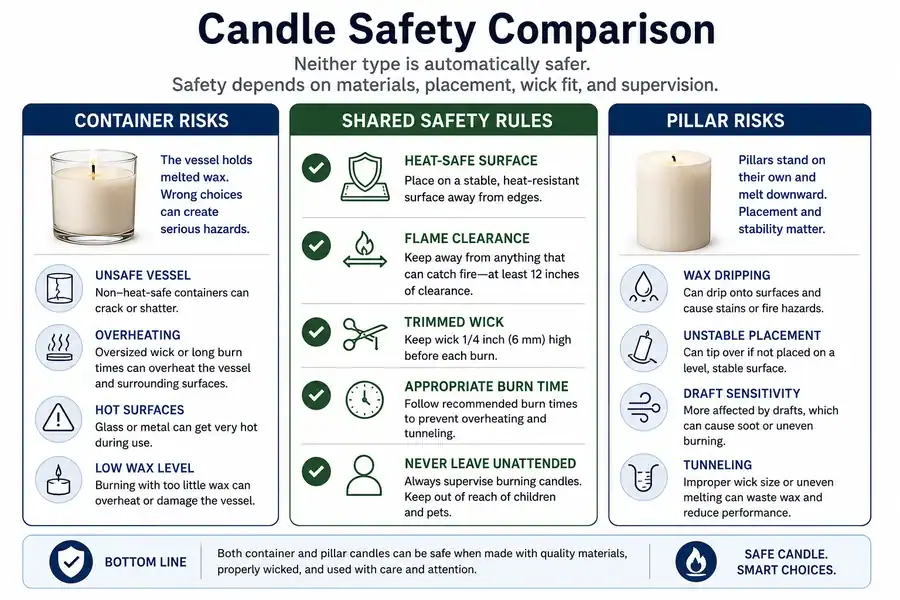
Container candles are usually easier to manage during normal home burning, but neither type is automatically safer.
“Safer” means lower practical risk when the candle is made with suitable materials, wicked correctly, placed on a stable heat-safe surface, and burned under supervision. It does not mean safe with any jar, any wick, any wax, or unattended burning.
National Candle Association candle safety guidance applies to both formats: trim the wick, use a stable heat-resistant surface, keep candles away from flammable materials, and never leave a burning candle unattended.
| Safety factor | Container candles | Pillar candles | Safer practical choice |
|---|---|---|---|
| Hot wax containment | Vessel holds the melt pool. | Melted wax can run if the wall fails or the candle drips. | Container, if the vessel is heat-safe. |
| Vessel risk | Unsafe jars can crack, overheat, or fail. | No jar heat stress because there is no vessel. | Pillar, when container heat safety is uncertain. |
| Flame stability | Vessel can help reduce wax spill, but wick size still controls flame behavior. | Freestanding shape and placement matter more. | Tie, if both are wicked and burned correctly. |
| Surface protection | Vessel provides some separation from the surface. | A heat-safe plate or holder is more important. | Container, for casual home use. |
| Placement mistakes | Still risky near curtains, shelves, drafts, or clutter. | More vulnerable to tipping, dripping, or unstable holders. | Container, for beginners. |
| Making-stage risk | Hot wax, fragrance handling, and pouring safety still apply. | Hot wax plus mold handling and release steps. | Slight edge to container. |
| User supervision | Required for both. | Required for both. | Tie. |
Comparison method: the safety score weighs normal making risk, burn-surface risk, flame control, material failure, and how easily a beginner can misuse the format.
Container candles often feel safer because the melted wax stays inside a vessel. That is only true when the vessel is made for candle heat, the wick is matched to the wax and diameter, and the candle is burned as directed. A decorative glass, thin jar, cracked ceramic pot, or oversized wick can turn a container candle into the riskier choice.
Pillar candles remove jar heat risk, but they add freestanding flame and drip risk. A pillar candle needs a level heat-safe holder, enough space around it, and a wax-wick pairing that does not collapse the walls or create heavy dripping. A pillar placed directly on wood, fabric, plastic, or an unstable plate is not a safe setup.
For beginners, container candles are usually the safer practical starting point because the vessel reduces handling and wax-spill complexity. For makers who cannot confirm that a jar is heat-safe, a properly made pillar on the right holder may be the safer route than pouring into a random container.
Do not treat either format as child-safe, pet-safe, or safe while unattended. Both are open-flame products. Keep the comparison at the format level, then move to the right safety page when the question becomes technical.
For vessel questions, use the Container Safety & Heat Qualification page. For burn habits, use the Candle Burning Safety page. For flame size, tunneling, and overheating clues, use the Wick Testing Guide.
Which Type Needs Fewer Supplies and Tools?
Container candles need fewer specialty tools at the start, while pillar candles need molds and more finishing control.
This comparison is about supply burden, not brand choice. A container candle needs a vessel for each candle, while a pillar candle needs a mold that can be reused if it releases cleanly and keeps its shape.
| Supply category | Container candles | Pillar candles | Practical difference |
|---|---|---|---|
| Main form tool | Heat-safe jar, tin, or vessel | Pillar mold | Containers are simpler for a first batch; molds are reusable after setup. |
| Wick setup | Pre-tabbed wick, sticker or glue dot, centering tool | Wick, mold threading, seal, centering setup | Pillars add more handling before pouring. |
| Wax choice | Often container wax or a blend made for jars | Usually firmer pillar wax or blend | Pillars depend more on wax structure. |
| Release step | None | Required | Mold release adds one more failure point. |
| Finishing work | Trim wick, label, lid if used | Remove from mold, smooth base, correct surface flaws | Pillars usually need more visible finishing. |
| Per-candle item | New vessel each time | Wax and wick, with reusable mold | Containers repeat vessel cost; pillars repeat less hardware cost. |
| Presentation supplies | Lid, label, box, dust cover | Holder, wrap, label, box | Gift setup depends on style, not only format. |
| Optional upgrades | Wick bars, warning labels, pour pitcher, thermometer | Mold release, sealing putty, leveling tools, finish tools | Pillars add more mold-related accessories. |
Comparison method: supplies are grouped as one-time tools, reusable equipment, per-candle consumables, and optional upgrades.
Container candles are easier when you want a short supply list. The vessel becomes the candle body, the package, and part of the presentation. That makes the first shopping decision simpler, as long as the vessel is suitable for candle heat.
Pillar candles can become cheaper to repeat after you own reliable molds, but the first setup is less simple. The mold must be sealed, filled, cooled, opened, and cleaned. If the candle sticks, cracks, or dents, the problem is more visible than it would be in a jar.
A beginner who already owns safe jars or buys a container kit will usually spend less time sorting tools. A maker who wants reusable form tools, freestanding shapes, and less dependence on jars may prefer pillars after learning the mold process.
For a complete supply list, use the Candle-Making Supplies Checklist. For vessel choice, use the Container Buying Guide. For freestanding shapes, use the Pillar Mold Guide.
Which Type Has More Beginner Mistakes?
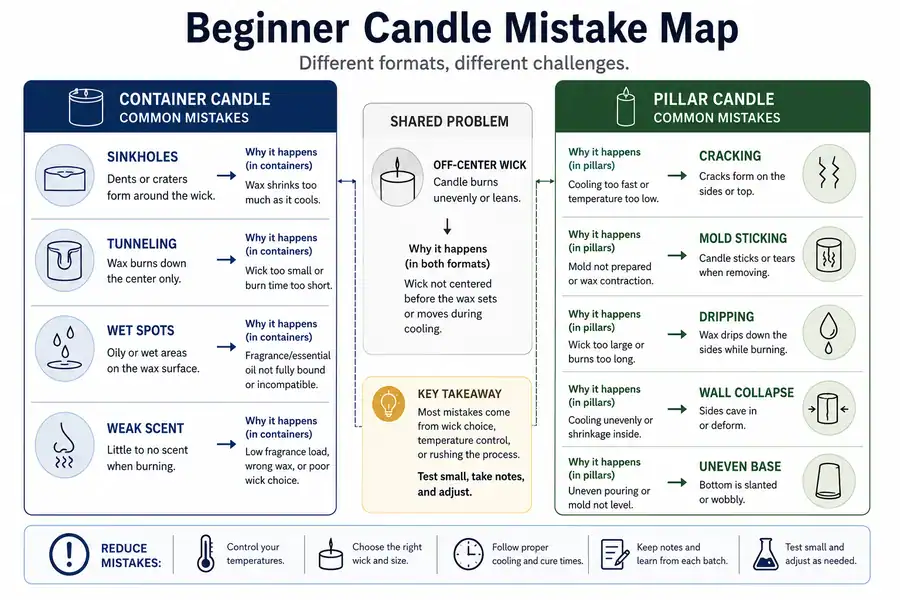
Pillar candles usually create more beginner mistakes because the candle must release cleanly, stand straight, and burn without a vessel.
Container candles still fail, but many problems are easier to see, patch, or test inside the jar. “Easier” includes easier recovery, not just fewer pouring steps.
| Common mistake | More common in | Why it happens | Comparison-level fix |
|---|---|---|---|
| Wrong vessel or mold assumption | Both | The maker treats format as decoration instead of structure. | Define the candle type before buying supplies. |
| Sinkholes or sunken tops | Container candles | Wax contracts as it cools in the vessel. | Top off or adjust pour process in the container guide. |
| Tunneling | Container candles | Wick, wax, diameter, or first-burn pattern is mismatched. | Move to wick testing if the burn pool stays narrow. |
| Cracking | Pillar candles | Wax blend, cooling rate, mold temperature, or release timing is off. | Treat it as a pillar-process issue, not only a wax flaw. |
| Mold sticking | Pillar candles | Mold prep, wax choice, release method, or cooling is wrong. | Use a mold-release guide instead of forcing the candle out. |
| Dripping or wall collapse | Pillar candles | Wick size, wax firmness, and candle diameter do not match. | Test the wick and burn on a heat-safe holder. |
| Off-center wick | Both | Wick shifts while wax sets. | Use a centering tool and check alignment before the pour cools. |
| Weak scent result | More visible in containers | The maker expects format alone to control scent. | Compare wax, fragrance load, cure time, and wick separately. |
Comparison method: problems are grouped by format-specific cause, beginner visibility, and whether the fix belongs on this comparison page or a deeper troubleshooting page.
Container candle mistakes often involve the jar environment. The top can sink, the wax can pull from the glass, or the candle can tunnel if the wick is too small for the diameter. These are frustrating, but the vessel keeps the candle intact while the maker learns.
Pillar candle mistakes often affect the whole candle body. A crack, stuck mold, uneven base, weak wall, or heavy drip can make the candle hard to use or gift. Pillars give more design freedom, but the format gives beginners fewer places to hide mistakes.
The lower-risk beginner choice is a container candle because most early errors stay inside the vessel. The higher-learning choice is a pillar candle because it teaches structure, release, burn balance, and finishing sooner.
For defect-level fixes, use the Candle Troubleshooting Hub. For flame and melt-pool problems, use the Wick Sizing Guide. For single-issue problems, move to the sinkholes, frosting, tunneling, or mold-release pages instead of expanding this comparison into a diagnostic guide.
Which Is Cheaper to Start and Repeat?
Container candles are often cheaper to start, while pillar candles can be cheaper to repeat after you own good molds.
Cost depends on whether you mean first-batch setup, per-candle materials, failed batches, gift presentation, or small-batch repetition. A cheaper format is not automatically the better format if it causes more waste or safety risk.
| Cost factor | Container candles | Pillar candles | Budget meaning |
|---|---|---|---|
| First-batch setup | Usually lower | Usually higher | Containers need fewer specialty tools. |
| Repeat hardware | Higher | Lower after mold purchase | Jars are usually consumed each time; molds are reused. |
| Per-candle presentation | Often built in | Often separate | A jar can act as packaging; a pillar may need a holder or wrap. |
| Failed batch cost | Moderate | Moderate to high | Failed pillars may be less giftable because flaws are visible. |
| Shipping or transport prep | Higher breakage concern with glass | Higher surface-damage concern | Storage and packaging change the real cost. |
| Gift value | Strong for labeled jars | Strong for decorative shapes | “Better value” depends on recipient and style. |
| Small-batch repetition | Good with bulk vessels | Good with reliable molds | Repetition favors the format with fewer recurring mistakes. |
Comparison method: costs are separated into startup tools, reusable equipment, per-candle consumables, presentation supplies, and waste from failed batches.
Container candles are budget-friendly when the goal is a first usable candle. You can buy a small set of vessels, wicks, wax, fragrance if used, and basic pouring tools without adding mold-specific items. The tradeoff is that every new candle needs another safe vessel.
Pillar candles cost more to learn because the mold system matters. Once the mold works well, the repeat cost can feel lower because you are not buying a jar for every candle. That saving can disappear if the pillar cracks, sticks, drips, or needs extra finishing supplies.
For hobby use, containers usually give the simpler budget path. For repeated decorative batches, pillars can make sense after the mold and wax pairing are stable. For selling, do not use this section as a pricing model; business pricing needs costs, labor, packaging, testing, fees, and market position.
For deeper math, use the Candle-Making Cost Calculator. For business pricing, use the Candle Business Pricing Guide. For supplies, return to the Supplies Checklist before buying jars, molds, or bulk wax.
Which Burns Better: Container or Pillar Candles?
Container candles usually burn in a more contained way, while pillar candles depend more on diameter, wick choice, wax structure, and burn setup.
Burn performance is not controlled by candle format alone. Wax type, wick size, candle diameter, fragrance load, and burn testing can change how either type performs.
| Burn factor | Container candles | Pillar candles | What it means |
|---|---|---|---|
| Melt pool control | The vessel holds the melted wax. | The wax body must manage its own melt pool. | Containers are easier for beginners to interpret. |
| Drip risk | Lower when the wick and vessel match. | Higher if the wax wall softens or the wick is too large. | Pillars need closer format control. |
| Tunneling risk | Common when the wick is too small or the first burns are poor. | Possible when wick, wax, or diameter is mismatched. | Both types need burn testing. |
| Burn time | Depends on wax amount, diameter, wick, and burn pattern. | Can be long in large sizes but not by format alone. | Pillars do not always burn longer. |
| Flame control | Vessel shape can affect airflow and heat. | Open sides make placement and drafts more important. | Room setup affects pillars more. |
| Beginner reading | Easier to watch through the top opening. | More visual clues appear on the sides and base. | Pillars expose more performance problems. |
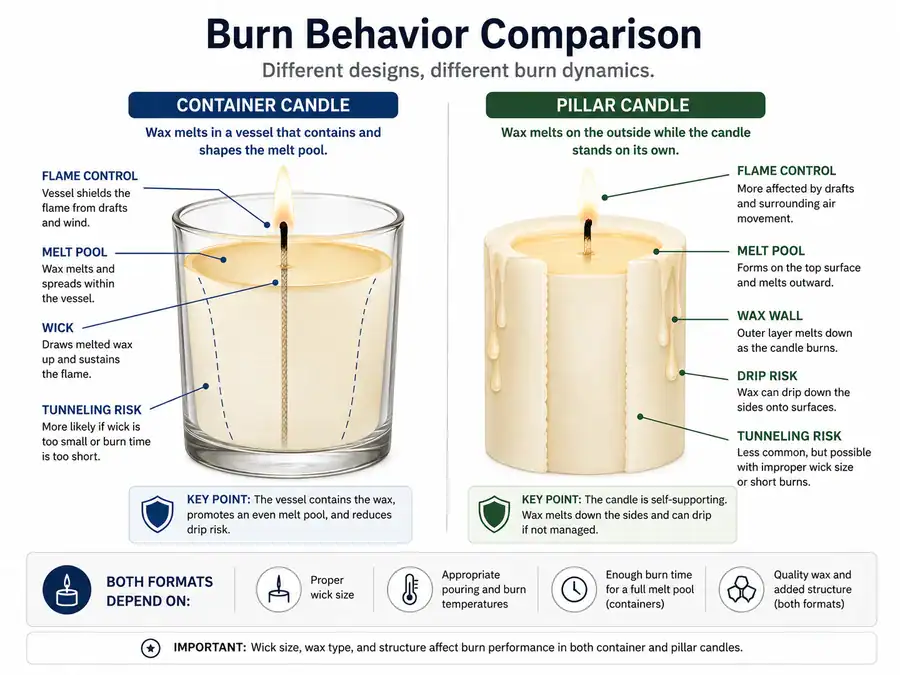
Comparison method: burn behavior is compared by containment, drip risk, tunneling risk, wick sensitivity, burn consistency, and how easily a beginner can read the result.
Container candles often perform better for everyday use because the vessel contains the melt pool. That does not mean they cannot tunnel, soot, overheat, or burn poorly. A too-small wick can leave wax on the sides, while a too-large wick can create an unsafe flame or excess heat.
Pillar candles can burn well, but their performance depends more on balance. The wax must be firm enough to hold shape, the wick must fit the diameter, and the candle must sit on a heat-safe holder. A pillar that burns too hot can drip or lose its wall; one that burns too cool can tunnel down the center.
The clearest answer is this: container candles are easier to make burn acceptably, while pillar candles can look and perform beautifully after better wick and wax control. For burn-time rankings across more candle formats, use the Candle Burn Time Comparison; for flame and melt-pool testing, use the Wick Testing Guide; for wax behavior, use the Wax Types Guide.
Which Type Is Better for Home Fragrance?
Container candles are usually better for everyday home fragrance because they are easier to place, contain the melt pool, and fit common scented-candle use.
This is a candle-format comparison, not a fragrance formulation guide. Scent strength still depends on wax, wick, fragrance oil, fragrance load, vessel size, cure time, and burn testing.
| Home-use goal | Container candle fit | Pillar candle fit | Decision note |
|---|---|---|---|
| Living room fragrance | High | Medium | Containers are easier to place, label, cover, and relight. |
| Bedroom ambience | High | Medium | A lidded container is easier to store between uses. |
| Bathroom scent | High | Low to medium | Containers handle small-room placement better. |
| Dinner table décor | Medium | High | Pillars work well when scent should stay subtle. |
| Daily scented use | High | Medium | Containers match common home-fragrance habits. |
| Decorative scent accent | Medium | High | Pillars can add shape and height while carrying light scent. |
| Strong scent goal | Depends on formula | Depends on formula | Format helps, but scent strength is not format-only. |
Container candles are good for home fragrance because they suit normal room placement. They can have lids, labels, dust covers, and stable bases. The vessel makes them easier to keep on a shelf, nightstand, bathroom counter, or coffee table when used with safe burn habits.
Pillar candles can be scented, but they are often chosen for visual presence rather than strong room fragrance. A scented pillar can work for ambience, centerpieces, and decorative displays, yet it still needs the right wax, fragrance use, wick, and burn surface.
Choose a container candle when the main goal is an everyday scented candle. Choose a pillar candle when the main goal is visual atmosphere with scent as a secondary feature. For adding fragrance, use the Scented Candle Making Guide; for weak or strong scent questions, use the Fragrance Throw Guide; for safe material handling, use the Fragrance Oil Safety Page.
Which Type Is Better for Gifts and Décor?
Container candles are usually easier to gift, while pillar candles often work better as freestanding décor or centerpiece candles.
Gift and décor suitability means presentation, packaging ease, handling risk, visual impact, and expected use after gifting. It does not mean trendiest design, highest product value, or the safest decorative add-on.
| Gift or décor goal | Better fit | Why | Caution |
|---|---|---|---|
| Beginner handmade gift | Container candle | The vessel looks finished and is easier to label. | Use only suitable candle containers. |
| Branded or labeled gift | Container candle | Labels, lids, and warning labels fit naturally. | Poor labels can peel or look unfinished. |
| Easy packaging | Container candle | The candle is already protected by its vessel. | Glass or ceramic can still break. |
| Rustic centerpiece | Pillar candle | The freestanding shape gives height and visual weight. | It needs a stable heat-safe holder. |
| Formal table décor | Pillar candle | Pillars create a sculptural look without a jar. | Keep flame clearance and drip risk in mind. |
| Gift shipping or transport | Container candle | The vessel protects the wax surface. | Fragile vessels need padding. |
| Decorative display | Pillar candle | Shape, texture, and grouping are stronger. | Exposed wax can scratch, dent, or collect dust. |
| Everyday usable gift | Container candle | The recipient can place and use it with less setup. | Burn directions still matter. |
Container candles are good gifts because they are already housed, easier to label, and simpler to package. A lid, dust cover, label, and box can make a container candle feel complete without needing a holder or extra display piece.
Pillar candles are better for décor when the goal is visual shape. They work well as centerpieces, mantel accents, ceremonial candles, or grouped displays. They need more care because the wax is exposed, the base must be stable, and the burn surface matters.
Decorative add-ons should not sit near the flame or interfere with burning. Dried botanicals, loose decorations, ribbons, and exterior wraps can create safety problems if they are placed where heat or flame can reach them.
For broader gift planning, use Candle Gift Ideas. For visual design, use the Decorative Candle Guide. For wrapping, boxing, and labels, use the Candle Packaging Guide.
Storage and Small-Batch Factors That Can Change the Choice
Storage, handling, and repeat batches can change which candle type feels better after the first pour.
These factors do not replace the main ease, safety, cost, and burn comparisons. They help you decide whether the finished candle will be easy to keep, move, gift, repeat, or make in small batches.
Which Type Is Easier to Store and Handle?
Container candles are usually easier to store and handle because the vessel protects the wax, but fragile containers can still break.
This is everyday storage and handling guidance, not shipping compliance, warehouse planning, or fulfillment logistics. “Safer” here means lower practical risk of damage, dust, dents, breakage, unstable storage, or messy transport.
| Handling factor | Container candle risk | Pillar candle risk | Prevention note |
|---|---|---|---|
| Dust exposure | Lower if the candle has a lid or dust cover. | Higher because the wax surface is exposed. | Cover or box finished candles. |
| Surface dents | Lower because the vessel protects the sides. | Higher because the wax can scratch, dent, or scuff. | Wrap pillars separately. |
| Breakage | Higher with glass or ceramic vessels. | Lower for jar breakage, but wax can chip. | Avoid thin glass and pad fragile containers. |
| Heat exposure | Vessel and wax can still overheat in poor storage. | Wax can soften, warp, or sweat. | Store both in a cool, stable place. |
| Transport | Easier to keep clean, but heavier and breakable. | Lighter in some cases, but more exposed. | Use dividers, wraps, or boxes. |
| Gift handling | Easier for casual gifting. | Better for display gifts if wrapped well. | Match packaging to the format. |
Container candles are easier to keep clean because the vessel acts as protection. A lid, box, or dust cover makes them practical for shelves, gifts, and casual transport. The tradeoff is breakage: glass and ceramic can crack, chip, or shatter if packed poorly.
Pillar candles avoid jar breakage but need more surface protection. Their wax is exposed to dust, scratches, dents, fingerprints, heat deformation, and pressure marks. They are often better wrapped separately rather than stacked loosely.
For full storage conditions, use the Candle Storage Guide. For wrapping, boxes, labels, and gift packaging, use the Candle Packaging Guide.
Which Type Is Easier to Make in Small Batches?
Container candles are usually easier to make in small batches because the vessel-based workflow is more repeatable.
Small-batch means hobby repeats, gift batches, or early maker batches. It does not mean industrial production, wholesale operations, business compliance, tax planning, ecommerce logistics, or legal labeling systems.
| Small-batch factor | Container candles | Pillar candles | Easier option |
|---|---|---|---|
| Batch setup burden | Similar jars, pre-tabbed wicks, and repeat fill weights simplify setup. | Mold sealing, release prep, and wick threading add setup time. | Container |
| Repeat consistency | Standard vessel sizes make repeat batches easier to track. | Mold reuse helps, but release and finish can vary. | Container |
| Cleanup | Jars stay with the candle, but pouring tools still need cleaning. | Molds need cleaning and release control. | Container |
| Reusable equipment | Vessels are usually consumed per candle. | Molds can be reused many times. | Pillar |
| Defect visibility | Some flaws are hidden by the vessel. | Surface defects are more visible. | Container |
| Storage after batch | Easier if lids or boxes fit. | Needs wrapping or separation. | Container |
| Long-term workflow | Simple to repeat with bulk jars. | Efficient once mold release and finishing are controlled. | Tie after practice |
Container candles are better for early repeat batches because the workflow is easier to standardize. If you use the same jar size, wick family, wax weight, fragrance percentage, and pour process, each batch becomes easier to compare.
Pillar candles can scale well for hobby makers once the mold process is stable. The reusable mold is a real advantage, but the maker must control release, cooling, surface finish, and storage. A small change in wax behavior can show up more visibly on a pillar than inside a container.
For deeper batch planning, use the Small-Batch Candle Production Workflow.
Container vs Pillar Candles: Which Should You Choose?
Most beginners should choose container candles first, while pillar candles are better for freestanding décor and reusable mold work.
There is no universal winner. “Better” means better for your goal, safety conditions, supplies, budget, fragrance needs, décor plans, storage needs, and repeat-making workflow.
| User goal | Recommended type | Why | Caution | Next step |
|---|---|---|---|---|
| First candle project | Container candle | It has fewer specialty steps and a more forgiving format. | You still need a safe vessel and wick testing. | Use the Container Candle Guide. |
| Lowest beginner frustration | Container candle | Many early flaws stay inside the vessel. | Tunneling, overheating, and sinkholes can still happen. | Use the Candle Troubleshooting Hub. |
| Everyday home fragrance | Container candle | It fits common room-use habits and stores easily between burns. | Scent strength depends on wax, wick, fragrance, and testing. | Use the Fragrance Throw Guide. |
| Freestanding décor | Pillar candle | It gives height, shape, and display value without a jar. | It needs a heat-safe holder and stable placement. | Use the Pillar Candle Guide. |
| Gift candles | Container candle | It is easier to label, lid, box, and hand to someone. | Fragile vessels need careful packaging. | Use the Candle Packaging Guide. |
| Rustic or centerpiece display | Pillar candle | The candle body becomes the visual feature. | Exposed wax can dent, dust, drip, or warp. | Use the Decorative Candle Guide. |
| Lower startup effort | Container candle | The first supply list is usually shorter. | Each candle needs a suitable vessel. | Use the Supplies Checklist. |
| Reusable mold workflow | Pillar candle | Molds can be reused after the setup is working. | Mold release and finishing add failure points. | Use the Pillar Mold Guide. |
| Early small-batch repeatability | Container candle | Standard jars make batches easier to repeat and compare. | Jar cost repeats with every candle. | Use the Small-Batch Production Workflow. |
| Learning wax structure | Pillar candle | The format teaches hardness, release, wall strength, and burn balance. | It is less forgiving for visible defects. | Use the Wax Types Guide. |
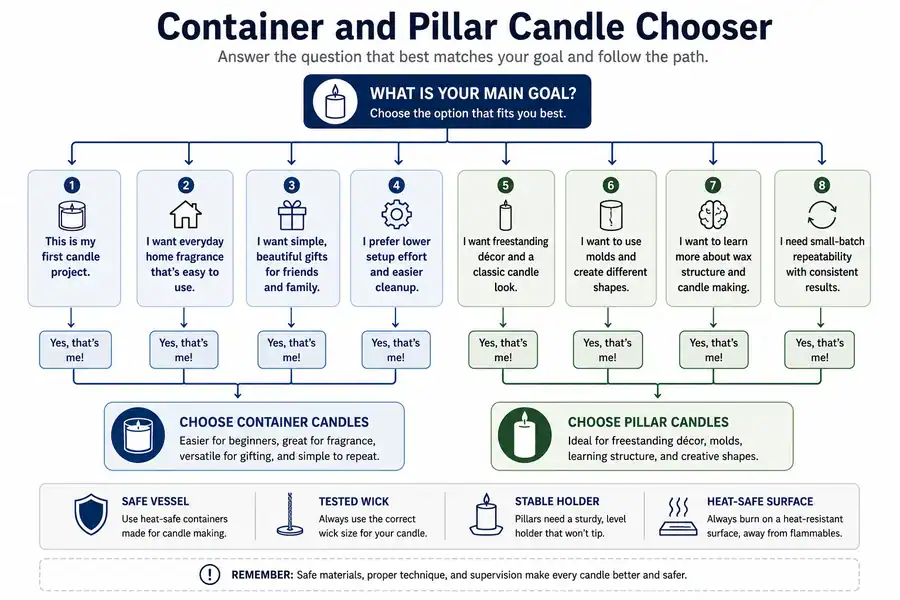
Choose container candles if you want the easier beginner route, stronger everyday home-fragrance fit, and simpler gifting. Choose pillar candles if you want sculptural décor, freestanding presentation, reusable molds, and a format that teaches more about candle structure.
The safest answer is conditional: either type can be safe or unsafe depending on materials, wick size, placement, and supervision. Do not choose a random jar just because container candles are beginner-friendly, and do not burn a pillar without a stable heat-safe holder.
The simplest decision is this: start with container candles for practical success, then try pillar candles when you want shape, décor, and mold-based learning.
FAQs
These FAQs answer the remaining comparison points around ease, safety, burn behavior, fragrance, décor, and which candle type to make first.
Are container candles better than pillar candles?
Container candles are better for most beginners, everyday home fragrance, and simple gifting. Pillar candles are better when the goal is freestanding décor, reusable molds, or sculptural presentation.
Are pillar candles harder to make?
Pillar candles are usually harder for beginners because they require a mold, clean release, stable shape, and stronger control over wax structure. They are not too advanced for hobby makers, but they add more visible failure points.
Are pillar candles safe?
Pillar candles can be safe when they are properly made, placed on a stable heat-safe holder, burned away from flammable materials, and supervised. They are not safe when burned on an unsafe surface, near drafts, or without enough clearance.
Do pillar candles burn longer than container candles?
Pillar candles do not always burn longer than container candles. Burn time depends on wax amount, candle diameter, wick size, wax type, burn pattern, and testing.
Which type should I make first?
Most beginners should make container candles first because the setup is simpler and the vessel supports the candle. Pillar candles are a better first choice only when your main goal is molded décor.
Can container candles be dangerous?
Container candles can be dangerous if the vessel is unsuitable, the wick is too large, the candle overheats, or it is burned without supervision. A container candle is only safer when the vessel, wick, wax, and burn habits are suitable.
Final Takeaway
Container candles are the better first choice for most beginners because they are easier to set up, easier to gift, easier to store, and usually simpler to burn safely at home.
Pillar candles are better when the goal is freestanding décor, molded shapes, reusable mold work, and learning how wax structure affects candle performance. The safest comparison remains conditional: container candles need suitable vessels and tested wicks, while pillar candles need stable holders, safe burn surfaces, correct wicks, and enough clearance.